
English teaching in Japan is one of the most common jobs for foreigners, but other career fields and roles surprisingly don’t require a high level of Japanese. That said, you do need some level of basic-to-intermediate speaking skills to live comfortably in Japan.

While many jobs in Japan require fluency in Japanese, there are still plenty of opportunities available for non-Japanese speakers. Thanks to Japan’s increasing globalization and demand for international talent, you can now find jobs in industries like tech, hospitality, design, and more where little to no Japanese is required. In this article, we’ll explore 11 jobs you can land in Japan without needing Japanese fluency, and what you’ll need to get started.

Want to fast-track your career in Japan? Coto Academy’s 3-month Business Japanese Course is designed to help you master keigo (business Japanese) and improve workplace communication skills. Gain the confidence to speak professionally with colleagues and clients and open up new career opportunities!

Can I Really Work in Japan Without Knowing Any Japanese?

The short answer is yes, you can get a job without needing Japanese, and that job doesn’t have to be an English teacher. 

You might have more limited options, and your opportunities depend largely on your skills and the current job market trend. The IT industry, for example, is one of the largest industries in the Japanese economy. The Japan Times estimated that the country would face a shortage of 600,000 IT-related professionals by 2030. A lot of companies are eager to hire foreign IT workers as a solution. If you have a background or knowledge in tech, recruiters in top companies are willing to hire you from overseas and sponsor your stay in Japan, even if you don’t necessarily have a high level of Japanese language skills.

Recommended: Top 8 IT and Tech Job Sites in Japan 

It’s relatively easy to get accepted as an English teacher, ALT, and eikaiwa teacher if you come from an English-speaking country. There are plenty of opportunities in a lot of industries, even if you only speak English. In fact, a lot of foreigners, who’ve lived here for more than 10 years, can’t speak Japanese. 

There’s a catch, though: you’re closing a lot of doors if you don’t bother to learn at least conversational-level Japanese. Live here long enough, and eventually, you will realize that you can miss out on getting promotions and attractive job offers. 

Even a decent conversational level or the ability to speak Japanese confidently (which is the focus of Coto Academy), can widen your job opportunities. Even if that job doesn’t require Japanese, showing that you are learning will give you a good impression and open more career opportunities.

English-speaking Jobs in Japan With No Japanese Required

We’ll be covering jobs that fall under the Engineer/Humanities visa, or the 技術/人文知識/国際業務 (gijutsu/jinbun-chishiki/kokusai-gyoumu). Most professional jobs fall under this category because they include fields like human resources, accounting, tech, marketing, and sales. 

What we won’t cover are the jobs under the Specified Skills Visa, or 特定技能ビザ (tokutei ginou bisa). The type of jobs you do on this type of visa are work-related tasks, like construction, automobile maintenance, food service, hospitality, and nursing care. We won’t be recommending blue-collar and part-time jobs. 

1. Recruiter and Consultant Job in Japan

working as a recruiter in japan

A career at an international consulting firm in Japan is attractive to foreigners for a few reasons. Generally, even if you are a fresh graduate,  you will still receive a higher base salary. 

It’s also one of the most popular options for foreigners who want to change their careers. This is because it’s possible to become a recruiter without any prior experience or relevant background. You don’t need a relevant degree like human resources, psychology, or communication, although that’s always a plus point. Instead, hiring managers and recruiting companies decide on the right candidate based on their soft skills: negotiation, strong communication, confidence, and critical thinking. 

Most of all, you don’t need Japanese language ability to be a recruiter. Most of your clients will be bilingual, and most of the consulting firm’s databases are managed in English. In fact, you should be able to speak it well, because negotiations are done in English. 

The life of a consultant is coveted and competitive. Rather than HR, think of recruiters as a sales job. To be a top biller, you need to be able to thrive under pressure and in a fast-paced environment. But it’s extremely rewarding, too. 

The annual starting salary is typically 3.6 million JPY, but the number can go up depending on the size and contract of your company. Keep in mind that this doesn’t include your bonuses yet. If you perform well, you can easily double and triple your income.

Top consulting firms in Japan are Robert Walters, Michael Page and Hays, but you will also find mid to smaller-sized recruitment companies.

You can also be an internal recruiter for global and international companies, so always check the “Careers” page of your dream company. There might be an open position for talent acquisition specialists in Japan.

2. Creative and Marketing Roles in Japan

marketing job in japan

With Japan’s growth as both a travel destination and an economic hub, many companies are now turning their attention to previously untapped markets: global and non-Japanese audiences. Some are expanding their brand presence overseas, while others are adapting their services for foreigners living in Japan, creating demand for skilled professionals who can localize and market effectively in either (or even both!) directions.

As a result, depending on the company, you might see a demand for international talent that can focus on global outreach. Marketing and advertising agencies in Japan like Humble Bunny, which is an expert in helping companies localize for the Japanese market, actively seek bilingual or English-speaking marketers or project managers to help bridge cultural and communication gaps.

3. Real Estate Jobs in Japan

To buy a house, invest in a property, or hunt for an apartment, you have to deal with real estate agents and go through rigorous procedures — all in Japanese. In 2020, the country recorded 2.89 million foreigners living here, so there was high demand for English-speaking housing agents. 

Now, a lot of real estate companies provide multilingual support, including English. Some of them exclusively specialize in handling foreign clients. 

There was a high demand for English-speaking housing agents in Japan. In 2020, the country recorded 2.89 million foreigners living here, and a big chunk of them have trouble going to the typical Japanese real estate company. With travel restrictions and borders easing, we can expect a surge of newcomers and returning international residents. 

Now, you can find real estate agencies that specialize in finding an apartment for foreigners, which is where you can come in. Usually, experience in real estate brokerage transactions is preferred, but a lot of companies welcome candidates with relevant experience. 

Another attractive feature is the commission system, too. Top salespeople can earn up to 20 million JPY as compensation.

4. English Teaching Jobs in Japan

The first thing that comes to mind when you put “English” and “jobs in Japan” together is “English teacher”. In order to teach English in Japan, you will need to have a Bachelor’s degree, but it doesn’t have to be relevant to education. Teaching certifications, like the TEFL, are preferred but generally not required. 

You can’t group all English teachers the same. 

1. ALT (Assistant Language Teacher)

More than half of the English teachers in Japan are ALTs. As an ALT, you’re not in charge of teaching the whole class. Rather, you’re working with the Japanese teacher at the school you’re assigned to. Your role is to become the language instructor and “cultural ambassador”. 

You don’t need any educational license, master’s degree or relevant education degree to be an ALT. 

2. Eikaiwa Teacher

Eikaiwa is an English conversation school, and the students can either be children or adults. The word “Eikaiwa” stems from 英 or “Ei” (English) and 会話 or “Kaiwa” (Conversation). Giant Eikaiwa companies include NOVA, ECC, AEON, Berlitz or Peppy Kids Club

3. Private school or university teacher

Salaries for ALT and Eikawa teachers are decent, but not the best. In terms of a career within the education industry in Japan, becoming a full-time teacher at a private school or university is your best bet to nail a higher salary and better career progression. 

There are over 700 universities in Japan, and some of them have an English learning program. Schools will often require you to have at least a master’s degree in education, alongside TEFL or TESOL, and even prior teaching experience. 

Other than the above, you can become an English teacher for adults or for kindergartens. 

Here are some popular job sites to search for English:

4. One Coin English

Some English-teaching jobs are also available on a part-time basis. Schools like One Coin English, which provide English conversation lessons, offer part-time positions, meaning you can work while studying Japanese or job hunting for other full-time positions. They have locations across Tokyo, including Iidabashi and Shibuya.

5. IT and Tech Engineer Jobs in Japan

engineer role in japan

There’s no denying that Japan is facing an IT shortage, so having a background in IT can seriously make you a sought-after candidate. You can find more than 100 programming jobs on job platforms like LinkedIn and Glassdoor alone, and it’s easy to see why. Japan’s IT industry takes about 3% of the world market, and all companies, regardless if they’re traditional Japanese or international, need web designers, developers, and IT professionals.

Because of this lopsided supply-demand IT job market situation, requirements for the Japanese language are relatively low, sometimes none at all. Startup and unicorn companies like Mercari and Zehitomo hire tech engineers from overseas. Japanese technology group NEC partnered with Persol Career and has provided an app that matches companies in Japan with Indian tech engineers.

Tokyo Dev, one of the leading IT job sites in Japan, did a survey of more than 435 software engineers living in Japan. The average salary is 8.5 million yen per year, which is almost half more than what the average worker in Japan makes (6.2 million yen).

Out of all of them, only a third can speak Japanese fluently, and 80% of these employees use English as the primary language to communicate with their coworkers.

Note that even though there is a big pool of vacant engineering and tech positions, the roles are still coveted. You will need to be adept in JavaScript, HTML/CSS, and Python (all common coding languages), but some corporations may use TypeScript, C++, and SQL.

Here are some popular job sites that are specifically for IT and tech-related roles in Japan:

We’ve created a separate article dedicated to listing the best IT job sites in Japan.

6. Hospitality Jobs in Japan

In 2019 (pre-COVID), Japan recorded 8 million overseas travelers. Urban centers like Tokyo and famous holiday destinations are generally more foreign-friendly. Besides English-speaking Japanese staff, some hotels will have native customer support employees: front desk agents, chefs, PR staff, and general managers. If you can bring relevant experience and background to the table, check out the job listings on Career Cross and Daijob.

Another great way to look for job vacancies is by exploring the career section of each company’s website. Global hotel chains will also do internal transfers or approach prospective candidates themselves.

7. Customer Service Positions in Japan

Responsibilities of a customer service staff include resolving customer queries, recommending solutions, and guiding service users through features and functionalities. To be successful in this role, you should be an excellent communicator. Generally, Japan-based companies favor bilingual customer service, but if you’re a mid-career professional, there are open positions that require little Japanese: supervisors, site directors, managers.

If a company deals with a large volume of foreign customers, it may hire. You can find customer service job advertisements in Japan in recruitment agencies like Michael Page, Hays, and Robert Walters.

Check out some of the more popular bilingual recruitment agencies in Japan.

8. Graphic, Product, or Creative Designer Career in Japan

Designers are also in high-demand jobs in Japan at the moment. Whether it’sa UI/UX specialist, a graphic designer, or a product designer, your main selling point will be your hard skills and portfolio. General requirements include knowledge of Photoshop and Illustrator, but some companies may require advanced skills in HTML, CSS, and JavaScript (depending on the position). You can find more job listings on Google.

9. Study Abroad Staff in Japan

Currently, Japan is restricting the number of foreign students who can enter from their home countries (subject to change). The industry might be in a lull right now, but things are starting to pick back up.

Usually, you can go and live in Japan as a student in two ways: independent application, where you find a university and apply directly, or through an agent. Companies like Coto School Finder help foreign students apply for a school in a Japanese language school and a student visa. Besides that, they provide additional support, like helping you find an apartment or share a house.

Because they are dealing with international students, these agencies are not just looking for English-speaking staff, but native Korean, French, Chinese, Vietnamese, and Italian student coordinators, too.

Universities in Japan with an English track program — or at least those that deal with a large volume of foreign students — will also hire foreigners to manage their students.

Where to Find Jobs in Japan that Don’t Require Japanese

The best chance to get a career in Japan that doesn’t require high Japanese skills is through browsing job posting sites and hiring platforms like LinkedIn, GlassDoor, Jobs in Japan, Career Cross, and GaijinPot Jobs. Check out some of the best foreigner-friendly job hunting sites in Japan for more options.

Besides that, we recommend that you do your own research. Find out about the industry and look for companies that you might like. Visit their website. Most companies have a designated Careers page (“Work with Us”, “Careers”).

If you have more years of experience in your pocket working in a niche industry (like healthcare, automotive, or infrastructure), approach a recruiter. They deal with highly specialized positions that are often mid-career or even at C-levels, so you have a better chance of being matched with a potential job in a top company that is willing to negotiate your terms and salary.

Want to Boost Your Career in Japan? Take Japanese Lessons at Coto Academy

While there are jobs in Japan besides English teaching, your options might still be limited. The best way to boost your career prospects in Japan is by improving your Japanese skills!

Why not take Japanese lessons at Coto Academy and open more doors for your career? With locations in Shibuya, Yokohama, and online, our classes are designed to fit the busy schedules of working professionals. Discover how we can help you achieve your Japanese language goals. If you’re unsure where to start, we offer a free Japanese level check to guide you on the right path.

FAQ

Can I get a job in Japan if I don’t speak Japanese?

Yes, it’s possible to find jobs in Japan that don’t require Japanese, especially in industries like IT, design, hospitality, and international sales. However, your options may be more limited compared to fluent speakers, and most of these roles are in global companies or startups.

What kind of jobs in Japan don’t require Japanese?

Jobs in tech (like software engineering, UI/UX design), translation/localization (for your native language), content creation, digital marketing, international customer support, and even certain hospitality roles at international hotels may not require Japanese.

Do I need a visa to work in Japan without speaking Japanese?

Yes, you’ll still need a valid work visa. Most companies that hire non-Japanese speakers will sponsor your visa if you meet the job and education requirements. Common visa types include the Engineer/Specialist in Humanities/International Services visa.

How can I find jobs in Japan that don’t require Japanese?

You can check job boards like Japan Dev, GaijinPot Jobs, Jobs in Japan, and LinkedIn. Filtering for “No Japanese Required” or “English-only” will help narrow down your search.

Where can I study Business Japanese?

You can study Business Japanese with Coto Academy. Coto offers flexible Business Japanese courses designed for working professionals, covering everything from keigo (honorific language) to real-world business situations like meetings, emails, and presentations.

Want to work in Japan? You might like related content like:

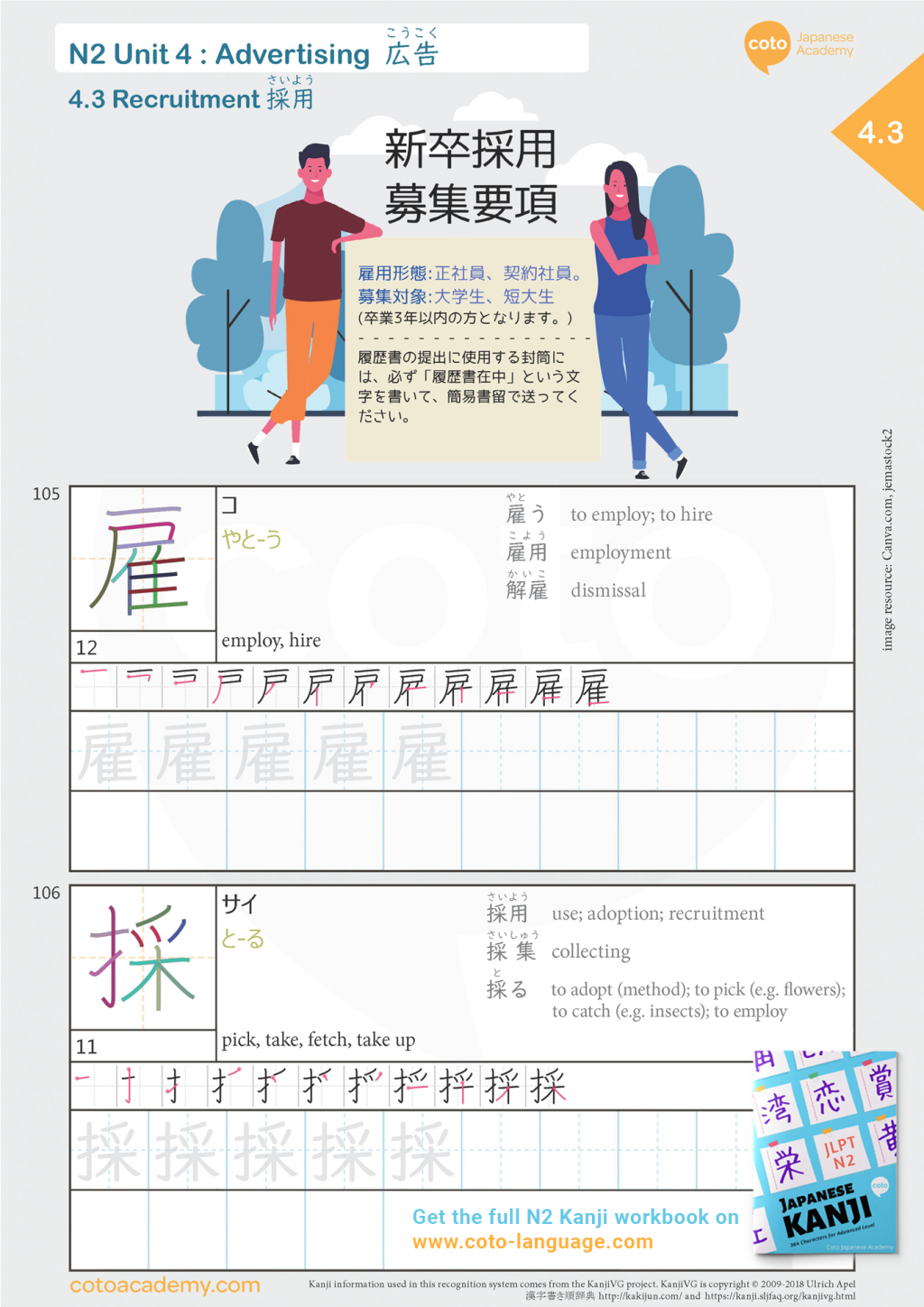
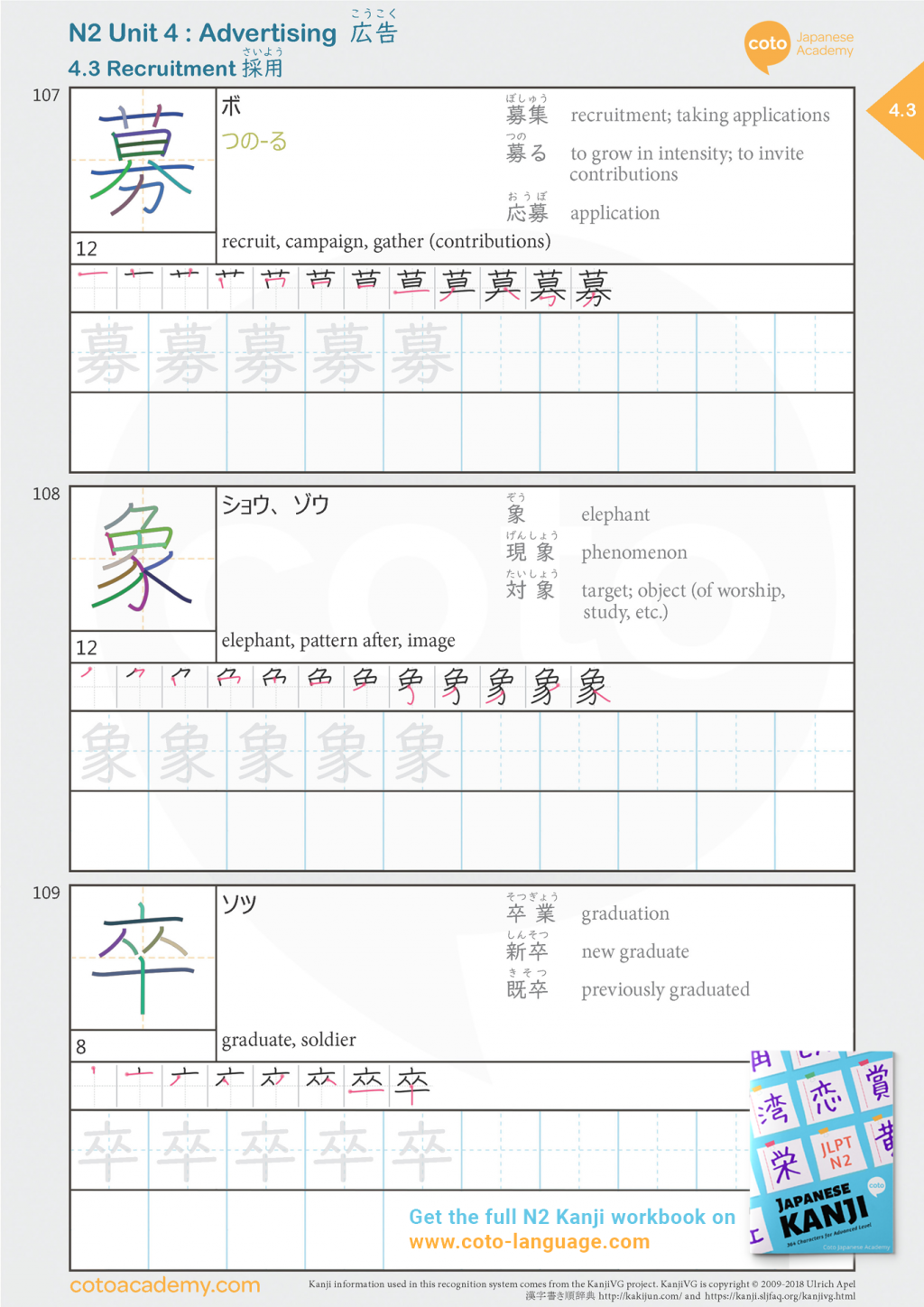
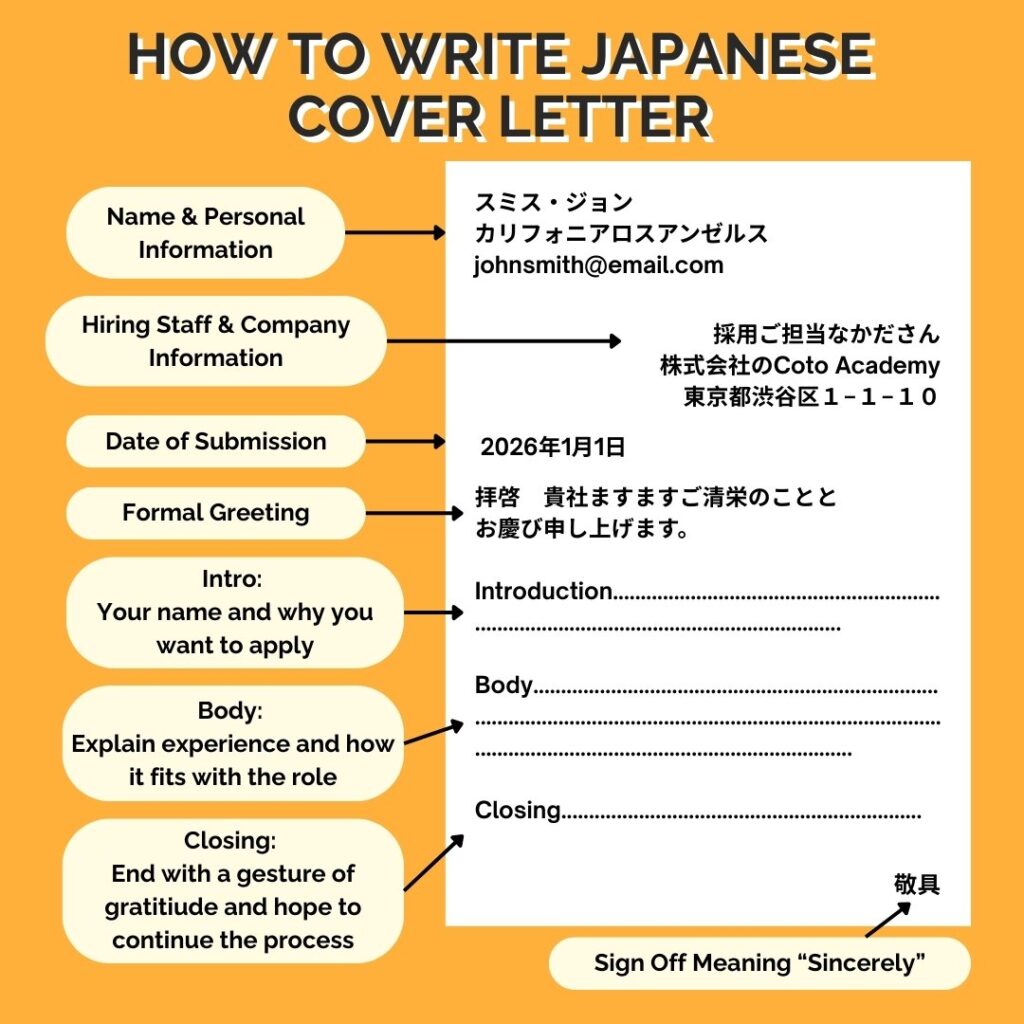
If you are planning to work in Japan, or finding a part-time job during your time studying in Japan. The business level Japanese skills are required in most cases. Before you start job hunting in Japan, let’s learn some kanji with our Kanji worksheet.

Our Business Japanese course designed to help you reach Japanese business fluency with an eye towards career advancement.

You can also level up your Japanese business emails with our online course.

Click here to download: FREE Kanji Writing Practice Sheet – JLPT N2 Unit 4 Recruitment – PDF
N2 JLPT japanese kanji recruitment job hunting

Click here to get the full N2 Kanji writing workbook – Digital Download

https://cotoacademy.com/course/business-japanese-language-course-tokyo/
https://cotoacademy.com/course/jlpt-prep-course/
https://cotoacademy.com/support/free-jlpt-kanji-writing-worksheet-pdfs-for-jlpt/

Welcome to the ultimate guide to passing the JLPT N2! If you’re already studying for it — or at least considering it — chances are you’re ready for a change. JLPT N2 is widely recognized as the practical benchmark for Japanese fluency. Employers in Japan frequently list it as a minimum requirement, and for many international students and professionals, it’s the credential that makes everything else possible. It’s also one of the most challenging standardized language exams in the world.

In this blog, we will cover everything you need to know about the JLPT N2 exam (test contents, length, scoring methods, etc.), how to register, how to prepare, what happens on test day, and some resources and lessons we offer at Coto Academy to help you through your studies.

Keep scrolling if you are considering or planning to take the JLPT N2!

What is the JLPT?

Before we get started, what exactly is the JLPT? JLPT stands for Japanese-Language Proficiency Test, also known as 日本語能力試験. As the name suggests, the exam measures and certifies the Japanese proficiency of non-native Japanese speakers and is used by universities and employees inside and outside Japan. It is normally carried out twice a year in Japan and is available in certain other countries. JLPT Exams are often taken by Japanese learners who are planning a future in Japan!

What are the different levels of the JLPT?

The JLPT is divided into five levels: N1, N2, N3, N4, and N5. N1 is the most advanced level, and N5 is the most basic.

  • The N4 and N5 tests you on basic Japanese that you can often learn in a classroom environment
  • The N3 acts as a bridge between N4/N5 and N2/N1
  • The N2 and N1 tests you on a wider spectrum of Japanese knowledge used in various situations in everyday life

Who should take the JLPT? What are the advantages of taking the N2?

Your JLPT scores will be useful if you are looking for a job or planning to pursue education in Japan. JLPT certifications can also be advantageous when immigrating to Japan, as those who have passed the N2 and N1 qualify for preferential treatment.

Additionally, passing the JLPT N2 can be a fitting goal for Japanese learners wanting to test their ability to understand Japanese used in everyday situations and in various circumstances to a certain degree.

Pass JLPT N2 with prep courses at Coto Academy!

What does the N2 test on?

The JLPT N2 is an exam for upper-intermediate/advanced-level speakers. The JLPT N2 tests your ability to understand Japanese used in everyday situations and various circumstances to a certain degree. This includes having no difficulty in:

  • Reading materials are written clearly on a variety of topics, such as articles and commentaries in newspapers and magazines, as well as simple critiques, and comprehending their contents
  • Reading written materials on general topics and following their narratives, as well as understanding the intent of the writers
  • Comprehending orally presented materials such as coherent conversations and news reports, spoken at nearly natural speed in everyday situations as well as in a variety of settings, and following their ideas and comprehending their contents
  • Understanding the relationships among the people involved and the essential points of the presented materials

What is the JLPT N2 used for?

There have been some major policy shifts in 2025–2026 that make N2 more relevant than ever.

1. For your visa application in Japan

Historically, JLPT N2 wasn’t a formal visa requirement for most categories but that’s changing significantly. In October 2025, the Business Manager visa now requires either the applicant or a full-time employee to have Japanese language ability at B2/JLPT N2 level or higher. Previously, there was no language requirement at all.

As of mid-April 2026, the Engineer/Specialist in Humanities/International Services visa (Gijinkoku) now requires N2 or equivalent for roles that involve Japanese communication — meetings, client interaction, documentation, and similar duties. English-only roles at international companies may still be exempt if the job genuinely doesn’t require Japanese

Importantly, the revision mainly targets foreigners entering Japan for the first time and requiring a Certificate of Eligibility. It doesn’t apply to international students in Japan transitioning from a student visa to a work visa after graduation.

Read more: Japan May Require JLPT N2 for Work Visa in 2026 (What We Know)

2. For your employment

Even before these visa policy changes, N2 was already the de facto standard in the Japanese job market. Many employers prefer candidates with N2 or higher to ensure smooth workplace communication, even when it’s not legally required. Most office and business roles expect N2, while specialized fields like law or medicine typically expect N1.

N2 is generally considered the threshold for functioning professionally in Japanese — reading documents, participating in meetings, handling client communication, and navigating administrative tasks.

How many sections are on the N2 Exam?

It is important to be aware of the structure of the exam to study for it efficiently. The JLPT N2 Exam consists of two main sections. Each section tests you on different aspects of the Japanese language.

SectionQuestion types
1. Language Knowledge(Vocabulary/Grammar) and Reading– Kanji reading
– Orthography
– Word formation
– Contextually-defined expressions
– Paraphrases
– Usage
– Sentential grammar 1 (selecting grammar form)
– Sentential grammar 2 (sentence composition)
– Comprehension (short passages)
– Comprehension (mid-size passages)
– Integrated comprehension
– Thematic comprehension (long passages)
– Information retrieval
2. Listening– Task-based comprehension
– Comprehension of key points
– Comprehension of general outline
– Verbal expressions
– Quick response
– Integrated comprehension

What is and is not covered in the JLPT N2 Exam?

For the above three sections, you must master approximately 6,000 vocabulary words and 1,000 kanji. Although this may sound like a lot, you should already know around 3700 words and 650 kanji from N3-N5, so you are already halfway there! The vocabulary words and kanji covered in the N2 Exam include basic nouns and verbs from N4 and N5 and more complex terms necessary to understand difficult written materials such as newspapers, magazines, and simple critiques.

Furthermore, you must be familiar with grammar points such as particle usage, formal and casual conjugations of verbs and adjectives for past and present tenses, and sentence combinations. You must know around 200 more grammar points besides what you already know from the N3. Before taking the test, you should be comfortable reading and writing longer passages.

Because the JLPT Exam does not test on speaking, Japanese learners who are not comfortable speaking in Japanese can theoretically still pass, as long as they have mastered the vocabulary, kanji, and grammar covered on the N2 Exam. (However, you must keep in mind that Japanese speaking and conversational abilities are still necessary for life if you are seriously considering a future in Japan!)

How long is the N2 Exam?

You are given different amounts of time for each of the two test sections. You are given 155 minutes to complete the JLPT N2 Exam.

SectionTime
Language Knowledge (Vocabulary/Grammar) and Reading105 minutes
Listening50 minutes
Total Time155 minutes

What is the scoring for the JLPT N2 like?

Although the N2 Exam contains two sections, the scoring is divided into three. In total, your overall score can range from anywhere between 0 to 180.

For JLPT N2, the passing score is anything above an overall score of 90 points. However, besides meeting the overall score of 95 points, you must also meet sectional pass marks of 19 points in the Language Knowledge (Vocabulary/Grammar) Section, Reading Section, and Listening Section. This means that even if your overall score is above 90 points, if you do not meet the sectional pass marks for all three of the sections, you cannot pass. Thus, balancing your knowledge and avoiding relying on one section for points is important.

SectionRange of Scores
Language Knowledge (Vocabulary/Grammar) 0 – 60
Reading0 – 60
Listening0 – 60
Overall Score0 – 180

For how long should I study to pass the N2?

how many hours does it take to pass jlpt - study hours N2

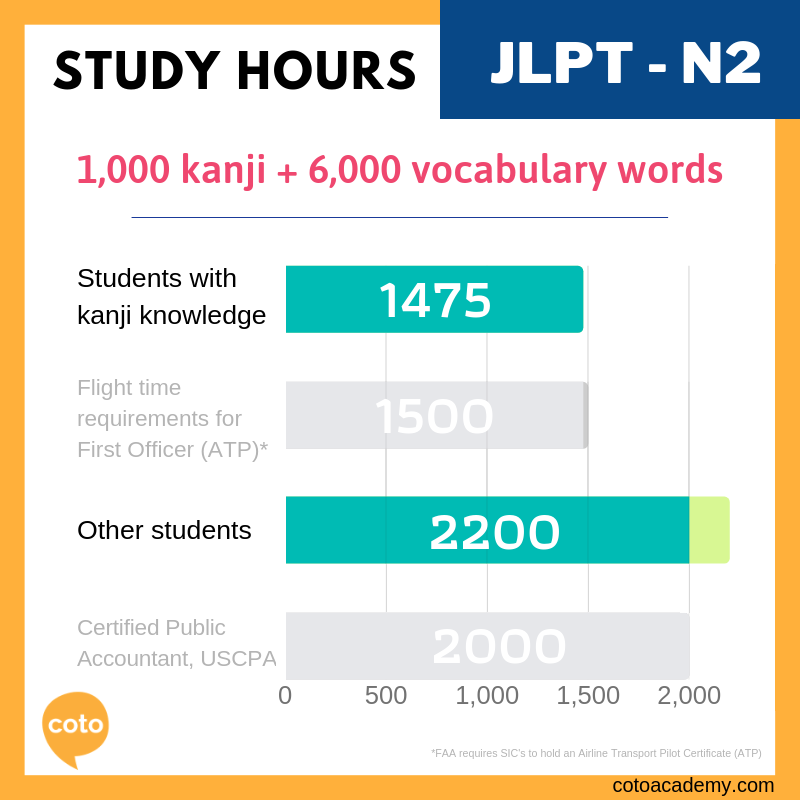
For students with kanji knowledge, 1,475 hours of JLPT study are required. A restricted privileges ATP certificate allows a pilot to serve as a co-pilot until he or she obtains 1,500 hours. So you can become the co-pilot of an aircraft for this number of hours.

For other students, it takes about 2,200 hours. As a reference, credentials for a USCPA (Certified Public Accountant) take 2000 hours. Have fun crunching numbers!

For more information on the necessary study hours for all levels of the JLPT, check out this blog article How Many Hours Does it Take to Pass the JLPT.

How to Study for JLPT N2

1. Kanji and Vocabulary

As previously mentioned, the JLPT N2 Exam covers around 1,000 kanji. (Of course, you do not have to know all of them to pass, but it’s impossible to predict which ones will be on the exam.) The best way to master the vocabulary for N2 is to memorize the words along with their kanji. This will also help you retain all the kanji, so the vocabulary and kanji study reinforce each other.

Anki is one of the most effective tools for N2 vocab and kanji precisely because it fights forgetting rather than just building familiarity. The spaced repetition system surfaces cards right before you’d naturally forget them, which means you spend more time on weak items and less time reviewing things you already know.

For N2 specifically:

  • Use a pre-built deck like the Core 6000 or a dedicated JLPT N2 vocabulary deck rather than building from scratch — saves enormous time
  • Add example sentences to cards wherever possible so you’re learning words in context, not in isolation
  • Create cards that test you on kanji readings in compounds, not just the meaning alone
  • Review consistently in short daily sessions (15–20 min) rather than long cramming sessions

We have also provided samples of the worksheets free of charge at the below links! These are very useful as they give you an idea of some kanji you will be tested on during the N2 exam. Click on the topic to download.

2. Grammar

N3 grammar is largely about building functional communication: expressing wants, reasons, conditions, and basic conjunctions. JLPT N2 grammar raises the bar considerably. The focus shifts toward nuance: understanding how similar expressions differ, using formal and written registers, and handling grammar that appears in news articles, formal writing, and professional speech rather than everyday conversation.

Alongside these, you’ll encounter conjunctions that link ideas with precision: ~にもかかわらず (despite), ~に反して (contrary to), and ~に加えて (in addition to). The volume is significant, but the bigger challenge is understanding how each form fits into a specific context or register.

What makes N2 grammar particularly demanding is the number of near-synonyms that are tested side by side. Pairs like ~かねる (unable to bring oneself to do something) and ~かねない (at risk of doing something) look almost identical but carry opposite implications. Similarly, ~ことから, ~ため, and ~結果 all express cause and result, but differ in nuance and formality. The exam regularly presents options that translate nearly the same way into English, so success depends on understanding the subtle distinctions.

The most effective way to study N2 grammar is to combine structured drilling with real reading. Kanzen Master N2 Grammar groups patterns by function and gives enough practice sentences to surface those nuances.

Here’s an example of our grammar videos:

3. Listening

The JLPT N2 listening section tests your ability to follow natural-paced Japanese across a range of situations, like workplace conversations, announcements, interviews, and informal exchanges. The difficulty is that speakers don’t slow down or simplify for learners, and questions often hinge on a single phrase, a speaker’s implied intention, or a detail buried in the middle of a longer exchange.

A common trap is that the audio will present multiple plausible-sounding options, and the correct answer often depends on nuance — what the speaker implies rather than what they say outright. Many learners who score well on grammar and vocabulary underperform on listening simply because they haven’t trained their ears enough to process spoken Japanese at speed.

The most effective preparation combines passive and active listening. Passive exposure like podcasts, Japanese drama, YouTube — builds familiarity with natural rhythm, intonation, and connected speech over time. But active listening practice is what actually moves the needle for exam performance: working through past JLPT papers under timed conditions, pausing to identify exactly where comprehension broke down, and drilling those weak points. Shadowing, hich is the process of repeating audio in real time to match pace and intonation, is particularly useful for closing the gap between recognition and real-time processing. The goal is to stop translating mentally and start understanding directly in Japanese.

4. Reading

N2 reading passages are longer, denser, and more abstract than anything at N3. You’ll encounter formal essays, opinion pieces, notices, and informational texts, often with embedded clauses, formal grammar structures, and vocabulary that doesn’t get simplified for the reader.

The section tests not just comprehension but interpretation: understanding the writer’s argument, identifying the main point of a paragraph, or inferring meaning from context. Time pressure is a real factor, and many test-takers run out of time not because they can’t understand the passages but because they read too slowly or get stuck on unfamiliar words.

Building reading speed and tolerance for ambiguity is as important as expanding vocabulary. Strong N2 readers develop the habit of moving forward through a passage even when a word or phrase is unclear, using context to approximate meaning rather than stopping to decode every sentence.

NHK Web Easy is a good bridge for upper-intermediate learners, while regular NHK News or editorial content better reflects the density and register of actual exam passages. The underlying skill the reading section rewards is the ability to follow a logical argument in formal Japanese, which ultimately comes from reading widely and consistently in the months leading up to the exam.

Should You Take JLPT N2 Lessons

Studying for the JLPT N2 on your own is possible, but it’s a significant undertaking. The jump from N3 to N2 is one of the steepest in the entire test series. Many learners who attempt N2 through self-study alone find themselves cycling through textbooks without a clear sense of where their weak points are or how to address them efficiently.
Taking lessons with a qualified Japanese teacher changes the dynamic considerably. A good tutor can diagnose exactly where you’re losing points

For example, at Coto Academy, JLPT N2 preparation is something the teachers work on with students every day — whether through group courses structured around the exam syllabus or private lessons tailored to your specific weak points. If you’re based in Tokyo or prefer to study online, it’s worth exploring what a more guided approach could do for your preparation timeline.

The dedicated JLPT N2 Prep Course covers everything on the exam syllabus in small groups of no more than eight students.

If you prefer a more immersive pace, the Intensive Course runs every weekday and builds the kind of fluency with abstract and complex Japanese that N2 demands. For learners who want something tailored entirely to their weak points, Private Lessons offer a one-on-one plan built around your specific needs and schedule.

Ready to Pass the JLPT N2? Prepare with Coto Academy!

Whether you’re just starting your N2 journey or looking to close the gap before your next exam date, Coto Academy’s experienced teachers are here to help. Study in Tokyo or online, at a pace that works for you. You can explore our JLPT prep course or contact us right away for a free consultation and level check!

Check out our guides for other JLPT levels as well:

With the Japanese government moving toward requiring Japanese language ability for the “Engineer / Specialist in Humanities / International Services” visa — typically JLPT N2 or a Business Japanese Test (BJT) score of 400 or higher — a lot of applicants are suddenly asking the same question: what exactly is the BJT, and why have so few people heard of it?

The Business Japanese Test is both a compelling alternative and a strong complement to the JLPT, particularly for those looking to work in Japan. Unlike the JLPT, which measures general proficiency, the BJT is designed specifically for a business environment — making it a valuable credential for anyone who wants to demonstrate workplace-ready Japanese to a potential employer.

Now that the BJT is one of only two Japanese language certificates that the Japanese government acknowledges for the key professional work visa, how does it compare to the JLPT? And should you take it? From how to sign up, what to prepare, and what to bring on the test day, keep reading our ultimate guide on the BJT to find out everything you need to know. 

What is the Business Japanese Test (BJT)? 

According to the official BJT website, the Business Japanese Proficiency Test (BJT) is a language assessment that measures your ability to communicate effectively in professional and business settings in Japanese. 

The whole test is multiple choice, where each question has 4 total options to choose from. The test uses a scaled score where the difficulty of the question has a certain weight in the final result. So each question does not represent “1 point” equally. This scaled scoring provides reliable results. 

The Japan Kanji Aptitude Testing Foundation developed this test for professionals aiming to work in Japanese companies or communicate in Japanese business environments.

BJT vs JLPT: How different are they?

BJTJLPT
Full nameBusiness Japanese TestJapanese Language Proficiency Test
OrganizerJETROJapan Foundation + JEES
FocusLevels/scoringGeneral language proficiency
Levels / scoring0–800 continuous score (no pass-or-fail system)5 levels (N5–N1) on a pass-or-fail system
Visa threshold400+N2 or above
Skills testedListening, readingListening, reading, vocabulary, grammar
FormatComputer-based (CBT)Paper-based
FrequencyMonthlyTwice a year (July & December)
Global reach~28 countries87 countries
Annual test takers~20,000~1.4 million

Unlike the JLPT (Japanese Language Proficiency Test), which focuses more on general Japanese skills, including listening, grammar, and vocabulary, the BJT emphasizes language usage for different work situations, such as promoting a project, communicating between different teams with different specialties, and handling business meetings or negotiations. To a certain extent, the BJT also tests your knowledge of Japanese business manners

The BJT is also more flexible when it comes to scheduling. While the JLPT is held just twice a year, the BJT is available monthly, though it is offered in fewer countries overall.
It’s worth noting that while the JLPT remains the most widely recognized Japanese language certification by governments, private companies, and society at large, the BJT is becoming more popular.

If your goal is to work in a Japanese-speaking office, the BJT is often seen as a more professionally relevant qualification. Another amazing advantage of the BJT is that you can take it any time of the year, depending on availability at a testing center nearest to you. Here is a more detailed breakdown of the exams:

BJT and the Professional Working Visa

In April 2026, the Japanese government announced new language requirements for foreigners applying for the Engineer / Specialist in Humanities / International Services visa. Specifically, applicants falling under Category 3 or 4 are now required to demonstrate Japanese language proficiency equivalent to CEFR B2, the level used in their day-to-day work.

This is where the BJT becomes especially relevant. Under the new guidelines, an applicant is considered to meet the CEFR B2 standard if they satisfy any one of the following conditions:

  • Holds JLPT N2 or higher
  • Has scored 400 or higher on the BJT Business Japanese Proficiency Test
  • Has resided in Japan for 20 years or more as a mid- to long-term resident
  • Has graduated from a Japanese university, or completed a specialized or advanced course at a Japanese technical college or vocational school
  • Has completed compulsory education in Japan and graduated from high school

This makes the BJT one of only two officially recognized Japanese language tests — alongside the JLPT — that can satisfy this visa requirement. For working professionals who may not have pursued general language study through the JLPT pathway, the BJT offers a meaningful alternative: one that reflects the kind of Japanese they actually use on the job.

Another advantage worth highlighting is timing. Because the BJT is held monthly and delivered via computer, there’s no need to wait for a fixed test window the way you would with the JLPT, which runs just twice a year. For someone applying for a visa or a new job, that flexibility can make a real practical difference. You can prepare, sit the test, and have your results in hand without building your timeline around a twice-yearly schedule.

Where and how often is the BJT held?

Unlike the JLPT, which is only offered twice a year, the BJT is available year-round via computer-based testing (CBT) in over 15 countries, including East Asia, parts of Southeast Asia, parts of the Americas, and Europe. Tests are administered at recognized testing centers that can be found on the BJT website. Availability may vary by region and testing center, and you can select time slots that are most convenient for you. 

Keep in mind that you can only take the test once every 3 months!

Test Locations within Japan:

Sapporo, Sendai, Koriyama, Niigata, Tokyo, Yokohama, Chiba, Hamamatsu, Nagoya, Matsumoto, Osaka, Kyoto, Kobe, Okayama, Hiroshima, Matsuyama, Fukuoka, Kitakyushu, Kumamoto, Oita, Naha

Test Locations Outside of Japan:

China, Hong Kong, Taiwan, Korea, Thailand, Vietnam, Malaysia, Indonesia, Myanmar, India, Singapore, America, Mexico, Brazil, France, England, Germany, Italy

How much does BJT cost?

To take the BJT in Japan, it is a flat fee of ¥7,000, including tax. However, the fee will vary depending on the region. For instance, the fee in the United States, France, England, and Italy is $76 (USD), while in Mexico and Brazil the fee is $42 (USD).

How is the BJT scored?

Unlike the JLPT with a specific passing score, there is no pass or fail for the BJT. Instead, the exam scores your answers from 0 to 800 total points and evaluates your results on a scale of six levels from J5 to J1+. The J1+ is the highest level, and J5 is the lowest. Here is a breakdown of the J5 to J1+ levels by points:

J1+: 600 – 800 

This is the highest level, indicating you have more than sufficient knowledge and communication ability to speak business Japanese, use the most appropriate choice of words, and carry out all work duties.

J1: 530 – 599

The J1 indicates a very strong ability to speak and use words appropriately in different work situations, such as handling business meetings, phone calls, and negotiations. While not at the same level of accuracy as the J1+, this level does display a high level of business Japanese ability.

J2: 420 – 529

The J2 shows that you have extensive knowledge in Japanese, but may not understand the best choice of words for differing contexts. This is a moderately high degree of business Japanese.

J3: 320 – 419

The J3 indicates you have the ability to understand simple business conversations, meetings that are not too complex, and some Japanese business customs. This is an intermediate/moderate level of business Japanese.

J4: 200 – 319

This is a beginner level of business Japanese, indicating an ability to understand simple business conversation if spoken slowly.

J5: 0 – 199 

This is the most introductory level. This score means very minimal to no business Japanese understanding and communication ability.

How the BJT is structured

The BJT lasts 1 hour and 45 minutes and is divided into three main sections: listening comprehension, listening and reading comprehension, and reading comprehension. 

1. Listening Comprehension: Mondai (問題) 1 and 2

This section is designed to test your understanding of Japanese in a variety of business situations. The main format for the listening comprehension portion of the exam is audio conversations followed by questions. This portion of the exam consists of 5 questions for situational understanding, 10 questions for conversational listening comprehension, and 10 questions for general listening comprehension. 

The total time takes around 45 minutes.

2. Listening and Reading Comprehension: Mondai (問題) 3 and 4

The Listening and Reading Comprehension combines audio with visual information such as graphs, slides, and different reading materials. This section focuses on testing your ability to interpret spoken language in context with written visuals, with 3 subsections including situational understanding, information listening and reading comprehension, and general listening and reading comprehension.

The total time takes approximately 30 minutes.

3. Reading Comprehension: Mondai (問題) 5 and 6

The last test is the reading comprehension test, which tests your understanding of written communication in professional settings. The test consists of reading materials, business documents, emails, and memos. The test consists of four areas: vocabulary and grammar, expression, reading comprehension, and general reading comprehension

The total time takes roughly 30 minutes. 

Is the BJT difficult?

The BJT can be challenging, especially for those unfamiliar with Japanese business language and culture. However, the test is designed to assess real-world skills, not just academic knowledge. If you’re already working in a Japanese company or studying business Japanese, you may find the test more practical and intuitive than the JLPT.

Many learners find the listening and visual interpretation section the most difficult, as it requires multitasking and quick comprehension.

How to prepare for the BJT

There are many ways you can prepare for the BJT, including taking business Japanese courses, practicing with sample questions, and finding good listening material. To start, the official BJT website has sample questions you can look through and practice. But to get more sufficient practice in, you can get the Official BJT Preparation Book (ビジネス日本語能力テスト公式問題集). You can also find online websites that offer BJT practice questions or find good listening materials, such as business Japanese podcasts or YouTube channels. 

We highly recommend practicing and getting familiar with keigo and general business Japanese communication. Our Business Japanese courses at Coto Academy are a great way to practice business Japanese, both for work and to help prepare for the BJT exam. 

Who accepts BJT scores?

The BJT Business Japanese Test is now an officially recognized path to meeting Japan’s new work visa. Previously, many businesses, universities, and Japanese language schools accepted BJT scores as a credible index for Japanese abilities. A BJT score is a great way to display your business Japanese skills on a resume or 履歴書 (rirekisho) and may help you to stand out, while it’s not usually a requirement for most jobs. Some universities may even apply the BJT to course credits or use the BJT scores as a part of their evaluation criteria for university entrance exams. 

Due to this, language schools are also adopting curricula or classes that help students prepare for the BJT and may even use the score as another means to help students display their language abilities.

JLPT or BJT: Which is more widely accepted?

While it doesn’t hurt to add either one to your academic or work resume since both will help you stand out, JLPT test results are more commonly listed as a standard for certain roles, academic programs, or even visas. However, most roles that do require some form of Japanese language ability, either a JLPT or BJT score, are accepted as a credible qualification of language proficiency. The BJT can also be used in place of JLPT for displaying your eligibility for certain visas in Japan.

While a BJT or JLPT score may get your foot in the door for an interview with a Japanese company, it is just as important to demonstrate you can actually speak Japanese. 

If you want to learn Japanese, you can join lessons at leading language schools like Coto Academy, which offers business Japanese courses.

How to apply for the BJT

So, now that you have decided to take the BJT, what are the steps to apply and take the test? Below, we provided a breakdown of how to sign up:

1. Make a reservation for the BJT exam via the PearsonVUE website

the business japanese proficiency test website

You can go to the official reservation site through the BJT website or by clicking the link above. You can toggle the language to switch to English if necessary and click “create an account” to register.

2. Agree to the Privacy Policies

accept the privacy policy at the bjt website

This page is meant to inform you of the privacy policies regarding the personal data you will share, as well as CCTV recordings during the test itself. Make sure all the boxes are checked and click “agree” to continue to the application. 

3. Provide your personal information

creating a web account at the bjt website

There are 4 total steps. In the first 2 steps, you provide information such as your name, address, and contact information.

creating an account at the bjt website

On the third step, you must select the month you plan on taking the BJT. 

creating an account at the bjt website

On the last step, you finalize your account by making a username and password as well as providing 3 security questions with answers (be sure to choose answers you can remember very accurately without any spelling errors or variations),

4. Schedule an exam

Once you have successfully created a web profile, click on the “BJT: BJT Business Japanese Proficiency Test” to start booking your exam date and location. 

Confirm your native language. 

Afterwards, read through the policies regarding retaking the exam, rescheduling, and cancelling the exam. Note that full refunds for the exam are possible if you cancel at least 24 hours before the exam date.

6. Choose your test center and preferred date

business japanese proficiency test center

You will be brought to a screen where you can search for test centers by location. The website will automatically display the test centers closest to the address you registered when you created your account. But if you prefer test centers at a different location, you can type in a desired area in the search box.

After choosing your desired test center, click a date that works best with your schedule. 

book an appointment for the bjt

You can click “Explore more times” if the available appointment time does not work with your schedule. Once you have chosen a time frame, click “Book this appointment”.

7. Pay the examination fee 

paying examination fee for bjt

Once you’ve completed your application, you will need to pay the test fee to finalize the exam reservation. Confirm the test location, appointment time, and contact information, and click “Proceed to Checkout”.

Lastly, enter your payment information; you can pay with either a debit or credit card. In Japan, the fee will amount to ¥7,000 but, as mentioned, the exam fee varies by country and test location.

After paying, you will receive confirmation and test details via email.

What to bring to the BJT

Since the BJT is a computer-based exam, you won’t need to bring much for the exam itself. You will only need to bring 2 forms of identification, at least one has to have a clear photo of your face. Make sure the names written on your IDs match the names you wrote when making an account for the BJT. 

Any electronic devices you bring, such as a cellphone, should be shut off and stowed away in your bag before entering the exam room. You are not allowed to have any study materials once you enter the testing room. 

Conclusion: Is the BJT Worth Taking?

If you plan to work in a Japanese company, apply for internships, or communicate professionally in Japanese, the BJT is a highly practical and respected certification. Unlike the JLPT, it focuses on real-world usage and evaluates your ability to operate in a business environment, making it a valuable tool to advance your career.

Whether you’re a foreign job seeker in Japan or a company doing cross-border work, the BJT helps prove that you’re more than just fluent; you’re ready to break into the Japanese workplace. 

To help prepare for the BJT or for getting more Japanese practice for working in Japan, fill out the form below to get in touch with us!

FAQ

What does the BJT focus on testing?

The BJT, as claimed on its website, focuses on testing your proficiency in business Japanese communication and comprehension. So, how well can you understand Japanese in different workplace contexts, including emails, charts, business conversations, negotiations, and the most appropriate choice of words in certain situations?

What is the difference between the BJT and JLPT?

The BJT is a computer-based exam focusing primarily on Japanese for business and work communication. By contrast, the JLPT is a paper-based exam that tests general Japanese abilities, with upper levels focusing on academic language.

Is the JLPT N1 equivalent to the BJT J1+?

While there is some correlation with JLPT and BJT skill levels, such as N1 holders generally achieving higher BJT scores, both exams measure different skillsets, so having a high JLPT level does not guarantee a high score on the BJT and vice versa. Data on this matter shows N1 holders had scores that varied widely, indicating the JLPT does not test practical business skills to the same extent as the BJT.

Does a BJT score help with getting a visa in Japan?

The Immigration Bureau does refer to BJT scores for your eligibility for certain visas, especially ones with certain language requirements. JLPT results are also often considered as a form of language certification.

Do schools, companies, and other organizations recognize BJT scores?

Schools, companies, the Japanese government, and other organizations across Japan recognize and accept BJT scores as a form of credential for language abilities. Even for roles that don’t ask for any kind of language proficiency score, including a BJT score on your resume will definitely help you stand out. 

How much does the BJT cost?

The cost of the BJT in Japan is ¥7,000. However, the price varies depending on the region. In the United States, Germany, Italy, and France, the exam costs $76.

When can I get my BJT test results?

The BJT test results are immediately available right after you complete the test since the exam is computer-based. You can also view your exam results by logging into your BJT (PearsonVUE) account.

Taking the JLPT instead? You might like our blog on:

You may be familiar with the JLPT, but have you heard of the BJT and TOPJ? While the JLPT is the most widely recognized proof of Japanese language proficiency, an increasing number of companies and foreigners are now opting for the JLPT test alternatives.

But from JLPT, BJT, and TOPJ, which one should you take? Nowadays, there is even a lot of debate on which test is the best, especially if you want to find a job in Japan. Which certification test should you study for, and which ones will get you hired? This conundrum can be challenging for prospective job seekers in Japan. 

In this blog, we’ll cover three main Japanese proficiency tests that you can take to get hired in Japan. We’ll also discuss which certification is best for whom, whether you’re a job seeker in Japan or want to study at a Japanese university.

JLPT vs. BJT vs. TOPJ: Which Certificate Gets You Hired in Japan?

Why Does Japanese Certification Matter for Jobs in Japan?

If you’ve checked out major job boards aimed towards foreigners, such as LinkedIn, Indeed, or GaijinPot, you probably noticed that most non-English teaching jobs require some form of Japanese proficiency, whether it is conversational level or near-native level. 

While some jobs don’t require a high level of Japanese, having business-level or advanced Japanese proficiency opens the door to more opportunities in Japan and helps your resume stand out.

However, you can’t just say that you have conversational Japanese proficiency without the proof to show it. That’s why it can be helpful to have some proof of Japanese proficiency, and possessing a certificate in Japanese can certainly help with the job hunting process in Japan.

Do Japanese employers really ask for a Japanese language certificate?

When applying for jobs, some job portals allow you to upload a scanned copy of your Japanese language certificate as proof. However, not all companies require it.

The question is: if you don’t upload a certificate but list it on your resume, can you claim to have, for example, a JLPT N2?

Even if some employers don’t always request proof, never lie about your qualifications.

If you don’t have a certificate, you can still indicate your estimated Japanese level, but you should not claim to possess a certificate you haven’t earned. Similarly, claiming native-level proficiency when you are not will likely be revealed during the interview process.

Take JLPT Preparation Class at Coto Japanese Academy!

What is the JLPT?

The Japanese Language Proficiency Test is the most widely known proficiency test for Japanese learners. Held throughout Japan and in 85 countries, the JLPT measures Japanese proficiency on a scale of five different levels:

JLPT LevelDescription
N5The lowest level you can obtain through the JLPT; you can understand some basic Japanese.
N4You can understand basic Japanese, such as comprehension of daily topics and basic vocabulary.
N3You can understand Japanese at a daily conversational level.
N2You can understand Japanese at an advanced level or business-level proficiency.
N1You can understand Japanese at near-native proficiency. The highest level you can obtain in the JLPT.

What the JLPT does is test your proficiency in reading, grammar, vocabulary, kanji, and listening. The test is structured into different sections depending on which level of JLPT you’re taking; for N5 to N3, you will take the test in three sections, whereas for N2 and N1, you will take the test in two sections:

  • N5–N3:
    • Section 1: Vocabulary 
    • Section 2: Reading and grammar
    • Section 3: Listening
  • N2–N1:
    • Section 1: Vocabulary, grammar, and reading
    • Section 2: Listening

You will then receive your test results at least two months after taking the JLPT. To pass the JLPT, you will need to not only meet the minimum required score for each section, but also for the overall test. Passing marks for the overall test can vary according to the level you’re taking; for example, if you’re taking the N3, the minimum score for each section has to be 19 out of 60, but for the overall test, your score has to be 95 out of 180.

Advantages of taking the JLPT

There are many advantages to passing the JLPT, especially if you’re planning on taking the test at the N2 or N1 level. The prestige of possessing a JLPT certificate is advantageous since it’s the most widely known test of Japanese proficiency throughout the world, and is mainly used as a benchmark of Japanese proficiency.

Aside from job hunting advantages, a JLPT certificate can help you with your visa application; for example, possessing an N2 or N1 certificate will meet the benchmark requirements for being admitted to Japanese universities and higher education institutions. In addition, for some visas, such as the Type 1 Specified Skilled Worker visa, you might need an N5  certificate or higher to meet the language requirements for that visa. 

Read More: What to Know About Japan’s New Foreign Worker System Starting 2027

Disadvantages of taking the JLPT

Of course, just because the JLPT is the most widely taken proficiency test, it doesn’t mean that it has no flaws. 

Since the JLPT only tests vocabulary, kanji, reading, grammar, and listening, there are no speaking or writing tests that you have to take throughout the test. Speaking and writing are important aspects of learning Japanese, so the JLPT might not be a good indicator of your true proficiency in the language, especially since you might need to write reports or participate in meetings when working in Japan. 

This can also be detrimental to your overall Japanese proficiency if you revolve your studies around passing the JLPT (which can lead you to focusing too much on grammar and vocabulary and not speaking or writing). 

Furthermore, since the test is held once or twice a year, depending on where you live, waiting to take the JLPT can affect your job-hunting journey. If you need the Japanese certification immediately, then taking the JLPT might not be the best option.

What is the BJT?

An alternative to the JLPT is the Business Japanese Test, or the BJT, which tests your ability to communicate in professional and business settings in Japanese. 

Unlike the JLPT, the BJT is more focused on practical Japanese, particularly in work-related situations. This test is held in 16 different countries, including Japan. The test is mainly computer-based (though you will need to take it at a test center), and you can take the BJT once every three months.

The test lasts for a total of 1 hour and 45 minutes and will test your listening and reading comprehension in a variety of business situations, such as situational understanding, information listening, and written materials such as memos, emails, and business documents. 

Instead of grading on a pass/fail basis, the BJT is scored from 0 to 800 on a scale of six levels, from J1+ to J5. The highest level you can obtain is J1+, with a score of 600 to 800, which demonstrates that you have an advanced knowledge of business Japanese and can use the language in a variety of business situations. You will receive your BJT results immediately after the test.

Learn more about the Business Japanese Test here.

Advantages of taking the BJT

The advantages of taking the BJT are that since it tests you on your Japanese in the workplace, studying for the test allows you to adapt to Japanese workplaces easily, since you will be tested on your ability to understand a variety of Japanese business situations, as well as comprehend business documents and emails. In addition, since results are always instantaneous, you can use these results in lieu of JLPT scores for job hunting, university applications, and even visa applications. 

Disadvantages of taking the BJT

Like the JLPT, the BJT doesn’t really give you an idea about your ‘true’ Japanese proficiency, since it only tests you on business Japanese. This means that while your Japanese could be considered sufficient for the workplace, your practical Japanese proficiency might not be the best. Studying for the test can only prepare you for surviving a Japanese business setting, not daily life in Japan.

What is the TOPJ?

The Test of Practical Japanese, otherwise known as either the TOPJ or J.TEST, is another alternative test to the JLPT. Held in Japan and in 12 different countries, it tests your Japanese ability in daily, practical situations. The format of the test is similar to the JLPT in terms of sections; the TOPJ includes a writing comprehension section (though it depends on which level of the test you’re taking). 

Like the JLPT, the test is administered according to level, which uses letters from A to G to determine proficiency:

  • F/G level: The equivalent of the JLPT N5. The beginner level test is taken by those with basic proficiency in Japanese.
  • D/E level: The equivalent of the JLPT N4 and N3. This test is taken by those with intermediate proficiency in Japanese.
  • A to C level: The equivalent of the JLPT N2 and N1. This test is taken by those with advanced proficiency in Japanese.

Whichever level you are taking, the TOPJ is graded based on how many points you get. Unlike the JLPT, there is no minimum points requirement according to the section; instead, the letter grade that you will get is determined by how many points you score in the test overall. To get the lowest grade in the level you’re taking, you will have to meet the minimum score required for the overall test.

Advantages of taking the TOPJ

The format of the TOPJ really tests you on your use of Japanese in practical situations, which can give a better idea of your overall Japanese proficiency. As writing skills are an important indicator of Japanese proficiency, the addition of writing sections in the test can help you to find out what your Japanese proficiency is. Recently, the TOPJ has become an accepted credential for job hunting, university admissions, and even visa applications. 

Disadvantages of taking the TOPJ

While the TOPJ does prepare you to use Japanese in a variety of practical situations, the TOPJ isn’t widely known worldwide, as it’s mainly offered in Asian countries, except for Brazil. Furthermore, studying for the test can be difficult as resources for the test can be limited.

JLPT vs. BJT vs. TOPJ: Key comparisons

Japanese Language Proficiency TestBusiness Japanese TestTest of Practical Japanese
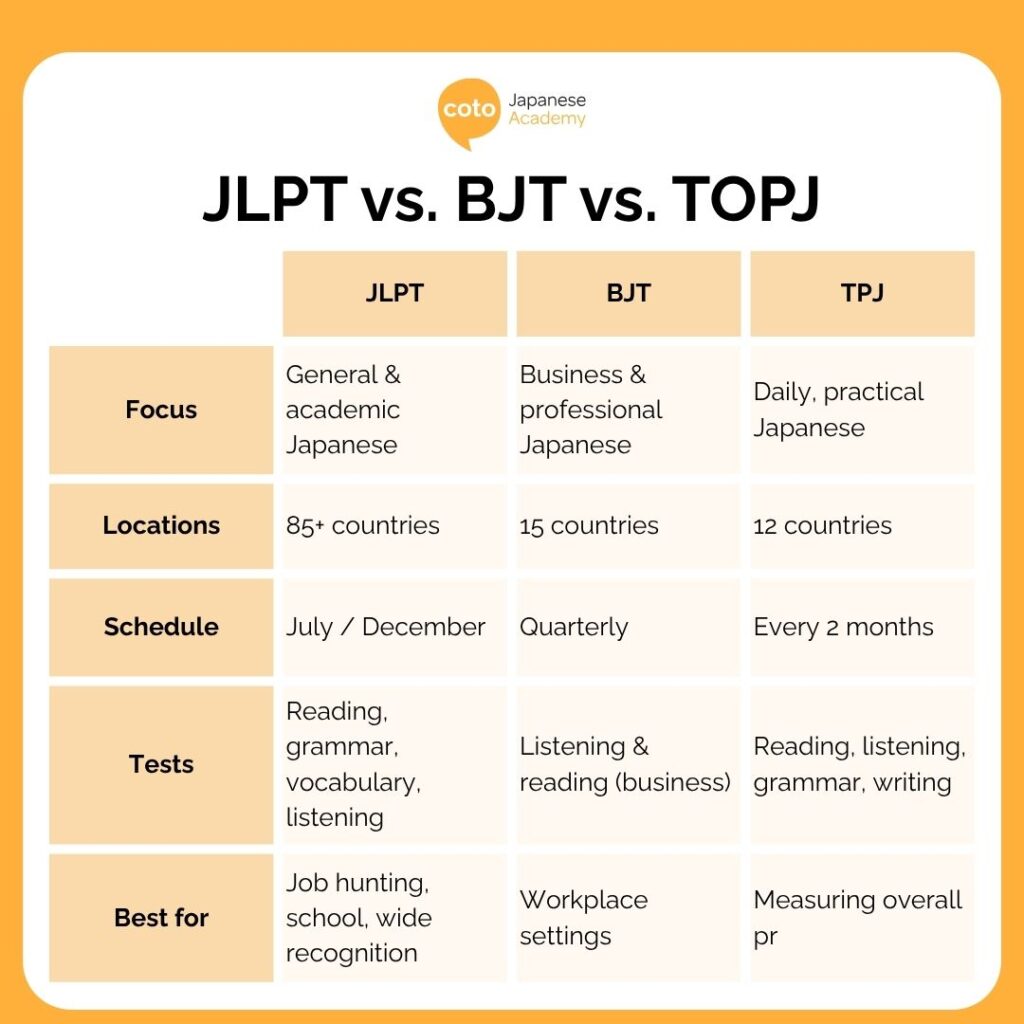
OverviewTests general and academic Japanese proficiency Tests Japanese proficiency in business and professional settingsTests Japanese proficiency in daily, practical situations
LocationJapan, and 85 different countriesJapan, and 15 different countriesJapan, and 12 different countries
Held when?July and/or December (depending where you live)Year-round; you take the test once every three monthsJanuary, March, May, July, September, November
What is being tested?Reading, grammar, vocabulary, and listeningListening and reading comprehension in business situationsReading, listening, grammar, and writing
ProsJuly and/or December (depending on where you live)Scores are available immediately after the exam. It is more focused on practical Japanese usage
Can be used in lieu of JLPT scores for study or work
Is becoming a widely accepted form of certification
Can give you a better idea of your overall proficiency
ConsDoesn’t really give you an idea of your overall proficiency
Only offered twice a year
Doesn’t give you an idea of your overall proficiency
Studying for the test only prepares you for workplace situations, not daily conversations
Isn’t as well-known as compared to the JLPT
Aside from practice questions on the official website, resources to study for this test are limited
Application fee (as of 2026)¥7,500 (in Japan)¥8,000 (in Japan)¥5,800 (in Japan)

Which Certificate Do Employers Actually Care About?

It can be difficult to decide which test you want to take for employment purposes. It’s true that most jobs in Japan do require business-level Japanese, and even though there are English-speaking jobs in Japan, most jobs do require fluency in both English and Japanese. This is why bilingual candidates are commonly sought after in the job market, especially at international companies. For the most part, however, the JLPT is widely accepted as proof of Japanese proficiency; the BJT can also be beneficial in job hunting as well.

JLPT N2 Benchmark for Key Professional Working Visa

For prospective job seekers looking to start a career in Japan, it might be useful to have a JLPT N2 certificate, as this will be a gateway to most bilingual jobs in Japan. Even if your resume is considered to be ‘perfect’, companies prefer to find someone with Japanese proficiency. If possible, possessing an N1 certificate can increase your chances of finding a job.
The reality is, the level of proficiency you’re going to need in Japanese depends on your role and industry. For most office jobs, you’re going to need a high level of proficiency (preferably N2 or N1), while jobs at international companies and in tech tend to not care about Japanese proficiency that much, though it’s a bonus to have Japanese certification.

Japan Will Require Proof of N2-Level Proficiency Soon

As of April 2026, Japan is now updating its visa requirements to mandate N2-level proficiency for the Engineer/Specialist in Humanities visa.

For applications submitted on or after April 15th, 2026, if your job requires you to engage in customer-facing work requiring language skills, you will need to provide documentation that proves your Japanese proficiency equivalent to CEFR Level B2. Scores and certificates that meet this requirement include having a JLPT N2 certificate, or a score of 400 in the BJT. However, the JLPT N2 is generally the most widely recognized, so it should be a key consideration when weighing your options.

We also recommend checking out our blog about the new Japanese language requirement for the Engineer/Specialist in Humanities visa here.

Best Certification Based on Your Goal

For Students

If you’re planning to study at a Japanese university, we recommend taking the JLPT N2, as it will help you increase your chances of being admitted. In addition, most Japanese universities will also require you to pass the EJU, or Examination for Japanese University Admission for International Students. This is just to test your language proficiency, as well as core academic proficiencies.

If you’re planning on studying at a Japanese language school, we recommend taking the JLPT N5 to prove that you have completed 150 hours of Japanese study. Some language schools offer BJT preparation courses for those who plan to work in Japan post-graduation. You can consider taking our JLPT preparation courses here.

For Job Seekers

While it is true that there are English-only roles in the Japanese job market, those types of jobs are rare. You should consider having a JLPT N2 or N1 certificate to increase your chances of getting hired, though having a BJT level of J1 can also increase your chances of securing an interview. Achieving a BJT level of J1+ can be more beneficial than J1 as it will demonstrate your proficiency in business Japanese to your future employers.

Final Verdict: Which Test Should You Take?

With all that being said, which certification will get you hired in Japan? The answer is, it depends on the company. While it is true that any proof of Japanese proficiency can increase your chances of securing a job in Japan, most companies will automatically assume that you would have a JLPT certificate due to its recognition and prestige. Likewise, a BJT certificate can show the company your ability to adapt to a Japanese work setting, and a TOPJ certificate can be used in a wide range of applications.
In the end, choose which certificate suits your job or even academic needs. To get started on your job hunting in Japan, we recommend checking out our recommendations for job boards here.

Good luck, future job seeker, in finding a job in Japan!

Want to prepare for any Japanese proficiency test?

If you want to prepare to take any Japanese proficiency test, why not study Japanese at Coto Japanese Academy? With over 25 years of experience in offering practical Japanese lessons in Shibuya, Shinjuku, Iidabashi, Minato, Yokohama, and online, we offer JLPT preparation as well as business Japanese courses for those who want to improve their language skills for work or school. 
Ready to take lessons with us? Contact us below by filling out the form, and get a free level check!

FAQ

Is having JLPT N3 enough to live in Japan?

Technically, yes. You can survive living in Japan with just N3, and some jobs only require conversational-level fluency in Japanese. 

If I’m taking the JLPT, can I skip the N5 to take the N4?

Absolutely! There’s no prerequisite for you to take the JLPT at higher levels, so you can take the N4 without having to take the N5.

Is N2 the equivalent of business Japanese?

Yes, having an N2 level of Japanese means that you have a near-advanced proficiency in the language, which means you can understand Japanese in professional settings.

The Japanese government just announced that on April 15, 2026, the Engineer/Specialist in Humanities/International Services visa (one of the most common work visas for foreign nationals) will be revised to include a Japanese language requirement. Under the new system, foreigners need to have Japanese language skills equivalent to the N2 level of the Japanese-Language Proficiency Test, or the B2 level of the CEFR standards.

However, the Japanese language requirements for work visas apply only to roles that already require Japanese proficiency, rather than to all applicants under the 技人国 (gijinkoku) visa category. Either way, how are these revisions actually going to work, who is this change for, and why is the Japanese government making these revisions in the first place?

This information is based on ongoing developments and should not be considered legal advice. We are not legal experts or an official immigration authority. For the most accurate and up-to-date information, please refer to the Residence Status: Engineer/Specialist in Humanities/International Services page provided by the Immigration Services Agency of Japan.

The JLPT N2 is Now Required for One of the Most Common Work Visas

The Immigration Services Agency officially stated on its website that Japan will require proof of Japanese proficiency for the gijinkoku visa. They’ve decided that Japanese proficiency needs to be at the CEFR B2 level, which is considered to be equivalent to the JLPT N2. However, there are a few things to keep in mind.

  1. You only need to submit a JLPT N2 certificate if your application falls under category 3 or 4 (employment at SMEs).
  2. Passing the JLPT N2 (CEFR B2) is not a strict requirement since the website outlines that alternative proof of proficiency could be accepted.
  3. Any new requirement will apply only to applicants entering Japan on a 技人国 (Gijinkoku) visa for the first time. Foreign nationals already in Japan on student visas who transition directly into this visa category could be exempt.
  4. Language requirements would only apply to jobs where Japanese is actually used.

So, let’s unpack what all that means.

What is the Engineering, Specialist in Humanities, and International Services Visa?

Before we discuss the exact revisions, we need to understand the exact visa that is being affected. The Engineer/Specialist in Humanities/International Services visa, known in Japanese as 技術・人文知識・国際業務 (Gijutsu, Jinbun Chishiki, Kokusai Gyoumu), is one of the most common work visas for foreign professionals in Japan. It is often abbreviated as 技人国 (Gijinkoku).

The gijinkoku is a flexible, wide-reaching work visa allowing foreigners to engage in a variety of industries that fall under engineering, humanities, or international services. Below is a breakdown of typical roles covered by the gijinkoku visa.

Engineering/Technical RolesHumanitiesInternational Services
Software engineering, data scientist, digital designer, developersMarketing, human resources, sales, general affairs, and financeTranslation & interpretation, international sales, public relations, language teaching

Basically, almost anything can fall under these broad categories, from software, marketing, consulting, creative, to even English teaching. So, it might be easier to define what this visa is not:

  • It is not a blue-collar labor visa
  • It is not meant for factory or construction work
  • It is not meant for hospitality or food service work (waiter, bartender, etc.)

Currently, the visa requires either a bachelor’s degree or some years of work experience in an industry relevant to the visa’s permitted work scope. To receive the visa, you do not need any Japanese language ability.

What are Category 3 or 4 Applications for the Gijinkoku Work Visa

Categories 3 and 4 are typically small and medium-sized enterprises (SMEs) that have existed for some time and have submitted their statutory withholding tax records for the previous year. Category 4 includes newly established companies (startups) or very small businesses with limited financial history.

So, how likely is it for foreigners to work in SMEs? The majority of foreigners are employed at small companies, over 36% work at companies with under 30 employees, and almost 20% work in companies employing between 30 and 99 employees, according to the Immigration Services Agency. With so many foreigners working for SMEs, they will need to have the JLPT N2 qualification if their job requires Japanese.

However, keep in mind, you are deemed to have JLPT N2 if you have:

・Graduated from a Japanese university, completed a specialized or advanced course at a Japanese college of technology or vocational school.
・Completed compulsory education in Japan and graduated from a Japanese high school

So, if you have already studied in Japan at a university, you do not need JLPT N2; however, the system will make it harder for overseas applicants to come to Japan if they are hired by smaller firms, or if they did not attend a Japanese higher education institution.

Why is Japan Making These Revisions?

What the gijinkoku visa is, the type of work it permits, and its eligibility criteria lead us directly into why Japan is going to make revisions to its language requirements. The government believes that many foreigners enter the country with the gijinkoku visa but end up working in sectors that do not fall under its permitted scope. So, the government feels that the visa’s lack of language proficiency requirements is partly to blame for this.

There are currently 468,068 gijinkoku visa holders according to the Ministry of Labor, Health, and Welfare (MLHW), making it the second most common visa after the permanent resident visa. With the number of foreign workers the visa brings into the country, Japan wants to ensure that all the foreigners meet qualifications while preventing visa holders from working in sectors not allowed under the gijinkoku work criteria. So, requiring proof of Japanese ability could bar candidates who don’t have that baseline qualification, as well as allow in more foreigners, more likely to integrate into Japanese society. 

So, it’s for this purpose that the JLPT N2 is going to be required for getting the visa. Additionally, the fact that the revisions are only for category 3 and 4 applications means small companies are the main target. With so many foreigners being employed by SMEs, they need to ensure these companies (with fewer financial records) are also complying. So the new policy also includes restrictions that will bar any company from hiring foreign workers for 5 years if they have any labor or harassment violations.

Recent policy discussions in Japan have also focused on tightening requirements for permanent residency. Specifically, government panels and ruling party officials are considering introducing a Japanese language requirement for permanent residency applicants as part of broader immigration reforms.

What Language Requirements Are Actually Being Proposed?

Japan will revise the eligibility criteria for the gijinkoku visa to require applicants to possess Japanese at the CEFR B2 level, which is approximately equivalent to the JLPT N2. 

However, there are some important caveats you should keep in mind:

1. Applicable Only to Roles Needing Japanese

These changes are only applicable to roles that require Japanese language ability. Since the gijinkoku visa is so flexible and covers a wide range of roles, certain positions such as English teaching (often covered by the gijinkoku), recruitment, inbound marketing, and certain engineering/technical roles likely wouldn’t be applicable for the new language requirement changes if no Japanese is required.

2. Revisions Likely Won’t Apply to Visa Status Changes or Renewals

The revisions also won’t be applied to foreigners seeking to change their visa status, such as university students changing their visa to the gijinkoku or current workers who are renewing their visa. So, if you’ve just changed jobs and will be needing to renew your visa, you won’t need to rush to pass the N2. The revision is mainly targeted at foreigners entering Japan for the first time and requiring a Certificate of Eligibility (COE).

3. JLPT N2 is One of Many Accepted Documents Proving Japanese Skills

The biggest elephant in the room is whether the JLPT N2 certificate will actually be a strict requirement for visa eligibility. It seems the government just wants proof of language ability at the CEFR B2 standard, which they feel is equivalent to the N2. So, an N2 certificate would be sufficient proof of language ability, but it doesn’t have to be the only one. Others include:

  • A score of at least 400 on the Business Japanese Test (BJT)
  • Graduating from universities in Japan, or completing advanced or specialized courses at vocational/technical colleges
  • Residing in Japan for 20 years or more as a medium-to-long term resident
  • Completing compulsory education in Japan and completing high school

About the JLPT N2 or CEFR B2

The N2 is the second-highest level of the Japanese Language Proficiency Test (JLPT), an exam that evaluates Japanese language abilities. The N2 is considered sufficient for working in Japanese, meaning you can engage in complicated dialogue, read articles, conduct meetings, and meet the diverse language demands of a working setting in Japanese.

However, the policy will stipulate submitting documents proving you’re at the CEFR B2 level, which officially corresponds to the N2. The CEFR, or the Common European Framework of Reference for Languages, is a global standard that measures language proficiency. According to the website, the B2 level means you can comfortably communicate with native speakers as well as understand concrete and abstract texts and discussions. You can also produce detailed writings on a range of subjects you are knowledgeable about. 

There is no test for the CEFR specifically, so Japan considers the N2 to be an indicator of being at the CEFR B2 level. But note that the JLPT N2 will not be the only certificate the government will consider, as mentioned above.

Who Will Need the JLPT N2 Under These New Revisions?

As mentioned, not every person seeking the gijinkoku visa will be subject to the new revisions. The main target of the revision is foreigners who are still living in their home country and need a COE. The revisions will be part of the eligibility requirements for receiving the COE, which is needed for granting the gijinkoku visa. However, these revisions are only applicable to job descriptions requiring Japanese language skills. 

Here are some typical roles that could require Japanese and fall under the gijinkoku qualifications:

  • Client-facing positions, such as consulting or sales
  • Domestic marketing positions
  • Translation and interpretation between Japanese and English
  • Any company where all operations are conducted in Japanese

So, let’s break down who does and does not apply for the Japanese language requirements when seeking the gijinkoku visa:

Applicable Visa SeekersNon-applicable Visa Seekers
Visa seekers working in positions requiring Japanese skillsVisa seekers working in positions where Japanese skills are not needed
Visa seekers living outside of Japan and coming for the first timeForeign residents seeking to change their status of residence
Visa seekers needing a COEForeign residents seeking to renew their visa
Visa seekers being employed by small companies (categorized as 3 or 4 applications on the ISA website)Foreign residents employed by larger companies (defined as category 1 or 2 applications on the ISA website)

Client-facing and Other Roles Requiring JLPT N2 for the Visa

Client-facing roles will probably need Japanese the most, but what do these roles actually entail? In English teaching, you are dealing with “clients” who could be your students or the parents whom you need to speak to directly, sometimes even in Japanese. However, these roles probably won’t expect you to have a JLPT N2 for the job since Japanese is not a core part of the role’s responsibilities. The Job Description will need to clearly state that Japanese language skills are necessary, but often, the extent to which is not clearly defined. So, in these cases, you would need to clarify what is needed and if you would need to submit proof of language abilities to immigration.

Most of the time, roles needing a high level of Japanese will clearly state that candidates should possess at least the JLPT N2 skill level, whether you have the certificate or not. But with the new revisions, you might need to submit certification to immigration. Usually, these roles involve speaking with Japanese stakeholders, which often includes external clients or business partners. In client-facing roles, you would need to engage with Japanese clients to discuss products, help with inquiries, or make recommendations. Since you often need to explain complicated details, respond to questions, and help clients make big decisions, your Japanese would need to be sharp.

“Client-facing” is not the only role needing high Japanese proficiency. A role involving internal stakeholders, where you have to speak, train, or participate in meetings with your colleagues and fellow employees, would require excellent Japanese. Also, translation and interpretation roles would need high proficiency, ideally a bi-lingual level, in Japanese as well as the target language. These roles are quite common across Japanese industries, especially with SMEs, since they often need resources for localization.

Impact on the Japanese Job Market & How to Prepare

So, what do these revisions mean for companies hiring and sponsoring foreign workers? Hiring companies will need to comply by ensuring that job descriptions clearly disclose language requirements, and the interview process will also need to thoroughly screen the candidates to determine if they actually meet the language demands of the role. 

This means if you apply for a role, you will need to submit proof of language abilities to both your job and the Japanese embassy in your home country for your COE. The Japanese job market might have a higher barrier to entry as the government now requires proof of language proficiency via certifications like the JLPT N2, and companies might become stricter about language screening. On the other hand, this change could potentially decrease the pool of candidates, making the job market in Japan less crowded. 

The Japanese government also wants to use the revisions to crack down on employers that have engaged in unfair labor practices or have harassed employees in the past. So, any companies with violations won’t be able to hire foreign employees for at least 5 years.

So, how can you prepare for getting a job in Japan that requires Japanese and showing proof of language skills for your visa? Here’s what you will need to know:

1. Start Preparing for Japanese Language Tests

While other exams and qualifications will be accepted for the gijinkoku visa, we highly recommend getting the JLPT N2. It has already been cited as sufficient for getting the visa and is considered equivalent to the CEFR B2. It is also the most accepted certification for Japanese language proficiency for companies, government agencies, and universities. Whichever exam you choose, just ensure it is considered to be equivalent to the CEFR B2 level.

To get started on preparing for the N2, consider joining JLPT prep courses at Coto Academy!

Want to study Japanese with us?

2. Get the Certificate

Once you pass the exam, you will need to be sure you download and print the certification, which you will need to submit to the Japanese embassy for your COE. Additionally, you might need to show proof of your language proficiency to the hiring company. They probably won’t ask for the certificate, since they will test your Japanese during the interview, but it might be good to have an extra copy or a digital one ready in case they ask for it.

3. Prepare for Japanese Interviews

Preparing for Japanese interviews will be just as essential as preparing for the JLPT, since you need the company to hire and sponsor you to come into Japan. While the Japanese you studied for the JLPT will be handy, it’s best to prepare specifically for Japanese job interviews by practicing responses to common interview questions, mastering your 自己紹介 (jikoshokai) or self-introduction, and brushing up your Japanese keigo. With practice, you will get the hang of how interviews work in Japanese, like interviews anywhere else, always be confident, and be yourself!

4. Apply & Submit the Documents for the COE

As mentioned, we are still getting updates on how the process will work with the new revisions. The current process generally goes as follows:

  • Once you land a job, you will need to submit all necessary immigration documents to your employer
  • Your employer will submit documents on your behalf for the COE
  • Once you receive your COE, you go to the Japanese embassy of your home country to apply for the visa by submitting your COE, passport, and other documents.
  • Once everything is approved, you will have to pick up your passport and visa
  • Upon arriving in Japan, your passport will get the official visa page, and you will receive a residence card

Final Verdict: Will the JLPT N2 be Required for Working Visas?

Since the government will add language requirements for the gijinkoku visa, the JLPT N2 is probably the safest for proving your language abilities are equivalent to the CEFR B2. However, alternative documents can be used as proof as well. Additionally, the planned revisions only apply to roles with job descriptions specifically requiring Japanese language skills. It will not apply to people already in Japan who are planning to renew or change their visa residence status. 

The new revisions will be effective by April 15, 2026, but we recommend keeping an eye out for the news to stay up-to-date and inform any life-changing decisions.

If you are planning on getting a job in Japan that requires Japanese skills, we highly recommend taking our JLPT preparation courses at Coto Academy! The course will break down the exam piece by piece, allowing a chance to understand the test’s sections, structure, and questions inside and out. If you’re worried about getting the certificate to meet the new language requirements, sign up today to be sure you’re ready to pass!

FAQ:

Will you need a JLPT N2 for working in Japan?

The Engineering, Specialist in Humanities, and International Services visa is the only work visa that will start requiring language proficiency equal to CEFR B2, which is equal to the JLPT N2. However, the N2 is not the only accepted certification, and this requirement only applies to overseas applicants who will work in jobs requiring Japanese.

What visa will start requiring Japanese language skills?

Japan plans to revise language requirements for the Engineering, Specialist in Humanities, and International Services visa, which is a work visa meant for college graduates to work in jobs related to their field of study or experienced professionals.

What type of work is covered in the Engineering, Specialist in Humanities, and International Services visa?

The visa generally covers white-collar work and technical roles such as data science, software engineering, technical engineering, marketing, sales, design, creative, finance, accounting, translation, interpretation, and language education.

What language level is the JLPT N2?

The JLPT N2 is considered to be equivalent to the CEFR B2, which is the global standard measure for language proficiency. Both of these levels indicate a high level, not necessarily complete fluency, of language proficiency. By this level, you express yourself comfortably with natives and explain details of a variety of different areas in which you are knowledgeable.

Read more:

What to Know About Japan’s New Foreign Worker System Starting 2027

Tourists Can No Longer Take the JLPT Exam In Japan From 2026

The Engineer’s Guide to Breaking Into Japan’s Tech Market

Whether you are coming to Japan to look for work or just want to apply to Japanese companies, a good cover letter will help you stand out! Just like in any other country, a cover letter is a chance for you to make an impression on your potential employers and personally explain your experience and motivations. This is your chance to show who you are beyond the hard figures on your resume.

A cover letter is a stepping stone for your employers to get to know you a bit more personally. With that said, how do you write a good cover letter, that too, in Japanese?

What Are Japanese Cover Letters

Cover letters, or カバーレター (cover letter) in Japanese, are a relatively new concept in Japan and were not typically part of a Japanese hiring process. However, they are being more adopted, especially with the increase in Japanese job boards. A cover letter is meant to provide context for your resume, personally introduce yourself, and ultimately persuade your potential employer that you are worth the time to interview. However, there are some key differences in structure, where Western cover letters are considered somewhat flexible, in Japan, you should stick to the following structure and content:

1. Name and Personal Details
2. Company Name and Details
3. Introduction
4. Qualifications & Reasons for wanting to join
5. Closing Statement & Request for Response
6. Sign-off

What a Cover Letter is Not

Your cover letter should not be a detailed autobiography describing your life from birth. You don’t need to share your whole life story, just parts that are relevant. For example, if you’re applying for an engineering job, you can say something like “ever since I was a kid, I was fascinated with how machines worked…” and then discuss how this led you to pursue your current academic or work qualifications. Remember to keep it relatively concise, ideally under 1 page.

Also, cover letters are not meant to be generic papers that are mass-mailed to a bunch of companies. They are meant to be personalized, showcasing your unique interest in the company you’re applying for.

Do You Need a Cover Letter in Japan?

Traditionally, Japanese companies only required a Japanese resume, or rirekisho, and submitting a cover letter was uncommon. However, nowadays, many English-based jobs in Japan recommend or require a cover letter, especially when submitting an English resume.

Still, although a cover letter may be listed as “optional,” it is highly recommended. It helps you stand out, demonstrates professionalism, and clearly explains your suitability for the position. In the early stages of the application process, the cover letter may not always be carefully reviewed. However, in the later stages, especially before final interviews, it is increasingly read by hiring staff and potential supervisors.

A cover letter in English should be formal, concise, and well-structured. It should summarize your career so far and highlight your skills and relevant experience that may not be fully reflected in your resume.

Breakdown of Japanese Cover Letters

As briefly discussed, there are 6 main sections of a typical Japanese cover letter: personal details, company details, introduction, body, closing, and sign off. So, let’s break down in detail how you should write each part, piece by piece.

Infographic of a Japanese cover letter

1. Name & Personal Details

Typically, at the very top of the resume is your name, followed by your address, phone number, and email address. You can align it to the right to make the section feel more separated from the rest of the cover letter. It’s not uncommon to have the date after your name and personal details.

2. Company Name & Details

Generally, you also provide the details of the company, including the name of the hiring manager, the company name, and the address. Some people decide to align the section to the right instead of the first section. This just helps to make each section feel more readable.

3. Introduction

Finally, for the actual cover letter, an introduction is normally written in Japanese as 採用ご担当様 (saiyou go tantou sama), which means Dear Hiring Manager. But it’s somewhat standard to use this common phrase at the start of a formal letter:
Example 1:
拝啓 貴社ますますご清栄のこととお慶び申し上げます。
Haikei kisha masumasu goseiei no koto to oyorokobimoushiagema su.
Dear Sir/Madam, I am happy to hear your company is doing well.

After the greeting, you introduce yourself by providing your name, the name of the position you are applying to, and expressing your interest. Here are some common phrases you can use when expressing interest in the company:

Example 2:
ぜひ一度、お話を伺える機会をいただければ幸いです。
Zehi ichido, ohanashi o ukagaeru kikai o itadakereba saiwai desu.
I’d really appreciate being given the chance to speak to you further about this.

Example 3:
・・・新聞で貴社の募集広告を拝見し、応募いたしました。
…shinbunde kisha no boshuu houkoku o haiken shi, obou itashimashita.
I wish to apply for the job post you advertised on…

Then, at the end of your introduction, give concrete reasons why you are interested in this job. Include useful phrases such as:

Example 4:
私は特にこの仕事に興味があります。なぜなら・・・
Watashi wa toku ni kono shigoto ni kyoumi ga arimasu. nazenara…
I am particularly interested in this job, the reason why is…

Example 5:
・・・として御社に勤務したいと考えております。
…toshite onsha ni kinmu shitai to kangaete orimasu.
I would like to work for you, in order to…

**Explaining Why You’re Leaving Your Company

If you’re currently working, you don’t necessarily need to give a reason for leaving your current company, especially since it’s better to focus on why you want to join the hiring company. But, if you feel the need, you can briefly describe the circumstances for why you are applying for the company and planning to leave your current employment. Try to emphasize pull factors (characteristics about the company that are motivating you to apply) without using any negative language about your current company (it’s actually a bad look). We highly recommend framing your plans to leave as a positive next step, rather than something negative, like you disliking something about your current company, or because your contract is ending.

Your reason should sound like you have learned something from your previous job. Here are some phrases that help you emphasize that:

Example 1:
現在の・・・の経験を活かし、さらに規模の大きいプロジェクトを担当したいと考えたためです。
Genzai no… no keiken o ikashi, sara ni kibo no okii purojekuto o tantou shitai to kanaeta tamedesu.
I would like to make the most of my experience in…, and take charge of larger-scale projects.”

Or an opening sentence describing what you currently do:

Example 2:
“現在私は・・・で・・・の担当として勤務しております。
Genzai watashi wa …de …no tantoutoshite kinmu shite orimasu.
Currently, I am working for… and my responsibilities include…

4. Qualifications & Reason for Wanting to Join

This is the meat of your cover letter, where you describe your background, why you think you are a fit, and why you would like to join the company. For writing this part, you should thoroughly read the job description and research the company so you can tailor your related work experience and skill sets to the qualifications of the job and the culture of the company.

Here are some common Japanese phrases you can use to highlight your skills:

Example 1:
・・・として・・・年働いてきた経験があります。
…toshite…nen hataraite kita keiken ga arimasu.
I have …years of experience working as…

Example 2:
・・・を使いこなすことができます。
…o tsuka konasukoto ga dekimasu.
I am an experienced user of…

You should also discuss your career objectives, how the position aligns with your goals, and how you can contribute to the company. Here is a phrase you can use:

Example 3:
貴社の・・・の実績を拝見し、・・・の分野において、今までの・・・のスキルを活かした仕事が可能だと考えました。また、・・・という社風にも大変魅力を感じております。
kisha no…no jisseki o haiken shi, …no bunya ni oite, ima made no… no sukiru o ikashita shigoto ga kanouda to kangaemashita. mata, …toiu shafunimo taihen miryoku o kanjite orimasu.
Having seen the achievements of your company, I thought that I could leverage my skills in… for the position in the field of…

Top Tip:
Increase your chances of being interviewed by matching your skill sets to the requirements listed on the job post.

Vocabulary

To help you, here are some skill-related vocabulary words that you can incorporate into your cover letter!

EnglishJapaneseHiraganaRomaji
Excellent communication skillsコミュニケーション能力こみゅにけーしょんのうりょくKomyunikeshon nouryoku
Deductive reasoning演繹的推理力えんえきてきすいりりょくEnekiteki suiriryoku
Logical thinking論理的思考能力ろんりてきしこうのうりょくRonriteki shikou nouryoku
Good interpersonal skills対人能力たいじんのうりょくTaijin nouryoku
Analytical skills分析能力ぶんせきのうりょくBunseki nouryoku
Negotiation skills交渉能力こうしょうのうりょくKoushou nouryoku
Presentation skillsプレゼンテーション能力ぷれぜんてーしょんのうりょくPurezenteeshon nouryoku
Machine learning Skills機械学習能力きかいがくしゅうのうりょくKikai gakushuu nouryoku
Programming languagesプログラミング言語ぷろぐらみんぐげんごPuroguramingu gengo

5. Closing

In the closing section, briefly reiterate your interest, leave a strong closing statement that shows your motivation to work for the company, and politely ask for a response to your application. To start your closing paragraph, you can use some of these common phrases to express your motivation to work for the company:

Example 1:
貴社の一員となり、思う存分自分の力を発揮したいと考えております。
Kisha no icchin to nari, omou zonbun jibun o hakki shitai to kangaete orimasu.
I am highly motivated and look forward to the varied work that a position in your company would offer me.

Then, near the end of your closing section, here are some expressions to show gratitude and how they can contact you to move forward in the process.

Example 2:
お時間を割いていただいてありがとうございました。お目にかかれる日を楽しみにしております。私には・・・を通してご連絡ください。
Thank you for your time and consideration. I look forward to the opportunity to personally discuss why I am particularly suited to this position. Please contact me via…

Example 3:
お忙しいなか恐縮ですが、どうぞ宜しくお願いいたします。
Oisogashii naka kyoushuku desuga, douzo yoroshiku onegai itashimasu.
Sorry to bother you when you are busy, and thank you for your consideration.

These expressions are great for ending your cover letter since they show appreciation for the reviewer’s time and consideration and encourage them to contact you again. These are a few of the many expressions you can use to close your cover letter. You always want to close strong by expressing appreciation and how you are looking forward to continuing the process with them.

6. Signing-Off

At the very end of the cover letter, you should sign off like you would an email. But depending on how you started your cover letter, you would have to pair your opening with the closing. One of the most common openings used in both cover letters and formal letters in general is as follows:

拝啓 (haikei) meaning “Dear Sir/Madam,” which can only be paired with 敬具 (keigu), meaning “Sincerely,” or “Regards.”

Sometimes it is common to sign off with a signature, but in most cases, you can just type your name, especially since you will mostly send cover letters online.

Quick Tip: After sending your resume, wait about 2-3 weeks and send a follow-up by letter, email, or phone. Contrary to what people might believe, this proactive approach is often seen as a good characteristic by the hiring company and shows your enthusiasm and willingness to work for the company.

Do’s & Don’ts for Writing Cover Letters

Here are some things to be mindful of when you write your cover letter!
Things to do:

  • Write clearly and accurately
  • Use full sentences
  • Use correct grammar
  • Be confident
  • Keep the length of the cover letter to 1 page or less (it is a summary of your resume)
  • Let a native Japanese or a Japanese of yours read your letter and give you feedback on how to improve
  • Use correct industry jargon, but do not overuse it
  • Show that you have done research about the job for which you are applying
  • Use positive, future-forward language expressing how you’re excited to continue working with the company.

Things not to do:

  • Avoid using overly haughty words; confidence is good, but you don’t want to come across as arrogant or prideful.
  • Try not to start all your sentences with “I”. Makes you look like a one-man show
  • Avoid too many contractions such as I’m, don’t, He’s or she’s.
  • While humor can help you stand out, try to ensure your tone is formal and do not rely too heavily on humor.
  • Do not use exclamation marks.
  • Do not say anything negative about your previous employer. This will not give you the best impression on the hiring team.
  • Do not use short forms or text speak.

Read More: Guide to Japanese Keigo

Conclusion: Cover Letters Can Help You Stand Out in the Japanese Job Market

While cover letters were not the most common in the Japanese job market, they are slowly becoming common, especially as companies are starting to post more roles on job boards. So, try using some of the expressions on this blog on your next cover letter. These expressions will help your cover letter sound professional and clear while also expressing your interest in joining the company.

Start taking Japanese lessons and succeed in job hunting in Japan!

If you want to start learning Japanese, take classes at a top language school like Coto Academy. At Coto, you’ll gradually ease into both the Japanese language and culture, learning real Japanese as it’s spoken in everyday life.

We offer both part-time and intensive courses across four campuses in Tokyo and Yokohama. Soon we will be opening a campus in Shinjuku! We also have interactive online lessons so you can learn Japanese wherever you are.

At Coto Academy, classes are small, with only 8 students per classroom, so you get plenty of speaking practice and individual attention, and the curriculum is personalized based on different goals, whether you want to improve your business Japanese or practice more conversations.

Interested in studying with us? Fill out the form below for a free level check! You can also schedule a free consultation or chat with our team to find the best learning path for you.

FAQ:

Are cover letters required when applying for Japanese companies?

Japanese cover letters are not always required and are not as common as they are for Western companies. However, they are starting become more popular with companies that post jobs online and on different job boards.

How long are Japanese cover letters?

Japanese cover letters are typically concise, usually around one page or less, often consisting of just 3–4 short paragraphs that clearly discuss your background, motivations for joining, and appreciation to the interviewers for taking the time to consider your candidacy.

Do I have to explain why I'm leaving my current job?

Generally, it’s not necessary to discuss why you’re leaving your current company since you should just focus on what is motivating you to join the company. If you mention leaving your current job, keep it professional and positive. Avoid negative comments about previous employers. Detailed explanations are usually saved for the interview.

Should I write my Japanese cover letter in keigo?

Polite language (です・ます form) is standard. For more formal written submissions, respectful business expressions are recommended, like the ones we mentioned in this article. However, avoid overly complex keigo if it sounds unnatural. Clear and professional Japanese is better than forced formality.

Can I use the same cover letter for multiple companies

You can reuse the structure, but you should always customize the company name, why you’re interested in that specific company, and how your skills match their business. Japanese employers value sincerity and effort, so generic applications are easy to spot.

Planning to study for the JLPT? Short for the Japanese Language Proficiency Test, JLPT is the most recognized Japanese language certification used by employers, universities, and immigration authorities to assess non-native speakers’ Japanese proficiency.

People say that passing the JLPT opens many doors, like landing a job in Japan and even help with your visa application for permanent residence. But with so much at stake, the JLPT can also be one of the most stressful tests to take. How long should you study? Can you even take the test where you live? In this guide, we’ll cover everything you need to know about the JLPT, from registration to preparation strategies and resources, so you can walk into the exam room ready to pass!

What is the JLPT?

The Japanese Language Proficiency Test (JLPT) is a standardized exam administered by the Japan Educational Exchanges and Services (JEES) and the Japanese Ministry of Education. It evaluates and certifies the Japanese language skills of non-native speakers across five levels, from N5 (beginner) to N1 (advanced).

The JLPT was first introduced in 1984 in response to the growing demand for a reliable Japanese language certification. In its first year, only 7,000 people took the test. By 2024, around 1.72 million people took the test worldwide!

The exam has evolved significantly over time. Back then, it was a requirement for international students applying to Japanese universities. While the EJU (Examination for Japanese University Admission for International Students) has largely taken its place in academia, the JLPT remains a trusted credential for employers.

Originally held only once a year with just four levels, it now takes place twice a year (in July and December) in many countries, except in 2020, when it was canceled due to the COVID-19 pandemic.

Today, all JLPT levels use multiple-choice questions and use machines to score the test to maintain fairness. 

Study the JLPT Smarter with Coto Academy!

Self-study is tough, but you don’t have to do it alone. At Coto Academy, our students consistently pass at double the global average by focusing on the actual logic and strategy behind the test. Whether you join us in-person in Tokyo every Saturday or prefer our online sessions, this 3-month course covers everything, from vocabulary and kanji to the reading techniques that save you time on exam day.

Classes are kept small to make sure everyone gets the support they need!

  • Comprehensive coverage: 3 hours per class covering vocabulary, kanji, grammar, and reading strategies.
  • Expert guidance: Small class sizes with instructors who know exactly where students usually stumble.
  • Flexible learning: Join us in-person at our Tokyo campus every Saturday, or join from anywhere in the world via our online sessions.

Want to study JLPT with the best native tutors?

What are the JLPT levels?

magnified japanese text

There are five JLPT levels, each designed to measure different stages of Japanese language proficiency. 

The beginner levels, N5 and N4, focus on building a solid foundation in basic Japanese. N3 serves as a bridge between beginner and advanced skills, demonstrating the ability to handle everyday conversations comfortably. N2 is business-level Japanese and is the minimum requirement for many companies hiring foreign workers. Finally, N1 represents full fluency of the language.

Here’s an overview of how many kanji and vocabulary words you’ll need to know for each JLPT level:

JLPT LevelApproximate Kanji to KnowApproximate Vocabulary to Know
N5100800
N43001,500
N36503,750
N21,0006,000
N12,000+10,000+

Below is a detailed explanation of each level to help you decide which JLPT exam best suits your current skills and goals:

1. JLPT N5

The JLPT N5 is the most basic level, designed to test fundamental Japanese language skills. It is roughly equivalent to A1 on the Common European Framework of Reference for Languages (CEFR). This level evaluates your ability to understand and use simple phrases and everyday expressions written in hiragana, katakana, and basic kanji. 

At this point, you can prove that you can greet people, but you can’t express your opinion yet.

While N5 alone may not open many job opportunities, it serves as a valuable goal for beginners!

Read More: Ultimate Guide to Taking JLPT N5

2. JLPT N4

The JLPT N4 shows that you can handle basic Japanese used in daily life, including reading simple passages and understanding common conversations. It corresponds approximately to A2-B1 on the CEFR. 

Passing the JLPT N4 is usually manageable for those who have already cleared N5. However, N4 requires knowing about 200 additional kanji and roughly 700 more vocabulary words compared to the N5 level.

Read More: Ultimate Guide to Passing JLPT N4

Make sure to watch our YouTube video, where Nami-sensei teaches you how to use one of JLPT N3 grammar, dake (だけ)!

3. JLPT N3

JLPT N3 is the intermediate level of the Japanese Language Proficiency Test, sitting right between the beginner (5 or N4) and advanced (N2 and N1) tiers. It’s designed to test your ability to understand everyday Japanese used in a range of familiar situations.

At this level, you’re expected to have a solid grasp of grammar, a growing vocabulary, and the ability to read slightly more complex texts.

For many learners, N3 is an achievable milestone. It shows that you can handle daily conversations, understand basic news headlines, and navigate typical communication in a Japanese environment without much difficulty.

Professionally, JLPT N3 is often the minimum requirement for part-time jobs in Japan and may also be accepted for technical roles in global companies where some Japanese ability is helpful but not strictly essential, such as in IT or engineering teams.

Read More: Ultimate Guide to Taking JLPT N3 and the Complete JLPT N3 Vocabulary

4. JLPT N2

The JLPT N2 demonstrates advanced intermediate proficiency. At this level, you are expected to understand Japanese used in a wide variety of contexts, such as newspapers, TV shows, lectures, and business conversations. 

N2 is often regarded as the benchmark for business-level Japanese. Although N2 is the threshold for fluency, more companies are relaxing their standards for Japanese fluency to the N3 level. 

 It is approximately equivalent to B2 on the CEFR.

Read More: Ultimate Guide to Taking JLPT N2

5. JLPT N1

The JLPT N1 is the highest and most challenging level, indicating near-native fluency. It covers about 2,000 kanji and 10,000 vocabulary words. N1 tests your ability to comprehend complex texts such as academic articles, editorials, and detailed reports, as well as to follow nuanced conversations on specialized topics. 

Although N1 is the highest JLPT level, learners can further challenge themselves by taking the Business Japanese Proficiency Test (BJT). Unlike the JLPT, which focuses on general language proficiency, the BJT is designed to objectively measure practical communication skills in a Japanese business environment. 

Read More: Ultimate Guide to Taking JLPT N1

What is the structure of JLPT?

The JLPT measures your language skills across four main areas: vocabulary, grammar, reading, and listening. Each section has a time limit, and the structure varies slightly depending on the test level.

For JLPT N5 to N3, the exam is split into three sections:

  • Vocabulary
  • Grammar and Reading
  • Listening

For JLPT N2 and N1, vocabulary, grammar, and reading are part of the same section, making time management even more crucial.

Test duration by level

LevelTest SectionsTime AllotmentTotal Duration
N1Vocabulary, Grammar and Reading110 minutes165 min
Listening55 minutes
N2Vocabulary, Grammar and Reading105 min155 min
Listening50 minutes
N3Vocabulary30 min140 min
Grammar + Reading70 min
Listening40 min
N4Vocabulary25 minutes115 minutes
Grammar + Reading55 minutes
Listening35 minutes
N5Vocabulary20 minutes90 minutes
Grammar + Reading40 minutes
Listening30 minutes

JLPT section breakdown

1. Vocabulary (語彙)

This section tests your knowledge of Japanese words and kanji readings. You’ll need to recognize vocabulary in different formats, such as:

  • Kanji reading: Select the correct reading of the underlined kanji.
  • Orthography: Choose the correct kanji for a word written in hiragana.
  • Word formation: Complete compound words or expressions.
  • Paraphrasing: Pick a synonym or phrase with a similar meaning.
  • Usage and expressions: Choose the sentence where a word is used correctly or complete the missing parts.

2. Grammar (文法)

Though the dedicated grammar test section in JLPT is short, remember that the level-appropriate grammar is also a part of other sections like reading and vocabulary. You may encounter:

  • Grammar fill-in-the-blank: Choose the appropriate grammar form or phrases.
  • Sentence order: Rearrange jumbled parts into a grammatically correct sentence.
  • Phrase completion: Select the best phrase to complete a sentence naturally.

3. Reading (読解)

The reading section is the most difficult for many. You’ll read various texts and answer questions about them. The complexity increases at higher levels. Reading tasks may include:

  • Passage comprehension: Understand short to long texts.
  • Information retrieval: Extract key details from ads, notices, or schedules.
  • Integrated comprehension: Compare two passages (only in N2 and N1).
  • Thematic comprehension: Grasp the main idea of long-form texts (N2 and N1).

4. Listening (聴解)

The listening section of the JLPT tests how well you can understand spoken Japanese in real-life situations. You’ll hear short conversations, announcements, or monologues, and answer questions based on what you heard. Importantly, you only hear the audio once, and the questions appear after the audio, so active listening and memory are key.

  • Appropriate Response: Choose the best reply to a short conversation or question.
  • Task Comprehension: Understand what action is required based on instructions or requests.
  • Key Point Comprehension: Identify the main idea or important details of the dialogue.
  • Verbal Expressions: Interpret specific phrases or expressions in context.
  • Integrated Comprehension: (N2/N1 only) Follow longer conversations and compare opinions or viewpoints.

Passing score for JLPT

To pass the JLPT (Japanese-Language Proficiency Test), you must pass both the overall score requirement and the minimum sectional score. 

1. Overall score requirement

Each JLPT level has a different total score and passing threshold:

JLPT LevelTotal ScorePassing Score
N1180100
N218090
N318095
N418090
N518080

2. Minimum sectional score

Similarly, the minimum required scores for each section of the JLPT vary by level. Note that for JLPT N4 and N5, vocabulary, grammar, and reading are combined into a single section!

JLPT LevelVocabulary and GrammarReadingListening
Total scorePassing scoreTotal scorePassing scoreTotal scorePassing score
N1196019601960
N2196019601960
N3196019601960
JLPT LevelVocabulary, Grammar and ReadingListening
Total scorePassing scoreTotal scorePassing score
N4120381960
N5120381960

This means even if your total score meets the passing requirement, you won’t pass the test unless you also reach the minimum score in each individual section. 

For instance, in N2, you must score at least 19 points in both the combined Language Knowledge (Vocabulary/Grammar) & Reading section, and in the Listening section. You can’t rely on one strong area to make up for a weak one!

When and where can you take the JLPT? 

Wondering if you can take the JLPT in your home country? The Japanese-Language Proficiency Test (JLPT) is held twice a year, typically on the first Sunday of July and December, both in Japan and at select overseas locations.

However, some countries only offer the JLPT once a year, either in July or December, so it’s important to check your local schedule.

As of 2024, the JLPT is conducted in over 96 countries and regions. That means if you live in or near a major city, there’s a good chance a test center is available nearby. You can check the official JLPT site for the list of overseas test sites. 

How many hours does it take to study for JLPT?

The number of study hours needed to pass the JLPT can vary widely depending on the learner. If you’re living in Japan or regularly exposed to Japanese, especially kanji, you may progress more quickly. 

Learners with a background in Chinese or other kanji-based languages also tend to pick things up faster due to their familiarity with the writing system.

Exam levelHours needed to study
With kanji knowledgeWithout kanji knowledge
N5350 hours400 – 500 hours
N4550 hours800 – 1,000 hours
N3900 hours1325 hours
N21500 hours2200 hours
N12150 hours3900 – 4500 hours

Take a look at the table below for a rough estimate of how many hours you might need to spend studying for each JLPT level!

JLPT LevelEstimated Study Duration (1–2 hours/day)
N54 to 6 months
N4 7 to 9 months
N310 to 12 months
N2 14 to 18 months
N1 20 to 24+ months

If you study for 1–2 hours a day, you can expect to reach JLPT N5 or N4 in about 6 to 9 months. Advancing to N2 or N1, however, might take 2 to 3 years of consistent effort. Keep in mind that even some long-time learners haven’t reached N1!

You can read our more thorough breakdown of how many hours it takes to study for the JLPT!

How to study for the JLPT?

The best way to prepare for the JLPT combines multiple strategies: taking mock exams, joining a prep course, using varied study materials, immersing yourself in Japanese media, and, most importantly, being consistent.

Everyone learns differently, so there’s no single approach that works for everyone. The key is to find a routine that fits your goals and stick to it. Here are some tips:

1. Set up a study schedule

If you’re serious about passing the JLPT, especially with a high score, you need a realistic and consistent study plan. Design a daily or weekly schedule that includes time for vocabulary, grammar, reading, and listening.

For example:

  • Learn 10–20 new vocabulary words and kanji each day.
  • Dedicate one day a week to reading practice or mock test review.
  • Review previous content regularly to reinforce memory.

You never want to cram your JLPT exam preparation, especially for higher levels. 

2. Take mock exams

Practice exams help you get familiar with the JLPT format and time constraints. Simulating real test conditions helps reduce anxiety and improves time management. It also reveals your weak points so you can focus your efforts more efficiently.

Pro tip: For N2 and N1, where reading, vocabulary, and grammar are combined into one long section, poor time management can cost you the entire reading section. Practice under timed conditions to develop your pacing.

3. Join a JLPT prep course

While it’s entirely possible to prepare for the JLPT on your own, many learners find that structured guidance and support make a huge difference. 

Joining a course like the JLPT prep course at Coto Academy gives you access to expert teachers, well-organized lessons, and high-quality study materials. Plus, there will be classmates who share your goal, creating a motivating and encouraging environment.

Coto Academy’s JLPT courses cover everything you need to succeed, from essential grammar and vocabulary to kanji and exam strategies. Whether you prefer a focused three-month intensive program or a year-round course, we offer options for all JLPT levels!

3. Gather study materials

To effectively prepare for the JLPT, it’s essential to use a mix of study tools. Combining different resources helps reinforce your skills in kanji, vocabulary, grammar, reading, and listening, and keeps your study sessions more engaging.

  • Textbooks: JLPT-specific textbooks like the Shin Kanzen Master or TRY! series are great for targeted practice in grammar, vocabulary, and reading. We’ve curated a list of the best JLPT textbooks to help you choose the right one.
  • Online Resources & Apps: Make use of websites, mobile apps, and online platforms designed for JLPT learners. Need recommendations? Check out our blog on the best Japanese learning apps.
  • Flashcards: Flashcards are great for memorizing vocabulary and kanji. Tools like Anki, which use spaced repetition, can make your study more efficient. We’ve also created a guide to help you get started with Anki and listed our favorite Japanese decks.

4. Read newspapers and watch the news

This is especially helpful for JLPT N2 and N1 learners, where the reading section becomes more advanced. Anime can help you learn Japanese, but it might not be able to prepare you for JLPT N1.

Instead, you can switch to content that uses more formal and natural Japanese, like:

  • Japanese news (NHK, ANN on YouTube)
  • Newspapers and articles
  • TV shows that require concentration

Keep a dictionary handy and look up unfamiliar words as you read or listen. The more you expose yourself to real-world Japanese, the more comfortable you’ll become with kanji, grammar patterns, and idiomatic expressions.

person bringing jlpt textbooks

Best JLPT textbooks

There are many great textbooks you can buy to prepare for the JLPT, ranging from those that cover a lot of test elements to specialized ones that cover only vocabulary.

Some of our top recommendations include:

1. Genki

Best for: Beginners (N5 – N4)

If you’re enrolled in a Japanese language class, chances are you’ll be using either Genki or Minna no Nihongo. Both offer a solid foundation in grammar, vocabulary, and kanji through clear explanations. 

While it doesn’t specifically target JLPT N5 or N4, its content closely aligns with what you’ll need to pass those levels.

2. Minna no Nihongo 

Best for: Beginners (N5 – N4)

Another go-to for beginners, Minna no Nihongo is used by a lot of language schools in Japan. It’s more grammar-focused than Genki and written mostly in Japanese, which really helps with immersion. 

It does come with a translation and grammar guide in your language, so you won’t get lost.

3. Try! Japanese Language Proficiency Test

Best for: All levels

The Try! series is a favorite among JLPT test-takers because it’s made specifically for each JLPT level. It walks you through grammar with clear explanations, real-life example sentences, and practice questions that feel just like the actual test. 

What’s great is how it breaks things down into three simple steps: first, you see how grammar is used in real conversations, then you get to practice the basics, and finally, you apply what you’ve learned through listening and reading exercises. Each book also comes with an audio CD and a separate answer booklet!

4. Shin Kanzen Master

Best for: Intermediate to advanced (N3 – N1)

The Shin Kanzen Master series is one of the most thorough JLPT prep resources out there for serious learners aiming for a high score on N2 or N1. 

Each book focuses on a specific section of the test: grammar, vocabulary, reading, or listening, and goes into impressive detail. The vocabulary book, for example, is split into two parts: the first helps you learn words based on themes and everyday situations, while the second breaks them down by part of speech and usage. 

There’s also a mock test section so you can get a feel for the real exam.

5. Tango Vocabulary Series

Best for: Vocabulary practice for all levels

This compact, almost pocket-sized vocabulary book comes with a red plastic sheet that lets you hide the Japanese vocabulary for self-review. 

Each book is tailored to a specific JLPT level and organizes vocabulary by theme, like hobbies, family, and adverbs. It’s especially great for building a daily study habit and perfect for learners who want quick, portable practice sessions on the go.

6. Nihongo So Matome 

Best for: N3–N1 prep with lighter content

This series is designed to be completed in a short time (around 6 weeks per book). It’s great for learners who prefer visual aids and concise explanations. It’s not as in-depth as Shin Kanzen Master, but it’s great for reinforcing key concepts efficiently.

Of course, there are other great textbooks! We’ve made a full coverage of the best JLPT textbooks you can get based on each level:

How to register for the JLPT

If you’re planning to take the Japanese Language Proficiency Test (JLPT), it’s important to know when and how to register. The registration period opens a few months before the exam date, but the exact timing depends on where you plan to take the test.

In Japan:

  • For the July exam, registration usually opens around mid-March.
  • For the December exam, registration starts around mid-August.

Outside Japan:

  • For the July exam, registration is typically open from March to April.
  • For the December exam, registration usually runs from August to September.

Since these dates can vary by location, the best way to stay updated is visiting the official JLPT website.

How to register for the JLPT: 

  • Create a MyJLPT account: This online account is your portal to managing your test registration and viewing your results later on.
  • Complete the online application: Fill out your personal details, choose your test level, and select your test location.
  • Make your payment: Test fees are generally around 5,500 yen but can vary by country and test center. Your registration isn’t complete until payment is confirmed.

Test seats can fill up fast, especially in popular locations. Make sure to register as soon as the application window opens to secure your spot.

Find Out More: How to Register for The JLPT

How to find your test results 

Your JLPT results will be available online approximately two months after your test date. You can check them by logging into your MyJLPT account, where you’ll get instant access to your scores.

For those residing in Japan, the official physical certificate will be mailed to your registered address on a scheduled date. Once you receive it, you can also request an official transcript, which can be sent out right away.

If you need your results urgently, you may apply for express delivery of your transcript.

Want a detailed, step-by-step breakdown? Check out our full blog post on how to view your JLPT results!

Find Out More: How to Find Your JLPT Test Results 

how to study and pass the jlpt

Tips for taking the test

We already have a dedicated blog post with practical tips for test day (check it out!), but here are some essential reminders to keep in mind before and during the exam:

1. Bring an analog watch

Sometimes the wall clock is behind you or in a hard-to-see spot. Having your own watch helps you manage time without looking suspicious. Just make sure it’s not a smartwatch, as those are strictly prohibited.

2. Pack extra supplies

Bring multiple sharpened pencils and an extra eraser — better safe than sorry! You don’t want to be stuck with a broken pencil halfway through a timed section.

3. Answer every question

There’s no penalty for wrong answers, so make sure you fill in something for every question, especially if time is running out. Guessing is better than leaving anything blank — you’ve got nothing to lose!

4. Arrive early

It might sound obvious, but make sure to get to the test center at least 30–45 minutes before the exam starts. This buffer time allows you to check in, find your seat, and mentally prepare without feeling rushed. It’s also a great time to visit the restroom — while there are breaks between test sections, you can expect long lines, so going beforehand can save you unnecessary stress.

Read More:  10 JLPT Tips for The Actual Test Day

Plan to take the JLPT? Join a JLPT prep Course at Coto Academy!

Preparing for the JLPT on your own can be challenging. With Coto Academy’s online and in-person JLPT prep courses, you’ll do more than just pass — you’ll unlock your full potential, reach your target score, and go beyond.

Our expert instructors guide you through all test sections, with classes available in Tokyo and online. You can choose between a 3-month intensive course or take more structured, year-round lessons. Ready to get started? Contact us today for a Japanese-level assessment and a free consultation to find the perfect course for you!

Don’t believe us? See our past JLPT success rate story. Love our content and want more free resources on JLPT grammar and vocabulary? Don’t forget to subscribe to our YouTube channel, where we share new learning materials every week.

FAQ

What is the JLPT?

The Japanese-Language Proficiency Test (JLPT) is a standardized exam that measures and certifies your Japanese language ability. It has five levels: N5 (beginner) to N1 (advanced).

When is the JLPT held?

The JLPT is offered twice a year, typically in July and December. In some countries, it may only be available once a year, so check the official JLPT website or your local test center.

Where can I take the JLPT?

The JLPT is administered in over 90 countries and regions worldwide. Most major cities have test centers. You can find the full list of test locations on the official JLPT website.

How much does the JLPT cost?

The test fee is generally around 5,500 yen (approximately $50 USD), but fees may vary depending on the country or test site.

What is the passing score for the JLPT?

Passing requires meeting both the overall score and minimum sectional score requirements. Each level has different passing criteria, but generally, you need around 60% overall and a minimum score in each section.

Can I take the JLPT multiple times?

Yes, you can take the JLPT as many times as you want. Many learners retake the exam to improve their scores or advance to higher levels.

Can I pass JLPT N5 in 3 months?

If you study intensively and daily, you might be able to pass JLPT N5 within 3 – 6 months.