





Using Anki decks is one of the most effective, and certainly most convenient, ways to learn Japanese. Anki is a free, open-source flashcard program (available on any smartphone, tablet, and PC) that uses a spaced repetition system (SRS), allowing you to strategically space out repetition of cards to ingrain new words into your long-term memory. Through this, you can spend more time on words you have a harder time remembering and less on easier ones.
We strongly recommend Anki to learn new Japanese words and build vocabulary over time due to the versatility and accessibility of so many different decks. So, when you are just starting out, try using one of the pre-made Anki decks. Once you know your learning preference, you can then customize it. You can easily download thousands of Anki decks from the Anki website.
Now you are probably wondering what the best options are. So, we will share what our team of native Japanese teachers believe are the top 15 best Japanese Anki decks for learning Japanese, even from scratch!
What is Anki?
Anki is a flashcard app that uses spaced repetition, a learning technique that shows you cards at increasing intervals based on how well you remember them. It’s used by a wide range of people, from med students to language learners. Basically, it is used by anyone who needs to memorize a large amount of information over time.
An Anki deck is essentially a set of flashcards grouped together. You can have multiple decks for different topics (e.g., “JLPT N5 Vocabulary”, “Medical Terminology”, “GRE Prep”). Each card typically has a front (question, prompt) and a back (answer). You can also include audio, images, and formatting.
When learning Japanese with Anki, the front of the card is often the Japanese word, and the back shows the English meaning. As you become more familiar with Anki, you can start customizing your cards to suit your learning style. You can even add audio, pictures, tags, custom fields, or other types of media to make your flashcards more engaging and effective!
The Anki platform is pretty easy to navigate on your phone, tablet, or computer. You can simply use the search bar to find certain shared decks you desire, which, in this case, is Japanese. You can find even decks specific to an area you want to study, such as JLPT or Business Japanese.
The Anki website also allows you to access shared decks for languages directly, under which you can just click the “Japanese” link, and it will bring you to a page full of different Japanese Anki decks. There is also a search bar that you can use to find a specific topic.
You click on each Anki deck, look at the reviews, and see the contents. A rating column also shows how different users rate the deck. If you found an Anki Deck you want to use, simply click the “download” button to open Anki on your device. However, with there being hundreds of Japanese Anki decks for learning, choosing the right one can be difficult and confusing. This is especially true for first-time Anki users who have no idea where to start. So, let’s start getting into our top recommendations!
You can also head to our Japanese learner’s guide to Anki flashcards for complete beginners, if you need decks for beginners specifically.
Best Japanese Anki Decks
Now, let’s go through our top shared Anki Deck recommendations for learning Japanese! Many of these decks are beginner-friendly, but there are many that contain material for more advanced learners as well.
1. Japanese Core 2000 Step 01 Listening Sentence Vocab + Images
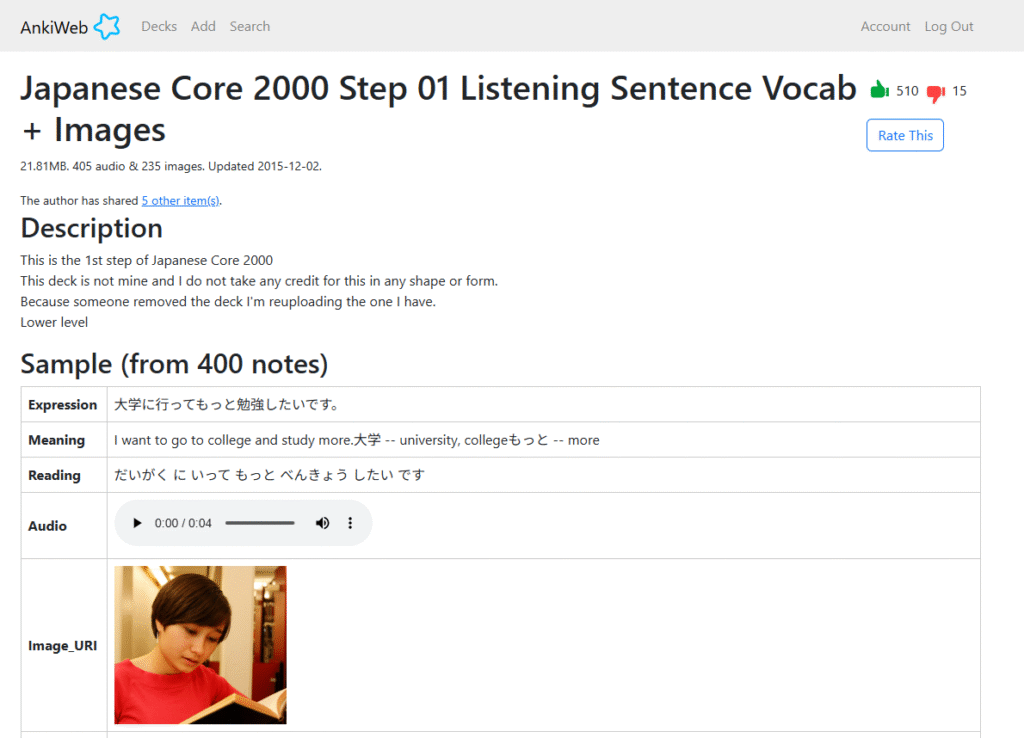
Japanese Core 2000 Step 01 is one of the most popular Anki decks for memorizing core Japanese vocabulary. Specifically customized for beginners in Japanese, this Anki Deck has over 2,000 Japanese words that are meant to be practical for you to start building real-world Japanese language you can start using soon.
The contents in this Anki deck are well-structured, with images provided for easier memorization. The deck is great for starting to practice your listening skills with 405 audio files. There are also 235 images and example sentences for the Kanji, which will help you associate new words with concrete pictures to help lock them into memory.
It would probably take 2-3 months to complete this Anki deck if you practice consistently. As we know, consistency is the number one thing for improvement.
Visit the Anki website to download the Anki Deck onto your computer. The flashcards will appear on your screen once the deck is imported to your device. You can edit the cards by clicking on the “edit” button.
2. Japanese Core 2000 Step 02 Listening Sentence Vocab + Images
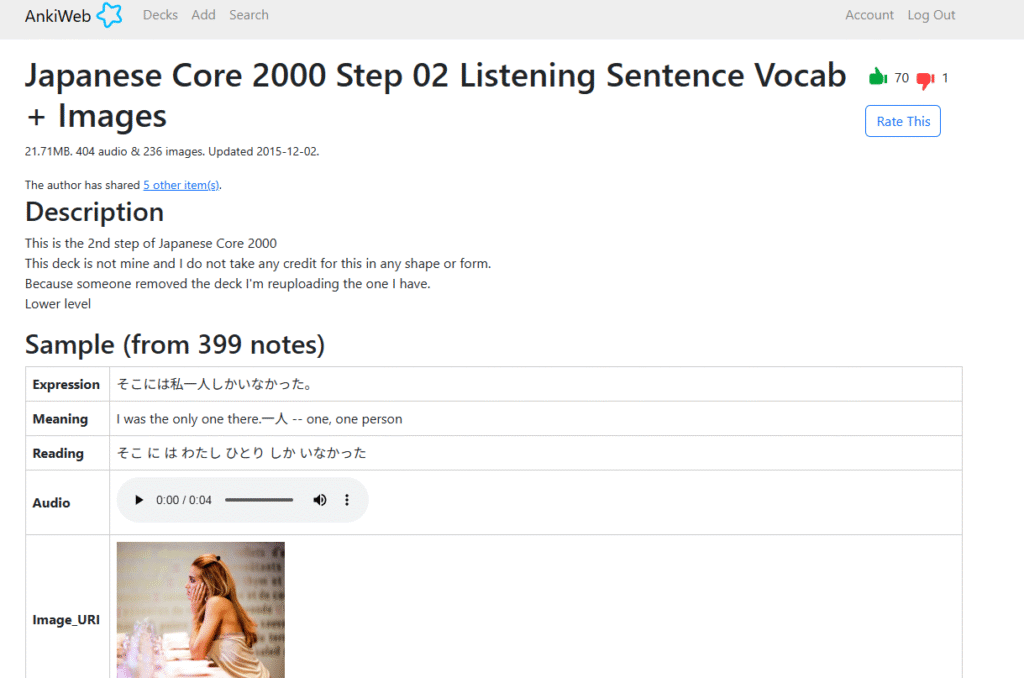
Japanese Core 2000 Step 02 is the second part of the Japanese Core 2000 Anki series. If you’re starting from scratch, it might be better to start with Step 01 before jumping into Step 02. This Anki Deck is still great for beginners and is a great step up from the previous deck, offering audio files, English translations, and images in the flashcards.
The deck consists of Japanese Kanji, verbs, and practical expressions used in daily life. This Anki Deck has over 404 Audio files and 236 Images. So, it’s great for listening practice as well as reading.
Similar to Step 01, it would probably take you 2-3 months to complete this Anki Deck if you practice consistently.
Visit the Anki website to download the Anki deck. The flashcards will appear on your screen once the deck is imported to your device. You can edit the cards by clicking on the “edit” button.
3. Japanese Basic Hiragana
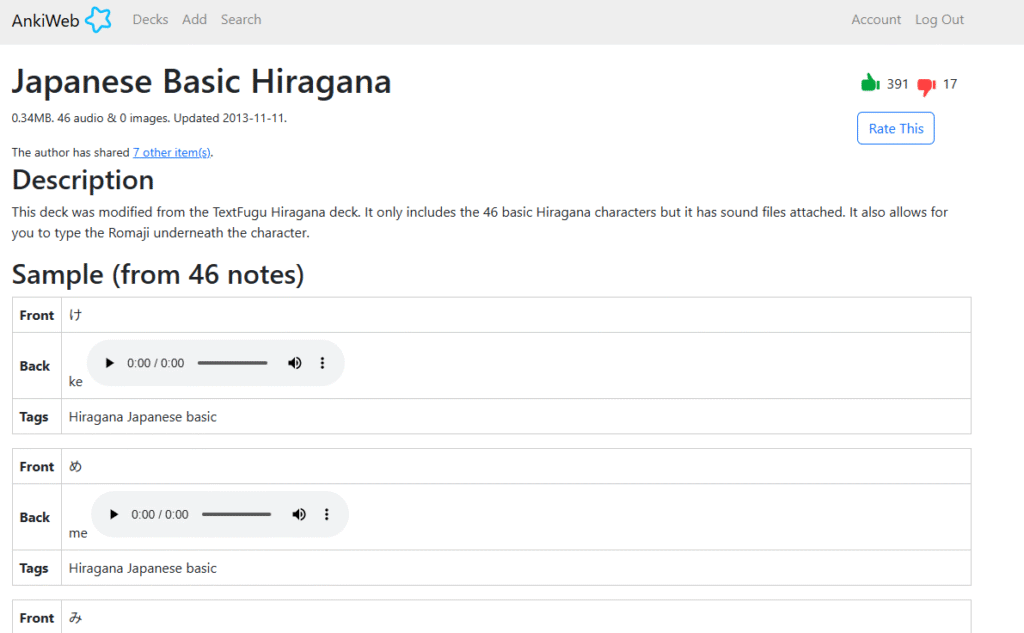
If you are starting completely from scratch and need to learn the basic Japanese writing systems, we highly recommend this deck. Unlike the Japanese Core Series Anki Deck, this Anki deck does not have any pictures, but it is particularly helpful if you want to remember hiragana characters.
The deck was modified from the TextFugu Hiragana deck and includes the 46 basic audio hiragana character files.
The best part about this deck is that you can type the romaji under each hiragana character before flipping the card to see if you got the answer right. This deck is perfect for beginners and is great for learning the basic 46 hiragana characters, which make up the majority of the writing system you will need to remember. The deck just doesn’t include the modified sound characters such as が (ga), ば (ba), ぱ (pa), ざ (za), and だ (da), which just add tenten to some of the basic characters to alter their sound.
So, we highly recommend using this deck to memorize the basic hiragana characters before you move on to some more advanced material!
4. JLPT Grammar from Jtest4you
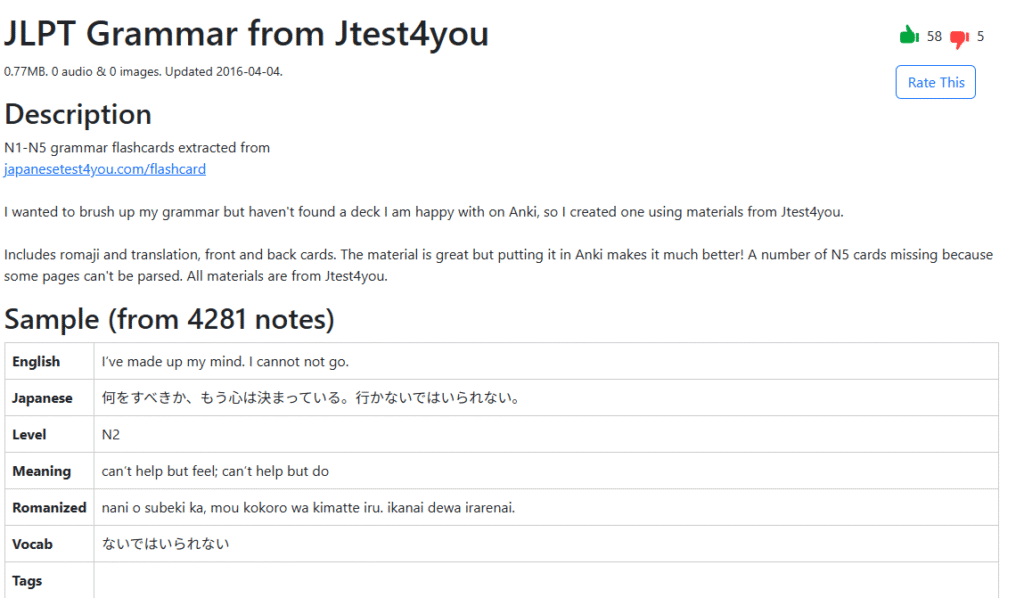
This is the all-in-one Anki deck if you want to focus on grammar. The Jtest4you Anki Deck is focused on JLPT grammar from N5 to N1. It includes example sentences, romaji, and translations that can be added to the front and back of the flashcards.
The vocabulary is divided into different JLPT levels, allowing you to study the specific level you need. The flashcards have you study each vocabulary term in different example sentences, allowing you to practice questions that are similar to the ones on the JLPT.
The front of each flashcard consists of kanji and the example sentences in Japanese, while the back of the flashcard shows the furigana, romaji, and English translation.
5. Japanese Visual Novel, Anime, Manga, LN Vocab – V2K
We all love Japanese anime and manga, but did you know you can learn Japanese from popular anime, visual novels, and manga as well?
This Anki deck consists of 2,000 Japanese vocabulary words based on the most commonly used phrases from Japanese novels, anime, and manga. The creator analyzed text from popular Japanese media to create a deck that actually reflects common words you would run into in real-life conversation.
The deck uses familiar English metaphors to help you understand how Japanese words and kanji are actually meant in the proper context rather than using direct translations that often lead to more confusion.
It’s very beginner-focused, where you can effectively learn kanji and furigana, along with pre-recorded audio so you can learn how to properly pronounce each word as well.
You will be able to pick up heaps of useful words, such as 全然駄目だ、結構, that are frequently mentioned in anime and manga. It will also significantly improve your reading and listening comprehension.
6. Katakana Reading Practice
Katakana Reading Practice is an Anki deck that acts as a guide for beginners in learning katakana. With over 1,000 words and phrases in Katakana, the flashcards focus heavily on foreign loanwords, proper names, onomatopoeia, animal names, and brand names.
Many users of this Anki deck have found it very helpful in improving their speed and confidence in speaking and writing katakana.
English speakers might think it’s unnecessary to learn katakana since many of them are loan words from English — but you’d be surprised that some Japanese katakana words don’t sound similar to the original English words, and the fact that there are many katakana words not from English. So, it’s worth spending some time learning different katakana vocabulary and practicing how to read and recognize each character efficiently.
7. Official KanjiDamage deck
KanjiDamage is the official kanji deck from the KanjiDamage kanji program, which helps you learn and effectively remember Kanji using mnemonics and a healthy dose of humor. There are over 1,700 Kanji to learn from in this Anki Deck.
You will learn a mix of commonly used Kanji as well as uncommonly used Kanji that have been put in random order. The stroke order for writing the Kanji is also included.
If you want to learn kanji frequency instead, check out another Anki Deck made by the same user, which is a reordered version of this Anki deck. It has been reordered based on the frequency of each Kanji character so that you can more common characters first, followed by the uncommon ones.
Visit the Anki website to download the Anki Deck onto your computer. Once the deck is imported to your device, the flashcards will appear on your screen. You can edit the cards by clicking on the “edit” button.
8. All-in-One Kanji Deck
Looking to learn pretty much everything there is to learn about Kanji? All in One Kanji deck is one of the most comprehensive and informative collections out there. It is perfect for those looking to practice writing the Kanji and gaining more knowledge on kanji meaning and readings.
The Anki deck is nicely formatted. With over 10,000 flashcards, you will learn how to read each kanji in onyomi, kunyomi, and nanori as well as learn the number of strokes and stroke orders.
It also teaches you how each Kanji has been changed from its original Chinese elements to become a Japanese character.
9. Tofugu: Learn Hiragana Deck
This Anki deck, created by Tofugu, a Japanese learning platform, helps you learn Hiragana through mnemonics, images, or shortcuts to help you remember and recall new material. With this deck, you will be able to learn the basics of Japanese pronunciation and hiragana through fun illustrations that will help you remember each character more easily.
10. Tofugu: Learn Katakana Deck
Similar to Tofugu’s Learn Hiragana Deck, this deck helps you learn Katakana through mnemonics.
Through descriptive and animative mnemonics, learning is more fun and interactive, and above all very effective for memorization!
11. Japanese Course Based on Tae Kim’s Grammar Guide & Anime
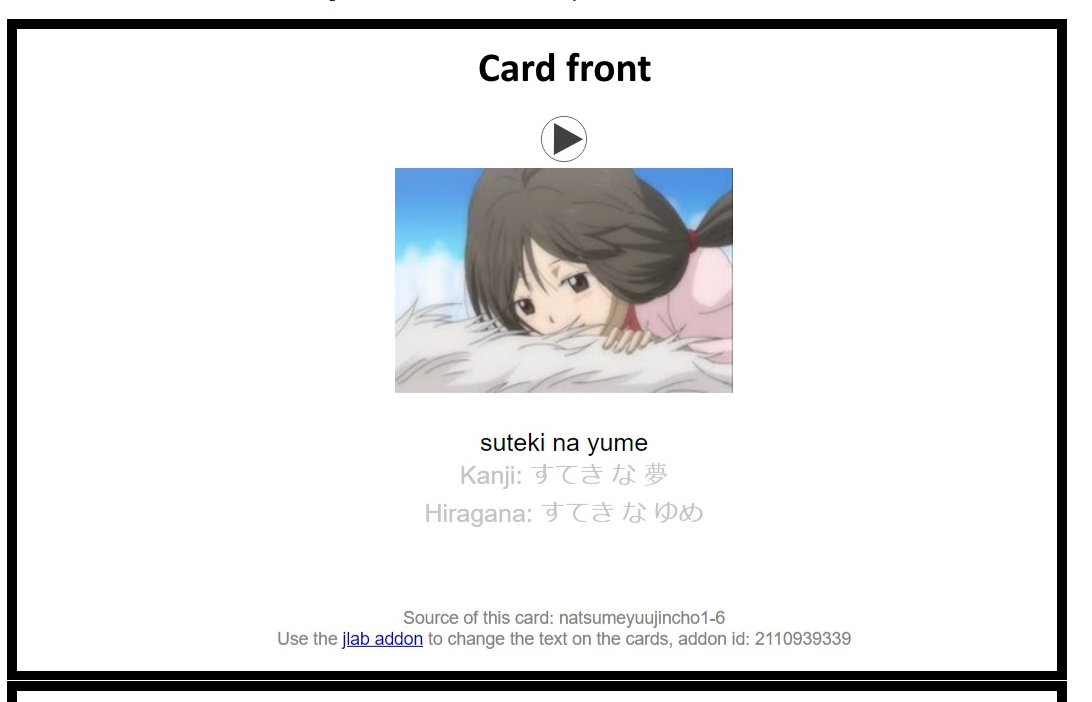
This is a self-contained Japanese course for beginners, built around Tae Kim’s Grammar Guide, a popular free resource known for its clear explanations of essential grammar points. The creators also developed a companion Anki deck, making it easy to study and review.
The course places a strong focus on listening comprehension, using real anime scenes to reinforce learning. Each flashcard shows a Japanese phrase on the front, along with a video clip of the sentence used in an anime. The back of the card includes the English translation and a detailed grammar breakdown, helping learners understand both meaning and structure.
12. Genki 1 & 2 Kanji
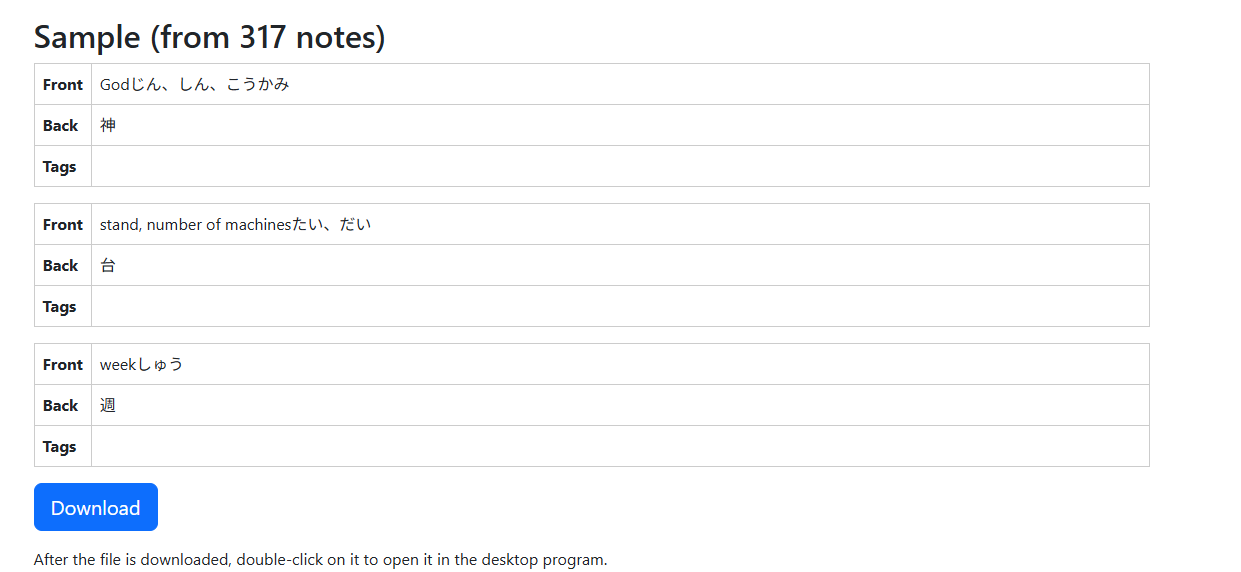
If you’ve taken a Japanese class, chances are you’ve used the well-known Genki textbook series. This Anki deck is a simple but effective tool that was created to help students learn how to write the kanji introduced in Genki I and Genki II.
The deck covers individual kanji characters from Lesson 3 to Lesson 23, following the exact order presented in the textbooks. Each flashcard shows the English meaning, along with the on-yomi and kun-yomi readings on the front, and the kanji character on the back.
It’s perfect for reinforcing writing practice and memorizing readings in context with the Genki curriculum.
13. Katakana Reading Practice
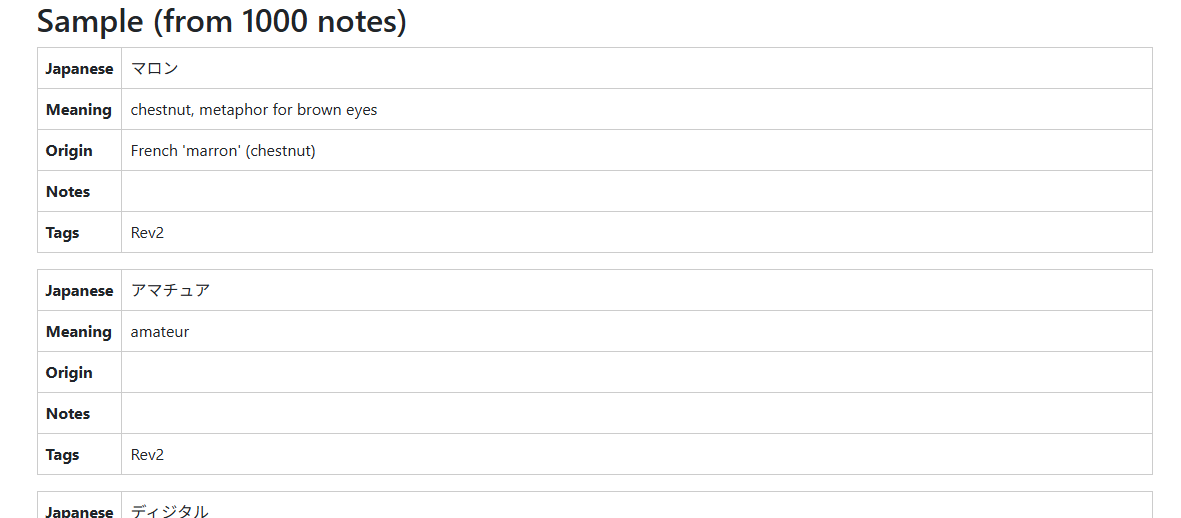
Reading katakana can be surprisingly challenging, even if you’ve already memorized the characters. Unlike hiragana, katakana is often used for foreign loanwords and names, which don’t always follow typical Japanese word structure.
This Anki deck features 1,000 cards designed to help you read katakana with speed and confidence. It focuses on loanwords from English, German, French, Portuguese, Chinese, and more, along with wasei-eigo (English-inspired words created in Japan, such as salaryman). You’ll also find cards with onomatopoeia, company names, animal names, and other real-world katakana usage to give you the exposure you need.
14. Remembering the Kanji 1, 6th Edition (2200 Kanji)
This Anki deck includes all 2,200 kanji from the 6th edition of Remembering the Kanji 1 by James W. Heisig. It was created to offer a complete and accurate companion to the book, as many existing shared decks were either incomplete, based on older editions, or lacked consistency in format and content.
The deck focuses solely on kanji characters, excluding primitive elements that are not kanji themselves. Each card includes a link to an external website for stroke order diagrams, allowing for easy reference and writing practice. It’s an ideal tool for learners following the Heisig method who want a streamlined, comprehensive study aid.
15. All in One Kanji Deck
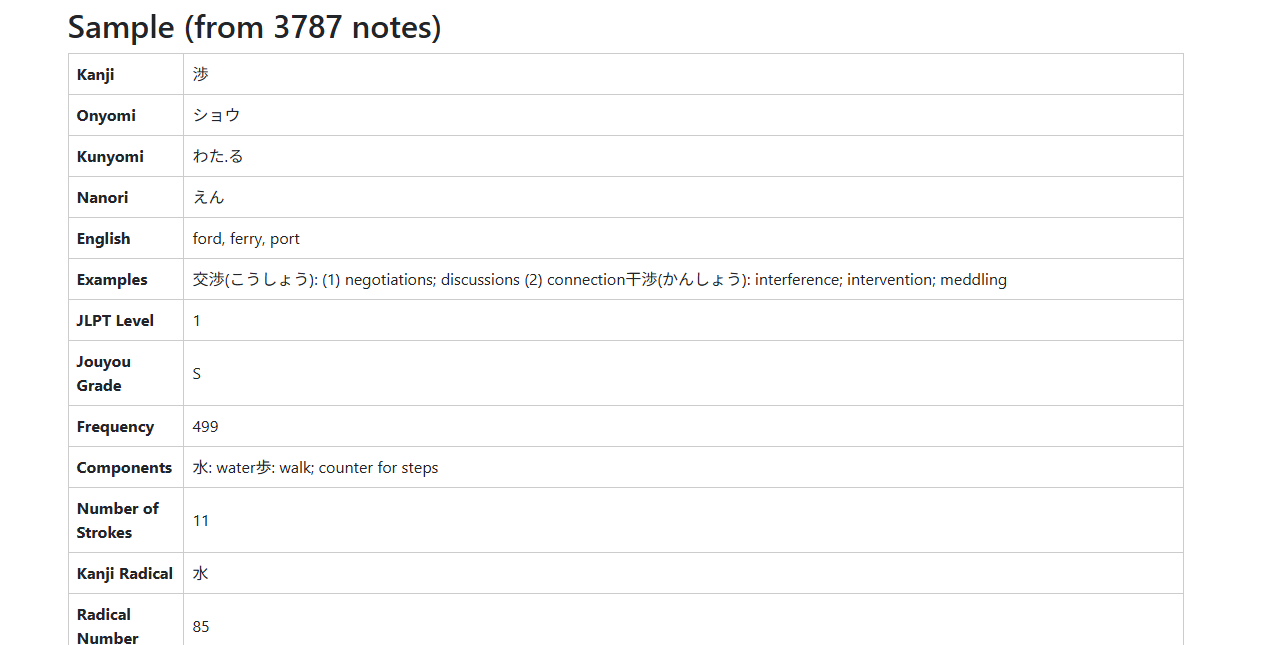
This comprehensive Anki deck includes the full set of 2,136 Jouyou Kanji — the official list of kanji designated by the Japanese Ministry of Education for daily use. These are the characters taught in Japanese schools and used in newspapers, books, and official documents. In addition to the Jouyou Kanji, the deck covers JLPT N5 to N1 kanji, 861 Jinmeiyou Kanji (used primarily in names), the 2,500 most frequent kanji, 3,007 kanji from Heisig’s Remembering the Kanji, and more.
16. Full Japanese Study Deck
The Full Japanese Study Deck consists of everything a Japanese learner would want, from JLPT-categorized vocabulary and kanji to additional words. The cards are designed simply. You can go through the subdeck, which contains the vocabulary and kanji, one by one.
It can be considered a “core deck” as well, as it contains common/essential words and kanji used in everyday Japanese (both in real life and in anime/manga). You can also find other subdecks, like the “ready-made mining material” subdecks, where all cards are suspended by default, and “reference material” subdecks for a quick search when you need to look up radicals, kana, and kanji.
Each card contains rich, detailed information: the English meaning, readings (onyomi, kunyomi, and nanori), stroke count, stroke order, and an example compound word. It also includes kanji classification levels such as JLPT level, Jouyou grade, and usage frequency.
Conclusion: Should You Learn Japanese with Anki?
Anki is an amazing tool for memorizing new Japanese vocabulary, phrases, and kanji, due to its spaced repetition system that helps you focus on your weakest areas while words you know better will show up later to ensure you don’t forget them. However, it should not be your only resource for learning Japanese. Don’t get us wrong, it’s a great tool with tons of incredible functions, including the ability to embed audio recordings and reading passages to help with listening and reading. But you still need to actually take what you learn and test it in real conversation. In other words, to actually practice speaking, preferably with a partner.
If you are self-studying Japanese, Anki is definitely one of the best ways to build vocabulary over time, but don’t forget to mix it with other resources too!
Take Your Anki Learning to The Next Level!
Anki is incredibly powerful for building vocabulary and strengthening your memory. But just like any learning process, the best way to truly learn Japanese is through immersion. That means speaking with native speakers, practicing conversations out loud, writing actively in Japanese, and so much more.
These are experiences you simply can’t get from Anki alone. That’s where Coto Academy comes in.
Since 2000, Coto Academy has been helping students learn natural, real-life Japanese through conversation-focused lessons. With campuses in Tokyo and Yokohama, plus a thriving online school, Coto offers an immersive learning environment wherever you are. You won’t just learn kanji, grammar, and vocabulary. You’ll learn how to use them in real situations, right away.
Why join Coto Academy?
- School locations in Shibuya, Minato, Iidabashi, and Yokohama, plus a fully online Japanese language school, so that you can learn anywhere, anytime!
- Small classrooms with only up to 8 students for personalized support
- Professional native Japanese teachers, all trained to help you succeed
- Over 60 different Japanese classes across 18 levels, tailored to your needs
You can explore our courses and talk with our staff. No string attached. We just want to help you learn Japanese,
FAQ
What is Anki?
Anki is a powerful flashcard app that uses spaced repetition to help you memorize information more efficiently. For Japanese learners, it’s especially useful for retaining kanji, vocabulary, grammar points, and listening comprehension.
Can I customize the Japanese Anki deck?
Yes! Anki is very flexible—you can edit cards, add audio, images, mnemonics, or even create your own card types to match your study style.
What’s included in this Japanese Anki deck?
That depends on the deck, but typically you’ll find:
- Listening and reading practice (optional with media decks)
Some decks are based on popular resources like Genki, Tae Kim, or Heisig, and include JLPT-level tagging (N5 to N1). - Kanji cards (with meanings, readings, stroke order, and examples)
- Vocabulary cards (with context sentences and audio)
- Grammar explanations
You May Be Interested In:
- Anki Add-ons You Need to Have
- The Ultimate Guide to Learning Japanese Online: Apps, courses and Resources
- Top 30 Japanese Learning Apps in 2025: Best way to learn online