
The question that perplexes all Japanese learners at the beginning: Why is ha (は) read as wa in Japanese, sounding exactly the same as わ? We all thought Japanese phonetics were pretty straightforward, but just when you think you’ve nailed the hiragana and katakana writing systems, you come across this conundrum. 

Of course, once you’re used to reading, writing, and speaking Japanese, this problem is less of a real concern and more of an annoying tick. It doesn’t matter. It is what it is. No one really knows the answer, right? The same thing goes for ​へ (he), which is sometimes pronounced as ‘e’, and を (wo), which is always pronounced as ‘o’.  

But exploring the cultural significance and history of Japan can help you better understand the language. And if you’re left exasperated by the cookie-cutter answer, we’re here to give you a deep dive into the complex world of the Japanese language and linguistic evolution.

The Short Answer to Why We Pronounce Ha (は) as Wa (わ)

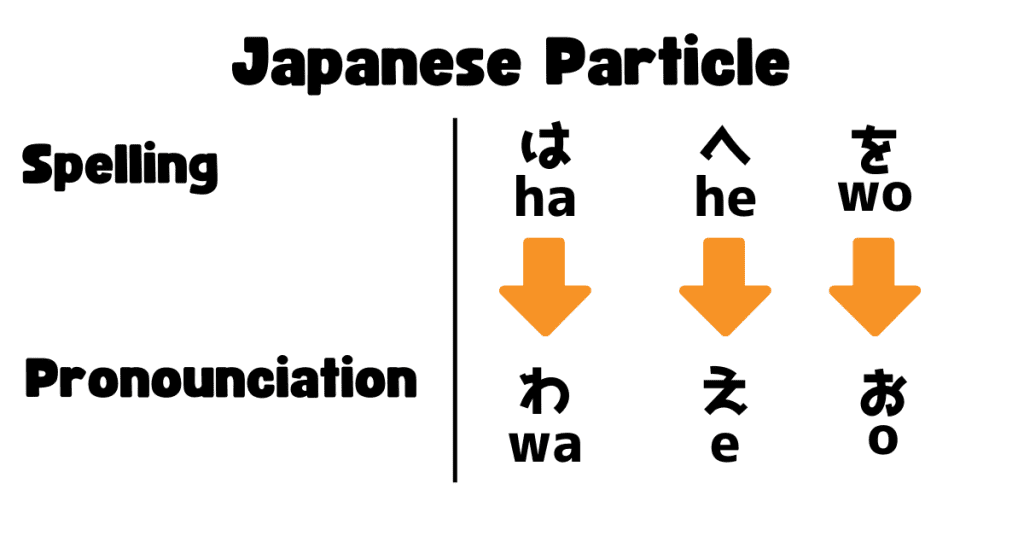
In grammar, は marks the topic of a sentence and is pronounced “wa” instead of “ha.” This is a special rule from classical Japanese that stuck — even though it’s written は, it’s spoken as “wa” when used as a particle.

Let’s take a look at three examples first, containing both the Japanese letters は and わ. 

おはようございます。
Ohayou gozaimasu. 
Good morning.

今日はいい天気ですね。
Kyou wa ii tenki desu ne. 
The weather is good today.

私の名前はコトです。
Watashi no namae wa Coto desu.
My name is Coto.

You may have pronounced the は and わ differently, or even interchangeably. You reflectively say kyou wa instead of kyou ha. Ohayou instead of owayou. And that’s great. That means you already know the proper Japanese phonetics. 

So did the sounds of these particles change since the spelling was set down? Or were the spellings intentionally chosen for some reason? Are there any other irregular kana spellings omitted?

The short answer is simple, really: if the は is used as a Japanese particle, it is pronounced as ‘wa’.  The particle は is the topic particle that identifies the topic of your sentence. 

If it’s used to build a Japanese word, as adjectives, adverbs, nouns, or even names, it goes back to its original pronunciation: ha. 

This is why the word おはようございます, which contains は, retains the typical ‘ha’ pronunciation. In the second and third sentences, は is the particle to help make the subject stand out: My name is Coto. Today is good weather.

The same thing for the character へ. Used in words, it is pronounced: “he”. When it’s a particle, it is pronounced: “e.” 

japanese history

The Evolution of Japanese Language Phonetics: Wa and Ha

The particle は is still pronounced “wa” because it’s a historical spelling rule that dates back to classical Japanese. Over time, the pronunciation of Japanese sounds evolved, but a few traditional particles kept their old spellings. While most words were updated to match modern pronunciation, particles like は (wa), へ (e), and を (o) kept their original written forms for grammatical consistency — a linguistic “fossil” from Japan’s past.

If you’re still unsatisfied with that answer, we get it. Why is the は  particle specifically an exception? How did the sound and rule evolve into what they are in the present day? That short explanation might have just opened more doors to even more questions. 

The truth is, discrepancies between spelling and pronunciation are common, no matter the language. You’ll probably notice it in English more than in Japanese. Take the word tongue or island, for example. The Japanese language is no different, although the fact that the current Japanese spelling is almost completely phonemic makes anomalies like this stand out more. 

Only a handful of traditional spelling quirks remained, and using は for the particle that is pronounced wa is one of them.

In fact, this is what you need to know: just like society in general, language is ever-changing, and the sounds made by characters will shift over time. 

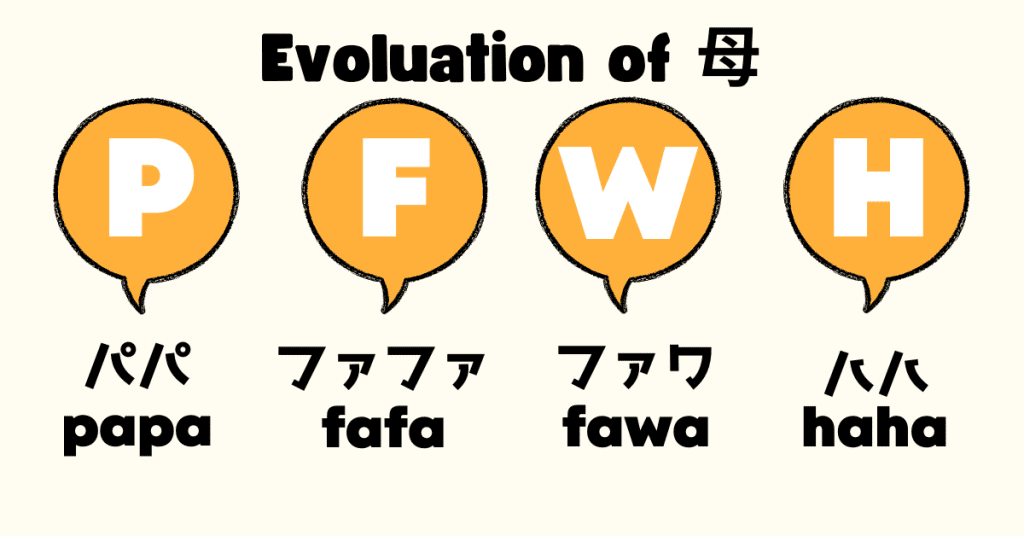
In the early history of Japanese (before 800 BC), the modern は  row of consonants, comprised of は, ひ, ふ, へ, ほ, were pronounced with ‘P’ as pa, pi, pu, pe, po. 

Enter the Nara Period (710 to 794). The ‘P’ sound underwent another change, shifting to a softer F sound: fa, fi, fu, fe, fo. This pronunciation stayed until the 16th century, judging from the transcripts made by the Portuguese of Japanese words that use the letter F where we would use H today.

evolution of は in the japanese language

For example, take the Japanese word for “mom”: 母. Today, it’s spelled as はは and pronounced as haha. In the old Japanese, the word is pronounced as fafa. 

After the Nara Period came the Heian Period (794 to 1185), where we see another shift: the F sound changed to W, but with a catch: the sound altered only when there was another vowel and when it was not at the beginning of the word.

The pronounciation changed from:

は    ひ    ふ    へ    ほ 
ha hi hu he ho

to:

は    ひ    ふ    へ    ほ 
ha hi hu he ho

This led to a verb such as 買う (買フor kafu in old Japanese) to be read as Kau (stemmed from kawu). The negative form of this verb underwent the same changes: instead of kapanai, it became kawanai.  

母 turns into fawa. The word for river, once pronounced as kafa, became the modern-day kawa. 

This marked the beginning of the transition where は is pronounced as わ. The particle は, which regularly appears after a vowel, was soon normalized as wa.

Eventually, in the Edo Period (1603 to 1867), people from various regions of Japan start to gather in Edo (the old Tokyo), This resulted in various dialects mixing and diluting. Eventually, the ‘F’ sound changed again to the H sound. 

Now, the 母 finally settled to its modern pronunciation that we know today: haha, spelled as はは. However, at that time, despite the new pronunciation, the words still used the old kana that represented the old pronunciation. 

This was the main linguistic problem. Up to World War 2, although the changes from the initial P sound to W sound were then widely accepted, the people still used historical usage. 

This meant 買う was still written 買フ (kafu) and 買わない was written as 買ハナイ (kahanai). Of course, the lack of standardized writing meant there was still a lot of confusing spelling. 

hiragana katakana japanese language

The Japanese Language Reform Changes Writing and Spelling

After World War 2, the Japanese government did a massive language reform to its writing and spelling rules to make things more even across the country. Remember the part where we said a lot of people from regional Japan were gathering in one capital? That was a huge wake-up call. So they decided to clean up the spelling and pronunciation of syllables. The official spelling of words needed to match the new pronunciation rules so that people wouldn’t think the word was supposed to be pronounced a different way. All ‘ha/は’ letters read as “wa” sounds were replaced with wa/わ. 川(かは) now was written as 川 (かわ). The kana へ, which was once pronounced e (now it’s he).

So Why Does The Particle Wa (は) Stick With The Old Spelling? 

The problem with change is that it’s usually easier said than done. Imagine this: close to a hundred million people in a country are following one unsaid linguistic rule. You can change the texts, rules, and writing across all books and paper, which in itself is already a mammoth task,  but you can’t change a society’s collective habit instantly. 

Now Japan has all these written texts where the wa ワ is written with the old Japanese rule: wa は kana. At the same time, the other は kana was now pronounced ha (ハ). 

And how do you make the entire nation write the wa は particle as wa わ? 

Simply put, it was too much trouble for Japan to try and make this change work — revamping the entire text, scripts, and literature for two particles was not worth it. The particles were excepted because many felt that changing these exceedingly common spellings would confuse people.

There you have it: up until today, we are saying the は particle according to the modern-day Japanese pronunciation, but the reason why it’s still spelled as ‘ha’ は and not わ is because we are still sticking to its traditional spelling. 

Modern pronunciation. Traditional spelling. Remember that.

Let’s Get Straight to The Point: Why Ha (は) Is Read as ‘Wa’

To sum up, は is pronounced as わ because the transcript reflects a pronunciation that did not change during the language reform. The sound わ  used to be written は in old kana usage in some cases. Old kana usage was much more irregular than it is nowadays. 

At that time, it was decided that for the particles alone, the same letters that had been used should continue to be used even though they are different from the actual pronunciation. 

Other Japanese Particles: Why を Is Read as “O” and へ as “E”

why particle ha は pronoounced wa わ in japanese language and other particles

It’s the same thing with the readings for the particles へ and を, too. The modern sound え used to be written as へ in some cases and お as を. Of course, pronunciation varies, and sometimes you can hear a clear difference between お and を, for instance. Still, in all words, besides the particles, the old pronunciation differences have disappeared as time has passed.

There is an exception to the “wa” rule besides the Japanese particle, though. When は is used as the last letter of the greeting phrase, it follows the sound of a ‘wa’ particle. 

こんにちは
Actual spelling: Konnichiha.
Pronunciation: Konnichiwa

こんばんは
Actual spelling: Konbanha
Pronunciation: Konbanwa. 

Original KanaPronunciation (Before Reform)Modern PronunciationModern SpellingExample WordMeaning
は (ha)“wa” (in certain words)waかわ (川)river
へ (he)“e” (as a particle)e (when a particle)へ (unchanged)学校へ行くgo to school
を (wo)“o”oを (unchanged)パンを食べるeat bread
Partice ha は he へ wo を

To Sum It Up

There you have it: the core reason behind this ‘problem’ is simply because Japan never bothered to fully fix the two particles they spelled “wrong”. Instead, they went the easy route and deemed it the official, right way to do it. Problem solved.

The good news is that you’ll only have to deal with these in hiragana. Katakana is almost exclusively for foreign words, so you’re not really going to see particles written in katakana. 

Want to learn more about the Japanese language? Head to Coto Academy

Like what you read? We have tons of fun, easy-to-read learning content that makes your Japanese studies less like a study. But if you want more support from a native teacher, connect with friends who share the same love for the Japanese language and study in a classroom, Coto Academy is your choice.

We offer a relaxed, cozy learning environment for students of all levels. Join our intensive Japanese course or part-time intensive courses!

Want to study Japanese with us?

FAQ

Why is the hiragana “は” pronounced “wa” in some sentences?

In Japanese, when “は” is used as a particle to mark the topic of a sentence, it is pronounced “wa.” This is a special grammatical rule, not a mistake or typo.

Why does Japanese use “は” instead of just writing “わ” for the particle?

It’s a result of historical spelling. Hundreds of years ago, Japanese pronunciation shifted over time, but the spelling for certain grammatical particles remained the same. The particle は was kept to preserve consistency in written grammar.

Why is "ha" used instead of "wa" in "Konnichiwa"?

In “こんにちは” (konnichiwa), the final character “は” is actually the topic particle, even though it looks like part of the word. The phrase is a shortened form of a longer greeting that originally ended in the particle は — so it’s pronounced “wa.”

Why do Japanese add “wa” at the end of sentences?

In casual or feminine speech, “wa” (わ, different from the particle は) can be added at the end of a sentence for emphasis or tone. It adds softness, emotion, or emphasis, often in a light or expressive way. Example: かわいいわ (kawaii wa) = “So cute!”

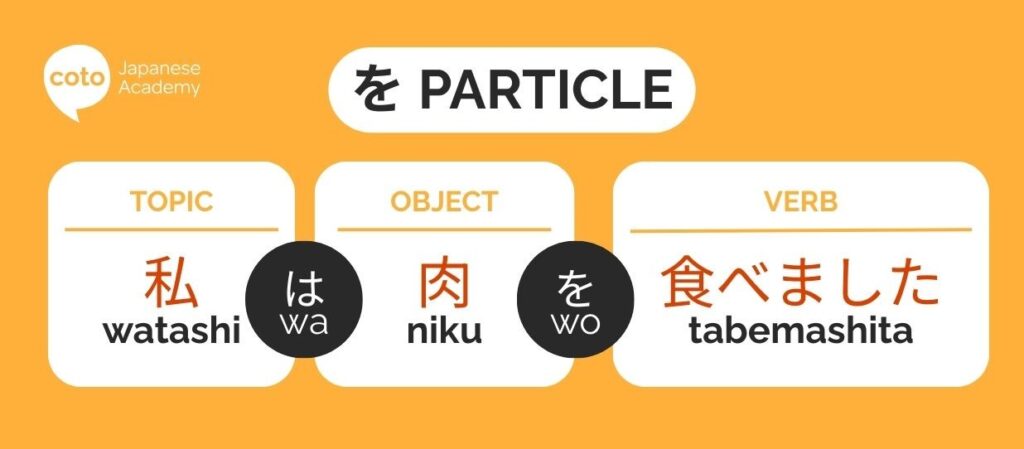
Out of all Japanese particles that exist, the particle を (pronounced “o”) might be one of the most straightforward. The を particle is used to make a word the direct object of the sentence or the thing that is acted upon by the verb. There is no direct equivalent in English since the language doesn’t use particles to indicate the object or subject of the sentence. 

So let’s explore how the を (o) particle works, its structure, and example sentences.

What is The Particle を (O)?

を is a Japanese particle that designates the direct object, the word that is affected by the verb. For instance, let’s look at a simple sentence:

食べる 
sakana o taberu
I eat fish

The particle を makes 魚 (sakana), or fish, the direct object, meaning it’s the object being acted upon. In this case, it tells us that the fish is the subject. You can think of を as a grammatical tool that turns words into the things that verbs affect in the sentence. 

Is を Pronounced as “Wo” or “O”?

を is pronounced as o, as in “ohio.” But you might be wondering why you often see を being written as “wo” in English. This is because to input を on a keyboard using the Roman alphabet, you have to type “wo”. If you have typed in Japanese on a Roman alphabet keyboard, you probably know that some characters need to be typed differently from how they are actually pronounced.

Pronunciation:

を → o 

Inputting on a Roman character keyboard:

wo → を

Generally, even in modern Japanese speeches, Japanese speakers prefer to spell it out as “o”. The “wo” pronunciation can sometimes be heard in songs, but it is often used to add emphasis, much like in Japanese, where singers sometimes exaggerate the “R” vowels into “L”. 

Structure of The Particle を (O)

structure of o particle

を is the only Japanese hiragana character that can only be used as a particle. In most cases, を attaches nouns in a sentence to designate them as the direct object. Take a look at the breakdown below:

TypeStructure
NounNoun + を

Usually, verbs come after を, following this typical sentence pattern:

Noun + を + verb

Example:

テレビを見る。
Terebi o miru。
I watch TV.

Changing Word Order with を

You are probably used to Japanese grammar, a typical order that generally goes as follows: subject → object → verb. However, it’s actually common to change the word order to create emphasis while still conveying the same meaning.

For example:

私がハンバーガーを食べた 
Watashi ga hanbaagaa o tabeta
I ate a hamburger

While this is a typical sentence structure in Japanese, grammar in Japanese is quite flexible and can be reordered like the following:

ハンバーガーを私が食べた
Hanbaagaa o watashi ga taberu
The hamburger, I ate it.

Despite the rearrangement of the words, “I ate a hamburger” is still clearly expressed. But, of course, the choice to rearrange the words might work to emphasize the subject or the object in certain contexts. 

Using を (O) at the End of the Sentence

It’s also common to use を at the end of a sentence as well, without saying a verb. Often, the verb is dropped since the meaning of the sentence is obvious based on the context. Let’s take a look at a couple of examples to understand how it works.

Example 1:

何を?
Nani o?
Of what?

This is a common question to ask when someone doesn’t specify. For instance, if someone says,昨日面白い映画を見た (omoshiroi eiga o mita) or “I watched an interesting movie yesterday,” you could respond with, 何を (nani o).

Example 2:

良いお年を
Yoi otoshi o
To a good new year!

This is a common Japanese New Year expression that roughly translates to “to a good new year.” The full expression includes the verb お迎えください (omukae kudasai).

Want to study Japanese with us?

Using を With Transitive vs Intransitive Verbs

One of the most common hurdles for new Japanese learners is deciding when to reach for the particle を (o) and when to let it go. The secret lies in the relationship between the subject and the action. To master this, we have to look at the world through the lens of transitive versus intransitive verbs.

Keep in mind that を can only be used with a transitive verb. Think of a transitive verb (他動詞; tadoushi) as an “active” force. These verbs require a direct object because someone or something is performing an action upon something else. 

Take the verb 開ける (akeru), meaning “to open.” When you physically reach out and move a door, you are performing a transitive action. In Japanese, you would say:

Transitive Verb:

ドアを開ける
Doa o akeru
Open the door

On the flip side, we have intransitive verbs (自動詞;  jidoushi). These verbs describe a state of being or a change that occurs naturally, without focusing on who started it. When using these, the direct object effectively disappears and becomes the subject of the sentence.

However, when it comes to intransitive verbs where there is no specified direct object, を is omitted. This is because を can only be used with verbs.  For instance, if you walk into a room and notice a door is already in the process of opening, you use the intransitive counterpart 開く (aku). Instead of using を, you switch to the subject particle が, resulting in:

Intransitive Verbs:

ドアが開く
Doa ga aku
The door opened

In this sentence, が is used instead of を, marking how ドア or “the door” became the subject when an intransitive verb is used. 

This is not to be confused with passive voice, where direct objects are still used with verbs like “eaten” or 食べられる (taberareru). Rather, intransitive verbs turn direct objects into subjects, which is why the Japanese particle changes. Let’s take a look at an example.

を vs Other Particles

Often, it feels like different particles can be used in similar situations, causing tons of confusion around deciding the correct particle to use. So, let’s explore how を is used compared to a couple of other particles.

1. を vs から (Kara)

を and から (kara) surprisingly have some overlap, specifically when discussing leaving a place. Say, you want to describe leaving your house. Which one should you use? Well, it actually depends on whether you are exiting or starting from your house.

Using を

When using を, the focus will be from the perspective of leaving your house. 

家を出る。
Ie o deru.
I leave the house.

Using から

When using から, the focus will be from the perspective of coming from your house.

家から出る。
Ie kara deru.
I come from my house.

2. を vs で (De)

を and で can also have some confusing overlap since sometimes you can use these particles to describe walking in a park, for example. But both of these particles express different situations.

Using を

When using を, you are describing the action of walking through a route rather than being at a location.

公園を歩く。
Kouen o aruku.
Walk through a park.

Using で

When using で, you are describing the location where an action is happening.

公園で歩く。
Kouen de aruku.
Walk in the park.

3. を vs は (Wa)

In a certain context, the particle は can replace を, but with a catch: when は (wa) replaces を (o), the meaning of your sentence shifts from a simple statement of fact to one of emphasis or contrast. In Japanese grammar, this is called topicalization. You are taking the “object” and promoting it to the “topic.”

Basically, you use を when you want to tell someone what you are doing as it is. You can replace it with は when you want to single out an object to compare it to something else or to emphasize that this is the specific thing you are talking about.

Why? When you switch to は, you are signaling to the listener: “Regarding this specific thing (as opposed to other things), here is the deal.” 

肉を食べます。
Niku o taberu
I eat meat.

When you replace the particle を with the same sentence, you add a new layer of context behind it.

肉は食べます。
Niku wa taberu
I eat meat (Speaking of meat, I eat it). 

We also swap to は when an object has already been brought up in conversation. If the object is what everyone is already looking at, it is no longer just an “object”. It is the topic

For instance, when your colleague is asking you about a report, they might ask:

レポートはどうですか?
Repooto wa dou desu ka?
How is the report?

In this case, when you want to answer, using を would feel slightly disconnected, like you’re introducing the report for the first time. Using は acknowledges that “the report” is the star of the current conversation.

レポートは書きました。
Repooto wa kakimashita.
As for the report, I wrote it.

Examples Sentences with を

Let’s take a look at some example sentences using を in different situations to really understand how this grammar tool works in actual spoken Japanese. Before that, check out the full vocabulary that appears in today’s examples at the table below.

Kanji / WritingFuriganaRomajiEnglish
毎日まいにちmainichievery day
日本にほんnihonJapan
雑誌ざっしzasshimagazine
読むよむyomuto read
大学だいがくdaigakuuniversity
経済けいざいkeizaieconomics
勉強するべんきょうするbenkyō suruto study
公園こうえんkōenpark
歩くあるくarukuto walk
階段かいだんkaidanstairs
上るのぼるnoboruto go up; climb
はしhashibridge
うえueabove; on top
たいていtaiteiusually
あさasamorning
いえiehouse; home
出るでるderuto leave

1. Direct Object (Most Common Use)

This is the most common and important use of を. It clearly expresses what you eat, read, watch, make, and much more. 

Example:

毎日、日本の雑誌を読む。
Mainichi, nihon no zasshi o yomu.
I read Japanese magazines every day.

2. With する (Suru) Verbs

When you use nouns with the verb する (suru), meaning “to do,” they become verbs. So, を marks what you’re doing.

勉強をする
Benkyou o suru
to study

However, in casual speech, を is often dropped to make the expression shorter, essentially transforming it into a single verb: 勉強をする (drop を) → 勉強する. This allows you to add other objects without making the sentence feel convoluted. 

Example:

大学で経済を勉強している。
Daigaku de keizai o benkyou shite iru.
I am studying economics at university. 

4. Using を for Movement Through Space 

を can also mark the place an action moves through, not just an object. You may think the particle で plays a similar role; however, で expresses destination. When using を, you express movement along a route or path, rather than the destination. 

This includes not only places like parks or roads, but also directional paths such as up, down, across, and along. Let’s take a look at some examples to get a better idea.

Example 1:

新宿の公園を歩く。
Koen o aruku.
I walk through the park in Shinjuku.

Example 2:

階段を上る。
Kaidan o noboru.
I go up the stairs.

Example 3:

橋の上を歩く。
Hashi no ue o aruku.
I walk across the bridge.

5. Using を with Leaving a Place

を is also used to describe leaving a place by pairing it with verbs like 出る (deru), which means “to leave.” You might be thinking that this is very similar to how the particle から (kara) is used. You’re completely right; however, there are some differences in nuance. 

You can think of using を to simply describe leaving a place. But when using から (kara), you are describing leaving or coming from a place.

Example:

たいてい、朝の9時から家を出る。
Taitei, asa no ku ji kara ie o deru.
I usually leave the house at 9 in the morning.

Conclusion

を (o) is an essential particle that is used to designate the word that is being affected by the verb in the sentence. It’s one of the building blocks of Japanese and is useful for letting the listener know, for instance, that you are eating the apple, りんごを食べる (ringo o taberu / I eat the apple), and not the other way around, りんごは食べる (ringo wa taberu / the apple eats)!

Learn Japanese with Coto Academy!

To really get a better idea of how to use を correctly in Japanese conversation, you should practice as much as possible. So, we highly recommend taking Japanese classes with us at Coto Academy, where we teach practical Japanese from practical everyday phrases to how to read and write Japanese you will see in everyday life. 

We will soon be opening a campus in Shinjuku and already have campuses in Shibuya, Minato, Iidabashi, and Yokohama. But, if you’re not in Japan, no worries! We also offer online classes! No matter where or how you decide to learn with us, we offer both intensive and flexible courses, which can be tailored to your Japanese level or your specific language goals. Sign up below to get started!

FAQ

What does the particle を mean in Japanese?

The particle を marks the direct object of a verb, or the word that is being affected by the verb. For example, 本を読む (hon o yomu), or read a book. を makes the word 本 (hon), or book, the direct object that is being “read” by the subject.

Is を always used for objects?

While its primary use is for designating objects, を can also be used for movement, which may not necessarily be an object. For instance, when describing a path or space you move through, you can say 公園を歩く(koen o aruku) or “to walk through the park.”

Can I drop を in casual speech?

It is quite common to drop を in casual conversation, for example, rather than saying ご飯食べる (gohan o taberu), or I eat food, you can instead say ご飯食べる (gohan taberu).

Do all verbs use を?

No, not all verbs use を; some verbs use other particles like が, に, or で instead, based on the situation. For example, 日本語が分かる (nihongo ga wakaru), which means “to understand Japanese,” uses が, rather than を.

Want to learn more about Japanese particles? Read our guide on:

Of all of the existing Japanese particles, the particle の (no) is the one that is used most to indicate possession, such as my, your, or its. It can also be translated to “of” or “about” in certain contexts. As you move beyond beginner-level learning materials, you will eventually learn that の can be used as a noun modifier — that is, turning words into nouns. This is just one of the many other ways の functions.

Let’s explore this versatile grammar point by going through its structure, clear examples, and more to fully understand how this grammar particle works. 

Basics of The Particle の (No)

の is a particle, which means it cannot be used on its own; rather, it attaches to other words and modifies them. By attaching の to a word, you can transform the term into a possessive form or use it as a modifier. You can think of this particle as a grammatical tool that connects two words together.

But don’t think of it as equivalent to a “ ‘s” in English, since depending on context, の would mean something closer to “of”, “about”, or just to simply modify the term it is attached to. It has a wide range of common uses that vary depending on the situation.

While particles like wa (は), ga (が), and o (を) are dropped in casual speech, the particle no (の) is almost always maintained. This is because no acts as the “glue” between two nouns; without it, the relationship between the words usually collapses.

Structure of Particle の (No)

As mentioned, の is a particle that attaches itself to different words. The structure is quite simple, generally following:

TypeStructure
NounNoun + の
Verb (casual form)Verb + の
い-AdjectiveAdjective + no
な-AdjectiveAdjective + な + の
ParticlesParticle + の

の can be used quite flexibly, being able to attach to nouns, verbs, and even other particles. Let’s explore how this works. 

1. Noun + の (no)

Whenever の attaches to a noun, it can make the noun a possessive or transform the noun into a modifier, meaning the noun modifies another word. Let’s take a look at some examples. 

私の本
Watashi no hon
My book

This is an example of の making a noun into a possessive. By attaching の to 私 (watashi), you’re basically transforming it from “I” to “my.”

日本の料理
Nihon no ryouri
Japanese food

In this case, の turns the noun, Japan, into a modifier that modifies the word “food”. Basically, it turns “Japan” into “Japanese.”

2. Verb + の (No)

When attaching の to verbs, it essentially turns the verb or a non-noun phrase into a noun. This allows you to treat the verb as an object in a sentence, to say, for example, ”running is fun.” 

Example:

日本語を話すのは難しいです。
Nihongo o hanasu no wa muzukashii desu.
Speaking Japanese is hard.

In our first example (“Speaking Japanese is hard”), の functions just like the English “-ing” (gerund) or “to [verb]” (infinitive). It takes an abstract action and makes it the subject or object of the sentence.

However, の can also be used as a placeholder for another noun when attached to a verb. This is useful for explaining something with a purpose or reason, similar to saying “why I want to…” or “why I do…”

Example 1:

食べたのは、そのチョコレートだ
Tabeta no wa, sono chokoreeto da
What I ate was that chocolate.

Example 2:

日本に来たのは、日本の文化が好きだからです。
Nihon ni kita no wa, nihon no bunka ga sukidakara desu.
I came to Japan because I like Japanese culture. 

Our second set of examples uses what linguists call a cleft sentence. Here, の isn’t just turning a verb into a noun; it is standing in for a specific noun that you reveal at the end of the sentence for emphasis.

3. Adjective + の (No)

You can also use の with adjectives, but only as a placeholder for an unspecified noun. 

If you’ve ever been shopping in Japan and found yourself pointing at a shelf, you’ve likely felt the need to say, “I’ll take the red one” or “Do you have a cheaper one?” In English, we use the word “one” to avoid repeating the noun. In Japanese, the tiny but mighty の (no) handles this job with ease. By attaching の to an adjective, you transform that descriptive word into a standalone object. 

Example:

甘いのが好きです。
Amai no ga suki desu.
I like the sweet one.

By using の, you’ve deleted the specific noun — in this case, sweets (お菓子) and replaced it with a generic placeholder. It’s the exact same logic as saying “I like the sweet one” in English.

We even often use this specific structure when making a choice. If someone offers you a choice between a spicy curry and a sweet curry, saying 甘いのが好きです doesn’t just mean you like sweet things in general. It signals, “Between these options, the sweet one is my preference.”

Want to study Japanese with us?

4. Attaching の to Other Particles

の can attach to other particles, transforming the phrase into a modifier. This is useful for omitting verbs and fitting more information on a single noun. For example, say you need to board a train, but specifically one that is heading towards Shinjuku. In English, you would say, “a train heading for Shinjuku,” as a single noun, train, that is being described as “heading for Shinjuku.” 

So, this is how you would express the same in Japanese:

新宿への電車
Shinjuku e no densha
A train heading for Shinjuku

The particle へ attached to 新宿 (Shinjuku) means “heading towards Shinjuku.” So, by attaching の to the phrase 新宿へ (Shinjuku e), you allow it to attach to 電車 (densha), or train. This basically creates a single noun, “a train heading for Shinjuku.

When you attach の to particles like から (kara), まで (made), and へ (he), you are essentially turning a “direction” or “timeframe” into an adjective. It allows you to describe a noun based on where it came from, where it’s going, or how long it lasts.”

先生からの手紙
Sensei kara no tegami
A letter from the teacher

We made a table below summarizing a few common modifications that can happen when you attach の to another particle.

CombinationFunctionExampleTranslation
からのSource友だちからのプレゼントA gift from a friend
へのDestinationへのメールAn email to my mother
までのLimit/Range10時までの仕事Work (that lasts) until 10:00
とのConnection大統領との面会A meeting with the President

You can also attach の to a variety of other particles, which may be too much to get into in one article. So, let’s just look at a couple more examples:

Example 1:

30分だけの映画
Sanjuupun dake no eiga
A movie that’s only 30 minutes.

Example 2:

別府からのお菓子
Beppu kara no okashi
A snack from Beppu

Stacking の (No) Particle

You can also use ” stack の to add more labels onto something. For instance, if you want to specify that you are going to an American hamburger restaurant, you will need to stack several labels onto the word “restaurant.” This is where の comes in handy. 

When you “stack” の, you are essentially zooming in from a wide-angle lens to a macro shot. In Japanese, this is called noun modification, and it follows a very strict logic: the most general information comes first, and the most specific details follow.

Example:

私のお父さんのアメリカのハンバーガーのレシピ
Watashi no otousan no amerika no hanbaagaa no reshipi
My Dad’s American hamburger recipe

While you can stack の indefinitely, stacking more than three or four can make a sentence feel heavy. It’s not grammatically wrong, per se, but it can make things confusing. For example, imagine hearing someone say:

私の会社の社長の奥さんの誕生日のプレゼント
Watashi no kaisha no shachou no okusan no tanjoubi no purezento
My company’s president’s wife’s birthday present.

Just like in English, having too many ‘of’s’ can make a sentence hard to follow. To avoid a repetitive ‘no-no-no’ rhythm, Japanese speakers often break up a long chain of nouns by swapping one of them for an adjective or a descriptive verb phrase.

Functions of Particle No

Common Uses of のJapaneseRomajiEnglish
Possession私の靴watashi no kutsumy shoes
Affiliation英語の学校eigo no gakkouEnglish school
Location / Time東京のスタジアムToukyou no sutajiamua stadium in Tokyo
Rank / Order最初の面接saisho no mensetsufirst interview
Degree / Measurement80キロの犬hachijuu kiro no inuan 80-kg dog
Apposition / Relationship弟のジョンotouto no Jonmy younger brother, John
Replacing a Noun私のはこれですwatashi no wa kore desumine is this

1. Possession

One of the most common uses of の is to describe ownership of something, whether its person’s possession or something belonging to another object (e.g., the tree’s leaves). It is similar to the possessive pronouns my, yours, and theirs. While you can think of の as a possessive particle, this is just one of many uses it has.

Example 1:

私の靴
Watashi no kutsu
My shoes

Example 2:

木の葉
Ko no ha
The tree’s leaves 

2. Affiliation

の can be used for affiliation, such as saying that you’re a part of a company, 三菱のジョンです (Mitsubishi no Jon) or John from Mitsubishi. It can also be used to affiliate a place, object, or idea with something else. 

You can also use の to show where something was made or where it belongs. This is very common when talking about an object from a certain place. 

3. Location or Time

Oftentimes の is also used to describe the location or time of something. While the particle に also seems to be used for this purpose, の can be used to indicate the time or location of objects without the use of any verbs. This allows the time or location to act as a modifier. 

You can think of it as describing the time or location of something (8 o’clock meeting) rather than describing when or where something is (the meeting is at 8). 

Example 1:

東京のスタジアム
Tokyo no sutajiamu
A stadium in Tokyo

Example 2:

12時の休憩
Juu-ni-ji no kyuuke
The 12 o’clock break

4. Rank or Order

の is often used to indicate the position, rank, or order of something within a sequence or group. In these cases, の connects the ranking expression to the noun it describes, similar to “the first…,” “number one…,” or “the top…” in English.

Example 1:

最初の面接
Saisho no mensetsu
First interview

Example 2:

日本一のハンバーガー
Nihon ichi no hanbaagaa
Japan’s number 1 burger

5. Degree

The particle の is also used to describe quantity, size, weight, length, or other measurable attributes. It connects a numerical expression or measurement to a noun. This usage is very common in everyday Japanese when describing: weight, length, volume, number of items, and price or scale.

Example 1:

80キロの犬
Hachi-juu kiro no inu
80 kg dog.

Example 2:

1000枚の本
Sen mai no hon
1000-page book

Need to review how to count and read numbers in Japanese? Check out our detailed guide: How to Count and Read Numbers in Japanese

6. Apposition or Relationship

The particle の can also be used to clarify identity, relationship, or category, where the second noun explains or specifies the first. This is similar to an apposition in English, such as “my friend, Sarah” or “the city of Kyoto.” 

Example 1:

弟のジョン
Otouto no jon
My younger brother, John

Example 2:

メキシコ料理のタコス
Mekishiko ryouri no takosu
The Mexican dish, tacos

7. Replacing a Noun 

の can stand in for a noun that was either already mentioned or is obvious to listeners. This is very similar to using “one” in English, like saying “the red one”. This is very commonly used in everyday Japanese conversation.

Example 1:

私のはこれです。
Watashi no wa kore desu.
Mine is this.

Example 2:

大きいのが好きです。
おおきいのがすきです
I like the big one.

Want to study Japanese with us?

Conclusion: Study More Japanese Particles with Coto Academy!

The particle の is an essential part of the everyday Japanese language, being used in conversation constantly. It’s one of the building blocks of the Japanese language, so it’s best to start incorporating this essential grammar point in your Japanese conversations.

If you want to improve your Japanese conversational skills, study at Coto Academy!

Coto Academy has been teaching Japanese for over 25 years, with campuses in Shinjuku, Shibuya, Yokohama, Iidabashi, and Minato. Our courses focus on practical Japanese, so the grammar you learn is designed for real-life use. We offer part-time, intensive, and fully online lessons to suit your schedule. Start learning Japanese effectively and confidently with Coto Academy today!

Why join Coto Academy?

  • Over  60+ different Japanese classes over 18 levels
  • Small classroom of only up to 8 students for personalized support
  • Professional, native Japanese teachers

Ready to get started? Fill out the form below to contact us!

FAQ: Particle の

What does the particle の (no) mean in Japanese?

The particle の mainly shows possession or connection between nouns, similar to “of” or “’s” in English.

Can の replace a noun?

When the noun is understood from context, の can act like “one” in English. For example. 赤いの = the red one.

Can I connect many nouns with の?

Yes, it is very common to connect or stack many nouns together using の, like saying 私の犬の食べ物 (watashi no inu no tabemono), which means “my dog’s food.” However, too many can start sounding unnatural or a bit convoluted.

If you know any Japanese or listen to the language closely, you would have come across a little thing called particles (助詞). If you are using anime or dramas etc. to boost your Japanese, you might have a vague understanding of particles (without really knowing what they are called). You probably have come across something similar to the following:

  • 「俺やる」ore ga yaru – I will do it! (Line from Naruto)
  • 「私アメリカ人です」watashi wa amerikajin desu – I am an American.

The bolded “が” (ga)” and “は” (wa) in these examples are particles and they were used to indicate the subject, 俺, and 私 (“I”).  But what actually are particles?

What Are Japanese Particles (助詞)? 

In short, particles indicate the role of nouns and verbs in a sentence.

In linguistic terms (for the language nerds!) Japanese is an agglutinative language, meaning that words are composed of morphemes or word parts/elements. Other agglutinating languages include Korean, Mongolian, Turkish, and Finnish. 

Conversely, English belongs to the “inflecting language” family, where nouns and verbs change to express things like tense. This is why the language’s structure is quite different.

So, particles are a type of morpheme that attach to nouns to convey information about its function in the sentence. Particles by themselves do not carry any meaning, but do when attached to nouns.

Still not making sense, right? Not to worry, since particles don’t exist in English, they are very difficult concepts to grasp. So let’s take a look at some examples: 

  1. 私がハンバーガーを食べる (わたしがはんばーがーをたべる) 

Watashi ga hanbāgā o taberu – I eat a hamburger.

The particles are:

(ga, subject marker): designates 私(watashi) as the subject

を (wo, object particle): indicates ハンバーガー as the object of the sentence or the thing being eaten by the subject. 

  1. 私は公園で走る (わたしはこうえんではしる) 

Watashi wa kōen de hashiru – I run in the park. 

The grammatical particles are:

は (wa): designates 私(watashi, “I”) as the subject.

で (de): designates 公園 (kōen, “park”) as the place where the subject is running. You can think of it as saying “at”.

So far, we have just introduced four particles, but even at a beginner level, you will be exposed to about 11 common particles, including the following:

 “が” (ga), “は” (wa), “を” (wo), “に” (ni), “で” (de), “へ” (e), “も” (mo), “と” (to), “から” (kara), “まで” (made), “より” (yori). 

This may seem like a lot to take in at once, so feel free to save or refer to this cheat sheet which provides simple short-hands to help you understand and remember each of the particles’ functions.

Japanese Particle Cheat Sheet showing the 11 essential particles beginners need to know

Japanese Particles List: 11 Must-Know Grammar Rules

We will now explore each of these particles in a bit more detail so we can explain how they work and how they can be very useful.

1.  が (Pronunciation: ga)

  1. 私の家族東京に来ました (わたしのかぞくとうきょうにきました)

Watashi no kazoku ga Tokyo ni kimashita – My family came to Tokyo.

The particle is “が” and it indicates “私の家族” (my family) as the subject of the sentence. However, there are 2 other main functions of “が” beyond being a subject marker. 

  1. In this sentence, the function of “が” is for exclusivity:

日本人です (わたしにほんじんです)

Watashi ga nihonjin desu – I am Japanese.

In this case, the sentence does not just state that the subject, “I,” is Japanese; it also gives the sentence the context that “I am the one who is Japanese, not someone else.”

It implies excluding the possibility of others being Japanese.

  1. The last function is as the subject in a question.

アイスを食べたんですか (だれがあいすをたべたんですか)

Dare ga aisu o tabetandesuka – Who ate the ice cream?

In this example, the particle “が” follows the question word (誰, who).

2. は (Pronunciation: wa)

  1. 日本人です (わたしはにほんじんです)。

Watashi wa nihonjin desu – I am Japanese.

The particle is the essential “は” in Japanese grammar! Although written as “は” in hiragana, its pronunciation is “wa.” The function of “は” can be broadly divided into three main uses. The first is to introduce the topic (Topic marker).

For example, in the sentence “私は日本人です” (Watashi wa nihonjin desu), “私” (I) before “は” is treated as the topic of the sentence.

While the English translation is “I am Japanese,” a more literal translation, reflecting the grammatical meaning, would be “As for me, I’m Japanese.” It might be a little difficult to understand, so let’s look at another example.

  1. ウサギ耳が長いです。(うさぎみみがながいです)

Usagi wa mimi ga nagai desu – As for the rabbit, its ears are long.

In Japanese, both “は” and “が” can appear in the same sentence. If both “は” and “が” are used to indicate the subject, it would seem like there are two subjects in this sentence, which would make the meaning unclear.

In this case, “は” marks the topic (“ウサギ” or rabbit), and “が” marks the subject (“耳” or ears, specifically the ears of the rabbit). Since the topic and the subject sometimes refer to the same thing, “は” and “が” might seem to serve similar functions, but there is an important difference.

  1. ピザ好きですが、パスタ好きじゃありません。(ぴざすきですが、ぱすたすきじゃありません)

Piza wa sukidesuga, pasuta wa sukija arimasen – I like pizza, but I don’t like pasta.

“は” also has a function of contrast. In the case above, “は” contrasts “ピザ” (pizza) with “パスタ” (pasta). The contrast between the two items is clear, but even when only one item is mentioned, for example:

コーラ好きじゃありません。(こーらすきじゃありません)

Ko-ra wa sukija arimasen – I don’t like coke (but I like other sodas).

Even if you are only referring to one item, it can imply that “other things” (such as other soda) are liked. So, “は” can change the context of the sentence when used instead of “が” in the sentence above.

3.を (Pronunciation: o)

読みます。(ほんよみます)

Hon o yomimasu – I read a book.

The third particle is “を.” (Note that the pronunciation of this hiragana “を” is “o,” not “wo!”)

“を” marks the direct object of the verb. To be more specific, it indicates the thing (book) is directly affected by the verb (read).

4. に (Pronunciation: ni)

  1. キッチン猫がいます。(きっちんねこがいます)

Kicchin ni neko ga imasu – There is a cat in the kitchen.

“に” has many functions, and it’s one of the particles that many learners are often confused about.

So, to put it simply, there are 3 common uses: the first use is to indicate the location of something, as shown in the sentence above. The particle lets us understand the cat is located in the kitchen.

  1. 毎朝7時起きます。(まいあさ7じおきます)

Maiasa shichiji ni okimasu – I get up at 7 o’clock.

The second use is for indicating time. Using “に” after a specific time (such as hours or dates) to express when something happens.

  1. 私は母花をあげました。

Watashi wa haha ni hana o agemashita. (I gave flowers to my mother.)

The third use is for indirect objects. In the sentence above, the direct object of the verb “あげます” (give) is “花” (flowers), and the indirect object is “母” (mother).

You need to use the particle “に” to make it clear your mother is who you gave the flowers to. 

5. で (Pronunciation: de)

  1. オフィス会議をします。(おふぃすかいぎをします)

Ofisu de kaigi o shimasu – We have a meeting in the office.

One of the main functions of “で” is to indicate the location of an action. As demonstrated above, “で” marks the place where the action (the meeting) is taking place. You can think of “で” as saying “at” or, in certain cases, “in.” 

It’s not a perfect translation, but for now I think this will be a useful shorthand in remembering how to use this particle. 

  1. フォーク食べます。(ふぉーくでたべます)

Fo-ku de tabemasu – I eat with a fork.

Another use of “で” is to express the means or methods of how you did something. Here, “で” indicated that eating was done with a fork.

6. へ (Pronunciation: e)

Map of Japan showing a typhoon heading toward the East demonstrating what the particle "へ” describes.

  1. 台風は東向かっています。(たいふうはひがしむかっています)

Taihu wa higashi e mukatteimasu – The typhoon is heading toward the east.

It’s written as “へ” in hiragana, but its pronunciation is “e”. The function of “へ” is to indicate the destination or direction of movement. At first glance, it may seem similar to “に,” but “へ” expresses a meaning that is more along the lines of “toward” or “in the direction of.”

For example,

日本に行きます。(にほんにいきます)

Nihon ni ikimasu – I’m going to Japan.

日本へ行きます。(にほんへいきます)

Nihon e ikimasu – I’m going toward Japan.

In the first sentence, “日本に行きます,” the destination, Japan, is clear. However, in the second sentence, “日本へ行きます,” implies “I’m going in the direction of Japan,” which carries a more nuanced meaning. It could mean that I might pass through other countries on the way or that I’m heading toward Japan but might end up somewhere else.

That said, in most cases, people are heading directly to their destination and will actually reach it, so the meaning is usually almost the same whether you use “に” or “へ.”

7. も (Pronunciation: mo)

  1. です。(わたしです)

Watashi mo desu – Me too.

“も” indicates addition or, simply put, means “also” or “too”. For example, in the sentence above, you are adding “私” (I) in response to someone else’s opinion.

  1. ショッピングモールで、何買いませんでした。(しょっぴんぐもーるで、なにかいませんでした)

Shoppingu senta de nani mo kaimasendeshita – I didn’t buy anything in the shopping mall.

Adding も after “何” (nani) will actually somewhat change the meaning of 何, which you probably learnt means “what”. In the above sentence, it means “anything” and can only be used with a negative verb (e.g. not buy, not sleep, etc.). 

For example, you could say something like “何もありません(nani mo arimasen)” meaning “I don’t have anything”. But in English, you can not say “I have anything” since it doesn’t make sense. It is the same in Japanese, saying “何もあります(nani mo arimasu)” is grammatically incorrect.

8. と (Pronunciation: to)

  1. ノートペンを買いました。(のーとぺんをかいました)

Nooto to pen o kaimashita – I bought a notebook and a pen.

There are 2 common functions of “と,” and in the sentence above, its function is to list all relevant items, similar to “and” in English. The key point with “と” is that it refers to all the items, so in this case, it means that the only things bought were a notebook and a pen.

  1. 今日大学の友達電話しました。(きょうだいがくのともだちでんわしました)

Kyo daigaku no tomodachi to denwa shimashita – Today, I called my university friend.

The above sentence demonstrates the second function, which is to indicate doing something together. You can think of it as saying “with.” Here, “と” shows that the action (making a call) was done with a friend.

9. から (Pronunciation: kara)

  1. から会社に行きます。(いえからかいしゃにいきます)

Ie kara kaisha ni ikimasu – I go to the office from (my) house.

Basically, “から” means “from”. In the sentence above, it allows the listener to understand the place from where the subject departed. While “に” is used to communicate where the subject is going. But “から” can be used for more than just physical places.

  1. 私はいつも午前9時から午後5時まで働きます。(わたしはいつもごぜん9じからごご5じまではたらきます)

Watashi wa itsumo gozen 9 ji kara gogo 5 ji made hatarakimasu – I always work from 9 am to 5 pm

In this example, “から” is used to discuss from which time you work and it’s often used along with the particle “まで” to indicate a range of time you are working. 

10. まで (Pronunciation: made)

飯田橋駅からCoto Japanese Academyまで、歩いてどのくらいかかりますか。(いいだばしえきからCoto Japanese Academyまで、あるいてどのくらいかかりますか)

Iidabashi eki kara Coto Japanese Academy made, aruite donokurai kakarimasuka – How long does it take to walk from Iidabashi Station to Coto Japanese Academy?

“まで” essentially means “until,” so in the example above, you are using から and まで to say “from Iidabashi station until Coto Academy”. You can think of “まで” as indicating a final limit. For example, you could say “30分まで(30 pun made)” to say “until (or up to) 30 mins”. Although often used with “から”, it can be used on its own as well.  

11. より (Pronunciation: yori)

妹は私より背が高いです。(いもうとはわたしよりせがたかいです)

Imoto wa watashi yori se ga takaidesu – My little sister is taller than me.

Lastly, “より,” which means “then.” You use it for making comparisons.

The thing before “より” serves as the reference point, and it expresses how the subject (or topic) compares to it. In the example above, “私” (me) is the reference, and it shows how tall “私の妹” (my little sister) is in comparison.

Essential 11 Japanese Particles Table

Image showing how just one particle can change the entire meaning of a sentence in Japanese.

Below is a table summarizing the 11 essential Japanese particles discussed above. Feel free to refer to this in conjunction with the Cheat Sheet to help you remember and use these 11 particles.

ParticleFunctionExample
が(ga)Designates subject いぬすきです。(I like dogs)
は(ha)Designates topicいぬたべた。(The dog ate)
を(wo, pronounced “o”)Designates Objectいぬたべた。(I ate the dog)
に (ni)Designates to or at a place/timeアメリカいった。(I went to America)
で (de)Designates place of actionアメリカステーキをたべた。(I ate steak in America)
へ (he, pronounced “e”)Designates movement toward a placeアメリカいった。(I went toward America)
も (mo)Indicates addition (”also” or “too”)にほんいった。(I went to Japan too)
と (to)Connects words together (“and”)いぬねこがすきです。(I like cats and dogs)
から (kara)Establishes start point (“from”)モンゴルからきた。(I came from Mongolia)
まで (made)Establishes end point (“until”)でんしゃはしぶやまでいく。(The train goes until Shibuya)
より (yori)Indicates comparison (“than”)しんじゅくはよこはまよりいそがしいです。(Shinjuku is busier than Yokohama)

Feel ready to explore particles deeper, check out our blog: Japanese Particles Cheat Sheet: Learn the Essential Particles for JLPT N5 and N4 which provides a cheat sheet with more particles.

Common Mistakes When Using Japanese Particles

With so many particles and some that have similar uses, I’m sure you found it a bit confusing. Here are some common pitfalls people fall into when making Japanese sentences with particles.

“が(Ga)” vs “は(Ha)”

誰はパーティーに行きましたか?(だれはぱーてぃーにいきました) ❌

Dare wa pa-ti- ni ikimashita ka? – Who went to the party?

The correct usage of “が” and “は” in relation to the subject can be pretty confusing, even for advanced learners. As mentioned earlier, the particle used with question words should be “が.” So the correct sentence would be, “誰パーティーに行きましたか?” (だれぱーてぃーにいきました – Who went to the party?)

“Ni” vs. “De”

公園に遊びました。(こうえんにあそびました) ❌

Koen ni asobimashita – I played in the park.

This is another very common mistake. Since both “に” and “で” are used to indicate a place, many people get confused about when to use each one.

When expressing a place, “に” refers to the location of something or someone, while “で” indicates the place where an action or event happens. In the example sentence, since “遊ぶ” (to play) is an action, the correct expression should be “公園で遊びました” (I played in the park).

Time + “に”

毎日に散歩します。(まいにちにさんぽします) ❌

Mainichi ni sanpo shimasu – I go for a walk every day.

As mentioned, “に” can indicate time. However, when it come to frequency and not a specific time, you don’t need to use “に.” In the sentence above, “毎日” (every day) doesn’t require “に.” So, the correct sentence would be: “毎日散歩します.” (I walk every day.)

In English, expressions like “9 o’clock” or “March 5th” use prepositions like “on” or “in,” but we don’t use any prepositions with expressions like “every day,” right? It is exactly the same in Japanese; there are time expressions that don’t need a particle.

Key Features of Japanese Particles 

In languages like English, you can form sentences without particles, so you might wonder: Do we really need particles in Japanese? 

Particles make it possible for the Japanese to rearrange the order of nouns and verbs to some extent while still making sense!

In Japanese grammar, the typical word order is: subject → time/frequency → place → object → verb. However, in many cases, changing the word order still conveys the same meaning.

For example:

私がハンバーガーを食べる (Watashi ga hanbāgā o taberu) 

can change to 

→ ハンバーガーを私が食べる (Hanbāgā o watashi ga taberu) 

→ 私が食べるハンバーガーを (Watashi ga taberu hanbāgā o) 

While these rearrangements might sound unnatural, the meaning “I eat a hamburger” remains clear.

Conclusion About Understanding Japanese Particles 

Starting your journey into the world of Japanese can be overwhelming, and particles are no exception. However, as you keep using and studying Japanese, you will get the hang of them. So, exposing yourself to as many Japanese sentences as possible will help you to get accustomed to how they are used in different situations and contexts. Watching anime is a great way to gain exposure in Japanese especially for particles, check out our article recommending Detective Conan.

Just like most grammar in your mother tongue, native Japanese speakers don’t consciously think about particles and just naturally use them to express what they want to. Believe it or not, you will reach this level too as you keep practicing and develop a sense of what feels right for what you want to say.

In Japan, we have the saying “習うより慣れろ” (“ならうよりなれろ” – “It’s better to learn by doing”), so immersing yourself in listening and reading Japanese to develop your own understanding might prove to be one of the most effective methods of learning this rather confusing concept.

The best way to expose yourself to as much Japanese as possible is through our Coto Academy Japanese lessons. The classes immerse you in the Japanese language and will have you practice making sentences with our native teachers. Take a look through our Coto Academy Courses to find lessons that are right for you! 

FAQ

There are many different types of particles, and it’s difficult to count exactly how many there are. However, the most common ones at the beginner level include “が” (ga), “は” (wa), “を” (wo), “に” (ni), “で” (de), “へ” (e), “も” (mo), “と” (to), “から” (kara), “まで” (made), and “より” (yori).


The main differences are:

  1. Topic marker (“は”) vs Subject marker (“が”)
  2. Old information (“は”) vs New information (“が”)
  3. Contrast (“は”) vs Exclusivity (“が”)

More detailed explanations of these differences will be covered in future articles.


It’s essential to understand the meaning and usage of each particle. Additionally, listening to and reading lots of Japanese is a helpful way to develop an instinct for correct usage.


I recommend the book “イメージでわかる!日本語の助詞https://www.ask-books.com/jp/978-4-86639-540-1/, which explains particles with illustrations and is available in English, Chinese, and Vietnamese for easier learning.

Want to study Japanese with us?

To make a long sentence in Japanese, you need to insert a variety of information between the subject and the predicate. This is made easier by the grammatical function of “particles. Learning Japanese particles can be confusing. But no worries, here is a detailed guide for beginners that clearly explains the rules and scenarios of each particle! 

A Quick Jump To…

What Do Particles Do?

It is a postposition and can freely lengthen sentences

Japanese particles function like English prepositions (“in,” “at,” etc.). As described below, English prepositions are placed before nouns, clauses, and phrases, whereas Japanese prepositions are placed after.

Make the word order loose

The word order is rather flexible – it is determined by the postpositions!

English does not have particles, but the word order in a sentence plays a role. Therefore, in English, if the word order changes within a sentence, it will have a different meaning (or non-sentence). On the other hand, in Japanese, however, the word order is not important; rather, it is the cluster of information, such as particles and the nouns, clauses, and phrases connected to them. In other words, changing the word order does not change the sentence’s meaning as long as a noun is paired with a particle. The Japanese language has multiple particles, each with a different function, as described below.

The Natural Word Order

いつ (when)、どこで(where)、 誰と(with whom)、何を(what)、どうした (how)

For Example:

  • 昨日夜 渋谷 友達 服バッグ 買いました。
  • Kinō no yoru, tomodachi to fuku to baggu o kai ni Shibuya e ikimashita.
  • Last night at Shibuya, my friend and I bought some clothes and bags.

→ 服バッグ 渋谷 友達 昨日夜 買いました。 (OK in conversation! )

But if the particle is changed, the meaning will be so different!

For Example:

  • 昨日夜 渋谷 友達 服バッグ 買いました。
  • Kinō no yoru Shibuya ga tomodachi ni fuku to baggu o kaimashita.
  • Last night, Mr / Mr. Shibuya bought some clothes and a bag for a friend.

Commonly Used Particles

1. は

【Subject】

  • タイ人です。
  • Watashi wa Tai hitodesu.
  • I am Thai.
  • これ500円です。
  • Kore wa 500-endesu.
  • This is 500 yen.

【Scenario】

  • 昨日居酒屋に行きました。
  • Kinō wa izakaya ni ikimashita.
  • Yesterday, I went to a tavern.
  • 夏休み何をしましたか。
  • Natsuyasumi wa nani o shimashita ka.
  • What did you do during your summer vacation?

【Comparison】

  • 寿司好きですが、刺身嫌いです。
  • Sushi wa sukidesuga, sashimi wa kiraidesu.
  • I like sushi, but I don’t like sashimi.

2. を

【Object / Object of verb】

  • 新聞読みます。
  • Shinbun o yomimasu.
  • Read the newspaper.
  • コーヒー飲みます。
  • Kōhī o nomimasu.
  • Drink coffee.

3. に

【Object / The other party of the object’s action】

  • 友達会います。
  • Tomodachi ni aimasu.
  • Meet a friend.
  • ネクタイをあげます。
  • Chichi ni nekutai o agemasu.
  • I give my tie to my father.
  • バス乗ります。
  • Basu ni norimasu.
  • Take the bus.

【Destination】

  • 中国行きます。
  • Chūgoku ni ikimasu.
  • I am going to China.
  • 日本来ます。
  • Nihon ni kimasu.
  • I will come to Japan.
  • うち帰ります。
  • Uchi ni kaerimasu.
  • I’m going home.

※The “へ” is also a particle for direction and destination and can be interchanged with “に”.

【Time of Action】

  • 7時起きます。
  • 7-Ji ni okimasu.
  • I get up at 7:00.
  • 11時寝ます。
  • 11-Ji ni nemasu.
  • I go to bed at 11:00.
  • 3時戻ります。
  • 3-Ji ni modorimasu.
  • Return at 3:00.

【Place of Existence】

  • 弟の部屋テレビがあります。
  • Otōto no heya ni terebi ga arimasu.
  • There is a TV in my brother’s room.
  • うち猫がいます。
  • Uchi ni neko ga imasu.
  • I have a cat in my house.

4. で

【Place of Action】

  • レストラン晩ごはんを食べます。
  • Resutoran de ban gohan o tabemasu.
  • We will eat dinner at a restaurant.

【Method】

  • バス行きます。
  • Basu de ikimasu.
  • I will take a bus.
  • はし食べます。
  • Hashi de tabemasu.
  • Eat with a chopstick.

【Decision Making】

  • ウェイター:パンとライス、どちらにしますか。
  • U~eitā: Pan to raisu, dochira ni shimasu ka.
  • Waiter: Would you like bread or rice?
  • あなた:パンお願いします。
  • Anata: Pan de onegaishimasu.
  • You: Bread, please.

5. の

【Ownership】

  • Watashi no kuruma
  • My car
  • 友達
  • Tomodachi no hon
  • Friend’s book

【Belong To】

  • A社社員
  • A-sha no shain
  • Company A’s employee
  • A大学学生
  • A daigaku no gakusei
  • University A’s student

【Attributes (Type/Characteristics)】

  • 日本語先生
  • Nihongo no sensei
  • Japanese teacher
  • いちごシャーベット
  • Ichigo no shābetto
  • Strawberry sorbet

【Company】

  • 友達ようこさん
  • Tomodachi no Yōko-san
  • My friend, Yoko
  • トム
  • Otto no Tomu
  • My husband, Tom

【Pronoun】

  • 赤い
  • Akai no
  • The red one.
  • 熱い
  • Atsui no
  • The hot one.

Do you want to study Japanese in Japan but have trouble finding accommodation? Coto is here to help! We assist our students in housing by working with our trusted partner – Oak House!
By using Oak House, you will get a 10,000 yen coupon!
Come Join Coto Now!! And Use Oak House Today!

Here are some benefits of using Oak House!

  • Furnished Rooms: Most Oak House properties come fully furnished, eliminating the need to buy furniture upon arrival. This can be a significant advantage, especially for short-term stays.
  • Simplified Move-in Process: Oak House handles most administrative tasks, such as key money, agency fees, guarantors, and utilities, which simplifies the move-in process and reduces upfront costs.
  • Multilingual Support: Oak House offers support in English, French, Chinese, and Korean, which can help you navigate the rental process if you don’t speak Japanese.

Here are the links for you! Use Oak House today!

6. と

【Those That Share an Act】

  • 友達映画を見ました。
  • Tomodachi to eiga o mimashita.
  • I saw the movie with friends.
  • えりさん結婚しました。
  • Eri-san to kekkon shimashita.
  • I married Eri.
  • 社長話します。
  • Shachō to hanashimasu.
  • I will talk to the president.

【Parallel】

  • パン
  • Pan to tamago
  • Bread and eggs

7. も

【Concurrence / Agreement】

  • これお願いします。
  • Kore mo onegaishimasu.
  • Please do this too.
  • 映画が好きです。
  • Watashi mo eiga ga sukidesu.
  • I like movies too.

【Emphasize】

  • ワインを5本飲みました。
  • Wain o 5-pon mo nomimashita.
  • We drank five bottles of wine.

8. から

【Duration or Starting Point of the Action】

  • うちから学校まで30分かかります。
  • Uchi kara gakkō made 30-bu kakarimasu.
  • It takes 30 minutes from our house to the school.
  • 明日は8時から仕事します。
  • Ashita wa 8-ji kara shigoto shimasu.
  • Tomorrow I will work from 8:00 am.

9. まで

【Period or End Point of an Action】

  • 9時から11時まで勉強します。
  • ku-Ji kara Jū ichi-ji made benkyō shimasu.
  • We will study from 9:00 to 11:00.
  • 合格するまで勉強をがんばります。
  • Gōkaku suru made benkyō o ganbarimasu.
  • I will study hard until I pass.

10. が

It serves primarily as the subject of a sentence, but it has other functions as well. Hence, many people get confused. Remember the following five functions.

【Object of Like, Possible Expression, and Want】

  • さかな好きです。
  • Sakana ga sukidesu.
  • I like fish.
  • トランペットふけます。
  • Toranpetto ga fukemasu.
  • The trumpet blows.
  • ほしいです。
  • Mizu ga hoshīdesu.
  • I need water.

【Subject of an Interrogative Question】

  • だれ来ますか。
  • Dare ga kimasu ka.
  • Who is coming?
  • いついいですか。
  • Itsu ga īdesu ka.
  • When is a good time?

【It Is The Subject of a Sentence with the Meaning of Possession or Existence】

  • うちに自転車あります。
  • Uchi ni jitensha ga arimasu.
  • We have a bicycle in our house.
  • トイレに猫います。
  • Toire ni neko ga imasu.
  • There is a cat in the bathroom.

【It Is the Subject Within a Noun-Modifying Clause】

  • これはベートーベンつくった曲です。
  • Kore wa bētōben ga tsukutta kyokudesu.
  • This is a piece of music created by Beethoven.

【The Following Objects】

① 好き、嫌い、上手、下手 Like it, dislike it, do it well, do it poorly

  • サッカー好きです。
  • Sakkā ga sukidesu.
  • I like soccer.

② わかる、できる、見える、聞こえる I know, I can do, I can see, I can hear.

  • ここから富士山を見ることできます。
  • Koko kara fujisan o miru koto ga dekimasu.
  • Fuji can be seen from here.

③ ほしい、したい I want it, I want to do it.

  • 新しいテレビほしいです。
  • Atarashī terebi ga hoshīdesu.
  • I want a new TV.
  • 日本語勉強したいです。
  • Nihongo ga benkyō shitaidesu.
  • I want to study Japanese.

【It Becomes Part of the Characteristics that the Subject Has】

  • 妹は髪長い。
  • Imōto wa kamiganagai.
  • My sister has long hair.
  • 日本は犯罪少ない。
  • Nihon wa hanzai ga sukunai.
  • Crime is low in Japan.

Confused about Japanese Particles?  Want to know the difference between wa and ga? Check out this easy to use reference guide.

Japanese particles are an indispensable key in understanding Japanese sentences. Learn changing how a particle is used can change the entire meaning of a sentence. In this blog, we sort out 13 common Japanese particles for the JLPT N5-N4 level. This cheat sheet covers 17 common particles, the usages, meaning and example sentences.

You can get the free download of our learning cheat sheet below.

Noun+

topic

emphasis; contrast

at least

①わたしはケンです。

I’m Ken.

Noun+

time

place

target

①わたしはあさ6じにおきます。

I get up at six in the morning.

Noun+

object

place

①わたしはまいあさ、しんぶんをよみます。

I read the newspaper every morning.

Noun+

②③Polite form +

object (like, be good
at…)

but

③~but(preface)

③おなかがいたいんですが、かえってもいいですか。

My stomach hurts. May I go home?

Noun+

by(means)

at(place)

in(time)

make of

because of

④にほんのいえはきでつくられます。

Japanese houses are made from wood.

Noun+

with

and

(say or write or think)
that

①わたしはともだちとあそびます。

I will play with my friends.

Noun+

also

all

as much as

totality

②このスーパーのしょうひんはどれもやすいです。

Anything at this supermarket is cheap.

から

Noun+から

Polite form, Plain form +から

from

because

②きょうははこどものたんじょうびですからはやくかえります。

It’s my kid’s birthday today so I will be going home early.

まで

Noun+まで

Up to; until

わたしは5じまではたらきます。

I work until 5 PM.

しか

Noun+しか

only (used with negatives)

わたしはひらがなしかかけません。

I can only write Hiragana.

だけ

Noun+だけ

only

かいしゃにがいこくじんがひとりだけいます。

There is only one foreign employee at the company.

のに

Verb(plain
form)+
のに

-adjective(plain form)+のに

-adjective(~な)+のに

Noun+のに

although; even though

しごとはいそがしいのに、きゅうりょうはやすいです。

Despite work being so busy, the salary is low.

ので

Verb(plain form)+ので

-adjective+ので

-adjective(~な)+ので

Noun+ので

Because; since

きょうはひまなので、かいものにいきます。

I am free today, so I’m going shopping.

If you want to learn grammar, check out our 30 must-know JLPT N5 grammar points.  

Start taking Japanese lessons and master Japanese particles!

Coto Academy is one of Japan’s leading language schools, with campuses in Shibuya, Yokohama, Iidabashi, Minato, and a fully online school. We offer flexible Japanese lessons, whether you’re looking for intensive, part-time, or online courses, so you can reach your language goals faster. 
Fill out the contact form below for a free level check and consultation!

Omitting particles in casual spoken Japanese is very common.  But when can you do this – and how should you do it?
In this short blog we will show you which particles can be skipped and which must remain.

Japanese Particles can be omitted only in conversational sentences, not in written language.

The first rule about Japanese particles is that omitting them can only occur in spoken Japanese. So when you are writing Japanese – remember to include them!

Japanese sentence patterns determine some relationships between words

As the heading above implies, the basic Japanese sentence pattern has an order which informs the relationship between certain words.

The basic sentence pattern in Japanese has the word order ” is is to V. ” (Subject is object is / to verb) , and its role can be understood by the position of the word even without particles. So, in a basic japanese sentence「は」and「を/が」 can be omitted.
Let’s look at a more detailed chart below that explains some of the common examples of omitted particles in Japanese Grammar.

Particle

Sentence / Particle

Can it be omitted? 

(Subject) ・お誕生日(は)いつ?
When is your birthday?

・山田さん(は)いる?
Is Yamada san there(here)??

Yes.

(Target or purpose)
(Target)

(Subject of movement or a state)

ケーキ(を)食べる?
Do you know where fresh fish are sold?

新鮮な魚(が)売っているところ(を)知っている?
Do you eat Cake?

・ねこ(を)飼いたいと思ってるんだ。
I think I would like to have a cat.

・背(が)高くなったね。
(You have gotten taller)

Yes.
(Direction)
(Direction・Destination)

・天気(が)いいから、海(に)行こうよ。・
Because the weather is nice – let’s go to the ocean.

今から、飲み(に)行かない?Why don’t we go out(drinking) now? 

Yes.
(Passive・Causative)

・この傷(を)見て、猫にひっかかれたの。
Look at this scar, a catch has scratched me.

・不注意で子供に怪我(を)させてしまった。
I injured my child inadvertently (by accident).

No.
(time)で(Place
(together)
・7時に銀座で友達とご飯(を)食べるから、6時にうち(を)出ようっと。
I’m going to eat with my friends in Ginza at 7, so I should leave home at 6 o’clock. 
No.
(Possesive) ・それ、私の時計。
That’s my watch.・
学校の先生なんだ。
I’m a teacher for the school. 
No.
(Means, deadline, cause, etc.) ・これ、1週間でできる?
Can you do this in 1 week?・
ハサミで切ったら?
What if you cut it with scissors? 
No.
(Parallels・addition) ・紙とペン(は)ある?
Do you have paper and a pen? 
No.
(Other) ・サッカーより野球のほうが好き。
I like baseball more than soccer.
・え、私がするの?
Eh, I should do it?・
この間、田中さんが行ったってレストラン、昨日テレビに出てたよ。
That restaurant that Tanaka-san went to the other day was on TV last night.
No.
(Other) ・姉は背(が)高いんだけど、私は低いの。
My sister is really tall, but I’m short.・
四国はまだ行ったことがないな。
I still haven’t been to Shikoku yet.
No.

If you would like to improve your Japanese – we offer a free level check and interview!  

If you are interested in studying Japanese, find out more about our school by filling out the form below.

5. no – の

の Can be used to express possession of an object – the following sentences show that it is an easy sentence pattern to learn and remember.
[Posession]
watashi no kuruma – My car.

tomodachi no hon – My friend’s book.
友達の本
の Can also be used to express affiliation to an organization in Japanese such as the following sentences.
[Affiliation]
A-sha no shain – An employee of Company A
A 社社員
A-Daigaku no gakusei – A Student of University A
A-大学学生
Further to this – の can be used to describe an attribute of a person or object’s identity.  Just like in English – we have the ability to do this by saying that someone is a “Japanese Teacher” – we can use の in the same way.
[Attribute (Type/Nature)]
Nihongo no sensei – Japanese Teacher
日本語先生
ichigo no shabetto – Strawberry Sherbert
いちごのシャーベット
Additionally, の can be used for Apposition / when there is a relationship between two people
[Apposition]
Tomodachi no Yoko-San – My friend yoko
友達よこ
otto no Tomu – My Husband Tom
トム
There is one more use for the の particle – which is using it as a pronoun.  We have the same pattern in english – we can say “the X one”.
[Pronoun]
akai no – The red one.
赤い
atsui no – The hot one.
暑い


6. to – と

The to – と particle in Japanese can be used to signify partnership in action – or to form pairs – here are several examples of the Japanese particle in use.
[A partner in an action]
Tomodachi to eiga o mimashita. – I saw a movie with my friend.
友達映画を見ました。
Eri-san to kekkon shimashita. – I married Eri-san.
エリさん結婚しました。
Shacho to hanashimasu. – I will speak with the CEO/Boss.
社長話します。
[Parallel phrases]
pan to tomago – Bread and Eggs
パン卵。

7. mo – も

The mo も particle is used to signify similarity and agreement in Japanese. Additionally it can be used to add emphasis to a particular statement in Japanese.
[Sameness / Agreement]
Kore mo onegaishimasu  – I’ll have this too please.
これお願いします.
Watashi mo eiga ga suki desu. – I also like movies.
映画が好きです.
[Emphasis]
Wain o go-hon mo nomimashita. – I drank five bottles of wine!
ワインを五本飲みました.

8. kara – から

Kara is used in Japanese to signify the origin of duration or origin of motion.
[Origin of duration or motion]
Uchi kara gakko made sanjuppun kakarimasu.  – It takes thirty minutes to get from our house to the school.
うちから学校まで三十分かかります.

9. made – まで

Just like with Kara – Made (まで) is used to signify the end point of a duration or motion.
[Termination of duration or motion]
Ku-ji kara juichi-ji made benkyo shimasu. – I study from nine until eleven o’clock.
九時から十一時まで勉強します。

10. Ga – が

The Ga (が) Particle can be used for several cases.  Although the particle “ga” essentially follows the subject of a sentence, it sometimes provides a function similar to other particles.  Because this can make “ga” confusing to use, try to remember the five patterns below.
[The subject of an interrogative sentence that uses an interrogative word]
Dare ga kimasu ka – Who is coming?
来ますか?
Itsu ga ii desu ka.  – When would be a good time?
いついいですか ?
[The subject of a sentence denoting possession or location]
Uchi ni pasokon ga arimasu.  – We have a computer at our home.
うちにパソコンあります。
Toire ni neko ga imasu.  – There is a cat in the restroom.
トイレに猫います。
[The subject of an embedded clause modifying a noun phrase]
Kore wa Betoben ga tsukutta kyoku desu. – This is a piece of music that is composed by Beethoven.
これはベートーヴェン作った曲です。
[Objects]
(1) suki, kirai, jouzu, heta (Like, Dislike, Be Good At, Be Bad At)

好き、嫌い、上手、下手
Sakka ga suki desu.  I like Soccer.
サッカ好きです。
(2) wakaru, dekiru, mieru, kikoeru (understand, can do, can see, can hear)
わかる、できる、見える、聞こえる
Koko kara Fuji-san o miru koto ga dekimasu.  – It is possible to see Mount Fuji from here.
ここから富士山を見ることできます。
(3) hoshii, shitai (want/need, want to do)
欲しい、したい
Atarashii terebi ga hoshii desu.  – I want a new TV.
新いテレビ欲しいです。
Nihongo ga benkyou shitai desu.  – I want to study Japanese.
日本語勉強したいです。
[An aspect of part of the subject.]
Imoto wa kami ga nagai.  – My younger sister has long hair.
妹うは髪長い。
Nihon wa hanzai ga sukunai.
日本は犯罪少ない。

Nihongo Fun & Easy, image, photo, illustration, picture
Nihongo Fun & Easy

Content originally appeared in Nihongo Fun & Easy – written by Teachers from Coto Japanese Academy – Get it here:

If you find this article helpful, Check out our other Basic Japanese Grammar Guide Series
Basic Grammar Guide Part I
Basic Grammar Guide Part II
Basic Grammar Guide Part IV