Confused about Japanese Particles? Want to know the difference between wa and ga? Check out this easy to use reference guide.
Japanese particles are an indispensable key in understanding Japanese sentences. Learn changing how a particle is used can change the entire meaning of a sentence. In this blog, we sort out 13 common Japanese particles for the JLPT N5-N4 level. This cheat sheet covers 17 common particles, the usages, meaning and example sentences.
You can get the free download of our learning cheat sheet below.
は
Noun+は
①topic
②emphasis; contrast
③at least
①わたしはケンです。
I’m Ken.
に
Noun+に
①time
②place
③target
①わたしはあさ6じにおきます。
I get up at six in the morning.
を
Noun+を
①object
②place
①わたしはまいあさ、しんぶんをよみます。
I read the newspaper every morning.
が
①Noun+が
②③Polite form +が
①object (like, be good at…)
②but
③~but~(preface)
③おなかがいたいんですが、かえってもいいですか。
My stomach hurts. May I go home?
で
Noun+で
①by~(means)
②at~(place)
③in~(time)
④make of
⑤because of
④にほんのいえはきでつくられます。
Japanese houses are made from wood.
と
Noun+と
①with
②and
③(say or write or think) that~
①わたしはともだちとあそびます。
I will play with my friends.
も
Noun+も
①also
②all
③as much as
④totality
②このスーパーのしょうひんはどれもやすいです。
Anything at this supermarket is cheap.
から
①Noun+から
②Polite form, Plain form +から
①from
②because
②きょうははこどものたんじょうびですからはやくかえります。
It’s my kid’s birthday today so I will be going home early.
まで
Noun+まで
Up to; until
わたしは5じまではたらきます。
I work until 5 PM.
しか
Noun+しか
only (used with negatives)
わたしはひらがなしかかけません。
I can only write Hiragana.
だけ
Noun+だけ
only
かいしゃにがいこくじんがひとりだけいます。
There is only one foreign employee at the company.
Start taking Japanese lessons and master Japanese particles!
Sentence Structure
In this guide to Basic Japanese Grammar, we will explain in broad terms, the most used Japanese sentence patterns and how to alter them to change them from positive statements to negative statements, as well as how to ask questions while using them. We will continue this series with part II – Grammar Particles
Basic Japanese Sentence Patterns
In broad terms, Japanese sentences can be divided into the following three patterns.
Watashi wa Nihon-jin desu.I am a Japanese person. [Noun Phrase] 私は日本人です。 Meari-san wa isogashii desu. Mary-san is busy. [Adjective phrase] メアリーさんは忙しいです。 Tanaka-san wa ramen o tabemasu. Tanaka-san eats ramen. [Verb Phrase] 田中さんはラメンを食べます。
“Desu” has a similar function to “to be” in English, and comes at the end of Noun and Adjective Phrases. Verb Phrases end with [-masu]. “Wa” is a particle that denotes topics and subjects. (The particles “ga” and “mo” can also indicate a subject.
Negative Sentences
Negative Sentences are made by modifying the end of a predicate, which is typically the last part of a sentence. This grammatical structure is the reason that one must listen to the very end of a Japanese sentence to know whether it is negative or affirmative.
Watashi wa Nihon-jin jya-arimasen. I am not a Japanese person. [Neg. Noun Phrase] 私は日本人じゃありません. Meari-San wa isogashiku nai desu. Mary-San is not busy. [Negative Adjective Phrase] メアリーさんは忙しくないです. Tanaka-San wa ramen o tabemasen. Tanaka-San does not eat ramen. [Neg. Verb Phrase] 田中さんはラーメンを食べません.
Interrogative Sentences (Questions)
Attach “ka” to the end of a Declarative Sentence to create an Interrogative Sentence.
Meari-san wa isogashii desu ka.Is Mary san busy? メアリーさんは忙しいですか? Tanaka-san wa ramen o tabemasu ka. Does Tanaka-San eat ramen? 田中さんはラーメンを食べますか?
Coto Japanese Academy is a Japanese school in Tokyo that provides small size group classes in a relaxed and fun environment. If you are looking for a Japanese school in Tokyo that provides speaking focused small group classes – please visit us at www.cotoacademy.com
Start taking Japanese lessons and master basic Japanese grammar!
Due to its somewhat controversial origins, National Foundation Day was abolished following the post-war constitution, but it subsequently bounced back 20 years later.
We wonder: does it still hold the same meaning?
What is Japan’s 建国記念の日 (National Foundation Day)?
National Foundation Day (Kenkoku Kinen no Hi, 建国記念の日) is a public holiday which occurs annually on February 11. If there is a day to be patriotic in Japan, it is National Foundation Day.
As the name implies, National Foundation Day celebrates the foundation of Japan, and the ascension of Japan’s first emperor: Emperor Jimmu.
According to the legend, Emperor Jimmu is a descendant of the sun goddess Amaterasu and Japan’s first ruler. His accession is traditionally dated as 660 BCE, on the first day of the first month following the Chinese Lunar Calendar.
“Kenkoku Kinen no Hi” Explained
“Kenkoku” (建国) means “founding of a nation”
“Kinen” (記念) means “commemoration”
“no” (の) is the possessive particle (similar to “of”)
And “Hi”(日) means “day”.
Putting those together, we have the direct — albeit fairly messy — translation “founding of a nation, commemoration day”
The Beginnings of the Holiday
The origins of National Foundation Day are bound tightly to the Meiji Restoration (Meiji Ishin, 明治維新) — a pivotal period in Japan’s history.
Though this fact alone doesn’t make the holiday contentious, rather, it was the government’s intent for the holiday at that time.
Joys of modernization came with the Meiji Ishin, but so did massive political, social and economic changes, including the government’s attempt to connect Shintoism to the State.
The national holiday “Empire Day” (Kigensetsu, 紀元節) was a direct product of these efforts, and from 1873 until 1945, Kigensetsu was used to commemorate the Emperor as the “one true ruler of Japan”.
National Foundation Day was originally called 紀元節 (Empire Day). Proclaimed by the Meiji government in 1872, Empire Day was likely created to unify the country under the Imperial family’s rule.
The same year Japan decided to officially adopt the Gregorian calendar was the first time this day was observed on January 29.
This holiday was deemed to be nationalistic in nature, so it was abolished in Japan’s Post-war Constitution. In 1873, Empire Day was moved to the 11 of February.
Indeed, as many Japanese were still observing the Chinese calendar, Empire Day was confused with the New Year celebrations.
Empire Day was abolished after World War II and re-established as National Foundation Day in 1966 after numerous complaints.
Why on the February 11?
The legend states that Emperor Jimmu ascended to the throne on the first day of the new year, but until 1873, Japan used the lunisolar calendar.
It was during the modernization of Japan that the Meiji Emperor deemed it necessary to switch from the Lunisolar Calendar to the Gregorian Calendar which is used in Japan today. Hence, the first day of the Lunisolar Calendar corresponds to February 11 in the Gregorian Calendar.
How is National Foundation Day Celebrated?
The original holiday, Kigensetsu, was once a big occasion in Japan. It was considered to be one of the four most famous holidays, and so the day was marked with celebrations and large parades.
These days, however, the day is much more understated. During this time, many businesses and government buildings are closed. Although you will probably see more Japanese flags, there aren’t many overt displays of patriotism.
Vocabulary
To commemorate Japan on this day, here are some kanji connected to this holiday, in order of difficulty (based on the Japanese Language Proficiency Test, otherwise known as the “JLPT”). How many did you already know? JLPT Level 5: Japan, 日本, reading: にほん, or more formally: にっぽん JLPT Level 4: Company, 社, onyomi:しゃ, kunyomi: やしろ JLPT Level 3: Holiday/absence from work, 休暇, reading: きゅうか JLPT Level 2: History, 史, reading: し JLPT Level 1: National Flag, 旗, onyomi: き, kunyomi: はた
Interested in Japanese culture? For related articles:
National Foundation Day, or Kenkoku Kinen no Hi, falls on February 11 every year. It’s a national holiday in Japan.
What was National Foundation Day first called in Japan?
National Foundation Day was originally called 紀元節 (Empire Day). In 1873, Empire Day was moved to the 11 of February because many Japanese were still observing the Chinese calendar, Empire Day was confused with the New Year celebrations.
How do Japanese people celebrate National Foundation Day?
These days, it’s less celebrated. During this time, many businesses and government buildings are closed. Although you will probably see more Japanese flags, there aren’t many overt displays of patriotism.
Not sure about your Japanese level? Take our free Japanese language assessment test
Get in touch with us and find out how we can help you achieve your Japanese language target. If you’re unsure where you are, we provide a free Japanese level check. You can also contact us at info@cotoacademy.com for any questions about course options and details.
Coto Japanese Academy is a unique Japanese Language School in Iidabashi Tokyo. We offer relaxed and fun conversational lessons for all levels of Japanese learners. If you are interested in our courses, please visit our contact page.
Are you planning on traveling Japan soon, but you don’t know any Japanese? Or are you looking to learn some Japanese common words that can help you get around in Japan?
Then this blog is right up your alley, with some simple Japanese travel words as well as some transportation related phrases to help you get around Japan!
In this article, we will review the basic travel Japanese phrases Nakamura sensei teaches in the video below.
Beginner Japanese Travel Phrases – Basic Vocabulary
Before getting into some more difficult phrases, let’s take a look at some basic travel Japanese words in the appropriate context. You may already be familiar with this vocabulary.
However Japanese words often carry slightly different meanings in different contexts.
So let’s look at some vocabulary!
大丈夫/だいじょうぶ/Daijoubu
The video below depicts a traveling Nakamura-sensei searching for their passport.
“Daijoubu” meaning “ok” or “fine”. This extremely handy phrase is used in all sorts of situations in Japan! And travel scenarios are no exception.
だいじょうぶですか? Daijoubu desu ka? Is everything ok/Are you ok?
はい、だいじょうぶです! Hai, daijoubu desu! Yes, I’m fine/Everything is fine!
Nakamura-sensei almost forgot her passport – but luckily the attendant got her attention with “sumimasen”. すみません、お客様! Sumimasen, okyaku sama! Excuse me, miss! And how did Nakamura-sensei respond?
ありがとうございます/Arigatou gozaimasu
“Arigatou gozaimasu” meaning “thank you” – this is a polite expression of gratitude. The casual form shortens to “arigatou”.
Perhaps a direct translation of this exchange into English sounds a bit rigid or stiff – but that’s part of what makes polite Japanese – or keigo language – polite.
どうぞ・おさきにどうぞ/ Douzo ・ O saki ni douzo
“Douzo” meaning “please” – to offer someone a favor. “O saki ni douzo” is a way to say “after you”, and is an appropriate phrase to use with strangers.
“O saki ni” roughly translates to “first”. So it’s a little bit like saying “you first”! Now that we have reviewed these basic words, let’s dig into some phrases!
Simple Travel Japanese Phrases
タクシーのりばはどこですか? Where is the taxi platform?
To understand how to use this phrase, let’s first break it down. タクシー (takushii) of course means “taxi”, and のりば (noriba) is a “terminal” or “platform”. So タクシーのりば is a taxi stop or taxi platform.
は (wa) is the grammar particle identifying the taxi stop as the subject of the sentence. You can read more about は in this blog post about Japanese grammar particles!
〜はどこですか? Where is~?
〜はどこですか (doko desu ka) is a useful question ending that simply means “where is~?” “Doko” means where and “desu ka” is the to be verb. The か (ka) indicates it is a question.
This phrase can be used with all sorts of other places or items, travel-related or otherwise. Below is a short vocabulary list of some travel-related words you can use with 〜はどこですか?
バスのりば – basu noriba – bus stop 駅(えき)– eki – train station トイレ – toire – washroom, bathroom 3番線(さんばんせん)- san ban sen – platform number 3
You can replace 3番線 with any number necessary to refer to whichever platform you need. That’s all for today’s blog! Remember to watch the video and subscribe 🙂
Looking for Online Japanese Lessons?
Interested in learning Japanese online? Look no further than Coto’s Online Japanese lessons! Sign up for a free account and browse our teachers!
First, watch Yuka-sensei’s video above about the JLPT N4 Grammar!
If you have been studying Japanese for a while now – there’s a good chance you have come across the Japanese grammar point も (mo).
As we stated in this article on basic Japanese grammar, the particle も is often used to signify similarity and agreement in Japanese. However, it can also be used to add emphasis to quantity or quantities.
In this blog article, we will examine the emphasis use of も, such as how to say “that many?!” This expression may appear on the JLPT N4 as well – so make note of its use!
JLPT N4 Grammar: Using も to Express “That many?”
Since this expression emphasizes quantity, も is used with counters. In Japanese, there are several different counters depending on the shape or matter of the object being counting.
For example, 枚 (まい/mai) is the counter for flat things, such as plates or pieces of paper, and 台 (だい/dai) is used to count machines and motor vehicles.
The structure is: number + counter + も
Example: Food
A: ケーキを30個食べました。 keeki o sanjyuu ko mo tabemashita I ate 30 cakes. B: え、30個も食べたんですか? E, sanjyuu ko mo tabetan desu ka? Eh, you ate that many?
In Yuka-sensei’s example above, the literal translation is something like “you ate as many as 30 cakes?” However for conversation, a more accurate translation of this phrase into natural English would be merely:
Eh, you ate that many?
Saying も after repeating the quantity adds emphasis in Japanese, indicating surprise and/or that something is impressive.
Example: Cars
A: 私の友達は、車を5台持っています! Watashi no tomodachi wa, kuruma o go dai motteimasu I have a friend who owns 5 cars! B: え、5台も持っているんですか? Eh, go dai mo motteirun desu ka? What, they own 5 cars? These expressions often end with んですか?
As Yuka-sensei points out in the video above, this is a way to add more emotion to what you are saying. It conveys interest or even curiosity in what the other party is telling them.
Now you can practice using this yourself either in studying for the JLPT, or in your daily conversations!
Looking for Online Japanese Lessons?
Interested in learning Japanese online? Look no further than Coto’s Online Japanese lessons! Sign up for a free account and browse our teachers!
In Japanese, there are several words that can be used to say “But” or “however” – such as kedo, shikashi, and demo.
Today we will look at the word でも (demo) and how it can be used in a Japanese conversation. It’s one of the most essential JLPT N5 grammar points.
In Japanese, the word for “But” is でも。
It usually appears at the beginning of a sentence after an initial concept.
For example:
日本人ともっと話したいです。でも、私の日本語はあまり上手ではありません。 nihonjin to motto hanashitai desu. demo, watashi no nihongo wa amari jouzu dewa arimasen. I want to speak to Japanese people more. But my Japanese is not so good.
or
スーパーに行きました。でも、閉まっていた。 Suu-paa – ni ikimashita. demo, shmatteita. I went to the supermarket, but it was closed
Demo is often used to start a new sentence or to connect two ideas together.
Grammar Point: でも
でも is a conjunctive particle that is used to connect two clauses. It is similar to the English word “but” in that it is used to contrast two ideas. However, there are a few key differences between the two words.
First, でも can be used at the beginning of a sentence, but “but” cannot. For example:
でも、私は日本語が下手です。 (Demo, watashi wa nihongo ga heta desu.) – But I am not good at Japanese.
Second, でも is more informal than “but.” It is commonly used in everyday conversation, but it is not as appropriate for formal writing.
How to Use でも
でも can be used in a variety of ways to express different shades of meaning. Here are a few examples:
To contrast two ideas:
私は日本語が話せます。でも、日本語が書けません。 (Watashi wa nihongo ga hanasemasu. Demo, nihongo ga kaけません.) – I can speak Japanese, but I cannot write Japanese.
To express a concession:
今日は忙しいです。でも、あなたのために時間を作ります。 (Kyou wa isogashii desu. Demo, anata no tame ni jikan wo tsukurimasu.) – I am busy today, but I will make time for you.
To express a reservation:
私は日本語が上手だと思います。でも、まだまだ勉強が必要です。 (Watashi wa nihongo ga umai to omoimasu. Demo, madamada benkyou ga hitsuyō desu.) – I think I am good at Japanese, but I still need to study.
Examples of でも in Japanese Sentences
Here are a few examples of how でも is used in Japanese sentences:
私は日本語が好きです。でも、漢字が難しいです。 (Watashi wa nihongo ga suki desu. Demo, kanji ga muzukashii desu.) – I like Japanese, but kanji is difficult.
今日は晴れです。でも、風がとても強いです。 (Kyou wa hare desu. Demo, kaze ga totemo tsuyoi desu.) – It is sunny today, but the wind is very strong.
私は日本に行きたいです。でも、お金がありません。 (Watashi wa nihon ni ikitai desu. Demo, okane ga arimasen.) – I want to go to Japan, but I don’t have money.
Conclusion
でも is a very common Japanese word that can be used to express a variety of different meanings. By following the tips in this article, you can learn how to use でも correctly and confidently in your Japanese conversations and writing.
Try it yourself! We’ve compiled 30 other N5 grammar points, so check them out here to prepare the upcoming test!
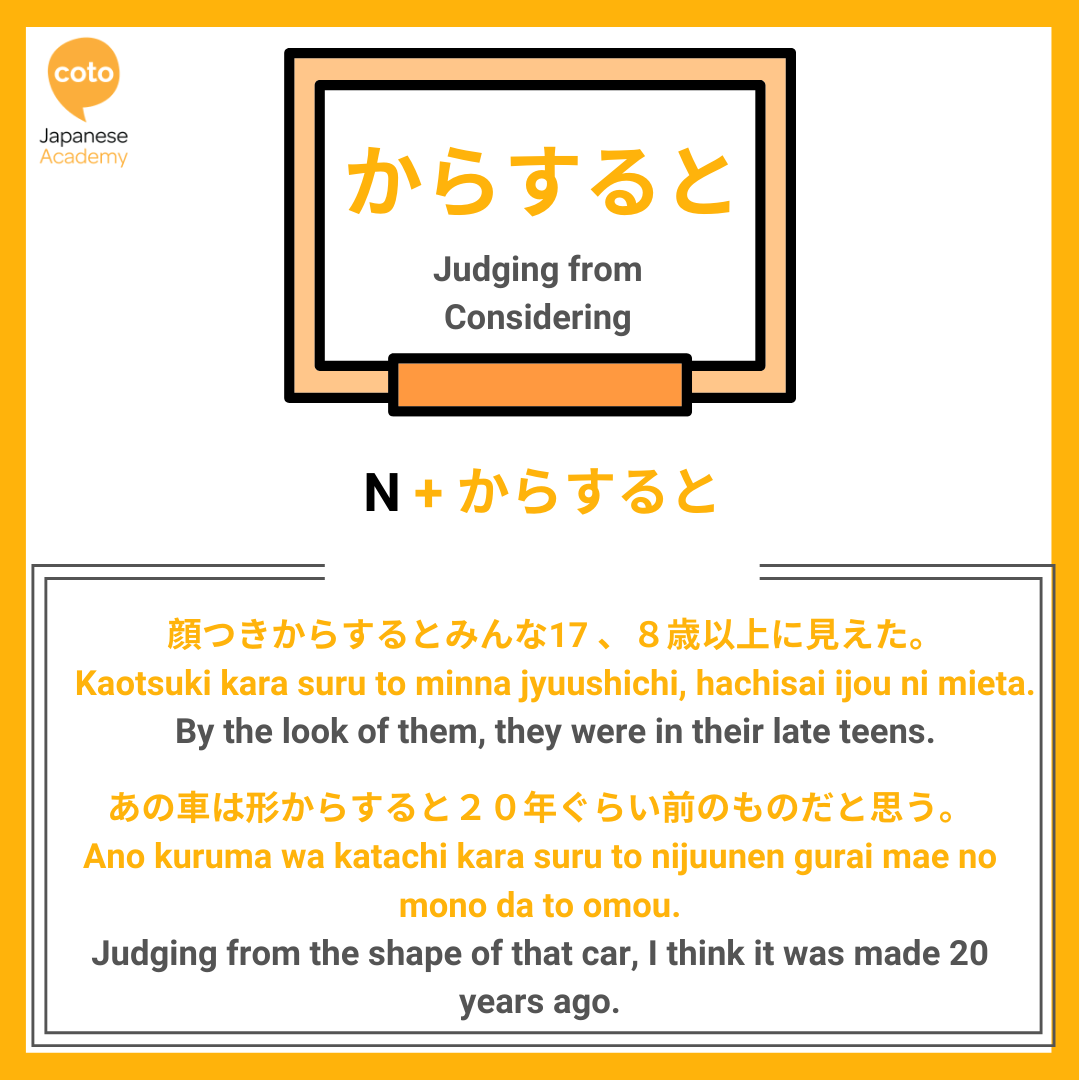
This grammar point is used to infer something based on another. It can be used with nouns only.
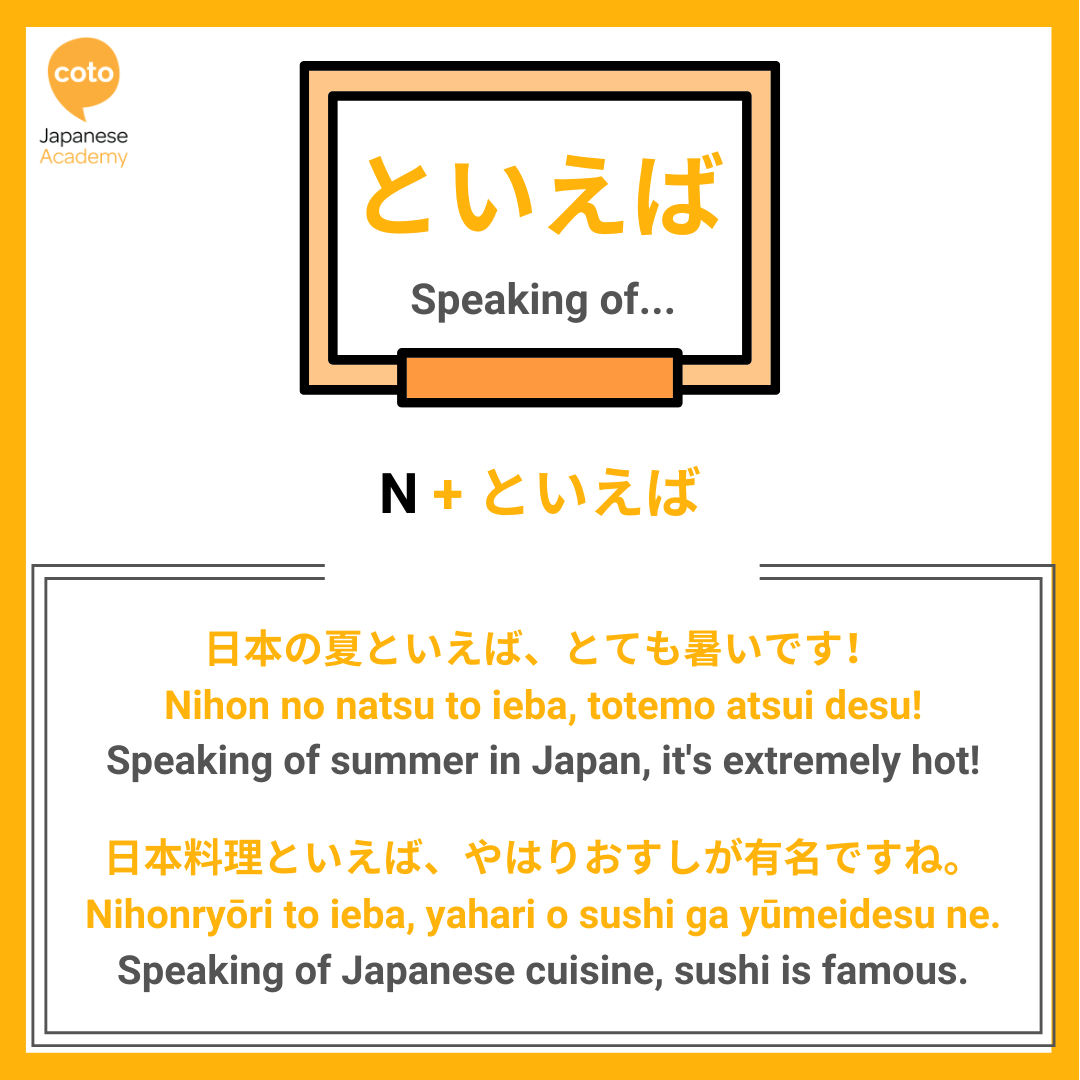
といえば
Grammar Point 2: といえば Toieba
This grammar point means ‘Speaking of…’ and is used when talking about a certain topic. It can be used with nouns.
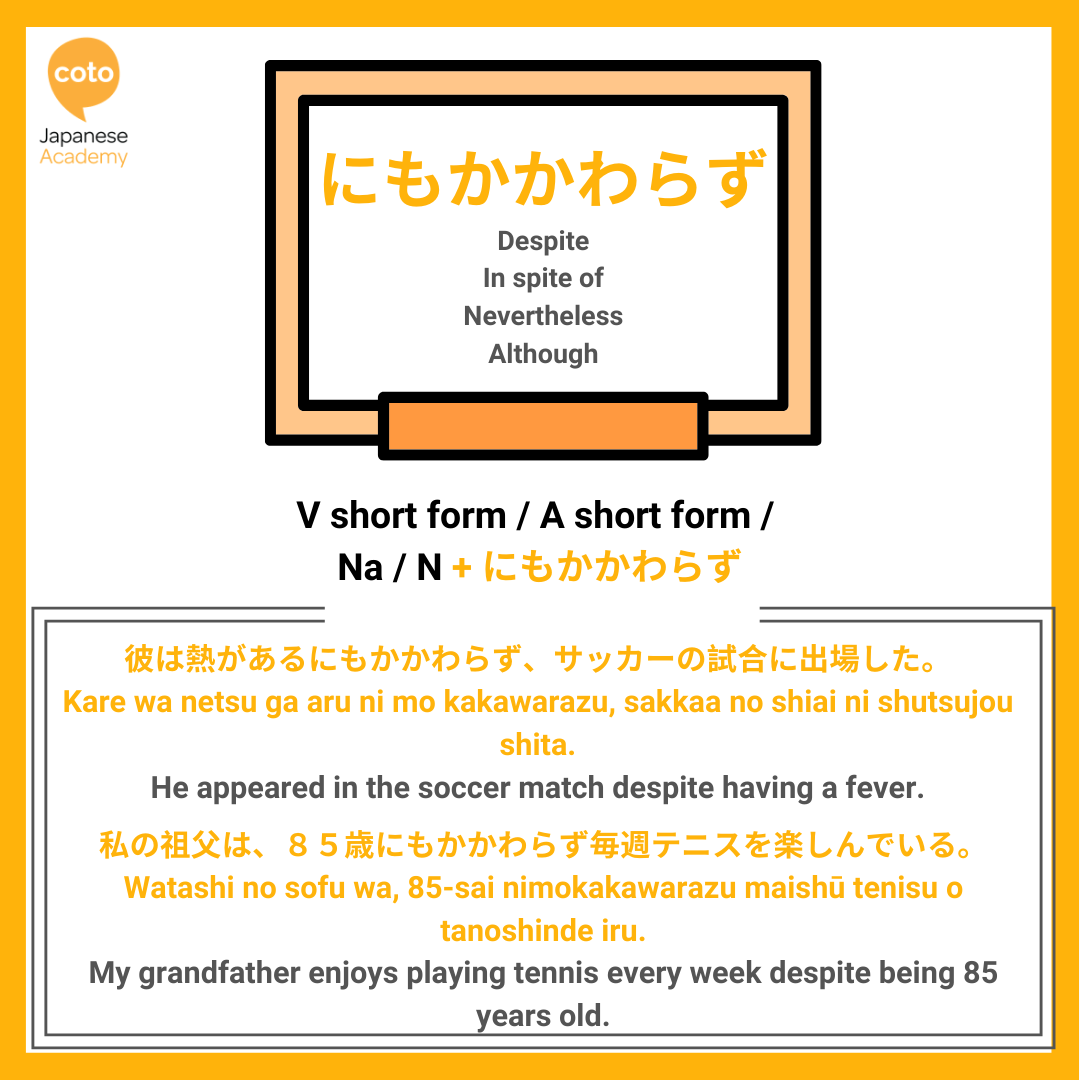
にもかかわらず
Grammar Point 3: にもかかわらず Ni mo kakawarazu
This grammar point means ‘although’, ‘in spite of’, ‘nevertheless’ or ‘although. It can be used by combining with verbs, い-adjectives, な-adjectives, and nouns.
もしない
Grammar Point 4: もしない Moshinai
This grammar point means ‘without even doing’ something. It is used with verbs in Group 1, 2 and 3. Remember to remove the ます or します when combining with the verb!
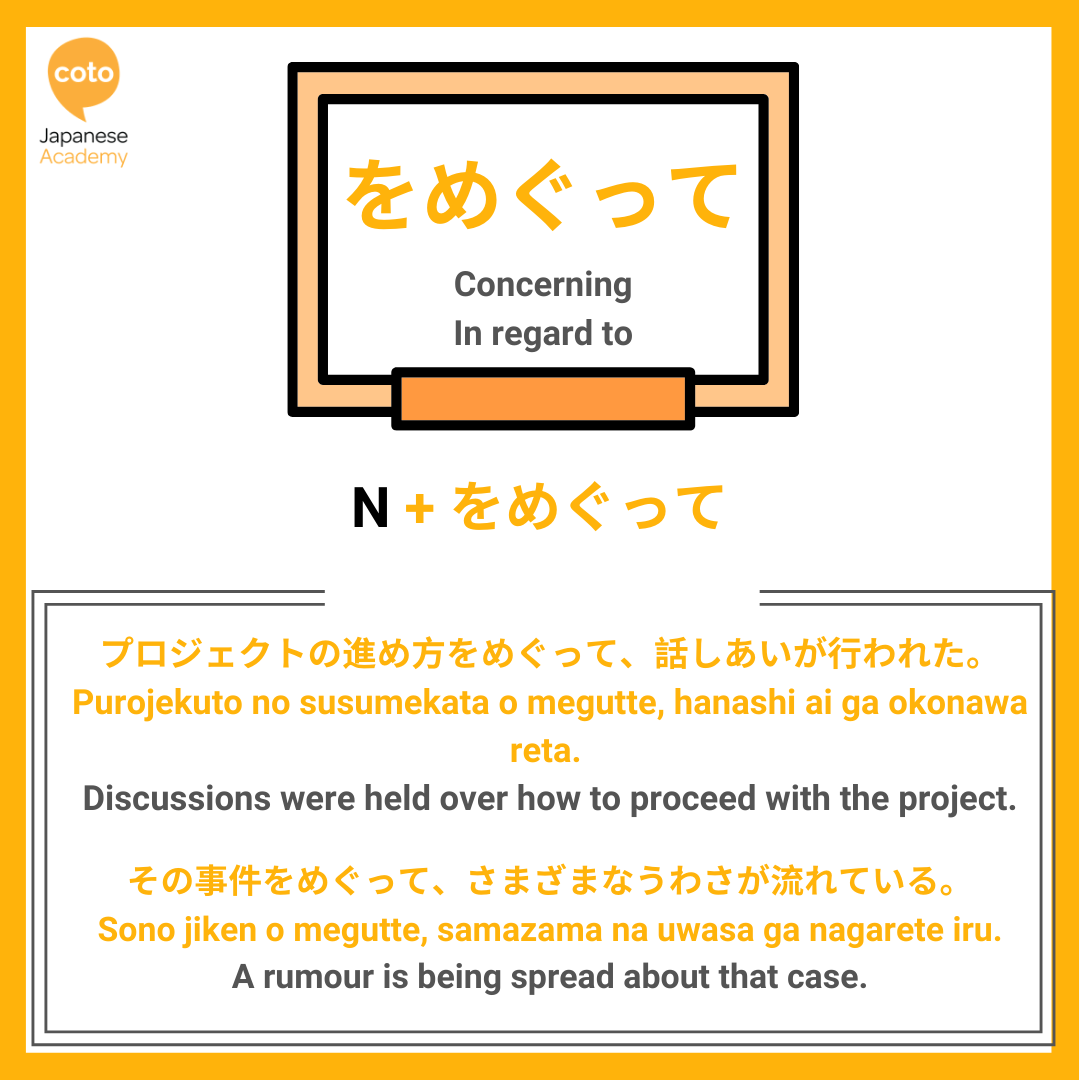
をめぐって
Grammar Point 5: をめぐって O megutte
This grammar point means ‘concerning’ or ‘in regard to’, and is used when referring to something. It is used by combining with either nouns or verbs.
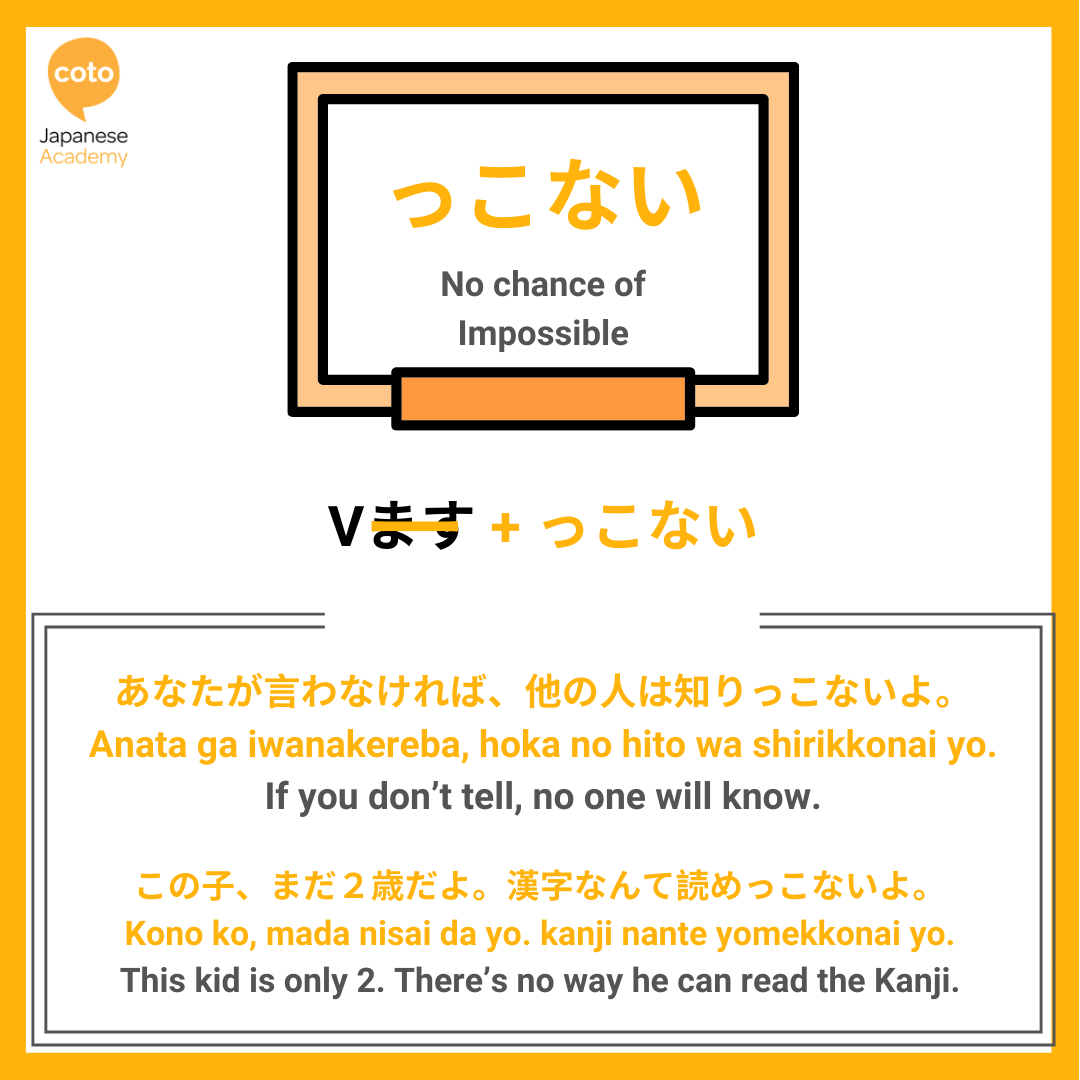
っこない
Grammar Point 6: っこない Kkonai
This grammar point means ‘no chance of’ or ‘impossible’. It is used with verbs with a ます-stem. Be sure to remove the ます when combining with the verb!
というものは
Grammar Point 7: というものは Toiumono wa
This grammar point is used to express the universal behavior on a certain topic. It is usually used to talk about a general idea or objective fact. It can be used by combining with nouns.
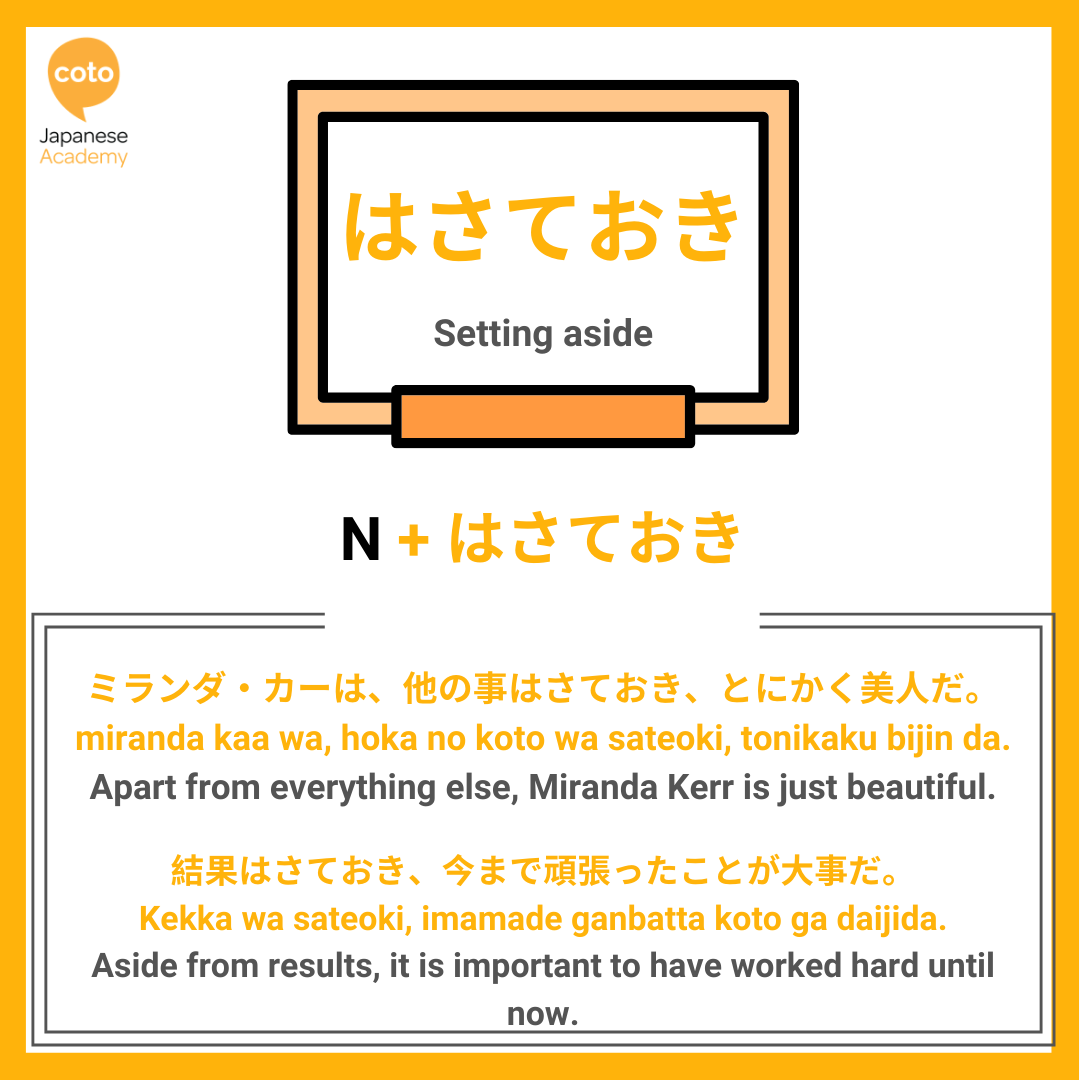
はさておき
Grammar Point 8: はさておき Wa sateoki
This grammar point is used to ‘set aside’ something. It can be used by combining with nouns.
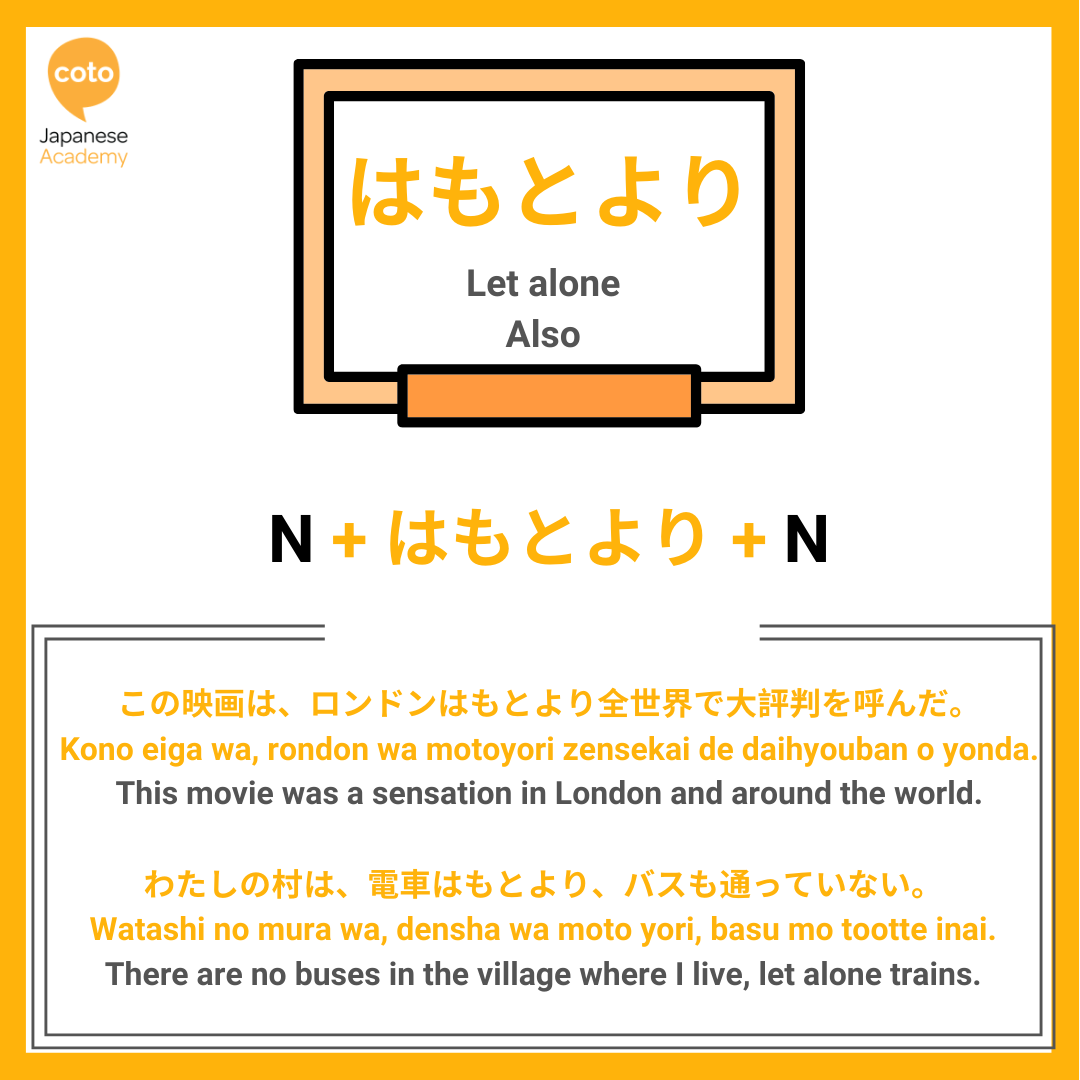
はもとより
Grammar Point 9: はもとより Wa motoyori
This grammar point means ‘let alone’ or ‘also’. It can be used by placing it in between 2 nouns.
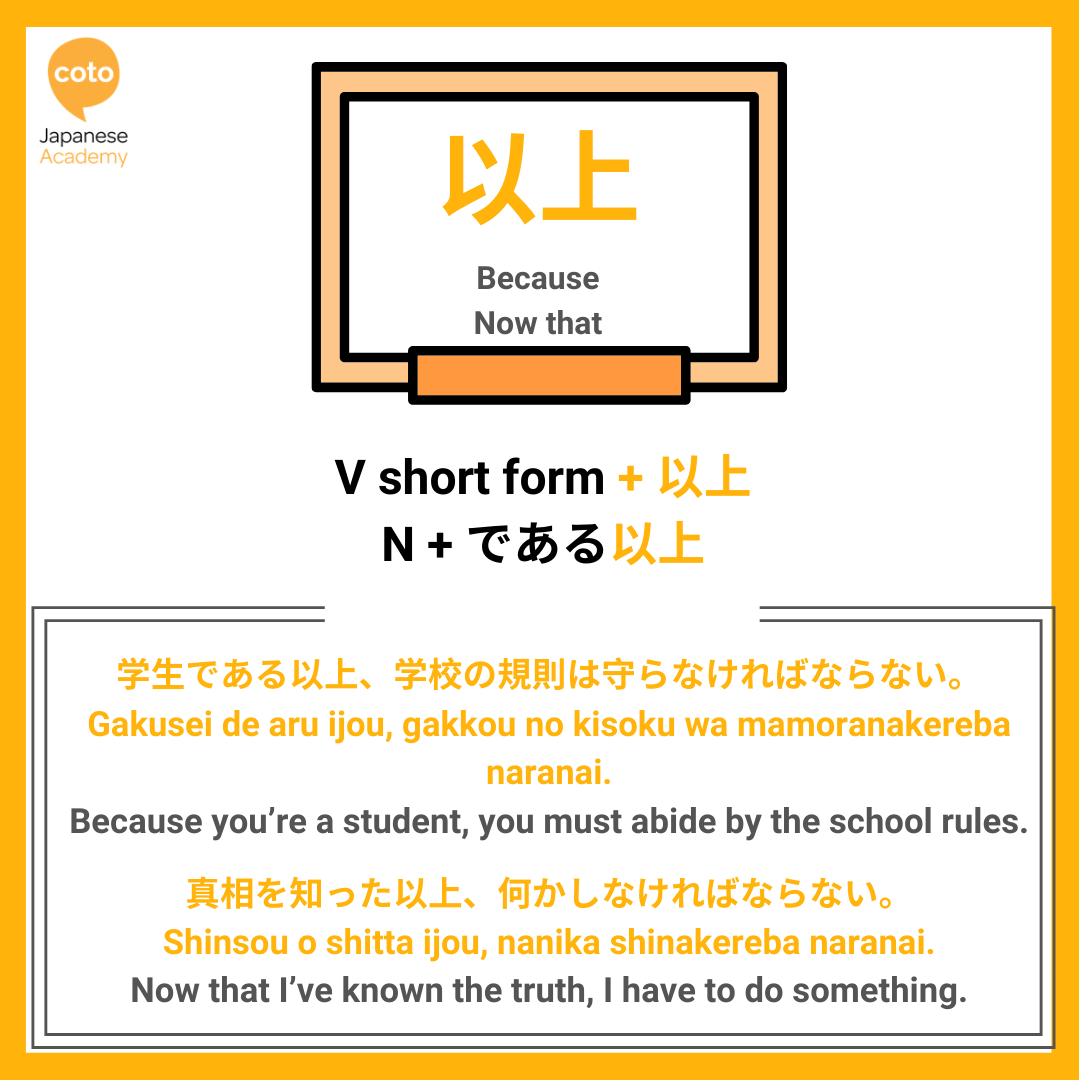
以上
Grammar Point 10: 以上 Ijou
This grammar point means ‘because’ or ‘now that’. It is used by combining either with a verb or noun. When added to a noun, be sure to include である before 以上, so it becomes (Noun)である以上.
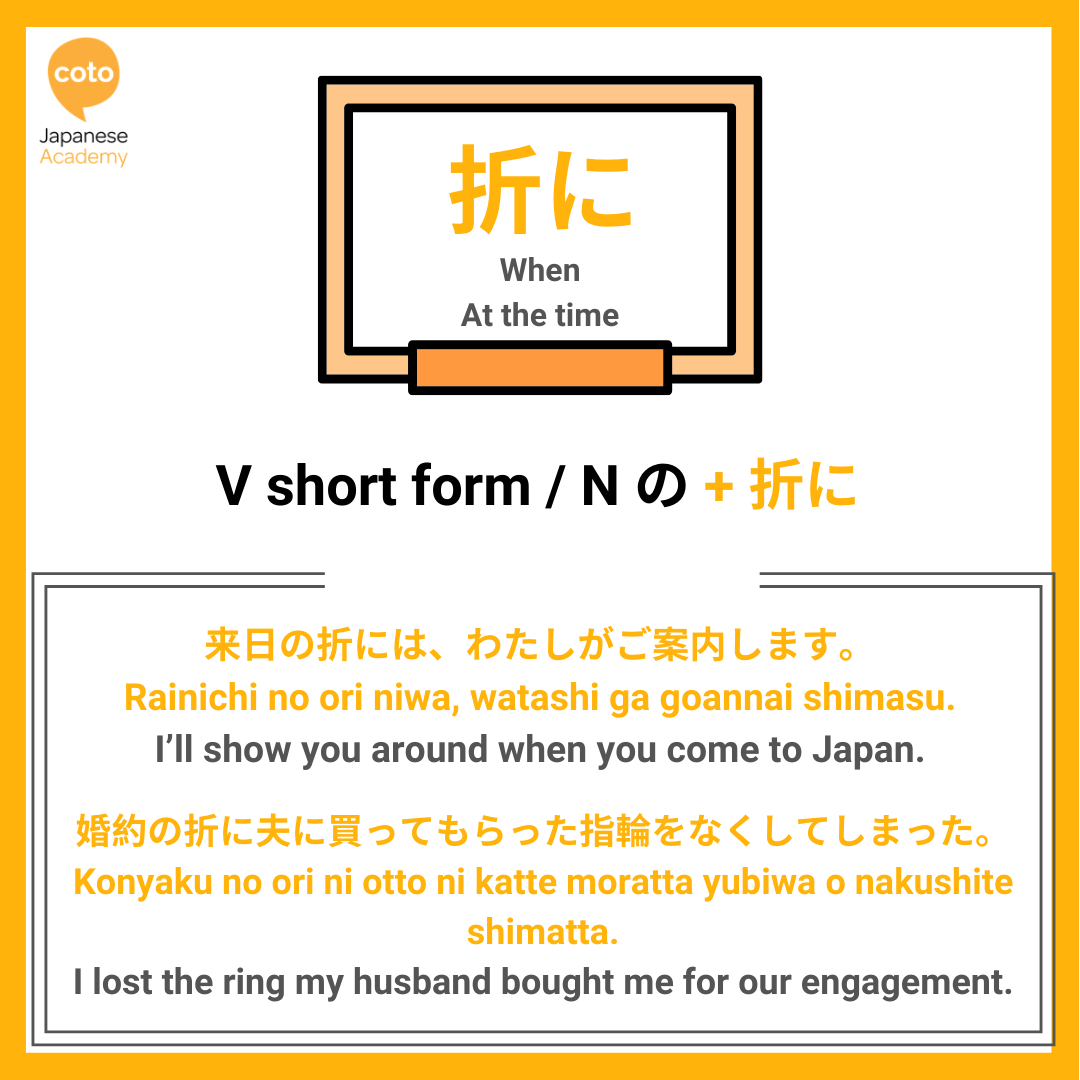
折に
Grammar Point 11: 折に Orini
This grammar point means ‘when’ or ‘at the time’. It can be used by combining with casual verbs or nouns.
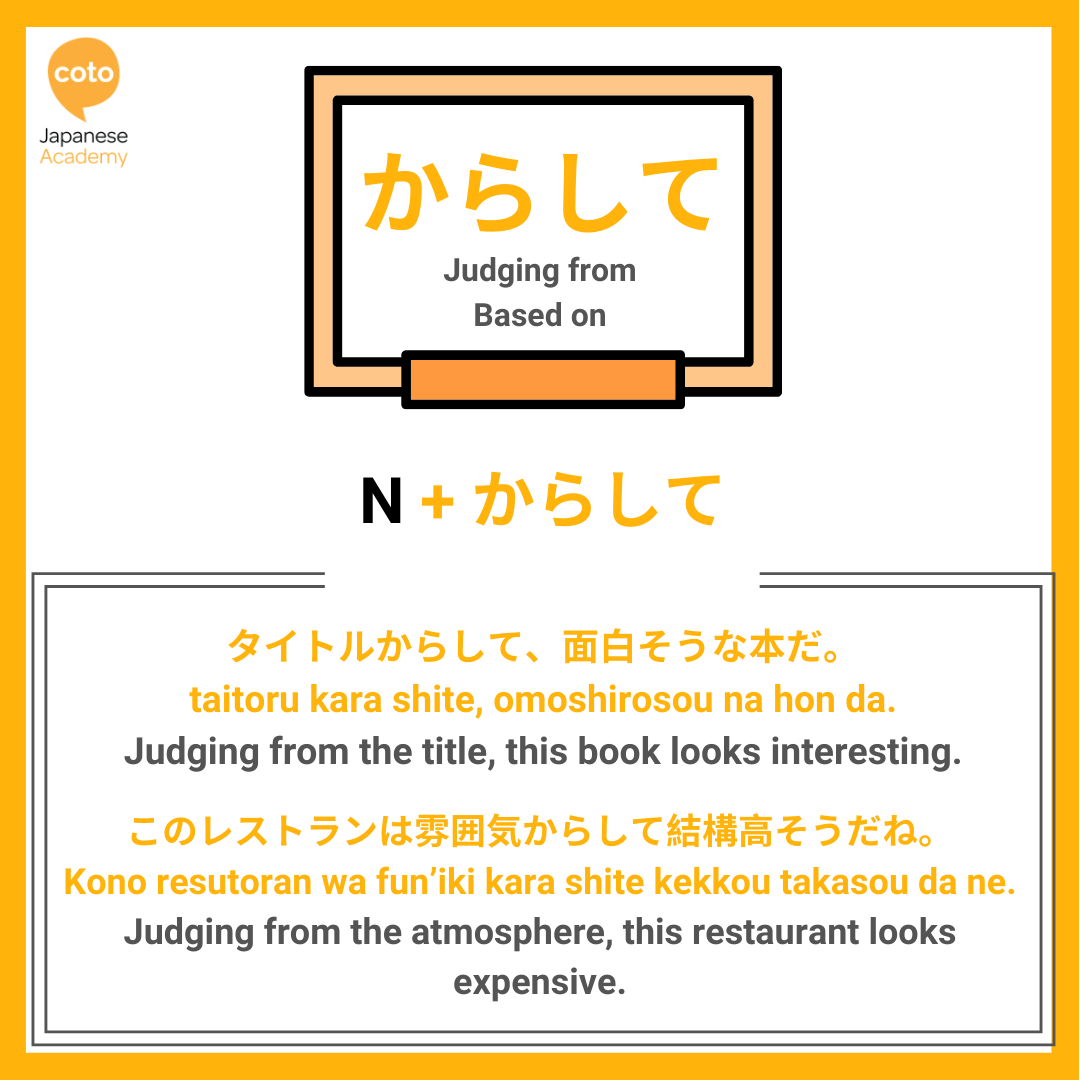
からして
Grammar Point 12: からして Karashite
This grammar point expresses when you are inferring something ‘judging from’ or ‘based on’ something. It can be used by combining with nouns.
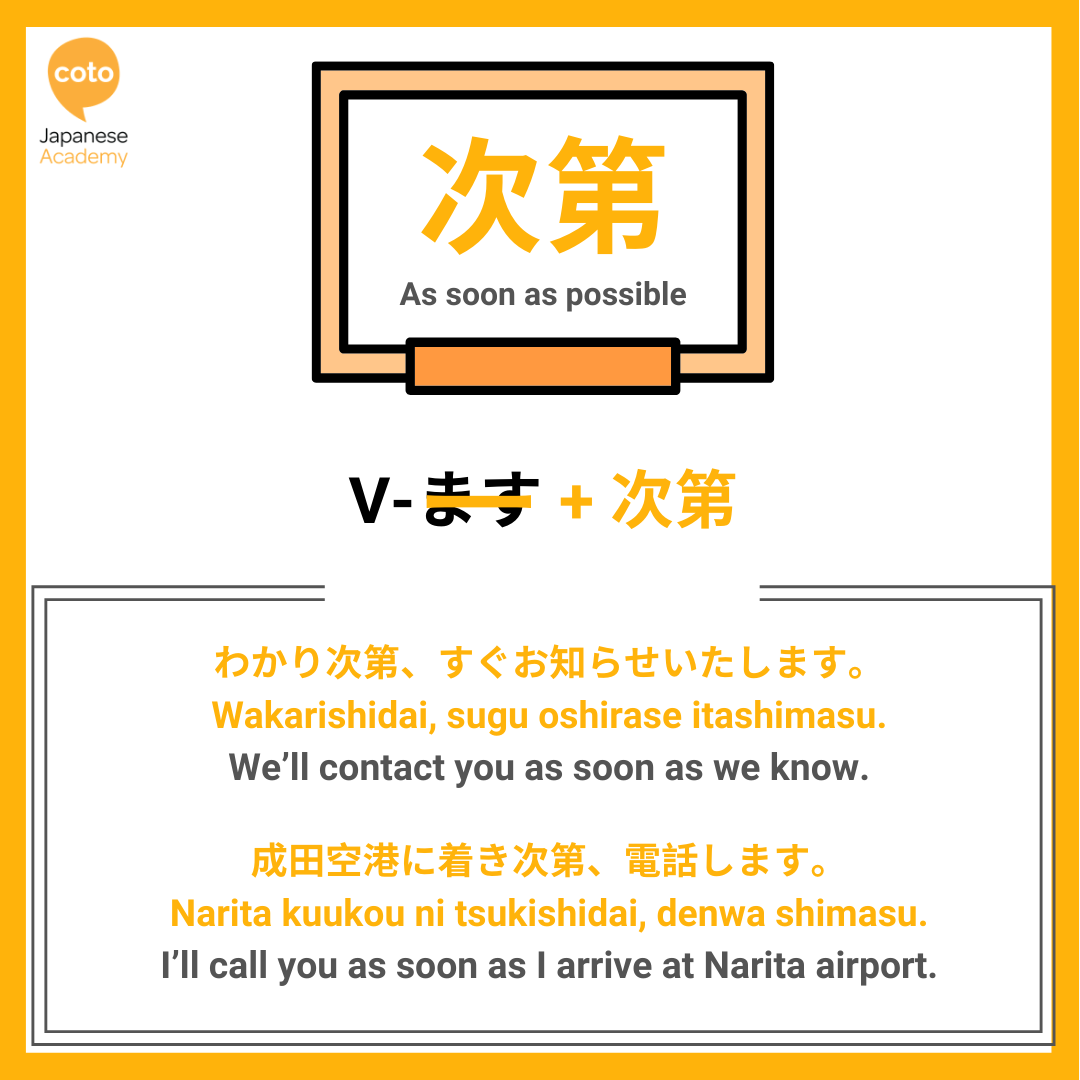
次第
Grammar Point 13: 次第 Shidai
This grammar point means ‘as soon as possible’ and can be combined with verbs with a ます-stem. Be sure to remove the ます at the back!
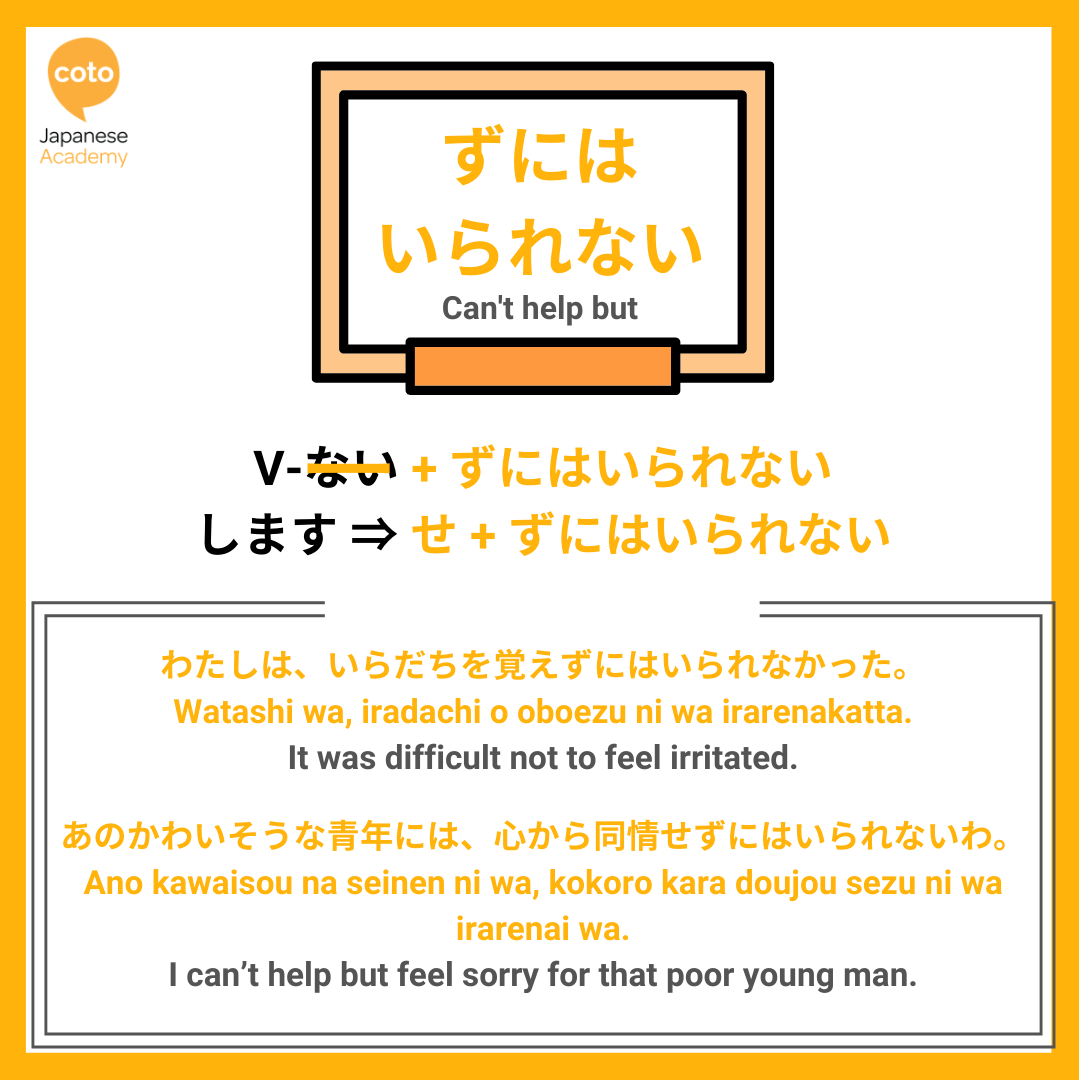
ずにはいられない
Grammar Point 14: ずにはいられない Zuni wa irarenai
This grammar point means ‘can’t help but’. It is used by combining with verbs with a ない-stem. When adding this grammar point to the verb, be sure to remove the ない at the back!
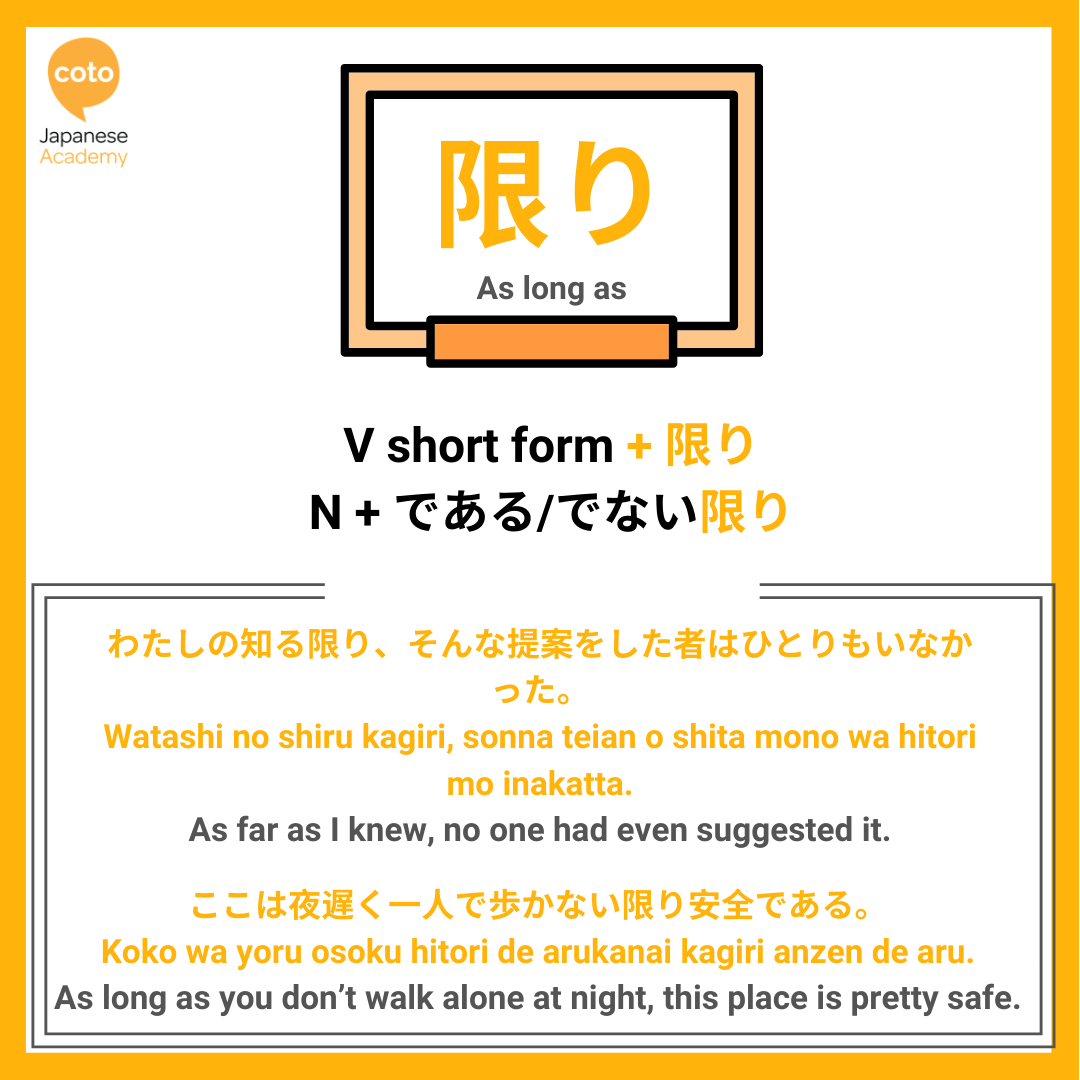
限り
Grammar Point 15: 限り Kagiri
This grammar point means ‘as long as‘. It can be used by combining it with either a verb or a noun. When added to a noun, be sure to include である or でない before 限り, so it becomes (Noun)である/でない限り.
ないものか
Grammar Point 16: ないものか Naimonoka
This grammar point means ‘Can’t we…?’ or ‘Can’t I…?’ and is a particle used in questions. It can be used by combining with verbs with a ない-stem.
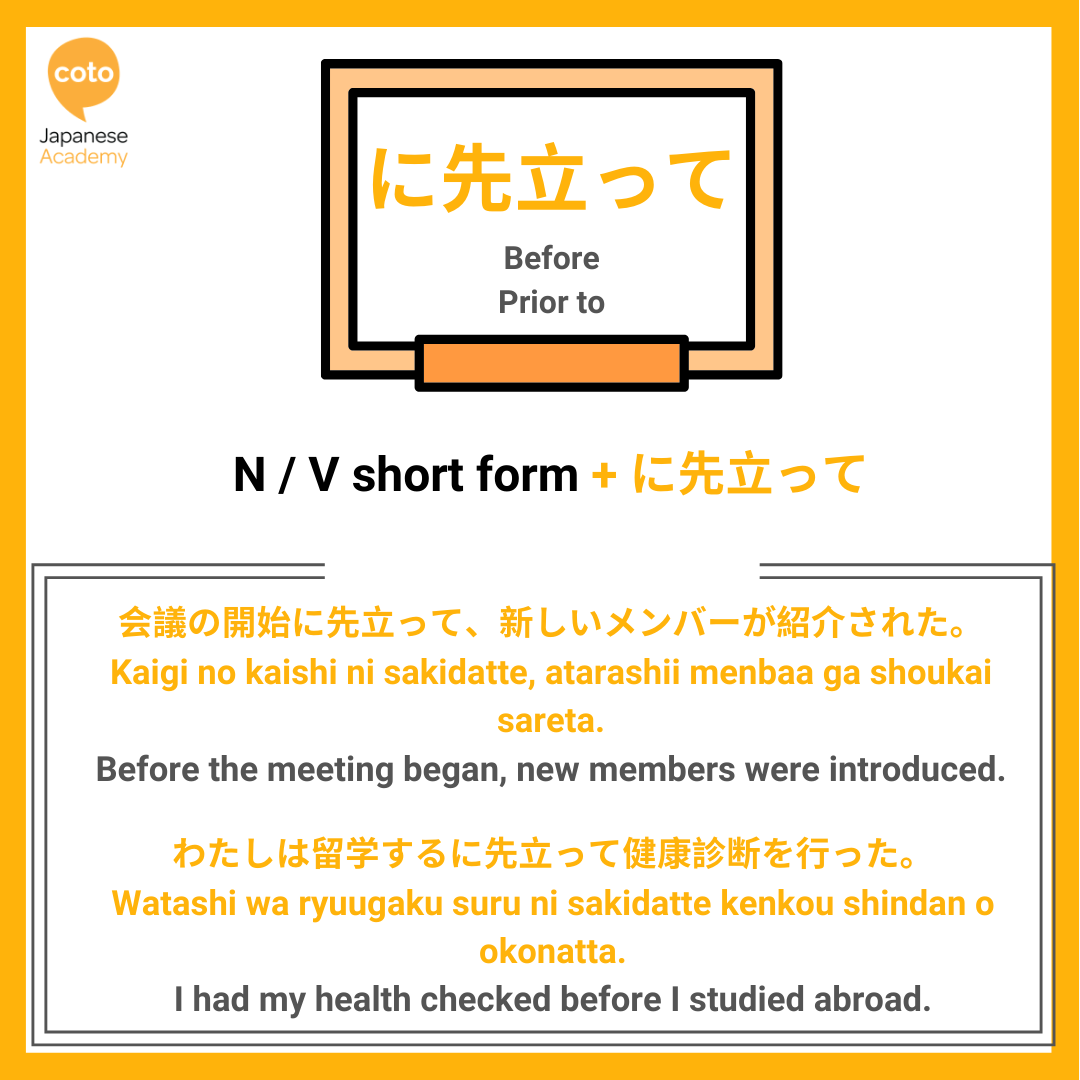
に先立って
Grammar Point 17: に先立って Ni sakidatte
This grammar point is used when you do something before another, or when something happens before another. It can be used by combining it with either nouns or verbs.
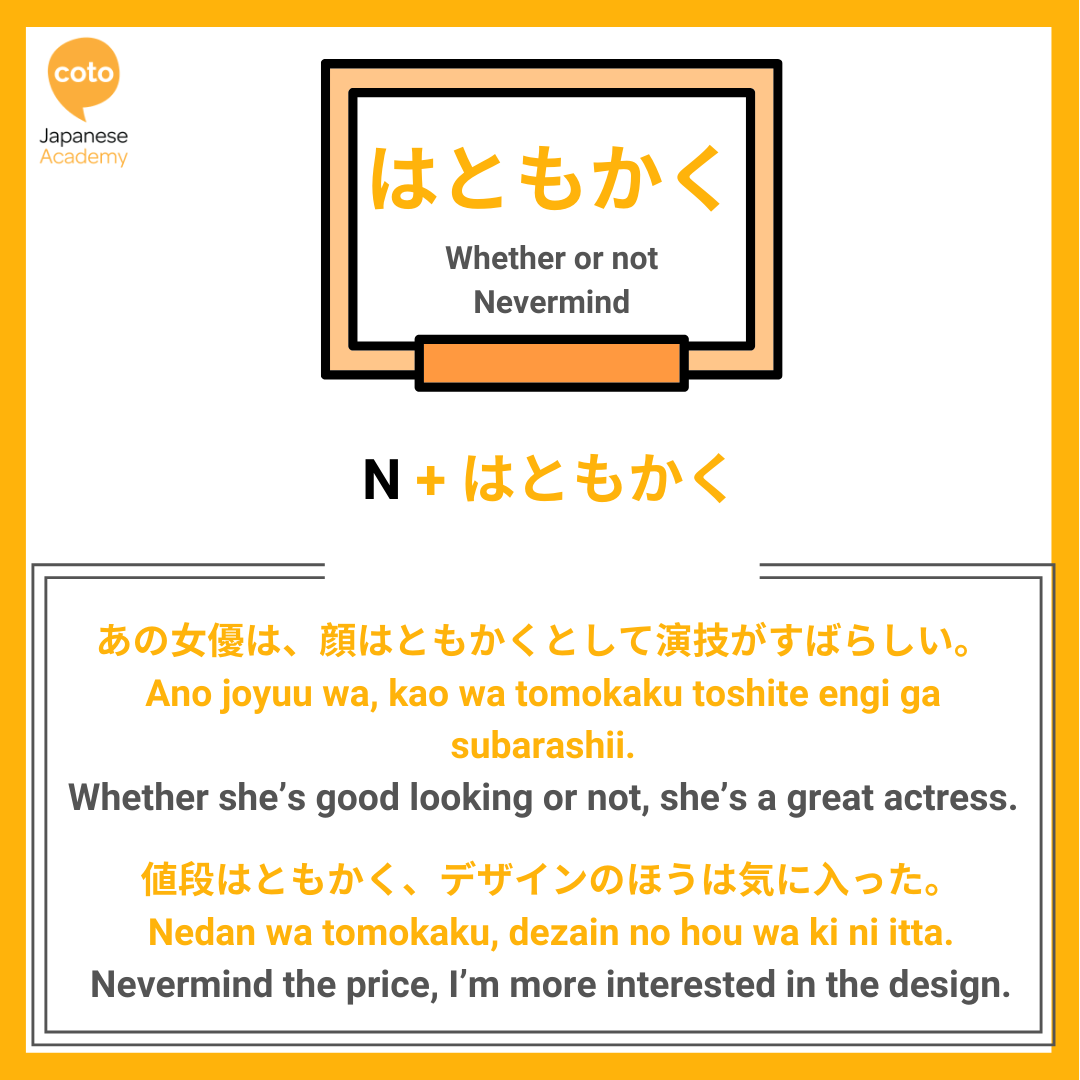
はともかく
Grammar Point 18: はともかく Wa tomokaku
This grammar point means ‘whether or not’ or ‘nevermind’, and can be combined with nouns.
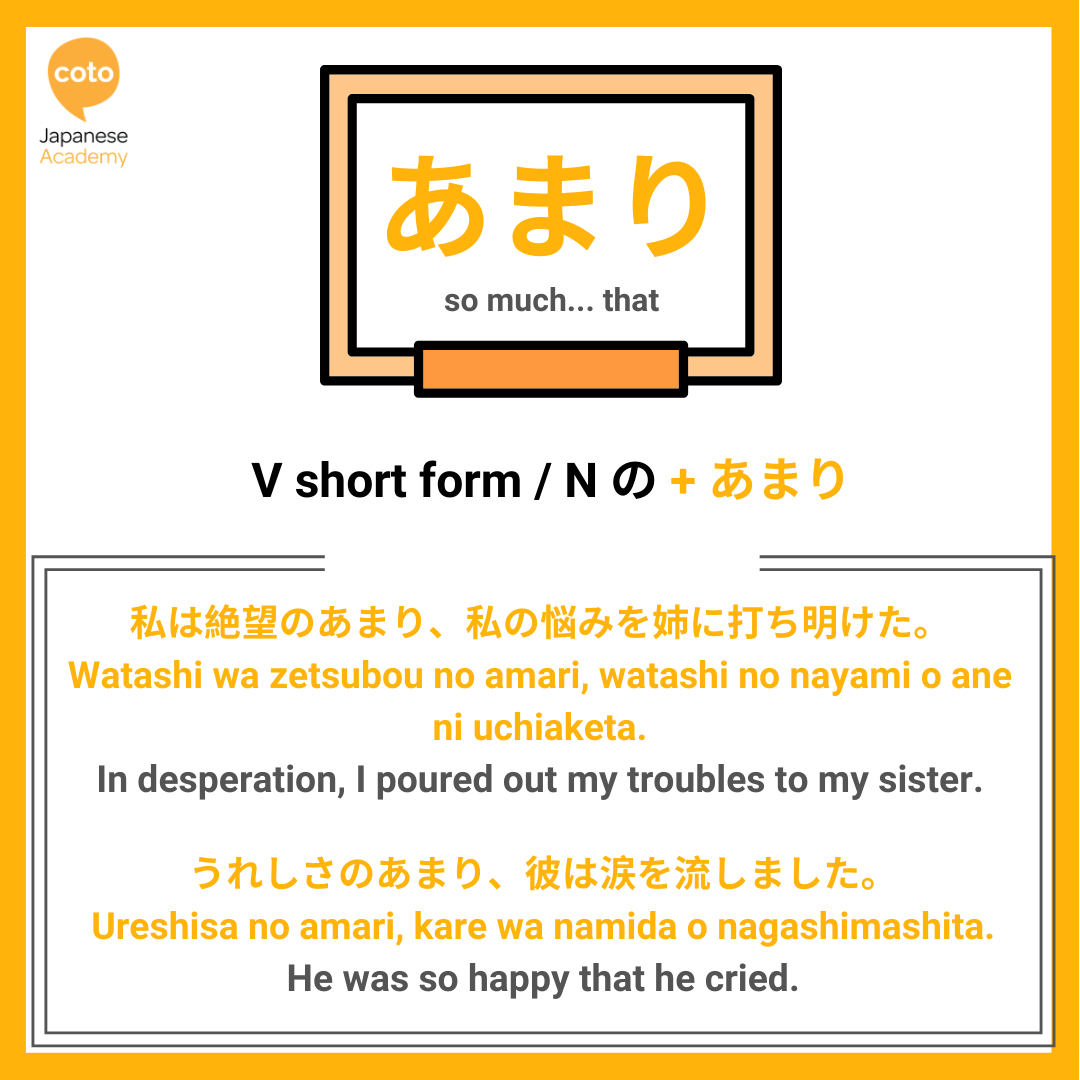
あまり
Grammar Point 19: あまり Amari
This grammar point means ‘so much… that’. It can be used by combining with either verbs or nouns. When added to a noun, be sure to include の after the noun, so it becomes (Noun)のあまり.
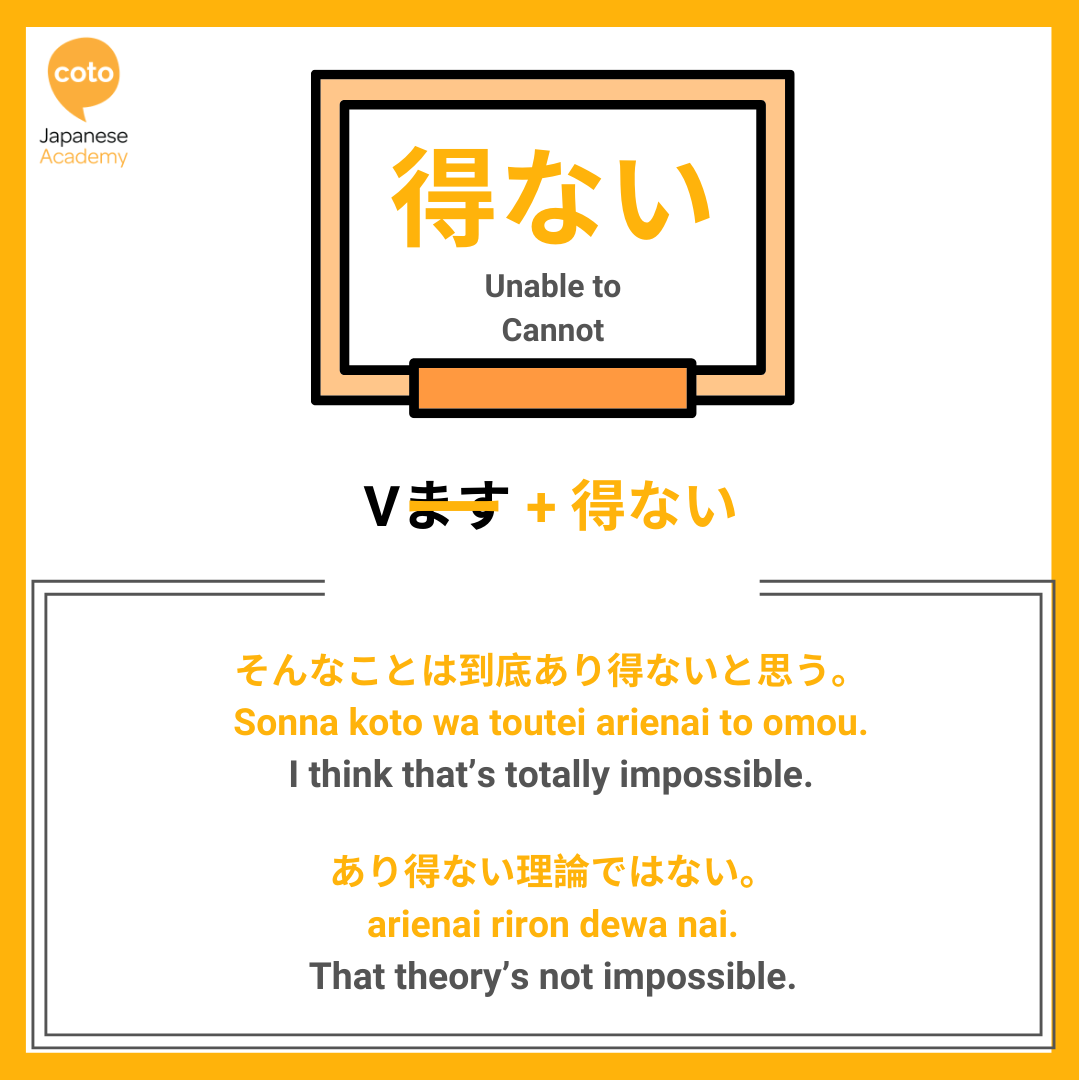
得ない
Grammar Point 20: 得ない Enai
This grammar point expresses something that is impossible to be done. It is used by combining with verbs with a ます-stem. Be sure to remove the ます at the back when adding this grammar point to the verb!
If you are interested in studying Japanese, find out more about our school by filling out the form below.
Want to know a list of popular Japanese anime phrases that you can use in real life? Yes, you canlearn Japanese from anime — but only if you do it right. The thing is, a lot of students mindlessly copy phrases they found on their favorite anime TV shows and films, but if you sound too much like an anime character, you’re in for a cringefest. At best, you’re stuck with saying “~senpai” and “eto“.
Here’s the problem: most anime — especially the seinen or shounen genre — use too-casual slang phrases. Apply them in real life, and you may sound like a yankee (Japanese juvenile deliquent), which isn’t the first impression you’d want to give to your Japanese friends.
In this blog post, we figured we’d share some natural Japanese anime phrases. They’re easy and, most of all, common. They’re perfect for beginners to mimic without being at risk of sounding stiff. You’ll hear them in popular series, like Naruto, Attack on Titan and Demon Slayer.
Here are the top 20 Japanese anime phrases that you can use to converse with your Japanese friends.
Note: Before we go further into the article, note that this article will mostly use hiragana, so prior knowledge of them is a must. If you’re still learning them, don’t worry — take a look at our hiragana chart to review them.
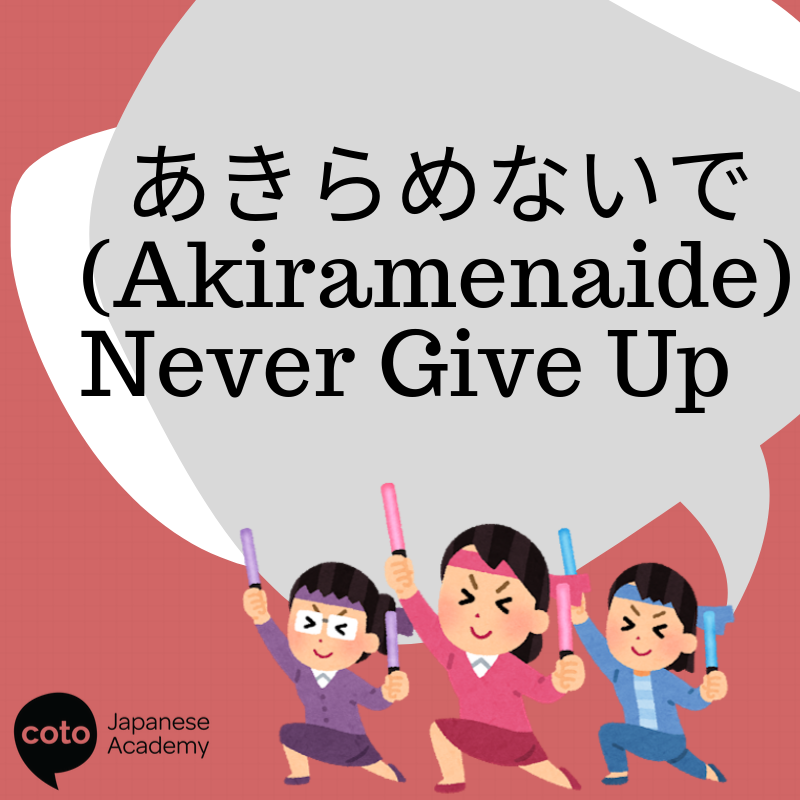
The spirit of fighting and never giving up is the core of every action-packed or hero-themed anime. Think Naruto, Attack on Titan and Haikyuu. When you’re on the verge of giving up, think, “I can’t give up (あきらめないで)!” When your Japanese friend is struggling to learn English, encourage them by saying the popular anime phrase “あきらめないで.“
あきらめなくてよかった! Akiramenaide yokatta! I’m glad I didn’t give up!
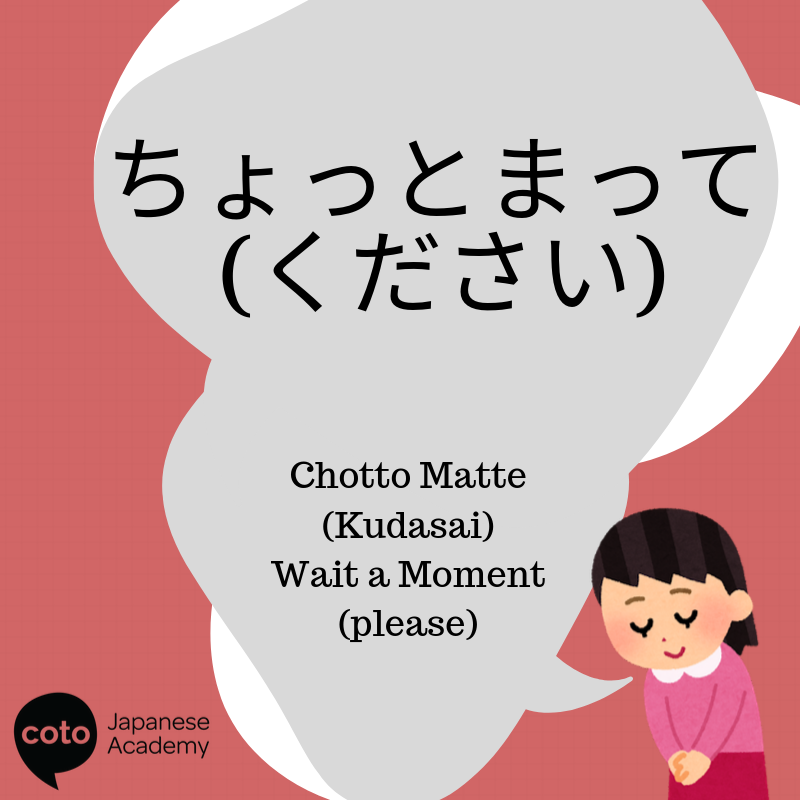
Another basic Japanese anime phrase you’ll find across all genres: ちょっとまって. It’s a casual, shortened form of ~てください, which means to “please do something”. ちょっとまってください is more polite, but it can still sound like you’re ordering someone.
We recommend saying ちょっとまって to your friends — or at least someone your age. For example, when your friend is walking too fast, you can say ちょっとまって!
Another indirect translation of this word is the English equivalent of “give me one second”. Technically, it holds the same meaning as “wait a moment”, but in Japanese, “one second” is “いちびょう”. It’s not culturally (nor contextually) understood. One way to avoid a few imaginary question marks is by making sure the direct translation (English-Japanese) is accurate.
急いで!電車に間に合わないよ! Isoide! Densha ni maniawanai yo! Hurry up! We won’t make it on time for the train!
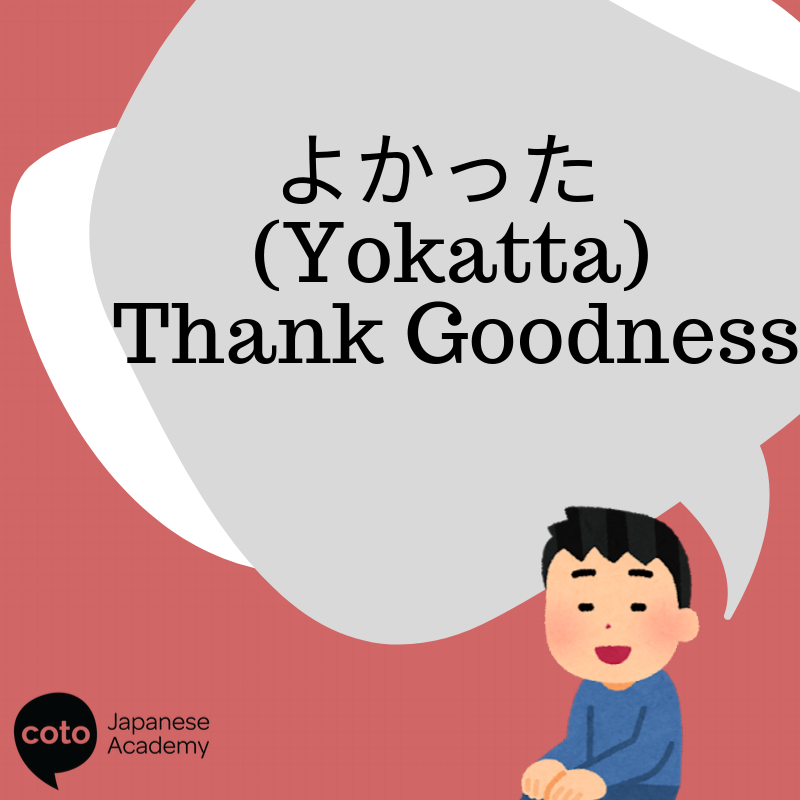
There’s a lot of translation to the Japanese adjective よかった. It’s the past tense of the word 良い, which can be both read as よい and いい.
Keep in mind that you can interpret よかった with a few things. The closest expression to in English is “Thank goodness” or “I”m glad.” In anime shows or films, you can see parents exclaim よかった when they found their lost child.
Another instance would be when someone finds their lost phone or wallet. They would sigh and exclaim “よかった!”
Alternatively, you can say よかったね~ which can mean, “Good for you,” or, “That’s great!”
財布をなくしてしまったと思ったけど、テブルの上にあった! Saifu o nakushite shimatta to omotta kedo, teburu no ue ni atta! I thought I lost my wallet, but it was above the table!
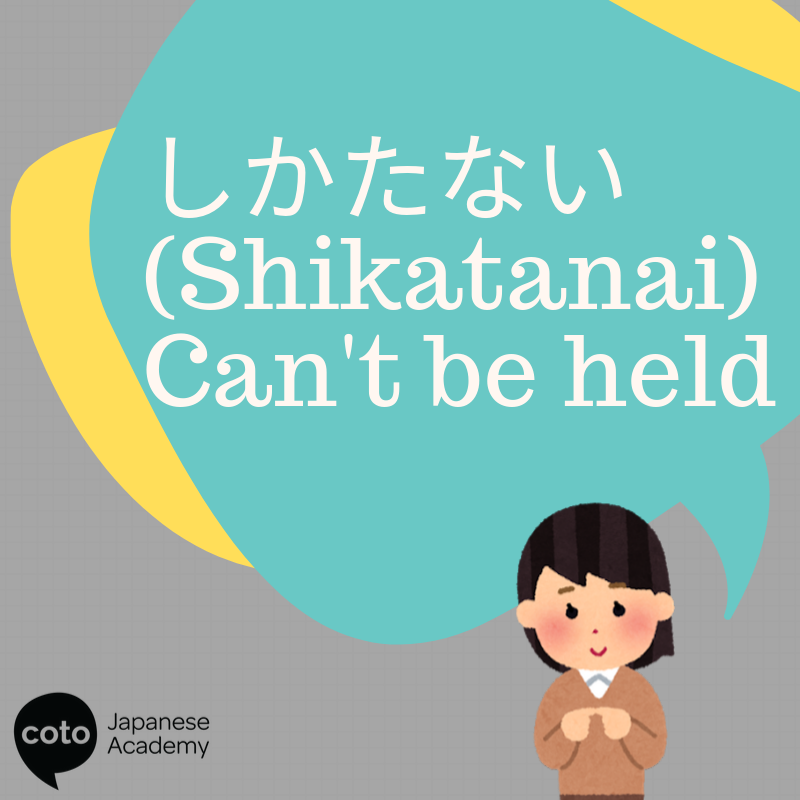
The meaning of this Japanese anime phrase is quite straightforward. The kanjiしかた means “method” or “way”. ない is the casual form of ありません, which is a negative form of the verb あります. A more grammar-accurate form of しかたない is しかたがない, which directly translates to “There is no way.”
The phrase means, “It can’t be helped”, and is used to indicate something is a foregone conclusion in a negative sentence.
For example, when you have to cancel a trip due to bad weather, there’s nothing you can do, so you’ll say しかたない or しょうがない.
Keep in mind that this common anime phrase is a casual expression, used between coworkers and friends. Don’t turn it into a formal form (しかたがありません) and expect to sound professional at work.
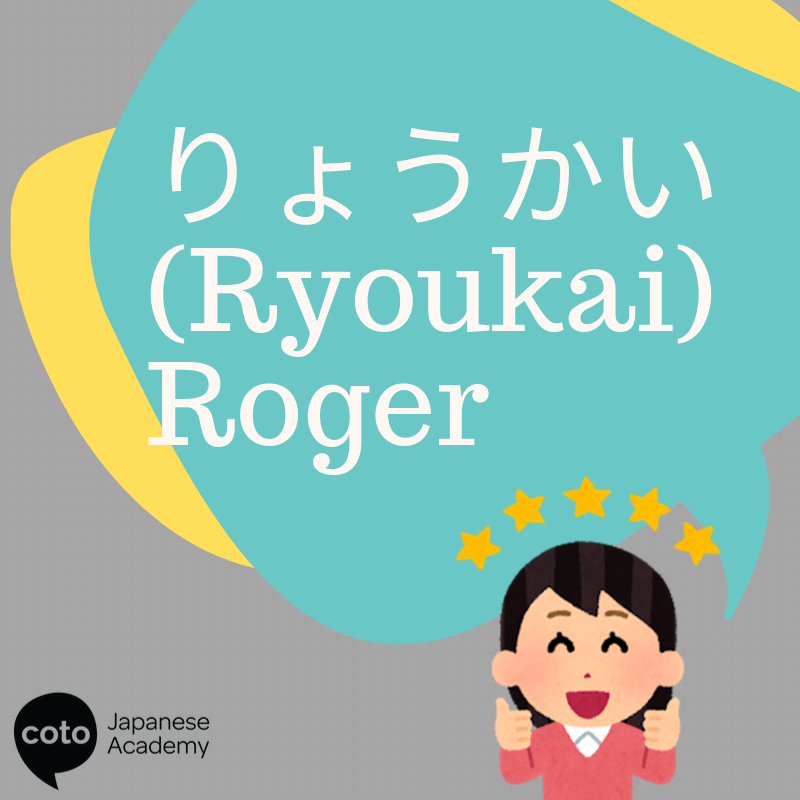
5. りょうかい: Roger!
りょうかい or りょうかいです can be used informally with your friends or family! It is an affirmation that means “Yes, I’ve got it!”
It is used to indicate that you understand something and you will execute on the person’s request. For example, when your mom asks you to buy eggs from the supermarket, you can use りょうかい or りょうかいです。
宿題を終わってから、必ず提出をください。 Shukudai o owattekara, kanarazu teishutsu o kudasai. After you finished the homework, please submit it.
りょうかい! Ryoukai! Understood!
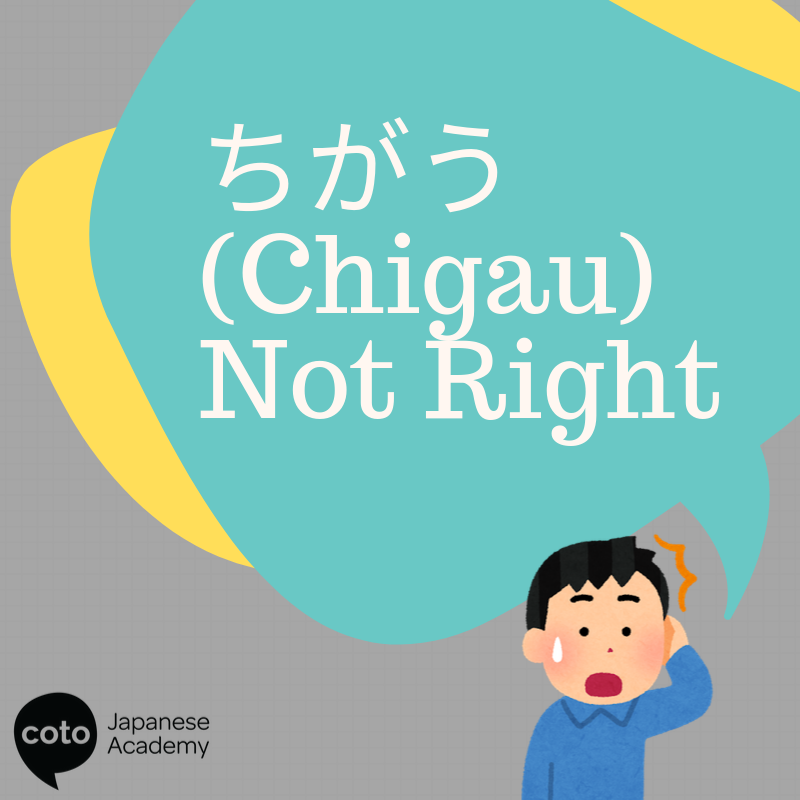
6. ちがう: Not right, the wrong way
The word 違う means “wrong”, and you’d usually use it to deny or refute something. Like よかった, Japanese people tend to use this in a lot of situations. It can simply mean “No,” “That’s not it,” or “It’s different.”
Your Japanese friend would say ちがう if you said something wrong or if they disagree on something. The more polite form of this verb is ちがいます. Japanese society practices being agreeable, so you might want to avoid (explicitly) contradicting someone in a formal setting. The last thing you’d want is to prove a point to your Japanese boss.
自分のシャツ、これでしょう? Jibun no shatsu, kore deshou? This is my shirt, right?
違う! それは私の! Chigau! Sore wa watashi no! No! That’s mine.
7. がんばって: I (You) will do the best!
You will come across one of these Japanese anime phrases very often. The word ganbatte stems from the verb ganbaru, or 頑張る (がんばる), which means “To do one’s best” or “Hang in there!”
The phrase がんばって (formally がんばってください) is used to encourage people to try hard. It can also be interpreted as “Good luck”. You can often hear people shouting がんばって in sports matches and marathons in Japan.
A more casual way to say がんばって is がんばれ
もう諦めたいよ。 Mou akirametai yo. I want to give up already.
あと少し!頑張ってください! Ato sukoshi! Ganbatte kudasai! A little bit more! Hang in there!
Other variations include 頑張りましょう (“Let’s work hard together”) and 頑張ってくれ (“Do your best for me”).
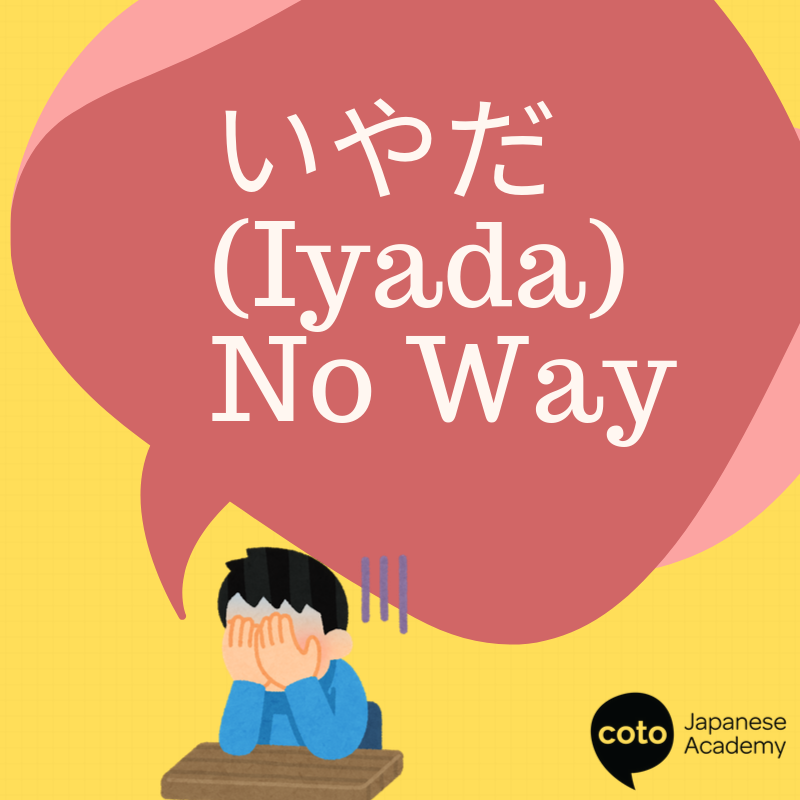
8. いやだ: No way!
The phrase いやだ means “No way” or “Not a chance.” It simply means refusal to do something or you do not want to do it. It shows the speaker’s negative feelings, and it’s generally used to express something that is detestable or unpleasant. For example, if you are forced to go to a haunted house, you can say “いやだ”!
In spoken conversations where people speak fast (and cut things short), いやだ can turn into its colloquial form やだ.
ボクちゃん、野菜食べてくれる? Boku-chan, yasai tabete kureru? Little boy, can you eat your vegetables?
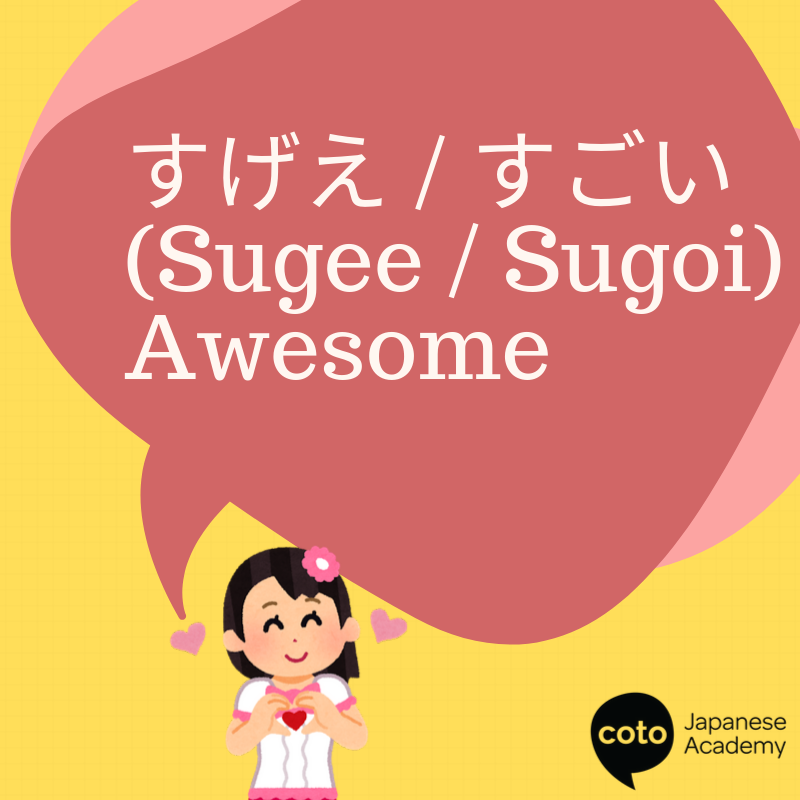
Although the Japanese language isn’t gendered, there is a certain speaking preference used by boys, like specific Japanese first-person pronouns that are perceived as “masculine”. すげえ is mainly used by boys, and it is super casual. The word stems from すごい, but instead of an ending that sounds like “oi”, they’d drag the vowel into a long “ee”.
Instances such as if you are a boy, when your Japanese friend scored highly on an exam, you can say すげえ! You can use すごい when you feel happy about your friend’s accomplishment, “ええ?すごいじゃん!”
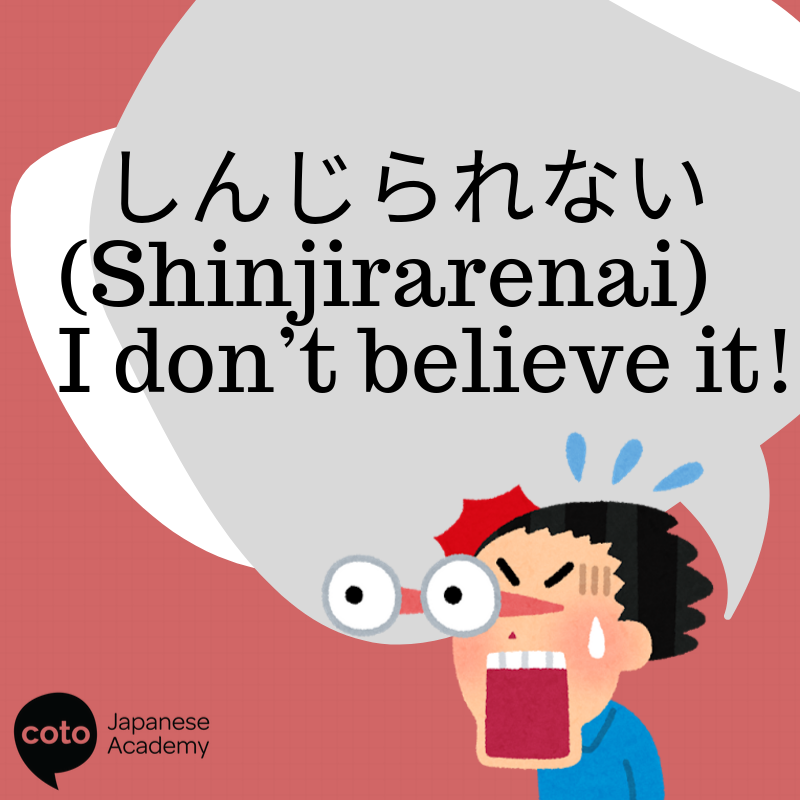
Have you ever taken a leap of faith — and actually succeeded? You can express your state of shock by saying 信じられない alone or add a よ particle at the ending to magnify your disbelief.
Let’s say that your friend is cooking for you, and you’ve heard that they are not a good cook. However, when you try their dish and find that it’s actually delicious, you might exclaim “I can’t believe it!”
信じられないほど美味しい! Shinjirarenai hodo oishii! I can’t believe it’s delicious!
Part Two
In this second part of Japanese phrases from anime that have real-world use cases, we introduce you to ten more phrases from anime.
11. 相変わらず: As usual
This is a Japanese phrase (or part of a phrase) that is commonly used to describe specific people or their behavior. The kanji for aikawarazu (相変わらず) first uses 相, which means: “mutual” or “together”. The second kanji in the word is 変わる which means “to change”. Put them together and you get “as usual” or “Without changing~”.
The phrase 相変わらず can be used for both making positive or negative judgments towards something or someone. In anime, you’ll find people can use it when they’re impressed or when they’re disappointed at a character’s unchanging attitude.
相変わらず彼女が美しい。 Aikawarazu kanojo ga utsukushii. She is pretty as ever.
相変わら彼が酷い。 Aikawarazu kare ga hidoi. He is as cruel as always.
12. ドキドキ: My heart is racing!
This is a Japanese onomatopoeia that describes the sound of your heart thumping. In particular, it’s used when you are nervous or flustered during an interaction with a crush.
You may have heard this multiple times if you watch romantic-comedy anime. Japanese people love onomatopoeia, and they often use repetitive words (such as doki doki).
Maybe doki doki doesn’t sound exactly like a heartbeat, but it’s pretty close. If you find yourself feeling nervous and notice your heart thumping, instead of using kinchou (緊張), you can use ドキドキ to describe your emotions.
先美人と話したんで、めっちゃドキドキだったよ! Saki bijin to hanashitan de, meccha dokidoki datta yo! I was talking to a pretty girl just now, and my heart was racing!
13. 任せて下さい: Leave it to me!
You have most likely heard this phrase in several different anime. You can use this in any situation where you are stepping in to help. The casual form you may have heard is 任せとけ (makasetoke) or 任せて(makasete). Both mean “leave it to me” or “I’ll handle this!”
Although you may have heard this used in anime fight scenes, you can of course use it in everyday situations. To use it at work, say the polite version 任せてください (makasete kudasai).
14. 気を付けて: Take care
Simply put, ki o tsukete means “take care”, or “be safe.” Since this uses the te-form, it is also a command or request. But in Japanese, these “commands” are not so strict. It’s like a friendly comment. To make it polite, add ください on the end (as with many Japanese phrases).
Bikkuru suru means to be shocked or surprised. This word is used across all anime genres and shows of many kinds! Suru is sometimes omitted, but either way, the sentiment is the same.
16. 面倒さい: What a pain!
Alright, we know you know this one. Mendokusai is used to express frustration. Pretty straightforward, めんどくさい just means “what a pain”, and used for situations that are inconvenient or something you would rather not deal with.
It’s not heavy enough to be used for very serious matters – mostly just frustrating or potentially stressful scenarios.
17. ぎりぎり: Just in time
This is another Japanese onomatopoeia that literally means something along the lines of “just barely”. It is often used with time measurements, such as to be ぎりぎりセーフ (girigiri seefu), which means to “just barely be safe” – or “just barely made it”.
終電にギリギリのところで間に合った。 Shuuden ni girigiri no tokoro de maniatta. I was just in time for the last train.
ギリギリのところで間に合う。 Girigiri no tokoro de maniau. I just made it under the wire.
18. 申し訳ございません: I am deeply sorry
Possibly one of the most practical phrases on this list for polite scenarios, 申し訳ございません (moushi wake gozaimasen) is a very formal and sincere apology often used in business or customer service situations.
This phrase utilizes the humble form keigo. It literally translates to “I have no excuse” and should be used for very serious apologies. It is important in Japanese culture to also express your apology with your body language. This means bowing deeply and showing your face.
19. とりあえず: For now
This is usually used at the beginning of a Japanese sentence to mean, “meanwhile, I will …” or “for now”. Although it often appears in anime, you can use this in a variety of different situations.
It can be used in either casual or formal settings. It is often used in business settings to complement explanations.
20: 久しぶり: Long time no see!
久しぶり (hisashiburi) is a one of the commonly used Japanese anime phrases that means “long time no see” in English. There isn’t a set time span for using this phrase as it’s highly subjective.
Use this with friends or family. Or, if you want to be polite you can say お久しぶりです. Adding the お at the beginning and the です at the end makes it more formal!
お久しぶりです。お元気ですか? Ohisashiburi desu. Ogenki desu ka? Long time no see. How are you?
Is it possible to learn Japanese through anime?
Yes, it’s possible to learn Japanese through anime as long as you use it as a supplement to your regular Japanese learning materials and resources.
How effective is learning Japanese through anime?
Learning Japanese through anime can be effective, especially for improving your listening comprehension and picking up new vocabulary, but it’s important to also study Japanese grammar and practice speaking and writing in Japanese.
What are some good anime to watch for learning Japanese?
Some good anime to watch for learning Japanese include “Your Name,” “Spirited Away,” “Attack on Titan,” “One Piece,” “Naruto,” and “Death Note.”
Should I watch anime with English subtitles or Japanese subtitles?
It’s recommended to watch anime with Japanese subtitles as this can help you improve your reading comprehension and pronunciation.
How can I improve my Japanese listening skills with anime?
To improve your Japanese listening skills with anime, try listening to the dialogue multiple times, pausing and rewinding when necessary, and practicing shadowing to improve your pronunciation and intonation.
What are some common Japanese phrases used in anime?
Some common Japanese phrases used in anime include “arigatou” (thank you), “sumimasen” (excuse me), “ohayou” (good morning), “daijoubu” (it’s okay), and “gomennasai” (I’m sorry).
Are there any online resources for learning Japanese with anime?
Yes, there are many online resources for learning Japanese with anime, including websites like Animelon and FluentU, and YouTube channels such as Japanese Ammo with Misa and Nihongo con Teppei.
Can I learn japanese by only watching anime?
It’s not recommended to learn Japanese by only watching anime, as it’s important to have a well-rounded approach to language learning that includes studying Japanese grammar, practicing speaking and writing, and using various learning materials and resources. While anime can be a fun and engaging supplement to your Japanese learning, it’s not a comprehensive or structured way to learn the language on its own. Additionally, some anime use slang or colloquial language that may not be appropriate in formal settings or everyday conversation
Start taking Japanese lessons and master anime phrases!
Get in touch with us and let us know how we can help you achieve your Japanese language target. If you’re unsure where you are, we provide a Japanese level check.