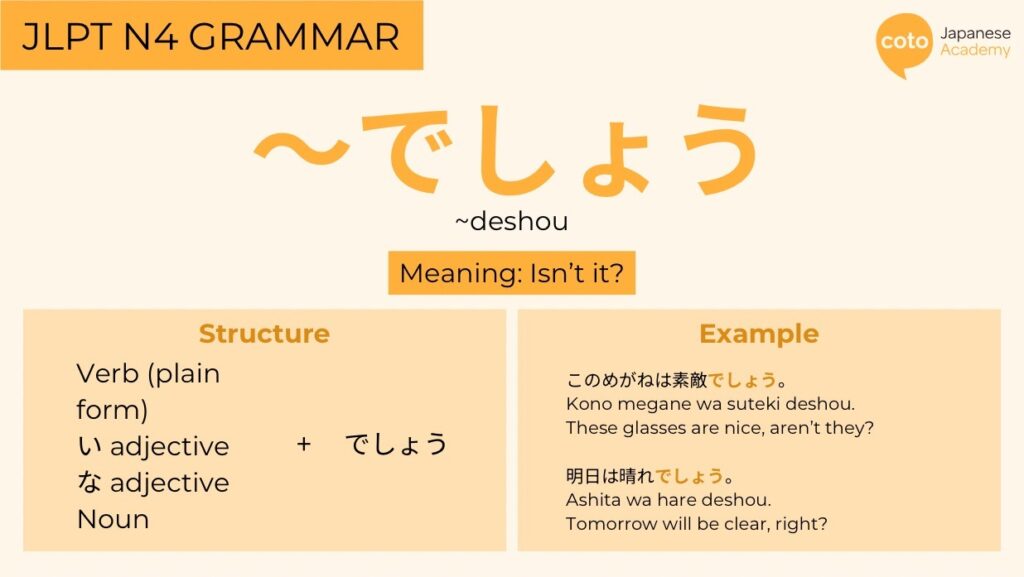
Ever used the Japanese grammar, でしょう (deshou)? Picture this. You recently got these new glasses, and you think they look nice. You want to tell your Japanese friend about your new glasses, but you want them to agree that they look nice. So what do you say when you want your friend to agree with you? You can say 素敵でしょう (suteki deshou), which translates in English to “Aren’t they nice?”
In Japanese, 〜でしょう (~deshou) is a way to seek agreement on something that you said.
Grammar patterns such as だろう or じゃない can be used to convey a similar meaning, whether you’re looking for sympathy, speculating, or want to confirm something. But which ones should you use and when? Knowing the difference between these grammar patterns can make or break your Japanese ability, and it can be the difference between sounding fluent and not.
In this blog post, we’ll show you how to use でしょう (deshou) as well as similar grammar patterns you can use to seek agreement, sympathy, and more.
Check Out Our Video Lesson on でしょう (Deshou)
Before you dive in, check out our quick video lesson on でしょう with our Japanese teacher, Nami-sensei!
Meaning of でしょう
でしょう is a grammar pattern that is used to seek agreement with the person you’re talking to. For example, you might use this grammar pattern to seek agreement with someone when talking about how expensive the food is at a restaurant:
このレストランの値段は高いでしょう。 Kono resutoran no nedan wa takai deshou. This restaurant is quite expensive, isn’t it?
You can also use this grammar pattern in other ways:
You can use it to sympathize with someone
Or to speculate about something based on one’s assumption.
今日は寒かったでしょう。早く入って。 Kyou wa samukatta deshou. Hayaku haitte. It must have been cold today. Come in quick.
田中さんはお金持ちでしょう。 Tanaka san wa okane mochi deshou. Tanaka-san is probably rich.
All Functions of でしょう
1. Use でしょう for Speculation
One of the most fundamental uses of でしょう in Japanese is to express uncertainty or speculation. It’s commonly used when the speaker wants to offer their best guess or interpretation.
However, でしょう does more than just show uncertainty. It also signals that the speaker is presenting their own opinion or perspective to the listener. Because of this, it can sometimes create a slightly assertive or confident tone.
In other words, even though you’re not 100% certain, you’re still guiding the listener toward your viewpoint.
For example, if you say:
明日は雨が降るでしょう。 Ashita wa ame ga furu deshou.
(It will probably rain tomorrow.)
In this case, you’re offering a considered opinion, perhaps based on a weather forecast or personal judgment.
2. Use でしょう for Showing Shared Understanding
Another common use of でしょう is to seek agreement or confirm shared understanding with the listener.
In this case, the speaker isn’t just expressing uncertainty—they’re inviting the listener to agree with them. It’s similar to saying “right?” or “don’t you think?” in English.
This usage softens the statement and makes it more conversational, helping build a sense of connection between the speaker and the listener.
For example, if you and your friend just watched a great movie, assuming the other person feels the same way, you can say:
この映画は面白いでしょう?
Kono eiga wa omoshiroi deshou?
(This movie is interesting, right?)
3. Use でしょう to Seek Validation
Another important function of でしょう is to show shared understanding by making a thoughtful assumption about the listener’s situation. In many cases, this can feel like confirming information while also expressing empathy.
LAで働いています。 LA de hataite imasu. I work in LA.
そうなんだ。毎日、通勤大変でしょう。 Sou nan da. Mainichi, tsuukin taihen deshou. Really? Commuting every day must be tough, right?
In this conversation, 「でしょう」 shows that the second person is making a reasonable guess about the speaker’s situation. At the same time, they present it as something likely true, which creates a sense of empathy and understanding.
4. Use でしょう to Seek Information
In conversation, でしょう」can also be used to ask questions and seek information. This usage often appears with question words such as なん (what), だれ (who), どこ (where), いつ (when), and なんで (why), and it adds a higher level of politeness and formality to the question.
どなたでしょう?
(Who are you?)
This sounds polite and somewhat formal, often used in situations like answering the phone or speaking to someone whose identity is unclear.
Grammar Structure of でしょう
Below is a basic grammar structure of でしょう as well as its meaning:
For な adjectives, omit the な at the end before using でしょう.
Other Alternatives to でしょう
1. だろう (Darou)
だろう can be translated as “probably” or “I assume” as this grammar pattern is used to speculate something based on one’s interpretation. It’s a more casual and assertive way of saying でしょう. You can also use this grammar pattern to confirm or find more information.
今日は雨が降るだろう。 Kyou wa ame ga furu darou. Today is probably going to rain.
袋に入った物は果物だろう。 Fukuro ni haitta mono wa kudamono darou. The thing in the bag is probably fruit.
2. じゃない (Ja nai)
Translated as “isn’t it,” it may look like you’re expressing disagreement with this grammar pattern, but like でしょう, you can also use it to seek agreement with someone. However, since you’re asking a question using じゃない, it can sound more blunt. We recommend adding か to the end of the grammar pattern to sound more polite, since it translates as “don’t you think?”
Type
Structure
Phrase
Phrase + じゃない + か
これは水じゃない?
Kore wa mizu ja nai?
This is water, isn’t it?
佐藤さんは事務所に来るんじゃないか?
Satou san wa jimusho ni kurun ja nai ka?
Isn’t Satou-san coming to the office?
3. ではないか (De wa nai ka)
This grammar pattern is the more polite version of じゃないか. Only use this grammar pattern when you’re expected to be polite, as it might sound unnatural.
Type
Structure
Phrase
Phrase + ではないか
今日は寒いではないか。
Kyou wa samui de wa nai ka.
Today is cold, isn’t it?
三田さんは会社員ではないか。
Mita san wa kaishain de wa nai ka.
Isn’t Mita-san a salaryperson?
4. ね (Ne)
Commonly translated as “isn’t it,” or “right,” this is a sentence-ending particle that is used to look for agreement or confirmation about something. It works similarly to でしょう,
Type
Structure
Sentence
Sentence + ね
今日は暑いね。
Kyou wa atsui ne.
Today is hot, right?
昨日のテストは難しかったね。
Kinou no tesuto wa muzukashikatta ne.
Yesterday’s test was quite difficult, wasn’t it?
Conclusion: Use でしょう when you want to seek agreement, sympathy, or speculation
でしょう is a versatile grammar pattern used to seek agreement or sympathy, or when you want to speculate on something. The next time you want to talk about something based on your own assumptions, or whether you want to get someone to agree with you on something, use this grammar pattern!
Interested in improving your Japanese? Learn with Coto Japanese Academy!
If you want to learn beyond these grammar patterns, why not study Japanese with us? With campuses in Shibuya, Yokohama, Iidabashi, Minato, Shinjuku, and online, Coto Academy has been offering lessons focused on practical Japanese for over 25 years.
We offer part-time, intensive, and fully online lessons to suit your schedule. Fill out the form below for a free level check and start your Japanese learning journey with Coto Academy today!
Want to keep improving your Japanese grammar? Check out more guides and take your skills to the next level.
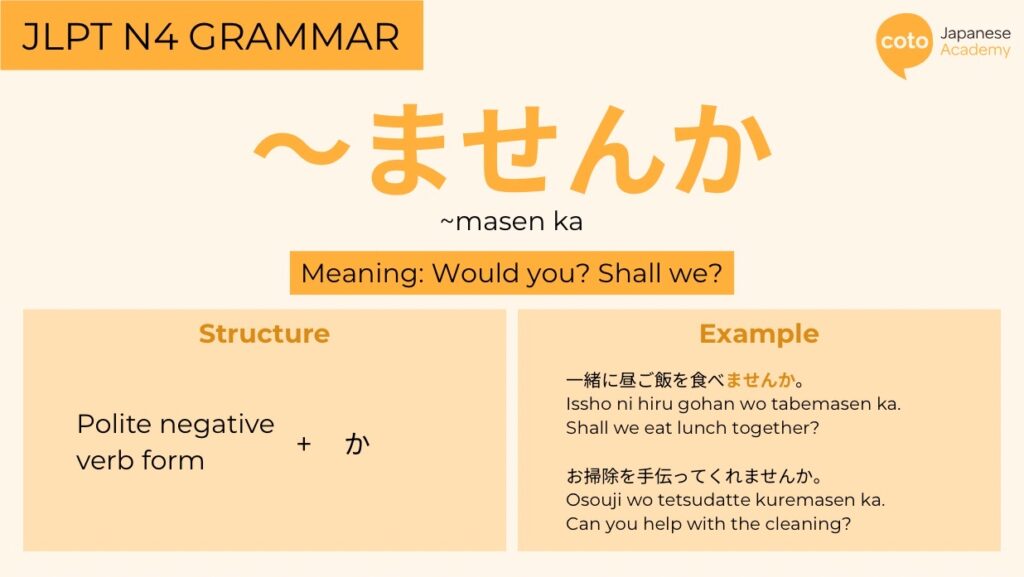
Ever heard a Japanese friend say いっしょに食べませんか? (issho ni tabe masenka) and wanted to respond, or say the same thing yourself? ~ませんか (masen ka) is one of the most natural and polite ways to make suggestions and invitations in Japanese. In this context, 食べませんか (tabemasenka) literally translates as “Won’t you eat?” but naturally means “Would you like to eat?” or “Shall we eat?”
But ませんか isn’t the only pattern worth knowing. Japanese has several similar expressions, like ~ましょうか (mashou ka) and ~ないか (nai ka), each with its own nuance and formality level. Knowing which to reach for is what separates textbook Japanese from real conversation.
In this blog post, we’ll show you how to use this handy grammar pattern, as well as similar grammar patterns you can use to make a suggestion or an invitation.
Make Sure to Watch Coto Academy’s YouTube Video About 〜ませんか (Masenka)!
Before you continue reading, why not take a moment to watch a quick YouTube lesson with our Japanese teacher, Nami-sensei?
Meaning of ~ませんか (Masenka)
~ませんか (masen ka) is a grammar pattern used to invite the listener to do something with the speaker. Translated into English, it means “would you like to,” “shall we,” or “will you.” By using this grammar pattern, you’re asking the person to do something with you whilst waiting for a response from them, whether it be an acceptance of the invitation or a rejection.
Difference between ~ませんか (Masenka) and ~ましょうか (Mashouka)
~ませんか (masen ka)
~ましょうか (mashou ka)
Core Meaning
Polite suggestion or invitation
Proactive suggestion or offer
Speaker’s Stance
Passive (leaves the decision to the listener)
Active (speaker initiates the action)
Nuance
“Would you like to…?”
“Shall I / Shall we…?”
Best Used When
Inviting someone into an activity politely
Offering help or proposing the next move
Both ~ませんか (masen ka) and ~ましょうか (mashou ka) are used to make suggestions or invitations in Japanese, but they carry distinct nuances that trip up many learners. So how are they different?
~ませんか leans toward the speaker’s perspective, inviting the listener. It’s polite, a little tentative, and leaves the decision entirely in the other person’s hands, making it ideal for invitations to someone you don’t know well or want to show respect to.
~ましょうか, on the other hand, comes from the speaker’s own initiative. It either offers to do something for the listener. For example, if you want to take the initiative to carry heavy luggage, you can say:
Take a look at these two sentences:
一緒に昼ご飯を食べましょうか。 Issho ni hiru gohan wo tabemashou ka. Shall we eat lunch (together)?
一緒に昼ご飯を食べませんか。 Issho ni hiru gohan wo tabemasen ka. Would you like to eat lunch (together)?
While both grammar patterns are polite ways to invite the listener to do something, ~ませんか (masenka) is more used for invitations to join the speaker, while ~ましょうか is used to suggest doing something together. In addition, compared to ~ませんか, which sounds softer, ~ましょうか sounds more assertive.
In the case of ましょうか, you’re showing the listener that you’re willing to do something with the listener before they agree to do it with you. This grammar pattern is usually used when you want to help someone with a task, such as carrying someone’s bag:
荷物を持ちましょうか。 Nimotsu wo mochimashou ka. Shall I carry your bags?
For ませんか, you’re respecting the listener’s opinion, which means you’re waiting for an answer from them. When you’re using this grammar pattern, it suggests that you’re waiting for the listener’s response.
Below are the common structures in which 〜ませんか (masenka) is commonly used:
Structure
Meaning
Verb ます+ ませんか
To invite someone to do something
For group 1 verbs (such as 買う, 行く) or group 2 verbs (such as 食べる or 見る), the grammar pattern is as follows:
Verb + ませんか
If you’re using this grammar pattern for irregular verbs (ex. する, くる), the grammar pattern is as follows:
Verb (stem) + ませんか
JLPT N5 〜ませんか Example sentences
As mentioned before, you can use this grammar pattern to invite someone to do something with you. For example:
ゆみさん、一緒に映画を見ませんか。 Yumi san, isshoni eiga wo mimasenka. Yumi-san, would you like to watch a movie (together)?
一緒に昼ごはんを食べませんか。 Issho ni hiru gohan wo tabemasen ka. Would you like to have lunch together?
私の家に遊びに行きませんか。 Watashi no ie ni asobi ni ikimasen ka. Do you want to come to my place?
映画を見ませんか。 Eiga wo mimasen ka. Do you want to watch a movie?
Alternatives to ~ませんか (Masenka)
While ~ませんか is your go-to for polite invitations, Japanese gives you several other patterns to express suggestions, each with its own level of formality, nuance, and social weight. Here is a breakdown of the most useful alternatives.
1. 〜ましょうか (mashou ka)
As we discussed, this is another way to ask someone to do something with you. Unlike ~ませんか, which puts the decision in the listener’s hands, ~ましょうか comes from the speaker’s proactive intention to act. It feels slightly more assertive
2. ~ないか (nai ka)
This is the casual way of saying ~ませんか. You can use this grammar pattern when you’re with friends or family. The nuance is more direct and relaxed than ~ませんか. It drops the formality entirely, so while it sounds natural among close friends, using it with a superior or stranger would come across as blunt or even disrespectful.
Type
Structure
Verb (ない form)
Verb + ないか
今年の夏、一緒にビーチに行かないか? Kotoshi no natsu, isshoni biichi ni ikanai ka? Want to go to the beach together this summer?
新しいレストランへ食べに行かないか? Atarashii resutoran e tabe ni ikanai ka? Want to eat at this new restaurant?
3. ~たらどう (tara dou)
This can be translated into English as “why don’t you” or “you should do this.” Unlike ~ませんか, which is used to invite someone to do something together, ~たらどう is directed entirely at the listener as a piece of advice — the speaker is not included in the action. Use it with care, as it can easily sound condescending or preachy if the relationship or tone isn’t right.
Type
Structure
Verb (たform)
Verb + たらどう Verb + たら
疲れたら、早く寝たらどうか。 Tsukaretara, hayaku netara dou ka. If you’re tired, why don’t you sleep early?
試験に失敗したら、もっと勉強したらどうか。 Shiken ni shikkaku shitara, motto benkyou shitara dou ka. If you fail the exam, why not study a bit more?
4. 〜てくれない (~te kurenai)
This grammar point is used when you ask the listener to do something for you, making it different from ~ませんか, which is an invitation to do something together. The focus here is on a favour or request directed at the other person. You can also convert this to the polite forms くれませんか (kuremasen ka) or もらえませんか (moraemasen ka) when speaking to someone you don’t know well. Be careful not to use 〜てくれ on its own, as it drops all politeness and can sound demanding or rude.
Be careful not to say 〜てくれ as it might come off as rude.
Type
Structure
Verb (て form) Verb (ないで)
Verb + てくれないVerb + てもらえない
日本語を教えてくれませんか。 Nihongo wo oshiete kuremasen ka. Would you please teach me Japanese?
出かけたら、コンビニで弁当を買ってくれない? Dekaketara, konbini de bentou wo katte kurenai? If you go out, would you buy me a bento at the convenience store?
Conclusion
The grammar ませんか (masenka) is handy when you want to invite someone to do something with you. Try using this grammar pattern the next time you want to grab a meal, check out a new place of interest, or even when you want to help someone with a certain task!
Learn More JLPT Grammar with Coto Academy!
Coto Academy has been offering Japanese classes for over 25 years, with campuses in Shibuya, Yokohama, Iidabashi, Minato, Shinjuku, and online. Our courses focus on practical Japanese, so the grammar you learn is designed for real-life use.
We offer part-time, intensive, and fully online lessons to suit your schedule. Start learning Japanese effectively and confidently with Coto Academy today! Fill out the form below for a free level check.
FAQ
What does ませんか mean?
ませんか (masen ka) means “will you,” or “would you” in Japanese. This grammar point is used to ask someone to do something with you, while respecting their opinion.
How do you use ませんか in a sentence?
Use this grammar pattern when you want to suggest doing something with the listener, such as inviting them out for lunch.
What’s the difference between ませんか and ましょうか?
When you’re using ましょうか (mashou ka), it implies that you’re willing to take on that action before the listener has a chance to respond, whereas ませんか (masen ka) implies that you respect the listener’s opinion or response.
Want to keep improving your Japanese grammar? Check out more guides and take your skills to the next level.
When learning Japanese, you may hear someone mention something unfamiliar using the grammar pattern という (to iu). This expression is commonly used to connect two nouns and introduce or explain a name, term, or concept. In English, it often translates to phrases like “called,” “known as,” or “something called…”
In this lesson, we’ll explore how という works, how it connects nouns, and look at several example sentences to help you understand how it’s used in everyday Japanese.
Make Sure to Watch Coto Academy’s YouTube Video About という!
Before you continue reading, why not take a moment to watch a quick YouTube lesson with our Japanese teacher, Nami-sensei?
Meaning of という
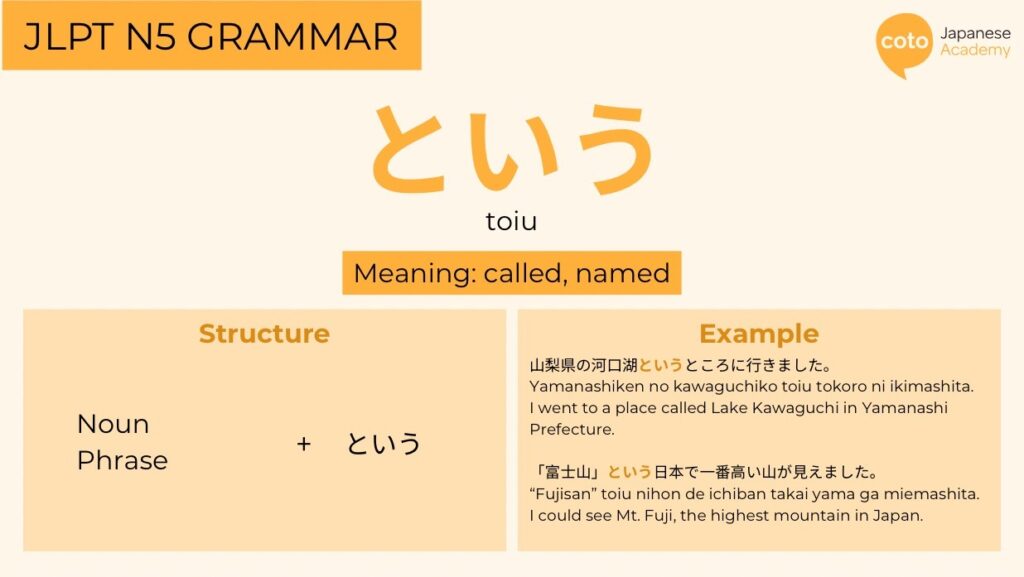
という is a way to define something, someone, or some place that isn’t known to the listener. It connects two nouns in order to introduce, explain, or identify something by name. It often translates into English as “called,” “known as,” or “something/someone called…”.
This is unlike its most basic usage, which is to indicate what someone says or said. For example:
ご飯を食べる前に、「いただきます」と言います。
Gohan wo taberu mae ni, “itadakimasu” to iimasu.
Before we eat, we say “itadakimasu.”
Although 言う (iu) means to ‘say something’, it actually implies that the listener doesn’t know about the information the speaker is talking about, and requires knowledge that isn’t known to them yet.
It is commonly used when:
Introducing a name
Explaining a term or concept
Referring to something someone said
Describing a category or type
You shouldn’t use this grammar point to define things that are common knowledge; for example, a place like Tokyo or food like sushi; everyone knows what Tokyo or sushi is. Only use this grammar point for things that aren’t common knowledge.
Grammar Structure of という
Below are the common structures in which という is used.
Structure
Pattern
Meaning
Noun + という + Noun
N + という + N
A noun called/known as something
Clause + という + Noun
Sentence + という + N
A noun described by a clause
Noun + という
N + という
Something called/known as
Sentence + という
Sentence + という
It is said that / the statement that
In simple terms, という works like a label or explanation marker. It links information (a name, phrase, or sentence) to a noun so that it can be described or identified.
For beginners, the most common and easiest pattern is:
Noun + という + Noun
Note that という is usually not used as a complete sentence by itself. It typically connects a word, phrase, or clause to a noun, so it needs to be followed by another word to complete the idea!
日本という国が好きです。 Nihon to iu kuni ga suki desu. I like the country called Japan.
Here, 日本という describes 国 (country), so the sentence continues and becomes complete.
Because of this, という is usually part of a larger phrase, rather than ending a sentence on its own.
Now that you know how to form sentences using this structure, let’s explore a few example sentences that use という (to iu). As mentioned before, you can use this grammar pattern to define or explain something, someone, or some place that might be unknown to the listener. For example:
私は先週、山梨県の河口湖というところに行きました。
Watashi wa senshuu, yamanashi ken no kawaguchiko to iu tokoro ni ikimashita.
Last week, I went to a place called Lake Kawaguchi in Yamanashi Prefecture.
「富士山」という日本で一番高い山が見えます。
“Fuji san” toiu ichiban takai yama ga miemasu.
I can see Mt. Fuji, the highest mountain in Japan.
You can also use といいます (to iimasu) to introduce something that the listener doesn’t know about.
この場所は日本語で何といいますか。
Kono basho wa nihongo de nanto iimasu ka.
What do you call this place in Japanese?
温泉の名前は「ゆらり」といいます。
Onsen no namae wa “yurari” to iimasu.
The name of the hot spring is called “Yurari.”
More ways to use という
1. ということ (toiu koto)
ということ (toiu koto) is a grammar pattern that is used to convert a phrase into a noun. It can be translated to “A is said to be.”
Is it true you’re going back to your country next month?
2. ということだ (toiu koto da)
This can be translated in English as “I heard that,” “Rumor has it that,” or “It means that.” Use this grammar pattern to talk about something that you heard from another person.
Satou san to Kinoshita san wa, kekkonshita toiu koto da.
Rumor has it that Satou-san and Kinoshita-san got married.
このイベントは中止されるということだ。
Kono ibento wa chuushi sareru toiu koto desu.
I heard that the event got cancelled.
3. というのは (toiu no wa)
Use this grammar pattern to define or explain something that isn’t known to the listener. It can be translated as “the meaning of A is B,” or “A, that is to say B.”
“Azasu” toiu no wa “arigatou gozaimasu” no mijikakushita iikata desu.
“Thanks” is a shortened way to say “thank you very much.”
4. というと (toiu to)
This grammar point can be translated to “speaking of…” in English. Use it in response to remind the speaker of something related to the topic being discussed earlier, or to provide more information on the subject.
Type
Structure
Noun
Noun + というと
仕事というと、山田さんが仕事を辞めるのを聞いたことがありますか。
Shigoto to iu to, Yamada san ga shigoto wo yameru no wo kiita koto ga arimasu ka.
Speaking of work, did you hear that Yamada-san is leaving their job?
日本料理というと、かけうどんが一番です。
Nihon ryouri toiu to, kakeudon ga ichiban desu. Speaking of Japanese cuisine, Kake Udon is the best.
Conclusion
という can be useful for explaining information that others might not know about, whether it be talking about a niche place you want to introduce others to, a person of interest, or something that listeners might not be aware of. Try using it the next time you want to talk about your favorite things!
Learn More JLPT Grammar with Coto Academy!
Coto academy has been offering Japanese classes for over 25 years, with campuses in Shibuya, Yokohama, Iidabashi, Minato, Shinjuku, and online. Our courses focus on practical Japanese, so the grammar you learn is designed for real-life use.
We offer part-time, intensive, and fully online lessons to suit your schedule. Start learning Japanese effectively and confidently with Coto Academy today! Fill out the form below for a free level check.
FAQ
What does という (toiu) mean?
という (toiu) means to “say something,” but in this context, this means to describe, define, or explain something that isn’t known to the listener.
How do you use という (toiu) in a sentence?
You can use という to define or explain something to the listener, for example, when you’re describing a place that isn’t common knowledge, or a food not everyone knows about.
When should you not use という (toiu)?
Don’t use という when the place, thing, or someone you’re defining or explaining is common knowledge.
To ask someone not to do something in Japanese, you typically use the JLPT N5 grammar pattern 〜ないでください (naide kudasai). It is similar to saying “please do not do (something)” in English and is a polite way to request that someone refrain from an action, though it can also be framed as an instruction, advice, or recommendation.
Basically, using ないでください, you are asking a person not to perform a certain action. It is the opposite of 〜てください, which is used to ask someone to do something.
Let’s learn how to use this JLPT N5 grammar point by breaking down its meaning, structure, and example sentences.
Make Sure to Watch Coto Academy’s YouTube Video About 〜ないでください (~Naide Kudsai)
Before you continue reading, why not take a moment to watch a quick YouTube lesson with our Japanese teacher, Yuka-sensei:
Meaning of 〜ないでください (~Naide Kudasai)
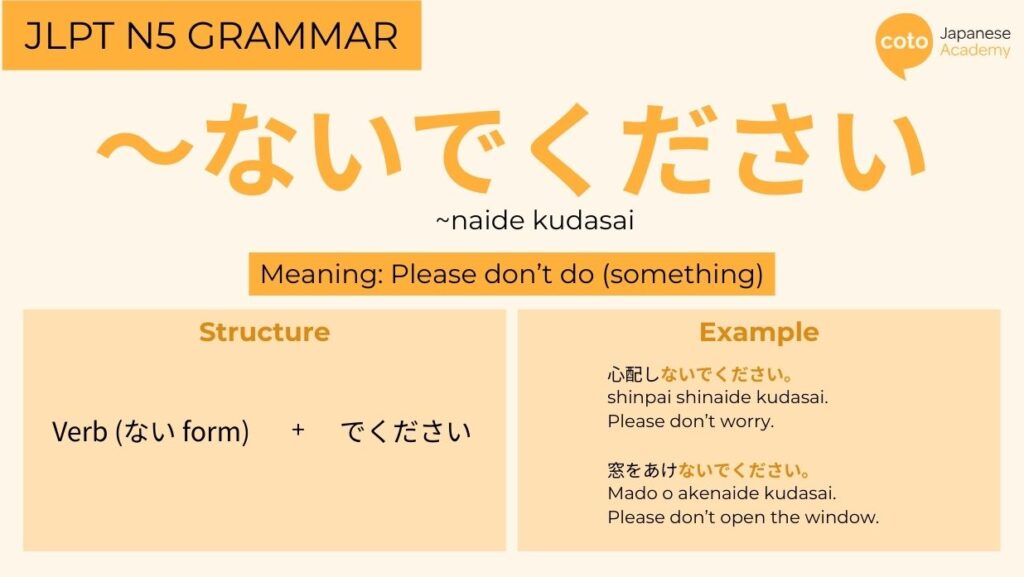
〜ないでください (naide kudasai) is a way of politely asking or requesting someone not to do something. Since it includes the phrase ください (kudasai), meaning “please”.
Although 〜ないでください is technically a polite form, it often carries a commanding tone. In Japanese culture, which values indirectness for the sake of harmony, using this in the wrong context can be an unintentional social blunder. For example, if you are speaking to a superior, such as a boss or a teacher, using 〜ないでください can sound overly direct or even bossy.
Generally, you use this expression in the following situations:
1. To kindly request that someone refrain from something
This is the most common “supportive” use of the phrase. It is often used when you are looking out for someone’s well-being or asking for a small favor that benefits them or the relationship.
無理をしないでください Muri o shinaide kudasai Don’t push yourself too hard.
2. Giving precautions or warnings
This usage is preventative. It’s meant to ensure someone’s safety or to prevent a mistake from happening before it’s too late.
3. As a softer way of denying or not giving permission
Instead of saying a flat “no” (which is very rare and often rude in Japanese), this form is used to steer someone away from an action they are about to take.
For example, if a friend is visiting your house and wants to open the window, but the AC is on, you can say:
窓を開けないでください 。 Mado o akenaide kudasai. Please don’t open the window.
3. To prohibit
On signs or in official announcements, the “politeness” of kudasai functions more like a formal rule than a personal request.
ここにゴミを捨てないでください Koko ni gomi o sutenaide kudasai Please do not litter here.
If you don’t know how to conjugate a verb into its negative form, here is a quick breakdown of how to conjugate different verbs into negative form and then use them with in 〜ないでください:
Dictionary Form
Negative Form
Example
English
撮る (toru)
撮らない (toranai)
撮らないでください (toranaide kudadsai)
Please don’t take (picture)
食べる (taberu)
食べない (tabenai)
食べないでください (tabenaide kudasai)
Please don’t eat
話す (hanasu)
話さない (hanasanai)
話さないでください (hanasaide kudasai)
Please don’t talk
捨てる (suteru)
捨てない (sutenai)
捨てないでください (sutenaide kudasai)
Please don’t throw away
開ける (akeru)
開けない (akenai)
開けないでください (akenaide kudasai)
Please don’t open
Casual Form of 〜ないでください (Naide Kudasai)
In casual conversation with friends, family, or people of equal or lower social status, you can simply omit ください (kudasai). This transforms a polite request into a casual “don” (think of it as removing the word “please”).
行かないで。 Ikanaide. Don’t go.
In even more informal contexts, adding the exclamative particle ね (ne) at the end is very common. This makes the “don’t” sound much softer. It changes “Don’t do it” to “Don’t do it, okay?” or “Make sure you don’t, right?”
忘れないでね Wasurenaide ne Don’t forget, okay?
Examples of 〜ないでください (~Naidekudasai)
Let’s explore a few examples to get a feel for how 〜ないでください works in Japanese. We will go through common examples in everyday conversation and public signs.
In Everyday Conversation
ここで写真を撮らないでください。 Kokode shashin o toranaide kudasai Please don’t take photos here.
教室で食べないでください。 Kyoushitsu de tabenaide kudasai. Please don’t eat in the classroom.
大きい声で話さないでください。 Ookii koe de hanasaide kudasai. Please don’t speak loudly.
ドアを開けないでください。 Doa o kakenaide kudasai. Please don’t open the door.
Vocabulary List
Check out all the new words in the example sentences above, and try to remember new vocabulary alongside today’s Japanese grammar
Japanese
Furigana
Reading
Meaning
ここ
ここ
koko
here
写真
しゃしん
shashin
photo
撮る
とる
toru
to take (a photo)
教室
きょうしつ
kyoushitsu
classroom
食べる
たべる
taberu
to eat
大きい
おおきい
ookii
big / loud
声
こえ
koe
voice
話す
はなす
hanasu
to speak
ゴミ
ごみ
gomi
trash/garbage
捨てる
すてる
suteru
to throw away
ドア
どあ
doa
door
開ける
あける
akeru
to open
〜ない
〜ない
nai
negative form
でください
でください
de kudasai
please do ~
Similar Grammar and Alternatives to ないでください (Naidekudasai)
When you need to move beyond the standard 〜ないでください, you have two directions: one that is much stricter/formal (prohibition) and one that is much softer/humble (requests).
1. 〜てはいけません (~Te wa ikemasen)
Meaning: “You must not…” or “It is forbidden.”
This is the standard polite way to express a strong prohibition. While it ends in the polite ~masen, the meaning is not a request; it is a rule. It is used when there is no choice in the matter.
ここでタバコを吸ってはいけません。 Koko de tabako o sutte wa ikemasen You must not smoke here.
2. 〜な (~Na)
Meaning: “Don’t!” (Command)
This is the dictionary form of a verb followed by the particle な. Despite its short length, it is the most aggressive and blunt way to tell someone not to do something.
You might hear it used by a father to a child in a moment of danger, or by characters in high-stakes movies. For instance, “動くな!” (Ugoku na!) means “Don’t move!” and carries a very commanding, almost barked tone.
3. 〜ないでいただけますか (~Naide itadakemasu ka)
Meaning: “Could you please not…?”
This is the most common way to be “more polite” than ~naide kudasai in a social or professional setting and keigo. By turning the request into a question, you are technically asking the other person if they would be willing to “grant you the favor” of not doing something.
Learn More JLPT Grammar with Coto Academy!
Next time you read a sign with 〜ないでください (~naide kudasai) on a sign, you know it’s asking not to do something! But if you want to practice using this JLPT grammar and many others in actual Japanese conversations, nothing beats practicing with a teacher who can offer practical guidance. So, consider signing up with us at Coto Academy!
Why Study at Coto Academy?
Coto Academy has been offering Japanese classes for over 25 years, with campuses in Shibuya, Yokohama, Iidabashi, Minato, Shinjuku, and online. Our courses focus on practical Japanese, so the grammar you learn is designed for real-life use.
We offer part-time, intensive, and fully online lessons to suit your schedule. Start learning Japanese effectively and confidently with Coto Academy today! Fill out the form below for a free level check.
FAQ:
What does 〜ないでください mean?
〜ないでください means “Please don’t do (something).” By adding this phrase to the end of a verb (negative form), you are politely asking them to refrain from something or to decline permission. It’s often on signs to communicate that something is not permitted.
Is 〜ないでください considered polite?
It is generally considered to be polite, being widely used in everyday conversation, public announcements, signs, and classroom settings. It’s similar to saying “please do not…” However, it can still be considered direct, so it might not always be the best in certain situations, like with your boss.
What is the casual version of 〜ないでください?
By dropping ください (kudasai), meaning “please,” you can make the expression more casual. For example, 食べないで (tabenaide), or “don’t eat,” would be considered more informal. For something very casual and to express a stronger demand, you can say 食べな (tabena), or “no eating!” But note this expression is rather rud
For Japanese learners, a significant milestone to aim for is the JLPT N5 exam, which evaluates basic proficiency in the language. But whether you’re taking the test or not, you’ll come across JLPT N5 grammar points either way, especially during the first year of your study, as it covers the very basic foundation of the Japanese language.
Although mastering these 30 grammar points alone won’t make you speak Japanese like a native, they are incredibly common and widely used in everyday conversations regardless of your fluency. So, let’s delve into some essential JLPT N5 grammar points that are crucial to know!
Study the JLPT Smarter with Coto Academy!
Are you planning to take the JLPT this July or December? While self-study is a great start, the JLPT is notorious for its strict time limits and tricky reading sections. Coto Academy students have a 35% higher pass rate than the national average, thanks to our proven JLPT Prep Course. We offer two flexible options: a year-round JLPT course and an intensive 3-month sprint course timed perfectly before test day. What makes these classes stand out is the teachers, who specialize in teaching JLPT. They will give you tips and techniques you simply won’t get from self-study.
Here, you will learn everything, including mock tests, reading practices, and explanations on Japanese grammar, vocabulary, kanji, and more! Join our class today!
This is the most basic grammar point that you’ll learn right after hiragana and katakana.
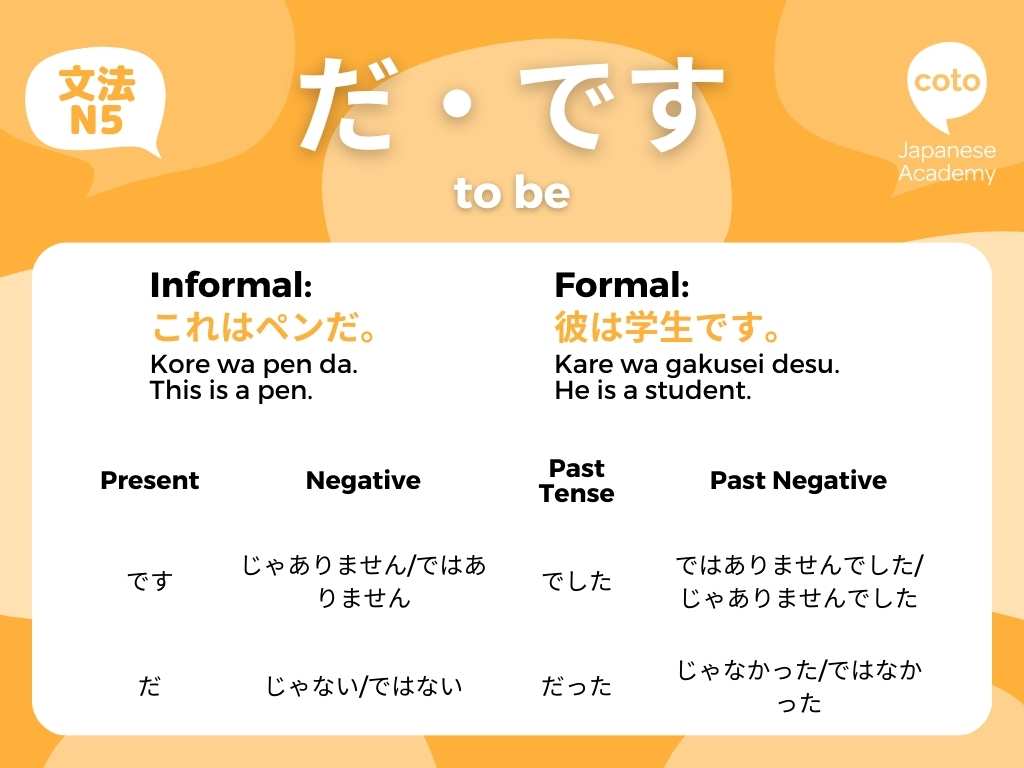
In Japanese, “da” (だ) and “desu” (です) are both copula verbs used for different levels of politeness and formality that make up the very basic sentence pattern. They serve as the equivalent of the English verb “to be” and are used to make statements or descriptions about nouns or noun phrases.
“Da” is the informal form of the copula verb and is commonly used in casual conversations or when speaking with close friends and family. It is often used in plain sentences or in informal situations. For example:
これはペンだ。 Kore wa pen da. This is a pen.
“Desu” is the polite form, and it’s widely used in formal situations, polite conversations — or when addressing people you are not familiar with. For example:
彼は学生です。 Kare wa gakusei desu. He is a student.
You can conjugate だ/です (da/desu) into negative, past tense, and past-negative forms that are similar to the English language.
Present
Negative
Past tense
Past negative
です
じゃありません/ではありません
でした
ではありませんでした/じゃありませんでした
だ
じゃない/ではない
だった
じゃなかった/ではなかった
2. にいます/あります (ni imasu/arimasu)
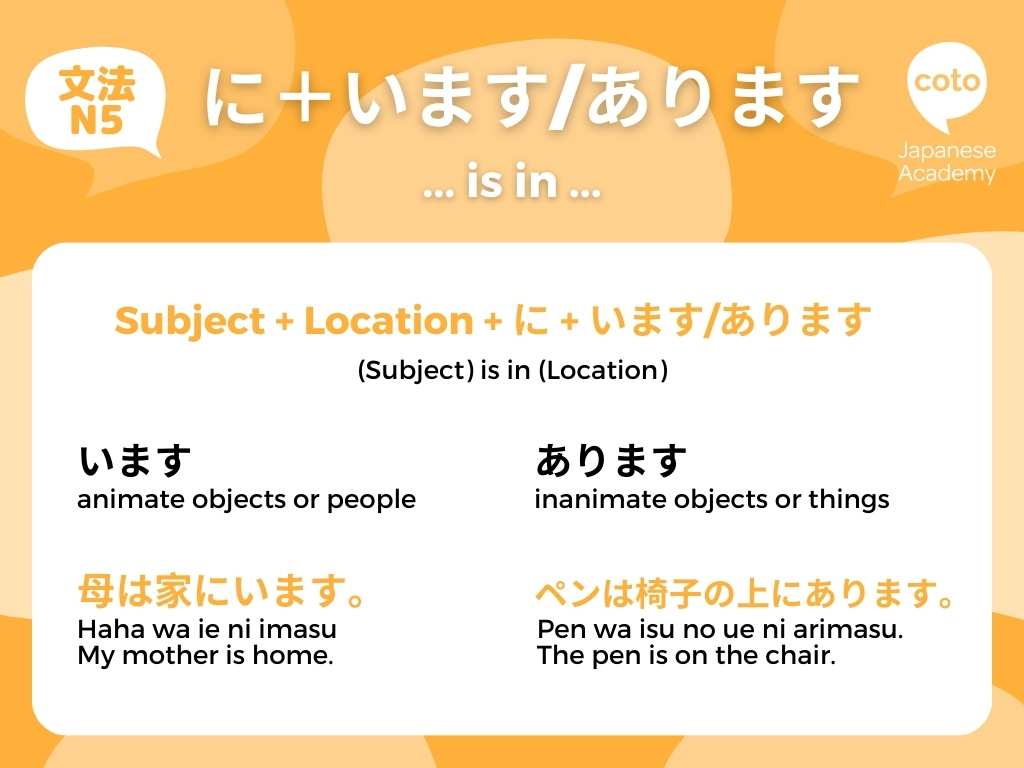
For basic Japanese grammar rules, に (ni) is used as a general preposition that means “in” in English to indicate the location of a person or object. If you are just starting to learn the language, the sentence structure you should first be learning is below:
Subject + Location + に + います/あります (Subject) is in (Location)
います and あります are both Japanese verbs used to indicate the existence or presence of animate and inanimate objects, respectively. あります is used for inanimate objects or things, while います is used for animate objects or people.
3. に/へ (ni/e)
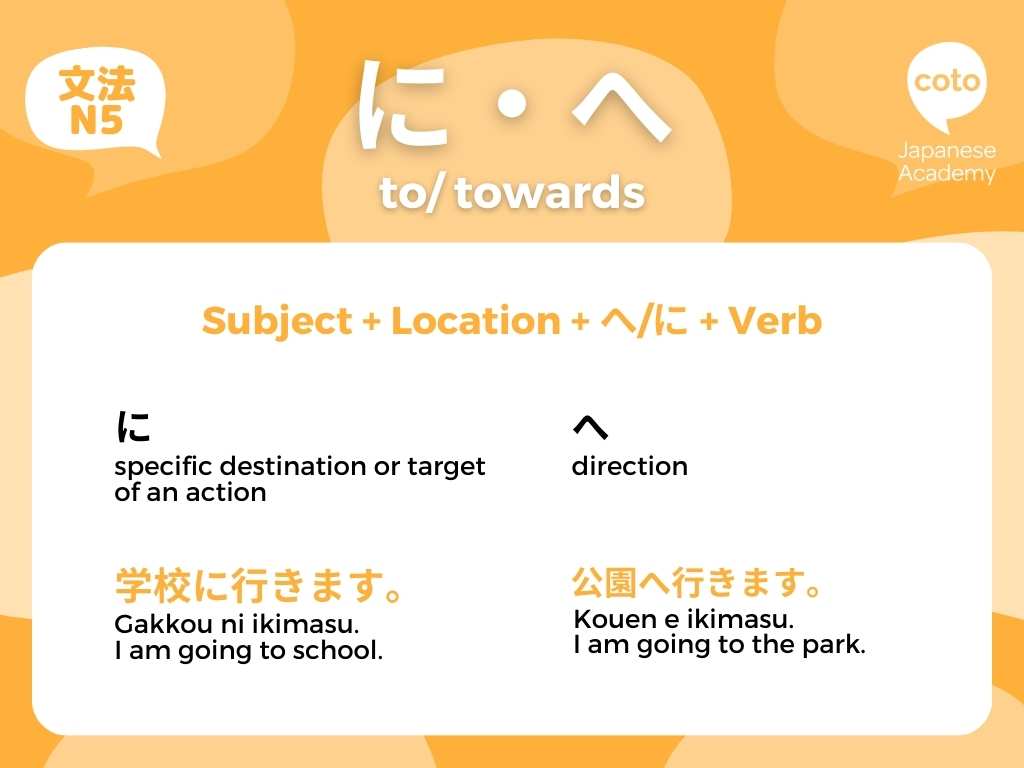
In Japanese, both “に” (ni) and “へ” (e) are particles used to indicate direction or destination. While they can be translated as “to” or “towards” in English, they have slight differences in usage.
“へ” is a particle that describes a direction, while に is used to indicate the specific destination or target of an action. The basic structure for the N5 grammar point is below:
Subject + Location + へ + Verb
For example:
学校に行きます。 Gakkou ni ikimasu. I am going to school.
公園へ行きます。 Kouen e ikimasu. I am going to the park.
Of course, there are a lot of verbs you need to memorize to hold simple conversations with. aJapanese native. Check out our top 100 basic Japanese verbs here.
4. も (mo)
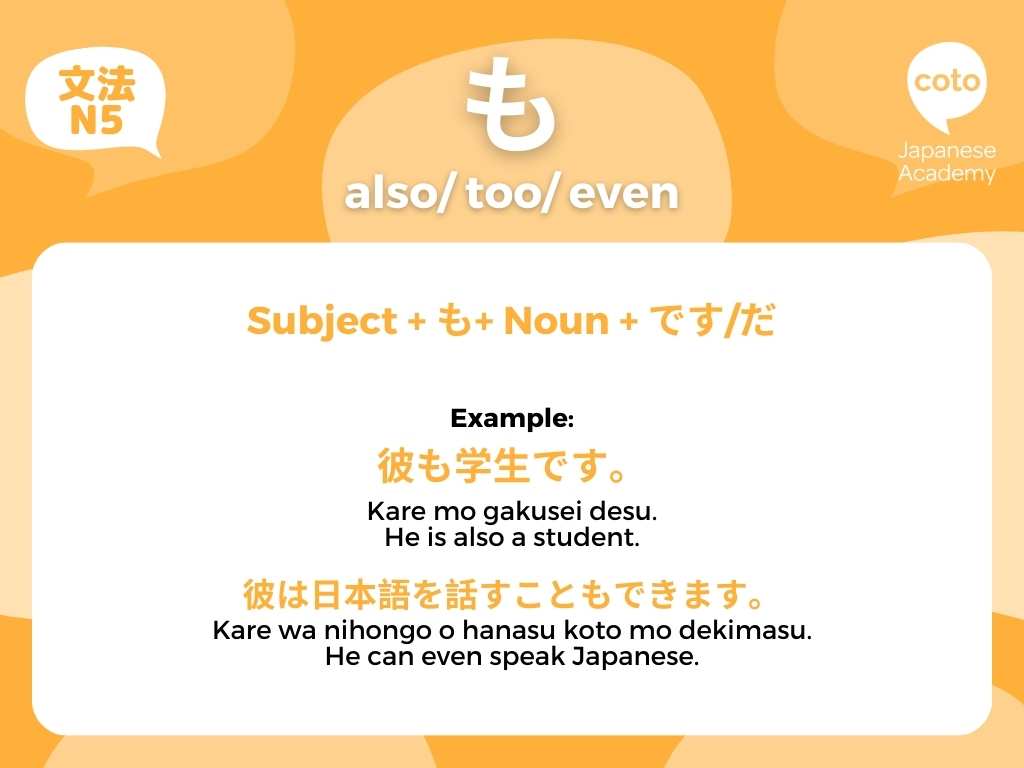
In Japanese grammar, the particle “も” (mo) is a versatile particle that has multiple uses and can be translated into English as “also,” “too,” or “even.”
For beginner and N5-level Japanese grammar, the “も” (mo) particle replaces the topic maker は (ha). For example:
彼も学生です。 Kare mo gakusei desu. He is also a student.
“も” (mo) can also emphasize a surprising or unexpected inclusion. It is used to express that the described action or situation is true even for the specific item or person mentioned.
彼は日本語を話すこともできます。 Kare wa nihongo o hanasu koto mo dekimasu. He can even speak Japanese.
For a more comprehensive guide on basic Japanese particles and their functions, head here.
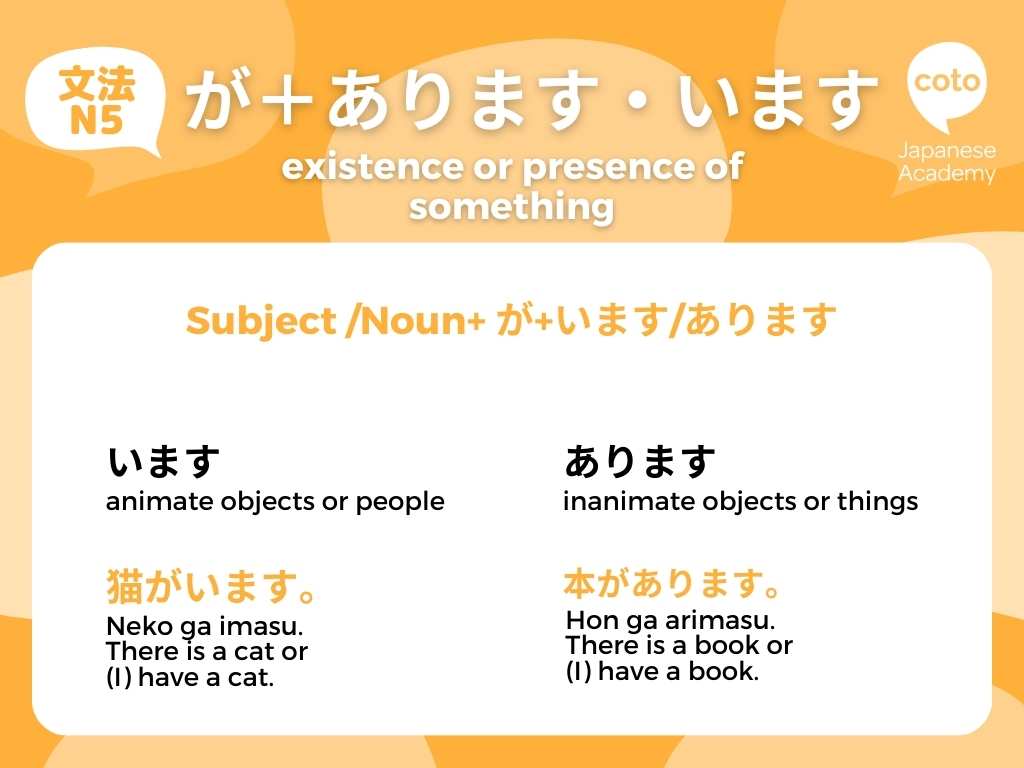
5. ~があります (ga arimasu)/~がいます (ga imasu)
The phrase “~があります” (“ga arimasu”) is used in Japanese to indicate the existence or presence of something. It is typically used with inanimate objects or non-living things.
つくえの上に本があります。 Tsukue no ue ni hon ga arimasu. There is a book on the table.
On the other hand, “~がいます” (“ga imasu”) is used in Japanese to indicate the existence or presence of animate objects or living beings. It can also be used to express the idea of someone or something “having” or “possessing” a certain characteristic or quality. For example:
猫がいます。 Neko ga imasu. There is a cat or (I) have a cat.
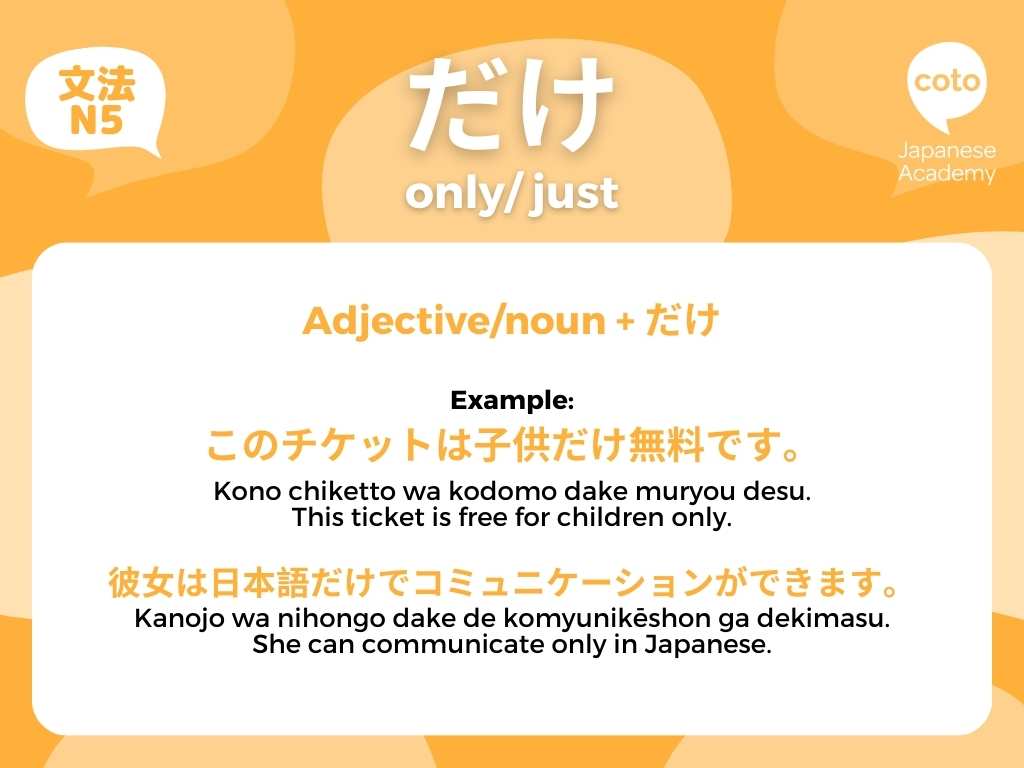
“Dake” (だけ) is a particle that is used to indicate “only” or “just.” It is used to specify a limited quantity or extent of something. “Dake” is placed after a noun or a quantity expression to indicate that there is no more than that amount or that it is the maximum.
Adjective/noun + だけ
Here are a few examples to illustrate the usage of “dake” in JLPT N5 Japanese grammar:
このチケットは子供だけ無料です。 Kono chiketto wa kodomo dake muryou desu. This ticket is free for children only.
彼女は日本語だけでコミュニケーションができます。 Kanojo wa nihongo dake de komyunikēshon ga dekimasu. She can communicate only in Japanese.
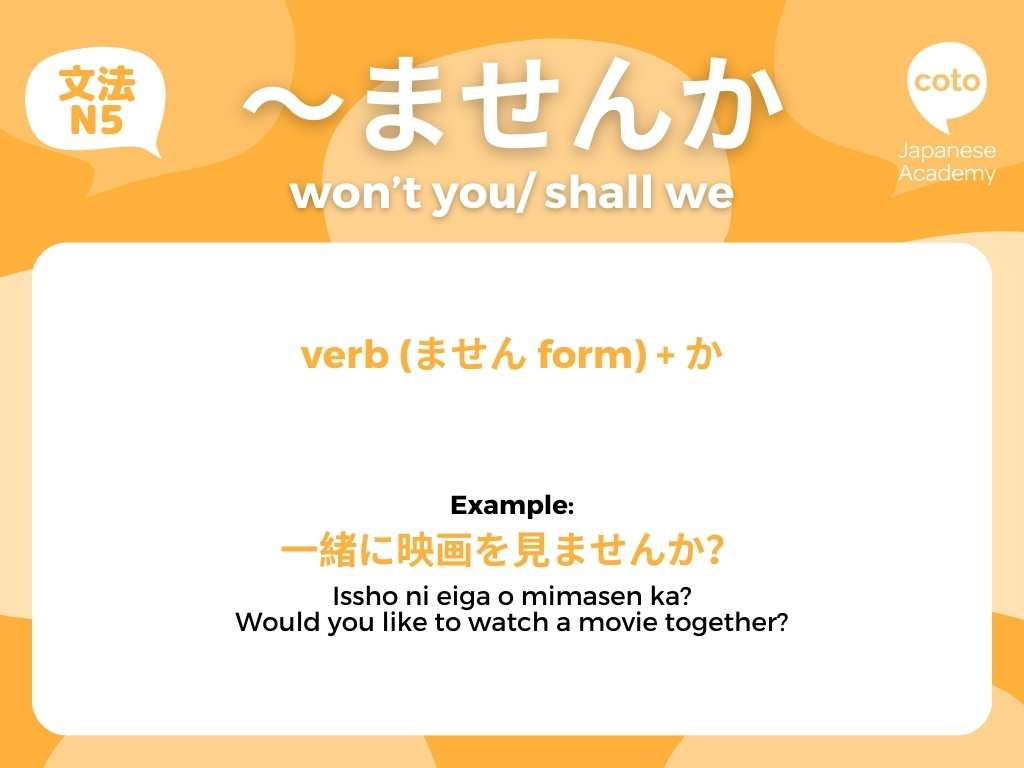
7. ~ませんか (~masenka)
For inviting someone or suggesting something, you can use the phrase “~ませんか” (“masen ka”). It is formed by adding the negative form of a verb and then attaching “か” at the end. It is commonly translated as “won’t you” or “shall we” in English.
一緒に映画を見ませんか? Goissho ni eiga o mimasen ka? Would you like to watch a movie together?
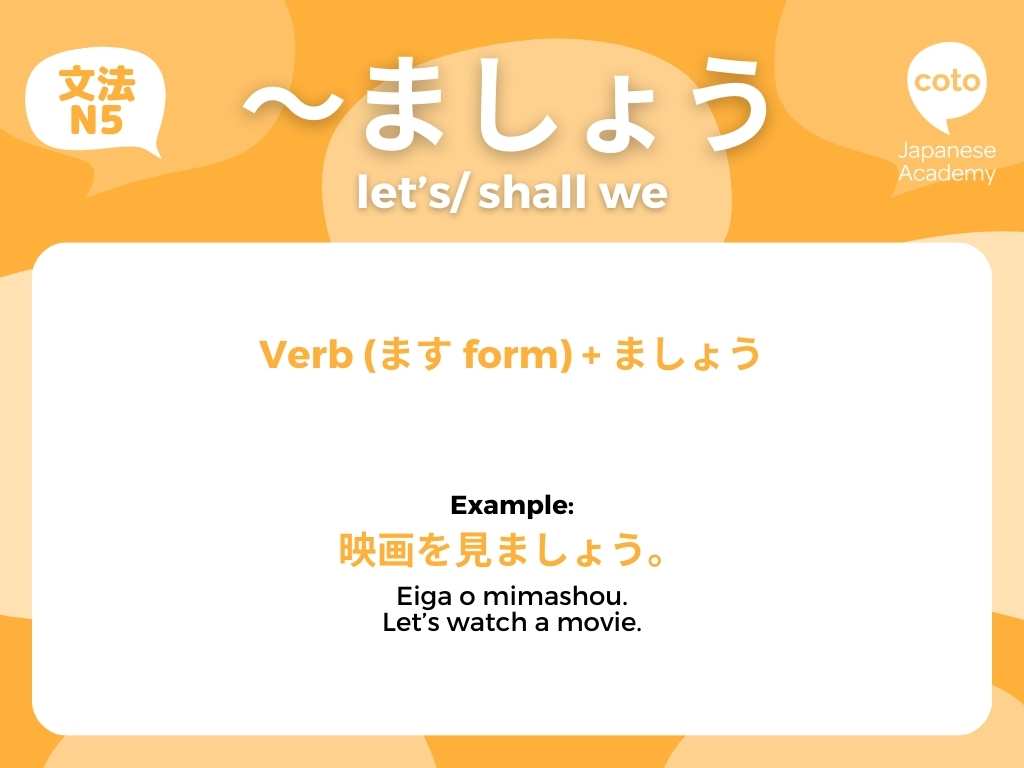
8. ~ましょう (mashou)
“ましょう” (mashou) is a volitional form commonly used to make suggestions or propose an action. It can be translated as “let’s” or “shall we” in English. You’ll use this when you want to suggest your friends or the other speaker do something — just remember that it has to be a verb!
To conjugate a verb into this form, you simply remove the ます and add ましょう:
Verb ます + ましょう
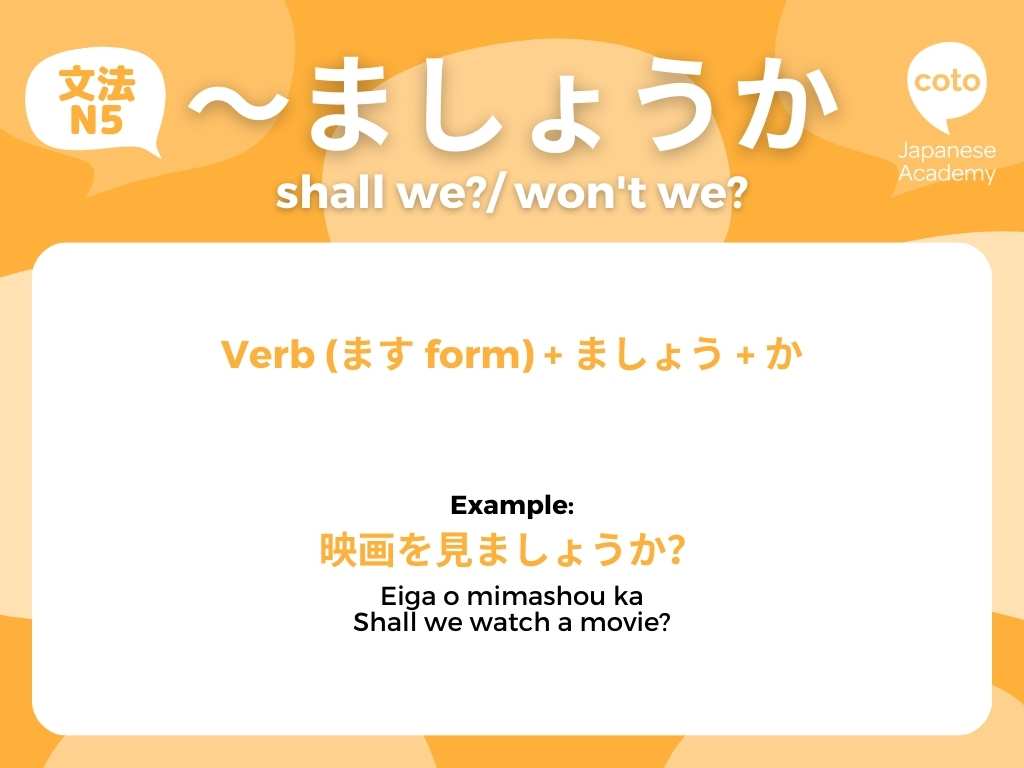
映画を見ましょう。 Eiga o mimashou. Let’s watch a movie.
9. ~ましょうか (mashouka)
“ましょうか” (mashouka) is a polite form derived from “ましょう” (mashou) by adding the question particle “か” (ka) at the end. It is used to make a polite invitation or ask for the other person’s agreement.
It has a similar meaning as ~ませんか (masenka), but it has a more direct nuance. Think of ~ましょうか as “Shall we?”, and ~ませんか as “Won’t you?”
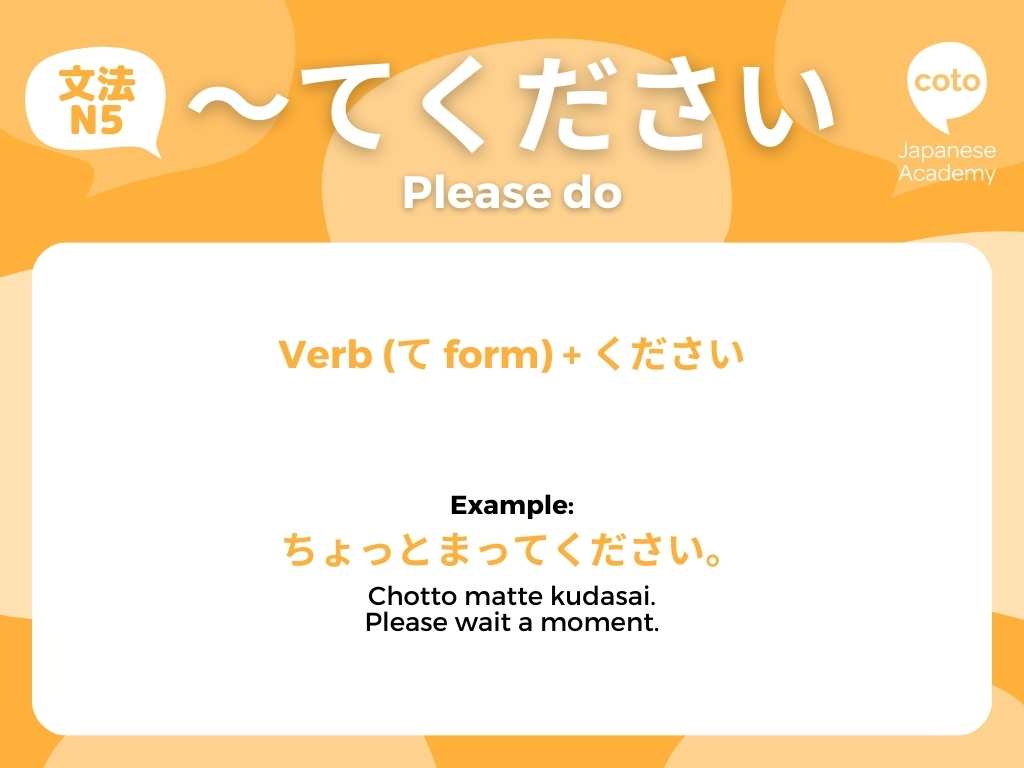
10. ~てください (te kudasai)
ください is used when you want to get something from the other speaker or party. In English, we can translate it to “Please give me (this).”
To form ~てください, you will need to know how to conjugate Japanese verbs into ~te (~て). There are three different conjugation groups, with some irregular verbs that have exceptions to the て form rules. If you haven’t learned them already, we’ve made a separate blog post on how to transform a verb into a ~te verb, complete with handy illustrated cards
ちょっとまってください。 Chotto matte kudasai. Please wait a moment.
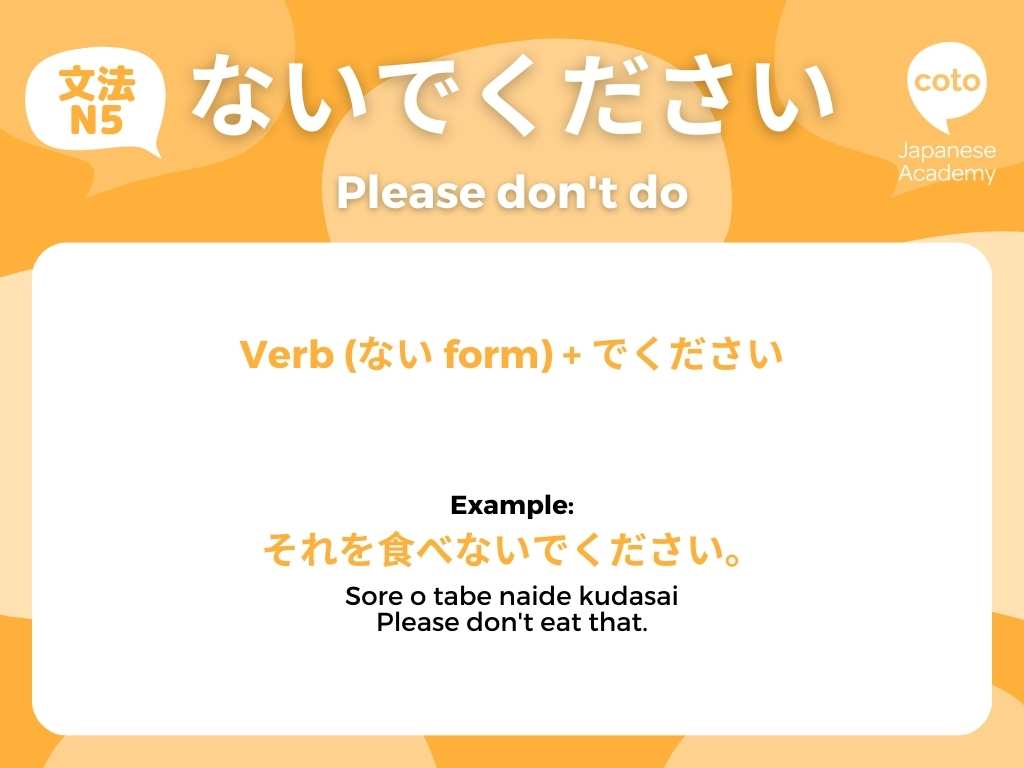
In Japanese N5 grammar, “ないでください” (“naide kudasai”) is a phrase used to make a negative request or ask someone not to do something. It is formed by combining the negative form of a verb and then adding “でください” (“de kudasai”) at the end.
Verb ない form + でください
For example:
迷惑しないでください。 Meiwaku shinaide kudasai. Please don’t be a nuisance to others.
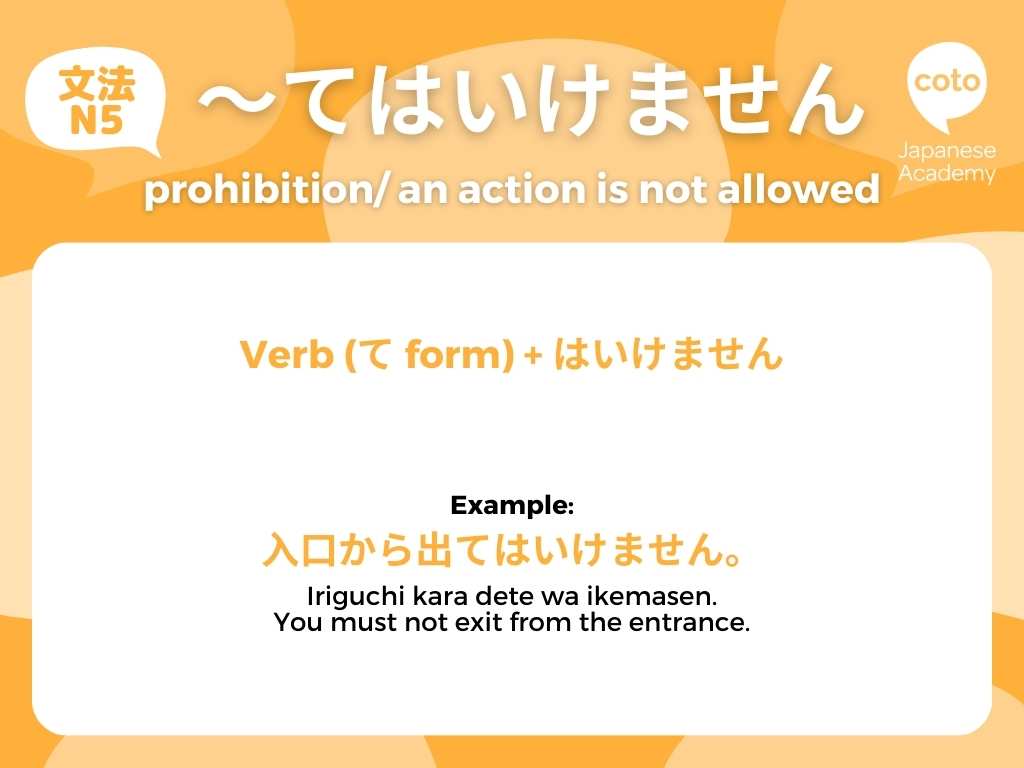
12. ~てはいけません (te wa ikemasen)
The phrase “~てはいけません” (“te wa ikemasen”) is used in Japanese to express prohibition or to indicate that an action is not allowed. It is formed by taking the te-form of a verb and adding “はいけません” (“wa ikemasen”) at the end.
The structure of “~てはいけません” is as follows:
[Verb in te-form] + はいけません
For example:
入口から出てはいけません。 Iriguchi kara dete wa ikemasen. You must not exit from the entrance.
Important: “~てはいけません” (“te wa ikemasen”) and “~ないでください” (“naide kudasai”) have similar meanings in that they both express prohibition or a request to refrain from doing something. However, there is a slight difference in tone and usage between the two. ~てはいけません emphasizes a strict prohibition or rule, while ~ないでください is a polite request to refrain from doing something.
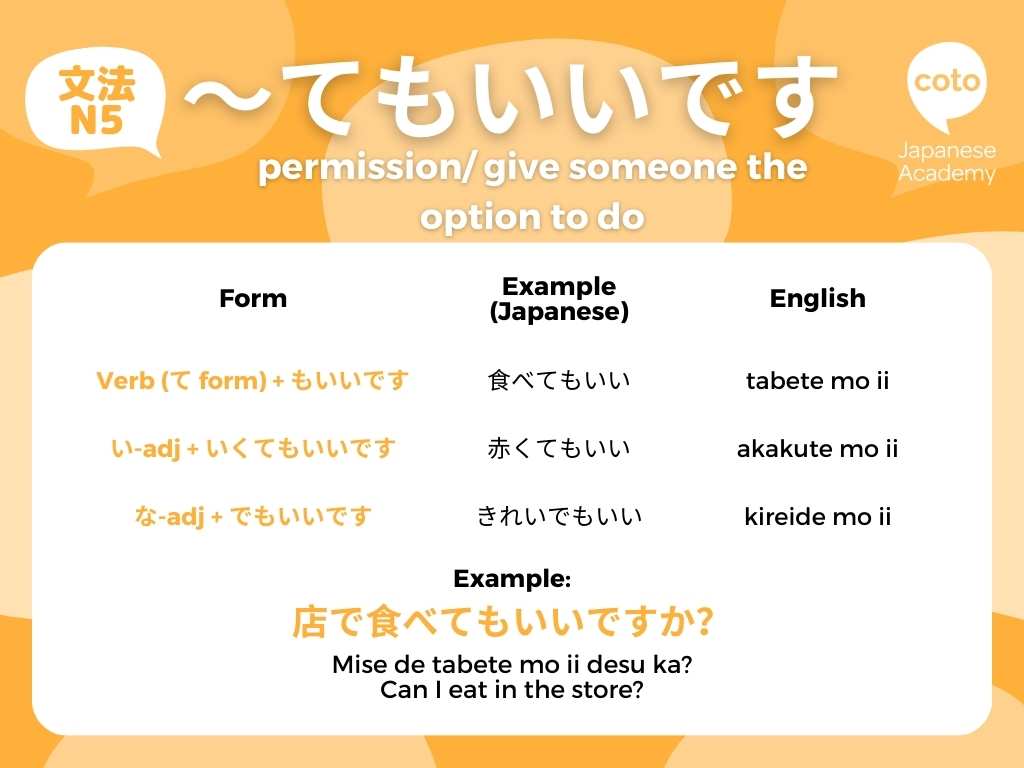
13. ~てもいいです (te mo ii desu)
The phrase “~てもいいです” (“te mo ii desu”) is used in Japanese to express permission or give someone the option to do something. It is formed by taking the te-form of a verb or an adjective and adding “もいいです” (“mo ii desu”) at the end.
The structure of “~てもいいです” is as follows:
Form
Example (Japanse)
English
Verb て-formもいいです
食べてもいい
Tabete mo ii
い-adjective + いくてもいいです
赤くてもいい
Akakute mo ii
な-adjectve + でもいいです
きれいでもいい
Kirei de mo ii
You can also ask for permission with this grammar structure by adding a か in the end to indicate a question.
店で食べてもいいですか? Mise de tabete mo ii desu ka? Can I eat in the store?
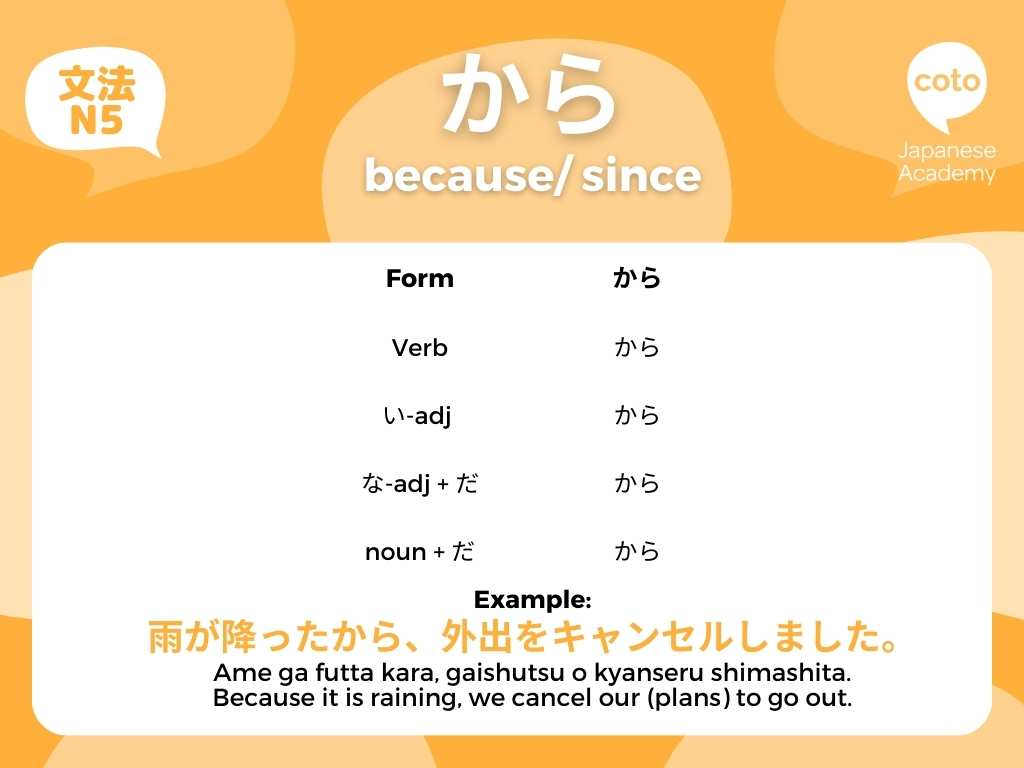
14. から (kara)
“Kara” (から) is a conjunction in Japanese that is used to indicate a cause or reason. It is often translated as “because” or “since” in English.
Verb
から
い-adjective
から
な-adjectve + だ
から
Noun + だ
から
It’s important to note that “kara” expresses a cause-and-effect relationship and focuses on the reason or cause preceding the resulting action or situation.
雨が降ったから、外出をキャンセルしました。 Ame ga futta kara, gaishutsu o kyanseru shimashita. Because it is raining, we cancel our (plans) to go out.
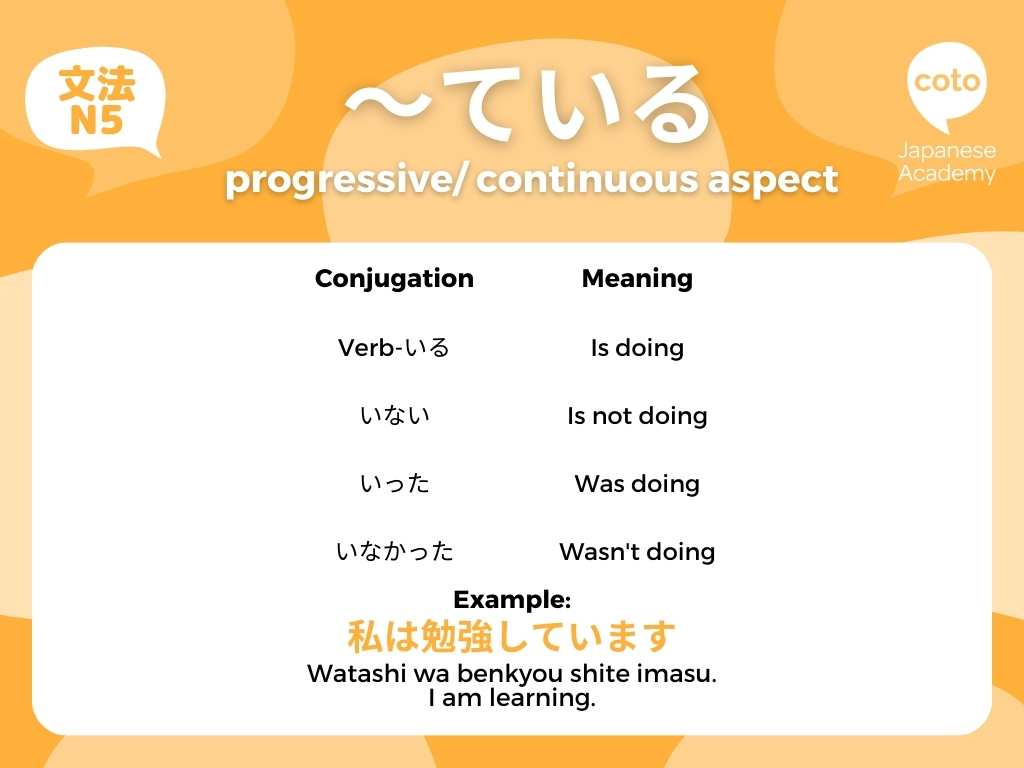
15. ~ている (te iru)
“Te iru” (ている) is a verb conjugation in Japanese that indicates the progressive or continuous aspect. It is commonly used to describe ongoing actions or states. In English, this would be a present (or past) continuous tense marked by verb-ing. You can also conjugate it to past, negative and past-negative tense.
Conjugation
Meaning
Verb -いる
Is doing
いない
Is not doing
いった
Was doing
いなかった
Wasn’t doing
私は勉強しています。 Watashi wa benkyou shite imasu. I am learning.
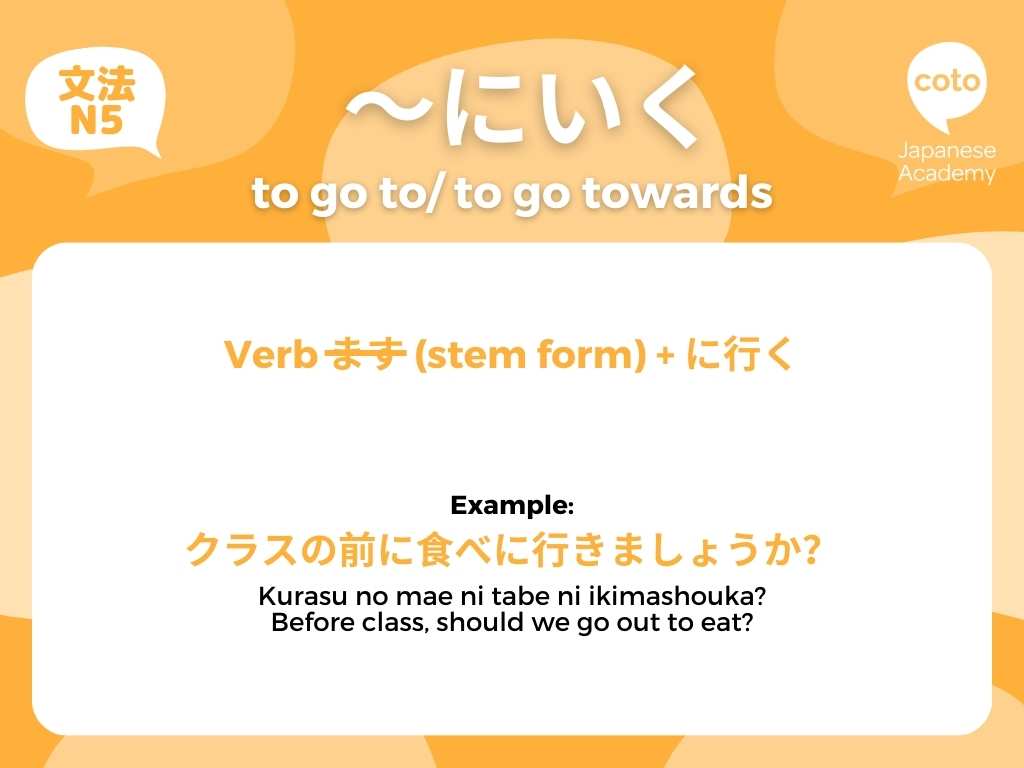
16. ~にいく (ni iku)
“~にいく” (~ni iku) is a commonly used phrase in Japanese that means “to go to” or “to go towards.” It is formed by combining the particle “に” (ni), indicating the direction or destination, with the verb “いく” (iku), meaning “to go.”
Verb ます (stem form) + に行く
In Japanese, the combination of a verb followed by “にいく” (ni iku) indicates the action of going somewhere to perform that verb’s action. It expresses the movement or direction toward a specific location for the purpose of engaging in the described action.
クラスの前に食べに行きましょうか? Kurasu no mae ni tabe ni ikimashouka? Before class, should we go out to eat?
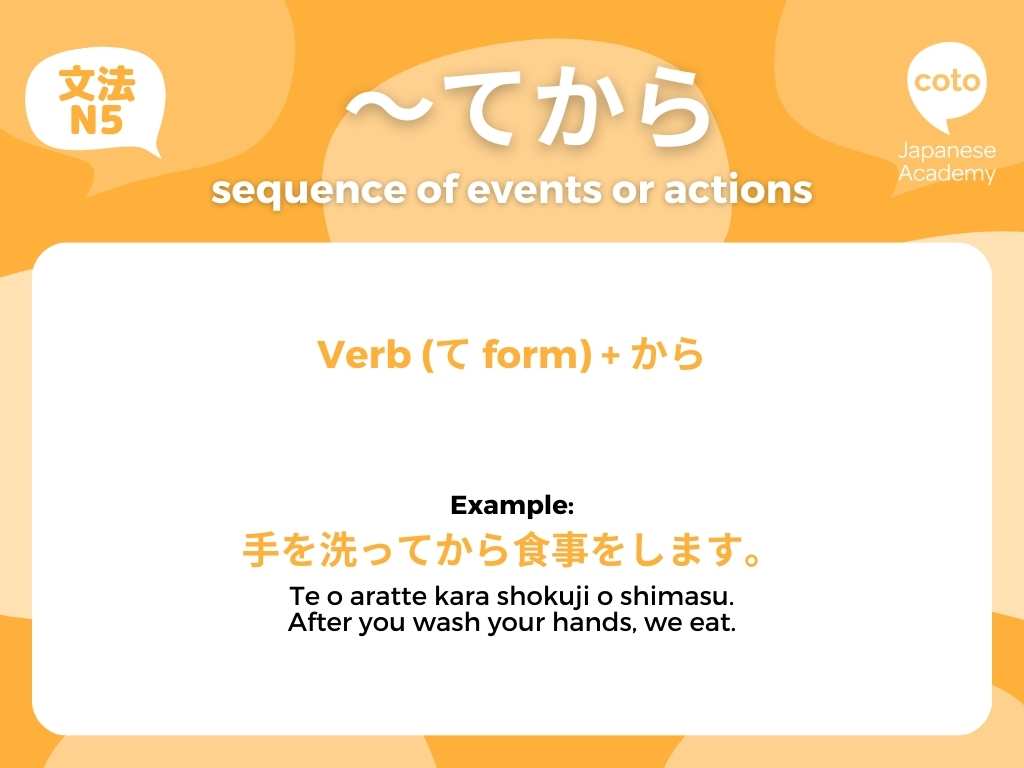
17. ~てから (te kara)
“~てから” (te kara) is a Japanese grammar construction used to indicate the sequence of events or actions. It signifies that one action takes place after another action has been completed. For example:
手を洗ってから食事をします。 Te o aratte kara shokuji o shimasu. After you wash your hands, we eat.
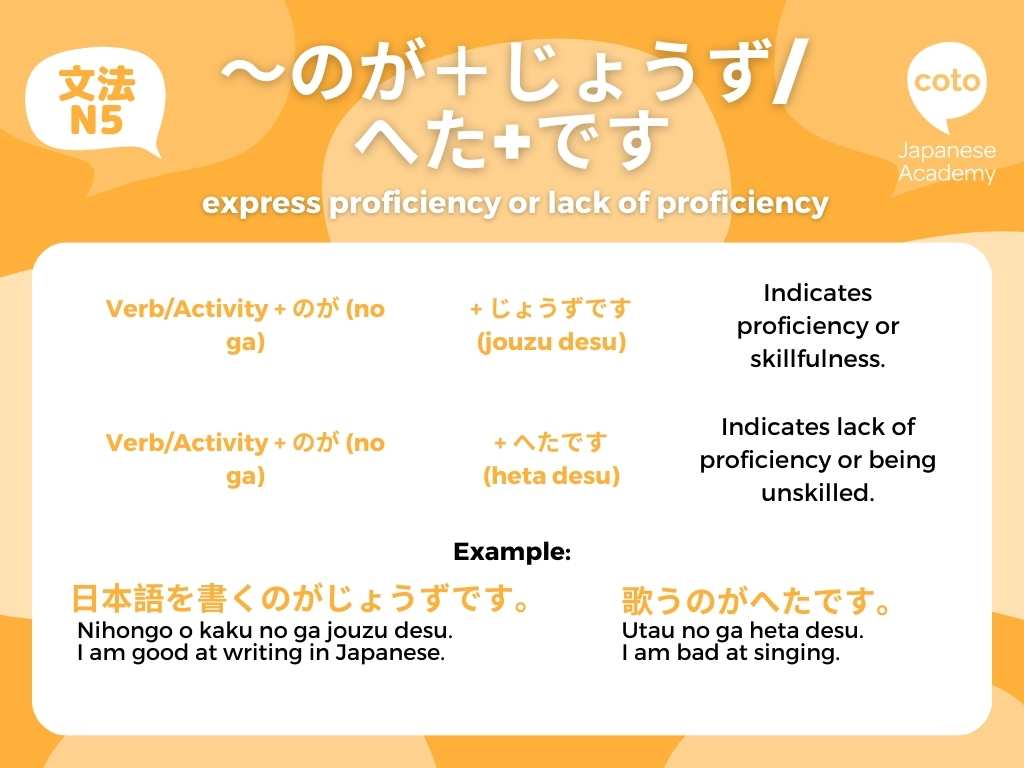
18. ~のがじょうずです/~のがへたです (no ga jouzu desu/ no ga heta desu)
The phrase “~のがじょうずです” (no ga jouzu desu) and “~のがへたです” (no ga heta desu) are used in Japanese to express proficiency or lack of proficiency in a particular skill or activity. Let’s break it down:
Verb/Activity + のが (no ga)
+ じょうずです (jouzu desu)
Indicates proficiency or skillfulness.
Verb/Activity + のが (no ga)
+ へたです (heta desu)
Indicates lack of proficiency or being unskilled.
In both cases, the structure starts with the verb or activity in its dictionary form, followed by “のが” (no ga), which acts as a nominalizer, turning the verb or activity into a noun. Then, it is followed by either “じょうずです” (jouzu desu) or “へたです” (heta desu).
日本語を書くのがじょうずです。 Nihongo o kaku no ga jouzu desu. I am good at writing in Japanese.
歌うのがへたです。 Utau no ga heta desu. I am bad at singing.
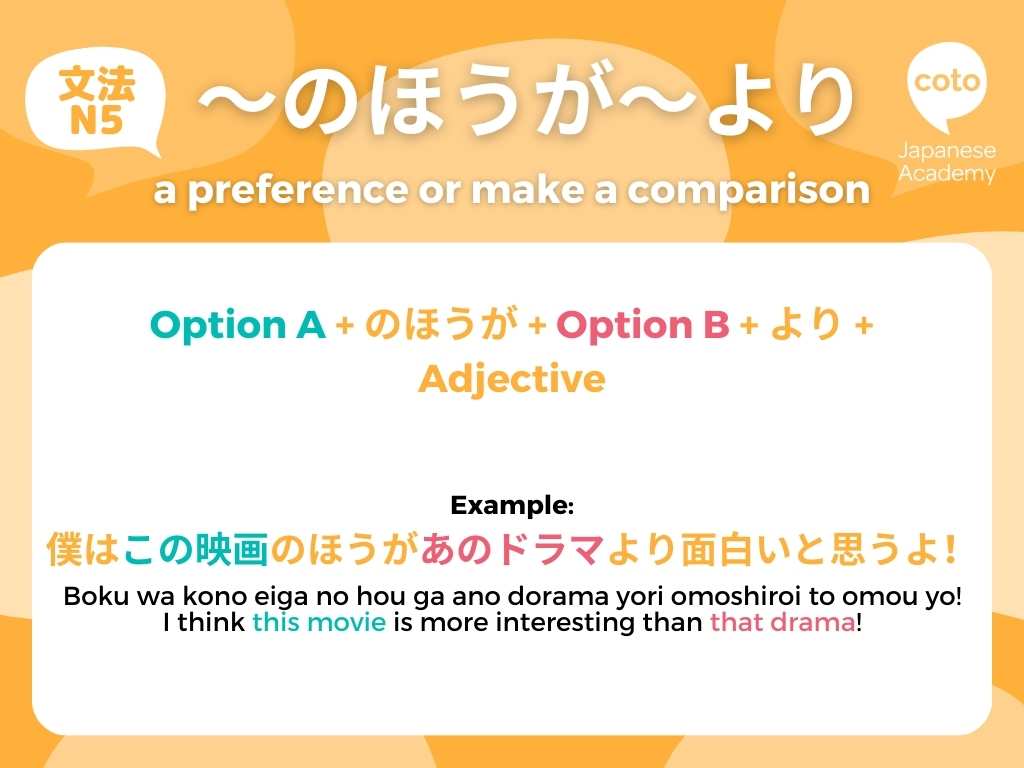
19. ~のほうが~より (~no hou ga ~ yori)
Imagine you have two options or things to compare, and you want to express a preference or make a comparison. That’s where “~のほうが~より” (no hou ga ~ yori) comes in! It’s a JLPT N5 grammar that helps you highlight one option over another. The structure will look like this:
(Option A) + のほうが + Option B + より (yori) + Adjective
Let’s take a look at an example using this JLPT N5 grammar!
この映画とあのドラマ、どちらが面白いと思う? Kono eiga to ano dorama, dochira ga omoshiroi to omou? Which do you think is more interesting, this movie or that drama?
僕はこの映画のほうがあのドラマより面白いと思うよ! Boku wa kono eiga no hou ga ano dorama yori omoshiroi to omou yo!) I think this movie is more interesting than that drama!
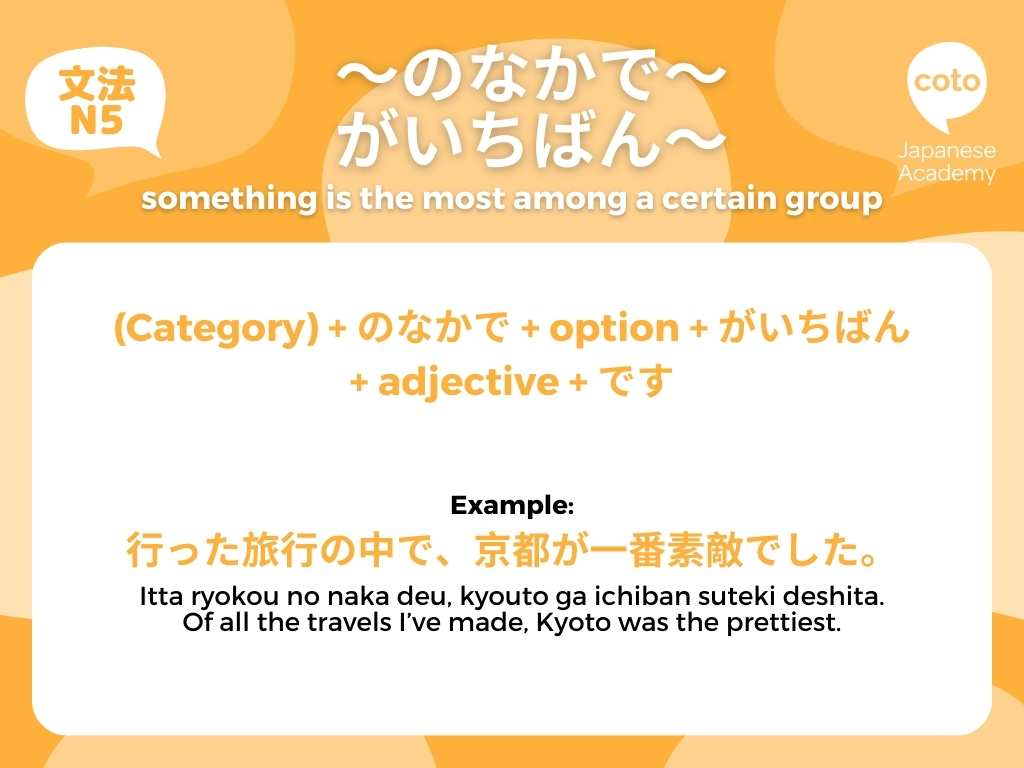
20. ~のなかで~がいちばん~ (~no naka de ~ ga ichiban ~)
This grammar pattern, ~のなかで~がいちばん~ (naka de ga ichiban), is used to express that something is the most among a certain group of things.
With this pattern, you can express your preference or opinion about a certain group of things. It’s a useful way to make comparisons in Japanese and it’s commonly used in everyday conversation. The sentence structure will typically look like this:
Let’s take a look at an example using this JLPT N5 grammar!
行った旅行の中で、京都が一番素敵でした。 Itta ryokou no naka deu, kyouto ga ichiban suteki deshita. Of all the travels I’ve made, Kyoto was the prettiest.
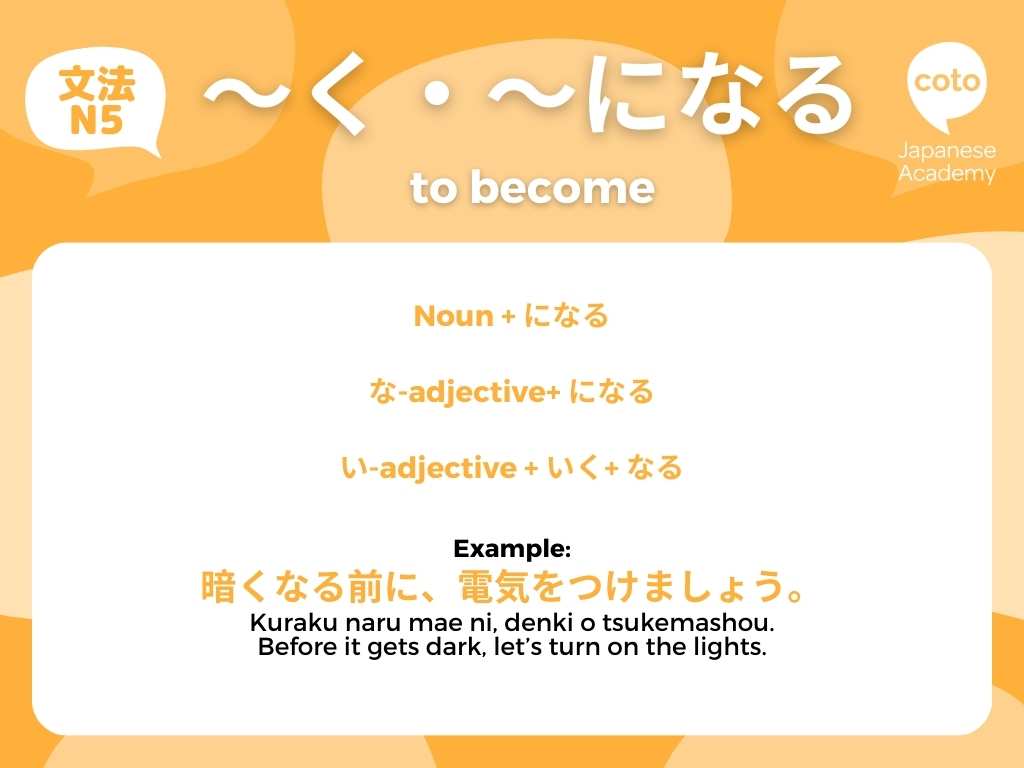
21. ~く/ ~になる (~ku/~ni naru)
Both “~ku naru” and “ni naru” are Japanese verb phrases used to express a change or transformation — translated to “to become” in English.
Noun + になる
な-adjective+ になる
い-adjective + いく+ なる
Let’s take a look at an example using this JLPT N5 grammar!
暗くなる前に、電気をつけましょう。 Kuraku naru mae ni, denki o tsukemashou. Before it gets dark, let’s turn on the lights.
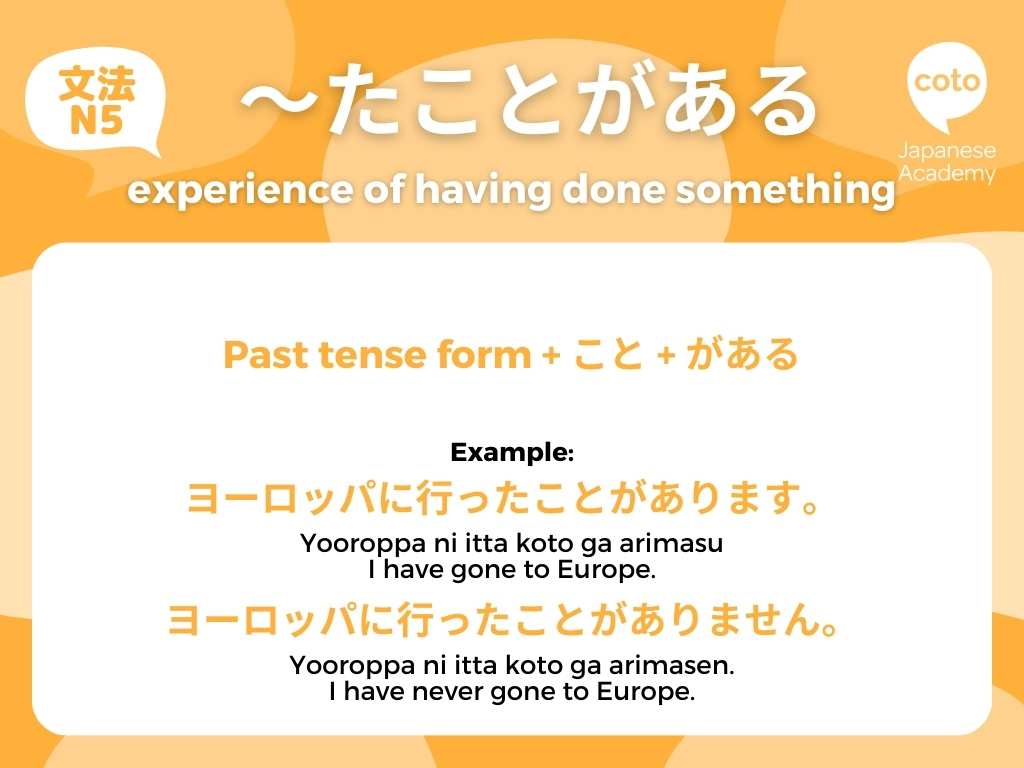
22. ~たことがある (~ta koto ga aru)
“~たことがある” is a Japanese grammatical expression that conveys the experience of having done something or having a certain experience in the past. It is used to indicate that an action or event has occurred at least once in a person’s life.
The structure “~たことがある” is like this:
Past tense form + こと + ある
If you conjugate ある into its negative form, the sentence will change the meaning into, “I have never been (action).”
Let’s take a look at an example using this Japanese Language Proficiency Test N5 grammar!
ヨーロッパに行ったことがありません。 Yooroppa ni itta koto ga arimasen. I have never gone to Europe.
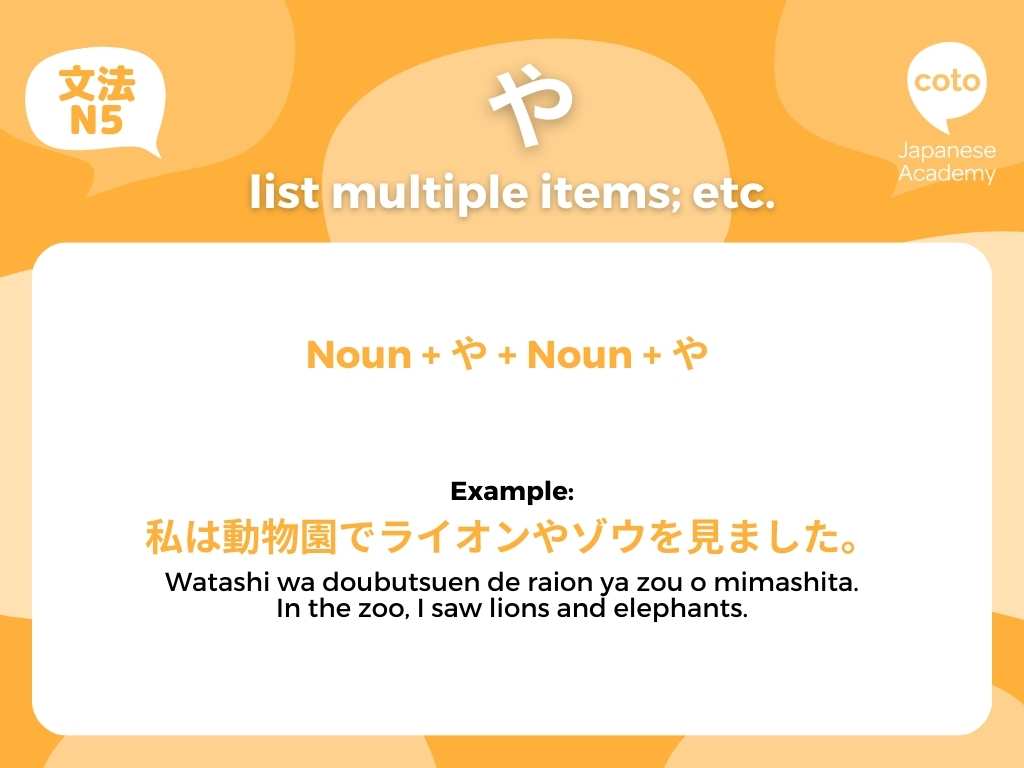
23. や (ya)
“や” is used to list multiple items or examples without specifying an exhaustive or complete list. It is very similar to the grammar と (to), which also means “and”, but や implies that there are other items that could be included — identical to “etc”.
To use this, you just have to add や after a noun: Noun + や + Noun + や
For example:
私は動物園でライオンやゾウを見ました。 Watashi wa doubutsuen de raion ya zou o mimashita. In the zoo, I saw lions and elephants.
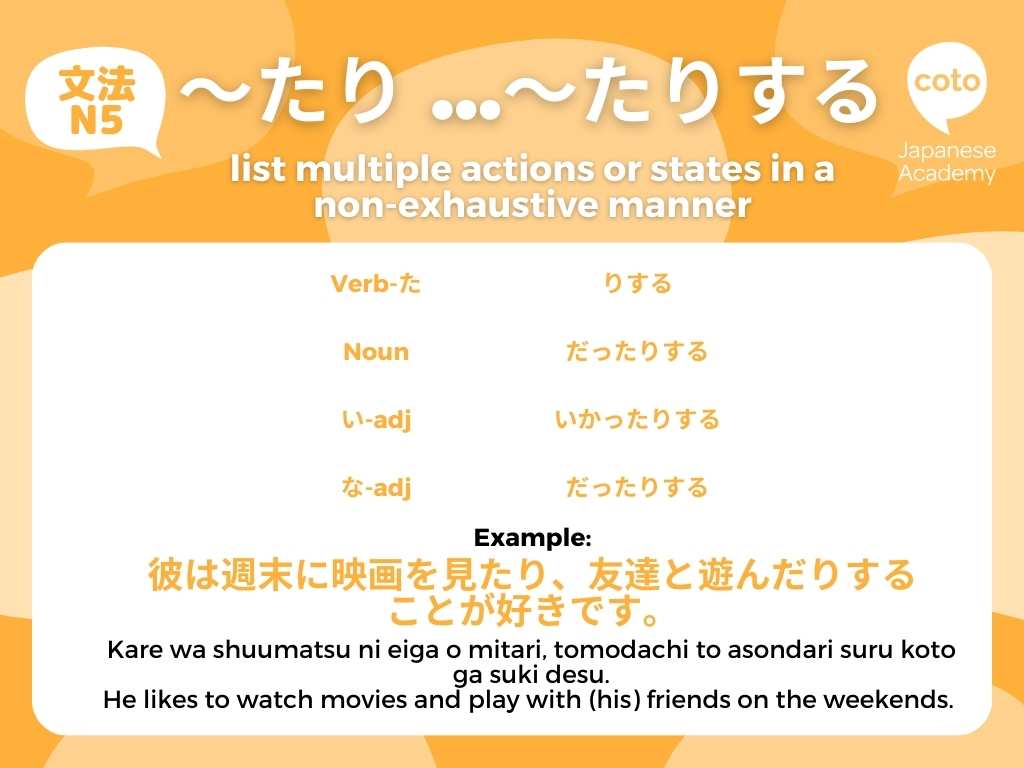
24. ~たり …~たりする (~ tari … ~tari suru)
The grammar pattern “~たり … ~たりする” in Japanese is used to list multiple actions or states in a non-exhaustive manner. It indicates that the actions or states mentioned are just a few examples among many possibilities.
It has a similar meaning to や that we explained above, but instead of a noun, this is typically used to indicate actions.
Verb-た
りする
Noun
だったりする
い-adj
いかったりする
な-adj
だったりする
For example:
彼は週末に映画を見たり、友達と遊んだりすることが好きです。 Kare wa shuumatsu ni eiga o mitari, tomodachi to asondari suru koto ga suki desu. He likes to watch movies and play with (his) friends on the weekends.
In this sentence, the speaker mentions watching movies and hanging out with friends as examples of activities the person likes to do on weekends. However, it doesn’t mean these are the only activities they engage in; there could be other things they do as well.
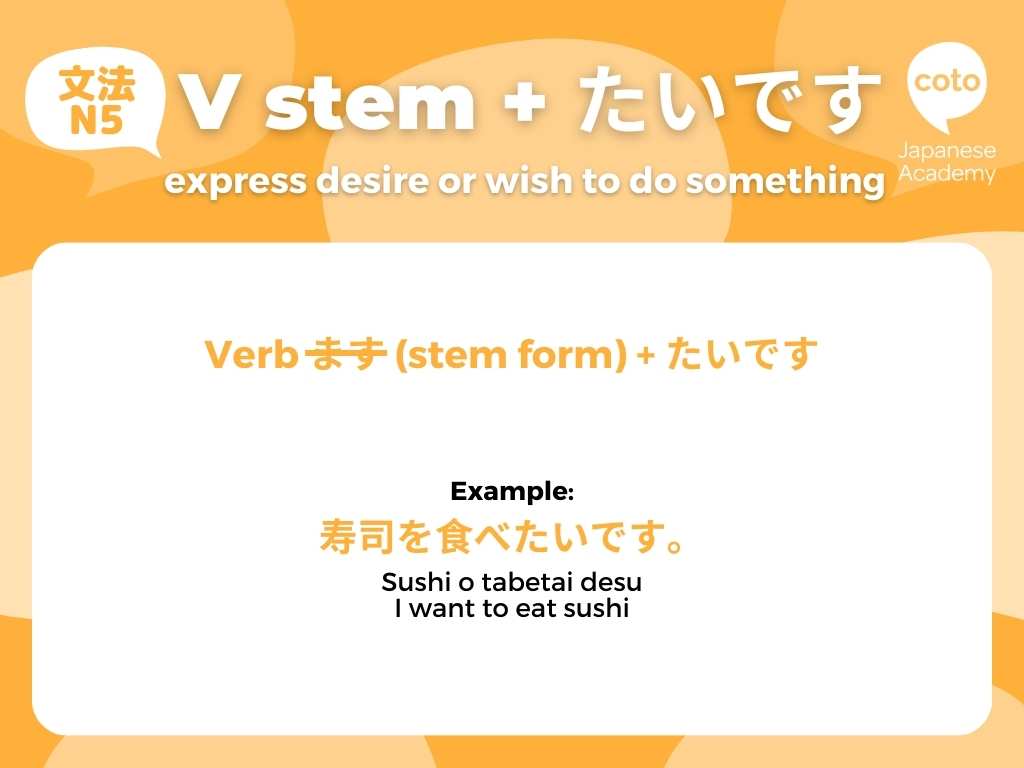
25. V stem + たいです (~tai desu)
Next, someone who is a beginner Japanese student should also know how to express desire or wish to do something. This is where “Verb + たいです” in Japanese is used to express a desire or a wish to do something. It is used when you want to convey that you want to do a certain action or engage in a certain state.
To make this grammar point, cut the ます from the ます form of verbs and add たい.
English
Dictionary Form
ます form (polite)
たい form
To eat
食べる
食べます
食べたい
To see
見る
見ます
見たい
To buy
買う
買います
買いたい
To go
行く
行きます
行きたい
To do
する
します
したい
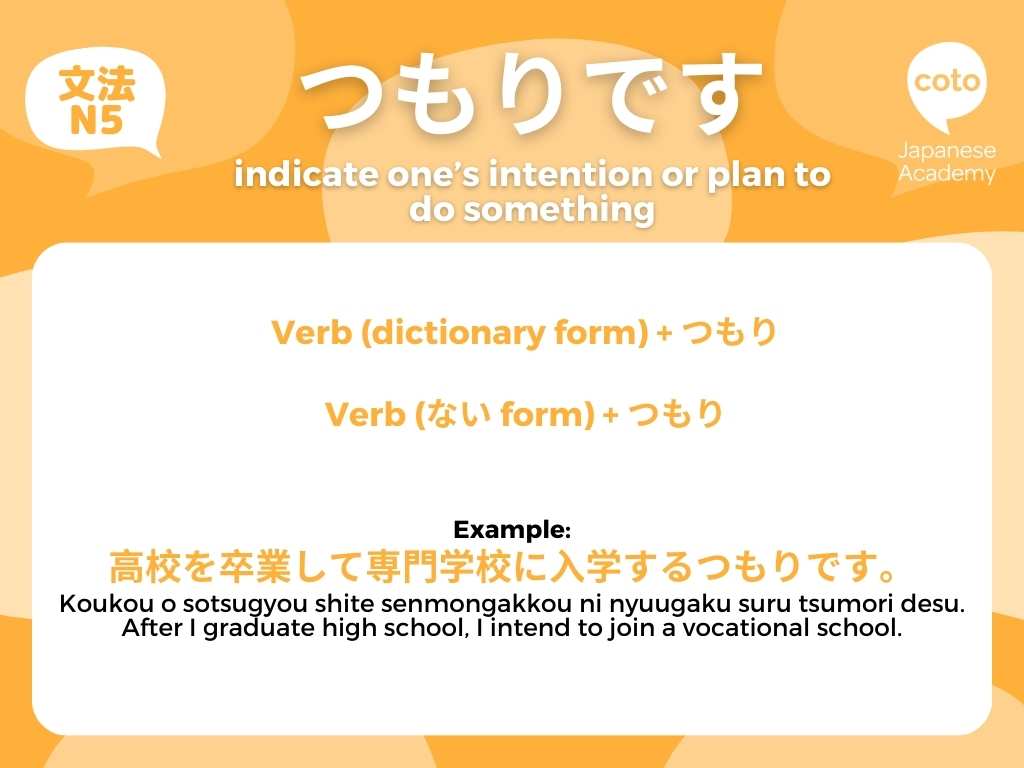
26. つもりです (tsumori desu)
To speak about your plans or intentions, you can use つもりです (tsumori desu). The grammar point “tsumori” is a Japanese construction used to indicate one’s intention or plan to do something. It is often translated as “intend to” or “plan to” in English. The structure is formed by attaching the verb’s stem or the noun to the stem of a verb followed by the auxiliary verb “tsumori” (つもり).
Note: The difference between “tsumori” (つもり) and “verb-tai desu” (verb-たいです) lies in the nuance of expressing intention or desire. Verb-tai desu” is used to express one’s personal desire or preference to do something. On the other hand, “tsumori” is used to express one’s intention or plan to do something. It implies a stronger commitment or determination to carry out the action.
Structure:
Verb (dictionary form) + つもり
Verb (ない form + つもり
For example:
高校を卒業して専門学校に入学するつもりです。 Koukou o sotsugyou shite senmongakkou ni nyuugaku suru tsumori desu. After I graduate high school, I intend to join a vocational school.
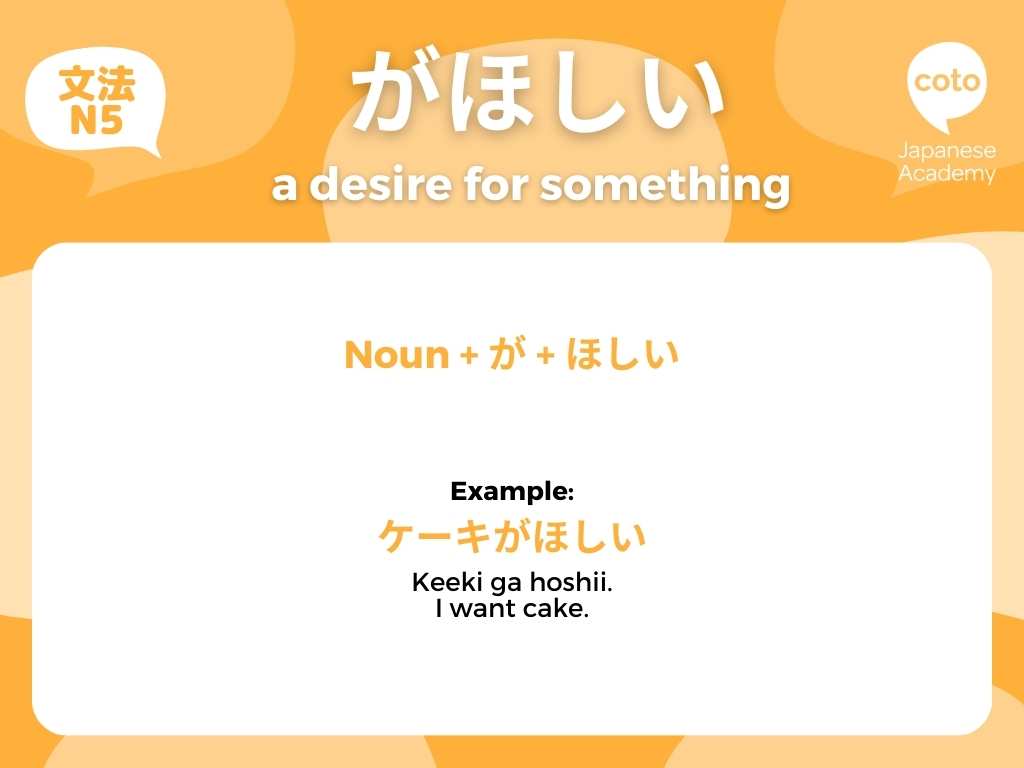
27. がほしい (ga hoshii)
In Japanese, the phrase “noun + ga hoshii” is used to express a desire for something.
Noun + が + ほしい
It’s important to note that the adjective “hoshii” always follows the noun it modifies and agrees with the subject of the sentence marked by “ga.” For example:
ケーキがほしい。 Keeki ga hoshii. I want cake.
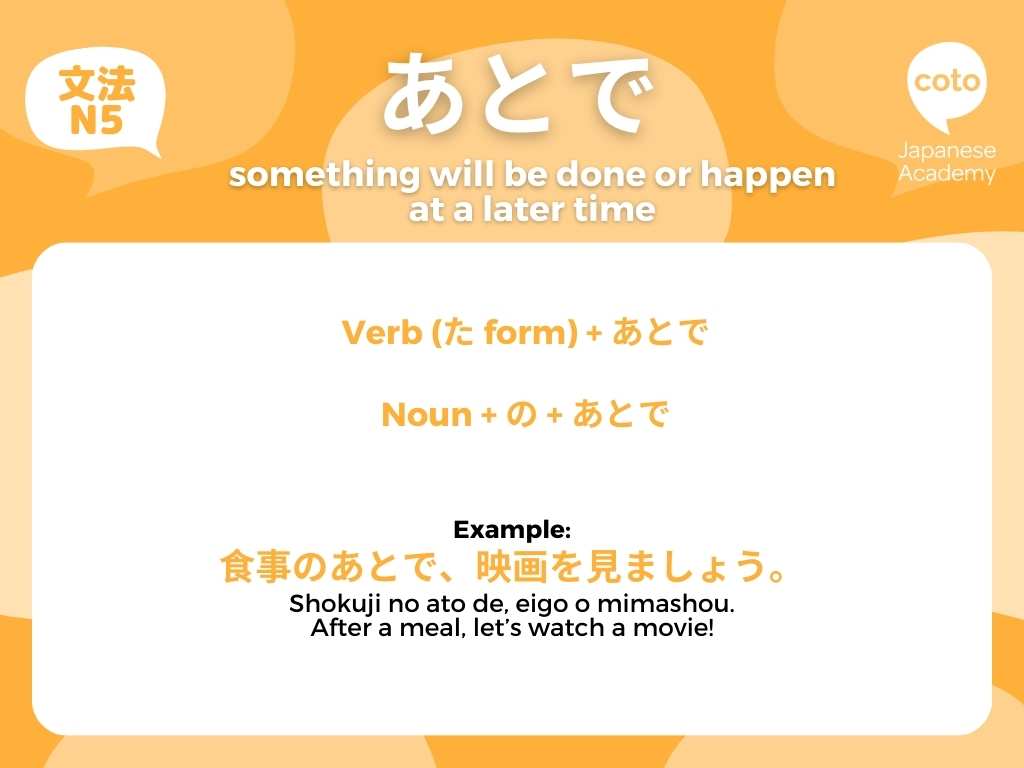
28. あとで (ato de)
In Japanese, “あとで” (ato de) is an expression used to indicate that something will be done or happen at a later time. It is often translated as “later” or “afterwards” in English. Let’s break down its grammar:
Verb (た form) + あとで
Noun + の + あとで
For example:
食事のあとで、映画を見ましょう。 Shokuji no ato de, eigo o mimashou. After a meal, let’s watch a movie!
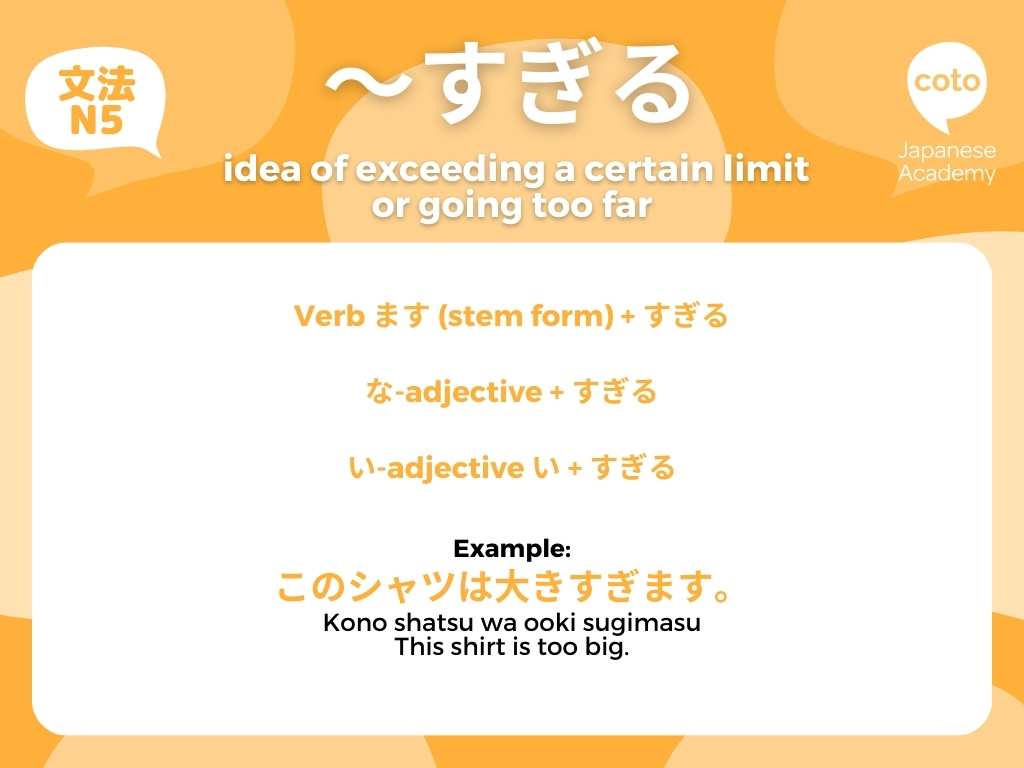
29. ~すぎる (~sugiru)
The grammar structure “~sugiru” in Japanese is a useful construction that conveys the idea of exceeding a certain limit or going too far. It is commonly attached to the stem of verbs or adjectives to express actions or states that are excessive or beyond what is expected or desired.
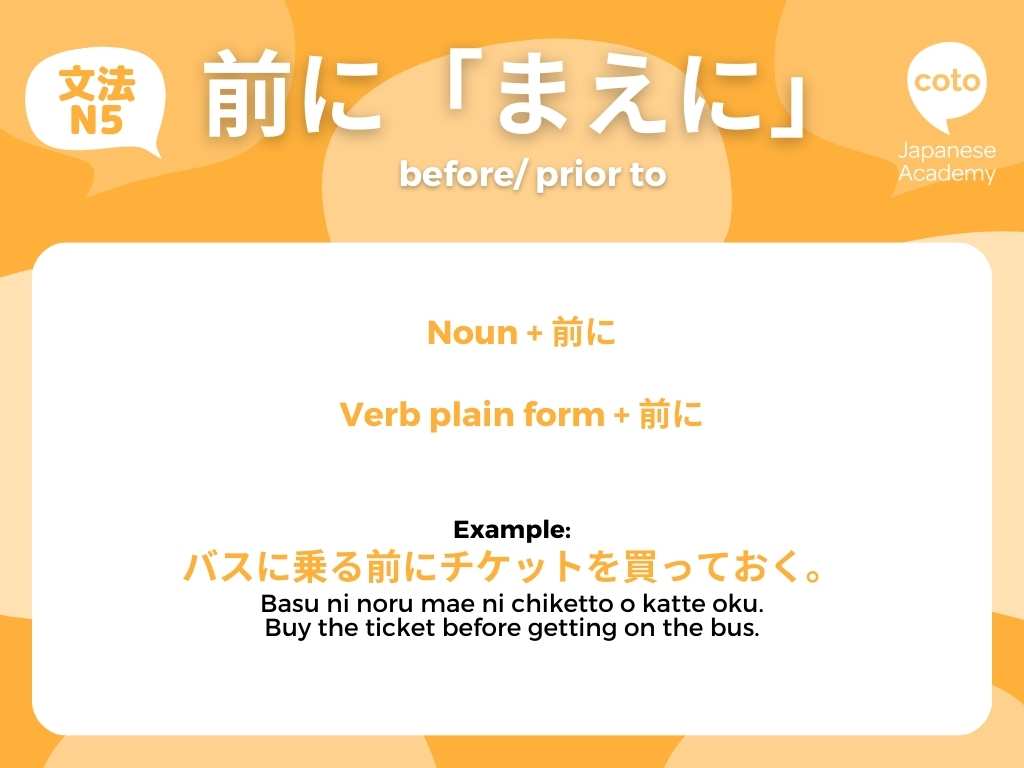
“前に” (mae ni) is a Japanese phrase that translates to “before” or “prior to” in English. When combined with a verb, the phrase that uses “前に” (mae ni) expresses that the action took place before a certain point in time or event.
Noun + 前に Verb plain form + 前に
Here are some examples:
バスに乗る前にチケットを買っておく。 Basu ni noru mae ni chiketto o katte oku. Buy the ticket before getting on the bus.
What’s next after learning these essential JLPT N5 grammar points? Learn must-know grammar points for other JLPT levels!
Ready to Pass the JLPT 2026? Join JLPT Lessons at Coto Academy!
If you’re thinking of taking the JLPT again or aiming for a higher level to boost your career in Japan, give yourself the best possible chance of success. Coto Academy students enjoy a higher pass rate than the national average thanks to our focused JLPT preparation courses.
Join Coto Academy’s highly popular JLPT prep course! Taught in Tokyo by experienced instructors who specialize in the JLPT, this course gives you the strategies, practice tests, and structured study approach to master every part of the exam. With expert guidance and proven methods, you’ll walk into your next JLPT feeling confident and ready to pass.
Contact us for a Japanese-level check and a free consultation on the best JLPT prep course for you!
What is JLPT N5?
A1: JLPT N5, or Japanese Language Proficiency Test N5, is the first level of the Japanese Language Proficiency Test. It assesses basic Japanese language skills and is suitable for beginners.
What are some common JLPT N5 grammar points?
Some common JLPT N5 grammar points include:
です (desu): A polite copula used for sentence endings.
は (wa): A particle used to mark the topic of a sentence.
が (ga): A particle used to mark the subject of a sentence.
ですか (desu ka): A polite question-ending expression.
の (no): A particle used to indicate possession or describe a noun.
How can I use the grammar point です (desu)?
The grammar point です is used to form polite sentences in Japanese. It is commonly used to state facts, describe things, and make general statements. For example: 私は学生です (Watashi wa gakusei desu) means “I am a student.”
When should I use ですか (desu ka)?
ですか is a polite question-ending expression. It is used to form yes/no questions in Japanese. For example: これはペンですか (Kore wa pen desu ka) means “Is this a pen?”
What does the particle は (wa) indicate?
The particle は is used to mark the topic of a sentence. It indicates the main subject or theme being discussed. For example: 私は日本人です (Watashi wa nihonjin desu) means “As for me, I am Japanese.”
How can Coto Academy help me learn Japanese?
From preparing JLPT to doing conversation practices, Coto Academy has differnent Japanese language courses that is tailored to differen needs. We are located in Shibuya, Iidabashi (Tokyo), and Yokohama. If you woud like to learn Japanese effectively in a small, fun class, contact us for a free level check and interview!
If you need to provide a reason or explanation for an action, you can use the JLPT N5 grammar, 〜ので (~node). It is similar to saying “because…” in English. It is often used to make a cause-and-effect statement, such as “since A, then B.”
Essentially, you can use 〜ので to logically connect 2 statements, similar to grammar 〜から(~kara). Let’s learn how to use this JLPT N5 grammar point by breaking down its meaning, structure, and example sentences.
Make Sure to Watch Coto Academy’s YouTube Video About 〜ので (~node)
Before you continue reading, why not take a moment to watch a quick YouTube lesson with our Japanese teacher, Yuka-sensei:
Meaning of 〜ので (~node)
〜ので is a way to provide a reason or reasoning for something. It also establishes a logical connection between two separate statements. It’s similar to the expression, 〜から (~kara), but has a more formal nuance. Generally, you use this expression to explain “why”, establish a cause-and-effect, and even give an excuse. 〜ので most closely translates to the following:
Because of
Given that
Since
Due to
JLPT N5 〜ので Sentence Structure
Unlike the English expressions “because” or “since,” which are used before the reason, 〜ので is used after providing the reason. For example, in English you might say “Because I’m busy, I won’t go to the party,” which in Japanese would be:
いそがしいので、パーティーに行きません。 Isogashii node, paatii ni ikimasen. Because I’m busy, I won’t go to the party.
You can think of 〜ので as being between two separate statements and connecting them logically, like a glue sticking 2 things together. So, 〜ので attaches at the end of the first statement, providing the reason. Specifically, it attaches to the last word of the reason statement. This word can be a noun, verb, or adjective.
Type
Structure
Verb (plain form)
Verb + ので
い-Adjective
い-Adjective + ので
な-Adjective
な-Adjective + な + ので
Noun
Noun + な + ので
Note that 〜ので itself does not conjugate into past, present, negative, or positive. The word to which 〜ので attaches is what conjugates. Let’s break down how this works with different verb conjugations.
Form
Plain Form + ので
Meaning
Present
雨が降るので
Because it will rain
Past
雨が降ったので
Because it rained
Negative
雨が降らないので
Because it won’t rain
Past Negative
雨が降らなかったので
Because it didn’t rain
Volitional
雨が降ろうので
Because it should rain
Difference Between 〜ので (~Node) and 〜から (~Kara)
As mentioned, 〜ので is similar to the grammar 〜から, which are both used to provide a reason or reasoning for something. They are largely used for the same purpose, with the only difference being the context in which they are used.
1. ので is more formal
One key difference between “から” and “ので” is that “から” is more casual, while “ので” is more polite and even objective. You can use から in everyday conversation with family and friends. However, neither of these expressions would feel out of place or rude in either formal or casual situations and are commonly used in both.
For example, a speaker might say:
雨が降っているから行きません。 Ame ga futte iru kara ikimasen. I won’t go because it’s raining.
In contrast, ので sounds softer and more polite, and it is often used in formal situations or when speaking respectfully. It presents the reason in a more objective or explanatory way, as in:
雨が降っているので行きません。 Ame ga futte iru node ikimasen. I won’t go because it is raining.
Because of this nuance, learners often use から in everyday speech with friends and family, while ので is preferred in polite conversations, such as when speaking to teachers, colleagues, or customers.
2. ので carries an apologetic nuance
ので has a bit of apologetic nuance, pairing well with phrases like すみません (sumimasen) meaning “excuse me” or “sorry.” This expression is preferred when apologizing or providing a reason to your boss or anyone in a formal capacity.
Another difference between ので and から lies in where the emphasis is placed. から tends to emphasize the speaker’s own judgment, decision, or action.
Let’s take a look at the two examples below.
時間がないからタクシーで行きます。 Jikan ga nai kara takushii de ikimasu. I will take a taxi because I don’t have time.
Here, the speaker is clearly stating their personal reason and decision. In contrast, ので emphasizes the situation or circumstances rather than the speaker’s choice.
時間がないのでタクシーで行きます。 Jikan ga nai node takushii de ikimasu. I will take a taxi because I don’t have time.
In the second example, the focus is on the situation of not having enough time. This makes the explanation sound softer and less self-centered, as if the circumstances naturally lead to the result, as if to say that the circumstances are responsible for the result.
3. Use から for future predictions
When giving reasons for predictions or assumptions about the future, Japanese speakers generally prefer から rather than ので. から appears when expressing predictions about the future using だろう or its polite form でしょう. I
This is because だろう and でしょう express the speaker’s assumption, guess, or prediction about something that has not happened yet. Since から naturally connects to the speaker’s reasoning or judgment, it fits well with statements that involve personal predictions or speculation.
For example, you might say:
雨が降りそうだから、試合は中止になるだろう。 Ame ga furisoudakara, shiai wa chuushi ni naru darou. Because it looks like it will rain, the game will probably be canceled.
Using ので in this type of sentence would sound unnatural because ので tends to present the reason as a more objective fact or established situation
Example Sentences Using 〜ので (~Node)
Let’s take a look at some example sentences to really understand how to use the JLPT N5 grammar point, 〜ので (~node)
Example 1:
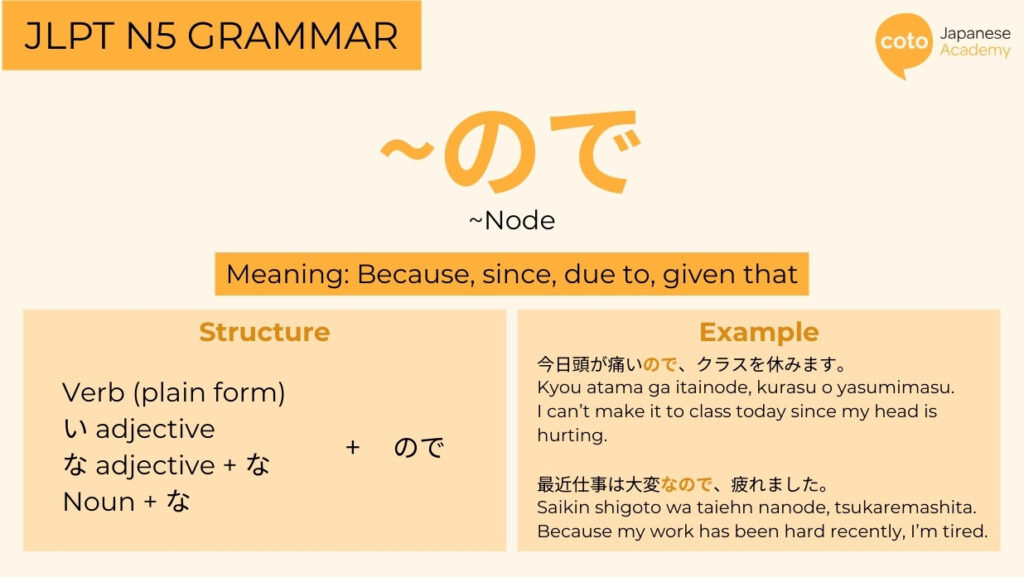
今日頭が痛いので、クラスを休みます。 Kyou atama ga itainode, kurasu o yasumimasu. I can’t make it to class today since my head is hurting.
Example 2:
雨が降っているので、出かけません。 Ame ga futte iru node, dekakemasen. Because it’s raining, I won’t go out.
Example 3:
最近仕事は大変なので、疲れました。 Saikin shigoto wa taiehn nanode, tsukaremashita. Because my work has been hard recently, I’m tired.
Example 4:
今日は日曜日なので、銀行は休みです。 Kyou wa nichiyoubi na node, ginkou wa yasumi desu. Since today is Sunday, the bank is closed.
Example 5:
すみません、少し疲れたので、先に帰ってもいいですか。 Sumimasen, sukoshi tsukareta node, saki ni kaette mo ii desu ka? I’m so sorry, but since I’m a bit tired, may I go home first?
Conclusion
〜ので is a very useful expression you can use to provide a reason or cause for something, and can even be used to apologize. So, try using it next time you speak Japanese to really understand how it works and ingrain it into your Japanese arsenal!
Learn More JLPT Grammar with Coto Academy!
If you want more practice using this phrase and many others in real Japanese conversations with a teacher who can offer practical guidance, sign up with us at Coto Academy.
Coto Academy has been teaching Japanese for over 25 years, with campuses in Shibuya, Yokohama, Iidabashi, Minato, and online. Our courses focus on practical Japanese, so the grammar you learn is designed for real-life use.
We offer part-time, intensive, and fully online lessons to suit your schedule. Ready to get started? Fill out the form below to contact us!
FAQ:
What does 〜ので mean?
〜ので is used to explain a reason or cause for something. It can be translated to “because,” “since,” or “due to.”
How is 〜ので different from 〜から?
〜ので is quite similar to 〜から since they are both used for explaining a reason or cause. But they differ in nuance with 〜ので being softer and even a bit apologetic, often being used with expressions like すみません (sumimasen), meaning “excuse me.” 〜から is a bit more direct and often used for giving personal reasons. However, neither of these expressions is considered rude and can be used in both formal and casual situations.
Can 〜ので be used to make requests?
〜ので is often used to politely explain the reason before making a request. For example, if you need a friend to tell you how to get somewhere, you can say 道が分からないので、教えてください (michi ga wakaranai node, oshiete kudasai), which means, “because I don’t know the way, please tell me.”
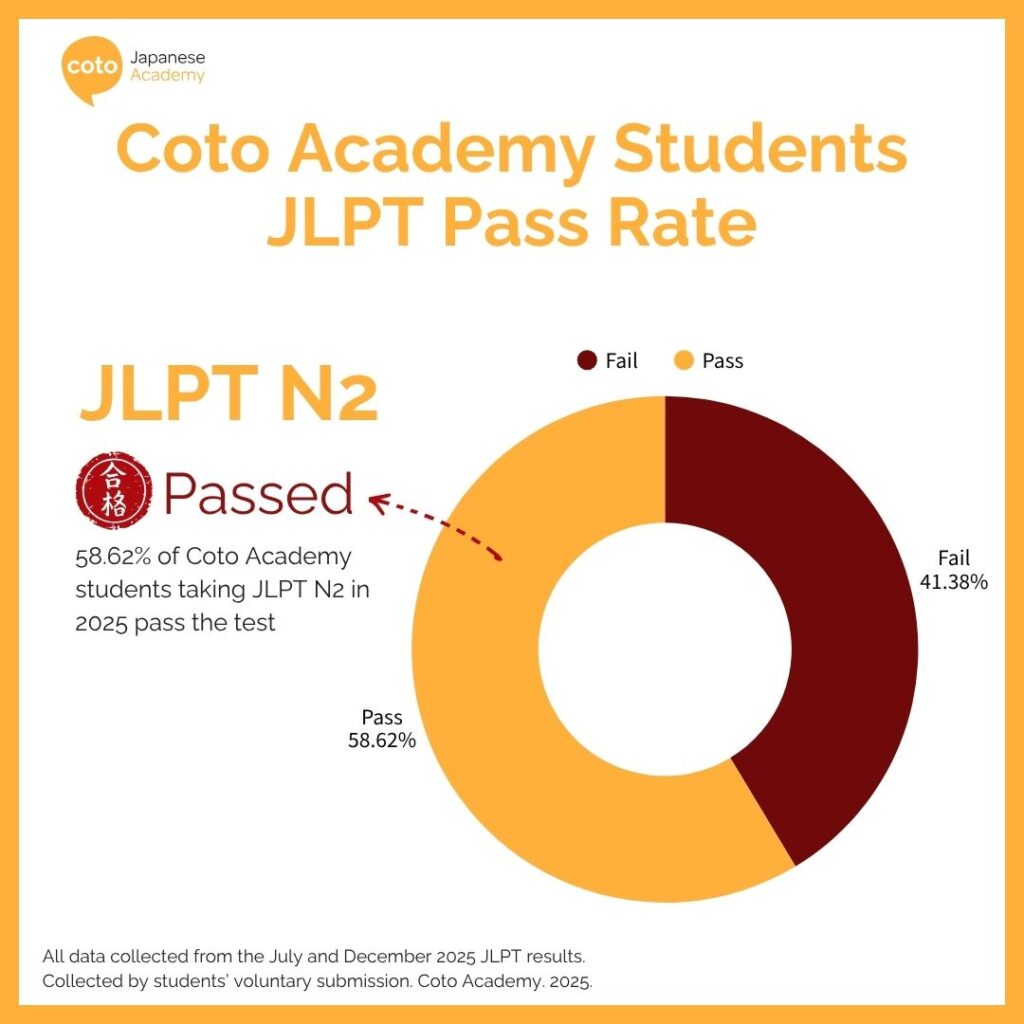
Do you know the pass rate of Coto Academy students who took the JLPT, and how it compares to the general JLPT pass rate? Among students who took the JLPT course at Coto Academy in 2025, 74.76% passed their target level. This was more than double the average national pass rate of 35.06%. So, this shows that students who take our JLPT course are much better prepared to take the exam and pass, but how is that?
If you’re also anxious about taking the JLPT and wondering how so many of our students passed despite the low national average and its difficulty, keep reading to find out how we maintain our pass rates and how we help prepare you for success.
What is the JLPT, and Why Does the Pass Rate Matter?
The Japanese Language Proficiency Test is administered by the Japan Foundation and Japan Educational Exchanges and Services to measure non-native Japanese speakers’ skills with the language. The test is divided into five increasingly difficult levels.
National pass rates are publicly low due to both the number of participants and differences in preparation, as well as the difficulty of levels JLPT N2 and N1. In 2025, the average JLPT pass rate was 33.42% at level N2 and 28.94% at level N1.
With that in mind, a school with a pass rate above this average indicates the program’s effectiveness. 28.94% looks small, but within that 28.94% was every N1 Coto student!
Want to increase your chances of passing the next JLPT? At Coto Academy, our expert instructors have helped students achieve a pass rate of 75% — that is more than double the national average of 35%. Join our comprehensive 3-month JLPT preparation course and study with a proven program designed for success.
Now, let’s break down Coto Academy students’ pass rates by JLPT level and see how they differ year by year.
Year
Coto Student Pass Rate
National Pass Rate (Japan)
2025
74.76%
30.26%
2024
75.00%
33.88%
2023
81.01%
38.60%
2022
81.01%
39.30%
2021
80.31%
43.80%
Based on the table, Coto students who took the JLPT course have passed the JLPT exam at around 2 times the national average each year since 2021, while the national average has been only around 30-40%. So, how does the JLPT pass rate break down by JLPT level?
Coto Academy’s JLPT Pass Rate Per Level
Below is a table of Coto students who successfully passed the JLPT in 2025, broken down based on level.
JLPT Level
Coto Academy’s Pass Rate
Global Pass Rate
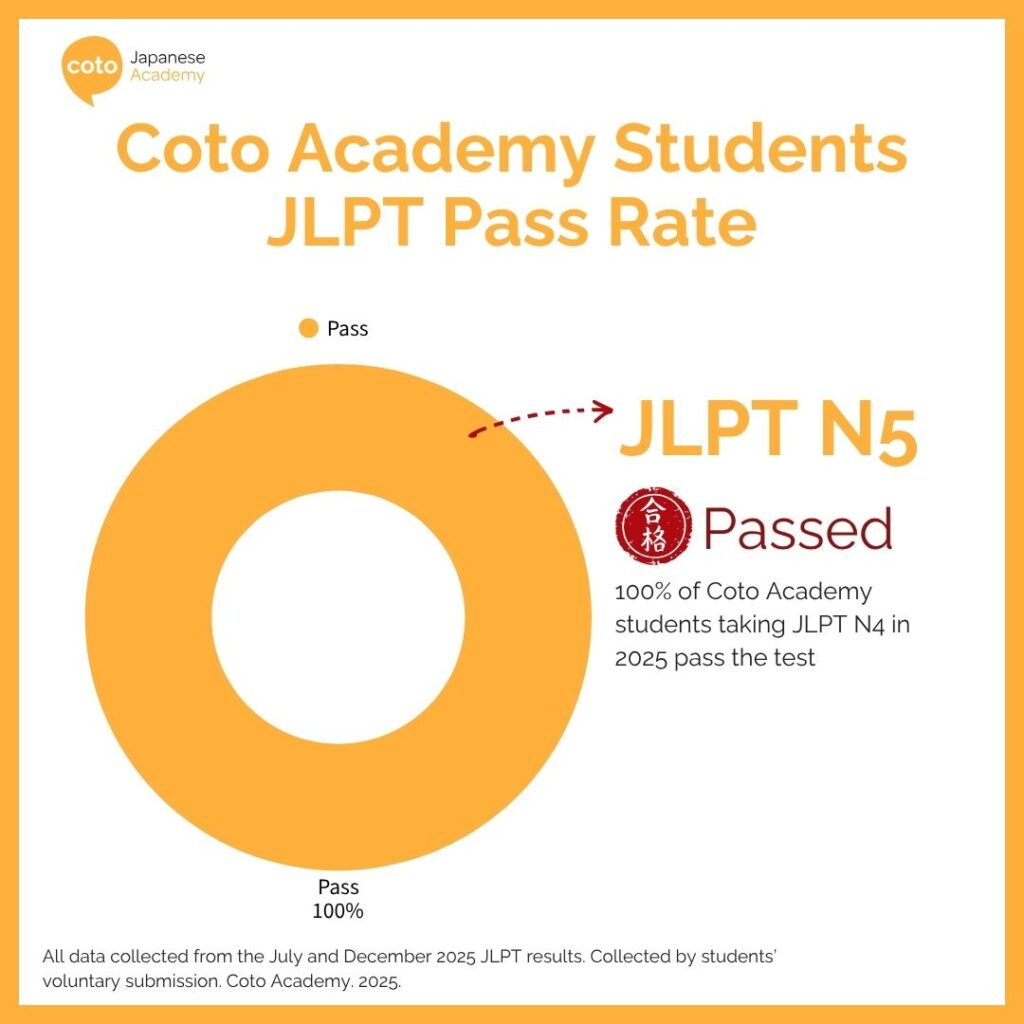
JLPT N5
100.00%
50.47%
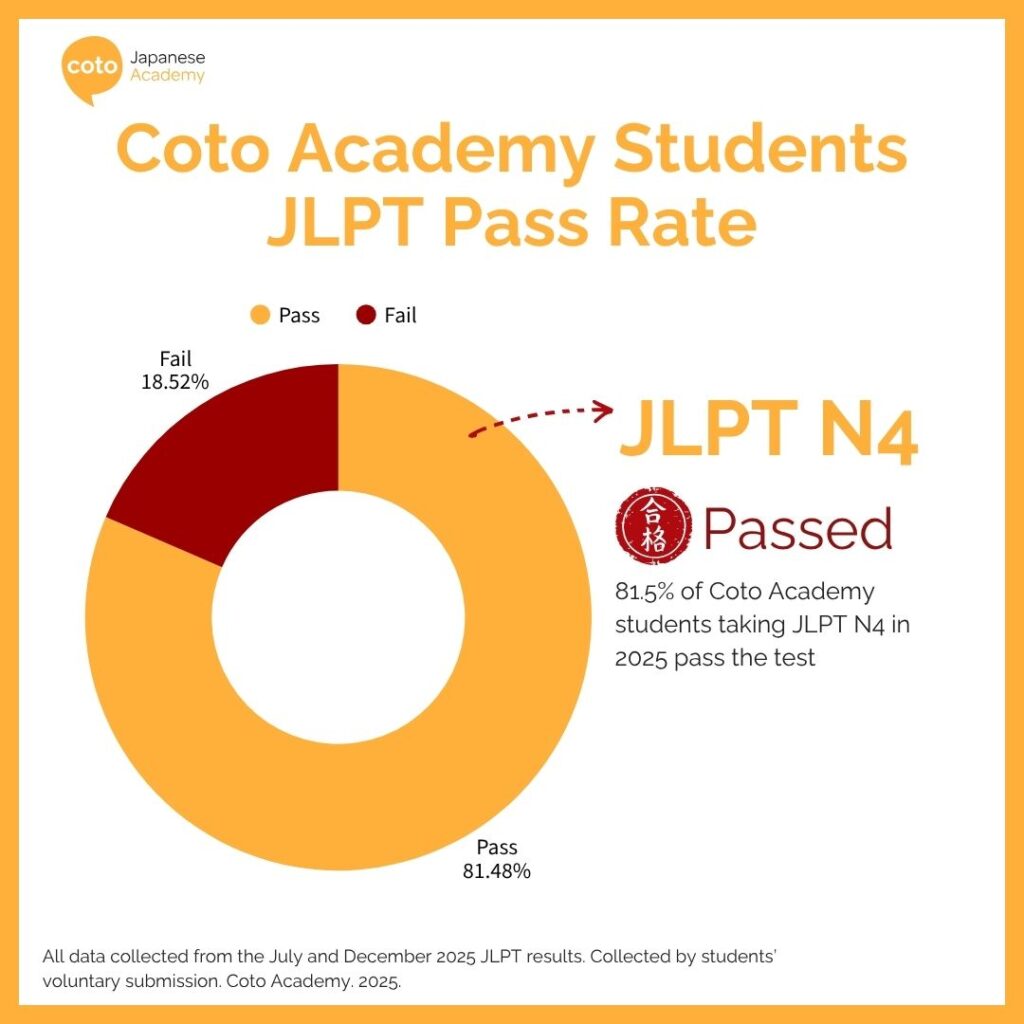
JLPT N4
85.71%
35.64%
JLPT N3
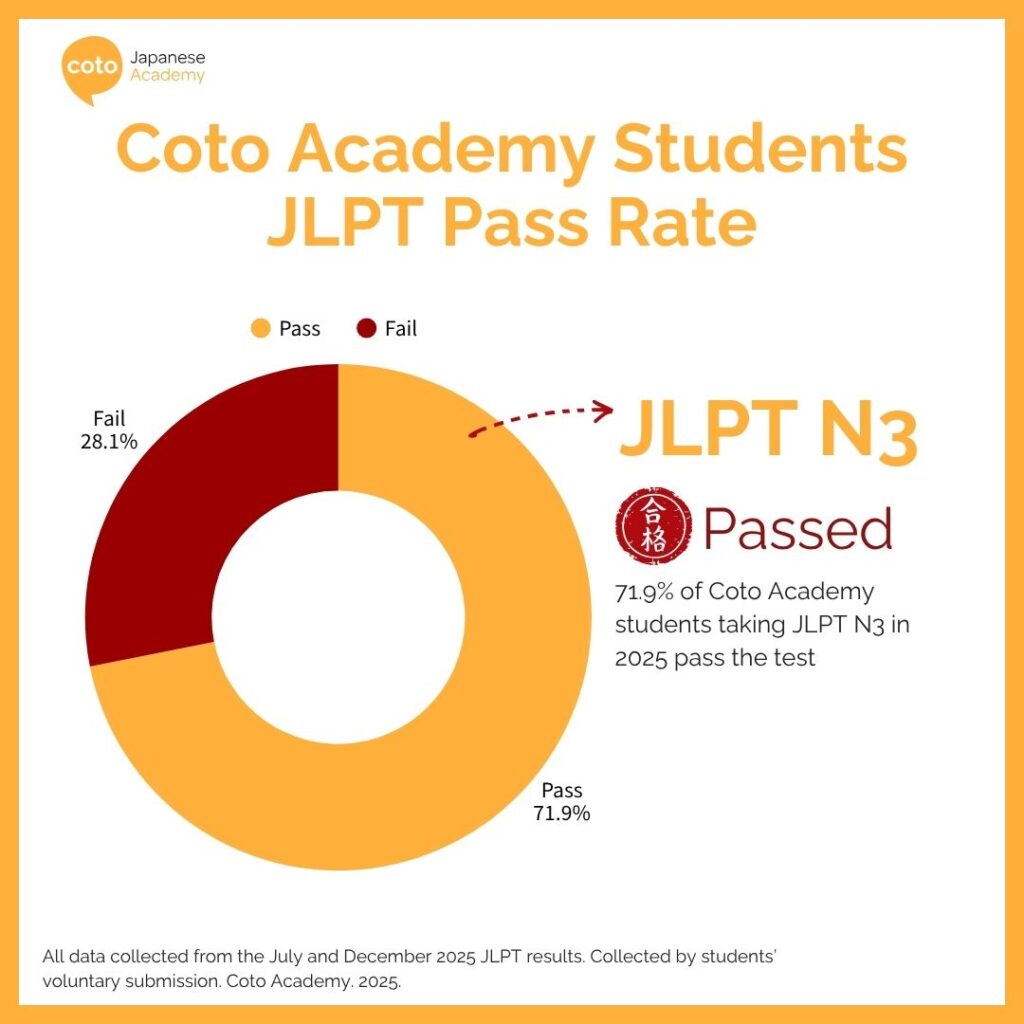
71.88%
34.37%
JLPT N2
58.62%
33.42%
JLPT N1
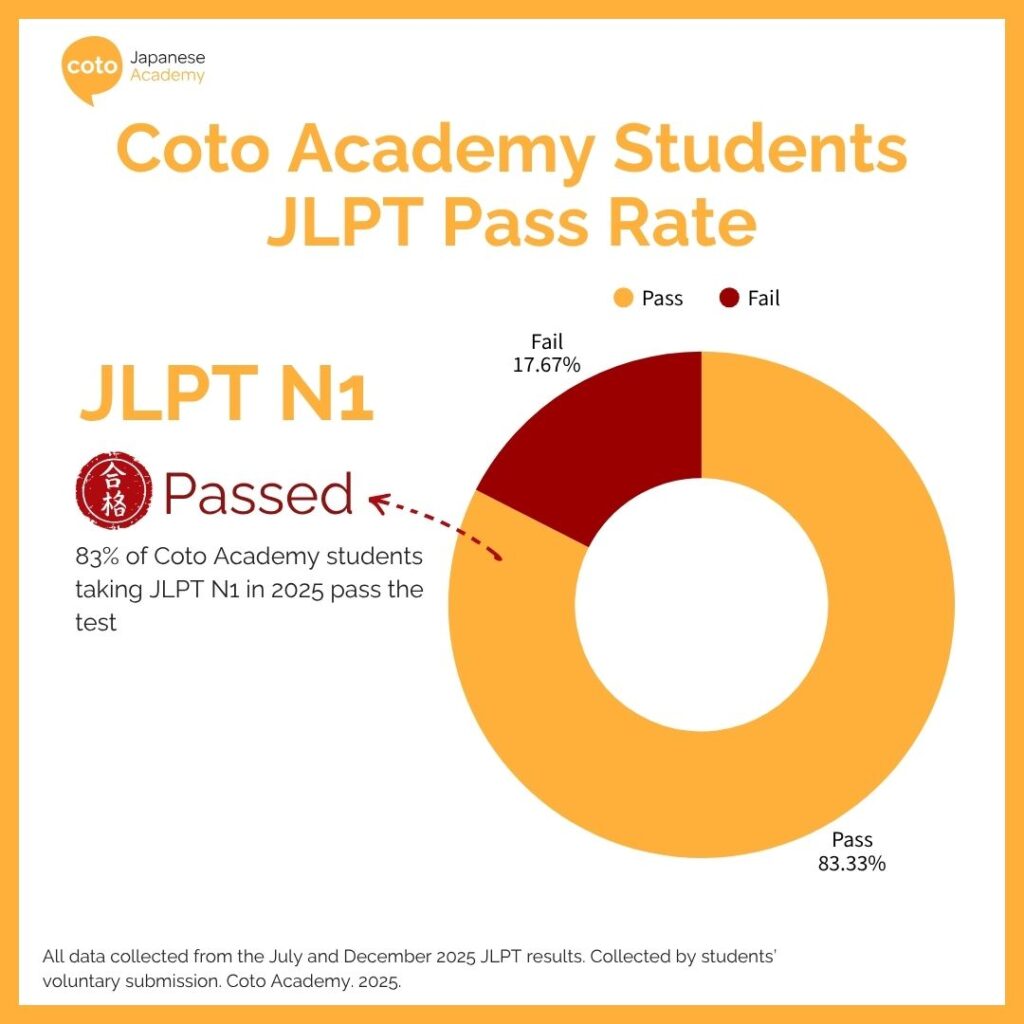
83.33%
28.94%
Coto students who took the N1, the most difficult JLPT level, had a pass rate more than 3 times the national rate. So, this is the result of our JLPT prep courses, coaching our students through each section of the exam, going over testing strategies, time management, and learning to avoid common pitfalls. Let’s go through what we actually do to prepare you for the JLPT.
Coto Academy’s JLPT N1 Pass Rate
In 2025, Coto Academy students who took the JLPT and studied our JLPT course had a pass rate of 83.33%. This is really high, considering the pass rate of JLPT N1 both overseas and in Japan is at 28.94%.
JLPT N1 is arguably the hardest test, but the one that proves your ultimate Japanese skill; passing it shows you don’t just have near-native fluency, but the ability to digest really complex academic and niche texts.
Coto Academy’s JLPT N2 Pass Rate
Coto Academy students who took JLPT N2 in 2025 had a pass rate of 58.62%. While this might seem low, the average JLPT N2 pass rate in 2025 overseas and in Japan is 33.42%, meaning our students had a 75% higher pass rate than the average.
JLPT N2 is often the golden benchmark for lots of work, and one of the bare minimum levels that allows you to be eligible for the Permanent Residence points-based system. Recently, depending on the industry and job you have, the Japanese government has required you to obtain JLPT N2 or demonstrate equivalent ability to apply for the Engineer/Specialist in Humanities/International Services visa.
Coto Academy’s JLPT N3 Pass Rate
71.88% of JLPT N3 students at Coto Academy passed both the July and December 2025 JLPT! As a reference, the average N3 pass rate is 34.37%.
Although it’s not typically considered in job applications or government visa requirements, JLPT N3 is often the starting point that proves you have conversational-level, fluent Japanese. It’s a good benchmark if you want to start a part-time job in Japan.
Coto Academy’s JLPT N4 Pass Rate
The global average pass rate for the N4 exam is notoriously tough at just 35.64%. However, Coto Academy students achieved an exceptional 85.71% success rate.
Coto Academy’s JLPT N5 Pass Rate
In 2025, Coto Academy achieved a remarkable 100% pass rate for the JLPT N5. Compared to the global average pass rate of 50.47%, our students were nearly twice as likely to pass. Learn with confidence and ace your next exam with us.
Though N5 might seem like the lowest and least important JLPT level, in recent years its relevance has grown, as it has become a certificate often required for entry to Japan. For those applying to a visa-eligible Japanese language school, such as Coto Institute, for example, you need to prove at least 150 hours of Japanese language study, and while there are other alternatives, a JLPT N5 certificate is often the most recognized.
How Does Coto Academy Prepare Students for the JLPT?
You might be wondering how you can join the many Coto students who pass the JLPT, so we highly recommend enrolling in our JLPT preparation courses! We offer 2 types of JLPT classes: the 3-month JLPT Course and the Year-Round JLPT Course. Here is a quick breakdown of the 2:
Element
3-Month JLPT Course
Full-Year JLPT Course
Course Length
3 months
12 months
Schedule
End of March – early July or September – early December
Year-round enrollmentStart anytime
Level
N4, N3, N2, and N1
N3, N2 and N1
Curriculum Focus
Comprehensive coverage of all JLPT sections: grammar, reading, listening, vocabulary, and kanji
Strong focus on grammar and reading, with deeper exploration of specific JLPT components based on class needs
Learning Style
Intensive, fast-paced exam preparation
Flexible, personalized, and in-depth learning
Best For
Students preparing for an upcoming JLPT who need a final intensive push before the exam
Students seeking steady progress, strong foundations, and long-term academic growth
Ideal Student Goal
Maximize score in a short time frame
Build lasting proficiency and confidence in Japanese
Note that our Intensive and Lite-Intensive Course for Beginners aligns with the JLPT N5 curriculum for those who want to start with N5-level material.
While either course could be a better fit depending on your learning goals, both are great for preparing you for the JLPT since they offer what we do best! Let’s break down what these are!
1. Structured JLPT-Focused Curriculum
Coto Academy’s curriculum targets the specific range of vocabulary, grammar patterns, and reading and listening skills necessary to excel at each JLPT level. Our curriculum is well-structured and allows students to track their progress so they know that they are reaching their goals.
The course also covers testing strategies, such as time management and breaking down how the questions themselves are structured, which will give students an extra edge beyond just the skills. Students will regularly complete exercises and practice tests, allowing them to see how their performance improves and where their weaknesses lie.
That’s where we get into the curriculum’s flexibility. The class can be tailored to the areas the students want to work on. So, this helps make sure the course helps students overcome their weaknesses, so they can be prepared for every area of the exam.
2. Small Class Sizes and Personalized Feedback
Coto Academy classes have at most 8 students, allowing each student to get the focus they need and the class to be tailored to students’ weaker areas. Teachers can understand each student’s goals, strengths, and weaknesses, providing more personalized support.
Our small classes allow us to create a tight-knit community where everyone feels that their questions and concerns are sufficiently addressed. No need to worry about getting lost in the crowd; rest assured, you’ll receive in-depth feedback and support from kind, professional staff who only want to help you reach your goals.
3. Regular Mock Exams and Timed Practice
Our courses regularly have students take mock exams and timed practice tests to replicate the actual JLPT environment. This allows students to see their progress and see concrete results of their studying and practicing. These will help you adapt to the exam structure, manage the time limit, and identify areas of the test you need to work on. Based on your weakest areas, the teacher can work with you to improve and turn them into strengths.
Giving you real practice that feels just like the exam will help you know exactly what to expect and master each area of the test. There are mock tests you can find online, but they don’t have a professional teacher who can work closely with you to set clear goals and a plan to achieve them!
4. Experienced, Qualified Teachers
Coto Academy’s teachers are committed to making the experience of learning Japanese fun, accessible, and personal. They each have years of classroom experience and specialize in teaching Japanese as a foreign language, which means you are learning from someone who genuinely knows how to get you to your goal.
At Coto Academy, we pride ourselves on our approach, which is what sets us apart from other language schools. Our teachers ensure each student feels genuinely supported by taking the time to understand where you are, where you want to go, and how to get you there. They are not just here to deliver a lesson; they are here to make sure you actually improve.
Unlike other learning platforms that rely on freelance instructors with varying levels of teaching experience, Coto Academy holds its teachers to a high standard because we believe that the quality of your teacher has just as much impact on your results as the quality of the curriculum itself. When you study with Coto, you are getting a team of dedicated professionals who are genuinely invested in your success.
Start Your JLPT Journey with Coto Academy!
Students who take our JLPT courses pass at twice the national pass rate, and that’s because our program works with each and every student to help them set and achieve their goals. Our small classes offer flexible curricula tailored to students’ needs, and with regular timed mock tests, students can track their progress and be ready to smash the exam!
Whether you prefer our 3-month JLPT course, our Year-Round JLPT course, or a flexible online option, Coto Academy offers everything you need to become JLPT-certified.
Ready to reach your Japanese learning goals? Get in touch with Coto Academy today to find the right JLPT course for you.
FAQ
What is Coto Academy’s JLPT pass rate?
Coto Academy’s JLPT pass rate was 83.15% in 2025. While the national average is relatively low, this data shows that the vast majority of Coto Academy’s students are prepared and able to become certified.
Which JLPT levels does Coto Academy offer preparation for?
Coto Academy offers preparation courses for levels N4 through N1.
How long does it take to prepare for JLPT N2 at Coto Academy?
Coto Academy offers both a 3-month intensive course and a 12-month course, which is more in-depth and focused on building lasting proficiency.
Can I study JLPT at Coto Academy online?
Yes! Coto Online offers 6-month and 12-month JLPT preparation courses with flexible scheduling and professional instructors.
Have you ever thought of taking a Japanese language proficiency test besides the JLPT? The JLPT (Japanese Language Proficiency Test) is considered the number one authoritative certification to prove your Japanese language skills, and it’s most recognized, too. Most employers in Japan require N2 or N1 to consider hiring foreigners, but there are other Japanese test alternatives to the JLPT.
Although the JLPT is held in as many as 85 countries and regions worldwide, it might not be available in your home country. Recently, the Japanese government announced that short-term visitors or foreigners without residency in Japan can no longer take the JLPT in Japan, further limiting their opportunities.
So what do you do if the JLPT isn’t available in your country, doesn’t fit your schedule, or simply doesn’t reflect the full range of your Japanese ability? Fortunately, there are several strong alternatives worth knowing about. Read on to find out which one might be the right fit for you.
Setbacks of the JLPT
There are a few setbacks when it comes to taking the JLPT. First, even in Japan, the JLPT is only held twice per year. Once in July and once in December, usually in the first week of each month. This means a few troubles: the window period for open applications is limited. If you miss a deadline, you will have to wait for another six months to register. This can move all your plans, like finding a job in Japan or applying for university. If there’s something urgent you need to attend to, you may not be able to reschedule, as JLPT applications close a couple of months prior to the test date.
Besides only being held twice a year, the JLPT has a few other limitations worth keeping in mind. Most notably, it doesn’t assess oral proficiency at all. With no speaking or listening production component, the exam can’t measure how naturally you express yourself, how well you hold a conversation, or how confidently you respond in real-time situations.
This is a particularly important gap to be aware of if your goal is to actually use Japanese in daily life, at work, or while living in Japan. Learners who focus purely on passing the JLPT can end up with an impressive certificate but struggle to hold a basic conversation — a frustrating and surprisingly common outcome. The exam is a valuable benchmark, but it only measures part of what it means to know a language. Pairing your JLPT study with regular speaking practice is the best way to make sure your skills develop in a more balanced, well-rounded way.
Japanese Language Test Besides JLPT
Test
Format
Frequency
Cost
Recognized By
Strengths
Limitations
J-CAT
Online adaptive test (reading, grammar, vocabulary, listening)
On demand
~3,000 JPY
Some schools and universities
Can be taken from home, instant JLPT-equivalent score, and anti-cheating measures
Not widely recognized by employers; no speaking or writing
Most widely recognized Japanese certification worldwide
No speaking or writing section; limited testing dates
1. J-CAT
We saw a lot of Japanese language schools and universities recommend this test when the JLPT tests were canceled, in or outside of Japan. Short for the Japanese Computerized Adaptive Test, the J-CAT can be taken online at home, with score sheets with JLPT equivalent.
The J-CAT is developed by a team at the University of Tsukuba. It uses an anti-cheating design. Once you take the test, exiting the window will log you out. The text is not copiable, and the questions are timed, too.
The Good: It’s cheaper than JLPT. In 2020, taking the J-CAT costs 3,000 yen (it used to be free before).
The Bad: The downside is that it’s not that well-known yet, so some companies and institutions might not accept the certification as proof of your Japanese proficiency. Like the JLPT, it doesn’t test speaking ability either — only listening, and reading grammar and vocabulary.
The Japanese Kanji Aptitude Test, better known as Kanji Kentei (or Kanken for short), is the test that focuses on your kanji skill. It’s made for native Japanese speakers, which makes it especially challenging for non-native speakers.
The test is divided into 10 levels (unlike JLPT, which only has 5), with 10 being the easiest and 1 most difficult. Level 10 only tests around 80 kanji, which is equivalent to the first-grade elementary level of a Japanese student. Level 1, on the other hand, tests 6,000 kanji, which is probably why it only has a pass rate of 15%.
The paper test takes place 3 times a year, usually in February, June, and October. Registration opens 3 months prior to the test. You can apply for Kanken online through a few simple steps.
The Good: It is more convenient. You will be sitting for Kanken on a computer at a test venue on the date chosen by you. There are more than 150 test venues in Japan. Test results are published faster, too — the result slip will be mailed to you about 10 days after the test.
If you’re in Japan, the Business Japanese Test (BJT for short) is another option. It’s run by the Japan Kanji Aptitude Testing Foundation, the same one behind Kanji Kentei. It’s a multiple-choice test that assesses your competence in Japanese business situations. Students who passed N1 or have advanced-level Japanese usually aim for BJT.
The BJT is specifically designed to test a candidate’s skill in Japanese business communication, so it’s widely recognized by companies. There is no pass or fail in the BJT. The points you score (meaning the correct answers you make) in total will determine your business Japanese level.
The Good: You can take the test any day and select a date and time that is convenient for you. There are a lot of testing locations outside Japan, including China, Taiwan, Korea, Indonesia, Myanmar, India, Singapore, America, France, England, Germany, and Italy
The Bad: At 7,900 JPY, the application fee is relatively expensive. The BJT doesn’t measure any communication skills as it only has listening, listening-reading, and reading sections.
The J-Test is similar to the JLPT in terms of how it’s aimed to measure your competency in Japanese. But whereas there are five levels in JLPT (N1 to N5), the J-Test works similarly to the BJT: you get the same exam paper, and how much you can answer the test (meaning the overall score) determines your ‘level’ of Japanese proficiency.
Unlike the JLPT, however, J-Test has a writing section, so it’s a more accurate way to test your communicative ability.
The Good: It’s available six times a year, which is a good Plan B for anyone who missed the JLPT for whatever reason or failed the test. It’s also cheaper than the JLPT (3,600 JPY compared to 5,500 JPY)
The Bad: It’s not as universally recognized as the JLPT, so a lot of companies might see it as a credible certification. It’s only available in Japan and East/Southeast Asia.
The language testing element that’s always missing on all the JLPT alternatives above is the speaking section. Most tests are done in written or multiple-choice form, so it’s not the most reliable means to assess how well you can actually speak Japanese.
The Japanese ACTFL OPI (Oral Proficiency Interview) is a 20 to 30-minute one-on-one spoken interview between a certified ACTFL tester and you. The whole session is speaker-centered. The tester will adjust the conversations according to how the examinee performed along the way.
The OPI involves a spontaneous, unrehearsed language, so it assesses your true ability to use Japanese appropriately in real-life situations. Your spoken language ability is evaluated based on the overall performance from a set rubric: function, accuracy, context, and more. A ‘proficiency rating’ is awarded based on how all of these factors are combined.
The Good: The ACTFL OPI is taken over the phone or on your computer, so you don’t have to be in Japan to be eligible for the interview.
The Bad: The Japanese ACTFL OPI only measures speaking ability, so it’s not as comprehensive as other tests.
Most Japanese language tests are designed with general proficiency in mind, but what if your goal is specifically to work in a Japanese business environment? The BJT (Business Japanese Proficiency Test) is designed exactly for that purpose. Rather than testing grammar and vocabulary in isolation, it assesses how well you can use Japanese in practical workplace scenarios: meetings, negotiations, phone calls, and professional correspondence.
The test is computer-based and consists of listening and reading sections built around realistic business situations. Your performance is scored on a scale from 0 to 800, rather than a pass/fail system, giving employers a more nuanced picture of your actual business communication ability.
Because it focuses on professional Japanese rather than everyday or academic language, the BJT is particularly valued by companies in Japan and multinational firms hiring for Japan-facing roles.
The Good: The BJT’s scoring scale gives a more granular assessment of your ability than a simple pass or fail — useful for both job applications and tracking your own progress.
The Bad: Its focus on business Japanese makes it less relevant if your goals are personal, academic, or conversational rather than professional.
Which Japanese Proficiency Test Should You Choose?
If your goal is…
Best choice
The most recognized Japanese certification
JLPT
A quick online proficiency assessment
J-CAT
Improving or certifying kanji ability
Kanji Kentei (Kanken)
Working in a Japanese company
Business Japanese Test (BJT)
Testing writing as well as reading/listening
J-Test
Proving your Japanese speaking ability
ACTFL OPI
With recent government policies placing greater importance on officially proving your Japanese ability, you may be wondering whether it’s still worth taking the JLPT or if a more affordable and accessible alternative will do.
The answer depends on why you need a Japanese language certificate.
For example, many student visa applicants must prove they have completed 150 hours of Japanese study or demonstrate equivalent proficiency. In practice, a JLPT N5 certificate is one of the most commonly accepted ways to satisfy this requirement, but its
Similarly, applicants for certain work visas—such as the Engineer/Specialist in Humanities/International Services visa—may, under specific circumstances, need to demonstrate Japanese ability equivalent to JLPT N2.
The good news is that the Japanese government often recognizes several equivalent Japanese language tests, not just the JLPT. If you’re applying for a visa, check the official list of accepted qualifications, as an alternative certification may also meet the requirements. That said, these tests are generally less well-known than the JLPT.
If your goal is employment, the situation is a little different. Most employers are familiar with the JLPT, and for business-related positions, the Business Japanese Test (BJT) is also widely recognized. If you’re taking a language test primarily to strengthen your resume or meet an employer’s requirements, we generally recommend choosing the JLPT or the BJT if your focus is business Japanese.
The Bottom Line
The JLPT is the ultimate benchmark to gauge your Japanese language competency, and it’s still the highest standard, too. The Japanese government even uses it for its point-based system for highly skilled professionals. For certain requirements, there is no alternative to the JLPT. With that being said, the JLPT does not measure active skills.
JLPT or other language certifications look good on paper, but the important thing is to be able to prove that you can speak Japanese at a certain level during the interview. Many people who don’t have any JLPT certification are fluent in Japanese and able to get work in Japan. Ironically, a lot of N1 or N2 holders can still face challenges during interviews — they might be good at theory, but not in real life.
These JLPT alternatives might not even be recognized for work or school, but it is good to know that there are some other options out there — just in case you’re making Plan B, C, D, E, and so forth when you missed the JLPT.
Ready to Pass the JLPT 2026? Join JLPT Lessons at Coto Academy!
Ready to Pass the JLPT? Join JLPT Lessons at Coto Academy!
Whether you want extra JLPT preparation or a customized, one-on-one lesson plan for other exams (like Kanji Kentei, BJT or even EJU), Coto Academy offers flexible Japanese courses that fit your goal.
For example, you can join Coto Academy’s highly popular JLPT prep course! Taught in Tokyo by experienced instructors who specialize in the JLPT, this course gives you the strategies, practice tests, and structured study approach to master every part of the exam. With expert guidance and proven methods, you’ll walk into your next JLPT feeling confident and ready to pass.
Contact us for a Japanese-level check and a free consultation on the best JLPT prep course for you!
Is there an alternative to JLPT?
Although JLPT is the most recognized language test, there are other Japanese tests you can take in our outside of Japan: J-CAT, J-TEST, Business Japanese Test, Kanji Kentei and ACTFL OPI (oral interview).
What is the Kanji Kentei Test?
The Japanese Kanji Aptitude Test, better known as Kanji Kentei (or Kanken for short), tests your knowledge of kanji. The test is divided into 10 levels (unlike JLPT, which only has 5), with 10 being the easiest and 1 most difficult.
Is passing the Business Japanese Test (BJT) hard?
There is no past or failure in taking the BJT. There is only one test. The points you score (meaning the correct answers you make) in total will determine your business Japanese level.