
Welcome to the JLPT N4 vocabulary mock test! This test is designed to prepare you for the vocabulary section of the JLPT N4, as well as build the skills necessary to pass the test with confidence.
We offer two versions of the test: there’s the online quiz version, where you’ll get your results instantly, and there’s the full written version, for those who want to learn manually.
Want to prepare for the JLPT with professional instructors? Join Coto Academy’s JLPT Prep Course!
3. 電車に乗るとき、先に ____ 人が降りるのを待ちましょう。 A. のっている B. のる C. のりかえる D. のりこす
4. 部屋が暗いので、電気を ____ ください。 A. つけて B. けして C. あけて D. しめて
5. 子どものころから、サッカーが ____ です。 A. とくい B. にがて C. すき D. きらい
6. 昨日、駅の前で財布を ___しまいました。 A. おとして B. わすれて C. なくして D. おいて
7. 毎朝、歯を ___ から朝ごはんを食べます。 A. みがいて B. あらって C. ふいて D. かわかして
8. この映画は ___ があって、とても感動しました。 A. かんどう B. ないよう C. いみ D. ばめん
9. 母は毎朝、近くの ___ へ買い物に行きます。 A. デパート B. スーパー C. コンビニ D. レストラン
10. 熱があるので、今日は学校を ___ します。 A. けっせき B. しゅっせき C. ちこく D. そつぎょう
11. 道が分からなかったので、警察官に ___ もらいました。 A. おしえて B. つれて C. みせて D. つたえて
12. 先生が黒板に書いたことを ____ に書きました。
A. ノート B. テスト C. きょうかしょ D. じしょ
13. このりょうりは ____ がきつくて、食べられません。 A. から B. あじ C. におい D. いろ
14. バスが来なかったので、駅まで ____ で行きました。 A. あるい B. はしっ C. およい D. とん
15. 明日の朝、早く起きるために ____ をセットしました。 A. テレビ B. ラジオ C. めざましどけい D. カレンダー
16. このかばんは ____ がよくて、たくさん入ります。
A. いろ B. かたち C. おおきさ D. おもさ
17. 彼は ____ な人で、いつも正しいことを言います。
A. しょうじき B. しんせつ C. ていねい D. まじめ
18. 試験の前に、ノートを ____ しました。
A. かくにん B. じゅんび C. せつめい D. しょうかい
19. あの店はいつも ____ がよくて、また行きたいです。
A. サービス B. ねだん C. りょうり D. ふんいき
20. 昨日、友達と映画を見た ____、夕ごはんを食べました。 A. あとで B. まえに C. あいだに D. ときに
21. 毎晩、寝る前に日記を ____ 習慣があります。
A. かく B. よむ C. みる D. かんがえる
22. 部長に新しい計画を ____ しました。
A. ていあん B. せつめい C. しょうかい D. かくにん
23. 電車が ____ したので、会社に遅刻してしまいました。
A. おくれ B. とまり C. こわれ D. すぎ
24. 旅行の前に、ホテルを ____ しておきました。
A. よやく B. じゅんび C. かくにん D. れんらく
25. この仕事は ____ があって、毎日楽しいです。
A. やりがい B. じしん C. きょうみ D. いよく
26. 友達に借りた本を、まだ ____ いません。 A. かえして B. かして C. よんで D. もって
27. 子どもが熱を出したので、すぐに病院に ____ 。 A. つれていきました B. いきました C. おくりました D. よびました
28. 彼女はいつも ___ に話すので、みんなに好かれています。 A. ていねい B. はやく C. おおきく D. やさしく
29. 風邪をひいたので、薬を _____ 、早く寝ました。 A. のんで B. かって C. もらって D. つくって
30. この道をまっすぐ行くと、右に _____ があります。 A. こうばん B. こうえん C. えき D. びょういん
Answer key
1. A. しゅっせき
2.A. はこべ
3. A. のっている
4. A. つけて
5. A. とくい
6. A. おとして
7. B. ないよう
8. B. スーパー
9. A. けっせき
10. A. おしえて
11. A. ノート
12. A. から
13. A. あるい
14. C. めざましどけい
15. C. おおきさ
16. A. しょうじき
17. A. かくにん
18. A. サービス
19. A. あとで
20. A. かく
21. A. ていあん
22. A. おくれ
23. A. よやく
24. A. やりがい
25. A. かえして
26. A. ていねい
27. A. つれていきました
28. A. ていねい
29. A. のんで
30. A. こうばん
How Many Words Do You Need to Know for the JLPT N4?
The JLPT N4 vocabulary list covers approximately 1,500 words, including the 800 or so words you should already know from N5. That means the net new vocabulary you need to acquire for N4 is closer to 600 to 700 words.
The good news is that N4 vocabulary is highly practical. At this level, you are moving beyond basic greetings and survival phrases into everyday conversation, talking about your daily routine, expressing opinions, describing experiences, and navigating common social situations. These are words you will encounter constantly in daily life in Japan, which means immersion and study naturally reinforce each other.
Pass the JLPT with Coto’s JLPT Preparation Course
Want to pass the JLPT with confidence? Why not take Japanese lessons with us? With over 25 years in practical Japanese instruction, we also offer specialized courses, whether it be for JLPT prep or learning business Japanese.
Ready to improve your Japanese? Contact us below and get a free Japanese level check.
FAQ
How much vocabulary do I have to study for the JLPT N4?
You should be able to understand at least 1500 vocabulary terms when studying for the JLPT N4.
Is N4 equivalent to B1?
No, we would say that achieving the N4 is the equivalent of obtaining a CEFR A2 level.
How many study hours does it take to pass the JLPT N4?
It depends on the learner, but usually it will take about 550 hours of study to pass the JLPT N4, with kanji knowledge. For learners without prior kanji knowledge, it might take about 800 to 1000 hours.
Spring, or haru (春), has arrived in Japan, and that means a few things! The cherry blossoms are blooming, temperatures are warming, and locals and tourists alike have gathered to enjoy and appreciate them. In Japan, the spring season typically lasts from the beginning of March to the end of May, and you know that the season has reached its peak when the cherry blossoms are in full bloom.
While spring in Japan is known for its cherry blossoms, there are many more things that are related to this season, such as seasonal ingredients, mild weather, and new beginnings. What could be a better way to learn about springtime in Japan than to learn essential Japanese spring vocabulary? In this post, we’ve gathered our favorite springtime words that you might come across, whether you’re planning to attend a hanami (花見) or try out new springtime foods.
Let’s get started!
What is Spring in Japanese?
In Japanese, the word for spring is haru (春). This is one of the essential spring-related vocabulary words that you need to learn.
Note that haru is only the kunyomi reading, or native Japanese reading. The onyomi, or the Sino-Japanese reading derived from Chinese, for haru is シュン (shun). For example, to say spring holiday, you would say haruyasumi (春休み), but spring vernal equinox is called shunbun (春分).
In Japanese, sakura (桜), which means cherry blossoms. They usually signify the beginning of spring in Japan. Cherry blossom flowers in Japanese are called hanazakura (花桜), with the word hana (花) meaning flowers.
Cherry blossoms bloom in a tree called 桜木 (sakura gi) — sakura tree, where the word gi (木). The reason why it is pronounced as “gi” and not “ki” is that 木 has a nanori reading “gi”. The change from ki to gi usually comes from rendaku (consonant voicing) plus name-specific readings.
Want to learn more Japanese? Join flexible Japanese lessons in Tokyo, Yokohama, or online, at Coto Japanese Academy!
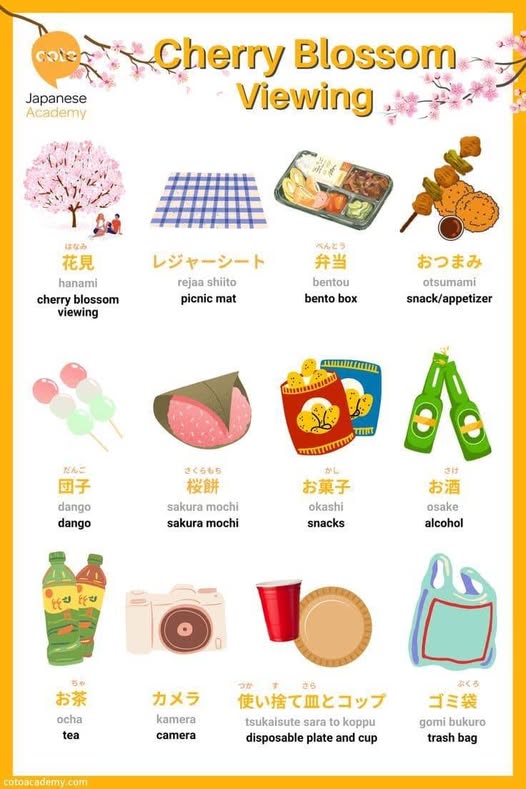
If you live in Japan, chances are you might be going to see the cherry blossoms in full bloom this spring. In this list, we’ve included some of the vocabulary you might need to fully enjoy the cherry blossoms this Spring. We’ve also included some sakura-themed food and drink for you to try as well.
Japanese
Romaji
English
桜
sakura
Cherry blossom
花見
hanami
Cherry blossom viewing
ピクニック
pikunikku
Picnic
夜桜
yozakura
Night cherry blossoms
花びら
hanabira
Petals
蕾
tsubomi
Bud (of a flower)
花
hana
Flower
桜餅
sakura mochi
Cherry blossom mochi
花見団子
hanami dango
Hanami dango (rice flour balls)
桜まじゅう
sakura manjuu
Sakura manjuu (glutinous rice flour sweet)
桜羊羹
sakura youkan
Sakura jelly
桜たい焼き
sakura taiyaki
Sakura fish-shaped cake
いちご大福
ichigo daifuku
Strawberry rice cakes
咲く
saku
To bloom
開花
kaika
First blossoms
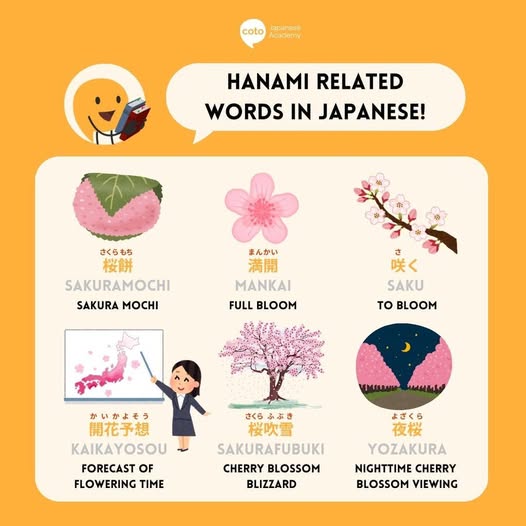
開花予想
kaikayosou
Cherry blossom forecast
満開
mankai
Full bloom (of cherry blossoms)
桜吹雪
sakura fubuki
Cherry blossom blizzard
Hanami literally means “flower viewing.” It usually refers to enjoying cherry blossoms with friends, family, or coworkers during spring. This is different from just coincidentally seeing cherry blossoms in Japan. During hanami, you are specifically going out to look for good cherry blossom spots.
That is why, if you are visiting Japan, you might often come across search terms like “best hanami spots.” These are places known for having some of the most beautiful cherry blossoms, often with hundreds or even thousands of trees.
Every year, the Japanese Meteorological Agency releases a cherry blossom forecast. The blooming period, from kaika (開花), meaning the first blossoms, to mankai (満開), meaning full bloom, is fleeting and often lasts only about two weeks. Because of this, timing your visit is important. Typically, cherry blossom season begins in warmer regions and gradually moves north. Colder areas like Hokkaido usually see cherry blossoms bloom the latest.
If you miss the peak blossom season, don’t worry. When the petals begin to fall, there is still a beautiful, almost anime-like moment known as sakura fubuki, which literally means “cherry blossom blizzard.” During this time, petals drift down from the trees and blanket the ground in pale pink and white.
It is especially breathtaking if you visit places with long rows or large numbers of cherry trees. You may see roads, rivers, and sidewalks covered in fallen petals. When the wind picks up, the petals swirl through the air from both the branches and the ground and create a scene that looks almost like spring snow.
In Japan, there are many types of cherry blossoms that you can find, whether on the streets of Tokyo or in the wild. Here we have listed several varieties of cherry blossoms, as well as how to differentiate between each type:
1. Yamazakura (山桜): Mountain Cherry Blossom
This type of cherry blossom can be seen growing in the mountains in Japan. They tend to grow in late March to early April, and can be characterized by having five, slightly pink petals.
2. Shidarezakura (枝垂れ桜): Weeping Cherry Blossom
This is one type of cherry blossom tree that is common throughout Japan. They are characterized as having drooping branches and bloom from late March to early April. The number of petals can vary; some Shidarezakura have five petals, while others have more.
This is another type of well-known type of cherry blossom tree, and probably one of the most well-known throughout Japan. Their flowers have five pale pink petals, and bloom around late March to early April.
4. Yaezaukra (八重桜) – Multi-layered Cherry Blossom
Yaezakura is more of an umbrella term that refers to any cherry blossom that has more than five petals in one flower. Some specific types of yaezakura include the Kanzan (関山), the Ichiyou (一葉), and the Chrysanthemum Cherry Blossom, or Kikuzakura (菊桜) in Japanese. They have varying blooming times, but generally you can see them from mid-April onwards, making them one of the late-blooming varieties of cherry blossoms.
5. Kanzakura (寒桜): Winter Cherry Blossoms
These are one of the earliest blooming varieties of cherry blossom, as they start blooming from late February to mid-March. Compared to its most popular counterpart, the Somei Yoshino, Kanzakura flowers have smaller, pink petals.
But spring in Japan isn’t just about the cherry blossoms and hanami viewings. There are other words that you need to know that are related to spring.; some are pleasant, others, not so much.
Japanese
Romaji
English
季節
kisetsu
Season
春
haru
Spring
春休み
haru yasumi
Spring holiday
春風
haru kaze
Spring breeze
春先
harusaki
Beginning of spring
春分
shunbun
Vernal Equinox/Spring Equinox
公園
kouen
Park
散歩(する)
sanpo (suru)
To go on a walk
(自転車に)乗る
(jitensha ni noru)
To ride a bike
果物狩り
kudamono gari
Fruit picking
田植え
taue
Rice planting
入学
nyuugaku
Entry into school
入学式
nyuugaku shiki
School entrance ceremony
卒業
sotsugyou
Graduation
卒業式
sotsugyou shiki
Graduation ceremony
新学期
shingakki
New school term
新年度
shinnendo
New fiscal year
新生活
shinseikatsu
New life
花粉症
kafunshou
Hay fever/pollen allergy
抗ヒスタミン薬
kouhisutaminyaku
Antihistemines
Japanese Vocabulary for Spring Food and Ingredients
Spring isn’t just about the cherry blossoms. It’s also about food, especially the ingredients. We’ve compiled a list of foods that you might see on your table during this season.
Japanese
Romaji
English
Japanese
Romaji
English
梅
ume
Plum
梅干し
umeboshi
Pickled plums
若葉
wakaba
Fresh young leaves
筍
takenoko
Bamboo shoots
いちご
ichigo
Strawberry
みかん
mikan
Mikan (Japanese Mandarin)
山菜
sansai
Mountain vegetables
蕗
fuki
Butterbur
屈み
kogomi
Ostrich Fern
わさび菜
wasabina
Wasabi Mustard Greens
山独活
yama udo
Mountain Asparagus
鯛
tai
Sea bream
漁り
asari
Japanese littleneck clams
イカナゴ
ikanago
Japanese sand lance
How to Talk About Japanese Spring
Although we have a separate guide on how to talk about the weather in Japanese, it’s important that you learn some words to describe the spring weather. Spring in Japan enjoys mild weather, with warmer temperatures compared to winter.
Japanese
Romaji
English
天気
tenki
Weather
気温
kion
Temperature
涼しい
suzushii
Cool
暖かい
atatakai
Warm
晴
hare
Clear
雨
ame
Rain
曇り
kumori
Cloudy
風
kaze
Wind
Describing the Spring Weather in Japanese
Now that you’ve learned the basics and picked up the essential spring vocabulary in Japanese, it’s time to put them into practice! Let’s go through some common phrases and questions you’ll often hear, or might want to ask yourself, when talking about spring in Japan.
春は暖かいです。 Haru wa atatakai desu. Spring is warm.
桜が咲き始めて、とてもきれいです。 Sakura ga saki hajimete, totemo kirei desu. The cherry blossoms are starting to bloom, and it’s very beautiful.
春の風は強いですね。 Haru no kaze ga tsuyoi desu ne. The spring winds are strong.
今日は天気がいいから、外で散歩します。 Tenki ga ii kara, soto de sanpo shimasu. The weather is great today, so I’ll go on a walk.
Conclusion: Learn Beyond Japanese Spring Vocabulary and Speak Japanese with Lessons at Coto Academy
Now that you’ve learned the basics of talking about the spring in Japanese, why stop there? There are plenty of other essential skills to master, like introducing yourself or discussing a specific topic in conversation.
If you want to build confidence and start speaking Japanese, consider joining conversation-focused Japanese lessons at Coto Academy. As a top-rated school with campuses in Tokyo and Yokohama, we offer fun and flexible lessons designed around practical, everyday conversation.
Ready to get started? Fill out the form below to contact us!
FAQ
When can I see cherry blossoms in 2026?
Always check the cherry blossom forecast, or kaikayosou (開花予想). You can then plan your visit from that forecast, but we recommend that you plan your trip early because it’s considered peak traveling season!
What month do the cherry blossoms bloom in Japan?
Generally, the most common types of cherry blossoms tend to start blooming around late-March to early April, but it can depend on the prefecture.
Which month is spring in Japan?
In Japan, spring lasts from the beginning of March to the end of May.
If you have Japanese artist friends, plan to study art, or pursue a career in art in Japan, then you might want to know some Japanese vocabulary related to arts — more specifically, visual art. Japan has a rich history in the arts, from the ukiyo-e works of Hokusai to more recent manga and anime. Talking about art in Japanese can be a great way to connect with the Japanese artist community as well!
We’ll start off with some general vocabulary related to colors, art forms, and even historical art styles, but we will also talk about buying art supplies in Japanese, so that next time you want to create art in Japan, you’ll know what to buy. For aspiring manga artists wanting to create their own manga in Japan, stick around for a surprise!
Japanese General Art-Related Vocabulary
This vocabulary list covers basic art terms in Japanese, but we’ve also included the different art forms you might see at an art gallery.
Japanese (Romaji)
Kanji
English
e
絵
Picture
bijutsusha
美術者
Artist
bijutsu
美術
Art
bijutsukan
美術館
Art gallery
irasuto
イラスト
Illustration
kaiga
絵画
Painting
shouzouka
肖像画
Portrait
fuukeika
風景画
Landscape
seramikku
セラミック
Ceramics
choukoku
彫刻
Sculpture
shishuu
刺繍
Embroidery
gurafikku dezain
グラフィックデザイン
Graphic design
dessan
デッサン
Sketch
sukecchi
スケッチ
Sketch
satsuei
撮影
Photography
shashin
写真
Photograph
eiga
映画
Film, movie
hanga
版画
Art print
kenchiku
建築
Architecture
insutareeshon
インスタレーション
Art installation
dejitaaru aato
デジタルアート
Digital art
mikusu media
ミクスメディア
Mixed media
rakugaki
落書き
Graffiti
Japanese Vocabulary List Related to Historical Art Styles
This vocabulary list covers most of the historical painting styles you might see at an art museum, such as the National Museum of Western Art in Tokyo. Whether you’re studying art history or just want to talk about specific art periods, these terms might help you to understand.
Japanese (romaji)
Kana
English
inshouha
印象派
Impressionism
posuto inshouha
ポスト印象派
Post-impressionism
runesansu bijutsu
ルネサンス美術
Renaissance art
chuusei bijutsu
中世美術
Medieval art
barokku
バロック絵画
Baroque painting
rokoko
ロココ美術
Rococo art
kyubisumu
キュビスム
Cubism
chuushou kaiga
抽象絵画
Abstract painting
poppu aato
ポップアート
Pop art
shurureasumu
シュルレアスム
Surrealism
Vocabulary Related to Japanese Traditional Art
This vocabulary list covers most words related to traditional Japanese visual art and sculpture. Note that when we talk about schools of art, we are talking about a style of art, not an actual school.
Japanese (romaji)
Kana
English
rinpa
琳派
Rimpa (school of art)
kanouha
狩野派
Kano (school of art)
nanga (bujinga)
南画(文人画)
Southern (literati) (school of art)
zenga
禅画
Zen Buddhist (school of art)
shodou
書道
Japanese Calligraphy
doguu
土偶
Earthen figure
haniwa
埴輪
Terracotta clay figures
ukiyo e
浮世絵
Ukiyo-e prints
moku hanga
木版画
Woodblock printing
toujiki
陶磁器
Japanese pottery
nihon shikki
日本漆器
Japanese lacquerware
Colors in Japanese
You might find yourself talking about specific colors when discussing a specific art piece. We’ve compiled most of, if not all basic colors that you might hear often.
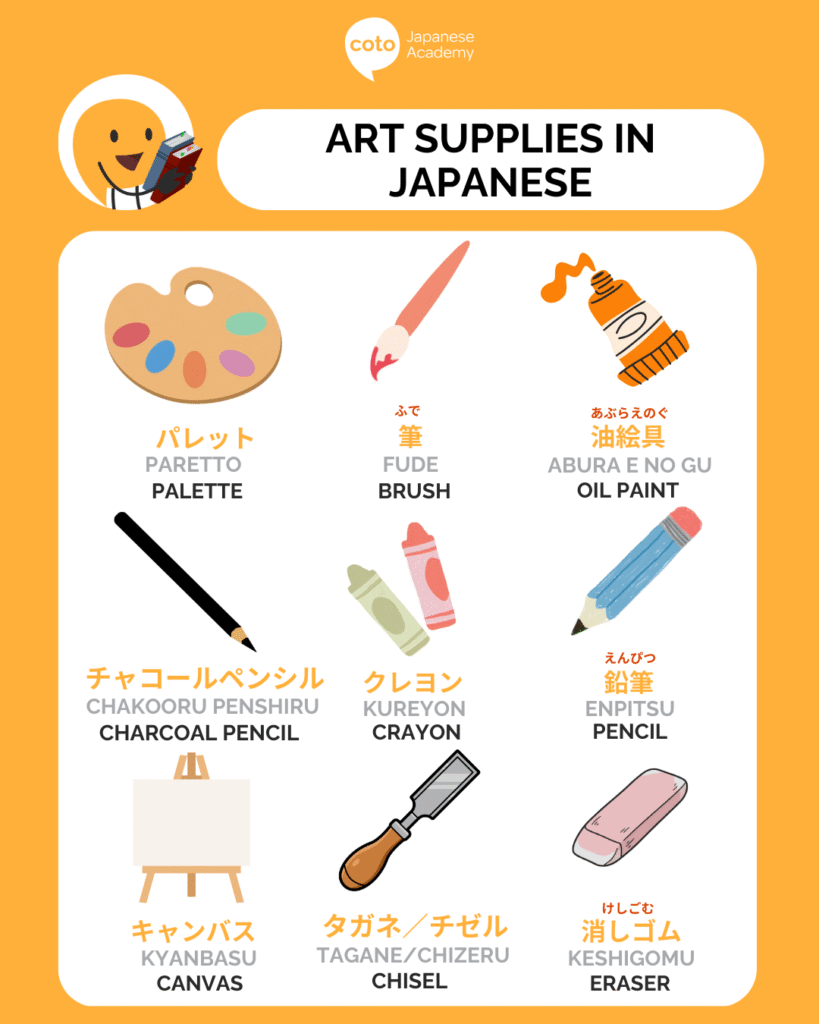
From buying specific types of paints to procuring other art mediums, this Japanese vocabulary list contains almost all types of art supplies you might see at an art store. If you’re looking to go to an art store such as Sekaido, this list might come in handy.
Japanese (Romaji)
Kanji/Kana
English
akuriru e no gu
アクリル絵具
Acrylic paint
suisai e no gu
水彩絵具
Watercolor paint
abura e no gu
油絵具
Oil paint
gasshu
ガッシュ
Gouache
paretto
パレット
Palette
fude
筆
Brush
suihitsu
水筆
Water brush
shodou fude
書道筆
Calligraphy brush
peintingu naifu
ペインティングナイフ
Painting knife
kureyon
クレヨン
Crayons
oiru pasuteru
オイルパステル
Oil pastel
maakaa
マーカー
Marker
mokutan
木炭
Charcoal
enpitsu
鉛筆
Pencil
iro enpitsu
色鉛筆
Color pencil
shapen
シャペン
Mechanical pencil
pen
ペン
Pen
fude pen
筆ペン
Brush pen
mannen hitsu
万年筆
Fountain pen
garasu pen
ガラスペン
Glass pen
keshigomu
消しゴム
Eraser
kyanbasu
キャンバス
Canvas
iizeru
イーゼル
Easel
sukecchibukku
スケッチブック
Sketchbook
inku
インク
Ink
moderu
モデル
Mannequin
iromi bonchou
色見本帳
Color swatch book
hasami
はさみ
Scissors
kattaa
カッター
Box cutter
tagane
鑽
Chisel
nendo
粘土
Clay
tekisuchaa tsuuru
テクスチャーツール
Texture tools (for modeling with clay)
kami
紙
Paper
pootoforio
ポートフォリオ
Portfolio
aato hon
アート本
Art book
Japanese Vocabulary for Manga Artists
Learning how to create manga in Japanese? This vocabulary list covers all things related to creating manga, as well as essential supplies needed to create your own manga. We’ve also included the different types of nibs manga artists use for their dip pens, as well as some terms used to describe different parts of manga manuscript paper.
Japanese (Romaji)
Kanji
English
e konte
絵コンテ
Storyboard
toon
トーン
Screentone
tsuke pen
つけペン
Dip pen
G pen
Gペン
G nib
saji pen
サジペン
Spoon nib
sukuuru pen
スクールペン
School nib
nihonji pen
日本字ペン
Japanese nib
maru pen
丸ペン
Mapping nib
genkou youshi
原稿用紙
Manuscript paper
purotto
プロット
Plot
neemu
ネーム
Storyboard
shitagaki
下書き
Rough sketch
pen ire
ペン入れ
Inking
toon sagyou
トーン作業
Applying screentones
hyoushi
表紙
Cover
uchiwaku
内枠
Inner frame
tachikiri sen
断ち切り線
Cut-off line
sotowaku
外枠
Outer frame
Conclusion: Talking about art in Japan shouldn’t be intimidating!
Creating and appreciating art in Japan shouldn’t feel intimidating. We hope that this list will give you some ideas on how to talk about art in Japanese to your artist friends, and we hope that you are able to navigate through an art store in Japan as well. Good luck and happy creating!
Learn Japanese with Coto Academy!
If you have always wanted to work in Japan as an artist, one of the things you need to do is learn Japanese. Now, you can join flexible Japanese lessons designed for adults at Coto Academy, a top language school with locations in Shinjuku, Shibuya, Yokohama, Iidabashi, and Minato.
Interested in joining intensive or part-time Japanese lessons? Contact us below to get in touch with our friendly staff!
There are plenty of art museums and galleries, such as the National Art Center and the National Museum of Western Art in Tokyo. There are also modern art museums, such as the Mori Art Museum, as well.
What do you call an artist in Japanese?
When referring to artists in Japanese, most people say “sensei” to show respect, as they are considered to be masters in their craft. For example, a manga artist might be called “sensei” due to their work.
Where can I buy art supplies in Japan?
Try shops like Sekaido, dedicated to art supplies. Some stationery stores, such as Itoya, have dedicated sections or floors related to art supplies.
Navigating pregnancy and childbirth in Japan can feel overwhelming, especially in a city as busy and diverse as Tokyo, if you are not familiar with the local language. From prenatal checkups to hospital visits and birth planning, knowing the right Japanese vocabulary can make communication with doctors, nurses, and support staff much smoother.
Expecting a baby in Japan? In this blog article, we will be taking a look at various useful vocabulary words in Japanese related to pregnancy and childbirth! This guide introduces essential Japanese words and phrases related to pregnancy and giving birth, with a focus on situations you are likely to encounter in Tokyo.
We will also share with you some information about giving birth in Tokyo, including what it’s like to be pregnant in Japan, a list of English-friendly hospitals in Tokyo, and details about childbirth financial aid in Japan.
Basic Medical Terms in Japanese
When preparing for pregnancy or childbirth in Japan, it’s helpful to know some basic medical terms that often come up in clinics and hospitals. Below is a table of general medical words you may need to know when going for a medical checkup in Japan. Sanfujinka (産婦人科) is the Japanese word for the obstetrics and gynecology department or OB-GYN clinic. In Tokyo, many women go to a sanfujinka for both routine prenatal checkups (ninshin kenshin or 妊娠検診) and delivery-related care. Some larger hospitals have a dedicated sanfujinka ward, while smaller private sanfujinka clinics often provide more personalized care.
Japanese
Pronunciation
English
産婦人科
Sanfujinka
Obstetrics and gynecology
病院
Byouin
Hospital
訪問時間
Houmon jikan
Visiting hours
医者
Isha
Doctor
看護師
Kangoshisan
Nurse
助産師
Josanshi
Midwife
妊娠
Ninshin
Pregnancy
妊婦
Ninpu
Pregnant Woman
分娩
Bunben
Delivery
入院
Nyuuin
Admission
定期検診
Teiki Kenshin
Regular Checkup
血液型
Ketsueki Gata
Blood Type
体重
Taijuu
Weight
身長
Shinchou
Height
体温
Taion
Body Temperature
血圧
Ketsuatsu
Blood Pressure
Vocabulary Related to Pregnancy & Childbirth
From prenatal checkups to delivery and postpartum care, let us look at some common pregnancy and childbirth terms you might encounter with doctors, midwives, and hospital staff. The table below consists of common terms used during pregnancy and childbirth in Japanese!
Japanese
Pronunciation
English
最終月経
Saishuu Gekkei
Last menstrual period
胎児
Taiji
Fetus
胎児心音
Taiji Shinon
Fetal heartbeat
胎動
Taidou
Fetal movement
超音波検査
Chouonpa kensa
Ultrasound examination
分娩予定日
Bunben yoteibi
Estimated date of delivery
つわり
Tsuwari
Morning sickness
痛い
Itai
Painful
陣痛
Jintsuu
Labor pain
頭痛
Zutsu
Headache
はきけ
Hakike
Nausea
背中が痛い
Senaka ga itai
My back hurts
出血
Shukketsu
Bleeding
注射
Chusha
Injection
麻酔
Masui
Anesthetic
分娩室
Bunben shitsu
Delivery room
帝王切開
Teiou sekkai
C-section
経腟分娩
Keichitsu bunben
Vaginal delivery
へその緒
Heso no o
Umbilical cord
いきんでください
Ikindekudasai
Please push
マタニティーマーク
Mataniti maku
Pregnancy Badge
母子健康手帳
Boshi kenkou techou
Health book for mother and child
Learn Japanese your way, while preparing for your little one
Caring for a newborn in Japan often involves visits to clinics, health centers, and stores that specialize in baby products. Whether you’re preparing for your baby’s arrival or adjusting to daily life after birth, check out important vocabulary that will help you navigate common situations in Tokyo and beyond.
Pregnancy in Japan – Baby vocabulary list
Japanese
Pronunciation
English
赤ちゃん
Akachan
Baby
双子
Futago
Twins
出生証明書
Shussei shoumeisho
Birth certificate
新生児室
Shinseiji shitsu
Nursery
赤ちゃんにあえますか。
Akachan ni aemasuka
‘May I see my baby?’
赤ちゃんを抱っこしてもいいですか。
Akachan o dakko shitemo iidesuka
‘May I hold my baby?’
ミルク
Miruku
Formula
人工栄養
Jinkou eiyou
Bottle feeding
母乳
Bonyuu
Breast milk
母乳栄養
Bonyuu eiyou
Breast feeding
母乳をあげたいです
Bonyuu o agetaidesu
‘I want to breast feed.’
授乳室はどこですか?
Jyunyushitsu wa doko desuka?
‘Where is the nursing room?’
What to Know About Being Pregnant in Japan
In Japan, the locals see pregnancy as a period for women to discipline themselves both mentally and physically. There is a huge “gaman” culture, which translates to ‘enduring’ or ‘bearing with it’. Hence, most Japanese women choose to give birth ‘naturally’ and not receive any kind of pain relief at all. As a matter of fact, pain relief such as an anesthetic is not a common thing at all in Japanese hospitals. So if you are looking to receive pain relief during your pregnancy and/or childbirth, do make sure to double-check with your hospital! Did you know that in Japan, fathers are not always permitted at birth? In some hospitals, fathers are required to wait in the waiting room while the mother gives birth in the delivery room. This is because having the father present during birth can be distracting to the doctor. Though it may be a different case in every hospital, this is a good point to note when choosing the hospital you wish to deliver at!
In Japan, all expectant mothers are able to receive a Maternity Mark keyring from Japan’s Ministry of Health, Labour and Welfare. This keyring is for showing strangers that special care should be given to you. For example, giving up a seat on the train or refraining from smoking near you.
English-friendly Hospitals in Tokyo
If you are looking for a hospital in Tokyo with services provided in English, rest assured that there are a couple in Tokyo that you can choose from! Below, we have included a list of some English-friendly hospitals in Tokyo.
Aiiku Hospital
Japanese Red Cross Medical Center
Sanno Hospital
Jikei Hospital, Women’s and Children’s Center
Seibo International Catholic Hospital
St Luke’s International Hospital
Financial Aid for Childbirth in Japan
If you are covered by Japan’s National Health Insurance (NHI) or employed by a company in Japan, you are entitled to receive Japanese insurance benefits. The government provides a lump sum called the ‘Childbirth and Childcare Lump Sum Grant’ worth 420,000 yen, which can be used to cover the costs of giving birth. Also, the government provides a child allowance, at 15,000 yen per month until the age of three, and 10,000 yen per child per month until the third year of high school.
Enjoy Japanese lessons for busy parents-to-be at Coto Academy!
Learning pregnancy-related vocabulary is especially helpful if you’re expecting a baby in Japan. It can make a big difference in how confidently you communicate with doctors, midwives, and childcare staff.
If you want to take your Japanese skills to the next level, why not join Coto Academy?
We know that preparing for a new arrival can make it tricky to stick to a strict study schedule. That’s why we offer flexible options: both in-person and online Japanese classes that focus on practical skills you can use in everyday life—whether it’s visiting a hospital, finding a nursery, or enrolling your child in preschool.
For those who prefer learning in person, we also have weekend and part-time courses, so you can study at a pace that fits your routine. This way, you can focus on both your growing family and your language learning—without having to choose one over the other.
Japan is one of those countries blessed with not just four seasons, but four amazing ones. Spring brings cherry blossoms, summer lights up with fireworks festivals, autumn glows with vibrant momiji, and finally, winter arrives with powder-soft snow in ski destinations like Hokkaido and sparkling winter illuminations in major cities like Tokyo.
But how do you describe the snow on your ski trip, or talk about plunging temperatures in Japanese? Japan has become one of the most sought-after destinations in recent years, and one of the best ways to appreciate the country even more is by learning to describe it in its own language. If you’re spending winter in Japan, this guide will walk you through useful winter vocabulary in Japanese, snow-related expressions, and everyday phrases to help you navigate Japan’s cold season!
Want to learn Japanese during your trip to Japan? Join short-term, flexible, and fun lessons at Coto Academy!
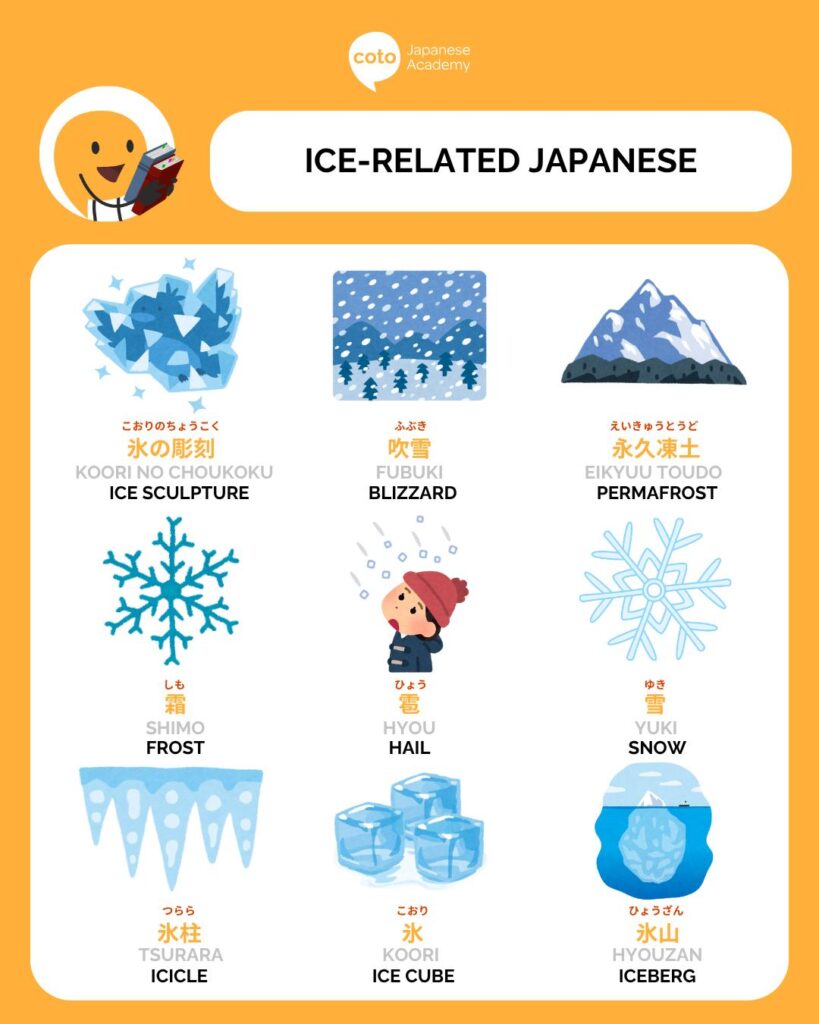
Let’s start with the basics! In Japanese, snow is called yuki, written as 雪. The kanji uses the radical 雨, which means “rain,” hinting at its connection to weather. The word yuki often appears in place names and is also a popular choice for girls’ names, especially those born in, you guessed it, winter.
From this single kanji, you can create all kinds of useful compound words.
The northern regions, especially Hokkaido, are commonly referred to as yukiguni (雪国), meaning “snow country.” These areas are famous for their yukiyama (雪山), or snow-covered mountains. A few handy related words that use the word yuki include 大雪 (ooyuki; heavy snow) and 雪だまる (yukidamaru; snowman).
Different Types of Snow in Japan
Specific regions in Japan, such as Niseko, are known for the exceptional quality of their snow, thanks to a perfect balance of climate, geography, and temperature. These destinations have become highly coveted among skiers from around the world. And if you’d like to get a little more specific, did you know that Japanese has several unique words to describe different types of snow?
1. Botan yuki (牡丹雪): Peony snow
The word 牡丹 (botan) means peony, a popular flower in Japan that blooms in spring. As its name suggests, botan yuki refers to large, beautiful snowflakes that resemble peony petals. Unlike powder snow, these flakes are large enough that you can clearly see their patterns.
These oversized flakes form because they contain much more moisture than typical snow. Another name for botanyuki is べた雪 (beta yuki), meaning wet, sticky snow.
2. 粉雪(Konayuki): Powder snow
This is the famous light, dry, fluffy snow often called Japow by skiers. It’s common in Hokkaido and high-altitude regions. The kanji consists of 粉, which means powder, and 雪, which means snow. Konayuki falls in fine, dry grains and often blows in the wind. It doesn’t clump or get heavy, which is why skiers and snowboarders love it.
3. Tamayuki (玉雪): Ball of snow
From the word 玉 (tama) meaning “ball,” tamayuki refers to round, pellet-like snowflakes. It’s seen at the beginning or end of winter when temperatures are slightly warmer, causing snow to form into soft, ball-shaped clusters.
4.細雪(Sasameyuki): Fine snow
Sasameyuki consists of delicate, tiny flakes that fall like dust. The term has a poetic nuance and is often used in literature to describe quiet, gentle snowfall. Despite the elegant name, this type of snow contains moisture and can be surprisingly heavy, appearing often in warmer regions with large amounts of precipitation.
5. 灰雪(Haiyuki): Ash-like snow
As the name implies, haiyuki falls in a fluttering motion similar to ash drifting in the wind.
The flakes are relatively thick and cast a faint gray shadow when sunlight hits them, creating a soft, hazy atmosphere.
6. 餅雪 (Mochiyuki): Mochi snow
A charming term that comes from 餅 (mochi), the soft, chewy rice cake. Mochiyuki describes snow that looks like fluffy, stretchy mochi, with a soft, rounded, and slightly sticky structure.
7. 雪花 (Yukibana): Snow flower
These rare, large snowflakes look like delicate flowers, bigger than botanyuki. They form under specific atmospheric conditions, and spotting them is considered special!
What is Winter in Japanese?
On the other hand, winter itself is called fuyu, written as 冬. It’s a simple, commonly used word you’ll hear often during the colder months: in weather forecasts, seasonal greetings, or everyday conversations about the chill in the air.
Winter-Related Japanese Vocabulary
Now that we’ve covered the basics, let’s move on to even more winter-related Japanese vocabulary! The table below includes useful words and phrases to describe winter weather and the activities that come with the season.
Japanese
Furigana
Romaji
Meaning
氷
こおり
koori
ice
寒い
さむい
samui
cold
冷たい
つめたい
tsumetai
cold to the touch
霜
しも
shimo
frost
風
かぜ
kaze
wind
吹雪
ふぶき
fubuki
blizzard
氷点下
ひょうてんか
hyōtenka
below freezing
冬休み
ふゆやすみ
fuyuyasumi
winter break
雪だるま
ゆきだるま
yukidaruma
snowman
除雪
じょせつ
josetsu
snow removal
イルミネーション
—
irumineeshon
winter light displays
Winter Fashion Vocabulary
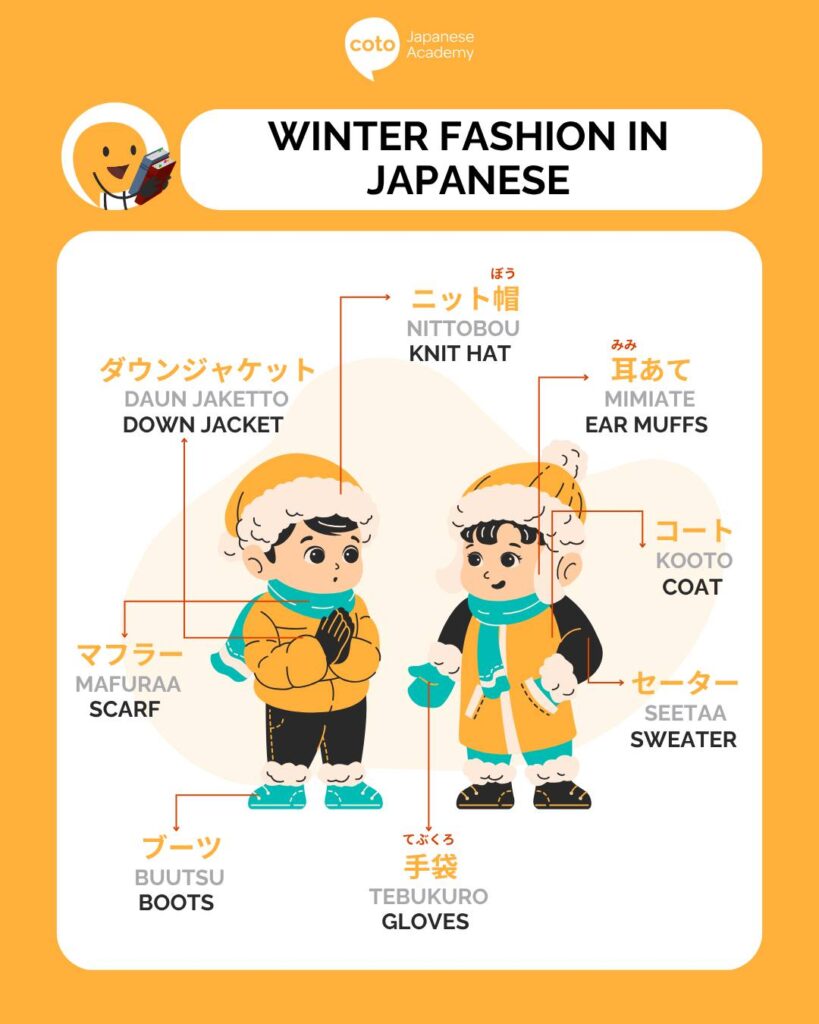
Winter in Japan varies a lot depending on where you are, but as a general rule, the further north you go, the colder it gets. In regions like Hokkaido and Tohoku, temperatures can drop to –5°C to –15°C (23°F to 5°F), and some areas get even colder. Central areas such as Tokyo experience a chilly winter.
No matter where you’re headed, it’s a good idea to layer up. Items like Heattech innerwear will keep you warm, and if you’re visiting snow-heavy regions, be sure to bring waterproof boots and a water-resistant coat to protect yourself from sleet and slush.
Japanese
Furigana
Romaji
Meaning
コート
—
kooto
coat
ジャケット
—
jaketto
jacket
マフラー
—
mafuraa
scarf
手袋
てぶくろ
tebukuro
gloves
ニット帽
にっとぼう
nittobou
knit hat / beanie
長靴
ながぐつ
nagagutsu
boots
ブーツ
—
buutsu
winter boots
イヤーマフ
—
iyaamafu
earmuffs
厚手の服
あつでのふく
atsude no fuku
thick/heavy clothing
セーター
—
seetaa
sweater
ホッカイロ
—
hokkairo
disposable body warmer
Winter Japanese Vocabulary on Sports
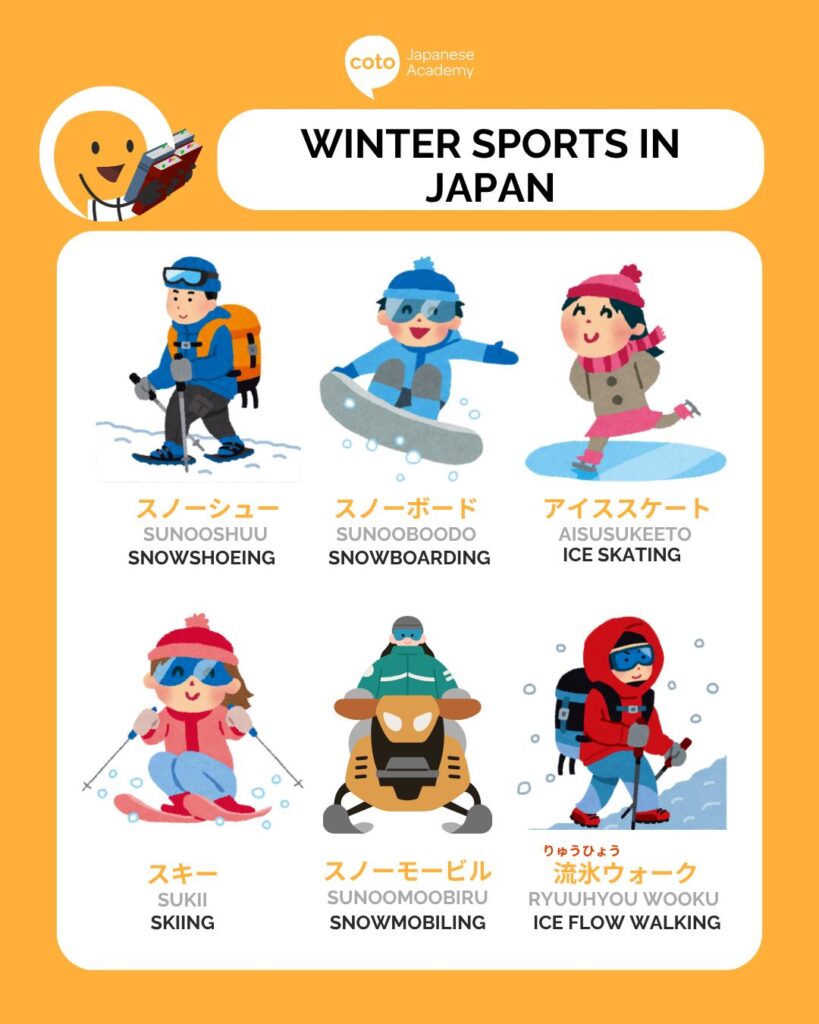
It’s no surprise that Japan has some of the best snow in the world. The northern regions, particularly Hokkaido and the Japan Alps, receive light, dry, and powdery snow, known as konayuki, which is perfect for skiing and snowboarding. Ski resorts like Niseko, Furano, and Hakuba attract visitors from around the world thanks to their deep, fluffy powder, well-maintained slopes, and reliable snowfall.
But what are some popular winter sports in Japan, and what winter sports vocabulary should you know?
Japanese
Furigana
Romaji
Meaning
スキー
—
sukii
skiing
スノーボード
—
sunooboodo
snowboarding
ゲレンデ
—
gerende
ski slope
リフト
—
rifuto
ski lift
雪山
ゆきやま
yukiyama
snowy mountain
新雪
しんせつ
shinsetsu
fresh snow / new snow
粉雪
こなゆき
konayuki
powder snow
スキーブーツ
—
sukiibuutsu
ski boots
ボードブーツ
—
boodo buutsu
snowboard boots
ストック
—
sutokku
ski poles
ゴーグル
—
googuru
goggles
ウェア
—
wea
ski/snowboard wear
レンタル
—
rentaru
rental gear
Seasonal Things During Winter in Japan
Winter in Japan typically spans December to February. During this time, it’s not just about snow and ice—Japan is filled with unique seasonal activities and celebrations. Here are some key events and words to know:
1. クリスマス (Kurusimasu): Christmas
Yes, Japanese people happen to celebrate Christmas too! Though different from other countries, they typically celebrate it by eating KFC and buying a Christmas cake, typically strawberry shortcake. Don’t forget to learn how to say Merry Christmas in Japanese!
2. 冬至 (Toji): Winter solsitce
Toward the end of December, the North Pole tilts farthest from the sun, making the shortest day and longest night of the year. This is known as the winter solstice. Japan observes traditional customs, such as yuzu baths and eating kabocha (Japanese pumpkin).
3. お正月 (Oshogatsu): New Year
New Year’s is the biggest holiday in Japan, lasting from January 1 – 3. Families gather, enjoy osechi ryori (a set of special dishes with symbolic meanings), and visit shrines or temples. Homes are decorated with kadomatsu (pine decorations) and shimenawa (sacred ropes) to welcome the New Year’s spirits.
4. 初詣(Hatsumde): First shrine visit
While many countries celebrate the first day of the year quietly at home, in Japan, people often go to shrines or temples for Hatsumode to pray for health, happiness, and success in the coming year.
6. 成人の日(Seijin no Hi): Coming of Age Day
Held on the second Monday of January, this holiday celebrates young adults who have turned 20, the age of adulthood in Japan. Those coming of age dress in formal attire, often furisode (long-sleeved kimono) for women and suits or hakama for men, and attend ceremonies at city halls.
Describing the Winter Weather in Japanese
Now that you’ve learned the basics and picked up the essential Japanese winter vocabulary, it’s time to put them into practice! Let’s go through some common phrases and questions you’ll often hear, or might want to ask yourself, when talking about winter in Japan.
今日は寒いですね。 Kyou wa samui desu ne. It’s cold today, isn’t it?
見て、外は雪が降っています。 Mite, soto wa yuki ga futteimasu. Look, it’s snowing outside.
外、凍えそう! Soto, kogoesou! It’s freezing outside!
山の上は風が強いね。 Yama no ue wa kaze ga tsuyoi ne. It’s windy up on the mountain, huh?
道、滑りやすいから気をつけてね。 Michi, suberiyasui kara ki o tsukete ne. The road’s slippery, so be careful!
Conclusion: Learn Beyond Winter Vocabulary and Speak Japanese with Lessons at Coto Academy
Now that you’ve learned the basics of talking about winter in Japanese, why stop there? There are plenty of other essential skills to master, like introducing yourself or discussing a specific topic in conversation.
If you want to build confidence and start speaking Japanese, consider joining conversation-focused Japanese lessons at Coto Academy. As a top-rated school with campuses in Tokyo and Yokohama, we offer fun and flexible lessons designed around practical, everyday conversation. You’ll learn Japanese that you can use immediately outside the classroom.
We offer intensive Japanese courses as well as part-time options, so whether you want to immerse yourself fully or fit lessons into a busy schedule, there’s something for you. Start your journey to speaking Japanese confidently today!
Why join Coto Academy?
Over 60+ different Japanese classes over 18 levels
Small classroom of only up to 8 students for personalized support
Professional, native Japanese teachers
Ready to get started? Fill out the form below to contact us!
FAQ
What is the word for “winter” in Japanese?
冬(fuyu) is the basic word for winter in Japanese.
How do you say “snow” in Japanese?
Snow in Japanese is 雪 (ゆき, yuki).
What are typical winter foods in Japan?
Typical winter foods include oden, hotpot, sukiyaki, and fugu. Find out about more winter foods in Japan here.
Halloween in Japan is just around the corner, and when is better time to learn some Japanese Halloween vocabulary, if not now? How else can you describe some of the ghosts, monsters, and creepy crawlers that will spring up across the nation? Japan is no stranger to celebrating various occasions, and Halloween is quickly gaining popularity, with Halloween-themed events and house parties becoming increasingly widespread.
People don’t just dress up in costumes and show up to different Halloween events in Tokyo. If you’re planning to parade around the city, it helps to know some Halloween-themed Japanese words, whether you want to describe your own costume or comment on someone else’s.
So, what are some key terms to know and look out for to make the most out of Halloween in Japan? Read more to find out!
Is Halloween Celebrated in Japan? Is it Different From the U.S.?
Halloween is becoming increasingly popular in Japan, especially in larger cities such as Tokyo, Osaka, and Kyoto. However, unlike in the U.S., Halloween in Japan is more focused on public festivities than on trick-or-treating at homes.
The spooky season is particularly popular among young people, thanks to its fun supernatural themes and the opportunity to wear costumes. Large costume events, such as the one in Ikebukuro, often focus on character cosplays from Japanese video games and anime.
While Japan hosts many cosplay-focused events, Halloween costumes in Japan and the U.S. share similarities. People in both countries enjoy dressing up as characters from movies, pop culture, and even Japanese media, so in terms of costumes, Halloween isn’t too different between the two countries.
The biggest difference is trick-or-treating, which has not caught on in Japan as much as costume events. Small-scale trick-or-treat activities may occur at elementary schools or locally organized events, but generally, only young children participate rather than entire neighborhoods or cities.
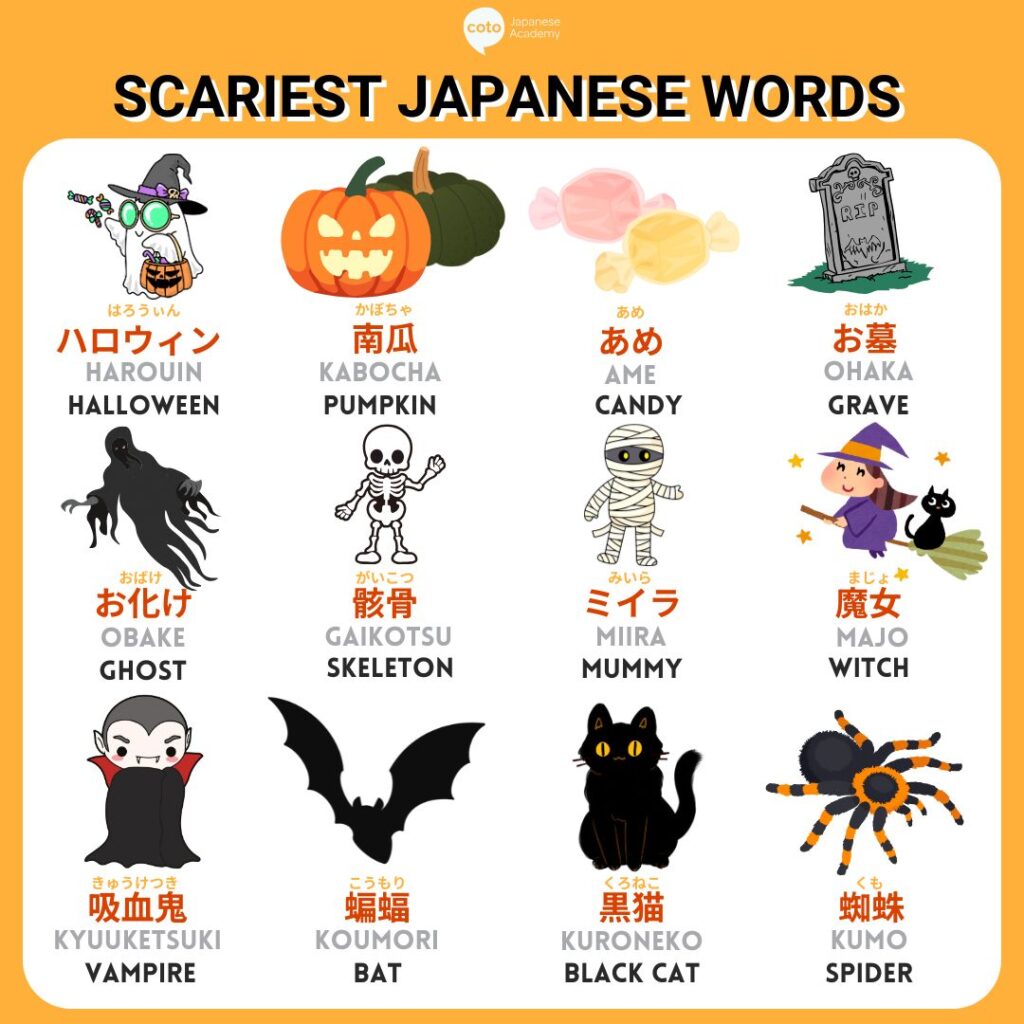
20 Scary Japanese Words About Halloween
1. ハロウィン (Harouin): Halloween
First up, the basic Halloween vocabulary in Japanese. Let’s take a look at the word ハロウィン (Harowin). Want to guess what it means? You’ve probably already guessed it by looking at the romaji, haven’t you? Well, for those who are still trying to figure it out, it actually means Halloween. Written in Katakana, it is more or less a direct translation from the English Word “Halloween” itself.
2. 南瓜 (Kabocha): Pumpkin
Of course, we cannot write about Japanese Halloween vocabulary without including pumpkin. Pumpkin, or 南瓜 (kabocha), is often written in hiragana as かぼちゃ instead of kanji. Kabocha translates to pumpkin or winter squash, and is one of the most popular autumn flavors in Japan.
The term also describes the Japanese variety of pumpkin that has a deep, dark green outside and an orange-colored flesh on the inside. The texture is soft and smooth, and the flavor is somewhat sweet with nutty notes. The fruit (fun fact: kabocha is botanically a fruit) is commonly used in Japanese cuisine, especially when it’s in season, which is around autumn and winter. You can find it in tempura, nabe, and a variety of other popular dishes.
So, to conclude, the word kabocha covers both the western and Japanese pumpkin. This term can describe the iconic Halloween pumpkin monster and the winter squash found in Japanese cuisine.
3. あめ (Ame): Candy
あめ is the word for candy, generally referring to the hard candies derived from sugars and starches such as rice, cornstarch, or potatoes. For a more general term encompassing all varieties of candy, such as chocolate, nougats, and caramels, you can say キァンディー (kiandii).
4. お墓 (Ohaka): Grave
お墓 (おはか), or ohaka, refers to the Japanese grave or tombstone. Japanese tombs look physically different compared to Western graves, but they play a similar role as a physical structure representing an ancestor or loved one being laid to rest.
While graves might be a common prop in Halloween decorations, in Japan, the Obon festival (which takes place in August) is when Japanese people visit family graves, which is known as お墓参り(ohaka mairi)
5. お化け (Obake): Ghost
お化け (obake) refers to ghosts or paranormal beings in general. The term obake comes from the term 化ける (bakeru), which means to transform. The term is similar to 化け物 (bakemono), which broadly refers to creatures that transform; one famous example is the kitsune, or shape-shifting fox, found in Japanese folklore.
The term now generally describes ghosts similar to yuurei (which we will describe next), as well as the paranormal, such as its usage in お化け屋敷 (obake yashiki) or haunted house. Obake yashiki are a popular activity in many theme parks, so be sure to visit one this Halloween!
6. 幽霊 (Yuurei): Spirit
幽霊 (ゆうれい), or Yuurei, refers to Japanese ghosts or spirits found throughout Japanese folklore. They are generally restless spirits who are tied to the world due to strong unresolved emotions, but are not necessarily dangerous. For example, they can be stuck in the world due to their love for their child and remain to watch over them like an invisible guardian.
Yuurei, who have strong emotions of anger or hatred, known as 怨霊 (onryou), meaning vengeful spirits, are very dangerous. So, be careful not to come across an onryou this Halloween!
7. 骸骨 (Gaikotsu): Skeleton
Another in our Japanese Halloween vocabulary list is gaikotsu. Gaikotsu refers to skeletons, usually human ones. This word generally describes the whole skeletal body of a human. To describe the skull, you can use the word 頭蓋骨 (zugai kotsu).
8. ミイラ (Miira): Mummy
You might think that the Japanese word for mummy is a literal loanword: maami. But for this preserved body, the Japanese language uses the Portuguese word mirra (myrrh). This is because miira refers to mummies wrapped in bandages, just like in horror movies. You’ll often see them in haunted houses (お化け屋敷, or obake yashiki) during Halloween events.
You are probably thinking of Akuma from the video game, Street Fighter. But they got the name of the character from an ancient Japanese term for devil or demon. The word can be traced back to Buddhist texts from around 700 AD. The character 悪 (aku) translates to “evil” or “bad” and 魔 (ma) just refers to the devil, so the literal meaning is “evil devil”. You really can’t find a more evil entity than Akuma.
10. 魔女 (Majo): Witch
Ma (魔) means demon or evil spirit, and jo (女) means woman. Together, 魔女 means witch. In Japanese culture, witches can appear as either frightening villains or magical heroines, depending on the story. Think of Studio Ghibli’s Kiki’s Delivery Service, which in Japanese is 魔女の宅急便 (Majo no Takkyubin), translating literally to witch delivery service.
In Japan, witches are not always represented as evil or malevolent; instead, they can be good-spirited people who have magical abilities.
Can you learn Japanese from anime like Kiki’s Delivery Service? To find out, read our blog on Learning Japanese with Anime!
11. 吸血鬼 (Kyuuketsutki): Vampire
Literally “blood-sucking demon.” 吸 (kyuu) means “to suck,” 血 (ketsu or chi) means “blood,” and 鬼 (ki or oni) means “demon.” Much like in the West, in Japanese media, vampires can be both terrifying and romanticized.
12. こうもり (Koumori): Bat
Often associated with darkness, caves, and vampires. While not inherently scary in Japanese culture, bats take on a spooky vibe during Halloween. This more scary image of the bat was adopted along with the Halloween holiday from the West.
13. 黒猫 (Kuroneko): Black Cat
In Japan, black cats have mixed symbolism. They can bring bad luck (like in the West) but are also considered good luck for single women, believed to help attract suitors. On Halloween, they’re more on the spooky side.
14. クモ (Kumo): Spider
Spiders are associated with fear and creepiness, especially their webs in haunted settings. In folklore, there’s even the Jorougumo (絡新婦), a spider woman who lures men to their doom.
15. ドキドキ(Doki doki): Heart Beating
Similarly, ドキドキ (Doki-Doki) is the onomatopoeia for a beating heart and actually has a wide range of uses in Japanese. It can be used to indicate excitement, nervousness, or as a way of expressing fear.
怖い(こわい)、心臓(しんぞう)がドキドキしちゃうよ!
Kowai, shinzou ga doki-doki shichau yo!
That’s scary, my heart is beating so fast right now.
16. 怒り(Ikari) – Anger or Hatred
The word 怒り(Ikari) can be used to express the anger and hatred that someone holds towards another individual. This word conveys intense anger or wrath. In Japanese folklore and horror, 怨霊 (onryou), which we described earlier, comes from the word 怒り(ikari) or anger and 霊(ryou/rei) or spirit. So, together the term means angry spirit.
17. 呪い (Noroi): Curse
Spells, hexes, and dark magic are all noroi. In Japanese horror, cursed objects, or noroi no ningyou (呪いの人形), and cursed videos, or noroi no bideo (呪いのビデオ), are common scary themes.
18. びっくり(Bikkuri): Surprised
Not always negative, but in a scary setting, it’s the sudden shock or jump-scare feeling. You can say びっくりした!, or “That scared me!” when surprised by a jump-scare from a horror movie or haunted house. Alternatively, you can also say the slang form, びびる (bibiru).
19. 不気味 (Bukimi): Eerie or Creepy
Not necessarily a Halloween-themed Japanese vocabulary, bukimi describes something unsettling, eerie, or unnerving, like an abandoned house at night or a creepy doll staring at you. Perfect Halloween atmosphere.
20怖い (Kowai): Scared
怖い (kowai) is an essential Japanese adjective for scary, usually as a way of expressing that something looks or is scary. For example, you can say “ホラー映画が怖いです”(horaa eiga ga kowai desu) or “horror movies are scary”. However, a common pitfall beginners make is when they say “私は怖い” (watashi wa kowai), which means “I am scary.” To say that “I am scared,” you must say, “私は怖がっている” (watashi wa kowagattiru).
Alternatively, the word 恐怖 (kyoufu) can also be used to express your fears and dread for something.
Expand Your Emotions With Japanese Halloween Words
Learning Halloween vocabulary in Japanese is not just about memorizing words; it’s about exploring how Japan interprets fear, the supernatural, and the mysterious. They are not just useful in Halloween but in expressing yourself in Japanese overall. Plus, don’t miss out on trying kabocha and ame, or candy.
To get the most out of this list of words, try practicing them with a professional teacher who can guide and train you to use them in natural, everyday conversation.
Why not join Japanese lessons at Coto Academy? Our classes are designed to help you engage with real, authentic Japanese culture.
We offer intensive Japanese courses as well as part-time options, so whether you want to immerse yourself fully or fit lessons into a busy schedule, there’s something for you. Start your journey to speaking Japanese confidently today!
Why join Coto Academy?
Professional, native Japanese teachers
Over 60+ different Japanese classes over 18 levels
Small classroom of only up to 8 students for personalized support
Fill out the form below for a free level check and consultation.
FAQ
Is Halloween popular in Japan?
Yes! Halloween has grown rapidly in Japan, especially in cities like Tokyo. It’s more about costumes, parties, and decorations than trick-or-treating, but spooky words definitely add to the fun.
What is the word for candy in Japanese?
Candy can either be あめ (ame), which generally describes Japanese hard candy, or キャンディー (kyandii), which refers to all varieties of candy in general.
Are there Japanese monsters or yokai tied to Halloween?
While Halloween in Japan borrows heavily from Western imagery (witches, vampires, bats), you’ll also find yokai like Jorougumo (the spider woman) or yurei (ghosts) being used in Halloween-themed events.
What are some Halloween Japanese vocabulary I should know about?
Some key Japanese Halloween vocabulary includes おばけ (obake, ghost), かぼちゃ (kabocha, pumpkin), こうもり (koumori, bat), ゾンビ (zonbi, zombie), and ハロウィン (Harowin, Halloween).
Want to expand your vocabulary beyond just Halloween-related Japanese vocabulary? You might want to check out:
It’s that time of year when the leaves burst into brilliant shades of red, gold, and when it finally feels socially acceptable to sip a satsumaimo (Japanese sweet potato) latte: autumn has arrived in Japan! Known as aki (秋), this season typically stretches from September to early December, reaching its peak during momiji season, when locals and travelers flock to parks and temples to admire the breathtaking autumn foliage. (Pro tip: check the nationwide autumn leaves forecast to catch the colors at their best!)
Japan’s crisp autumn is all about scenery, traditions, and flavors. And what better way to truly embrace aki than by learning some quintessential Japanese autumn vocabulary? We’ve gathered our favorite fall words, from the rustling leaves of momiji to the aroma of roasting chestnuts, perfect for anyone looking to savor Japan’s most cozy season.
Let’s take a look and learn!
Basic Japanese Fall Words
Spring, with its iconic cherry blossoms, might be the most famous season in Japan, but fall is also the perfect time to visit. While Japan experiences four distinct seasons, autumn has been growing increasingly popular in recent years. Let’s take a look at some basic Japanese autumn vocabulary first!
Japanese
Reading / Pronunciation
Meaning
秋
aki
Autumn
秋風
akikaze
Autumn breeze
ハロウィン
harouin
Halloween
紅葉
momiji
Autumn leaves
紅葉狩り
momijigari
Autumn leaf viewing
月見
tsukimi
Moon viewing festival
七五三
Shichi go san
Shichi-Go-San Festival
ハロウィン
Harowin
Halloween
温泉
Onsen
Hot spring
収穫
Shuukaku
Harvest
新米
Shinmai
New harvest rice
登山
Tozan
Mountain hiking
ハイキング
Haikingu
Hiking
霧
Kiri
Mist/fog
9月
Kugatsu
September
10月
Juugatsu
October
11月
Juuichigatsu
November
12月
Juunigatsu
December
1. Aki (Fall)
The first word you will probably need to learn is, of course, autumn itself. Aki (秋) is the Japanese word for autumn.
日本の秋は美しいです。 Nihon no aki wa utsukushii desu. Autumn in Japan is beautiful.
2. Harowin (Halloween)
The word ハロウィン (Harouin) is a loanword borrowed directly from English. In Japan, it’s less common for people to decorate their homes with elaborate displays, fog machines, or pumpkin carvings in their front yards. That said, Halloween has become a popular celebration influenced by Western traditions.
Instead of trick-or-treating, which is rare in Japan, the holiday is mostly celebrated with costumes, themed sweets, and citywide events, especially in urban centers like Tokyo. People often gather to dress up as their favorite characters.
In recent years, however, the rise in popularity and overtourism has led to stricter regulations, particularly in Tokyo’s Shibuya district. Measures have included banning alcohol sales at nearby convenience stores, setting curfews, and increasing police patrols to maintain order during the Halloween weekend.
3. Momiji (Autumn leaves)
The word momiji (紅葉) literally means “red leaves,” and it is closely tied to autumn in Japan. While it can generally refer to autumn foliage, most of the time it specifically describes the Japanese maple tree (Acer palmatum) and its vibrant crimson leaves.
4. Momijigari (Autumn leaf viewing)
Momiji is also central to the tradition of momijigari (紅葉狩り), or “autumn leaf hunting,” where people travel to famous spots to admire the seasonal colors, much like hanami in spring.
5. Tsukimi (Moon viewing festival)
Tsukimi (お月見), or “moon viewing,” takes place in mid-September to early October, depending on the lunar calendar. During Tsukimi, people gather to admire the full harvest moon, often decorating their homes with pampas grass (susuki) and offering seasonal foods like round rice dumplings (tsukimi dango), sweet potatoes, and chestnuts.
6. Shichi-Go-San (Shichi-Go-San Festival)
Another important autumn tradition is Shichi-Go-San (七五三), literally meaning “seven-five-three,” which celebrates the growth and health of children aged three, five, and seven. Held annually on November 15th, this festival sees children dressed in traditional kimono or formal attire visiting Shinto shrines with their families. The children are blessed for good health and longevity, and they often receive chitose-ame, a long, thin candy symbolizing a long and healthy life. S
Autumn Fall Foliage Vocabulary in Japanese
While the word momiji is perhaps most synonymous with autumn in Japan — similar to how sakura is associated with spring — did you know that the very same kanji used for momiji (紅葉) is also used for another autumn phenomenon called kouyou (紅葉)?
So what’s the difference between momiji and kouyou? Kouyou is a general term for autumn foliage in Japan, while momiji specifically refers to the intensely red leaves of the Japanese maple tree. Both words share the same “red leaf” kanji (紅葉) but describe different aspects of the same seasonal phenomenon: koyou encompasses all colorful leaves, including reds, yellows, and oranges, whereas momiji highlights the vibrant crimson hues of maples.
The activity of viewing these autumn leaves is called momijigari, or “red leaf hunting.” Let us take a look at other autumn foliage-related Japanese words!
Japanese
Romaji
Meaning
紅葉
kouyou
Fall foliage
落ち葉
ochiba
Fallen leaves
落葉
rakuyou
Fallen leaves
黄葉
kouyou
Yellow leaves
赤葉
akiba
Red leaves
彩り
irodori
Coloration or hues of leaves
枯葉
kareha
Withered or dead leaves
錦秋
kinshuu
Gorgeous autumn colors (poetic)
紅葉前線
kouyou zensen
Autumn leaf front (progression of colors across Japan)
楓
kaede
Maple tree
銀杏
ichou
Ginkgo tree or leaves
イチョウ並木
ichou namiki
Ginkgo tree-lined street
山紅葉
yama momiji
Mountain autumn foliage
紅葉狩り
momijigari
Autumn leaf viewing
Autumn Food and Flavors in Japan
As Japan’s weather shifts from the unbearably hot and humid summer to the cooler, crisper days of autumn, the food lineup changes as well. Bright, tangy, and bold summer flavors give way to earthier, heartier, and more mellow tastes that usher the season in.
While pumpkin spice might be the quintessential autumn flavor in the United States, in Japan, autumn is dominated by root vegetables and ingredients like sweet potato, pumpkin, chestnut, and mushrooms, particularly the prized matsutake mushroom.
Let’s take a look at some Japanese autumn food–related vocabulary. We also have a separate guide on autumn flavors in Japan, so be sure to check that out!
Japanese
Romaji
Meaning
栗
kuri
Chestnut
さつまいも
satsumaimo
Sweet potato
かぼちゃ
kabocha
Japanese pumpkin
松茸
matsutake
Matsutake mushroom
きのこ
kinoko
Mushroom
秋刀魚
sanma
Pacific saury
柿
kaki
Persimmon
梨
nashi
Japanese pear
栗ご飯
kurigohan
Chestnut rice
きのこご飯
kinoko-gohan
Mushroom rice
もみじ饅頭
momiji manju
Maple leaf–shaped cake
栗きんとん
kuri kinton
Sweet mashed chestnuts
Describing Fall Weather in Japan
We have a separate guide on how to describe the weather in Japanese, but we can’t create a Japanese autumn vocabulary without mentioning the weather. Autumn in Japan is one of the most pleasantly mild seasons, with temperatures cool enough to wear cozy sweaters, jeans, and boots, yet not so cold as to be uncomfortable.
Japanese
Reading / Pronunciation
Meaning
天気
tenki
Weather
気温
kion
Temperature
涼しい
suzushii
Cool
晴れ
hare
Clear
曇り
kumori
Cloudy
雨
ame
Rain
霧
kiri
Mist / Fog
寒暖差
kandansa
Temperature difference (day vs night)
日が短い
hi ga mijikai
Shorter days
夜
yoru
Night
風
kaze
Wind
Talking About Autumn in Japanese
Now that you’ve learned the basics and picked up the essential Japanese autumn vocabulary, it’s time to put them into practice! Let’s go through some common phrases and questions you’ll often hear, or might want to ask yourself, when talking about fall in Japan.
今日は秋風が気持ちいいです。 Kyou wa akikaze ga kimochi ii desu. The autumn breeze feels nice today.
山の木々が赤や黄色に染まっています。 Yama no kigi ga aka ya kiiro ni somatteimasu.
The trees in the mountains are turning red and yellow.
ハロウィンではかぼちゃを飾ります。 Harouin de wa kabocha o kazari masu. During Halloween, we decorate with pumpkins.
落ち葉の上を歩くのが楽しいです。 Ochiba no ue o aruku no ga tanoshii desu. It’s fun to walk on fallen leaves.
公園で紅葉を見ました。 Kouen de kouyou o mimashita. I saw the autumn leaves at the park.
秋は日が短くなります。
Aki wa hi ga mijikaku narimasu.
In autumn, the days become shorter.
Conclusion: Learn Beyond Japanese Autumn Vocabulary and Speak Japanese with Lessons at Coto Academy
Now that you’ve learned the basics of talking about the autumn in Japanese, why stop there? There are plenty of other essential skills to master, like introducing yourself or discussing a specific topic in conversation.
If you want to build confidence and start speaking Japanese, consider joining conversation-focused Japanese lessons at Coto Academy. As a top-rated school with campuses in Tokyo and Yokohama, we offer fun and flexible lessons designed around practical, everyday conversation. You’ll learn Japanese that you can use immediately outside the classroom.
We offer intensive Japanese courses as well as part-time options, so whether you want to immerse yourself fully or fit lessons into a busy schedule, there’s something for you. Start your journey to speaking Japanese confidently today!
Why join Coto Academy?
Over 60+ different Japanese classes over 18 levels
Small classroom of only up to 8 students for personalized support
Professional, native Japanese teachers
Ready to get started? Fill out the form below to contact us!
FAQ
What is the Japanese word for autumn?
The Japanese word for autumn is 秋 (aki). It refers to the season of fall in general.
What is the Japanese word for autumn leaves?
Autumn leaves are called 紅葉 (momiji or kouyou). Momiji often refers to red maple leaves specifically, while kouyou can describe all colorful autumn foliage.
How do you say “autumn leaf viewing” in Japanese?
The activity of viewing autumn leaves is called 紅葉狩り (momijigari), which literally means “hunting red leaves.” It’s a popular seasonal activity similar to cherry blossom viewing (hanami) in spring.
What festivals are celebrated in Japan during autumn?
Popular autumn festivals include:
ハロウィン (Harouin): Halloween
お月見 (Tsukimi): Moon viewing festival
七五三 (Shichi-Go-San): Celebration for children aged 3, 5, and 7
What is the difference between momiji and kouyou?
Both words use the kanji 紅葉. Momiji usually refers specifically to the red leaves of maple trees, while kouyou is a broader term encompassing all autumn foliage colors, including red, yellow, and orange.
If you’re preparing for the JLPT N3 or just stepping into intermediate-level Japanese, you’re entering an exciting stage. The JLPT N3 vocabulary list includes around 3,750 words, which contain a mix of practical terms you’ll encounter in everyday conversations, at school, in the workplace, and even in formal settings.
While N3 is often considered one of the more challenging JLPT levels, with a passing rate of only around 40%, success is absolutely within reach. The key lies in building a solid vocabulary foundation, mastering the 650 kanji that may appear, and staying consistent with mock exams and listening practice.
To help you stay on track, we’ve created a complete JLPT N3 vocabulary list, thoughtfully organized by theme.
Note: This list includes only new vocabulary introduced at the JLPT N3 level. It does not cover words already studied in JLPT N4 and N5. If you’re just starting out or need a refresher, be sure to check out our full JLPT N4 Vocabulary List and JLPT N5 Vocabulary List to build a strong foundation before moving on.
Pass the JLPT with Coto Academy!
Getting ready for the JLPT? Boost your chances of passing with Coto Academy’s JLPT Prep Course — designed for busy learners. With just 3 focused hours per week, you’ll turn your current Japanese skills into real test results in 3 months.
Nouns, or meishi (名詞), make up a large portion of the vocabulary you’ll learn at the JLPT N3 vocabulary. In this list, we’ve sorted them alphabetically for easier reference.
circle, full (month), perfection, purity, suffix for ship names
丸
まる
circle, perfection, suffix for ship names
満足
まんぞく
satisfaction
身
み
body, main part, oneself, sword
身
み
body, oneself
実
み
fruit, result
見送り
みおくり
send-off
味方
みかた
ally
見事
みごと
splendid, admirable
見舞い
みまい
enquiry, expression of sympathy
土産
みやげ
souvenir
都
みやこ
capital
明後日
みょうごにち
day after tomorrow
皆
みんな
all,everyone,everybody
無
む
nothing, naught, nil, zero
無
む
nothing, none
迎え
むかえ
meeting, welcome
虫歯
むしば
cavity, tooth decay
無駄
むだ
futility,uselessness
夢中
むちゅう
trance,ecstasy,delirium
胸
むね
breast,chest
無料
むりょう
free, no charge
芽
め
sprout
明確
めいかく
clarity (noun use)
命令
めいれい
command
迷惑
めいわく
nuisance
飯
めし
(sl) meals,food
綿
めん
cotton, padding
綿
めん
cotton
免許
めんきょ
license
申し訳
もうしわけ
excuse
毛布
もうふ
blanket
目標
もくひょう
mark, objective, target
木曜
もくよう
Thursday
木曜
もくよう
Thursday
文字
もじ
character
基
もと
basis
元
もと
origin
素
もと
prime
物語
ものがたり
story, legend
物事
ものごと
things
模様
もよう
pattern
文句
もんく
phrase, complaint
文句
もんく
complaint, phrase
文字
もんじ
letter (of alphabet), character
文字
もんじ
character (written)
役
やく
role, position
約
やく
approximately
役割
やくわり
role
家賃
やちん
rent
厄介
やっかい
trouble, burden, care
厄介
やっかい
trouble, burden, care, bother
宿
やど
inn
唯一
ゆいいつ
only, sole, unique
唯一
ゆいいつ
only, unique
勇気
ゆうき
courage
有効
ゆうこう
validity
友情
ゆうじょう
friendship
友人
ゆうじん
friend
有能
ゆうのう
capable
郵便
ゆうびん
mail,postal service
床
ゆか
floor
床
ゆか
floor
愉快
ゆかい
pleasant
行き
ゆき
going
輸出
ゆしゅつ
export
輸入
ゆにゅう
importation,import,introduction
夜
よ
evening, night
夜明け
よあけ
dawn
様
よう
way,manner
要求
ようきゅう
demand
用心
ようじん
care, precaution, guarding, caution
様子
ようす
appearance
様子
ようす
aspect, state, appearance
要素
ようそ
element
要点
ようてん
main point, gist
曜日
ようび
day of the week
予期
よき
expectation
予算
よさん
estimate, budget
予算
よさん
budget
予測
よそく
prediction, estimation
世の中
よのなか
society, the world
予報
よほう
forecast
予防
よぼう
prevention
読み
よみ
reading
余裕
よゆう
surplus, composure, margin
余裕
よゆう
surplus, composure, margin, room, time, allowance, scope, rope
喜び
よろこび
joy
四
よん
four
楽
らく
ease, comfort
利益
りえき
profit, gain
理解
りかい
understanding
陸
りく
six (used in legal documents)
理想
りそう
ideal
率
りつ
rate, ratio, proportion, percentage
留学
りゅうがく
study abroad
流行
りゅうこう
trend, fashion
量
りょう
quantity, amount
料金
りょうきん
fee
礼
れい
gratitude
例
れい
example
礼儀
れいぎ
manners, etiquette
冷静
れいせい
composure
列
れつ
queue,line,row
列車
れっしゃ
train
連想
れんそう
association (of ideas), suggestion
労働
ろうどう
labor, work
論争
ろんそう
controversy, dispute
論争
ろんそう
controversy, dispute
論文
ろんぶん
thesis, paper
論文
ろんぶん
thesis, essay, treatise, paper
輪
わ
ring, circle
別れ
わかれ
parting, farewell
脇
わき
side
脇
わき
side
綿
わた
cotton
話題
わだい
topic
話題
わだい
topic, subject
笑い
わらい
laugh, laughter, smile
笑い
わらい
laughter
悪口
わるくち
abuse, slander
我々
われわれ
we
我々
われわれ
we
湾
わん
bay
湾
わん
bay, gulf, inlet
.
JLPT N3 Verb
Now that you have learned some nouns, the next will be Japanese verb. JLPT N3 level, you’ll start seeing a wider variety of them, including more complex conjugations, formal expressions, and verbs used in both casual and professional settings.
This is also where you might be introduced to many compound verbs and more nuanced transitive or intransitive pairs.
In this list, we’ve organized verbs alphabetically. But as you study, it’s helpful to group them by function or form, such as る-verbs, う-verbs, irregular verbs, or by usage patterns like potential form, passive, or causative.
Japanese
Kana
English Translation
できる
―
to be able to
愛する
あいする
to love
明ける
あける
to dawn, to become daylight
与える
あたえる
to give
暖かい(い-adj)
あたたかい
warm, mild
当たる
あたる
to be hit
扱う
あつかう
to handle
当てる
あてる
to hit
浴びる
あびる
to bathe, to shower
表す
あらわす
to express, to reveal
有る
ある
to be, to have
抱く
いだく
to hold, to embrace
頂く
いただく
to receive (humble)
至る
いたる
to reach
祝う
いわう
to celebrate
引退
いんたい
to retire
受け取る
うけとる
to receive
動かす
うごかす
to move, to shift
失う
うしなう
to lose
疑う
うたがう
to doubt, to distrust, to be suspicious of
撃つ
うつ
to attack
移す
うつす
to move, to infect
訴える
うったえる
to sue, appeal
うなる
うなる
to groan
奪う
うばう
to snatch away
売れる
うれる
to be sold
描く
えがく
to draw, paint
得る
える・うる
to obtain
追い付く
おいつく
to catch up, to overtake
追う
おう
to chase
応じる
おうじる
to respond
終える
おえる
to finish
覆う
おおう
to cover
恐れる
おそれる
to fear
劣る
おとる
to be inferior
溺れる
おぼれる
to drown
及ぼす
およぼす
to exert, to cause
居る
おる
to be (animate)
下す
おろす
to lower
降ろす
おろす
to take down, to drop
飼う
かう
to raise
換える
かえる
to exchange
替える
かえる
to replace, to exchange
抱える
かかえる
to carry (in arms)
輝く
かがやく
to shine, to glitter
罹る
かかる
to suffer
掛かる
かかる
to take (time/money), to hang
限る
かぎる
to limit
描く
かく
to draw
隠す
かくす
to hide
隠れる
かくれる
to hide, to disappear
欠ける
かける
to be lacking
囲む
かこむ
to surround, to encircle
稼ぐ
かせぐ
to earn
数える
かぞえる
to count
語る
かたる
to talk
被る
かぶる
to suffer
刈る
かる
to cut (hair), to mow (grass), to harvest
感じる
かんじる
to feel
関する
かんする
to concern
効く
きく
to be effective
気付く
きづく
to notice
食う
くう
to eat (vulgar, male)
暮らす
くらす
to live, to get along
狂う
くるう
to go mad, to get out of order
加える
くわえる
to add
決定する
けっていする
to determine
行動する
こうどうする
to act, to behave
凍る
こおる
to freeze
越す
こす
to go over, to pass
異なる
ことなる
to differ
断る
ことわる
to refuse, to decline
好む
このむ
to like
殺す
ころす
to kill
転ぶ
ころぶ
to fall
叫ぶ
さけぶ
to shout, to cry
避ける
さける
to avoid, to ward off, to avert
支える
ささえる
to support
指す
さす
to point, to put up umbrella, to play
誘う
さそう
to invite, to tempt
覚ます
さます
to awaken
覚める
さめる
to wake up
従う
したがう
to obey, to follow, to accompany
支配する
しはいする
to control
支払う
しはらう
to pay
しまう
しまう
to finish
示す
しめす
to show
占める
しめる
to occupy, to account for
処理する
しょりする
to process
信頼する
しんらいする
to trust
空く
すく
to be empty
救う
すくう
to rescue from, to help out of
優れる
すぐれる
to excel
勧める
すすめる
to recommend
進める
すすめる
to advance, to promote
済ませる
すませる
to finish
注ぐ
そそぐ
to pour
育つ
そだつ
to grow up
備える
そなえる
to provide
対する
たいする
to confront
倒す
たおす
to beat, to bring down
確かめる
たしかめる
to confirm
助ける
たすける
to help
戦う
たたかう
to fight
叩く
たたく
to strike
立ち上がる
たちあがる
to stand up
経つ
たつ
to pass, to lapse
黙る
だまる
to be silent
頼る
たよる
to rely on, to depend on
通じる
つうじる
to communicate, lead to
捕まる
つかまる
to be caught
就く
つく
to take (position), to settle in
注ぐ
つぐ
to pour (into), to irrigate, to pay
付ける
つける
to attach, to join, to add, to append
繋ぐ
つなぐ
to connect
出会う
であう
to meet by chance
適する
てきする
to suit
通り過ぎる
とおりすぎる
to pass through
解く
とく
to unfasten
解ける
とける
to come untied
届く
とどく
to reach
飛ばす
とばす
to skip over, to omit
留める
とめる
to fasten, to turn off
取れる
とれる
to come off
流す
ながす
to drain
眺める
ながめる
to view, to gaze at
流れる
ながれる
to stream, to flow
怠ける
なまける
to neglect
悩む
なやむ
to be troubled, to worry
成る
なる
to become
為る
なる
to become
似合う
にあう
to suit, to match
握る
にぎる
to grasp, to mold (sushi)
濡れる
ぬれる
to get wet
願う
ねがう
to desire, to wish, to request
残す
のこす
to leave
除く
のぞく
to remove
伸ばす
のばす
to lengthen, to stretch, to grow (beard)
伸びる
のびる
to stretch
昇る
のぼる
to rise, ascend
計る
はかる
to measure
吐く
はく
to vomit
履く
はく
to wear (lower body)
外す
はずす
to remove
罰する
ばっする
to punish
話し合う
はなしあう
to discuss
放す
はなす
to release
離す
はなす
to separate
離れる
はなれる
to separate
省く
はぶく
to omit
貼る
はる
to stick, paste
引っ張る
ひっぱる
to pull
広がる
ひろがる
to spread
含む
ふくむ
to include
防ぐ
ふせぐ
to defend
振る
ふる
to shake
震える
ふるえる
to shiver
触れる
ふれる
to touch
吠える
ほえる
to bark, to roar
微笑む
ほほえむ
to smile
任せる
まかせる
to entrust
増す
ます
to increase, to grow
学ぶ
まなぶ
to learn
招く
まねく
to invite
守る
まもる
to protect, to obey
満ちる
みちる
to be full, to expire
見る
みる
to see
向く
むく
to face
向ける
むける
to turn toward
結ぶ
むすぶ
to tie, bind
申し込む
もうしこむ
to apply
燃える
もえる
to burn
持ち上げる
もちあげる
to raise, to lift up
戻す
もどす
to return
基づく
もとづく
to be based on
貰う
もらう
to receive
雇う
やとう
to hire
言う
ゆう
to say
譲る
ゆずる
to hand over
許す
ゆるす
to allow
酔う
よう
to get drunk
横切る
よこぎる
to cross
止す
よす
to quit
論じる
ろんじる
to argue, to debate
分ける
わける
to divide
割る
わる
to divide, to cut, to break, to halve
JLPT N3 Adjectives
Before diving in, make sure you’re already familiar with the difference between い-adjectives and な-adjectives, as JLPT N3-level adjectives go beyond the usual simple words like “kawaii” or “senpai.”
As always, list is organized alphabetically for easy reference, but for more effective study, try grouping adjectives by themes such as feelings, appearance, or degree.
Japanese
Kana
English Translation
かわいらしい
–
lovely
うまい
–
delicious
かわいそう
–
pitiable
いい
–
good
もっとも
–
natural, most reasonable
すてき
–
lovely, dreamy
きつい
―
tight, intense
愛する
あいする
to love
暖かい
あたたかい
warm
新た
あらた
new
偉大
いだい
great
うるさい
うるさい
noisy, fussy
嬉しい
うれしい
happy
穏やか
おだやか
calm, gentle
快適
かいてき
comfortable
賢い
かしこい
wise
硬い
かたい
hard
完全
かんぜん
perfect
気の毒
きのどく
pitiful
奇妙
きみょう
strange
巨大
きょだい
gigantic
臭い
くさい
odour, stench
苦しい
くるしい
painful, difficult
濃い
こい
thick, dense, strong
高価
こうか
high-priced
豪華
ごうか
wonderful, gorgeous, splendor, pomp, extravagance
最終
さいしゅう
last, final
最低
さいてい
least, worst
親しい
したしい
intimate
重大
じゅうだい
serious, important
上等
じょうとう
superior
新鮮
しんせん
fresh
慎重
しんちょう
prudent, cautious
すごい
すごい
amazing, terrific
素晴らしい
すばらしい
wonderful
鋭い
するどい
sharp, pointed
正
せい
regular, correct
正確
せいかく
accurate
積極的
せっきょくてき
proactive
粗末
そまつ
crude
大抵
たいてい
usually
単なる
たんなる
mere
辛い
つらい
painful
適切
てきせつ
appropriate
典型的(な)
てんけいてき
typical (implied from 典型)
得意
とくい
proud/specialty
苦手
にがて
poor at, dislike
激しい
はげしい
violent, intense
必死
ひっし
desperate (can be treated as na-adjective)
等しい
ひとしい
equal
不自由
ふじゆう
inconvenient (also noun)
不利
ふり
disadvantageous
豊富
ほうふ
abundant
真面目
まじめ
serious, honest (also noun)
貧しい
まずしい
poor, needy
真っ赤
まっか
deep red
真っ直ぐ
まっすぐ
straight
満ちる
みちる
to be full, to expire
妙
みょう
strange
面倒
めんどう
troublesome
有利
ゆうり
advantageous
豊か
ゆたか
abundant
よい
よい
good, nice, pleasant
容易
ようい
easy, simple
宜しい
よろしい
(hon) good, OK
立派
りっぱ
splendid, fine
冷静
れいせい
calm
JLPT N3 Adverb
Adverbs play a key role in adding detail and nuance to your sentences, helping you describe how, when, where, and to what extent actions occur. In JLPT N# vocabulary, you’ll find a wider range of adverbs that let you express subtle differences in timing, frequency, degree, and manner
Other JLPT N3 Vocabulary: Particles, Loanwords, Expressions
The JLPT N3 vocabulary section doesn’t just test your knowledge of word meanings. Ot also challenges your understanding of context and appropriate usage. This means you’ll encounter not only individual words but also common expressions and set phrases.
In addition, we group loanwords (often written in katakana) here, even though most of them are nouns. The good news is that if you already know English, learning these loanwords can be much easier since many are borrowed directly from English or other languages.
Thinking of taking the JLPT again or aiming for a higher level to boost your career in Japan? Pass the JLPT with Coto Academy’s JLPT prep courses. This special preparation class covers exam practices and all test sections, including how to master the reading, grammar, kanji, and listening. Our teachers are highly specialized in teaching JLPT, and you’ll learn alongside motivated peers!
Join the hundreds of successful students who’ve improved their JLPT results with Coto. See our past JLPT success rate story.
Currently, we offer an in-person JLPT prep course in Tokyo and Yokohama, and an online JLPT lecture course
Interested? Fill out the form below for a free level check. Our staff will get in touch with you!
FAQ
How many words are in JLPT N3?
JLPT N3 vocabulary includes about 3,500 to 3,750 words. This typically includes vocabulary you have learned in JLPT N5 and JLPT N4.
How many kanji should I study for JLPT N3?
You should study approximately 600 to 650 kanji for JLPT N3.
Typically, JLPT N3 can help you get part-time jobs that require intermediate Japanese, but it may not be enough for many full-time professional positions. For that, you would typically need JLPT N2 and above.
Yes, with focused and consistent study, passing the JLPT N3 in 5 months is definitely achievable. This requires setting a clear study schedule, regularly practicing vocabulary, grammar, kanji, listening, and reading comprehension.