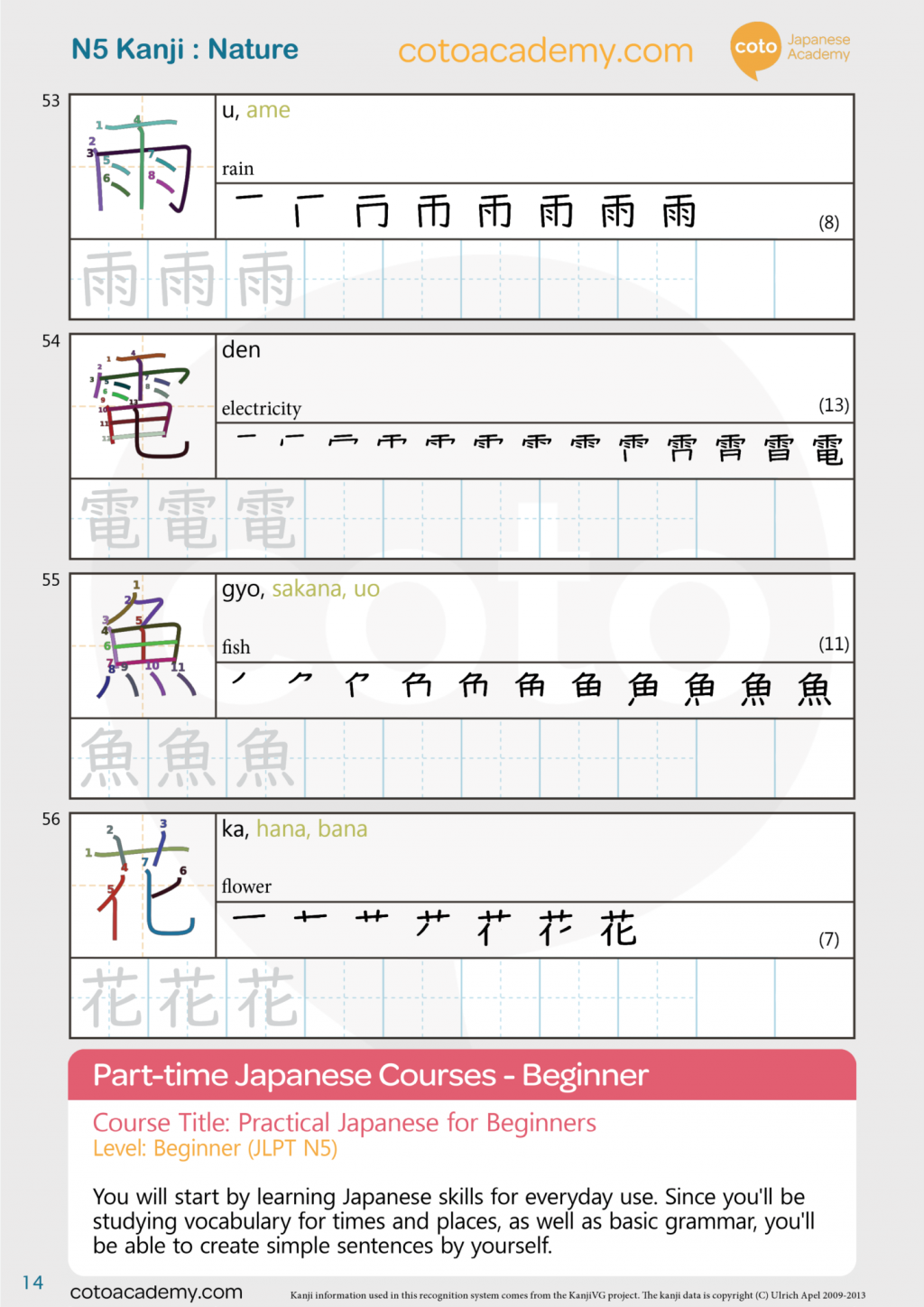
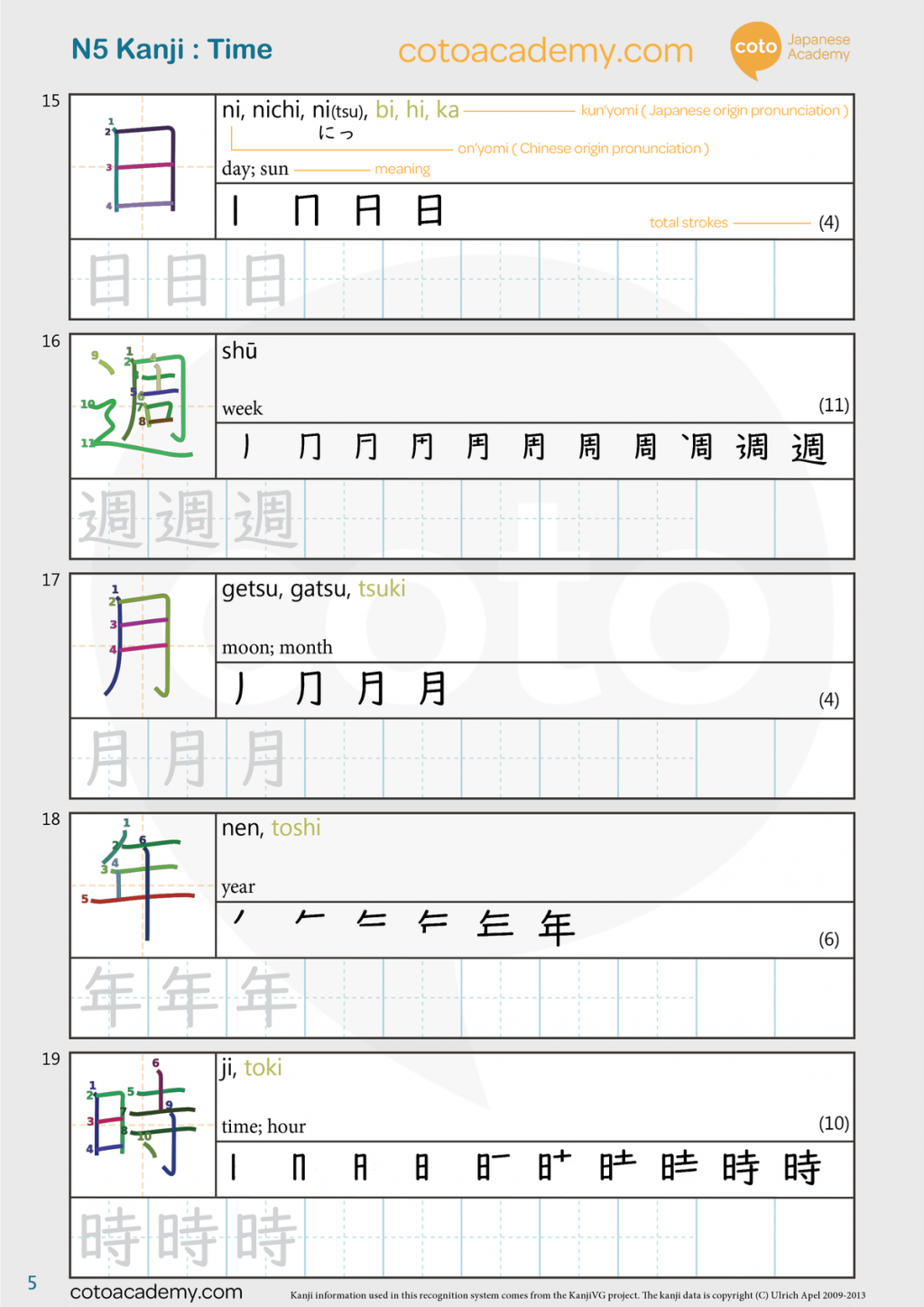
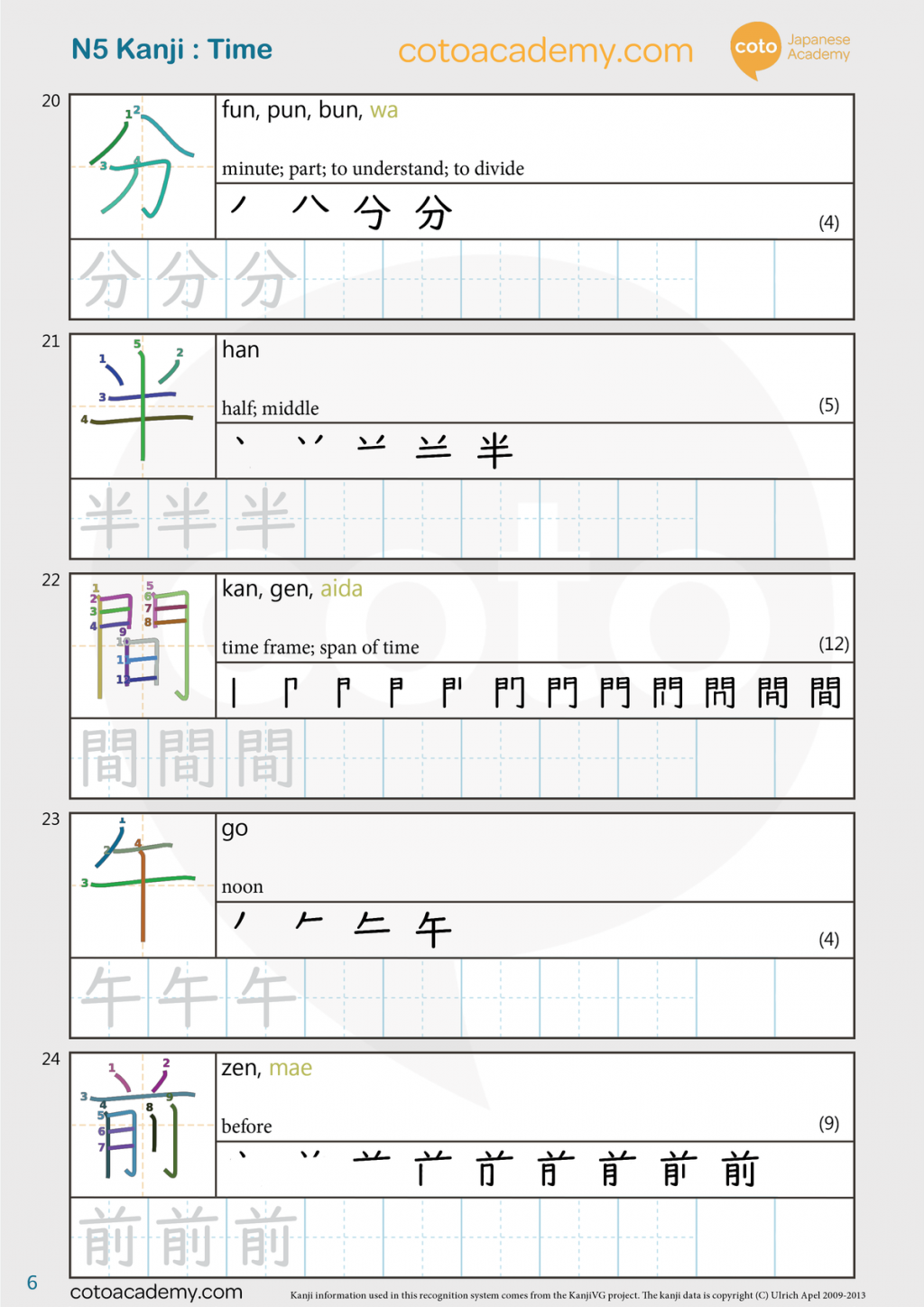
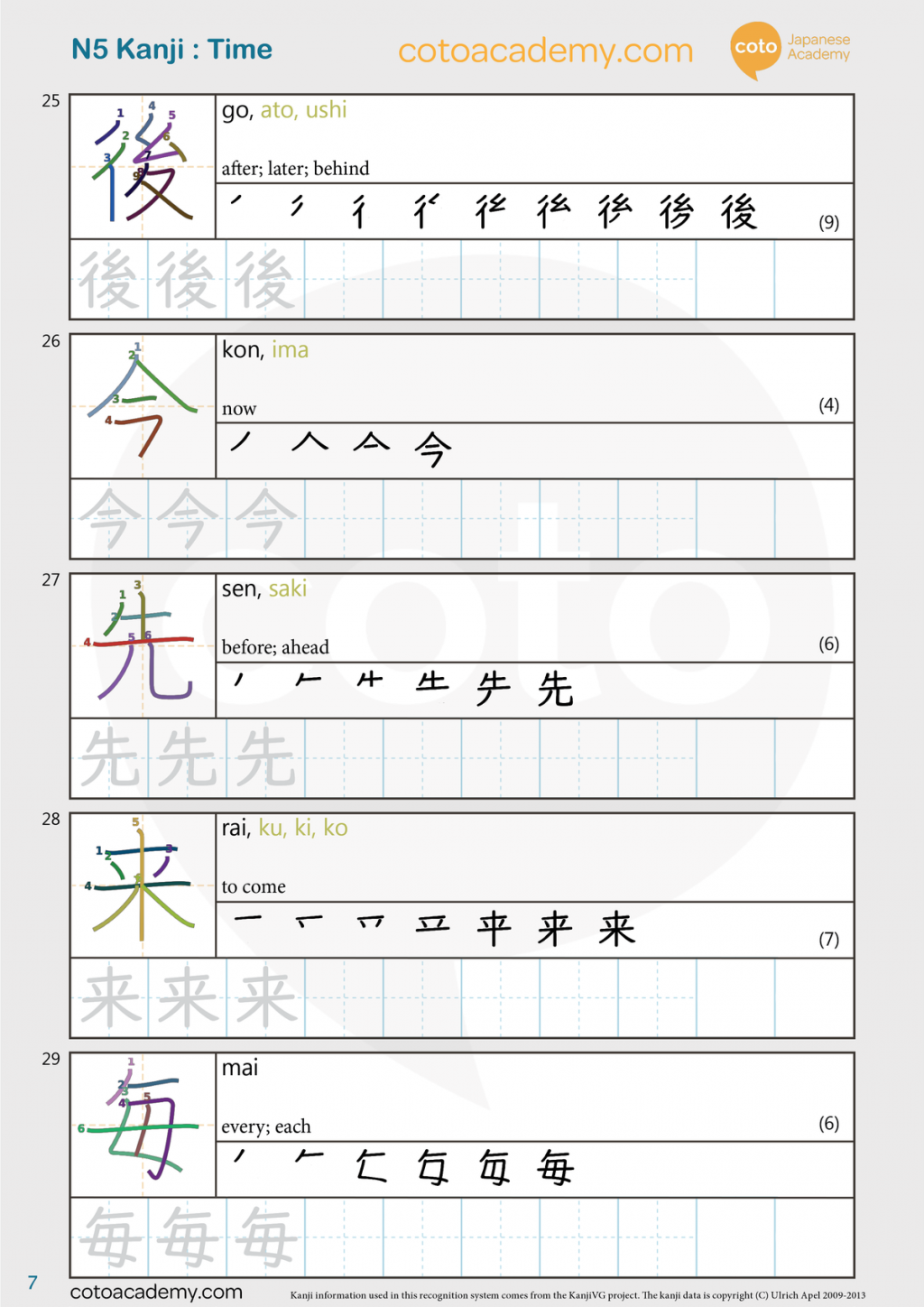
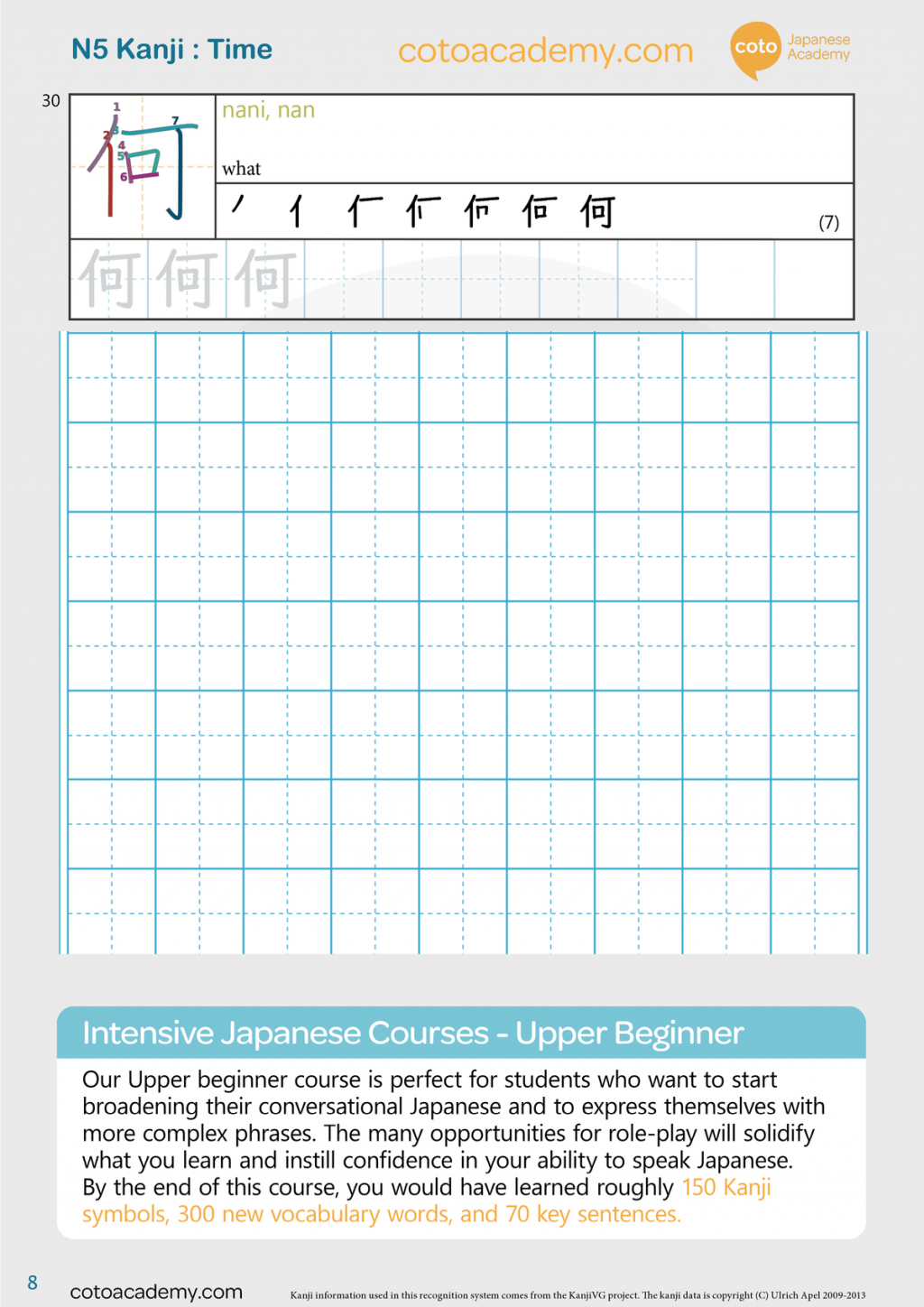
Do you know how to describe and write the position of something in Japanese using directions?
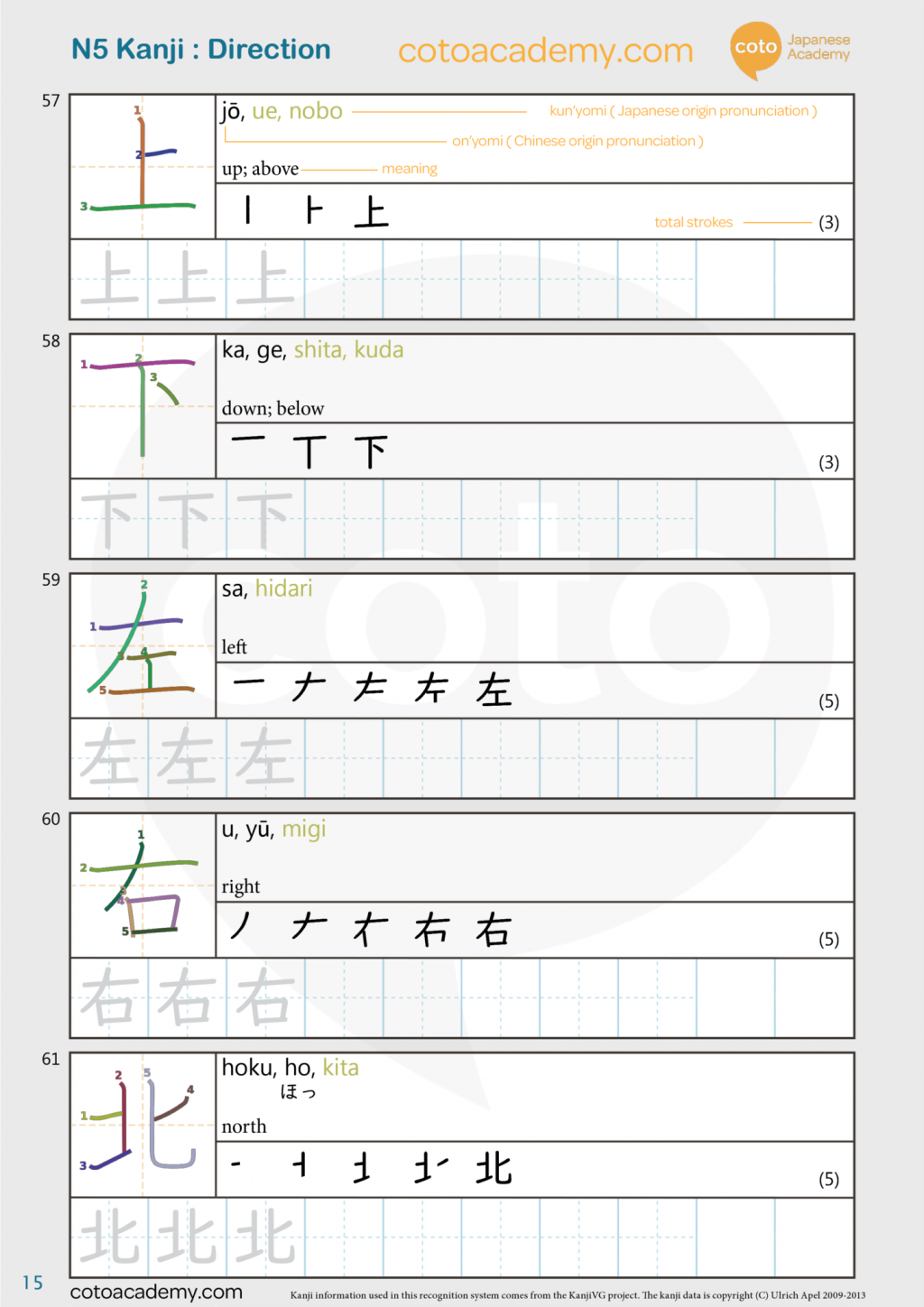
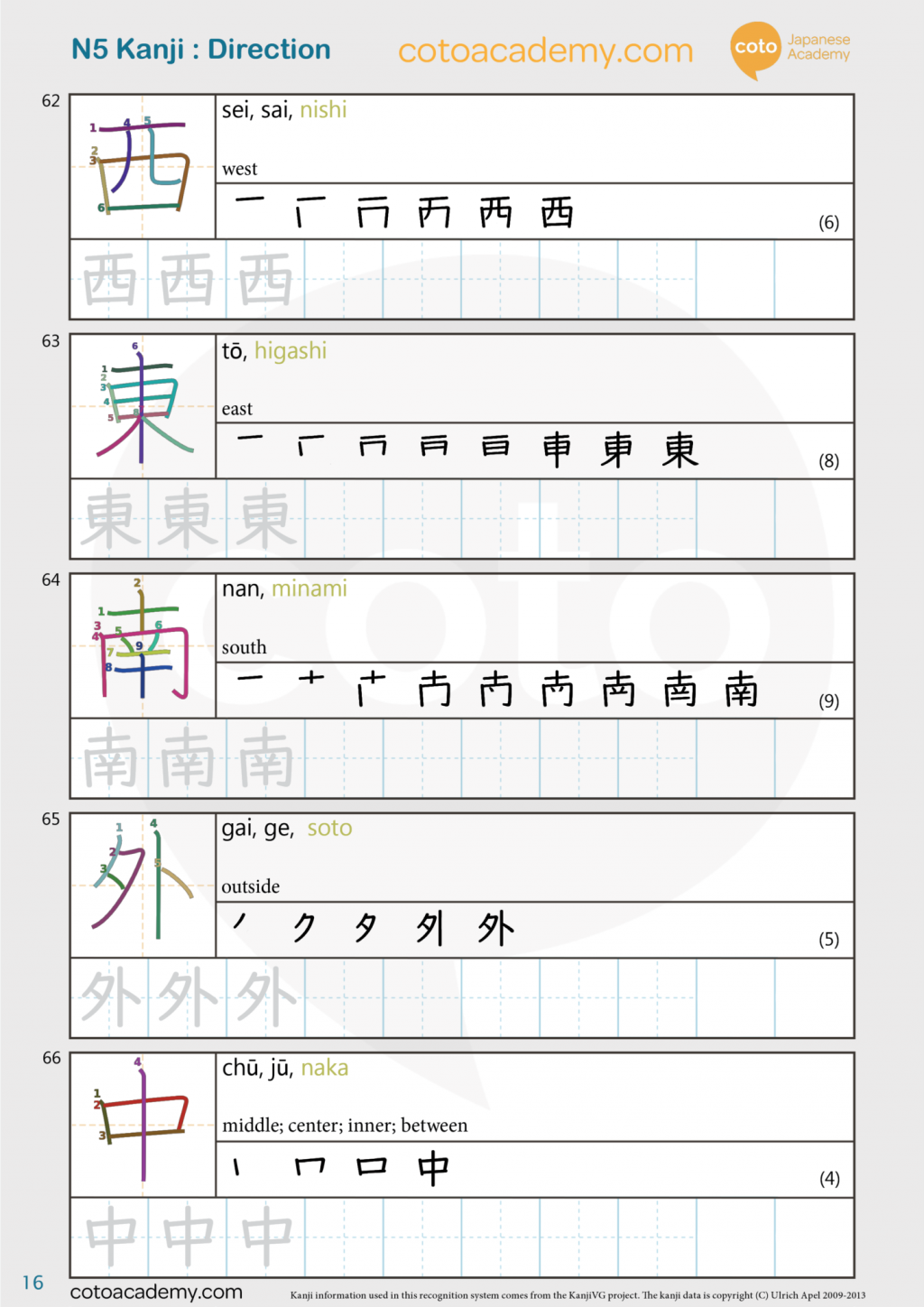
We have a new unit for your Kanji practice and studies! This features N5 Kanji that deal with directions such as up, down, north, south, etc.
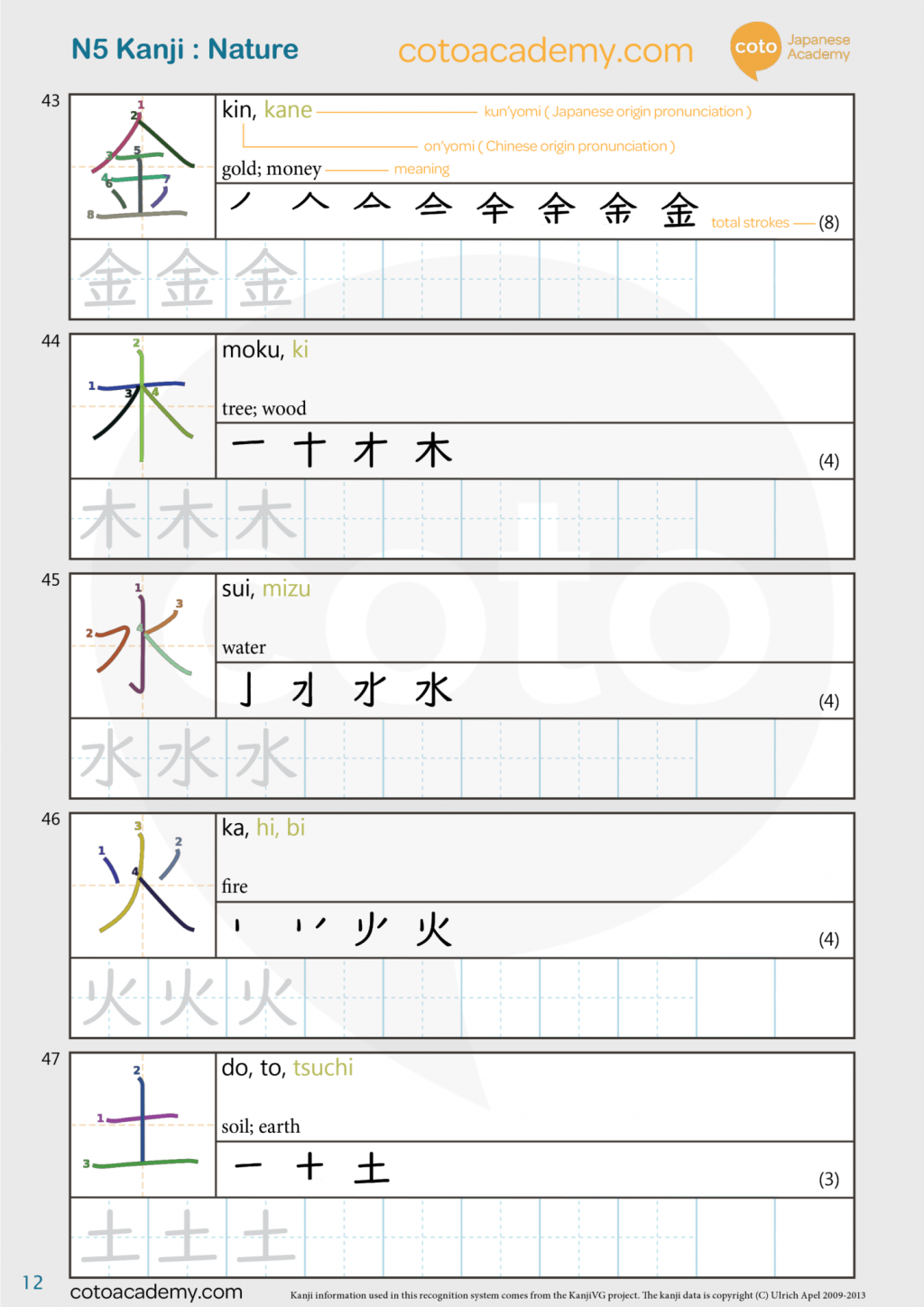
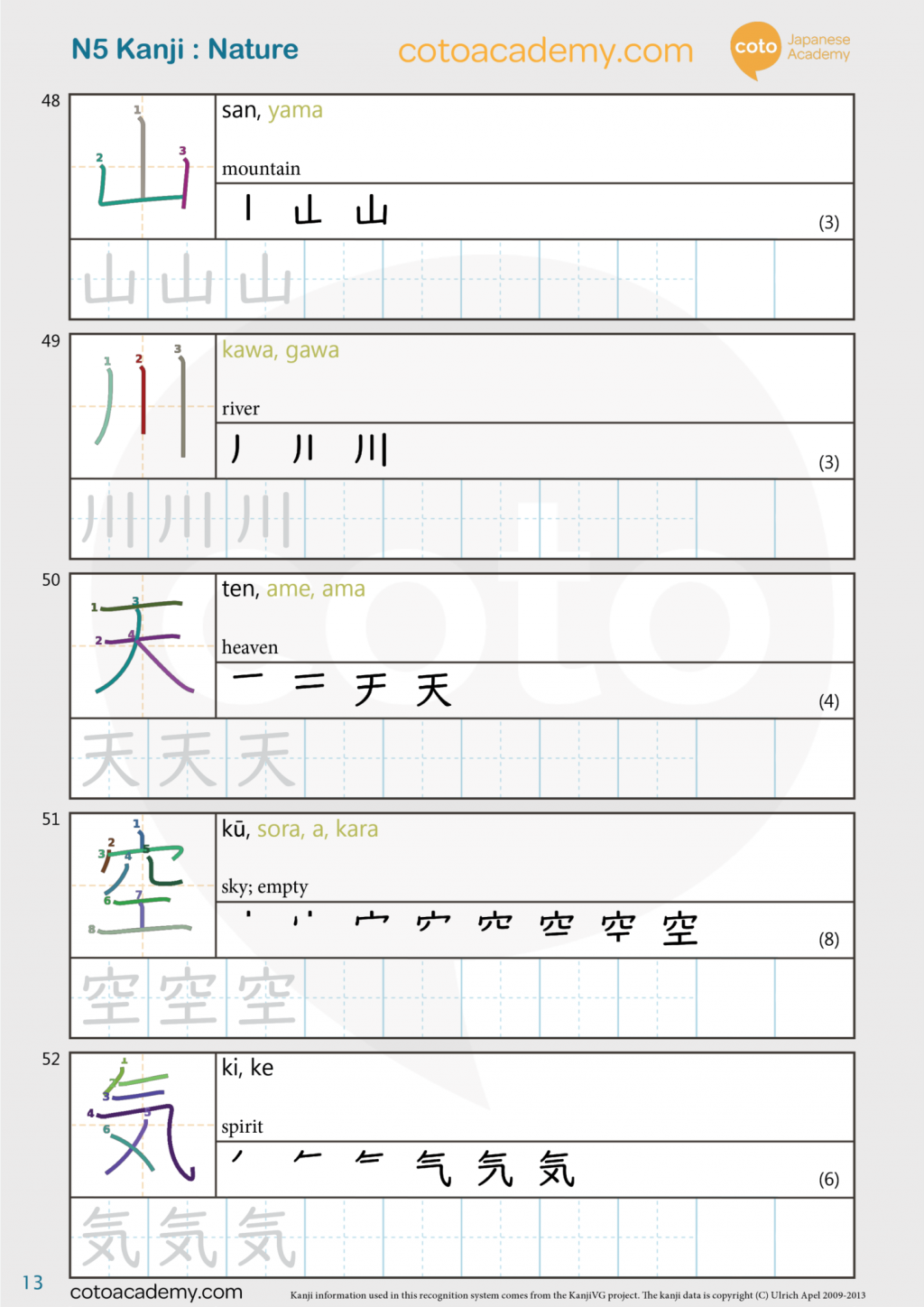
This is the fifth unit in a series of free Kanji writing practice sheets that you can download and print. It features N5 Kanji that will appear on the JLPT N5, and mastering these kanji is an important step to passing the test!
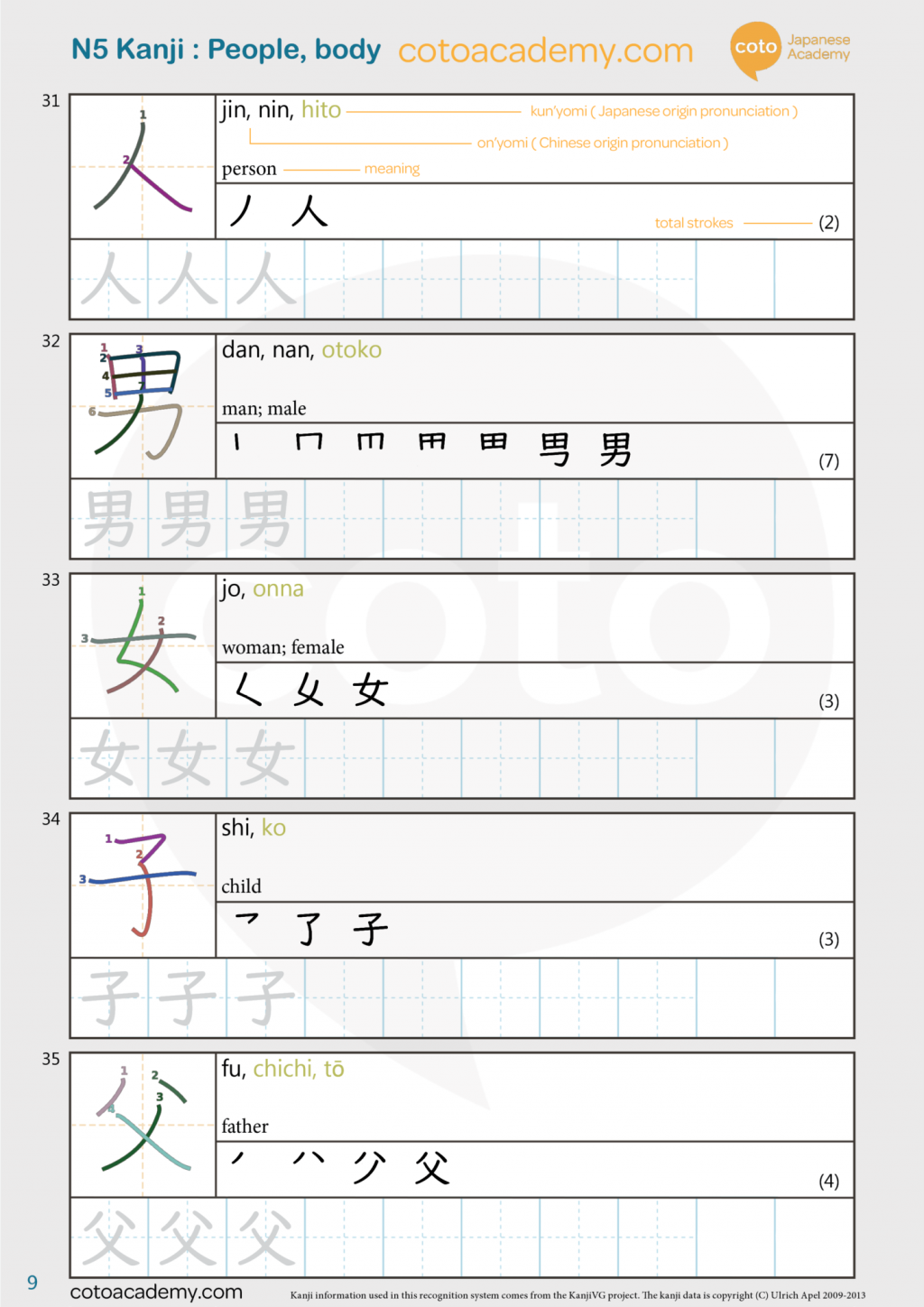
This is the third in a series of free Kanji writing practice sheets that you can download and print.
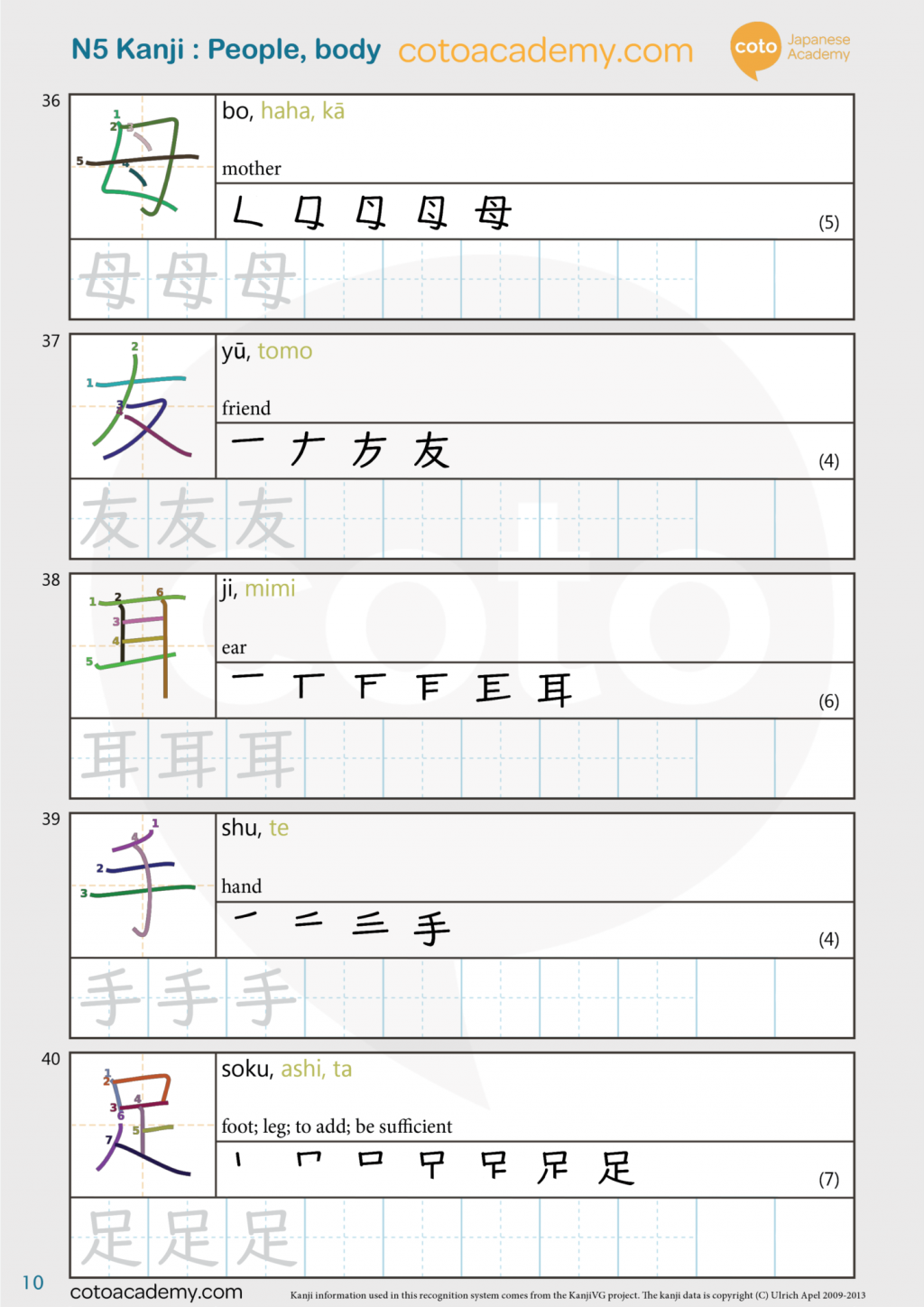
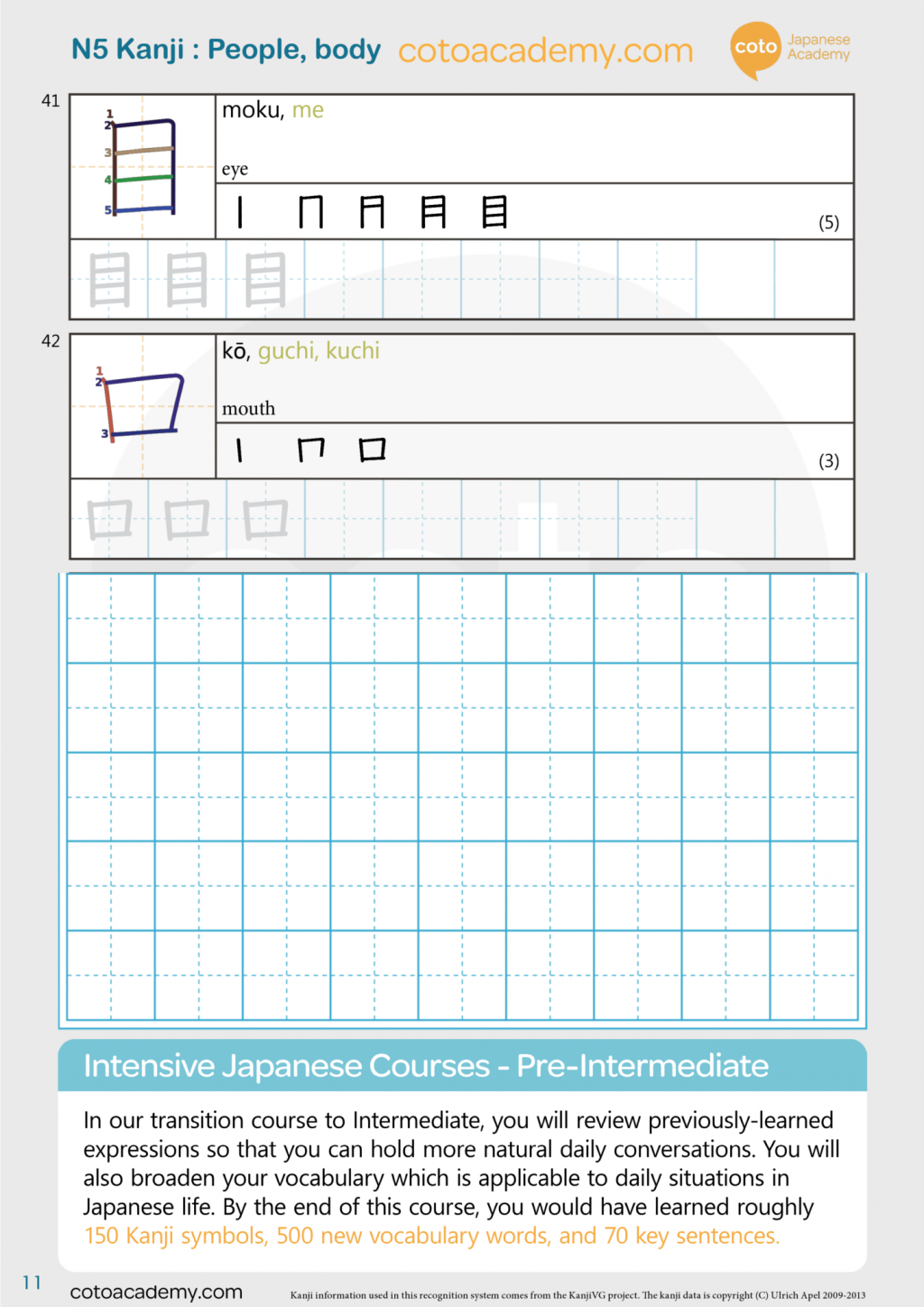
This series deals with kanji related to the human body. If you want to learn Japanese Kanji that relates to the human body, then you can download these excerpts for free.
We will be releasing more over the coming weeks – so stay tuned to this page as we will update it with new links.
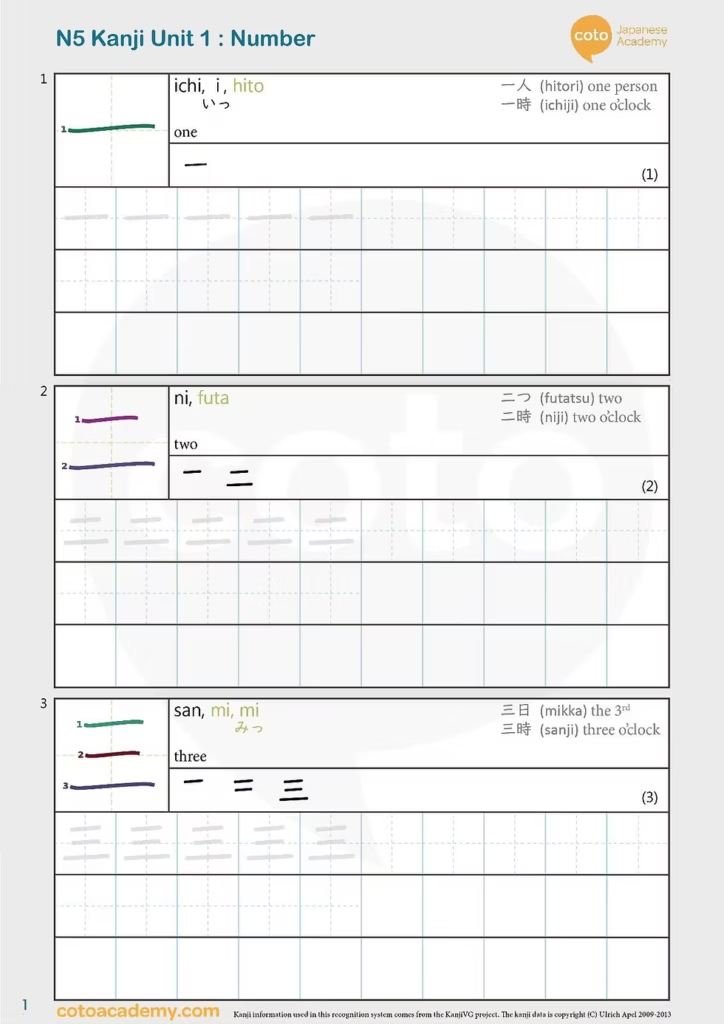
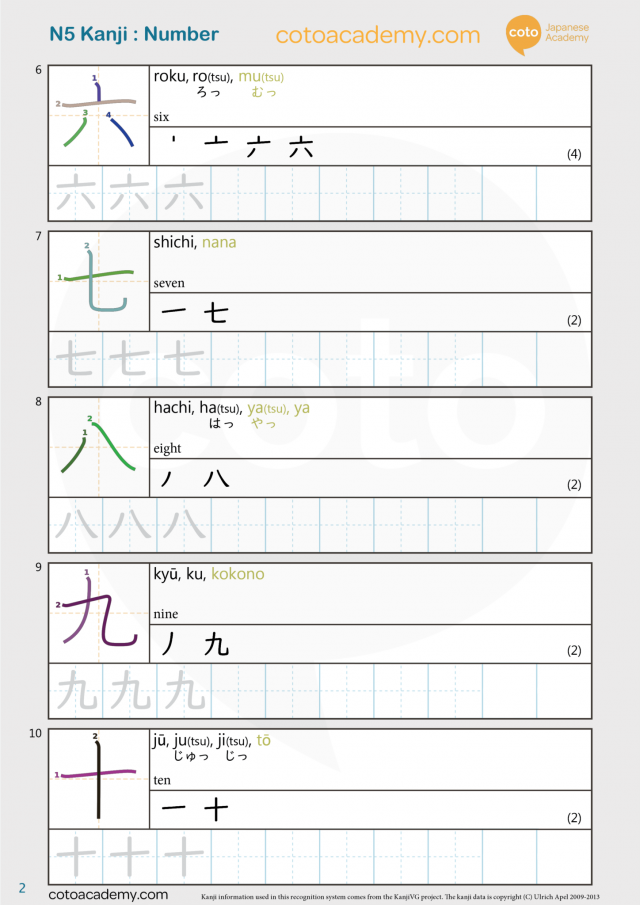
Learning kanji is one of the first big steps in mastering Japanese, and numbers are a great place to start. This free JLPT N5 Kanji Worksheet (Unit 1: Numbers) focuses on essential number-related kanji you’ll encounter early in your studies — perfect for beginners preparing for the JLPT N5. Download the PDF, practice writing each character, and build a strong foundation for your Japanese journey!
Getting ready for the JLPT? Boost your chances of passing with Coto Academy’s JLPT Prep Course — designed for busy learners. This class is perfect for students who plan to take the JLPT exam and work optimally towards their objectives. It covers exam practices and explanations of essentials such as Japanese grammar, vocabulary, kanji, and more!
These are the most basic kanji in Japanese — and they’re also the easiest to learn! Mastering numbers 1 to 10 will help you with counting, dates, prices, time, and more.
Number
Kanji
Kana
Meaning
1
一
いち
One
2
二
に
Two
3
三
さん
Three
4
四
し / よん
Four
5
五
ご
Five
6
六
ろく
Six
7
七
しち / なな
Seven
8
八
はち
Eight
9
九
きゅう / く
Nine
10
十
じゅう
Ten
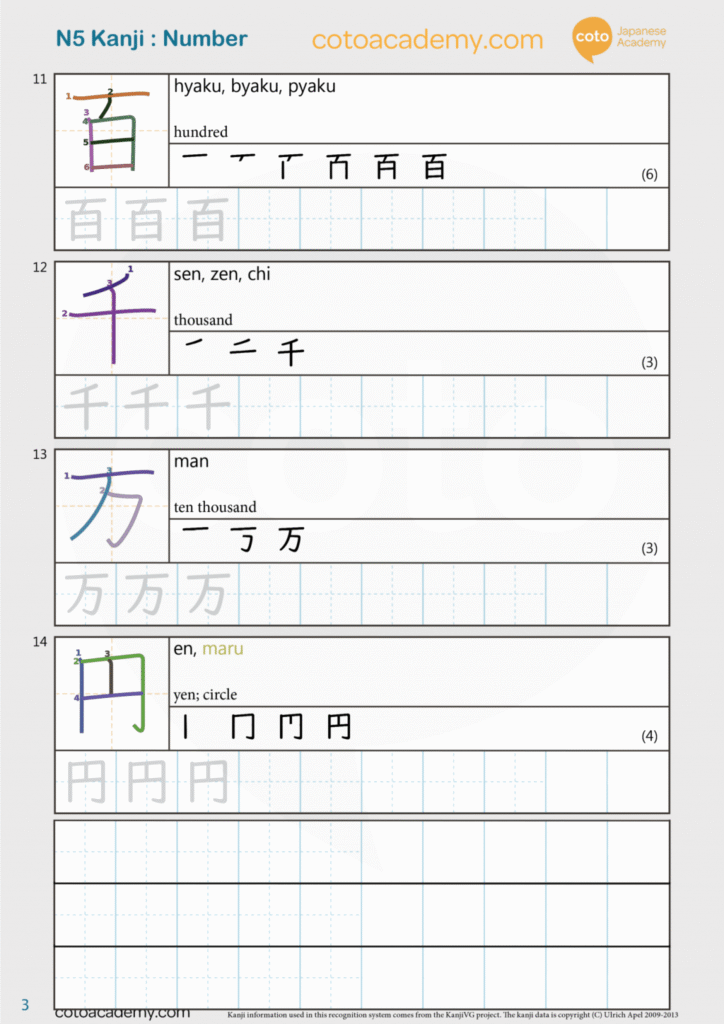
Free Kanji Number Worksheet
Simply save the picture for your own personal review!
Start taking Japanese lessons and master Kanji skills with us!
Welcome to the ultimate guide to passing the JLPT N2! If you’re already studying for it — or at least considering it — chances are you’re ready for a change. JLPT N2 is widely recognized as the practical benchmark for Japanese fluency. Employers in Japan frequently list it as a minimum requirement, and for many international students and professionals, it’s the credential that makes everything else possible. It’s also one of the most challenging standardized language exams in the world.
In this blog, we will cover everything you need to know about the JLPT N2 exam (test contents, length, scoring methods, etc.), how to register, how to prepare, what happens on test day, and some resources and lessons we offer at Coto Academy to help you through your studies.
Keep scrolling if you are considering or planning to take the JLPT N2!
What is the JLPT?
Before we get started, what exactly is the JLPT? JLPT stands for Japanese-Language Proficiency Test, also known as 日本語能力試験. As the name suggests, the exam measures and certifies the Japanese proficiency of non-native Japanese speakers and is used by universities and employees inside and outside Japan. It is normally carried out twice a year in Japan and is available in certain other countries. JLPT Exams are often taken by Japanese learners who are planning a future in Japan!
What are the different levels of the JLPT?
The JLPT is divided into five levels: N1, N2, N3, N4, and N5. N1 is the most advanced level, and N5 is the most basic.
The N4 and N5 tests you on basic Japanese that you can often learn in a classroom environment
The N3 acts as a bridge between N4/N5 and N2/N1
The N2 and N1 tests you on a wider spectrum of Japanese knowledge used in various situations in everyday life
Who should take the JLPT?What are the advantages of taking the N2?
Your JLPT scores will be useful if you are looking for a job or planning to pursue education in Japan. JLPT certifications can also be advantageous when immigrating to Japan, as those who have passed the N2 and N1 qualify for preferential treatment.
Additionally, passing the JLPT N2 can be a fitting goal for Japanese learners wanting to test their ability to understand Japanese used in everyday situations and in various circumstances to a certain degree.
The JLPT N2 is an exam for upper-intermediate/advanced-level speakers. The JLPT N2 tests your ability to understand Japanese used in everyday situations and various circumstances to a certain degree. This includes having no difficulty in:
Reading materials are written clearly on a variety of topics, such as articles and commentaries in newspapers and magazines, as well as simple critiques, and comprehending their contents
Reading written materials on general topics and following their narratives, as well as understanding the intent of the writers
Comprehending orally presented materials such as coherent conversations and news reports, spoken at nearly natural speed in everyday situations as well as in a variety of settings, and following their ideas and comprehending their contents
Understanding the relationships among the people involved and the essential points of the presented materials
What is the JLPT N2 used for?
There have been some major policy shifts in 2025–2026 that make N2 more relevant than ever.
1. For your visa application in Japan
Historically, JLPT N2 wasn’t a formal visa requirement for most categories but that’s changing significantly. In October 2025, the Business Manager visa now requires either the applicant or a full-time employee to have Japanese language ability at B2/JLPT N2 level or higher. Previously, there was no language requirement at all.
As of mid-April 2026, the Engineer/Specialist in Humanities/International Services visa (Gijinkoku) now requires N2 or equivalent for roles that involve Japanese communication — meetings, client interaction, documentation, and similar duties. English-only roles at international companies may still be exempt if the job genuinely doesn’t require Japanese
Importantly, the revision mainly targets foreigners entering Japan for the first time and requiring a Certificate of Eligibility. It doesn’t apply to international students in Japan transitioning from a student visa to a work visa after graduation.
Even before these visa policy changes, N2 was already the de facto standard in the Japanese job market. Many employers prefer candidates with N2 or higher to ensure smooth workplace communication, even when it’s not legally required. Most office and business roles expect N2, while specialized fields like law or medicine typically expect N1.
N2 is generally considered the threshold for functioning professionally in Japanese — reading documents, participating in meetings, handling client communication, and navigating administrative tasks.
How many sections are on the N2 Exam?
It is important to be aware of the structure of the exam to study for it efficiently. The JLPT N2 Exam consists of two main sections. Each section tests you on different aspects of the Japanese language.
Section
Question types
1. Language Knowledge(Vocabulary/Grammar) and Reading
– Task-based comprehension – Comprehension of key points – Comprehension of general outline – Verbal expressions – Quick response – Integrated comprehension
What is and is not covered in the JLPT N2 Exam?
For the above three sections, you must master approximately 6,000 vocabulary words and 1,000 kanji. Although this may sound like a lot, you should already know around 3700 words and 650 kanji from N3-N5, so you are already halfway there! The vocabulary words and kanji covered in the N2 Exam include basic nouns and verbs from N4 and N5 and more complex terms necessary to understand difficult written materials such as newspapers, magazines, and simple critiques.
Furthermore, you must be familiar with grammar points such as particle usage, formal and casual conjugations of verbs and adjectives for past and present tenses, and sentence combinations. You must know around 200 more grammar points besides what you already know from the N3. Before taking the test, you should be comfortable reading and writing longer passages.
Because the JLPT Exam does not test on speaking, Japanese learners who are not comfortable speaking in Japanese can theoretically still pass, as long as they have mastered the vocabulary, kanji, and grammar covered on the N2 Exam. (However, you must keep in mind that Japanese speaking and conversational abilities are still necessary for life if you are seriously considering a future in Japan!)
How long is the N2 Exam?
You are given different amounts of time for each of the two test sections. You are given 155 minutes to complete the JLPT N2 Exam.
Section
Time
Language Knowledge (Vocabulary/Grammar) and Reading
105 minutes
Listening
50 minutes
Total Time
155 minutes
What is the scoring for the JLPT N2 like?
Although the N2 Exam contains two sections, the scoring is divided into three. In total, your overall score can range from anywhere between 0 to 180.
For JLPT N2, the passing score is anything above an overall score of 90 points. However, besides meeting the overall score of 95 points, you must also meet sectional pass marks of 19 points in the Language Knowledge (Vocabulary/Grammar) Section, Reading Section, and Listening Section. This means that even if your overall score is above 90 points, if you do not meet the sectional pass marks for all three of the sections, you cannot pass. Thus, balancing your knowledge and avoiding relying on one section for points is important.
Section
Range of Scores
Language Knowledge (Vocabulary/Grammar)
0 – 60
Reading
0 – 60
Listening
0 – 60
Overall Score
0 – 180
For how long should I study to pass the N2?
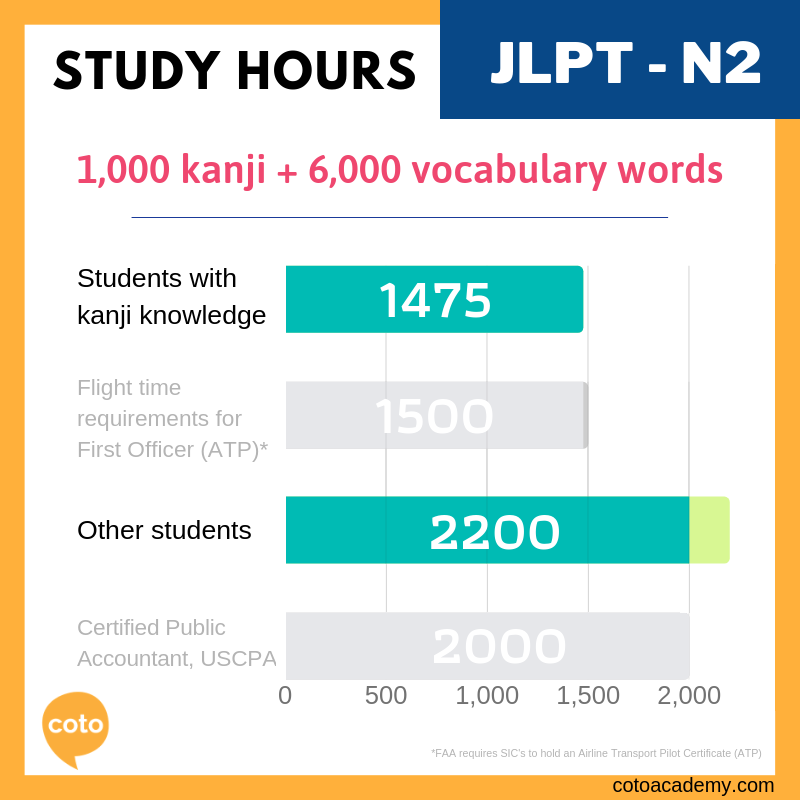
For students with kanji knowledge, 1,475 hours of JLPT study are required. A restricted privileges ATP certificate allows a pilot to serve as a co-pilot until he or she obtains 1,500 hours. So you can become the co-pilot of an aircraft for this number of hours.
For other students, it takes about 2,200 hours. As a reference, credentials for a USCPA (Certified Public Accountant) take 2000 hours. Have fun crunching numbers!
As previously mentioned, the JLPT N2 Exam covers around 1,000 kanji. (Of course, you do not have to know all of them to pass, but it’s impossible to predict which ones will be on the exam.) The best way to master the vocabulary for N2 is to memorize the words along with their kanji. This will also help you retain all the kanji, so the vocabulary and kanji study reinforce each other.
Anki is one of the most effective tools for N2 vocab and kanji precisely because it fights forgetting rather than just building familiarity. The spaced repetition system surfaces cards right before you’d naturally forget them, which means you spend more time on weak items and less time reviewing things you already know.
For N2 specifically:
Use a pre-built deck like the Core 6000 or a dedicated JLPT N2 vocabulary deck rather than building from scratch — saves enormous time
Add example sentences to cards wherever possible so you’re learning words in context, not in isolation
Create cards that test you on kanji readings in compounds, not just the meaning alone
Review consistently in short daily sessions (15–20 min) rather than long cramming sessions
We have also provided samples of the worksheets free of charge at the below links! These are very useful as they give you an idea of some kanji you will be tested on during the N2 exam. Click on the topic to download.
N3 grammar is largely about building functional communication: expressing wants, reasons, conditions, and basic conjunctions. JLPT N2 grammar raises the bar considerably. The focus shifts toward nuance: understanding how similar expressions differ, using formal and written registers, and handling grammar that appears in news articles, formal writing, and professional speech rather than everyday conversation.
Alongside these, you’ll encounter conjunctions that link ideas with precision: ~にもかかわらず (despite), ~に反して (contrary to), and ~に加えて (in addition to). The volume is significant, but the bigger challenge is understanding how each form fits into a specific context or register.
What makes N2 grammar particularly demanding is the number of near-synonyms that are tested side by side. Pairs like ~かねる (unable to bring oneself to do something) and ~かねない (at risk of doing something) look almost identical but carry opposite implications. Similarly, ~ことから, ~ため, and ~結果 all express cause and result, but differ in nuance and formality. The exam regularly presents options that translate nearly the same way into English, so success depends on understanding the subtle distinctions.
The most effective way to study N2 grammar is to combine structured drilling with real reading. Kanzen Master N2 Grammar groups patterns by function and gives enough practice sentences to surface those nuances.
Here’s an example of our grammar videos:
3. Listening
The JLPT N2 listening section tests your ability to follow natural-paced Japanese across a range of situations, like workplace conversations, announcements, interviews, and informal exchanges. The difficulty is that speakers don’t slow down or simplify for learners, and questions often hinge on a single phrase, a speaker’s implied intention, or a detail buried in the middle of a longer exchange.
A common trap is that the audio will present multiple plausible-sounding options, and the correct answer often depends on nuance — what the speaker implies rather than what they say outright. Many learners who score well on grammar and vocabulary underperform on listening simply because they haven’t trained their ears enough to process spoken Japanese at speed.
The most effective preparation combines passive and active listening. Passive exposure like podcasts, Japanese drama, YouTube — builds familiarity with natural rhythm, intonation, and connected speech over time. But active listening practice is what actually moves the needle for exam performance: working through past JLPT papers under timed conditions, pausing to identify exactly where comprehension broke down, and drilling those weak points. Shadowing, hich is the process of repeating audio in real time to match pace and intonation, is particularly useful for closing the gap between recognition and real-time processing. The goal is to stop translating mentally and start understanding directly in Japanese.
4. Reading
N2 reading passages are longer, denser, and more abstract than anything at N3. You’ll encounter formal essays, opinion pieces, notices, and informational texts, often with embedded clauses, formal grammar structures, and vocabulary that doesn’t get simplified for the reader.
The section tests not just comprehension but interpretation: understanding the writer’s argument, identifying the main point of a paragraph, or inferring meaning from context. Time pressure is a real factor, and many test-takers run out of time not because they can’t understand the passages but because they read too slowly or get stuck on unfamiliar words.
Building reading speed and tolerance for ambiguity is as important as expanding vocabulary. Strong N2 readers develop the habit of moving forward through a passage even when a word or phrase is unclear, using context to approximate meaning rather than stopping to decode every sentence.
NHK Web Easy is a good bridge for upper-intermediate learners, while regular NHK News or editorial content better reflects the density and register of actual exam passages. The underlying skill the reading section rewards is the ability to follow a logical argument in formal Japanese, which ultimately comes from reading widely and consistently in the months leading up to the exam.
Should You Take JLPT N2 Lessons
Studying for the JLPT N2 on your own is possible, but it’s a significant undertaking. The jump from N3 to N2 is one of the steepest in the entire test series. Many learners who attempt N2 through self-study alone find themselves cycling through textbooks without a clear sense of where their weak points are or how to address them efficiently. Taking lessons with a qualified Japanese teacher changes the dynamic considerably. A good tutor can diagnose exactly where you’re losing points
For example, at Coto Academy, JLPT N2 preparation is something the teachers work on with students every day — whether through group courses structured around the exam syllabus or private lessons tailored to your specific weak points. If you’re based in Tokyo or prefer to study online, it’s worth exploring what a more guided approach could do for your preparation timeline.
The dedicated JLPT N2 Prep Course covers everything on the exam syllabus in small groups of no more than eight students.
If you prefer a more immersive pace, the Intensive Course runs every weekday and builds the kind of fluency with abstract and complex Japanese that N2 demands. For learners who want something tailored entirely to their weak points, Private Lessons offer a one-on-one plan built around your specific needs and schedule.
Ready to Pass the JLPT N2? Prepare with Coto Academy!
Whether you’re just starting your N2 journey or looking to close the gap before your next exam date, Coto Academy’s experienced teachers are here to help. Study in Tokyo or online, at a pace that works for you. You can explore our JLPT prep course or contact us right away for a free consultation and level check!
Check out our guides for other JLPT levels as well:
Welcome to the ultimate guide to passing the JLPT N3 exam! The thought of taking the JLPT is stressful, but what about preparing for it? With so many things to learn, it’s easy for anyone to feel completely disorganized.
The JLPT N3 exam is a true testament to your progress and dedication to learning Japanese. Give yourself a well-deserved pat on the back, you are no longer a beginner! Preparing for and passing the N3 proves you are firmly in the intermediate stage of your Japanese journey and well on your way toward more advanced levels. In this blog, we will cover everything you need to know about the JLPT N3 exam, including test contents, length, scoring methods, registration, preparation strategies, what to expect on test day, and recommended resources to support your studies.
Study the JLPT Smarter with Coto Academy!
Getting ready for the JLPT? Boost your chances of passing with Coto Academy’s JLPT Prep Course. We offer two flexible options: a year-round course and an intensive 3-month sprint course timed perfectly before test day. What makes these classes stand out is the teachers, who specialize in teaching JLPT. They will give you tips and techniques you simply won’t get from self-study. The class also covers mock tests, reading practices, and explanations of essentials such as Japanese grammar, vocabulary, kanji, and more!
Before we get started, what exactly is the JLPT? JLPT stands for Japanese-Language Proficiency Test, also known as 日本語能力試験. As the name suggests, the exam measures and certifies the Japanese proficiency of non-native Japanese speakers and is used by universities and employees inside and outside Japan. It is normally carried out twice a year in Japan and is also available in certain other countries. JLPT Exams are often taken by Japanese learners planning a future in Japan!
If you are considering or planning to take the JLPT N3 exam, keep scrolling!
What Are The Different Levels of The JLPT?
The JLPT is divided into 5 different levels: N1, N2, N3, N4, and N5, with N1 being the most advanced level and N5 being the most basic.
The N4 and N5 tests you on basic Japanese that you can often learn in a classroom environment
The N3 acts as a bridge between N4/N5 and N2/N1
The N2 and N1 tests you on a wider spectrum of Japanese knowledge used in various situations in everyday life
What Are The Advantages of Taking JLPT N3?
If you are looking for a job or planning to pursue education in Japan, then your JLPT scores will come in handy. JLPT certifications can also be advantageous when immigrating to Japan, as those who have passed the N2 and N1 qualify for preferential treatment.
However, JLPT is only really useful for employment or immigration when you have passed the N2 or N1. This guide focuses on JLPT N3, which does not have much real-life use other than to check and prove your personal improvement in Japanese.
Still, the JLPT N3 Exam can be a fitting goal for Japanese learners wanting to test their ability to fairly understand Japanese used in everyday situations. An N3 certification acts as a nice intermediate-level bridge between the easier levels and the harder levels of the JLPT. It will prepare you for the more difficult stuff covered in N2 and N1!
The JLPT N3 level is a bridge between beginner and advanced levels, sitting between the N4 and the N2. The exam will test learners with more complex conversational Japanese while not diving too deep into business or work Japanese. Overall, passing the JLPT N3 shows you are able to handle yourself in daily conversations in Japanese.
What Does The N3 Exam Test?
In general, the JLPT N3 Exam is an exam for intermediate-level speakers. The JLPT N3 tests you on the ability to understand Japanese used in everyday situations to a certain degree. This includes having no difficulty in:
Reading and understanding materials concerning specific everyday topics
Grasping summary information, such as newspaper headlines
Reading and fairly understanding slightly difficult writings encountered in everyday situations
Listening and comprehending everyday conversations spoken at near-natural speed, following their contents, and grasping the relationships among the people involved
How Many Sections Are on The N3 Exam?
To study for the exam efficiently, it is important to be aware of the structure of the test. The JLPT N3 Exam consists of three main sections. Each of the three sections tests you on different aspects of the Japanese language.
– Task-based comprehension – Comprehension of key points – Comprehension of general outline – Verbal expressions – Quick response
What is and is not covered in the JLPT N3 Exam?
For all of the above three sections, you must master approximately3700 vocabulary wordsand 650 kanji. Although this may sound like a lot, you should already know around 1500 words and 300 kanji from N5 and N4, so you are actually already halfway there! The vocabulary words and kanji covered in the N3 Exam include basic nouns and verbs from N4 and N5, as well as more complex terms necessary to understand slightly difficult written materials, such as newspaper headlines.
Furthermore, you must be familiar with typical grammar points such as particle usage, formal and casual conjugations of verbs and adjectives for past and present tenses, and sentence combinations. Before taking the test, you should be comfortable with reading and writing middle-length sentences and passages.
Because the JLPT Exam does not test on speaking, Japanese learners who are not comfortable speaking in Japanese can theoretically still pass, as long as they have mastered the vocabulary, kanji, and grammar covered on the N3 Exam. (However, you must keep in mind that Japanese speaking and conversational abilities are still necessary for life if you are seriously considering a future in Japan!)
How Long is the N3 Exam?
You are given different amounts of time for each of the three test sections.
Section
Time
Language Knowledge (Vocabulary)
30 minutes
Language Knowledge (Grammar) and Reading
70 minutes
Listening
40 minutes
Total Time
140 minutes
In total, you are given 140 minutes to complete the JLPT N3 Exam.
What is the scoring for the JLPT N3 like?
Since the N3 Exam contains three sections, the scoring is divided into three as well.
Section
Range of Scores
Language Knowledge (Vocabulary/Grammar)
0 – 60
Reading
0 – 60
Listening
0 – 60
Overall Score
0 – 180
In total, your overall score can range from anywhere between 0 to 180.
For the N3 Exam, a passing score is anything above an overall score of 95 points. However, in addition to meeting the overall score of 95 points, you must also meet sectional pass marks of 19 points in the Language Knowledge (Vocabulary/Grammar) Section, Reading Section, and the Listening Section. This means that even if your overall score is above 95 points, if you do not meet the sectional pass marks for all three of the sections, you cannot pass. Thus, it is important to balance out your knowledge and avoid relying on one section for points.
For how Long Should I Study to Pass JLPT N3?
For students already with kanji knowledge, it takes 900 hours. This is about the same as attaining a Spanish Food Le Cordon Bleu diploma.
For other students, it takes around 1325 hours of studying. With this amount of time, you can become an architect!
As previously mentioned, the JLPT N3 Exam covers around 650 kanji. (Of course, you do not have to know all of them to pass, but it’s impossible to predict which ones will be on the exam). The kanji on the N3 will consist of all the N4 and N5 ones, as well as new kanji.
We have also provided samples of the worksheets for free at the links below! They will give you an idea of kanji that you will be tested on during the N3 exam. Click below to download!
As you move on from N5 and N4 to N3-level kanji, it becomes important to learn about kanji radicals and know the meanings of individual parts of kanji. This will help you memorize each kanji and recognize the meanings of words more effectively. When studying N3 kanji, we recommend you study parts of each kanji as well, since that will help you pick up on patterns and make each character easier to remember.
2. Mastering Grammar
Although the JLPT N3 Exam score includes vocabulary and grammar, we highly recommend studying and mastering both areas independently. Grammar and vocabulary will be tested with fill-in-the-blank sentences, emails, article passages, and reading comprehension questions. The exam will ensure you understand specific grammar and vocabulary by testing how to use them in the correct context.
We have whole articles dedicated to helping you prepare for JLPT N3 grammar and vocabulary. Please find them below:
If you need more materials, textbooks, or mock tests, we have also rounded up the 20 best JLPT N3 textbooks you can use to ensure you’re prepared to take on the JLPT N3 exam.
In addition, our YouTube Channel is also great for learning important N3 grammar points and improving your Japanese listening skills. We offer useful videos on phrases and grammar points commonly featured on the JLPT N3 and include familiar examples to help you get a grasp of how they are often used in daily life.
Here’s an example of our grammar videos:
If you are a person who learns better through videos and audio, check out our JLPT N3 Playlist, where we have compiled all of the N3 grammar videos for you.
How To Register for The JLPT N3
In order to take the JLPT at any level, you must first register for the exam online during the registration period. When you register, you can make a reservation for your desired test center and provide personal information that can be confirmed on the day of the exam. For a full step-by-step breakdown, read our How to Register for JLPT Guide.
Next Test Date: December 7, 2025
Application Period: Until September 8 (Thu), 17:00
It’s your big test day! Before heading out to your test center, make sure to bring your test voucher, writing utensils (mechanical pencils are accepted), and maybe some snacks and a watch to help you with time management.
For examinees in Japan, your test will begin at 12:30, but the test center will already be open from 11:45. We recommend that you head out early to be safe.
Once you arrive at your test venue, you will be asked to show your test voucher to the staff. Examinees are split into different rooms based on their voucher numbers. You will be instructed to enter one of these rooms.
Once you have found and entered your room, you will find the desk that has your number on it. You will receive instructions from staff and begin your exam when it’s time.
The whole exam will take several hours to complete (in the case of the N3 Exam, 140 minutes), and you will get short breaks between each section. When the exam is finished, you will need to wait until all test papers have been collected before you can leave the room.
*Processes at overseas testing sites may differ.
Final Remarks on Passing the JLPT N3 Exam
The JLPT N3 Exam is a true testament to your dedication to studying Japanese, as you have officially graduated from the beginner stages. It is a rather large jump from the previous N4 and N5 levels, with the exam featuring more kanji, longer reading sections, and more complex grammar. However, with our guide, you will be able to break apart the exam piece by piece and master each section with ease. Congratulations on how far you’ve come. Be sure to stay motivated by focusing on what you’ve accomplished. Being ready to take on the N3 is already a huge achievement.
To really be sure you’re prepared, consider taking our JLPT Prep courses! Taught in Tokyo by experienced instructors who specialize in the JLPT, this course gives you the strategies, practice tests, and structured study approach to master every part of the exam. With expert guidance and proven methods, you’ll walk into your next JLPT feeling confident and ready to pass.
Contact us for a Japanese-level check and a free consultation on the best JLPT prep course for you
FAQ:
What proficiency level is the JLPT N3 considered to be?
The N3 is an intermediate-level exam, acting as a bridge between beginner and advanced levels. The test will feature newspaper headlines, more complicated sentences, and medium & long-length passages.
How many kanji and vocabulary words do I need to know for the JLPT N3?
You need to know around 650 kanji and 3,750 vocabulary.
How long does it take to reach the N3 level?
Generally speaking, it takes 1 to 3 years to reach the JLPT N3 level or around 1,700 hours of studying. However, this amount of time can vary from person to person. If you aren’t sure you are ready, you can take N3 mock tests to understand how you feel about taking the real exam.
Can I skip straight to N3 without taking N5 or N4?
Yes! You don’t need to pass lower levels before attempting N3. However, most learners benefit from building a foundation with N4 before jumping into N3.
How hard is the JLPT N3 compared to N4?
N3 is a significant step up. While N4 focuses on simple grammar and vocabulary, N3 requires understanding longer sentences, intermediate grammar, and reading passages on everyday topics. Listening sections are also faster and more detailed.
Is JLPT N3 enough to work in Japan?
N3 shows intermediate proficiency, but many employers require N2 or higher for professional positions. However, it depends on the role and company, as recently more positions are only requiring N3-level Japanese. The N3 should be more than sufficient for most part-time jobs, internships, or study-abroad opportunities.
Check out our guides for other JLPT levels as well:
Planning to take the JLPT N5? Although it is technically the lowest level a foreigner can take, the N5 can be a great milestone for those who want to see if they have made real progress. Understandably, the thought of taking the JLPT is stressful, with so many things to learn and consider. So, where do you start?
Good news is you are in the right place! In this guide, we will cover everything you need to know about the JLPT N5 exam (test contents, length, scoring methods), how to register, how to prepare, what happens on test day, and some resources and lessons we offer at Coto Academy to help you through your studies.
Want to take your JLPT preparation to the next level? We have in-person and online JLPT courses taught by our experienced Japanese instructors to help you ace your next JLPT exam!
JLPT stands for Japanese Language Proficiency Test, also known as 日本語能力試験. As the name suggests, the exam measures and certifies the Japanese proficiency of non-native Japanese speakers and is used by universities and employees inside and outside Japan. It is normally carried out twice a year in Japan and is also available in certain other countries. JLPT Exams are often taken by Japanese learners planning a future in Japan!
Check out our guides for other JLPT levels as well:
The JLPT is divided into 5 different levels: N1, N2, N3, N4, and N5, with N1 being the most advanced level and N5 being the most basic.
The N4 and N5 tests you on basic Japanese that you can often learn in a classroom environment
The N3 acts as a bridge between N4/N5 and N2/N1
The N2 and N1 tests you on a wider spectrum of Japanese knowledge used in various situations in everyday life
Who should take the JLPT N5?
While JLPT is the most widely recognized standardized Japanese test, the JLPT N5 is often not enough to help you find employment. Still, the exam can be a viable first goal for beginner Japanese learners. You can set it as a short-term target. By taking the N5 Exam, you may be able to discover your strengths and weaknesses and pursue your studies more efficiently thereafter.
Additionally, JLPT N5 has recently become more necessary when applying for certain types of student visas. Japanese language schools may require you to either fulfill the requirement to study Japanese for 150 hours or have a JLPT N5 certificate before you can study in Japan!
If you’re seeking employment in Japan, holding JLPT N2 or, even better, JLPT N1 certification will give you a major advantage. Employers often grant preferential treatment to candidates who have passed N2 or N1, and N1 holders in particular can unlock the best opportunities.
What does the JLPT N5 test?
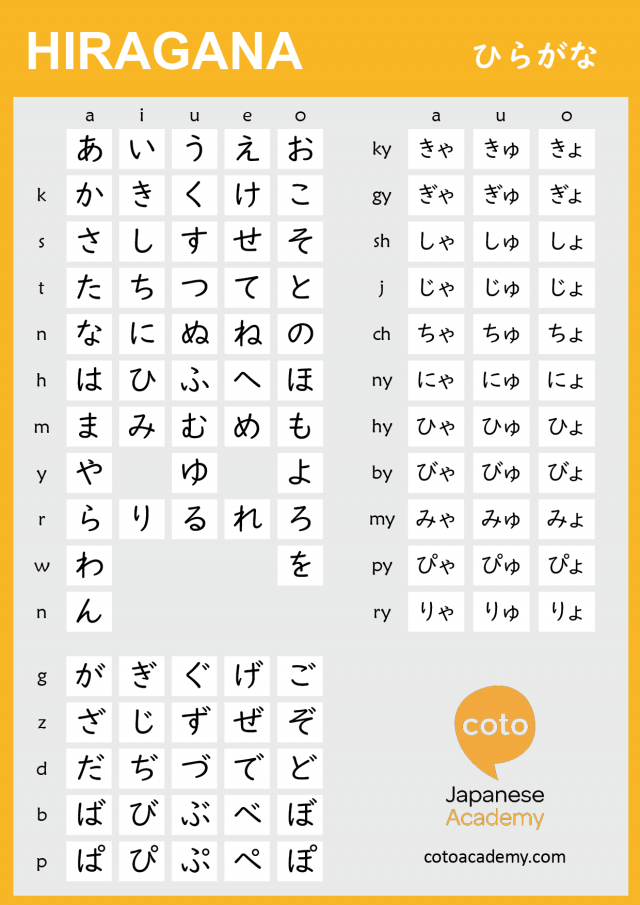
Generally, the JLPT N5 tests you on the understanding of some core basics of Japanese, including your ability to read and comprehend elementary expressions and sentences expressed in hiragana, katakana, and some kanji. You also need to be able to listen and comprehend typical, slow-spoken conversations abundant in everyday life and in classroom environments.
What are the different sections of N5 Exam?
The JLPT N5 Exam consists of three main sections. Each of the three sections tests you on different aspects of the Japanese language.
Section
Question types
1. Language Knowledge (Vocabulary)
– Kanji reading – Orthography – Contextually-defined expressions – Paraphrases
For all of the above three sections, you must master approximately 800 vocabulary words and 100 kanji. The 800 vocabulary words covered in the N5 Exam will correspond to the most commonly used words in the Japanese language. The 100 kanji will cover those that are naturally used in simple daily conversations, such as those related to numbers, time and days of the week, family members, and basic verbs.
Furthermore, you must be familiar with typical grammar points such as basic particle usage (は、が、を) and basic formal and casual conjugations of verbs and adjectives for past and present tenses. Before taking the test, you should be comfortable with reading and writing short, simple sentences.
Because the JLPT Exam does not test on speaking, learners who are not comfortable speaking in Japanese can theoretically still pass, as long as they have mastered the vocabulary, kanji, and grammar covered on the N5 Exam. (However, Japanese conversational abilities would make life much easier if you are seriously considering a future in Japan.)
If you are living in Japan already and want to improve your Japanese speaking, there are a variety of fun ways to practice Japanese and get out of your shell!
How long is the N5 Exam?
You are given different amounts of time for each of the three test sections.
Section
Time
Language Knowledge (Vocabulary)
20 minutes
Language Knowledge (Grammar) and Reading
40 minutes
Listening
30 minutes
Total Time
90 minutes
In total, you are given 90 minutes to complete the JLPT N5 Exam.
What is the scoring for the JLPT N5 like?
Although the N5 Exam contains three sections, the scoring is divided into two.
Section
Range of Scores
Language Knowledge (Vocabulary/Grammar) and Reading
0 – 120
Listening
0 – 60
Overall Score
0 – 180
Your overall score can range from anywhere between 0 to 180.
For the N5 Exam, a passing score is anything above an overall score of 80 points. However, in addition to meeting the overall score of 80 points, you must also meet sectional pass marks of 38 points in the Language Knowledge (Vocabulary/Grammar) and Reading Section and 19 points in the Listening Section.
How long should I study for JLPT N5?
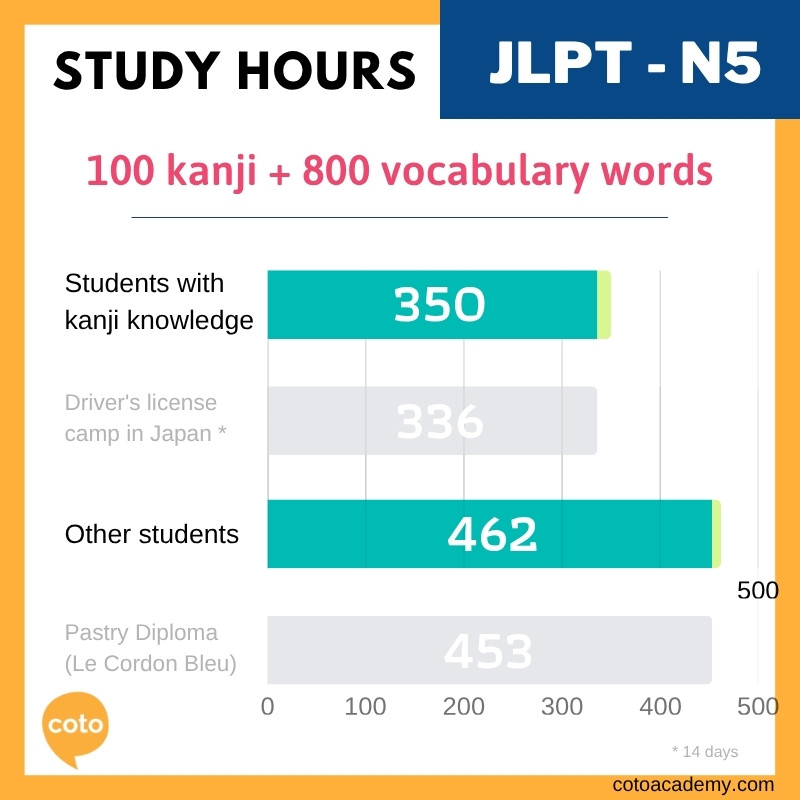
For students with kanji knowledge, like Chinese students, it takes 350 hours to pass the N5 exam. For other students who don’t have prior kanji knowledge, it takes 462 hours of studying.
These hours estimates are gathered when students self-report their estimated study time during the exam registration process. The question is added as a compulsory field.
In addition to hiragana and katakana, the JLPT N5 covers around 100 kanji and 800 vocabulary words. (Of course, you do not have to know all of them to pass, but it’s impossible to predict which ones will be on the exam.)
We highly recommend that you check out our JLPT N5 Self-Study Guide.
We have also provided several of the worksheets free of charge at the links below! These are very useful as they cover many of the kanji that you will be tested on during the N5 exam.
To become familiar with the most commonly used vocabulary words likely to appear on the JLPT N5 Exam, check out our list of the Top 100 Basic Japanese Words.
Mastering JLPT N5 Grammar
Although the JLPT N5 Exam scores vocabulary and grammar cumulatively, it is recommended that you study for them independently. The grammar section of the exam tests on basic particle usage (ha, ga, wo, etc.) and formal and casual conjugations of verbs and adjectives for past and present tenses.
To learn grammar points covered on the N5 Exam, you can check out the below the articles on basic Japanese Grammar:
To help you get prepared for the listening section, we have a 30-day challenge for you!
In our Free JLPT N5 30-Day Grammar Listening Challenge, you will spend 15 minutes each day for 30 days improving your listening and learning new grammar points. Each day, you will be given two phrases or grammar points and check your understanding with a flash card matching game. By the end of the course, not only will you have strengthened your listening, but you will have also learned 60 grammar points necessary to pass the N5 Exam!
Although self-studying is a great way to study at your own pace, textbooks and worksheets may not perfectly prepare you for what’s to come on the JLPT Exam.
How to register for JLPT N5
Registering for the JLPT can be done online via the official JLPT website. The tests are conducted worldwide. In Japan, the JLPT is held annually in July and December. Make sure to check the official site for the list of overseas JLPT test sites.
Application Period: The July exam application periods end in April. December exam applications end in September
Before heading out to your test center, make sure to bring your test voucher, writing utensils (mechanical pencils are accepted), and maybe some snacks and a watch to help you with time management.
For examinees in Japan, your test will begin at 12:30, but the test center will already be open from 11:45. We recommend you head out early to be safe.
Once you arrive at your test venue, you will be asked to show your test voucher to the staff. Examinees are split into different rooms based on their voucher numbers. You will be instructed to enter one of these rooms.
The whole exam will take several hours to complete (in the case of the N5 Exam, an hour and a half), and you will get short breaks between each section. When the exam is finished, you will need to wait until all test papers have been collected before you can leave the room. Check out our article on JLPT tips for the actual day.
Taking the JLPT? Join Preparation Lessons at Coto Academy!
Planning to take the JLPT? Maximize your chances of success with customized lessons at Coto Academy. Our experienced instructors have helped hundreds of students pass the exam. You’ll cover all sections of the test and practice with real mock exams based on past JLPT papers.
Spots fill up quickly. Sign up today and start your path to JLPT success!
FAQ
Around what level is the JLPT N5
The JLPT N5 is considered to be the most basic level of Japanese. To pass the test you would need to know around 800 vocabulary words and 100 kanji characters. The test mostly uses hiragana, katakana, and just a bit of kanji. You would also need to understand simple Japanese conversation.
How many hours of studying is needed to pass the JLPT?
While it depends on your current level and linguistic background, on average, it could take around 460 hours of study if you are starting from scratch. If your native language already uses kanji, the hours of study could be much less, around 350 hours.
Would passing the JLPT N5 have benefits for visas or getting jobs?
Passing the JLPT N5 could be considered when applying for certain work or long-term stay visas. Some roles that require a basic level of Japanese would consider the N5 certification a plus point for your application.
Is taking the N5 worth it?
The JLPT N5, while still testing a basic level, is still very valuable. It’s a great way to gauge your Japanese level and progress, which can be very motivating. It’s also an official certificate that you can use on your resume or other documents, showcasing your skills.