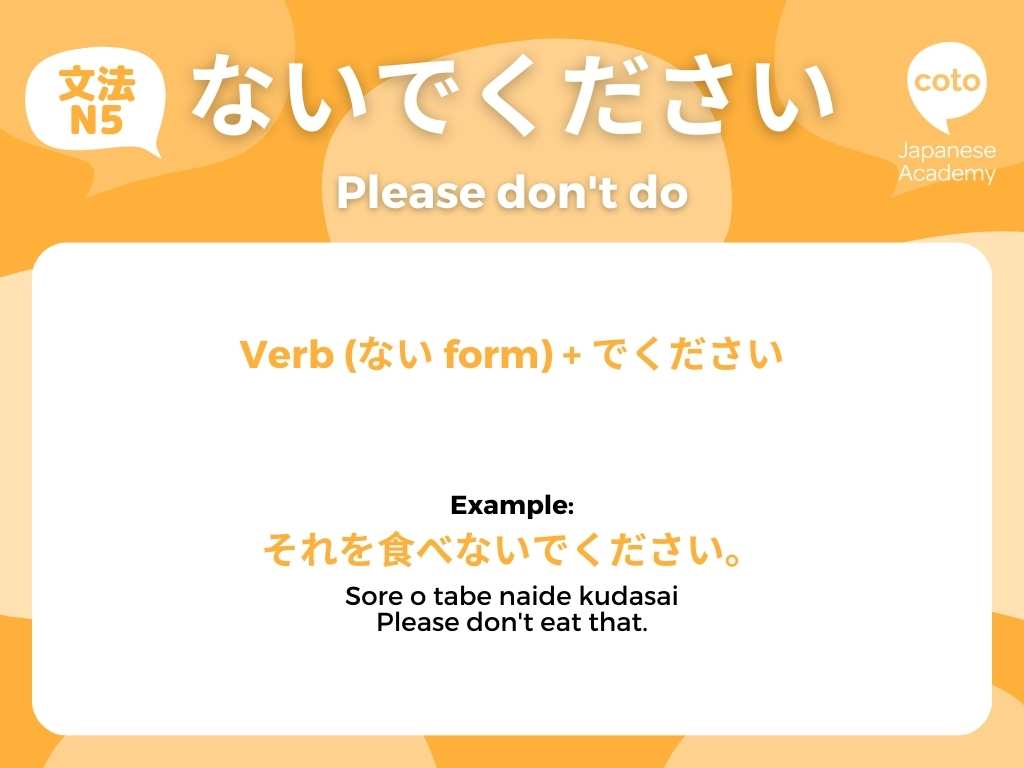
To ask someone not to do something in Japanese, you typically use the JLPT N5 grammar pattern 〜ないでください (naide kudasai). It is similar to saying “please do not do (something)” in English and is a polite way to request that someone refrain from an action, though it can also be framed as an instruction, advice, or recommendation.
Basically, using ないでください, you are asking a person not to perform a certain action. It is the opposite of 〜てください, which is used to ask someone to do something.
Let’s learn how to use this JLPT N5 grammar point by breaking down its meaning, structure, and example sentences.
Make Sure to Watch Coto Academy’s YouTube Video About 〜ないでください (~Naide Kudsai)
Before you continue reading, why not take a moment to watch a quick YouTube lesson with our Japanese teacher, Yuka-sensei:
Meaning of 〜ないでください (~Naide Kudasai)
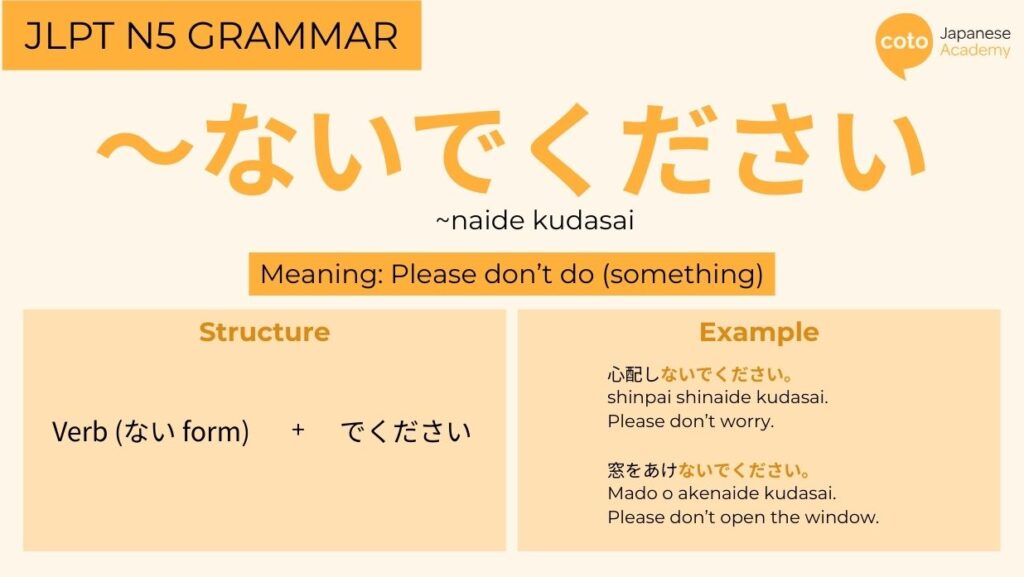
〜ないでください (naide kudasai) is a way of politely asking or requesting someone not to do something. Since it includes the phrase ください (kudasai), meaning “please”.
Although 〜ないでください is technically a polite form, it often carries a commanding tone. In Japanese culture, which values indirectness for the sake of harmony, using this in the wrong context can be an unintentional social blunder. For example, if you are speaking to a superior, such as a boss or a teacher, using 〜ないでください can sound overly direct or even bossy.
Generally, you use this expression in the following situations:
1. To kindly request that someone refrain from something
This is the most common “supportive” use of the phrase. It is often used when you are looking out for someone’s well-being or asking for a small favor that benefits them or the relationship.
無理をしないでください Muri o shinaide kudasai Don’t push yourself too hard.
2. Giving precautions or warnings
This usage is preventative. It’s meant to ensure someone’s safety or to prevent a mistake from happening before it’s too late.
3. As a softer way of denying or not giving permission
Instead of saying a flat “no” (which is very rare and often rude in Japanese), this form is used to steer someone away from an action they are about to take.
For example, if a friend is visiting your house and wants to open the window, but the AC is on, you can say:
窓を開けないでください 。 Mado o akenaide kudasai. Please don’t open the window.
3. To prohibit
On signs or in official announcements, the “politeness” of kudasai functions more like a formal rule than a personal request.
ここにゴミを捨てないでください Koko ni gomi o sutenaide kudasai Please do not litter here.
If you don’t know how to conjugate a verb into its negative form, here is a quick breakdown of how to conjugate different verbs into negative form and then use them with in 〜ないでください:
Dictionary Form
Negative Form
Example
English
撮る (toru)
撮らない (toranai)
撮らないでください (toranaide kudadsai)
Please don’t take (picture)
食べる (taberu)
食べない (tabenai)
食べないでください (tabenaide kudasai)
Please don’t eat
話す (hanasu)
話さない (hanasanai)
話さないでください (hanasaide kudasai)
Please don’t talk
捨てる (suteru)
捨てない (sutenai)
捨てないでください (sutenaide kudasai)
Please don’t throw away
開ける (akeru)
開けない (akenai)
開けないでください (akenaide kudasai)
Please don’t open
Casual Form of 〜ないでください (Naide Kudasai)
In casual conversation with friends, family, or people of equal or lower social status, you can simply omit ください (kudasai). This transforms a polite request into a casual “don” (think of it as removing the word “please”).
行かないで。 Ikanaide. Don’t go.
In even more informal contexts, adding the exclamative particle ね (ne) at the end is very common. This makes the “don’t” sound much softer. It changes “Don’t do it” to “Don’t do it, okay?” or “Make sure you don’t, right?”
忘れないでね Wasurenaide ne Don’t forget, okay?
Examples of 〜ないでください (~Naidekudasai)
Let’s explore a few examples to get a feel for how 〜ないでください works in Japanese. We will go through common examples in everyday conversation and public signs.
In Everyday Conversation
ここで写真を撮らないでください。 Kokode shashin o toranaide kudasai Please don’t take photos here.
教室で食べないでください。 Kyoushitsu de tabenaide kudasai. Please don’t eat in the classroom.
大きい声で話さないでください。 Ookii koe de hanasaide kudasai. Please don’t speak loudly.
ドアを開けないでください。 Doa o kakenaide kudasai. Please don’t open the door.
Vocabulary List
Check out all the new words in the example sentences above, and try to remember new vocabulary alongside today’s Japanese grammar
Japanese
Furigana
Reading
Meaning
ここ
ここ
koko
here
写真
しゃしん
shashin
photo
撮る
とる
toru
to take (a photo)
教室
きょうしつ
kyoushitsu
classroom
食べる
たべる
taberu
to eat
大きい
おおきい
ookii
big / loud
声
こえ
koe
voice
話す
はなす
hanasu
to speak
ゴミ
ごみ
gomi
trash/garbage
捨てる
すてる
suteru
to throw away
ドア
どあ
doa
door
開ける
あける
akeru
to open
〜ない
〜ない
nai
negative form
でください
でください
de kudasai
please do ~
Similar Grammar and Alternatives to ないでください (Naidekudasai)
When you need to move beyond the standard 〜ないでください, you have two directions: one that is much stricter/formal (prohibition) and one that is much softer/humble (requests).
1. 〜てはいけません (~Te wa ikemasen)
Meaning: “You must not…” or “It is forbidden.”
This is the standard polite way to express a strong prohibition. While it ends in the polite ~masen, the meaning is not a request; it is a rule. It is used when there is no choice in the matter.
ここでタバコを吸ってはいけません。 Koko de tabako o sutte wa ikemasen You must not smoke here.
2. 〜な (~Na)
Meaning: “Don’t!” (Command)
This is the dictionary form of a verb followed by the particle な. Despite its short length, it is the most aggressive and blunt way to tell someone not to do something.
You might hear it used by a father to a child in a moment of danger, or by characters in high-stakes movies. For instance, “動くな!” (Ugoku na!) means “Don’t move!” and carries a very commanding, almost barked tone.
3. 〜ないでいただけますか (~Naide itadakemasu ka)
Meaning: “Could you please not…?”
This is the most common way to be “more polite” than ~naide kudasai in a social or professional setting and keigo. By turning the request into a question, you are technically asking the other person if they would be willing to “grant you the favor” of not doing something.
Learn More JLPT Grammar with Coto Academy!
Next time you read a sign with 〜ないでください (~naide kudasai) on a sign, you know it’s asking not to do something! But if you want to practice using this JLPT grammar and many others in actual Japanese conversations, nothing beats practicing with a teacher who can offer practical guidance. So, consider signing up with us at Coto Academy!
Why Study at Coto Academy?
Coto Academy has been offering Japanese classes for over 25 years, with campuses in Shibuya, Yokohama, Iidabashi, Minato, Shinjuku, and online. Our courses focus on practical Japanese, so the grammar you learn is designed for real-life use.
We offer part-time, intensive, and fully online lessons to suit your schedule. Start learning Japanese effectively and confidently with Coto Academy today! Fill out the form below for a free level check.
FAQ:
What does 〜ないでください mean?
〜ないでください means “Please don’t do (something).” By adding this phrase to the end of a verb (negative form), you are politely asking them to refrain from something or to decline permission. It’s often on signs to communicate that something is not permitted.
Is 〜ないでください considered polite?
It is generally considered to be polite, being widely used in everyday conversation, public announcements, signs, and classroom settings. It’s similar to saying “please do not…” However, it can still be considered direct, so it might not always be the best in certain situations, like with your boss.
What is the casual version of 〜ないでください?
By dropping ください (kudasai), meaning “please,” you can make the expression more casual. For example, 食べないで (tabenaide), or “don’t eat,” would be considered more informal. For something very casual and to express a stronger demand, you can say 食べな (tabena), or “no eating!” But note this expression is rather rud
For Japanese learners, a significant milestone to aim for is the JLPT N5 exam, which evaluates basic proficiency in the language. But whether you’re taking the test or not, you’ll come across JLPT N5 grammar points either way, especially during the first year of your study, as it covers the very basic foundation of the Japanese language.
Although mastering these 30 grammar points alone won’t make you speak Japanese like a native, they are incredibly common and widely used in everyday conversations regardless of your fluency. So, let’s delve into some essential JLPT N5 grammar points that are crucial to know!
Study the JLPT Smarter with Coto Academy!
Are you planning to take the JLPT this July or December? While self-study is a great start, the JLPT is notorious for its strict time limits and tricky reading sections. Coto Academy students have a 35% higher pass rate than the national average, thanks to our proven JLPT Prep Course. We offer two flexible options: a year-round JLPT course and an intensive 3-month sprint course timed perfectly before test day. What makes these classes stand out is the teachers, who specialize in teaching JLPT. They will give you tips and techniques you simply won’t get from self-study.
Here, you will learn everything, including mock tests, reading practices, and explanations on Japanese grammar, vocabulary, kanji, and more! Join our class today!
This is the most basic grammar point that you’ll learn right after hiragana and katakana.
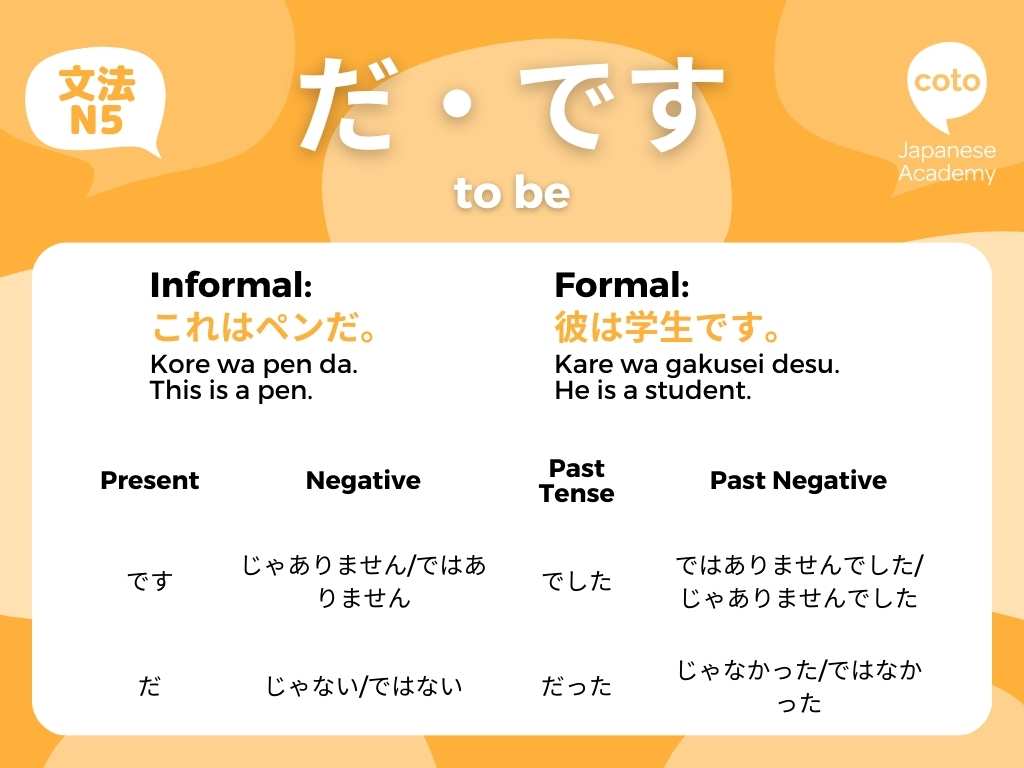
In Japanese, “da” (だ) and “desu” (です) are both copula verbs used for different levels of politeness and formality that make up the very basic sentence pattern. They serve as the equivalent of the English verb “to be” and are used to make statements or descriptions about nouns or noun phrases.
“Da” is the informal form of the copula verb and is commonly used in casual conversations or when speaking with close friends and family. It is often used in plain sentences or in informal situations. For example:
これはペンだ。 Kore wa pen da. This is a pen.
“Desu” is the polite form, and it’s widely used in formal situations, polite conversations — or when addressing people you are not familiar with. For example:
彼は学生です。 Kare wa gakusei desu. He is a student.
You can conjugate だ/です (da/desu) into negative, past tense, and past-negative forms that are similar to the English language.
Present
Negative
Past tense
Past negative
です
じゃありません/ではありません
でした
ではありませんでした/じゃありませんでした
だ
じゃない/ではない
だった
じゃなかった/ではなかった
2. にいます/あります (ni imasu/arimasu)
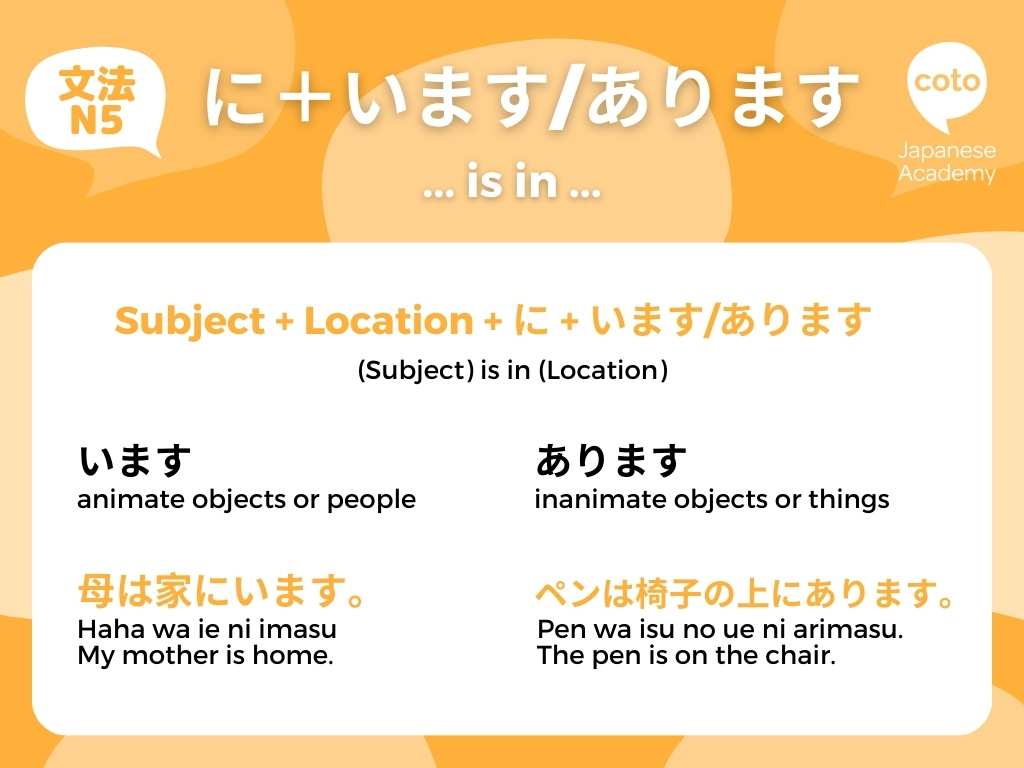
For basic Japanese grammar rules, に (ni) is used as a general preposition that means “in” in English to indicate the location of a person or object. If you are just starting to learn the language, the sentence structure you should first be learning is below:
Subject + Location + に + います/あります (Subject) is in (Location)
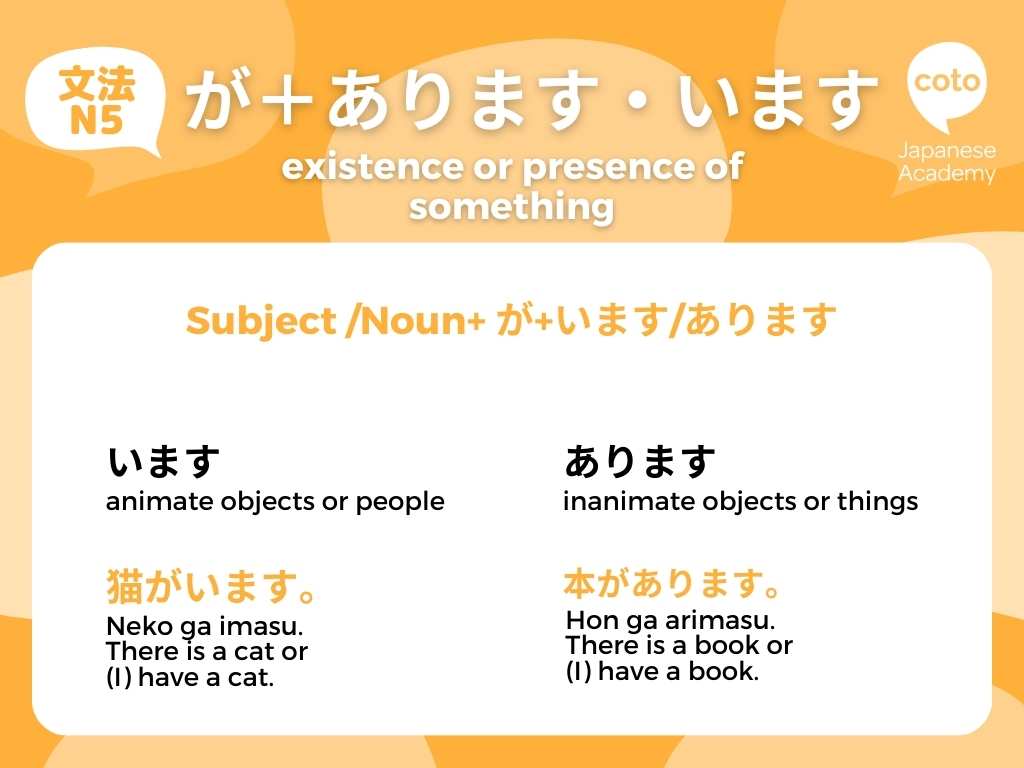
います and あります are both Japanese verbs used to indicate the existence or presence of animate and inanimate objects, respectively. あります is used for inanimate objects or things, while います is used for animate objects or people.
3. に/へ (ni/e)
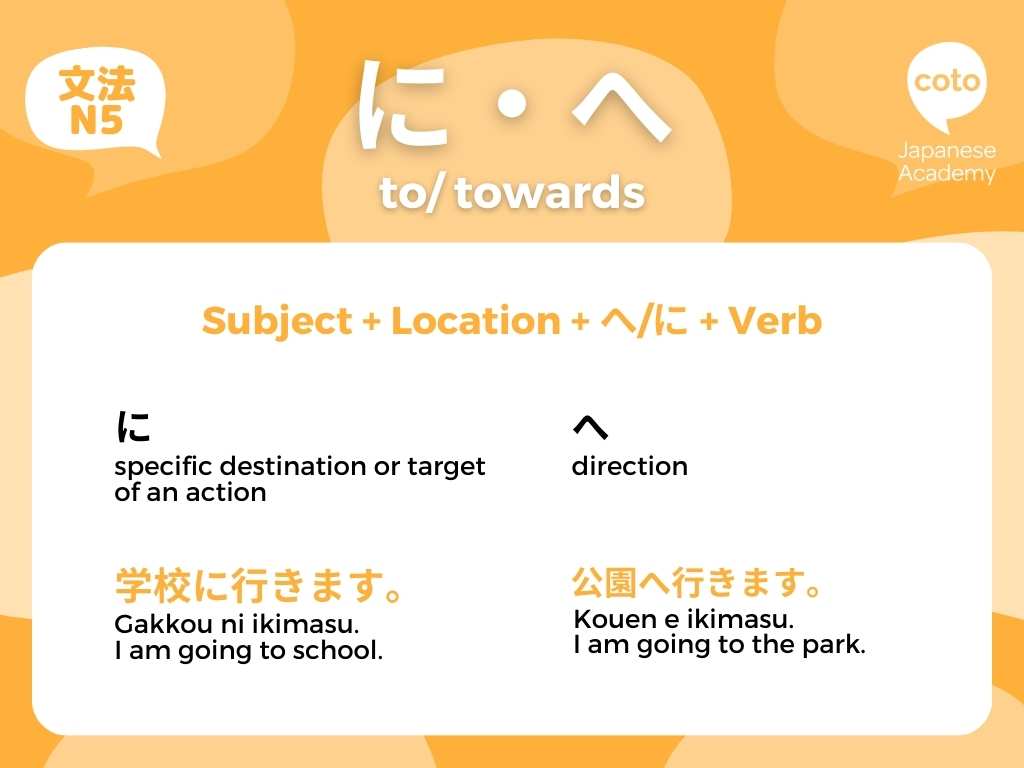
In Japanese, both “に” (ni) and “へ” (e) are particles used to indicate direction or destination. While they can be translated as “to” or “towards” in English, they have slight differences in usage.
“へ” is a particle that describes a direction, while に is used to indicate the specific destination or target of an action. The basic structure for the N5 grammar point is below:
Subject + Location + へ + Verb
For example:
学校に行きます。 Gakkou ni ikimasu. I am going to school.
公園へ行きます。 Kouen e ikimasu. I am going to the park.
Of course, there are a lot of verbs you need to memorize to hold simple conversations with. aJapanese native. Check out our top 100 basic Japanese verbs here.
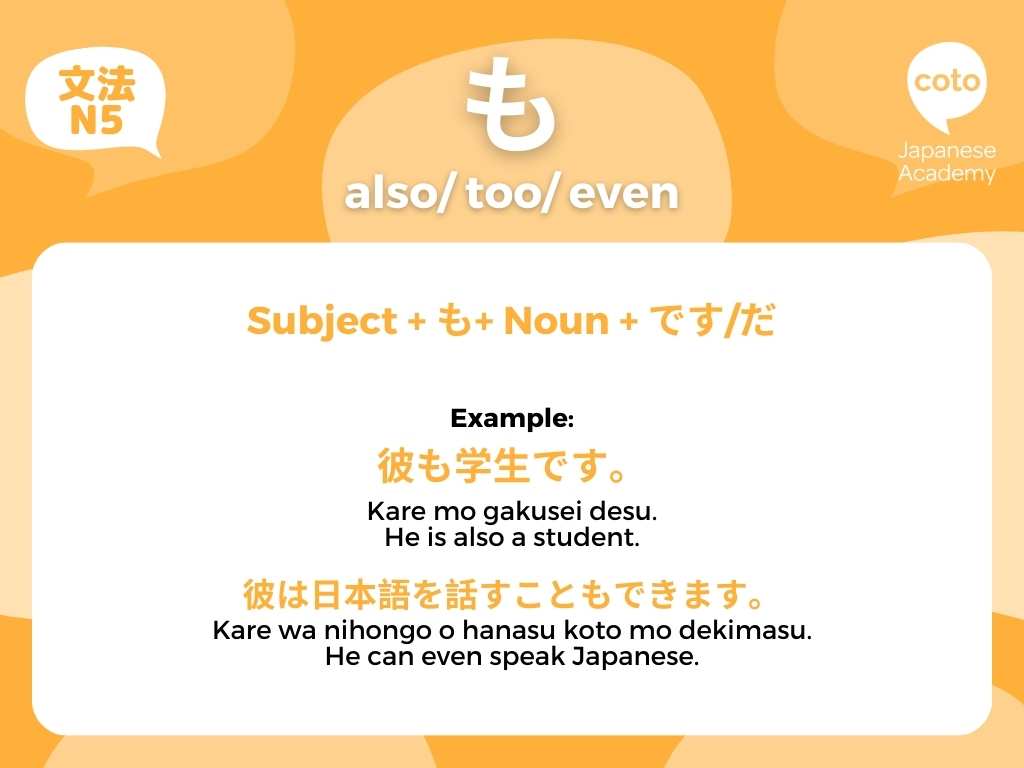
4. も (mo)
In Japanese grammar, the particle “も” (mo) is a versatile particle that has multiple uses and can be translated into English as “also,” “too,” or “even.”
For beginner and N5-level Japanese grammar, the “も” (mo) particle replaces the topic maker は (ha). For example:
彼も学生です。 Kare mo gakusei desu. He is also a student.
“も” (mo) can also emphasize a surprising or unexpected inclusion. It is used to express that the described action or situation is true even for the specific item or person mentioned.
彼は日本語を話すこともできます。 Kare wa nihongo o hanasu koto mo dekimasu. He can even speak Japanese.
For a more comprehensive guide on basic Japanese particles and their functions, head here.
5. ~があります (ga arimasu)/~がいます (ga imasu)
The phrase “~があります” (“ga arimasu”) is used in Japanese to indicate the existence or presence of something. It is typically used with inanimate objects or non-living things.
つくえの上に本があります。 Tsukue no ue ni hon ga arimasu. There is a book on the table.
On the other hand, “~がいます” (“ga imasu”) is used in Japanese to indicate the existence or presence of animate objects or living beings. It can also be used to express the idea of someone or something “having” or “possessing” a certain characteristic or quality. For example:
猫がいます。 Neko ga imasu. There is a cat or (I) have a cat.
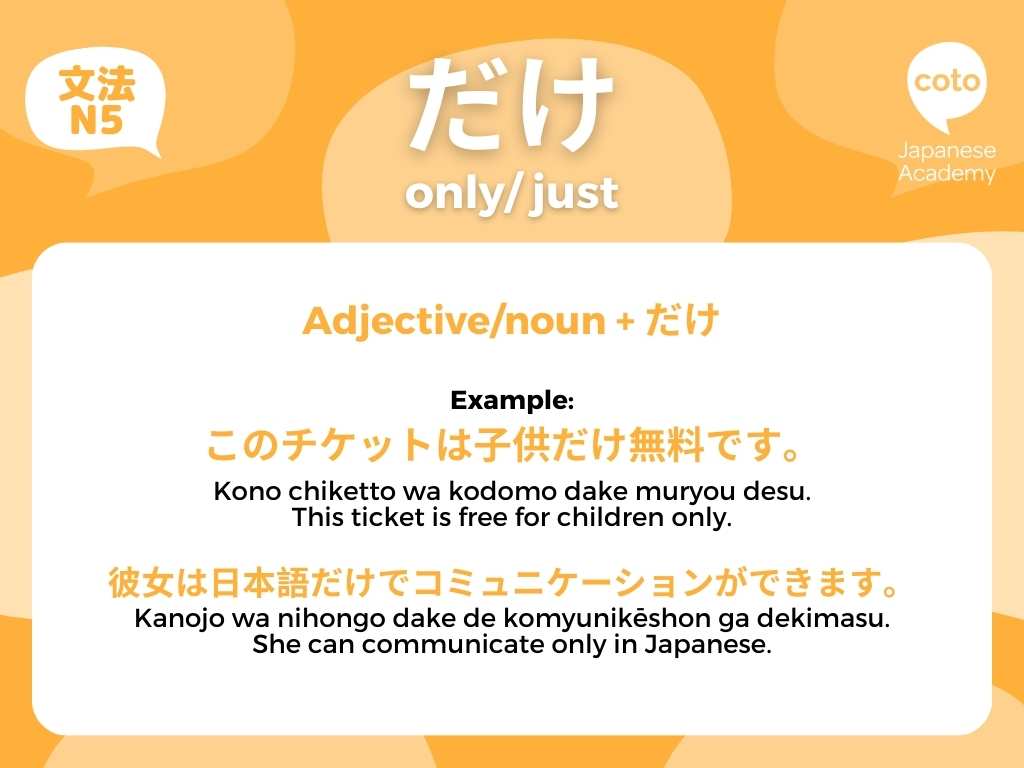
“Dake” (だけ) is a particle that is used to indicate “only” or “just.” It is used to specify a limited quantity or extent of something. “Dake” is placed after a noun or a quantity expression to indicate that there is no more than that amount or that it is the maximum.
Adjective/noun + だけ
Here are a few examples to illustrate the usage of “dake” in JLPT N5 Japanese grammar:
このチケットは子供だけ無料です。 Kono chiketto wa kodomo dake muryou desu. This ticket is free for children only.
彼女は日本語だけでコミュニケーションができます。 Kanojo wa nihongo dake de komyunikēshon ga dekimasu. She can communicate only in Japanese.
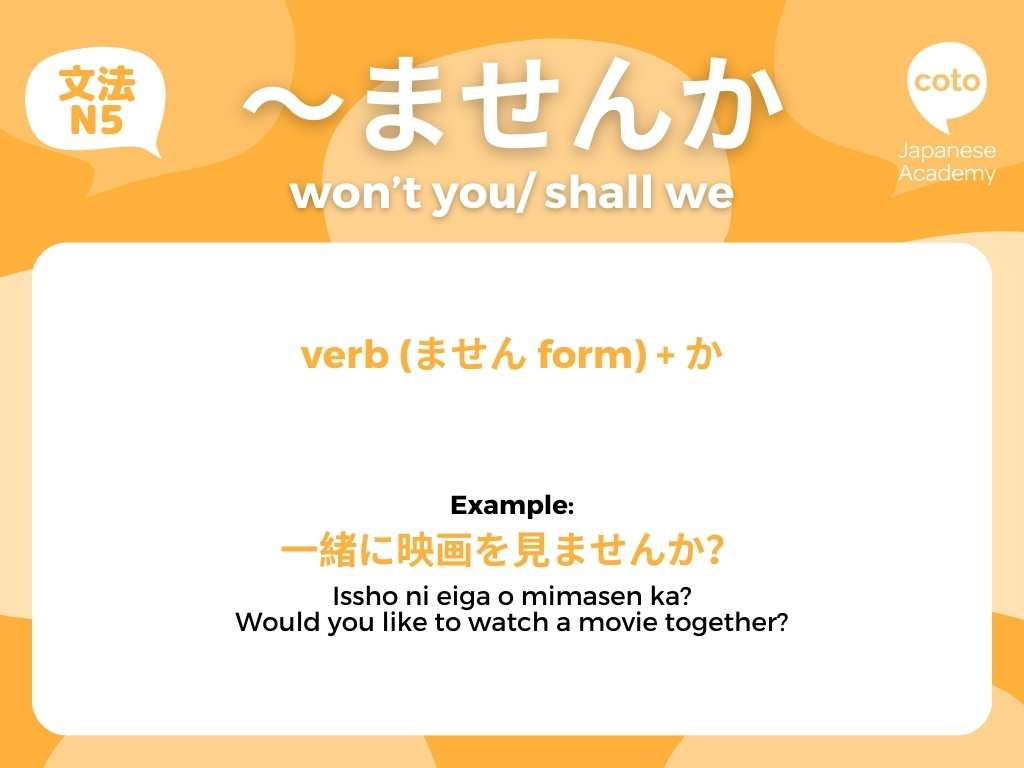
7. ~ませんか (~masenka)
For inviting someone or suggesting something, you can use the phrase “~ませんか” (“masen ka”). It is formed by adding the negative form of a verb and then attaching “か” at the end. It is commonly translated as “won’t you” or “shall we” in English.
一緒に映画を見ませんか? Goissho ni eiga o mimasen ka? Would you like to watch a movie together?
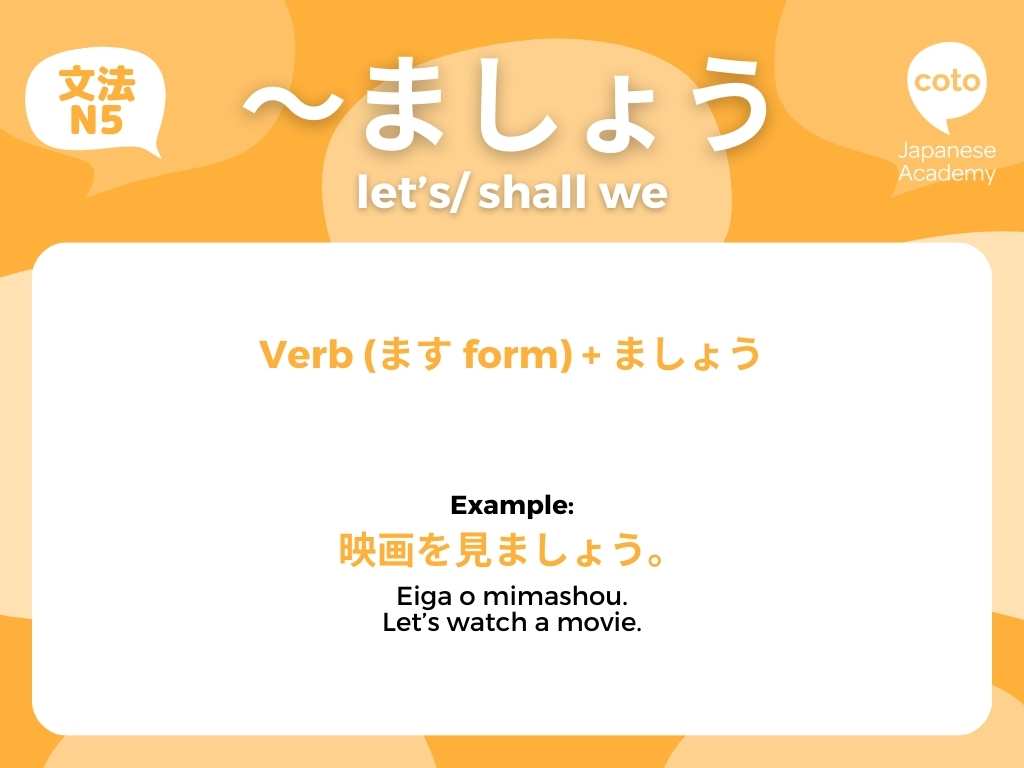
8. ~ましょう (mashou)
“ましょう” (mashou) is a volitional form commonly used to make suggestions or propose an action. It can be translated as “let’s” or “shall we” in English. You’ll use this when you want to suggest your friends or the other speaker do something — just remember that it has to be a verb!
To conjugate a verb into this form, you simply remove the ます and add ましょう:
Verb ます + ましょう
映画を見ましょう。 Eiga o mimashou. Let’s watch a movie.
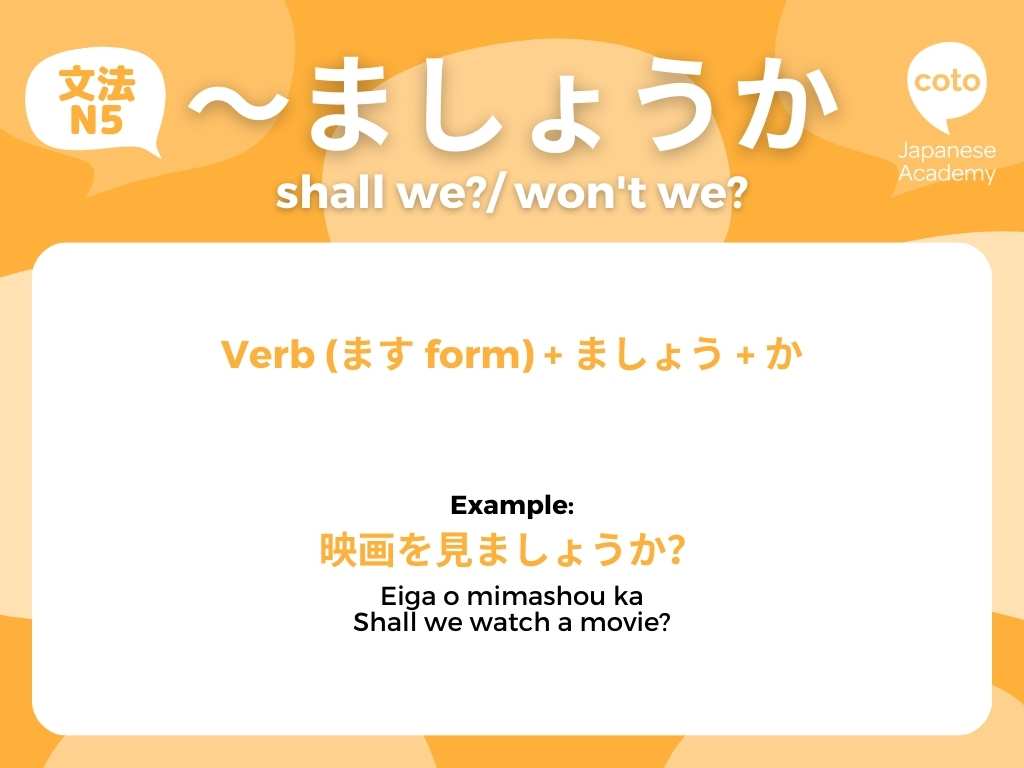
9. ~ましょうか (mashouka)
“ましょうか” (mashouka) is a polite form derived from “ましょう” (mashou) by adding the question particle “か” (ka) at the end. It is used to make a polite invitation or ask for the other person’s agreement.
It has a similar meaning as ~ませんか (masenka), but it has a more direct nuance. Think of ~ましょうか as “Shall we?”, and ~ませんか as “Won’t you?”
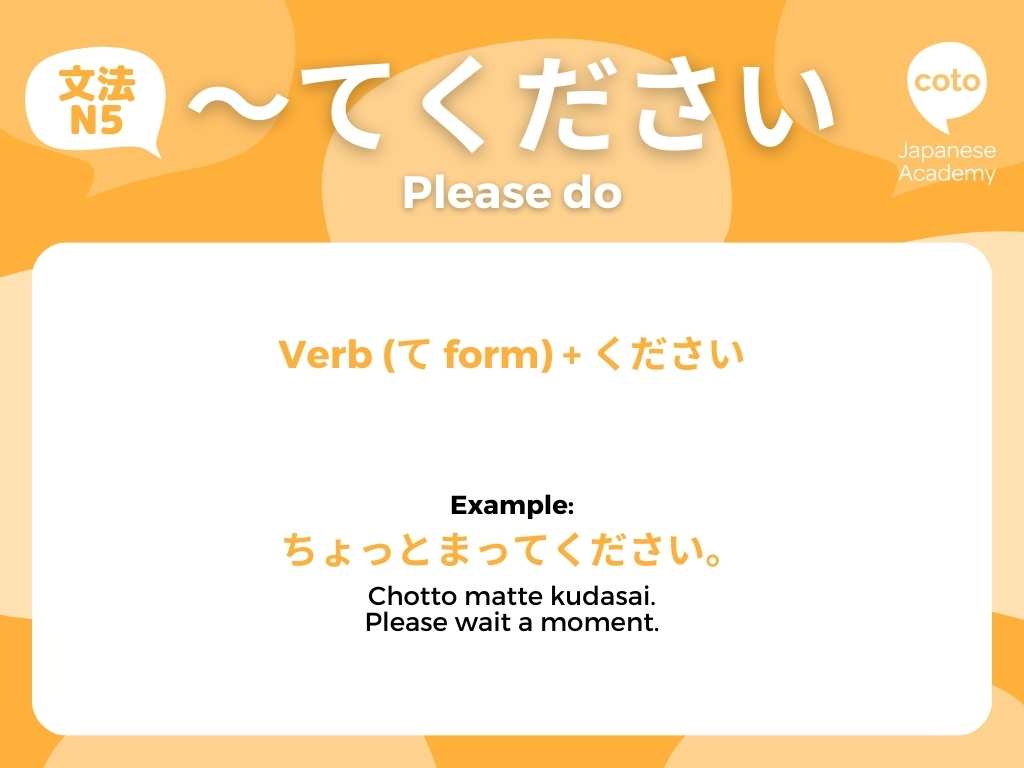
10. ~てください (te kudasai)
ください is used when you want to get something from the other speaker or party. In English, we can translate it to “Please give me (this).”
To form ~てください, you will need to know how to conjugate Japanese verbs into ~te (~て). There are three different conjugation groups, with some irregular verbs that have exceptions to the て form rules. If you haven’t learned them already, we’ve made a separate blog post on how to transform a verb into a ~te verb, complete with handy illustrated cards
ちょっとまってください。 Chotto matte kudasai. Please wait a moment.
In Japanese N5 grammar, “ないでください” (“naide kudasai”) is a phrase used to make a negative request or ask someone not to do something. It is formed by combining the negative form of a verb and then adding “でください” (“de kudasai”) at the end.
Verb ない form + でください
For example:
迷惑しないでください。 Meiwaku shinaide kudasai. Please don’t be a nuisance to others.
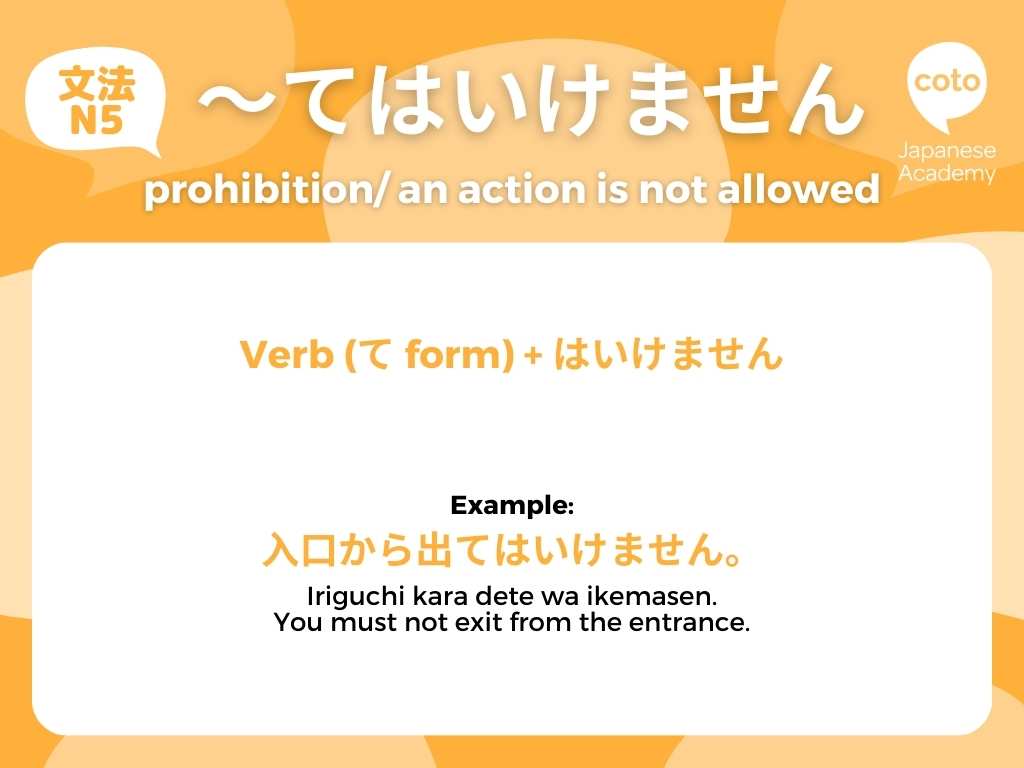
12. ~てはいけません (te wa ikemasen)
The phrase “~てはいけません” (“te wa ikemasen”) is used in Japanese to express prohibition or to indicate that an action is not allowed. It is formed by taking the te-form of a verb and adding “はいけません” (“wa ikemasen”) at the end.
The structure of “~てはいけません” is as follows:
[Verb in te-form] + はいけません
For example:
入口から出てはいけません。 Iriguchi kara dete wa ikemasen. You must not exit from the entrance.
Important: “~てはいけません” (“te wa ikemasen”) and “~ないでください” (“naide kudasai”) have similar meanings in that they both express prohibition or a request to refrain from doing something. However, there is a slight difference in tone and usage between the two. ~てはいけません emphasizes a strict prohibition or rule, while ~ないでください is a polite request to refrain from doing something.
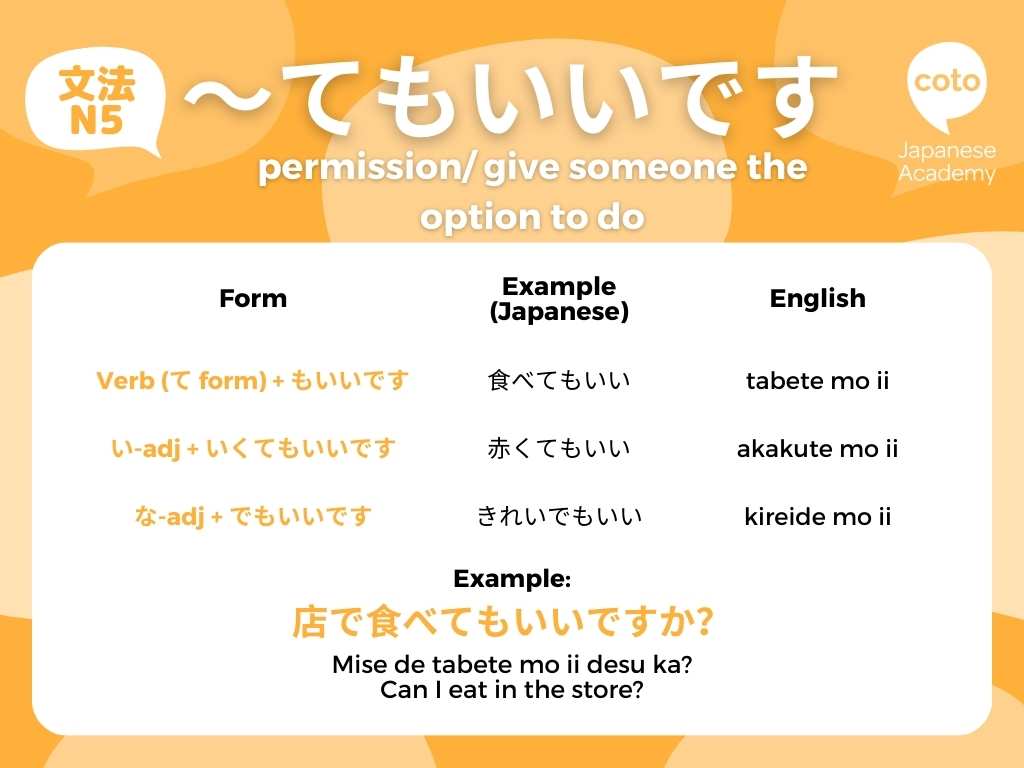
13. ~てもいいです (te mo ii desu)
The phrase “~てもいいです” (“te mo ii desu”) is used in Japanese to express permission or give someone the option to do something. It is formed by taking the te-form of a verb or an adjective and adding “もいいです” (“mo ii desu”) at the end.
The structure of “~てもいいです” is as follows:
Form
Example (Japanse)
English
Verb て-formもいいです
食べてもいい
Tabete mo ii
い-adjective + いくてもいいです
赤くてもいい
Akakute mo ii
な-adjectve + でもいいです
きれいでもいい
Kirei de mo ii
You can also ask for permission with this grammar structure by adding a か in the end to indicate a question.
店で食べてもいいですか? Mise de tabete mo ii desu ka? Can I eat in the store?
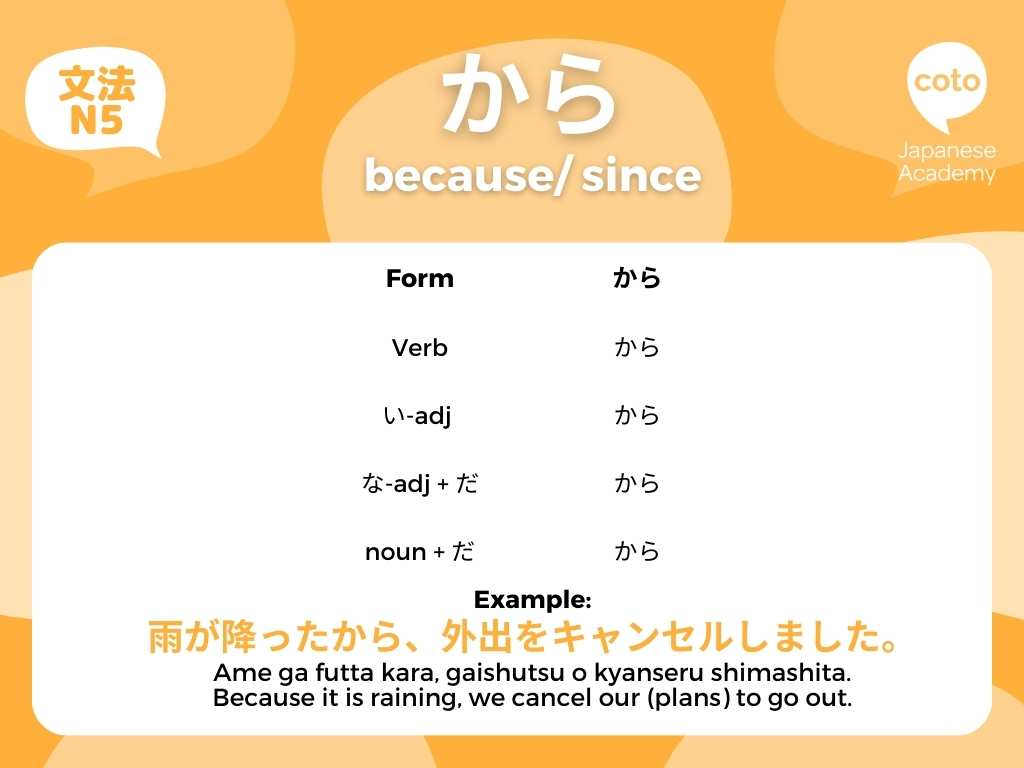
14. から (kara)
“Kara” (から) is a conjunction in Japanese that is used to indicate a cause or reason. It is often translated as “because” or “since” in English.
Verb
から
い-adjective
から
な-adjectve + だ
から
Noun + だ
から
It’s important to note that “kara” expresses a cause-and-effect relationship and focuses on the reason or cause preceding the resulting action or situation.
雨が降ったから、外出をキャンセルしました。 Ame ga futta kara, gaishutsu o kyanseru shimashita. Because it is raining, we cancel our (plans) to go out.
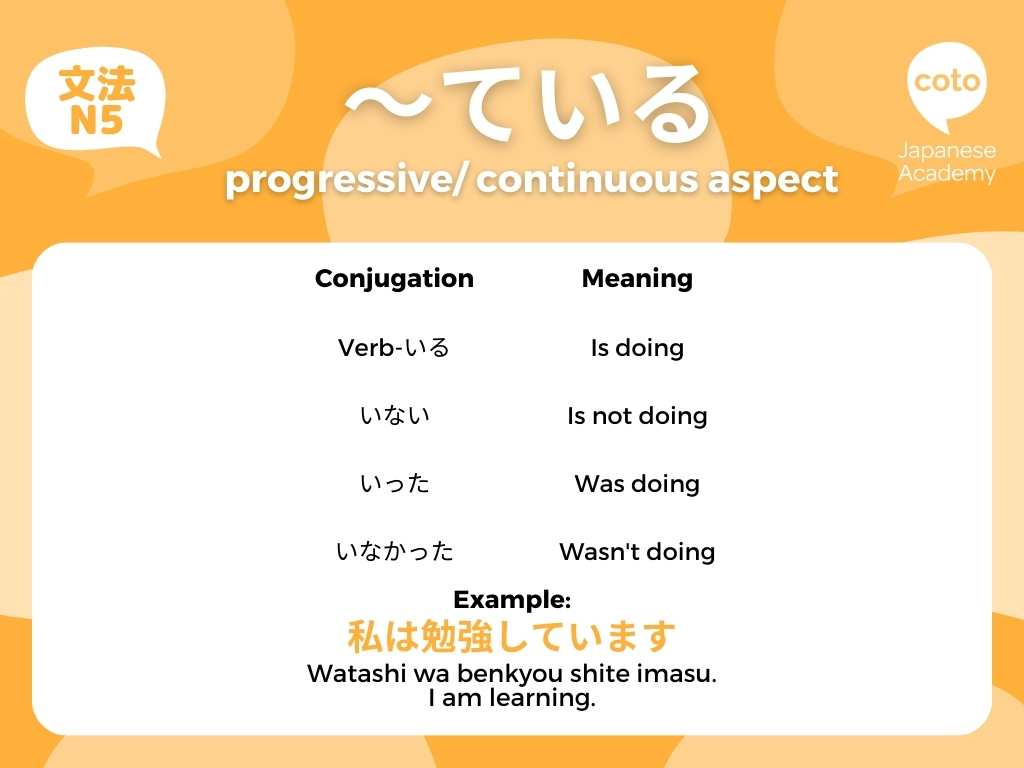
15. ~ている (te iru)
“Te iru” (ている) is a verb conjugation in Japanese that indicates the progressive or continuous aspect. It is commonly used to describe ongoing actions or states. In English, this would be a present (or past) continuous tense marked by verb-ing. You can also conjugate it to past, negative and past-negative tense.
Conjugation
Meaning
Verb -いる
Is doing
いない
Is not doing
いった
Was doing
いなかった
Wasn’t doing
私は勉強しています。 Watashi wa benkyou shite imasu. I am learning.
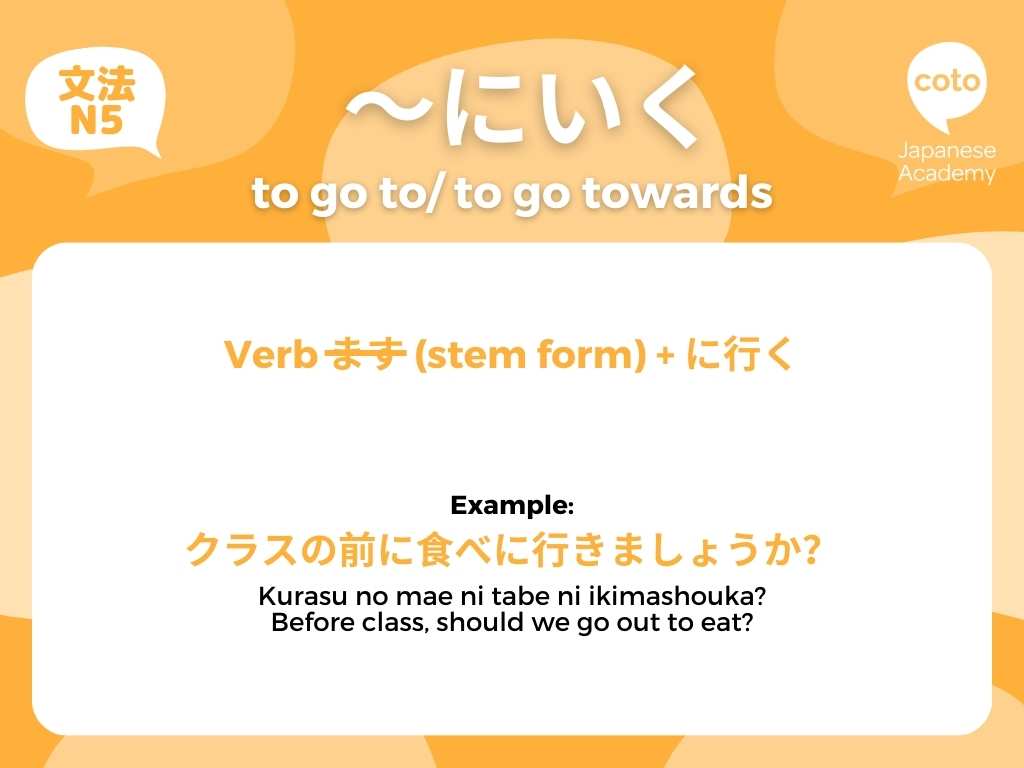
16. ~にいく (ni iku)
“~にいく” (~ni iku) is a commonly used phrase in Japanese that means “to go to” or “to go towards.” It is formed by combining the particle “に” (ni), indicating the direction or destination, with the verb “いく” (iku), meaning “to go.”
Verb ます (stem form) + に行く
In Japanese, the combination of a verb followed by “にいく” (ni iku) indicates the action of going somewhere to perform that verb’s action. It expresses the movement or direction toward a specific location for the purpose of engaging in the described action.
クラスの前に食べに行きましょうか? Kurasu no mae ni tabe ni ikimashouka? Before class, should we go out to eat?
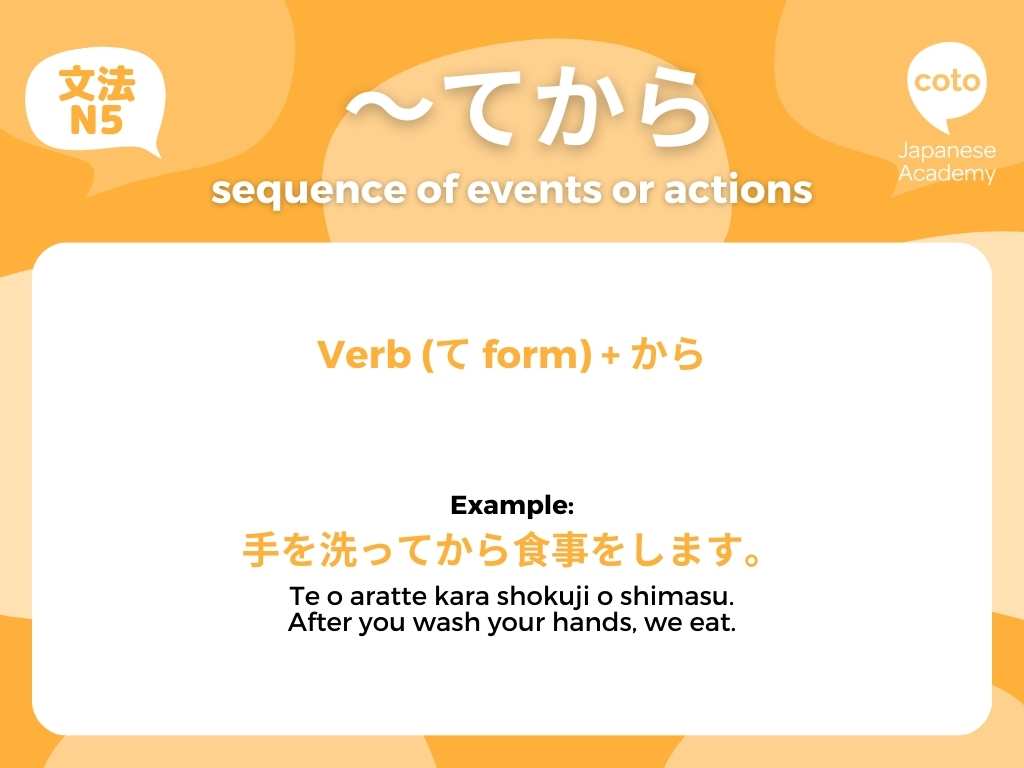
17. ~てから (te kara)
“~てから” (te kara) is a Japanese grammar construction used to indicate the sequence of events or actions. It signifies that one action takes place after another action has been completed. For example:
手を洗ってから食事をします。 Te o aratte kara shokuji o shimasu. After you wash your hands, we eat.
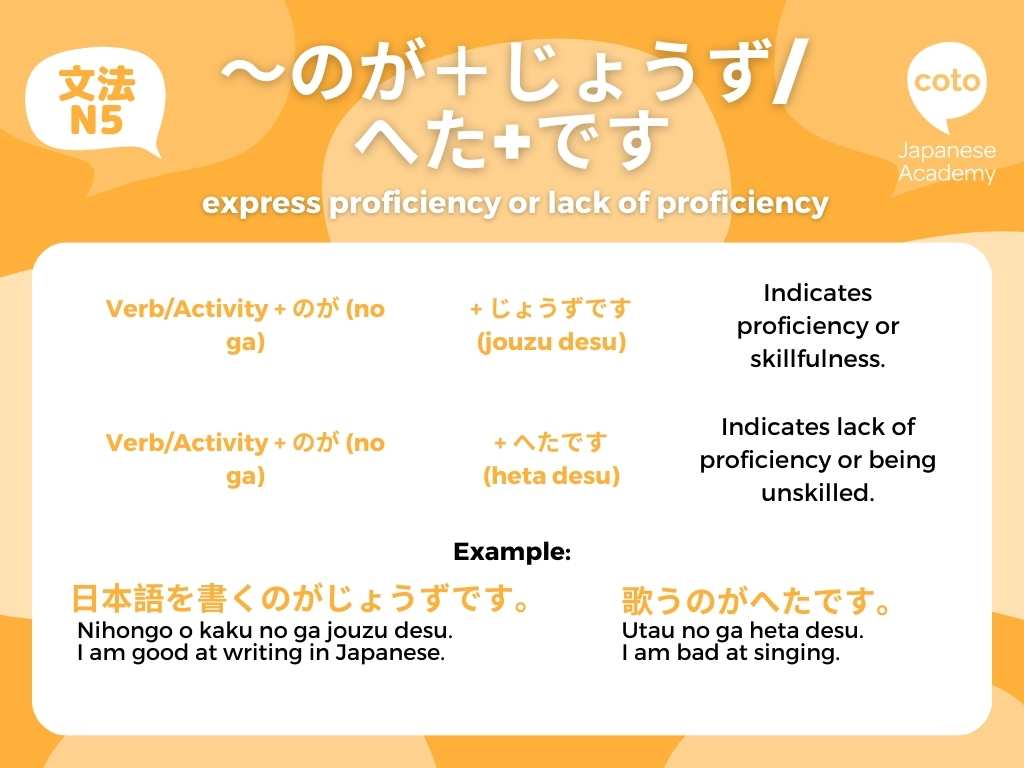
18. ~のがじょうずです/~のがへたです (no ga jouzu desu/ no ga heta desu)
The phrase “~のがじょうずです” (no ga jouzu desu) and “~のがへたです” (no ga heta desu) are used in Japanese to express proficiency or lack of proficiency in a particular skill or activity. Let’s break it down:
Verb/Activity + のが (no ga)
+ じょうずです (jouzu desu)
Indicates proficiency or skillfulness.
Verb/Activity + のが (no ga)
+ へたです (heta desu)
Indicates lack of proficiency or being unskilled.
In both cases, the structure starts with the verb or activity in its dictionary form, followed by “のが” (no ga), which acts as a nominalizer, turning the verb or activity into a noun. Then, it is followed by either “じょうずです” (jouzu desu) or “へたです” (heta desu).
日本語を書くのがじょうずです。 Nihongo o kaku no ga jouzu desu. I am good at writing in Japanese.
歌うのがへたです。 Utau no ga heta desu. I am bad at singing.
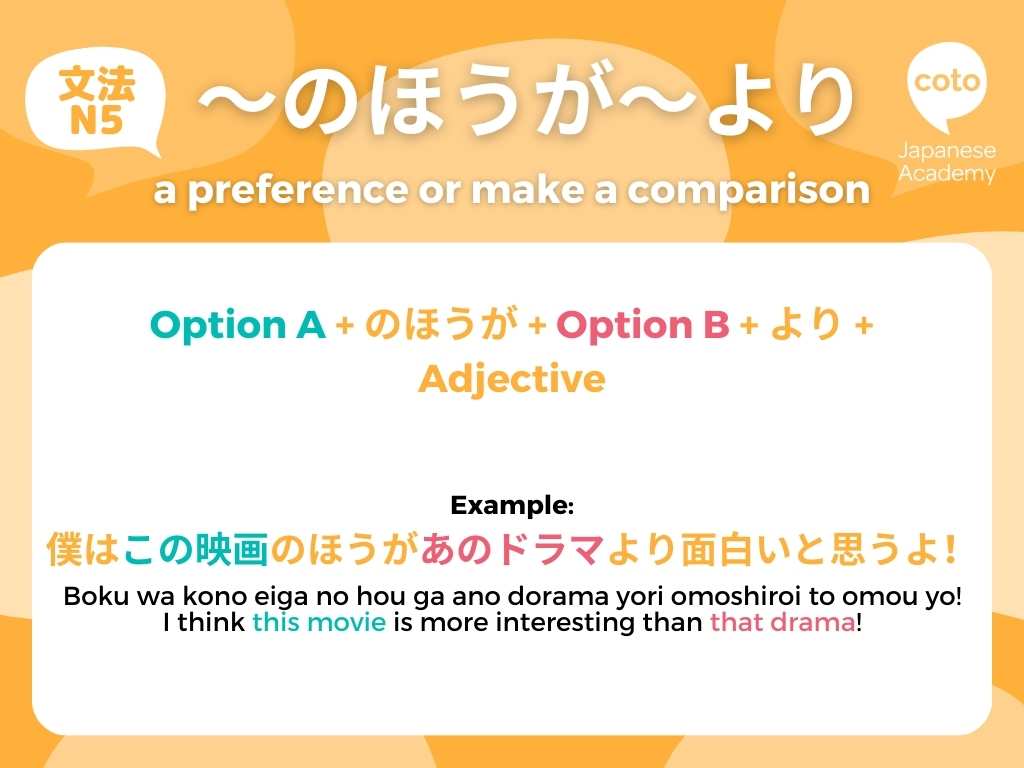
19. ~のほうが~より (~no hou ga ~ yori)
Imagine you have two options or things to compare, and you want to express a preference or make a comparison. That’s where “~のほうが~より” (no hou ga ~ yori) comes in! It’s a JLPT N5 grammar that helps you highlight one option over another. The structure will look like this:
(Option A) + のほうが + Option B + より (yori) + Adjective
Let’s take a look at an example using this JLPT N5 grammar!
この映画とあのドラマ、どちらが面白いと思う? Kono eiga to ano dorama, dochira ga omoshiroi to omou? Which do you think is more interesting, this movie or that drama?
僕はこの映画のほうがあのドラマより面白いと思うよ! Boku wa kono eiga no hou ga ano dorama yori omoshiroi to omou yo!) I think this movie is more interesting than that drama!
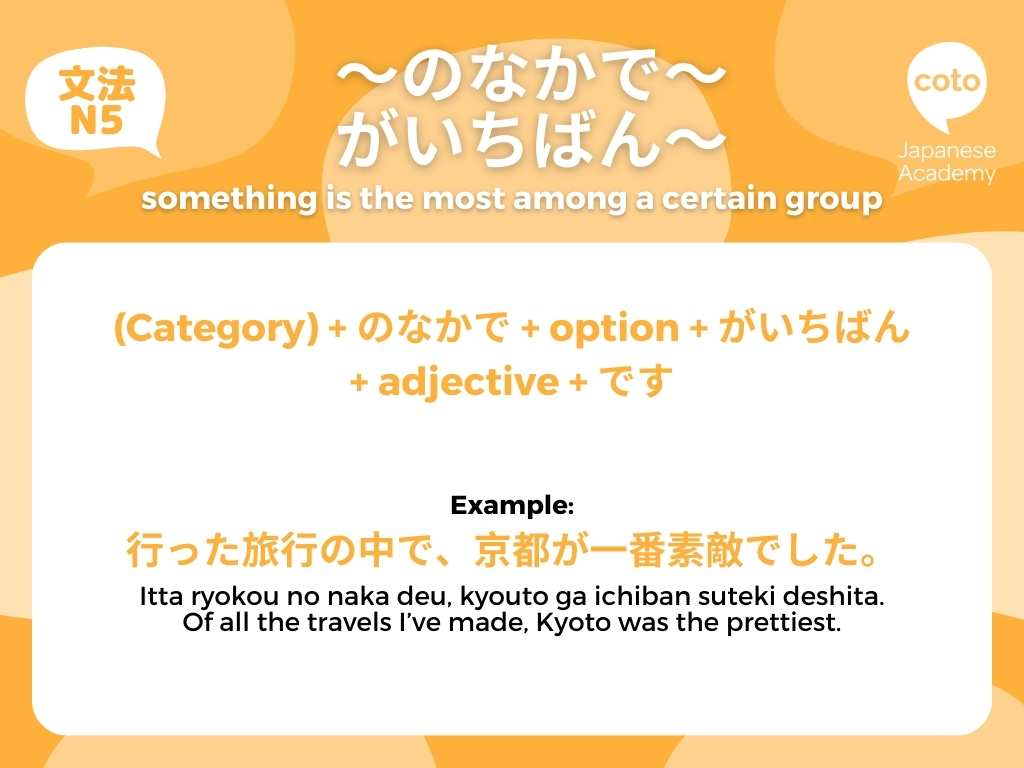
20. ~のなかで~がいちばん~ (~no naka de ~ ga ichiban ~)
This grammar pattern, ~のなかで~がいちばん~ (naka de ga ichiban), is used to express that something is the most among a certain group of things.
With this pattern, you can express your preference or opinion about a certain group of things. It’s a useful way to make comparisons in Japanese and it’s commonly used in everyday conversation. The sentence structure will typically look like this:
Let’s take a look at an example using this JLPT N5 grammar!
行った旅行の中で、京都が一番素敵でした。 Itta ryokou no naka deu, kyouto ga ichiban suteki deshita. Of all the travels I’ve made, Kyoto was the prettiest.
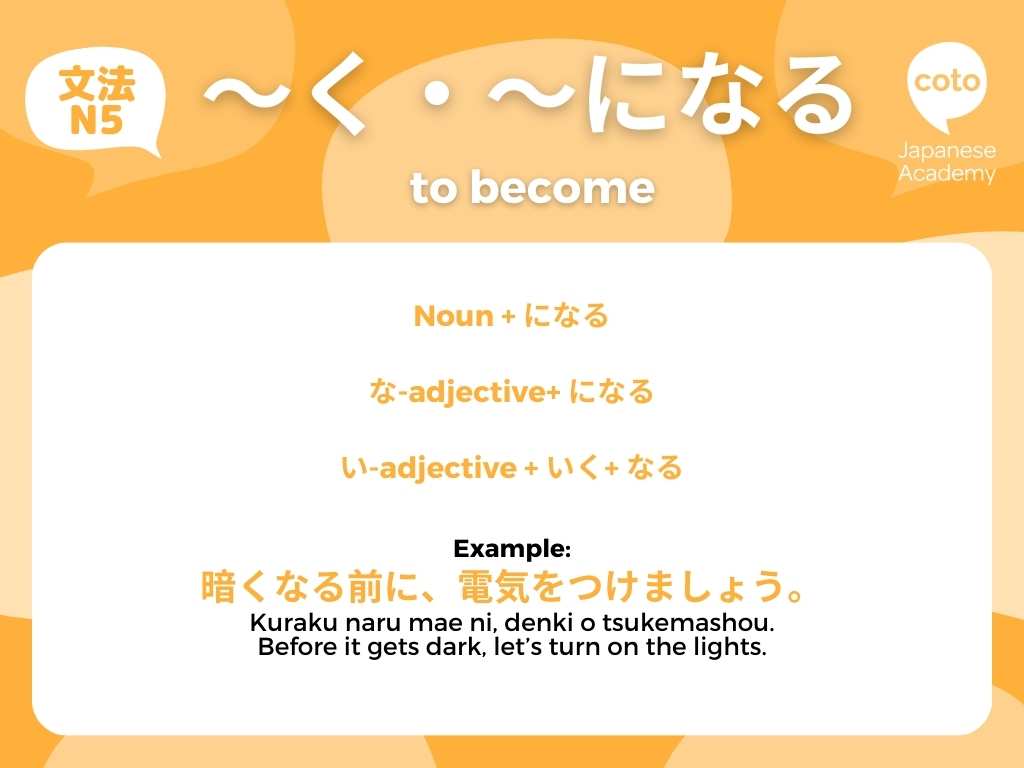
21. ~く/ ~になる (~ku/~ni naru)
Both “~ku naru” and “ni naru” are Japanese verb phrases used to express a change or transformation — translated to “to become” in English.
Noun + になる
な-adjective+ になる
い-adjective + いく+ なる
Let’s take a look at an example using this JLPT N5 grammar!
暗くなる前に、電気をつけましょう。 Kuraku naru mae ni, denki o tsukemashou. Before it gets dark, let’s turn on the lights.
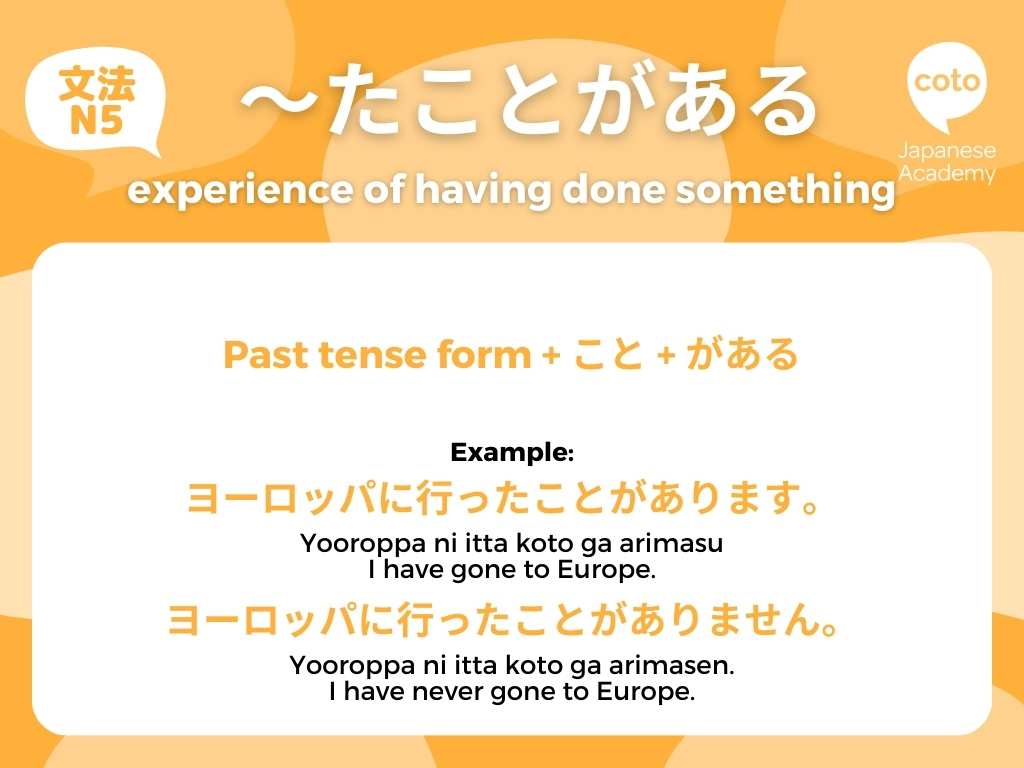
22. ~たことがある (~ta koto ga aru)
“~たことがある” is a Japanese grammatical expression that conveys the experience of having done something or having a certain experience in the past. It is used to indicate that an action or event has occurred at least once in a person’s life.
The structure “~たことがある” is like this:
Past tense form + こと + ある
If you conjugate ある into its negative form, the sentence will change the meaning into, “I have never been (action).”
Let’s take a look at an example using this Japanese Language Proficiency Test N5 grammar!
ヨーロッパに行ったことがありません。 Yooroppa ni itta koto ga arimasen. I have never gone to Europe.
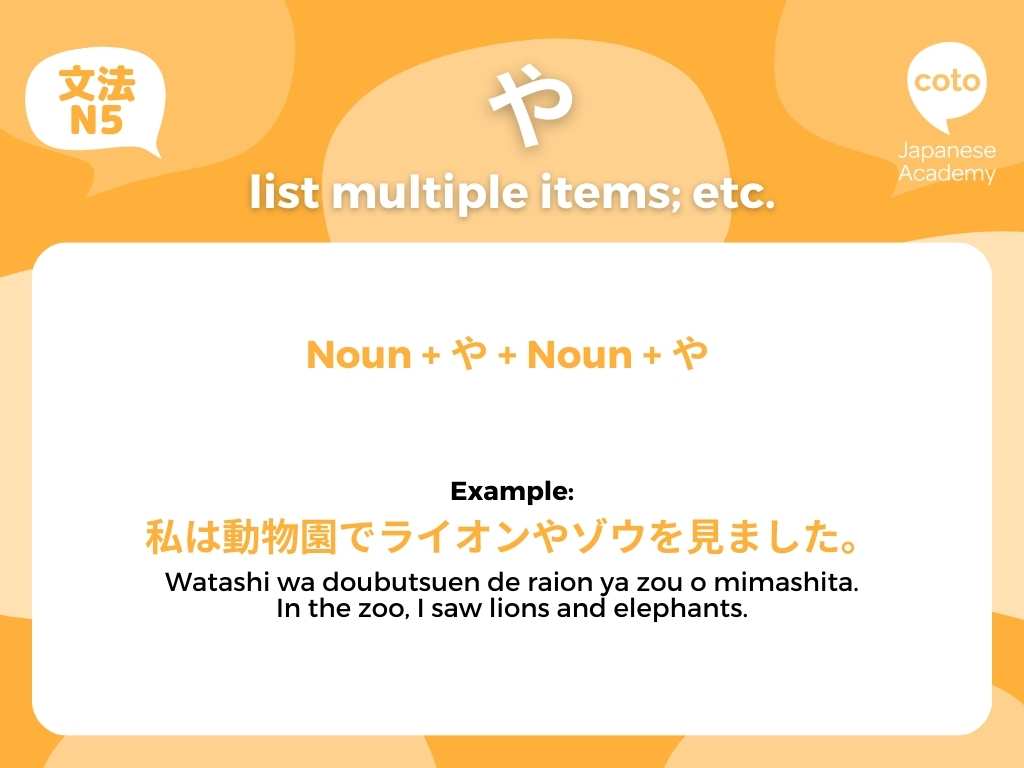
23. や (ya)
“や” is used to list multiple items or examples without specifying an exhaustive or complete list. It is very similar to the grammar と (to), which also means “and”, but や implies that there are other items that could be included — identical to “etc”.
To use this, you just have to add や after a noun: Noun + や + Noun + や
For example:
私は動物園でライオンやゾウを見ました。 Watashi wa doubutsuen de raion ya zou o mimashita. In the zoo, I saw lions and elephants.
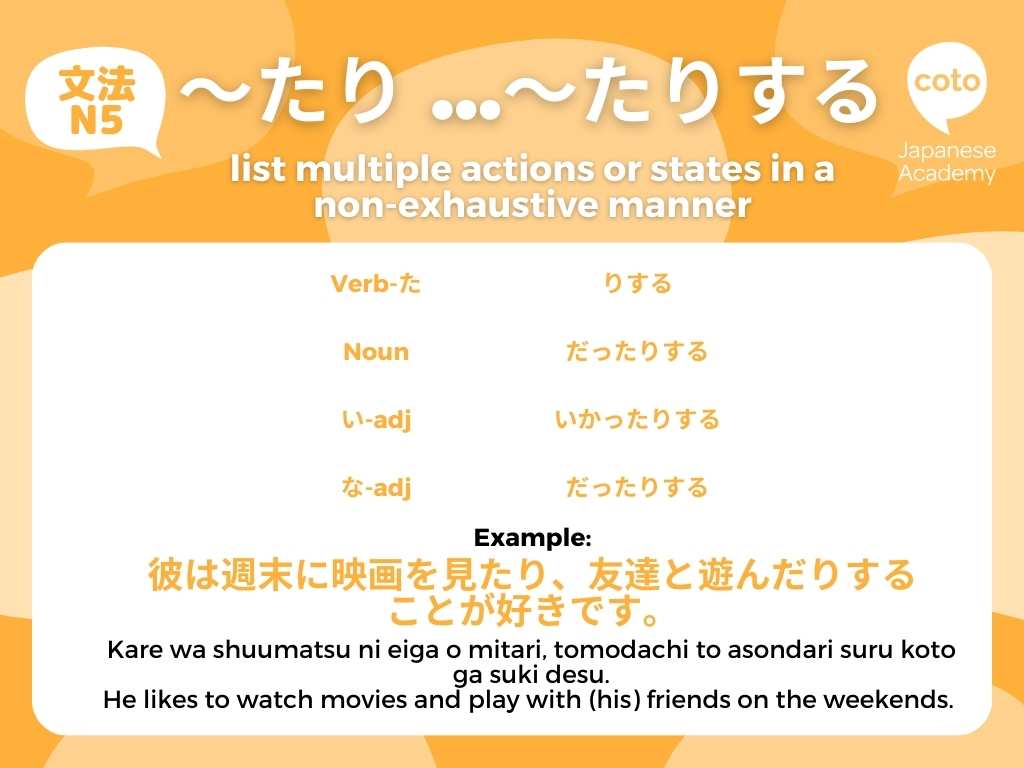
24. ~たり …~たりする (~ tari … ~tari suru)
The grammar pattern “~たり … ~たりする” in Japanese is used to list multiple actions or states in a non-exhaustive manner. It indicates that the actions or states mentioned are just a few examples among many possibilities.
It has a similar meaning to や that we explained above, but instead of a noun, this is typically used to indicate actions.
Verb-た
りする
Noun
だったりする
い-adj
いかったりする
な-adj
だったりする
For example:
彼は週末に映画を見たり、友達と遊んだりすることが好きです。 Kare wa shuumatsu ni eiga o mitari, tomodachi to asondari suru koto ga suki desu. He likes to watch movies and play with (his) friends on the weekends.
In this sentence, the speaker mentions watching movies and hanging out with friends as examples of activities the person likes to do on weekends. However, it doesn’t mean these are the only activities they engage in; there could be other things they do as well.
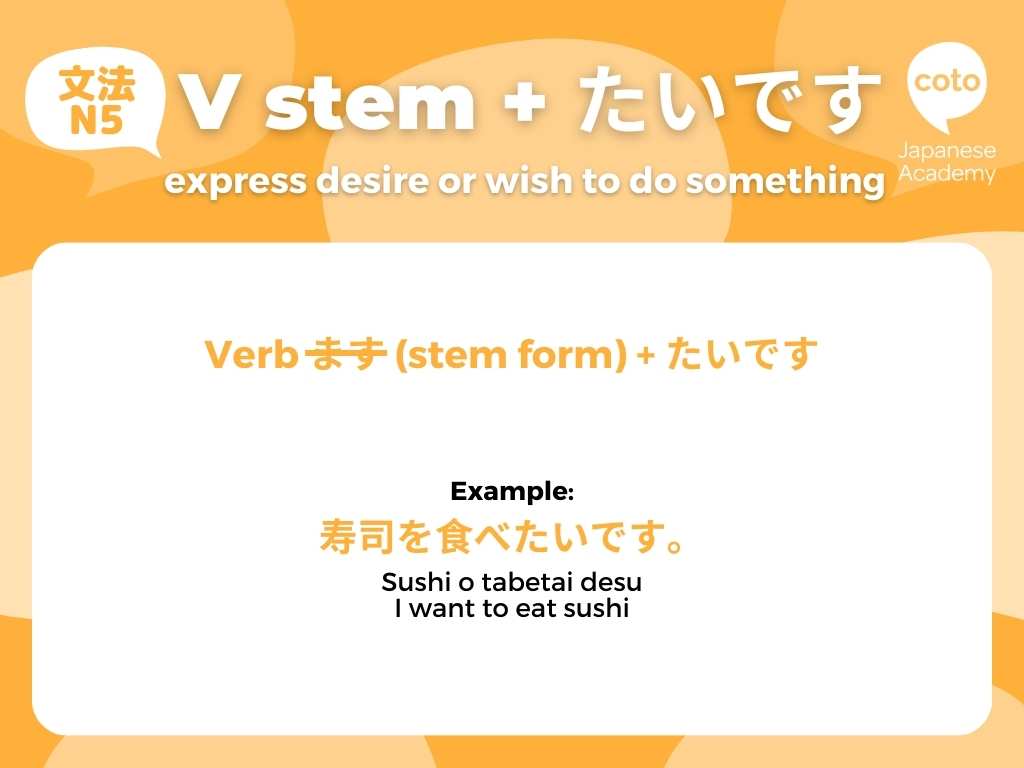
25. V stem + たいです (~tai desu)
Next, someone who is a beginner Japanese student should also know how to express desire or wish to do something. This is where “Verb + たいです” in Japanese is used to express a desire or a wish to do something. It is used when you want to convey that you want to do a certain action or engage in a certain state.
To make this grammar point, cut the ます from the ます form of verbs and add たい.
English
Dictionary Form
ます form (polite)
たい form
To eat
食べる
食べます
食べたい
To see
見る
見ます
見たい
To buy
買う
買います
買いたい
To go
行く
行きます
行きたい
To do
する
します
したい
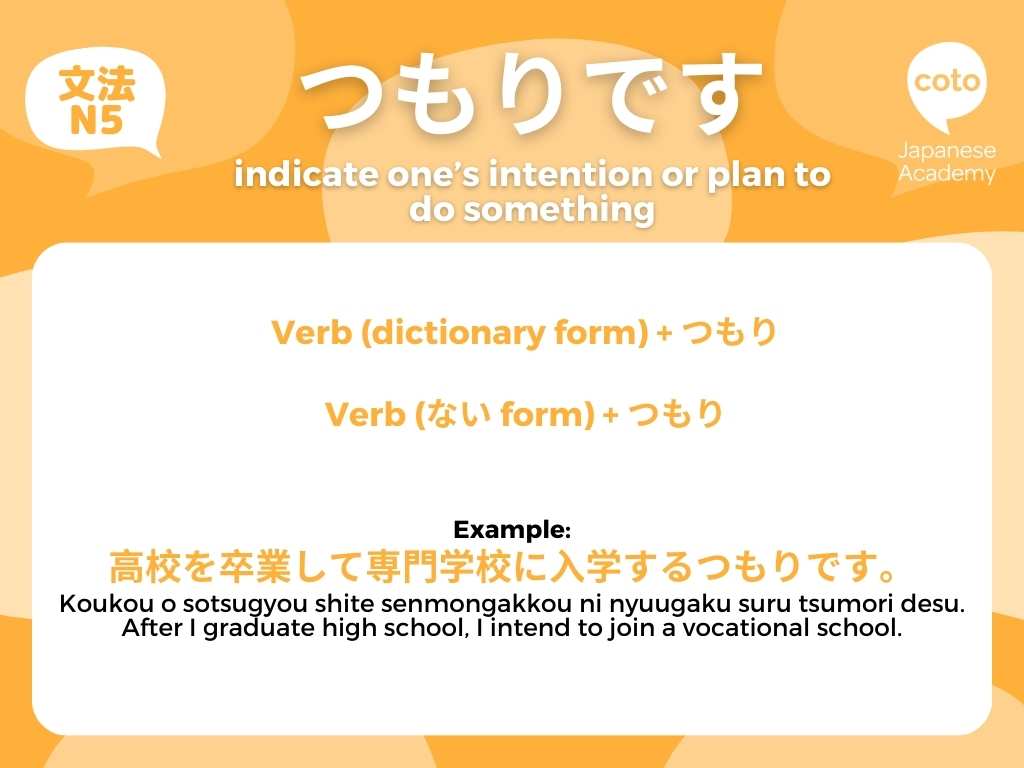
26. つもりです (tsumori desu)
To speak about your plans or intentions, you can use つもりです (tsumori desu). The grammar point “tsumori” is a Japanese construction used to indicate one’s intention or plan to do something. It is often translated as “intend to” or “plan to” in English. The structure is formed by attaching the verb’s stem or the noun to the stem of a verb followed by the auxiliary verb “tsumori” (つもり).
Note: The difference between “tsumori” (つもり) and “verb-tai desu” (verb-たいです) lies in the nuance of expressing intention or desire. Verb-tai desu” is used to express one’s personal desire or preference to do something. On the other hand, “tsumori” is used to express one’s intention or plan to do something. It implies a stronger commitment or determination to carry out the action.
Structure:
Verb (dictionary form) + つもり
Verb (ない form + つもり
For example:
高校を卒業して専門学校に入学するつもりです。 Koukou o sotsugyou shite senmongakkou ni nyuugaku suru tsumori desu. After I graduate high school, I intend to join a vocational school.
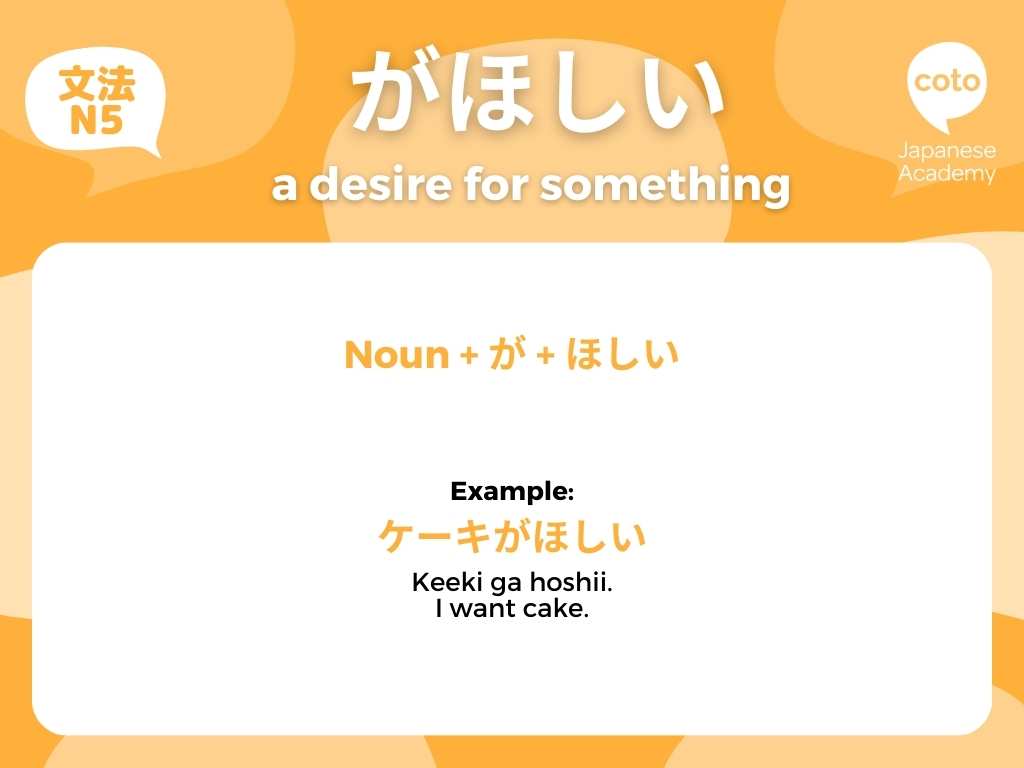
27. がほしい (ga hoshii)
In Japanese, the phrase “noun + ga hoshii” is used to express a desire for something.
Noun + が + ほしい
It’s important to note that the adjective “hoshii” always follows the noun it modifies and agrees with the subject of the sentence marked by “ga.” For example:
ケーキがほしい。 Keeki ga hoshii. I want cake.
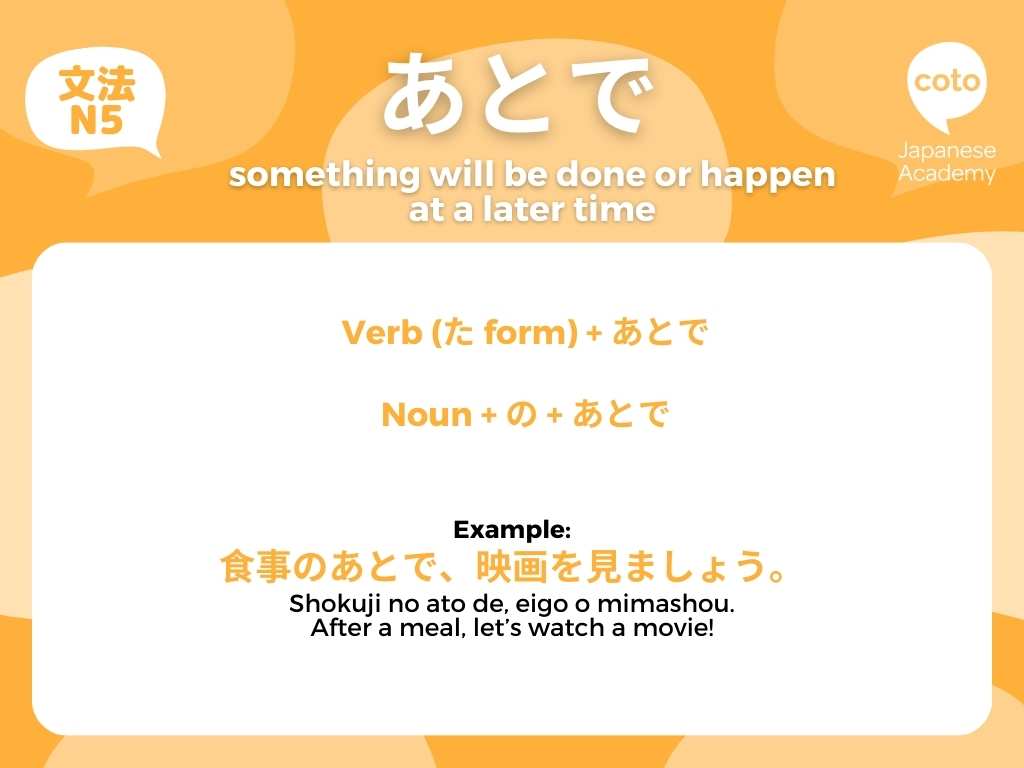
28. あとで (ato de)
In Japanese, “あとで” (ato de) is an expression used to indicate that something will be done or happen at a later time. It is often translated as “later” or “afterwards” in English. Let’s break down its grammar:
Verb (た form) + あとで
Noun + の + あとで
For example:
食事のあとで、映画を見ましょう。 Shokuji no ato de, eigo o mimashou. After a meal, let’s watch a movie!
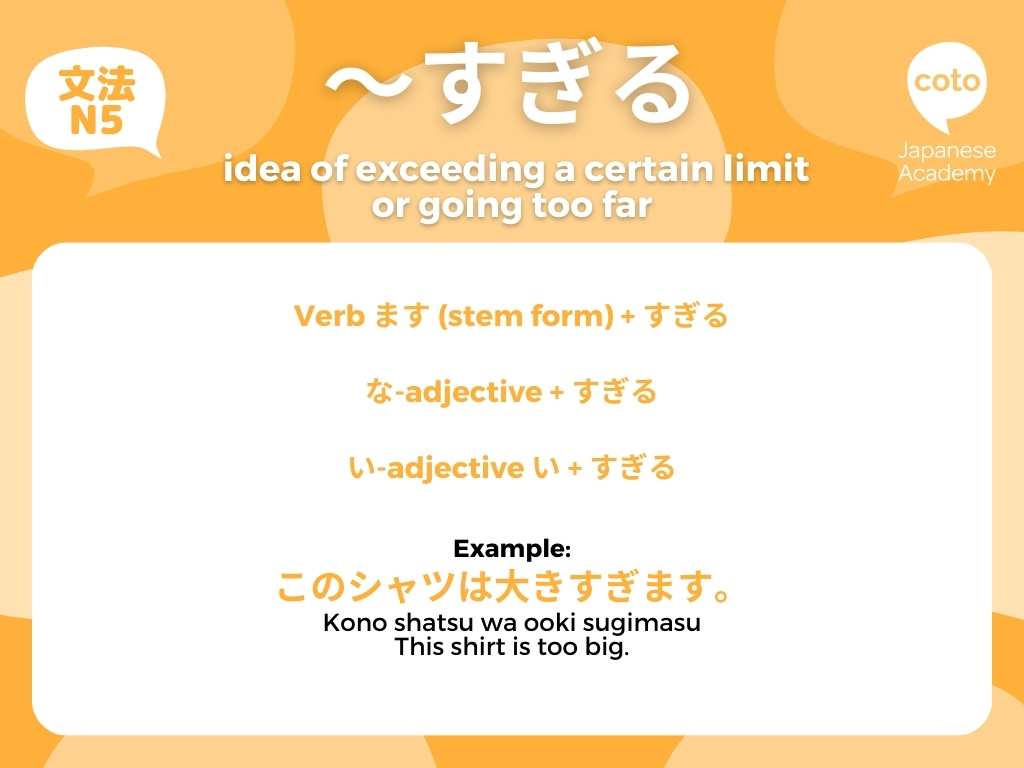
29. ~すぎる (~sugiru)
The grammar structure “~sugiru” in Japanese is a useful construction that conveys the idea of exceeding a certain limit or going too far. It is commonly attached to the stem of verbs or adjectives to express actions or states that are excessive or beyond what is expected or desired.
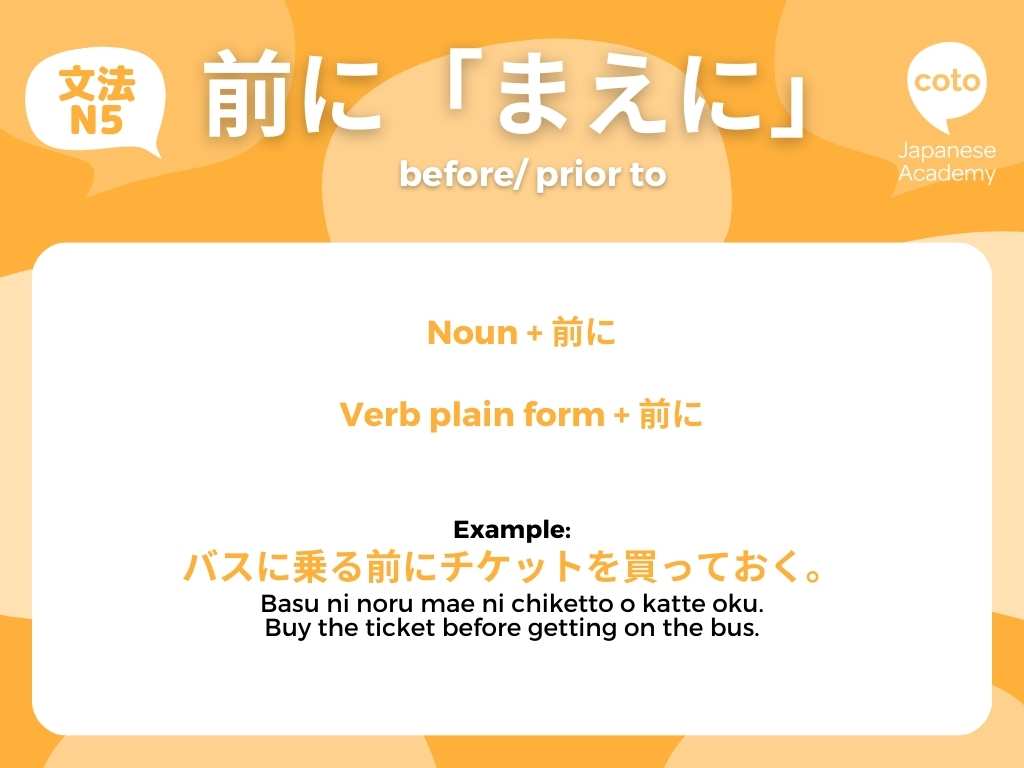
“前に” (mae ni) is a Japanese phrase that translates to “before” or “prior to” in English. When combined with a verb, the phrase that uses “前に” (mae ni) expresses that the action took place before a certain point in time or event.
Noun + 前に Verb plain form + 前に
Here are some examples:
バスに乗る前にチケットを買っておく。 Basu ni noru mae ni chiketto o katte oku. Buy the ticket before getting on the bus.
What’s next after learning these essential JLPT N5 grammar points? Learn must-know grammar points for other JLPT levels!
Ready to Pass the JLPT 2026? Join JLPT Lessons at Coto Academy!
If you’re thinking of taking the JLPT again or aiming for a higher level to boost your career in Japan, give yourself the best possible chance of success. Coto Academy students enjoy a higher pass rate than the national average thanks to our focused JLPT preparation courses.
Join Coto Academy’s highly popular JLPT prep course! Taught in Tokyo by experienced instructors who specialize in the JLPT, this course gives you the strategies, practice tests, and structured study approach to master every part of the exam. With expert guidance and proven methods, you’ll walk into your next JLPT feeling confident and ready to pass.
Contact us for a Japanese-level check and a free consultation on the best JLPT prep course for you!
What is JLPT N5?
A1: JLPT N5, or Japanese Language Proficiency Test N5, is the first level of the Japanese Language Proficiency Test. It assesses basic Japanese language skills and is suitable for beginners.
What are some common JLPT N5 grammar points?
Some common JLPT N5 grammar points include:
です (desu): A polite copula used for sentence endings.
は (wa): A particle used to mark the topic of a sentence.
が (ga): A particle used to mark the subject of a sentence.
ですか (desu ka): A polite question-ending expression.
の (no): A particle used to indicate possession or describe a noun.
How can I use the grammar point です (desu)?
The grammar point です is used to form polite sentences in Japanese. It is commonly used to state facts, describe things, and make general statements. For example: 私は学生です (Watashi wa gakusei desu) means “I am a student.”
When should I use ですか (desu ka)?
ですか is a polite question-ending expression. It is used to form yes/no questions in Japanese. For example: これはペンですか (Kore wa pen desu ka) means “Is this a pen?”
What does the particle は (wa) indicate?
The particle は is used to mark the topic of a sentence. It indicates the main subject or theme being discussed. For example: 私は日本人です (Watashi wa nihonjin desu) means “As for me, I am Japanese.”
How can Coto Academy help me learn Japanese?
From preparing JLPT to doing conversation practices, Coto Academy has differnent Japanese language courses that is tailored to differen needs. We are located in Shibuya, Iidabashi (Tokyo), and Yokohama. If you woud like to learn Japanese effectively in a small, fun class, contact us for a free level check and interview!
Are you planning to take the JLPT and wondering how you can apply online in Japan? You are in the right place. This blog will be a thorough guide on how to apply for the JLPT if you are planning to take the test in Japan, step by step. It’s almost that time of the year again when most of us are getting all ready to sign up for the Japanese Language Proficiency Test, otherwise known as the JLPT. In 2026, there are a few important updates to keep in mind — including a new rule that only residents of Japan can take the JLPT in Japan. Tourists and short-term visitors are no longer eligible. With varying difficulty levels from N5 to N1 (with N1 being the most difficult), it is relatively important to start deciding on which level to take on the test date, and if you are eligible. Now, let’s go through how to register for the JLPT in Japan and the key details you should know before signing up!
When is the 2026 JLPT test?
The JLPT in Japan is held twice a year: in July and in December. For 2026, the first JLPT will be held on Sunday, July 5, 2026, and the second JLPT will be held on Sunday, December 6, 2026. This frequency might vary if you are taking the JLPT outside. Either way, these tests are usually held on the first Sunday of July and December.
First JLPT Test in 2026: First week of July
Second JLPT Test in 2026: First week of December
In 2027, you can alsoexpect the tests to take place around early July and early December. Registration usually opens a few months before each test, with exact dates varying depending on your location. It’s best to check the official JLPT website or your local test center for the most accurate information as the dates approach.
When is the application period for the 2026 JLPT?
Registration for the JLPT takes place a few months before the actual test date. The registration period for the July 2026 JLPT is open from March 17 to April 7.
The registration period for the December 2026 JLPT is expected to open in August and close in September 2026—the same timeline typically applies to the December 2027 test as well.
Tourists and short-term visitors are no longer allowed to take the JLPT in Japan
Starting in 2026, Japan no longer allow tourists or short-term visitors to take the JLPT in Japan. Moving forward, the administration will require proof of residency and for applicants to input their residence card (在留カード, zairyuu card) number.
According to the announcement, “The 2026 JLPT is primarily intended for non-native Japanese speakers who are mid-to-long-term residents or special permanent residents.”
People in certain visa categories can apply for the JLPT in Japan, but with a few conditions.
Non-native Japanese speakers who have Japanese nationality
People with permission for provisional stay (residence and contact information must be properly verified)
Those under the Japan–U.S. Status of Forces Agreement or the UN Forces Agreement
Diplomats
Officials
However, if you fall into any of these categories, you’ll need to declare your status during the application process. You may also be asked to provide identification documents, such as your passport, to confirm your nationality or visa status.
According to JEES, this decision comes after a large number of overseas applicants who use invalid phone numbers and contact information, which leads to problems in delivering physical documents, such as the test voucher or score reports, when the JLPT results are out. Because of this, when you are applying online via the MyJLPT portal, you will now have to provide your residence card number and its expiration date.
Study the JLPT with Coto Academy!
Coto Academy students have a higher pass rate than the national average, thanks to our proven JLPT Prep Course. We offer two flexible options: a year-round JLPT course and an intensive 3-month sprint course timed perfectly before test day. Our 3-month, semi-intensive course meets every Saturday for 3 hours, covering everything from high-frequency kanji to the specific logic needed to ace the reading section. What makes these classes stand out is the teachers, who specialize in teaching JLPT. They will give you tips and techniques you simply won’t get from self-study. Join our class today!
You have two options: take the test locally in Japan (only available if you hold a valid Japanese residence card) or in an educational institute overseas. The JLPT is hosted in local institutions in most Southeast Asian countries, North America, Europe, Latin America, the Middle East, Africa, Oceania, and South Asia. However, the frequency of the JLPT might vary, with some hosting the JLPT twice a year and others only once a year. For the full and comprehensive list of overseas institutes that conduct JLPT, head down to the link over here to check if it is an approved institute.
As the location in which you take the JLPT varies, there may be different procedures, windows, or deadlines that you have to take note of. However, the test date still remains the same. For more information on how you would go about applying for the JLPT online or otherwise, please click on any one of the links below:
Looking at the test components, JLPT Test Levels N1 to N3 are composed of 3 Components: Reading (60 marks), Vocabulary (60 marks), and Listening (60 marks). As for JLPT Test Levels N4 to N5, there are 2 Components: Japanese Language Knowledge (120 marks) and Listening (60 marks).
If you are unsure of how to prepare for JLPT N2 or N3, click on the links and it will lead you to a guide we came up with some time back!
However, in order to pass, you need to meet 2 conditions:
Score at least 19 marks for any sections with 60 marks obtainable and 38 marks for sections with 120 marks obtainable.
Meet the overall passing grade for the test at each level. Here’s a list of the passing marks:
JLPT Level
Vocabulary/ Grammar)
Reading
Listening
Total Score
N1
19
19
19
100
N2
19
19
19
90
N3
19
19
19
95
JLPT Level
Vocabulary/ Grammar and Reading
Listening
Total Score
N4
38
19
90
N5
38
19
80
How to Apply to the JLPT in Japan Online
If you are living in Japan as a resident (for example, as a student, employee, or dependent), you can take the JLPT in Japan. Applying the JLPT online requires two big steps: creating your MyJLPT account and applying for the JLPT level you want to take.
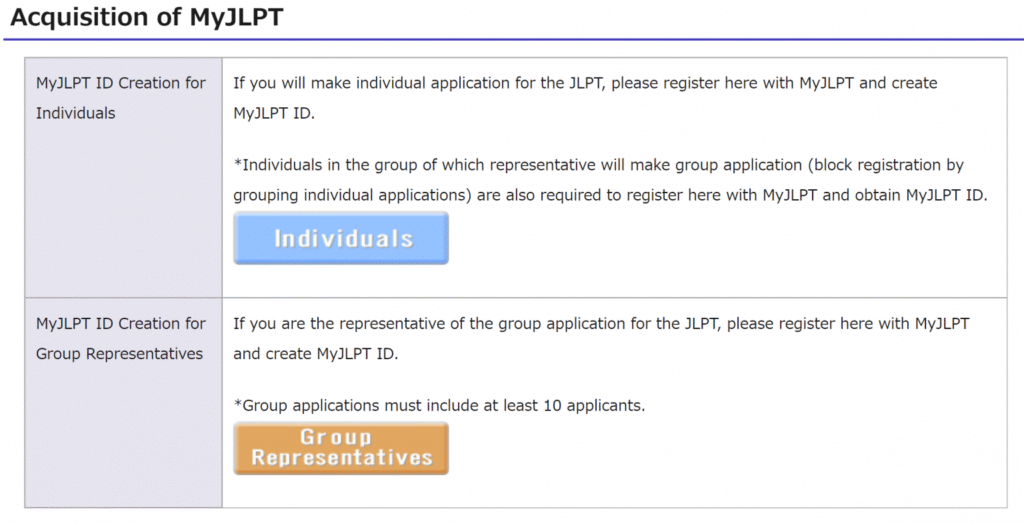
Part 1: Create Your MyJLPT Account
MyJLPT is a website for people who want to take the Japanese-Language Proficiency Test (JLPT) in Japan. On MyJLPT, you can apply for the test, check your test results, and request a Certificate of Result and Scores online. The website is managed and operated by Japan Educational Exchanges and Services (JEES). Visit this page to start creating your MyJLPT account.
Typically, for most of us, we want to apply for the JLPT as individuals.
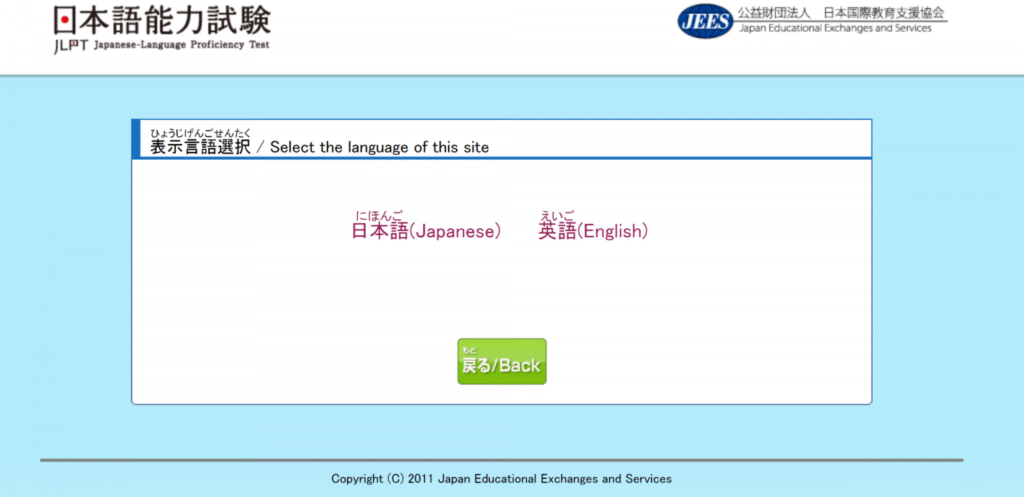
To reduce misunderstanding, we highly recommend selecting English for the language setting.
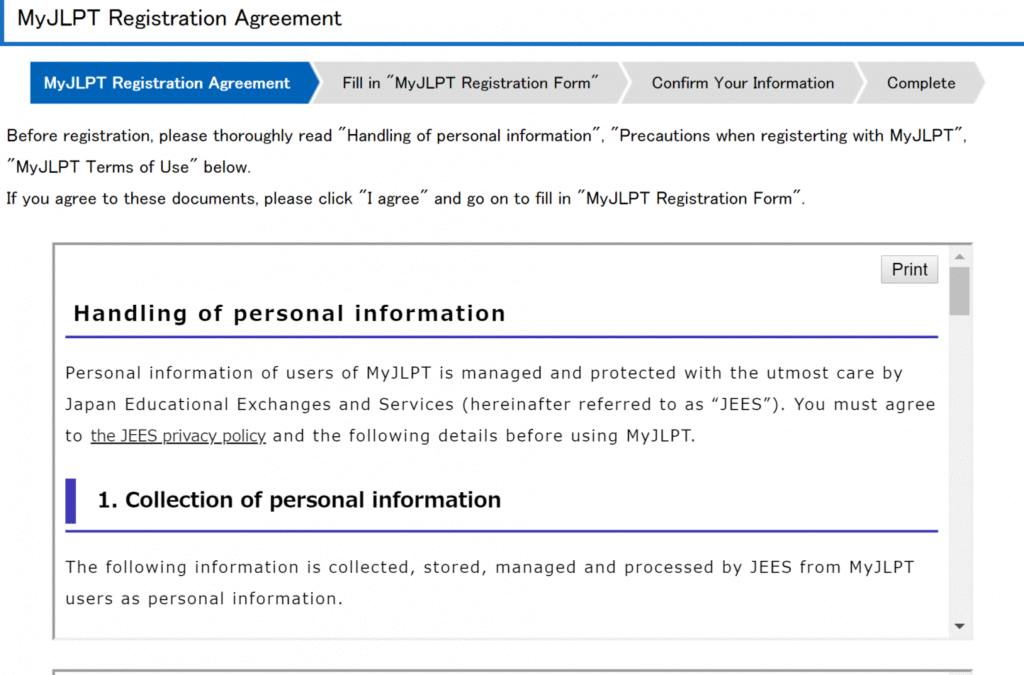
Once you click on your desired language, the site will take you to a long registration agreement. This lists everything from how they handle personal information to the exact eligibility of those who will be able to use MyJLPT.
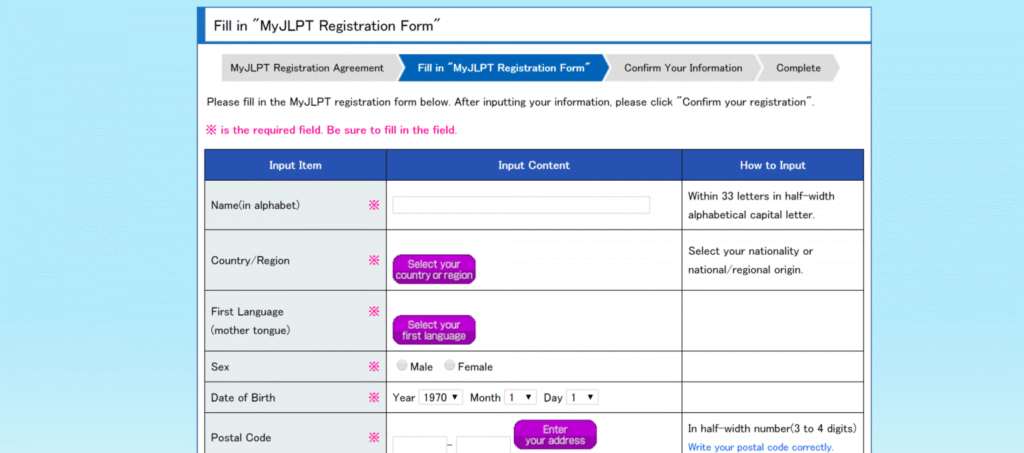
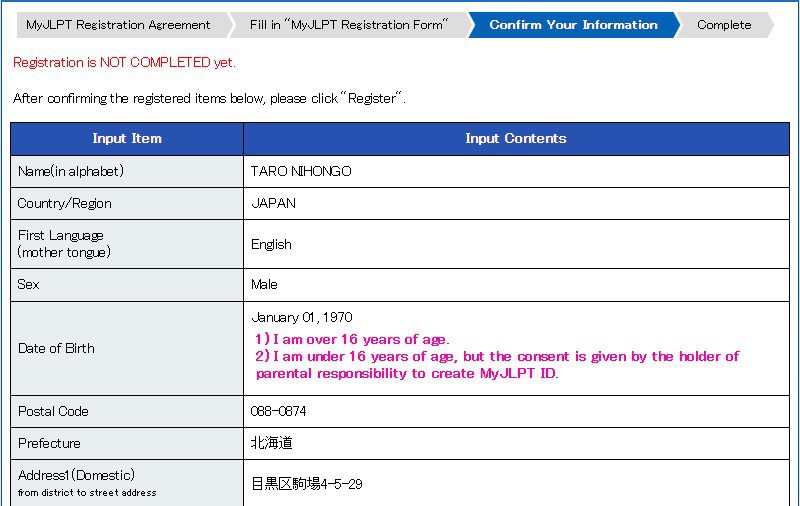
Next, you will fill out all of your personal information. Make sure your name and address match the current address on your residence card, as well as your date of birth. Do not lie. Your information is often used for cross-checking on the day of the test.
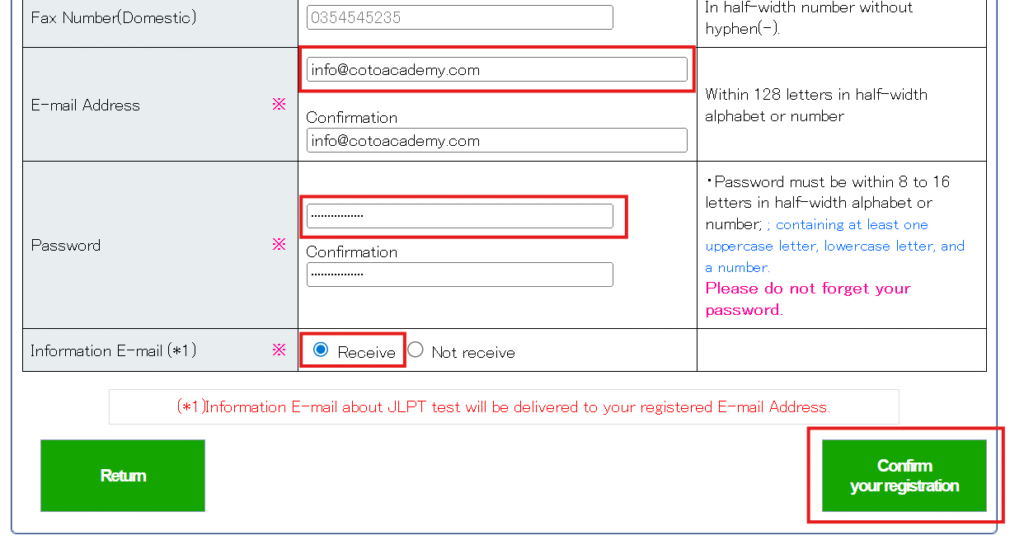
At the bottom of the page, you will set your email and password. Do not forget this information, as it will be used the next time you log in to your MyJLPT page to check your past scores and JLPT records. Finally, we highly recommend that you opt to receive information emails from the JLPT! This will allow them to send you notifications regarding the test. The JLPT administrator does not send a lot of marketing emails, so you will not get spammed!
Finally, confirm your personal information and check your email Inbox for a confirmation email. They will give you your new MyJLPT ID, which you will use to log into your MyJLPT account.
Part 2: Registering for the JLPT Online with your MyJLPT Account
Once you have obtained the MyJLPT ID, you will be asked to complete the online application from your MyJLPT page. You can log back in by going to the official JLPT in Japan website once again. The website itself is more friendly to certain web browsers, and the site recommends that you use Microsoft Edge.
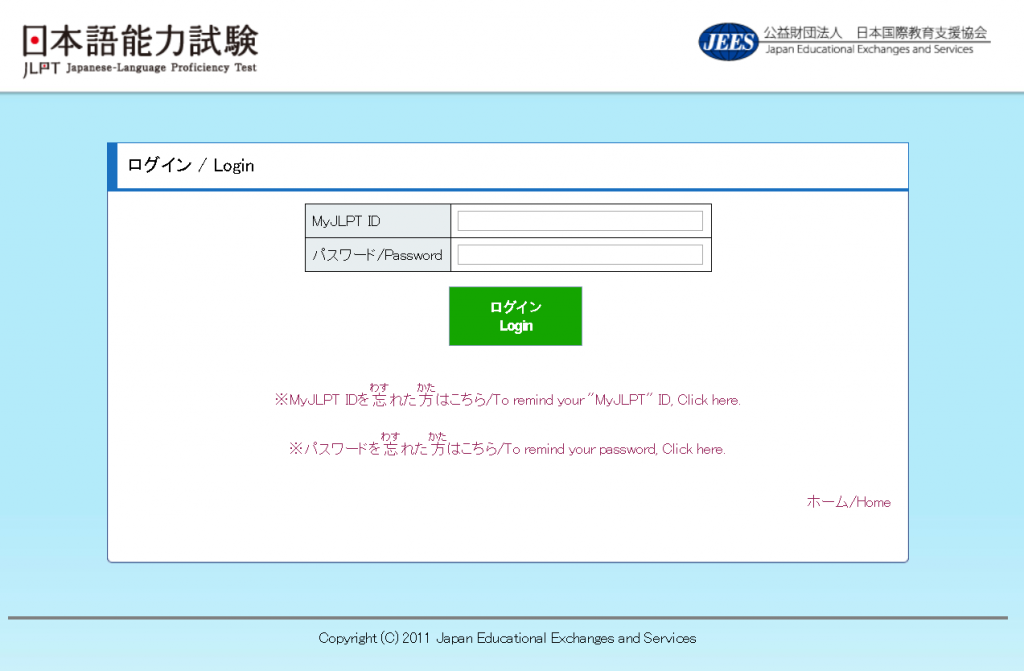
Step 1: Log in to your My JLPT account
First, try to log in to your MyJLPT account. Input your ID (which should be sent to your inbox the moment you finished registration) and the password you set.
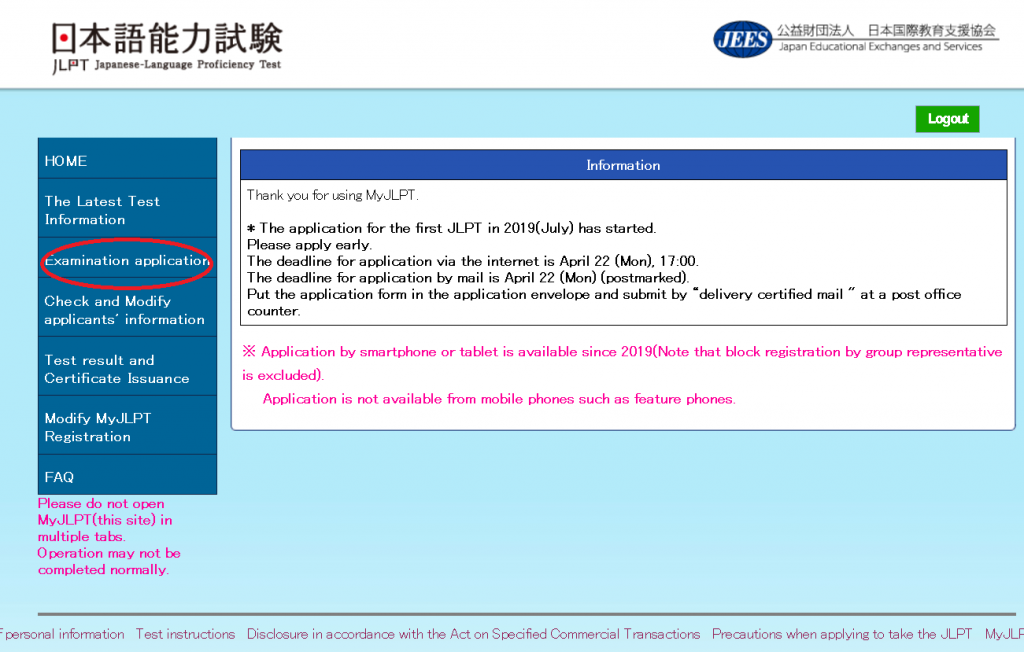
Step 2: Click on “Examination application”
Before you start your application, there’s one important thing to keep in mind!
When you log in to your MyJLPT account, you will only see the test that is currently within the official application period. If the application window is not open yet, the test simply will not appear.
For example, if you log in on March 1, hoping to apply for the July 2026 JLPT, you may not see anything available. Don’t panic! This just means the application period hasn’t started yet. The system will let you know that it is not currently accepting applications.
The best thing to do is check the official announcement dates and come back during the designated application period. Once it opens, you’ll be able to complete your registration without any issues.
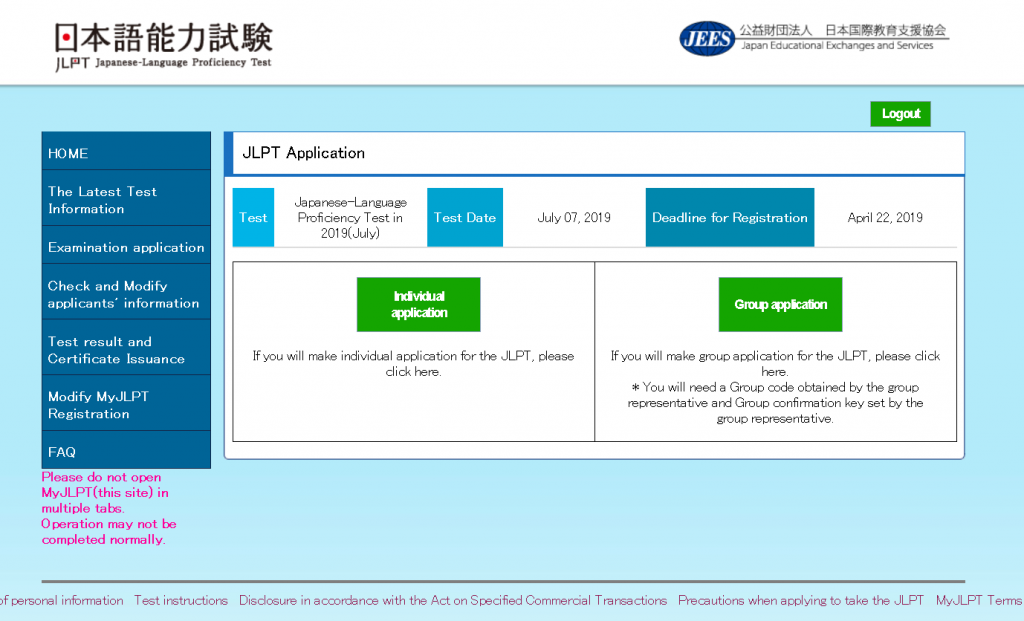
Step 3: Choose your application type
Most of us will apply for the JLPT involuntarily, so select “Individual application”.
Step 4: Sign the agreement to the privacy policy
Next, you’ll be directed to the privacy policy and some important rules. It may look like one of those long pages that make you want to skip reading, but there are a few important things you should know.
For example, the JLPT application fee is not refundable once you have paid it, even if you later decide to cancel your application.
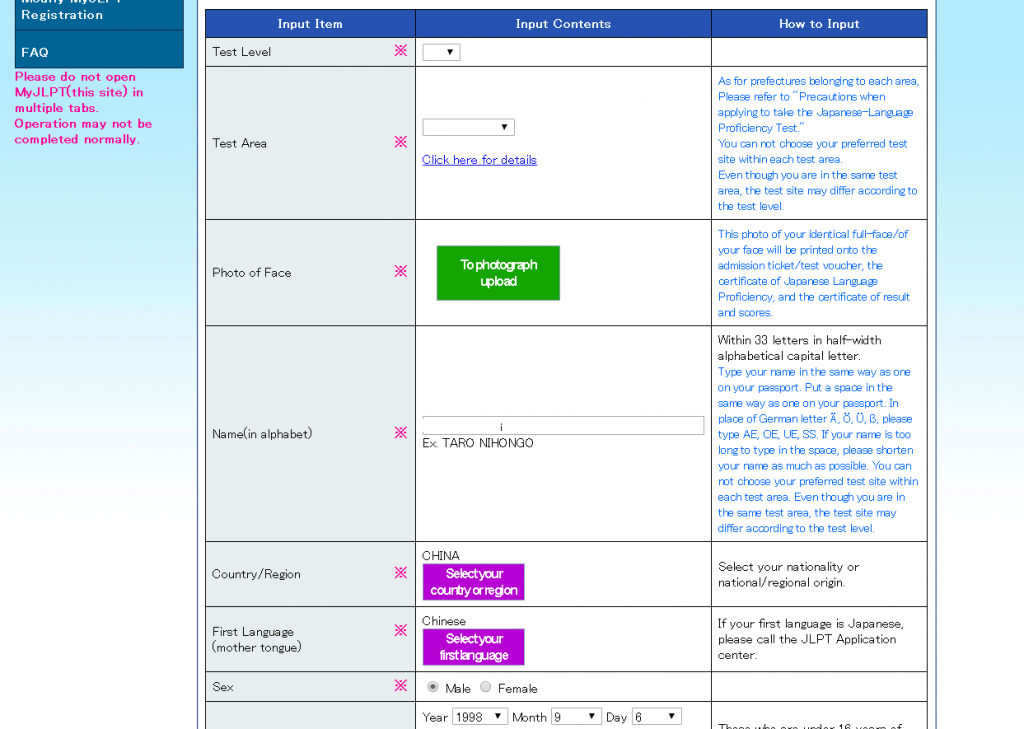
Step 5: Choose your level and fill in the other details required
This is the part where you should double-check everything carefully — especially the city where you want to take the JLPT and the test level you are applying for. Make sure all your information is correct before you move on.
You will also need to upload a clear, full-face passport-style photo. This photo will be used as identification and will appear on your admission ticket, test voucher (which you must bring to the JLPT test center), and your Certificate of Result and Scores. So choose a proper photo that clearly shows your face.
Tip: If you enter the wrong JLPT level or the test area, you can still change your test level or test location during the application period. Just make sure you do it before the deadline, because no changes are allowed after that!
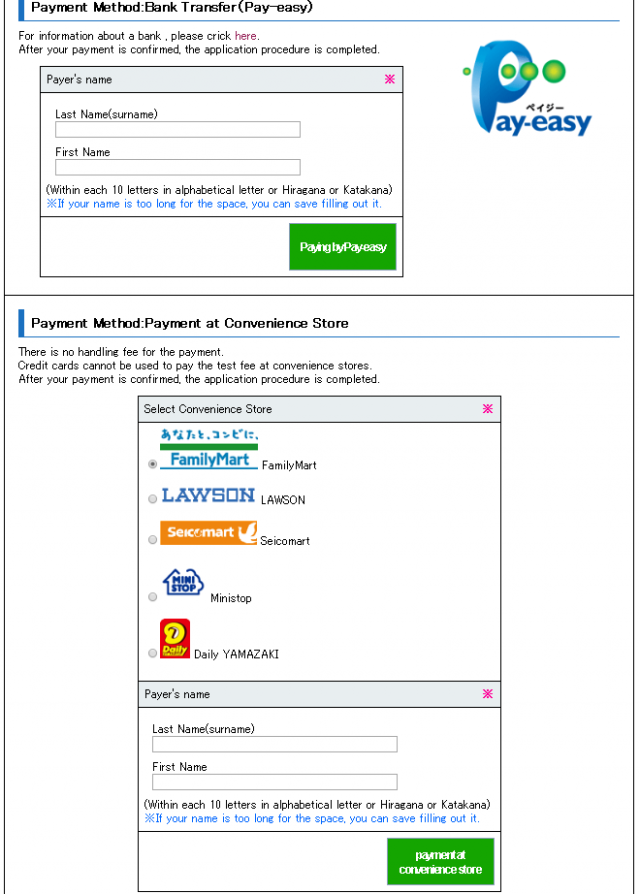
Step 6: Choose Payment type
If you are in Japan, you can pay the test fee through several payment methods: credit card, bank transfer, or payment via the convenience store. Please confirm the available payment methods for countries outside Japan. Generally, a credit card is acceptable.
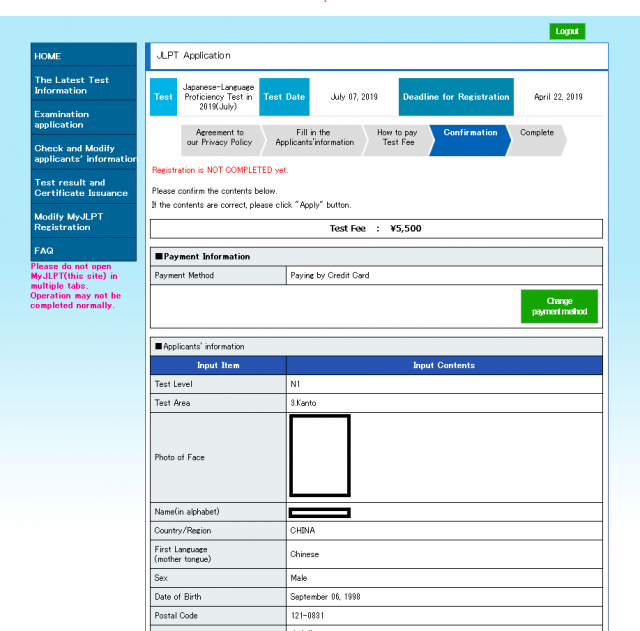
Step 7: Confirm your information
Final step: The application will be completed after confirmation of your information
How Much Does the JLPT Exam Cost?
As of 2025, the JLPT in Japan costs around ¥7,500 in Japan. After completing your application, you must complete payment before your registration will be confirmed.
Test fees may vary based on the location in which you decide to take the test, and can be more expensive overseas. For example, in the USA and Canada, the test fee is around $100.
If you are in Japan, the payment options for the JLPT range from online with a credit card to cash at a convenience store or post office. If you are outside of Japan, the payment method will depend on the test location. From January 17, 2022, a separate fee of 110 yen will be required for a cash payment from a Japan Post Bank ATM. For group applications, a fee of 110 yen will be required for each “payment number”.
The test payment window for December is from early to late September. After making payment, you will be set to receive a Test Voucher, which you will need to bring to your test venue to confirm and verify your status as a participant of the JLPT you have signed up for. Ensure that this slip of paper is well-kept and not lost, as it is very important. With these, remember to bring in some form of identification together with your Test Voucher. With that, take the test, and you’re all good to go.
When Will I Get My JLPT Results?
After all that hard work, just sit back, relax, and give yourself a well-deserved break. Until the time comes, enjoy yourself! But until when? Well, the release of results can vary based on whether you’ve taken the test locally or from an overseas educational institute, but here are some dates you can stay on the lookout for!
Local July Test: Early September
Local December Test: Early February
Overseas July Test: Early October
Overseas December Test: Early March
Note: For Overseas Students, collect your Score Reports and hopefully, a Certificate of Proficiency, at your Local Host Institute. As for Local Students, the Score Reports and Certificates will be mailed to you directly based on the address associated with your MyJLPT Account.
If you have questions about our school or taking JLPT Prep lessons with us, don’t worry. Here’s a link to the FAQ site where you can check to see if it answers any queries you have. With that, we would like to wish you all the best and happy studying!
Start taking Japanese lessons and pass the JLPT exam!
Double your chances of passing the test with Coto Academy’s JLPT Prep Course! Our 3-month, semi-intensive course meets every Saturday for 3 hours, covering everything from high-frequency kanji to the specific logic needed to ace the reading section. Whether you join us in-person in Tokyo or via our online classrooms, you’ll get the expert strategy and peer support needed to walk into the exam with confidence. Seats are limited to keep class sizes small and effective—secure your spot today, and let’s reach your goal together.
Comprehensive Coverage: 3 hours per class covering vocabulary, kanji, grammar, and specialized reading strategies.
Expert Guidance: Small class sizes with instructors who know exactly where students usually stumble.
Flexible Learning: Join us in-person at our Tokyo campus every Saturday, or join from anywhere in the world via our Online sessions.
When is the next JLPT in 2026 and when can I sign up?
For 2026, the first JLPT will be held on Sunday, July 5, 2026, and the second JLPT will be held on Sunday, December 6, 2026.
Where do I apply for the JLPT?
To apply, you will need a MyJLPT account, which you can sign up for here. Once you have an account, you can sign in with your account and start to register.
When do the JLPT results come out?
Depending on when you take the test, the release of the results can differ. In general, you will get your results 2-3 months after the test. Here is when you should look out for your results, depending on when you take the test!
Local July Test: Early September
Local December Test: Early February
Overseas July Test: Early October
Overseas December Test: Early March
I have a question about the JLPT that isn't addressed here. What do I do?
If you have any JLPT-related inquiries, you can visit the JLPT FAQ site. Your answer should be there.
When is JLPT 2026?
The JLPT is held twice a year, typically in July and December. In 2026, you can expect the tests to take place around early July and early December. Registration usually opens a few months before each test, with exact dates varying depending on your location. It’s best to check the official JLPT website or your local test center for the most accurate information as the dates approach.
Pass JLPT With Confidence With Professional JLPT Course
Aiming to pass the JLPT with your highest possible score? Join Coto Academy’s highly rated JLPT lesson, a specialized program taught only by expert native tutors designed to maximize your success through rigorous exam practice and explanations for all test sections.
Our JLPT prep course covers exam practices and explanations of essentials such as Japanese grammar, vocabulary, kanji, and more! We offer three–month and year-round preparation courses for all JLPT levels: N1, N2, N3, and N4. Online JLPT courses for a six-month and a full-year duration are also available.
Availability:
Weekday 9:00 – 21:00, Saturday 10:00 – 17:00
Levels:
JLPT N1-N4
Class size:
Max 8 students
Location:
Iidabashi, Yokohama, and online Language Schools
Length:
50 min, 100 min or 150 min per day
Frequency:
Depends on the course
Focus:
JLPT-exam preparation
Things to note: Short-term courses emphasize solving practical problems rather than reviewing concepts, functioning like an audit.
4.8
Top JLPT School In Japan
Hear from our students
4.5
Garrett
The class is fun, and the materials are great. I really appreciate the focus on conversation.
5.0
Timothy
The friendly staff and relaxing environment make it a great place to study. I especially enjoy the conversation classes, which help with real-life Japanese.
5.0
Ynez
I found the real-life interactions with teachers very helpful and would love more opportunities to practice.
5.0
Ian
I appreciate how knowledgeable and patient the teacher is. The lessons are relaxing and easy to study, making learning enjoyable.
4.5
Kyle
The intensive class is great, and the teachers and staff are amazing. I really enjoy my classes here.
4.5
Ebony
The staff is kind, and the teachers are great. If you want to take Japanese classes, I recommend Coto!
Why Study JLPT with Coto Academy?
Increase Your Chances of Passing the JLPT As of 2025, Coto Academy students enjoy a 58% higher pass rate than the global average. Join us and increase your chances of passing with our proven approach.
JLPT-specialized Japanese Instructors At Coto Academy, you study exclusively with professional instructors who bring years of experience and a proven track record of success to help you pass the JLPT with the best results possible.
Course Specifically Designed for JLPT Success Our structured courses go beyond simple theory, focusing on the practical tips, tricks, and exam strategies you need to master every aspect of the test.
What is the JLPT?
The JLPT (Japanese-Language Proficiency Test), or Nihongo Nouryoku Shiken, is the world’s most recognized standardized exam for certifying the Japanese language skills of non-native speakers. This multiple-choice exam evaluates your mastery of vocabulary, kanji, grammar, listening, and reading comprehension. Today, the JLPT serves as a global benchmark for employers, universities, and immigration authorities to accurately assess professional and academic Japanese proficiency.
Accelerate your JLPT journey with a 3-month course designed to be strategically scheduled before the test dates. This twice-a-year course covers all exam sections in-depth, including kanji, reading, and grammar. The course style usually focuses on solving mock JLPT exam questions, perfect for those seeking a final push before test day.
Establish a solid foundation in Japanese with our year-long preparation course on JLPT grammar and reading. This specialized program targets key JLPT sections in depth, and also offers flexible learning options to accommodate your schedule.
End of March – early July or end of August – early December
Year-round enrollment Start anytime
Level
N4, N3, N2, and N1
N3, N2 and N1
Curriculum Focus
Comprehensive coverage of all JLPT sections: grammar, reading, listening, vocabulary, and kanji
Strong focus on grammar and reading, with deeper exploration of specific JLPT components based on class needs
Learning Style
Intensive, fast-paced exam preparation
Flexible, personalized, and in-depth learning
Best For
Students preparing for an upcoming JLPT who need a final intensive push before the exam
Students seeking steady progress, strong foundations, and long-term academic growth
Ideal Student Goal
Maximize score in a short time frame
Build lasting proficiency and confidence in Japanese
What will you learn at each JLPT level?
・Build on N5 knowledge with more complex sentences and kanji.
・Improve reading comprehension and expand key JLPT-specific vocabulary.
・Strengthen skills with past exam questions and targeted exercises.
・Bridge the gap between beginner and intermediate levels.
・Study nuanced grammar and tackle longer, more complex reading passages.
・Benefit from structured practice tests and expert feedback.
・Advance towards fluency with in-depth grammar, idioms, and business Japanese. ・Focus on high-level reading, listening, and comprehension skills. ・Learn exam strategies and time-management techniques for success.
・Develop native-level comprehension and analytical reading skills. ・Master challenging kanji, literary texts, and sophisticated expressions. ・Gain the ability to handle complex conversations, business documents, and academic materials.
Course Fees For JLPT Courses
Choose a plan that suits you! A ¥10,000 registration fee is required for new students.
Monthly plan
Package plan
Subscription Plan
36,800
16 Lessons
Starter Plan
43,200
16 lessons
Middle Plan
83,200
32 lessons
Growth Plan
120,000
48 lessons
Ultimate Plan
230,400
96 lessons
Step 1
Book your FREE consultation
Step 2
Meet us online or
at our school
Step 3
Start your Japanese
language journey
Get started!
Complete the form and our team will contact you as soon as possible!
JLPT Course Guide and Materials
JLPT Level
CEFR Level
Course Options
Year-Round Course Material
3-Month Course Material
Main Goal
N5
A1
Japanese Crash Course, Japanese Intensive Course, Lite Intensive Course
Genki, Coto Academy’s original material, Nihongo Fun & Easy
Our JLPT Exam Prep Courses are designed to help people ace their JLPT exams. We offer short and long-term courses that focus on different targets. The short-term courses focus on exam practices, while the long-term courses focus on building grammar and reading foundations.
Can I join JLPT Exam Prep Courses anytime?
You can join our year-round courses anytime, but our three-month courses usually open around March and August, so stay tuned!
Can I attend the JLPT Prep Course online?
Yes! Coto Academy offers Japanese lessons both in-person and online. You can join our online Japanese classes from anywhere, allowing you to improve your Japanese skills with flexible scheduling and interactive lessons. Check our website for available courses and schedules. course
What is Coto Academy's success rate for its JLPT prep course?
Passing rates for our JLPT students vary by level, but overall, as of 2026, Coto Academy students who take the JLPT have a 58% higher chance of passing compared to the global average.
Do you offer JLPT N5 lesson?
Coto Academy’s JLPT course is available for JLPT N4 to N1 levels. However, we do offer beginner Japanese lessons that correspond with the JLPT rubric, such as Japanese Intensive Course or Japanese Lite Intensive Course.
News & resources
MyJLPT 2025 Results: How to Check Your JLPT Scores and What to Do Next
Need to check your JLPT results? Don't worry this blog is here to help! Learn how to check your JLPT results with this guide now.
If you’re preparing for the JLPT N3 or just stepping into intermediate-level Japanese, you’re entering an exciting stage. The JLPT N3 vocabulary list includes around 3,750 words, which contain a mix of practical terms you’ll encounter in everyday conversations, at school, in the workplace, and even in formal settings. While N3 is often considered one […]
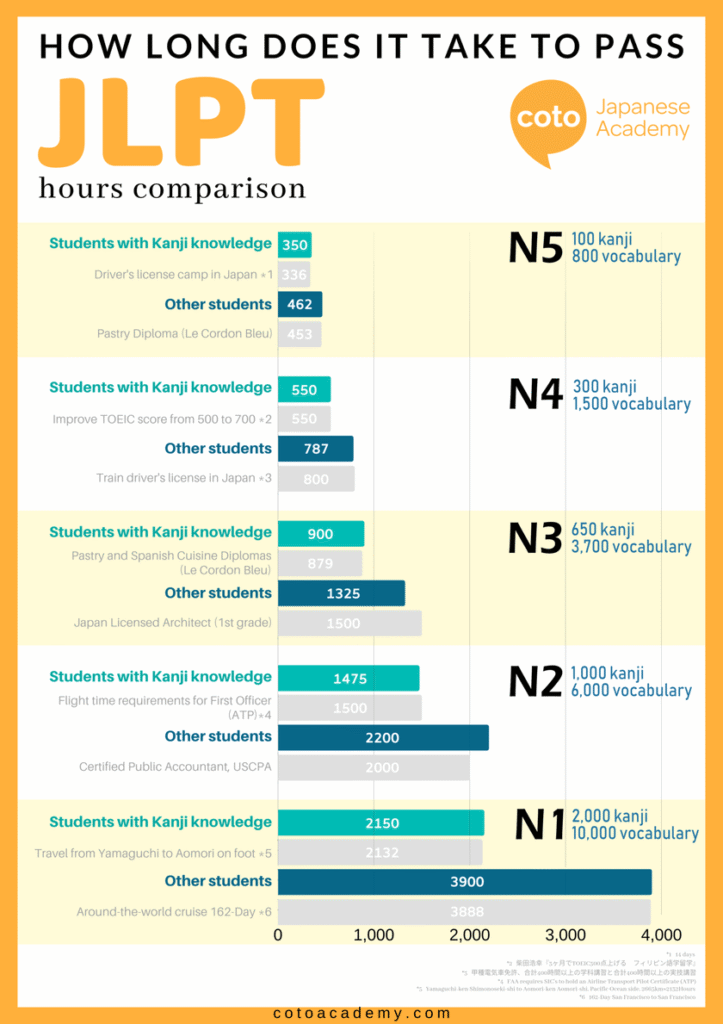
Learn how many hours of study it will take you to pass each level of the JLPT. This illustrated guide compares how many hours of Japanese study per JLPT level. Did you know that it takes just as long to pass the N2 as it does to become a certified public accountant in the US?
When I arrived in Japan in January 2019, I barely knew Japanese. However, I was determined to learn the language as I thought life would be so much fun and easier if I was able to do basic communication with the locals. I could order food by myself, I could ask for directions if I […]
How many study hours do you need to pass the JLPT? The Japanese Language Proficiency Test is the benchmark for your knowledge of the Japanese language. One of the first questions that probably comes to mind is: “How long do I need to prepare for the JLPT?”
The answer isn’t the same for everyone. It depends on things like your current level, how you study, and whether you’ve learned the language before. Still, having a rough idea of the time commitment for each level (from N5 to N1) can really help with planning and staying motivated.
In this post, we will show you some interesting comparisons of the number of JLPT study hours it will take you to pass each exam level.
Aiming for the July or December JLPT?
Getting ready for the JLPT? Boost your chances of passing with Coto Academy’s JLPT Prep Course. We have a special 3-month program specifically dedicated to help you learn and succeed in gramma, vocabulary, kanji, and reading strategies. You’ll learn with native instructors who has years of experience teaching Japanese. Historically, our students have had double the passing rate compared to the global average. We don’t just teach Japanese; we teach you how to beat the test.
The number of study hours needed to pass the JLPT can vary a lot depending on the learner. If you’re living in Japan or regularly exposed to Japanese, especially kanji, you may be able to progress more quickly thanks to daily practice and immersion. Similarly, learners who already know Chinese or Korean often need fewer hours because of shared kanji or grammar patterns.
Note that the numbers above are cumulative totals. For example, to reach JLPT N2, you need about 1,500–2,200 hours total, not just 1,000 hours after passing N3. If you have already passed N4 and are aiming for N3, you’d need around 250–400 more hours, depending on your level.
To help you plan, here’s a breakdown of the estimated total study hours for each JLPT level, along with how many days it might take if you study 1 hour a day. We’ll also include how those numbers change if you study 2 hours daily.
How many days to study for the JLPT?
JLPT level
Days needed (1 hour/day)
Days needed (2 hours/day)
N5
250 – 400 days
125 – 200 days
N4
600 – 750 days
300 – 375 days
N3
950 – 1,100 days
475 – 550 days
N2
1,600 – 2,200 days
800 – 1,100 days
N1
2,150 – 4,500 days
1,075 – 2,250 days
What do these numbers mean?
Some learners can reach JLPT N5 in just 6 months, and with intensive study, it’s even possible to pass JLPT N1 within 2 years. But how long it takes depends on how much time you put in consistently. Here’s a general breakdown based on studying 1 hour per day:
N5: If you study just 1 hour per day, you could be ready in under a year.
N4: Builds on N5 with more vocabulary and grammar. Studying 1 hour a day means about 1.5 to 2 years of study.
N3: Intermediate level, with a big jump in vocabulary and kanji. It can take around 3 years at 1 hour per day.
N2: Upper-intermediate, where you handle complex grammar and real-world materials. This level often takes 4.5 to 6 years at 1 hour per day.
N1: It may take around 6 years of 2 hours per day study, or up to 12+ years if you’re studying lightly!
For students with kanji knowledge, it takes around 350 hours to study for the JLPT! It’s close to the hours you would spend in preparing for a driver’s license in Japan.
For other students who don’t have prior kanji knowledge, it takes 400 – 500 hours. That is about the same as if you were to take a course to obtain a pastry diploma in Le Cordon Bleu, which is around 453 hours!
The number of study hours increases quite a bit when you’re starting Japanese from scratch, since you first need to learn the basics—like hiragana and katakana—before even beginning to tackle kanji and grammar.
Study Hours Needed for JLPT N4:
Estimated study time: 550 – 1,000 hours
JLPT N4 builds upon what you learned in N5. You’ll expand your vocabulary to around 1,500 words and know about 300 kanji. Grammar becomes a bit more complex, and you’ll begin to understand more conversational Japanese, such as simple instructions, or casual dialogue.
For students with kanji knowledge, it takes 550 hours to pass the test.
If you are a non-native English speaker, that is about the same as studying to improve your TOEIC score from 500 to 700.
For other students, it’s 787 hours. With this time, you can become a train driver in Japan!
Study Hours Needed for JLPT N3:
Estimated study time: 900 – 1,325 hours
N3 represents a big jump in difficulty and marks the shift to intermediate Japanese. You’ll need to know around 650 kanji and 3,700 vocabulary words. At this level, you should be able to understand written and spoken content on everyday topics with some abstract language.
For students with kanji knowledge, it takes 900 hours. This amount of hours is the same as getting a Spanish Food Le Cordon Bleu diploma, which requires around 880 hours!
For other students with no prior kanji knowledge, it would take around 1,325 hours to study for JLPT N3. With this amount of time, you can become an architect, as that course takes 1500 hours.
Study Hours Needed for JLPT N2:
Estimated study time: 1,500 – 2,200 hours
N2 is often required for working in Japan or entering a Japanese university. You’ll be expected to know about 1,000 kanji and 6,000 vocabulary words. The test includes more complex texts, nuanced grammar, and fast-paced spoken Japanese.
For students with kanji knowledge, it takes around 1475 hours to study for the JLPT. This number is equivalent to becoming a co-pilot of an aircraft! For other students, it’s 2,200 hours, which is almost the same time it would take to get a USCPA (Certified Public Accountant).
Study Hours Needed for JLPT N1:
Estimated study time: 2,150 – 4,500 hours
To pass JLPT N1, it generally takes 3,900 – 4,500 hours to study without any prior kanji knowledge. If you already know most of the kanji, it requires around 2,150 hours.
You might notice there’s a big jump between JLPT N2 and N1. The difficulty gap is significant, with N1 requiring much deeper understanding of grammar, vocabulary, and kanji. Because of this, many learners spend one to three years just moving from N2 to N1, even after years of study to reach N2.
To put that into perspective: 2,150 hours is about the same amount of time it would take to walk from the southern tip of Yamaguchi Prefecture to the northern edge of Aomori Prefecture, which is a journey across the length of Japan’s main island, Honshu. And 4,500 hours? That’s roughly the time it would take to travel around the world on a cruise ship!
Pass the JLPT with Coto Academy!
Now that you know how much time it takes to prepare for the JLPT, it’s time to make a plan! The best way to pass the JLPT is by studying at a top language school like Coto Academy.
Coto Academy offers both online and in-person JLPT preparation courses in Tokyo, led by experienced instructors who will guide you through every section of the exam. Whether you’re aiming for N5 or N1, our focused, supportive environment will help you stay motivated and on track. Ready to pass the JLPT with confidence? Join Coto Academy!
Want more tips on how to pass the JLPT? Check out our other in-depth guides and start preparing smarter today!
It typically takes around 350 to 500 hours of study to pass the JLPT N5. This level covers basic grammar, vocabulary, and hiragana/katakana.
Can I pass the JLPT by studying on my own?
Yes, many learners pass the JLPT through self-study, but joining a structured course like those at Coto Academy can significantly improve your efficiency and chances of success.
Is it possible to become fluent in Japanese in 2 years?
Yes, it’s possible if you study consistently and immerse yourself. To reach conversational fluency, aim for 1.5–3 hours of study per day, practice speaking regularly, and expose yourself to real Japanese (TV, podcasts, books).
Can I pass JLPT N3 in 1 year?
Yes, you can pass JLPT N3 in 1 year if you study around 3 hours per day consistently. It takes around 900 – 1,325 hours to study for JLPT N3.
To ensure a smooth test day experience, it’s important to have a checklist of items to bring to the JLPT test center. You’ve spent the last few months preparing for the JLPT (Japanese Language Proficiency Test). You’ve reviewed everything you need to know the night before the test day. But now, you need to start packing — and now you’re wondering what to bring to the JLPT test center!
Taking the JLPT is an important step towards mastering the Japanese language. As you gear up for the big day, it’s crucial to ensure that you have everything you need to make your test experience a success. That’s why we’ve created the ultimate checklist of what to bring to the JLPT test center. From essentials to some extra things to bring just in case, we’ll guide you through the must-have items you should pack in your bag, along with some useful tips to help you stay calm and focused on the day of the test. So, let’s dive in and make sure you’re fully prepared and equipped to ace the JLPT!
What You Can Bring to The Desk at the JLPT Test Center
1. Your JLPT Test Voucher
If you are in Japan, you should have received a JLPT test voucher by mail. It’s a small slip that you can open, containing your JLPT test ID, your face (which you must submit when you register for the JLPT online), and personal information. It also includes confirmation of the test site and map. Your JLPT test ID will also help you find your exact seat in the exam room. There’s the test number on each table and possibly a map of the room layout printed outside so you can quickly locate where you need to sit.
2. Valid ID
This is arguably the most important thing that you’ll need to have; otherwise, you might need to retake the test another time. A proper identification that shows your face and name allows the exam proctors to confirm if you are the right person to take the test. From personal experience, they will usually double-check your face during the course of the exam. If you are in Japan, it’s good to bring your residence card or passport.
For those taking the JLPT outside Japan, check what kind of identification is accepted. Generally, a driver’s license, a passport or a residence card should be okay.
3. 2B Pencil (and extra pencils)
The JLPT answer sheet will be read on the computer, so you’ll have to make sure you’re bringing a pencil that is 2B or darker so the computer can scan it.
One thing we recommend is that instead of using a traditional wood pencil, opt for a mechanical pencil! You’ll be doing a lot of shading and note-taking, so the tip of the pencils can get dull pretty quickly. It’s a hassle to sharpen them on your table!
Just make sure that even your mechanical pencils have extra leads.
Keep in mind that using mechanical pencils may not be allowed in different countries or test sites, so make sure you confirm and have traditional wooden pencils as a backup!
4. An eraser
This is a no-brainer, but opt for a good-quality eraser instead of relying on the eraser tip on top of your pencil.
5. Wristwatch
This is the one tip we recommend for the actual JLPT test day. Exam rooms usually have a wall clock somewhere — but that’s if they provide one at all. But be warned: these clocks can be placed at the back of the room, where you will need to turn your back every time to check the time.
The JLPT proctors are very strict, so moving your head around will raise suspicions and possibly alert them of possible attempts to cheat.
When you’re rushing to answer the JLPT questions, time also becomes very critical. The proctors will not announce how many minutes you have left or give you any warnings. The proctors will only say, “Time’s up. Put your pencils down.” Time management is something you need to handle yourself.
Do you want to spend every few minutes glancing at the wall clock and possibly lose focus? After all, time is very critical when taking the JLP, especially on higher levels like N2 or N1 (where you have even less time to answer more questions)!
The best way to handle this is by bringing your own wristwatch. With this, you can easily know how much time you have left.
One thing, though: make sure that it’s an analog or traditional watch. Smart watches or anything digital or with alarms is not allowed.
6. A water bottle with no label
Some test sites allow you to bring a water bottle and put it on the table as you take the tests, but this is only if the bottle has no label or writing on it.
Study the JLPT Smarter with Coto Academy!
Are you planning to take the JLPT this July or December? Sop guessing if your self-study is enough. This is your sign to join Coto Academy’s JLPT Prep Course. Our 3-month, semi-intensive course meets every Saturday for 3 hours, covering everything from high-frequency Kanji to the specific logic needed to ace the reading section.
Whether you join us in-person in Tokyo or via our online classrooms, you’ll get the expert strategy and peer support needed to walk into the exam with confidence. Seats are limited to keep class sizes small and effective. Secure your spot today and let’s reach your goal together!
The above items are allowed to be on your desk at all times. The rest of these items must be in your bag, but they’re handy for rests between test sections.
1. Your Own Snacks
The JLPT usually lasts 3 hours, with a short break between the vocabulary/reading sections and the listening sections. Many of us use this time to fuel up, go to the toilet, and do a last-minute review. You might be hungry (or just want to avoid your stomach rumbling in the exam room) then.
You can check if your test site has a nearby convenience store to grab a few food items. However, from personal experience, we noticed most exam takers would also be lining up at the Konbinistore. You can buy your snacks on the way in the morning or have them prepared beforehand just in case you don’t have enough time to buy food, eat them, and come back to the exam room.
2. Spare stationery
You never know when you’ll find a malfunctioning mechanical pen or when you’ll drop your eraser. Carry a small pouch containing spare stationery items like extra pencils, pens, erasers, and a pencil sharpener. This will help you avoid any last-minute panic if your primary writing instrument fails or breaks during the test.
3. Sweater or jacket
Test centers can be chilly, so consider bringing a light jacket or sweater to stay comfortable.
4. Textbook or pocket dictionary (for review)
This is an option if you are still anxious about a few vocabulary or grammar points. Before the test begins or during the break, take a quick look at a few grammar points as a quick review. Additionally, I find it helpful to have a pocket dictionary on hand during the test to look up answers (although we recommend this after you finish all test sections to keep a positive mindset).
We’ve seen some students bring their own flashcards, too, which are far lighter than heavy textbooks.
5. Your phone
This goes without saying, but your phone needs to be on silent mode and in your bag! Better yet, the safest opion is to turn it off altogether! We have heard cases and our students have seen alarms go off during the JLPT exam! Be careful, even if you turn it to silent mode or airplane mode.
Test proctors are very strict. Violating any of the above may lead to misconduct charges!
6. Positive Mindset!
Although not a tangible item, maintaining a positive mindset is crucial for success in any examination. Believe in yourself and your abilities. Take a deep breath, stay calm, and approach the test with confidence. Remind yourself that you have prepared diligently and are ready to demonstrate your Japanese language skills.
Tips for a Successful JLPT Test Day
Now that you know what to bring and what not to bring, here are some additional tips to help you have a successful JLPT test day! For more practical tips for the JLPT test day, head to this article!
1. Arrive early
Plan to arrive at the test center at least 30 minutes before the scheduled start time. This will give you enough time to check in and get settled. You never know if you’ll have a hard time finding the test site, too.
2. Get a good night’s sleep
Instead of attempting to cram everything the night before, ensure you have a restful night’s sleep before the test to stay alert and focused.
3. Don’t skip breakfast
You’re going to be taking the JLPT for a few hours, so avoid getting hungry and out of focus by eating breakfast. Even if you’re not someone who eats breakfast, make the day an exception.
4. Make sure your phone is silent and on airplane mode
Here’s a mistake we have seen way too often — and it’s one that can cost you the entire JLPT. Someone forgets to completely turn off their phone. Maybe they thought silent mode was enough, or they just missed the reminder. And then, right in the middle of the test — ding!
Even if it’s unintentional, the JLPT has a strict system: yellow cards are for warnings, but red cards? No second chances. Especially during the listening section, where even the smallest noise can throw off everyone’s focus.
To be safe, instead of setting it to silent or airplane mode, turn off your phone completely and keep it in your bag. It’s such a simple thing, but it could make the difference between passing and failing.
4. Follow instructions carefully
Take the time to read the instructions thoroughly before starting each section of the test. In Japan, the proctors might speak in English and maybe some Japanese appropriate to your level.
Preparing for the JLPT requires careful planning and organization. By following this ultimate checklist of what to bring to the JLPT test center, you can ensure a stress-free test day experience. Remember, being well-prepared will give you the confidence you need to perform your best. Good luck on your JLPT journey!
Start taking Japanese lessons and pass the JLPT exam!
Statistically, Coto Academy students are twice as likely to pass compared to the global average. If you are taking the N4, N3, N2, or N1 this July or December, self-study alone is a risk. Our 3-month JLPT Prep Course (3 hours/class) is designed to bridge the gap between “knowing Japanese” and “passing the test.”
We focus on the high-frequency kanji and the specific logic needed to beat the reading section’s strict time limits. Whether you join us in Tokyo or Online, you’ll get the exam-winning strategies you won’t find in a textbook.
Expert Tactics: Specialized training in vocabulary, grammar, and reading speed.
Double the Pass Rate: Proven strategies that work.
Saturday Intensive: 3 hours of focused prep that fits your work week.
From medals to diplomas, we all like receiving something that rewards our skill and hard work; it’s even better if those awards illustrate an ability that can land you a good job or scholarship! But for languages, this can be tricky. What can you do to demonstrate how good you are at Japanese? For most, this dilemma is solved by the JLPT: the Japanese Language Proficiency Test. But, what actually is the JLPT? Is it really worth taking? Luckily, you don’t have to practice for these questions; we’ve got all the answers right here!
What is the JLPT?
Okay. This is the first big question. We already told you that the JLPT is a test that measures your proficiency in Japanese, but this is pretty vague! To begin, the JLPT is the most popular and well-known test for Japanese. Many employers looking to hire those with Japanese language skills ask for your JLPT level, and many language schools offer classes aimed specifically at passing the JLPT (us included)! It’s been offered (with revisions) since 1984, so it has a good reputation both academically and in the workplace.
The JLPT focuses on two points: your “knowledge of Japanese-language vocabulary and grammar… [and also your] ability to use [that] knowledge in actual communication”2. To test these topics, the JLPT has three areas in its tests: one section on your vocabulary and grammar knowledge, one section on your reading abilities, and one section on your listening skills. (Note that the JLPT doesn’t test your writing or speaking abilities, but these are still important to practice!)
Are you planning to take the JLPT this July or December? Sop guessing if your self-study is enough. This is your sign to join Coto Academy’s JLPT Prep Course. Our 3-month, semi-intensive course meets every Saturday for 3 hours, covering everything from high-frequency Kanji to the specific logic needed to ace the reading section.
Whether you join us in-person in Tokyo or via our online classrooms, you’ll get the expert strategy and peer support needed to walk into the exam with confidence. Seats are limited to keep class sizes small and effective. Secure your spot today and let’s reach your goal together!
So, that’s what the JLPT is. But, how does the test work? To start, you’ll need to figure out which level of the JLPT you want to take. Instead of one big test for everyone, the JLPT is split into 5 different tests, each one corresponding to a different level of Japanese. The N1, or level 1, is for those who are basically fluent; you’re expected to understand the Japanese used in a wide variety of situations. Meanwhile, N5 (level 5) is for beginners and covers basic concepts taught in Japanese classes. Levels N2-N4 are in between these. In sum, once you pass the test for a certain level, you are certified as understanding Japanese up to that level of fluency.
JLPT levels and structure
The JLPT is divided into five levels, with N5 being the most basic and N1 being the most advanced. Each level assesses different aspects of language proficiency, including vocabulary, grammar, reading comprehension, and listening skills. Here’s a breakdown of the JLPT levels and their corresponding skills:
1. N5: This level is suitable for beginners who have mastered basic Japanese grammar, vocabulary, and kanji. It focuses on basic greetings, daily conversations, and simple reading and listening comprehension.
2. N4: N4 is designed for learners who can understand and use everyday expressions and basic grammar structures. It covers a broader range of vocabulary, more complex grammar patterns, and longer reading passages.
3. N3: At this level, learners are expected to have a solid grasp of intermediate grammar, a wider range of vocabulary, and the ability to understand and summarize written and spoken materials on various topics. Usually, if you are looking for part-time jobs in Japan, they will require at least JLPT N3-level, particularly if the job is customer-facing.
4. N2: N2 is a more advanced level that requires a deeper understanding of Japanese grammar, and idiomatic expressions, and the ability to comprehend more complex reading and listening materials. This is typically the minimum requirement if you are looking to get a full-time job in Japan.
5. N1: The highest level of the JLPT, N1, is for learners who have near-native proficiency in Japanese. It tests advanced grammar, sophisticated vocabulary, and the ability to comprehend complex texts and spoken language in various contexts. In the past, most Japanese companies wanted you to have JLPT N1 to be at least considered for a position, but now, the requirement has gotten looser and changed to JLPT N2.
As for the test itself, it generally takes anywhere from an hour and a half (N5) to almost three hours (N1). The harder the test, the longer it takes! For N1 and N2, there are two sections: vocabulary, grammar, and reading in one, and listening in the other. N3, N4, and N5 have three sections: vocabulary, grammar and reading, and listening. Luckily, though, everything is multiple-choice!
Check out our guides for other JLPT levels as well:
One great thing about the JLPT is that it is very accessible! It is open to all non-native speakers of Japanese, even if you have Japanese citizenship. You don’t have to be a student or work in a certain field to take it; if you are a Japanese learner, you are eligible! There aren’t any age restrictions for the test either. Additionally, if you have a disability, the JLPT will work with you to make sure you have access to the appropriate accommodations!
When and where is the JLPT held?
The JLPT is generally held twice a year: once in the summer and once in the winter (though this can vary depending on the location). The exact dates change every year, so you’ll need to check the JLPT website before making any plans!
As for where the JLPT is held, the JLPT is held both inside Japan and out. Inside Japan, you can take the test in any of the 47 prefectures; when you register for the test (more on that in a moment), you’ll receive a test location based on your home address. Outside of Japan, there are locations in all seven continents (including areas specific to Oceania, Southeast Asia, and the Middle East); you can simply select the location that works the best for you! Since locations change from year to year, you can find the most current list of test sites here
How do you register for the JLPT?
The registration process for the JLPT is slightly different depending on where you want to take the test. In Japan, you’ll need to make an account online with MyJLPT (which is free). Once you do this, you can enter your information, find out where you’ll be taking the test, and pay the test fee (via credit card, Pay-easy, or at a convenience store). Then voila! You’ll receive a test voucher in the mail with your information on it (which you’ll need to bring to the test site), and you’ll be all set for the JLPT. For those needing accommodations, check out this page as well.
Outside of Japan, you’ll need to first select the location you want to test at (again, found at this link here). Then, you’ll click the corresponding link to go directly to the institution hosting the test (usually a university) and follow their instructions to register and pay the test fee. The application windows, guidelines, and fees vary based on the test location, so make sure you check those out thoroughly before registering! You’ll also receive a test voucher that you’ll bring with you to the testing center. For more details about testing abroad, you can find them here. (Those needing accommodations will need to contact their testing institution directly to arrange adjustments.)
The length of the JLPT varies depending on the level. Generally, the higher the level, the more time you will have. However, keep in mind that the language and reading sections of both JLPT N1 and N2 are combined into one, which means you need to learn how to practice better time management.
For JLPT N4, these are the different amounts of time for each of the three test sections.
Section
Time
Language Knowledge (Vocabulary)
25 minutes
Language Knowledge (Grammar) and Reading
55 minutes
Listening
35 minutes
Total Time
95 minutes
For JLPT N2, these are given different amounts of time for each of the two test sections. JLTP N1 lasts 170 minutes.
Section
Time
Language Knowledge (Vocabulary/Grammar) and Reading
105 minutes
Listening
50 minutes
Total Time
155 minutes
All the tests are taken in one day, with a short toilet break in between sections.
What is The Score Required to Pass the JLPT?
For JLPT N1 to N5, the range of scores one can get is between 0 and 180 points. Depending on your level, the passing scores also change accordingly.
JLPT Level
Passing marks (Total)
N5
80 out of 180
N4
90 points out of 180
N3
95 points out of 180
N2
90 points out of 180
N1
100 points out of 180
There are also score requirements for individual sections of the test.
For N5 and N4, the sectional passing mark for Listening is 19 points out of 60 points. The passing mark for Language Knowledge (Vocabulary/Grammar) and Reading is 38 points out of 120 points.
For N3, N2, and N1, the sectional passing mark for Language Knowledge (Vocabulary/Grammar), Reading, and Listening is 19 points out of 60 points for every section.
How to Check Your JLPT Results
The JLPT results are available online around two months after the test day. The online test result announcement will be viewable for only a certain duration. Keep in mind that due to traffic, there may be a delay in connection during the announcement date.
For international residents in Japan, the physical result certificate will be delivered on a specific date. You can also issue a transcript, which will be immediately sent after the resulting certificate is received. Students who are in a hurry to get the transcript may apply for an express delivery request.
Next, it’s time for the other big question. Now that you know what the JLPT is, should you even take it? Like all tests, there are pros and cons to the JLPT, which is what we’ll cover for you below.
Pro 1: It’s The Most Recognized Japanese Language Certificate
One of the biggest benefits of the JLPT is that it is the most recognized Japanese language test currently available. Employers needing those with Japanese skills (especially in Japan) look for applicants who’ve passed higher levels of the JLPT, and some schools require JLPT scores for scholarships. If you’re looking for a certification that can apply to a myriad of situations and is well-received, the JLPT is the best option.
Pro 2: A Lot of Study Support
Another benefit is the amount of help there is for passing the JLPT. The JLPT itself offers practice workbooks for each testing level, and many language schools offer classes specifically targeted for those looking to pass the JLPT. (You can find our own list of JLPT courses here), Of course, there is also plenty of advice for learners online as well. So, if you do choose to take the JLPT, you’ll have plenty of resources to make sure you’re on the right path.
Pro 3: Helps You Get Permanent Residence
If you’re looking to move to Japan, taking the JLPT can also make things easier. Those who pass the N1 and N2 levels can receive points towards the Japanese government’s “Point-based Preferential Immigration Treatment System for Highly Skilled Foreign Professionals”. The more points you have, the easier it will be to immigrate! Those who want to practice medicine in Japan also have to pass the N1 level in order to move forward with the certification process. Even if you just want to study at a Japanese university, having an N1 or N2 certification can be a requirement in some cases.
Lastly, aiming to pass the JLPT can simply be good motivation for studying Japanese. It can be hard to study with no goal in sight, so having a concrete deadline and specific concepts to master can help increase your enthusiasm for learning!
Con 1: Expensive Test Fee
Unfortunately, the JLPT isn’t perfect. One of its biggest drawbacks is its cost; while the exact testing fee varies by location, you can generally expect to pay around 60 – 70 USD per attempt. This is pretty pricy by itself, but if you want to retake the test or try a different level, you’ll need to pay that cost a few times. You also can’t get a refund once your payment has been processed, no matter what your reason is for needing one.
Con 2: It’s Only Held Twice a Year
Another downside to the JLPT is that it is only offered twice a year (or less in some locations), and at very specific testing sites. This means that you have to think ahead, make detailed plans, and clear your schedule months in advance to take the JLPT. There are no options to take the test remotely, so unless you already live in the cities where the tests are given, you will also have to travel and pay the associated travel costs.
Con 3: It Doesn’t Test Your Speaking and Writing Skill
Another issue is with the test itself. It doesn’t measure writing or speaking skills, so if you are looking to get better in those areas, studying for the JLPT won’t help you improve. Some students also say that the questions at higher levels pertain to grammar and vocabulary that is only used in extremely formal or literary situations; this means that you may spend a lot of time studying very specific and rarely-used parts of Japanese. It’s also been said that some of the questions seem to have more than one right answer.
Con 4: It Doesn’t Guarantee Anything
Lastly, having a JLPT certificate doesn’t automatically mean you’ll be able to get a job in Japan or in your desired field. People have gotten a good job with only a JLPT N3 certificate, while you might see some who are struggling to get a job when they have an N1 certificate.
At this point, keep in mind that owning a JLPT certificate, while certainly useful, isn’t a golden ticket to employment. In fact, the most it can do is to make you be on par with other Japanese native candidates, but it’s very rare that you’ll receive special treatment because of it (if you are aiming for a very traditional Japanese company). Another thing is that while a JLPT certificate might look good on paper, you’ll need to prove your Japanese language ability during interviews — something that a lot of candidates fail to do as their speaking ability isn’t on the same level as their reading/writing ability.
With that said, having the JLPT can be beneficial if you are searching for the right job that values bilingual speaking ability. This can include international sales and marketing, talent acquisition, and more.
Some jobs in Japan, like IT-related positions or English teaching, don’t require a high level of Japanese ability. Check the list here.
Many employers ask for a degree or related job experience in addition to the JLPT certificate. Many employers look for N1 or N2 certifications as well (or sometimes N3), so having N4 or N5 won’t give you much real-life benefit.
Preparing for the JLPT can be a challenging task, but with the right strategies, you can make the process more manageable and increase your chances of success. Here are some tips to help you prepare effectively:
1. Set realistic goals
Start by setting specific, achievable goals for each study session and overall preparation. Break down the syllabus into smaller, manageable sections and allocate time for each of them.
2. Create a study schedule
Establish a study routine that suits your schedule and stick to it. Consistency is key when it comes to language learning. Allocate dedicated time for each skill area, such as vocabulary, grammar, reading, and listening.
3. Practice regularly
Regular practice is essential to reinforce your learning and improve your skills. Make use of the study materials and resources mentioned earlier to practice reading, listening, and answering sample questions.
4. Review and revise
Regularly review and revise what you’ve learned to ensure retention. Focus on weak areas and identify patterns of mistakes to strengthen your understanding.
5. Simulate test conditions
Familiarize yourself with the test format by taking practice exams and mock tests. Time yourself and create an exam-like environment to get accustomed to the pressure and time constraints.
That said, how well you prepare for the JLPT the night before is just as important as your six-month-long study plan. Check out some practical JLPT tips to follow for the actual test day.
Conclusion
Most people don’t enjoy taking tests, but it is often a necessary part of school and getting jobs. But, knowing what tests to take and when can sometimes be just as hard as the test itself! However, now that you know what the JLPT is as well as some of its pros and cons, you can decide if it is right for you or will help you to reach your goals. Some aspirations (such as becoming fluent) don’t need a JLPT score to achieve. However, others (such as a job in Japan) might require a JLPT certificate. Regardless of what you decide, as long as you keep studying Japanese, you’ll be a winner!
Start taking Japanese lessons and pass the JLPT exam!
Double your chances of passing the test with Coto Academy’s JLPT Prep Course! Our 3-month, semi-intensive course meets every Saturday for 3 hours, covering everything from high-frequency kanji to the specific logic needed to ace the reading section. Whether you join us in-person in Tokyo or via our online classrooms, you’ll get the expert strategy and peer support needed to walk into the exam with confidence. Seats are limited to keep class sizes small and effective—secure your spot today and let’s reach your goal together.
Comprehensive Coverage: 3 hours per class covering vocabulary, kanji, grammar, and specialized reading strategies.
Expert Guidance: Small class sizes with instructors who know exactly where students usually stumble.
Flexible Learning: Join us in-person at our Tokyo campus every Saturday, or join from anywhere in the world via our Online sessions.
When I arrived in Japan in January 2019, I barely knew Japanese. However, I was determined to learn the language as I thought life would be so much fun and easier if I was able to do basic communication with the locals. I could order food by myself, I could ask for directions if I got lost or I could understand anime without subtitles.
I have read plenty of books, used different websites and applications, taken some classes, as well as used various methods to study Japanese. Fast forward to now, I have finally passed JLPT N2. Even though I still have much more to learn, I feel like I have more confidence to communicate in my daily life and I’m glad that I decided to take the exam last December.
In this article, I will write about how I prepared for the exam in the past year, how I did on the actual test day and what I (or anyone who plans to take an exam) can do to improve the chance of passing JLPT N2.
In the beginning, I tried to find the best motivation to learn Japanese and I decided to take the JLPT exam because I could study regularly, took the exam and saw the result of my hard work. By the time of December 2020, I passed N3. My kanji, vocabulary and grammar were okay, however, my listening and speaking skills didn’t reach the level I wanted them to be so I decided to put N2 on hold and focused on other skills instead.
I was constantly checking LinkedIn and realized that most Japanese companies require a minimum N2 level
By the end of 2021, I was working at home for 2 years due to the pandemic and I reached the point where I was so done with my repetitive life. I was constantly checking LinkedIn and realized that most companies require a minimum N2 level for jobs in Japan (check out other job-hunting websites here), so I decided it might be time to get back to studying for JLPT again.
How I Studied for JLPT N2
When I prepared for JLPT N2, I was mostly studying by myself at my own pace using different resources. I normally have different textbooks in one study session such as grammar, vocabulary, kanji and reading books. I usually read one chapter (which can be around 3-4 pages) of each book per day when I have free time during work or after work hours. For me, the weekend is my cheat day so I don’t really study Japanese because I think studying every day can be too tiring.
Learning JLPT N2 Grammar
My office has offered a Japanese class for one hour per week and we used TRY! JLPT N2 Grammar (TRY! 日本語能力試験 N2 文法から伸ばす日本語). I mainly use this book because the design of the book is simple and looks easy on the eyes. Each grammar point is separated nicely with an English explanation and some cute pictures. I didn’t feel overwhelmed when I read the book and it encouraged me to study the whole chapter outside of the class without feeling too tired. I also like this book because it contains a bit of everything. You can do some grammar, reading, and listening exercises at the end of each chapter.
On the other hand, I also used the famous New Kaizen Master Grammar JLPT N2 (新完全マスターN2文法). This book contains so many grammar points which probably cover everything you need to know for the exam. However, all the explanations are in Japanese and sometimes I even needed to use google translate to understand what they are saying in the book. It was very useful but it took a lot of time to study this book and I found it a little bit too intense.
I have been using Wanikani since the beginning of my Japanese learning. This app teaches kanji and vocabulary using repetitive and mnemonics methods. You learn the radicals, the kanji that use these radicals and the vocabulary that uses these kanji. Then, you review the lesson repetitively until you pass to the next level and the cycle continues.
By the time I prepared for N2, I had already reached level 35 and luckily the kanji in these levels are in the N2 exam. The method they use is a great help for memorizing. The only downside of Wanikani is that you need to start from the beginner level because you can’t skip the level. So if you already know kanji, it won’t be fun to start learning from 一、ニ、三 again.
Besides the app, I also studied kanji from Kanji Master N2 (漢字 マスター N2). I like this book because the structure is simple. Each page is divided into categories and it has only 6 kanji with some vocabulary or simple example sentences so it was not too much to memorize in one day. The other book I used was 2500 Essential Vocabulary for JLPT N2 (はじめての日本語能力試験 N2単語2500). This book contains all the vocabulary you should know for the exam. Plus, I like the red sheet that you can put on the page to hide the vocabulary so you can review them later.
We have also provided samples of our N2 Kanji Worksheets at the below links! These are very useful as they give you an idea of some kanji that you will be tested on during the N2 exam. Click on the topic to download.
Reading and listening are always my weakest points when it comes to studying for JLPT N2. I had struggled to finish the reading section of N3 exam so I decided that I need to practice reading more and bought Nihongo So-matome JLPT N2: Reading Comprehension (日本語総まとめ N2 読解). The book is already designed for you to read 2 pages a day for 6 weeks. It has different types of reading you will see in the exam and also includes some points that you should be careful about. It’s easy to read with some explanation and strategy to tackle the articles.
As for listening, I didn’t buy any books but I mostly just browsed the “JLPT N2 listening test” on YouTube. There are plenty of videos of the past exams online that I could practice with so I tried to do at least one video per day.
After finishing the books for each skill set, I also review all my studies with Japanese Language Proficiency Test N2 Complete Strategy・Text & Practical Quest (一発合格!日本語能力試験N2完全攻略テキスト&実践問題集). This book contains some explaining and practice for all of the skills so I could recap all of the vocabulary, and grammar as well as reading and listening comprehension one more time. I also bought some mock test books to prepare myself because it’s extremely important to be familiar with the test structure and time management.
Last month before the exam, I studied with Shin Nihongo 500 Mon (新にほんご500問). This book comes with 4-week study plans where you have to answer 3 sections (kanji reading, vocabulary and grammar) daily. On the 7th day of each week, you will have to answer the questions about what you have been learning so far that week. I felt like I could recap what I had learned and correct my mistakes. Moreover, the book is small and easy to carry anywhere.
Besides studying for JLPT, I also studied Japanese regularly with the Duolingo app. It is fun, easy and fast. It feels like I’m playing a game and learning something.
I also take Natural and Fluent Japanese Communication 1 and 2 as well as Japanese Explanation Training at Coto Academy. I would like to improve my speaking skill but the grammar points in these classes are around N2 and N3 levels so it felt like a recap for my JLPT preparation at the same time. Practicing them in conversation also helped me to remember easier which helped me quite a lot during the exam.
How I Did During the Exam
Even though you are well prepared for the exam, unexpected things can happen to throw you off and that was what happened to me on the actual exam day. I had arrived almost an hour before the exam time and there was a massive queue in front of the exam site. Due to some unknown issue, the examinees couldn’t enter the building and I was finally able to arrive at my seat 2 minutes before the exam started. Some people still entered the room 10 minutes after while the staff was explaining about the exam.
The N2 exam is divided into 2 sections: 105 minutes for language knowledge (vocabulary and grammar) and reading, and 50 minutes for listening. I started doing the exam while I was still kinda stressed out by the queuing situation. However, I did my best to calm down because I had no time to waste. During my N3 exam, I had barely finished the reading section so I knew that I had to power through the others as fast as I could.
My strategy was to answer what I knew. If I didn’t, I just let it go and I tried not to spend too much time thinking about it. Even if I don’t know, I would pick the answers that are most likely to be correct without leaving them blank because there was a chance that I didn’t have enough time to come back to answer them. I shaded the dubious answers lightly on the exam sheet so I could easily erase and change the answer later. If I didn’t have time to reread the questions, I could just easily shade them heavier in no time.
I was able to finish the vocabulary and grammar part within an hour. I couldn’t answer here and there but I just dove into the reading section. The first few parts were relatively short so I didn’t have much trouble. However the longer the articles were, the less concentration I had. By the end of the last few parts, I didn’t know what I was reading anymore. I tried to read the questions first and skim through the articles to find answers which saved me some time.
We had a short break so I rushed out of the room for a toilet as fast as I could to beat the long queue and came back for the listening section. The important thing is that they will play the audio one time only so you need to listen carefully and pick the answer right away because you won’t have time to come back as they will collect the answer sheet right after the audio ends.
The listening went well until some unexpected event occurred. During the part where I had to listen to short questions and 3 choices of responses. The audio played the question, then skipped the answer and played the next questions instead. The whole room was gasping and I assumed a lot of the examinees lost their concentration. The exam continued until the end but the staff decided to replay the missing answers and the next 2 questions. Once again, the answers to the second question were missing and they had to replay for the third round. By that time my brain didn’t function anymore and I was ready to prepare for another N2 exam.
My JLPT N2 Result
I took the exam in December so the result came back at the end of January. In order to pass N2, you must score more than 90 points overall and more than 19 points in each section (language knowledge, reading and listening).
I passed N2 with a few scores above the passing score. Surprisingly I had the best score from the listening section. I received A and B on vocabulary and grammar respectively. On the other hand, I got the lowest score in the reading section as I expected and the score was actually a bit below 50% (but still more than 19 points).
Advice to Myself and Others who Want to Take the Exam
Even though my score isn’t very good, I have learned so much from this test, especially, I should be calmer and more relaxed when unexpected events occur. Moreover, I have some tips which I think might be helpful for test preparation.
Pick your own books
It’s great to find reviews and comments on which books you should buy for exam preparation because there are plenty of books out there. However, I think it’s important to go check the bookstore or find a PDF example online before buying anything. Everyone has different preferences. Some people like to read texts with a lot of explanations while some like to see various example sentences. You should pick the books that suit your style and you don’t feel like giving up after a few pages.
Do a lot of mock tests
One of the hardest things in the JLPT exam is time management. Even though you know everything, you can fail the test if you can’t finish the exam in time. It’s important to do a lot of mock tests to be familiar with the test structure so you know how much time you should spend on each section. You can learn which part you aren’t good at or which part you take too much time to do.
Find your weak point
You can look at previous exams or mock tests and see which section you have the lowest score in. Then, you can focus on that particular section such as buying specific books that concentrate on that skill. My weakest point is reading so I try to focus on it. Besides reading more books, I also plan to take a News Reading class at Coto as well.
Conclusion
There is a big gap between N3 and N2 but nothing is impossible. How I prepared for JLPT N2 might be different from other people, but I hope you find this article useful and encourage you to prepare for the examination. It’s important to learn with your own style and at your own pace. I hope you can find your favorite books or any other methods to study and good luck with the upcoming exam!
Looking to enhance your career prospects and take your Japanese language proficiency to the next level? Look no further than Coto Academy’s JLPT N2 preparation course! Our comprehensive online program is specifically designed to help you master the essential elements of the JLPT N2 exam, ensuring you have the skills and knowledge necessary to succeed.
Our online seminar-style lectures are structured to provide you with personalized attention and support, allowing you to work through the material at your own pace while listening to the lecture on the screen. Plus, if you prefer in-person learning, we also offer a fantastic JLPT prep course that provides you with face-to-face instruction and practical support.
Sign up today and take the first step toward your language learning goals!