






The JLPT N3 phrase, にしては, is often used to express a contrast or comparison of someone or something. It is similar to saying “for” or “considering that,” and it is often used to express how something or someone is somewhat different from the norm or what is expected.
So, let’s learn how to use this JLPT N3 grammar point by breaking down its meaning, structure, and example sentences.
Make Sure to Watch Coto Academy’s YouTube Video About 〜にしては (~Ni Shite wa)
Before you continue reading, why not take a moment to watch a quick YouTube lesson with our Japanese teacher, Natsumi-sensei:
Meaning of にしては (Ni Shite wa)
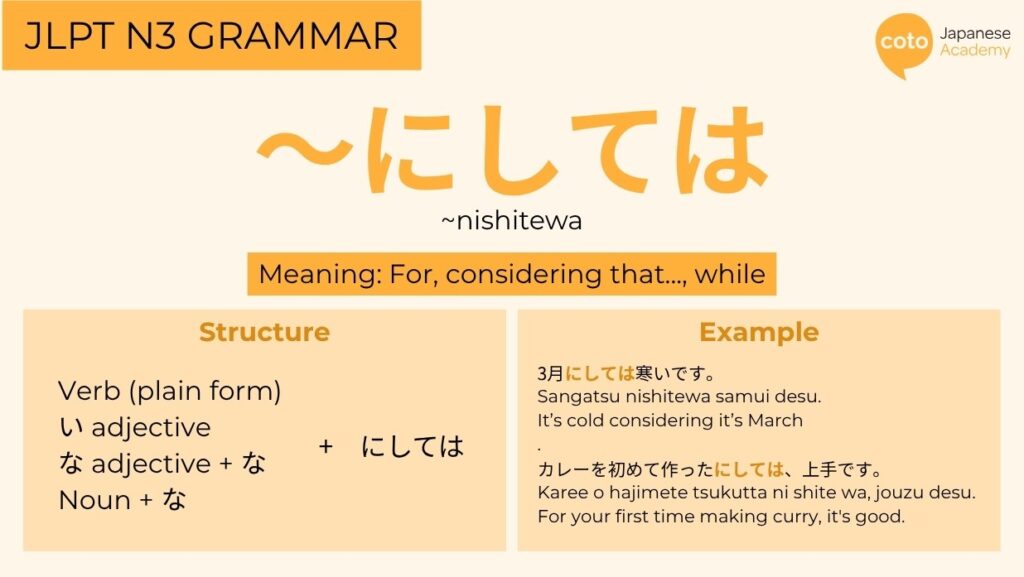
にしては (nishitewa) closely translates “for (someone/something),” “considering that…” or in some cases “while.” It is often used to highlight an observation about someone or something that differs from a certain standard or norm. Let’s take a look at an example to demonstrate how it works:
ステーキにしては、安いですね。
Suteeki nishitewa, yasuidesu ne.
For a steak, it’s quite cheap.
You can see how にしては is used to highlight that the subject is cheap, given that it’s a steak. So, this grammar is used when you want to make a relative statement, since in this example, you are not necessarily saying the steak is cheap. Rather, you are saying that it’s cheap, given it’s a steak.
It is just like using the preposition “for” as in “he’s tall, for someone his age.” In the same way, にしては establishes a comparison of how something/someone is from what is expected or standard. Generally, you only use this grammar to express an observation about someone or something rather than to express something about yourself.
Structure of にしては (Ni Shite wa)
The grammar pattern, にしては, can attach to virtually anything, including verbs, い- and な- adjectives, and nouns.
| Type | Structure |
| Verb (dictionary/plain form) | Verb + にしては |
| い-Adjective | い-Adjective + にしては |
| な-Adjective | な-Adjective + にしては |
| Noun | Noun + にしては |
When attaching にしては to verbs, the verbs must be in dictionary form. For example:
いつもマックを食べるにしては、細いですね。
Itsumo makku o taberu nishite wa, hosoidesune.
For someone who always eats hamburgers, he’s quite skinny.
Here にしては is attached to the verb 食べる (taberu), meaning to eat. You simply attach it to the verb in dictionary form, and you can also attach it to verbs conjugated in different forms, such as past, present, and negative. Let’s break down how this works with different verb conjugations.
| Form | Plain Form + ので | Meaning |
| Present | 食べるにしては | Considering I eat |
| Past | 食べたにしては | Considering I ate |
| Negative | 食べないしては | Considering I won’t eat |
| Past Negative | 食べなかったにしては | Considering I didn’t eat |
にしては (nishite wa) vs として (toshite)
にしては and として (toshite) can both be used to evaluate something in relation to a category or standard, but there is a difference in nuance, changing the meaning being expressed between the two.
Both にしては and として share a similar grammatical structure, the te-form of する (suru), which is して (shite). That means they both involve highlighting an aspect of something from which another thing follows. The distinction comes down to the particles に (ni) and と(to) that precede して.
として uses the particle と, which establishes a logical connection between the two statements, where the second statement is the result of the first. On the other hand, にしては uses the particle に, which implies that both statements exist or happen at the same time. This reflects に’s role as a location particle where A is the setting or context in which B is observed. The particle は then takes the entire phrase attached to にしては and frames it as something being compared, which is where the evaluative and surprising nuance of にしては comes from. Here is a side-by-side example to illustrate this:
Using として:
医者として、患者を助けるのは当然だ。
Isha to shite, kanja o tasukeru no wa touzen da.
As a doctor, it is only natural to help patients.
The role of a doctor directly produces the expectation that follows. So, the second statement, “it is only natural to help patients,” is a result of being a doctor.
Using にしては:
医者にしては、体があまり丈夫じゃないですね
Isha ni shite wa, karada ga amari joubu ja nai desu ne.
For a doctor, he isn’t very healthy, is he?
Here, being a doctor is the backdrop or location against which the observation is placed and compared. The result is surprising precisely because both statements exist at the same time but don’t align with expectations.
にしては is used when something is surprising or unexpected, given what we know about a person or thing. It sets up a standard based on a category and then highlights that the result doesn’t quite match that expectation, either better or worse than expected. 〜として, on the other hand, simply states that something is being considered in the role or capacity of something else, with no sense of surprise or contrast at all.
Example Sentences Using にしては
Now, let’s go through some example sentences to really understand how to use にしては in actual conversation.
Example 1:
3月にしては寒いです。
Sangatsu nishitewa samui desu.
It’s cold considering it’s March.
Example 2:
カレーを初めて作ったにしては、上手です。
Karee o hajimete tsukutta ni shite wa, jouzu desu.
For your first time making curry, it’s good.
Example 3:
日本語を勉強して一年にしては、上手に話せますね。
Nihongo o benkyou shite ichinen ni shite wa, jouzu ni hanasemasu ne.
For someone who has only studied Japanese for one year, you speak it quite well.
Example 4:
子供にしては、難しい本を読んでいますね。
Kodomo ni shite wa, muzukashii hon o yonde imasu ne.
For a child, you’re reading quite a difficult book.
Example 5:
値段にしては、品質がいいですね。
Nedan ni shite wa, hinshitsu ga ii desu ne.
For the price, the quality is quite good.
Learn More JLPT Grammar with Coto Academy!
If you want to practice using this JLPT grammar and many others in actual Japanese conversations, nothing beats practicing with a teacher who can offer practical guidance. So, consider signing up with us at Coto Academy!
Why Study at Coto Academy?
Coto Academy has been offering Japanese classes for over 25 years, with campuses in Shibuya, Yokohama, Iidabashi, Minato, Shinjuku, and online. Our courses focus on practical Japanese, so the grammar you learn is designed for real-life use.
We offer part-time, intensive, and fully online lessons to suit your schedule. Start learning Japanese effectively and confidently with Coto Academy today! Fill out the form below for a free level check.
FAQ:
What does にしては mean?
にしては means “for ~” or “considering that ~.” It is used when the result is surprising or unexpected, given a particular standard or category. The speaker sets up a baseline expectation from (A) and then observes that (B) doesn’t quite match it, either better or worse than expected.
Can にしては be used for both positive and negative contexts?
Yes, にしては works in both positive and negative contexts. The result can be better than expected or worse than expected. The key is simply that it is notable or surprising given the standard by the statement preceding にしては.
What is the difference between にしては and として?
として simply defines a role or capacity with no implied judgment, just that statement B logically results from A. にしては sets A as a context to compare B against, always carrying a nuance of surprise. If the sentence highlights something unexpected, use にしては. If it neutrally states a role, use として.
You may also be interested in reading:
JLPT N4 〜させてください (~Sasete Kudasai) “Please Let Me…”
JLPT N4 Grammar〜のに: Meaning, Structure & Examples
JLPT N4 Grammar: 〜しよう Shiyou (Volitional form – How to say “Let’s do…” in Japanese)