






The JLPT N4 grammar 〜させてください (~sasete kudasai), which closely translates to “please let me do…” It is often used as a polite way of asking for permission to do something. So, let’s learn how to use this JLPT N4 grammar point by breaking down its meaning, structure, and example sentences.
Make Sure to Watch Coto Academy’s YouTube Video About 〜させてください (~sasete kudasai)
Before you continue reading, why not take a moment to watch a quick YouTube lesson with our Japanese teacher, Natsumi-sensei.
Meaning of 〜させてください (~sasete kudasai)
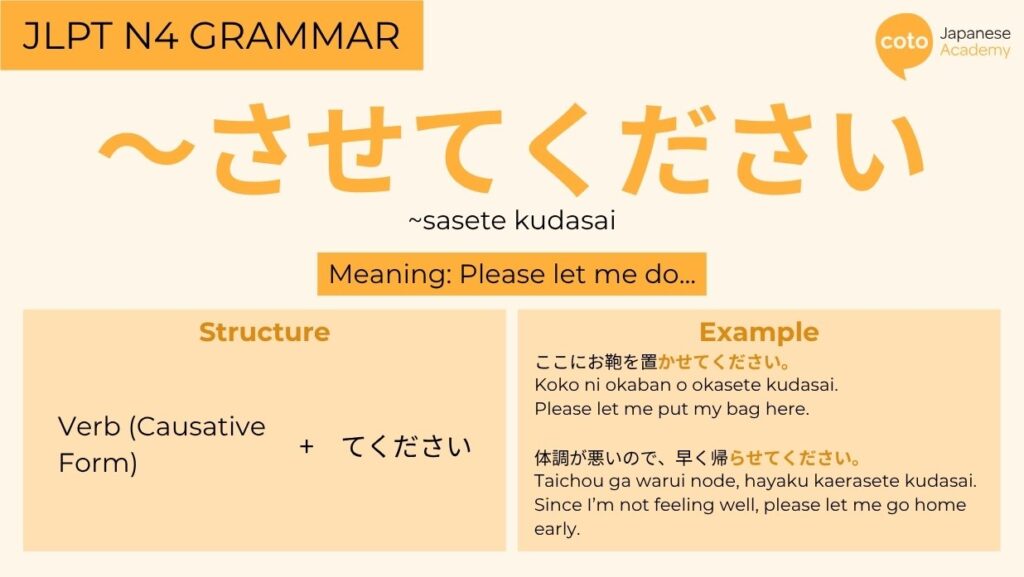
〜させてください means “please let me do (something),” which is used for asking permission to do something on your own or for asking someone to let you do something. The phrase consists of the term させる (saseru), meaning “let me do,” which is the causative form for する (suru), or “to do.” Then ください (kudasai) means “please.” You can use this grammar structure with other verbs as well.
Do you know the difference between ください (kudasai) and お願いします (onegaishimasu)? To find out, check out our blog: What is the Difference Between ください and お願いします!
Sentence Structure of 〜させてください (~sasete kudasai)
The grammar, 〜させてください (~sasete kudasai), makes use of the causative verb form, させる (saseru), which is a verb conjugation that expresses something like “to let…” Then you conjugate the causative verb form into て form and add ください (kudasai). Here is a breakdown of the expression 〜させてください (~sasete kudasai) using the verb する (suru) meaning “to do”:
する (suru) → させる (saseru)
Then, to form the rest of the expression:
させる (drop the る) + て (te) + ください (kudasai) = させてください
Basically, you can conjugate any verb into causative form and add 〜てください to form the structure of the expression:
| Type | Structure |
|---|---|
| Verb (causative form) | Verb (causative form) – る + てください |
Likely the trickiest part of this grammar pattern is that the conjugation changes based on the type of verb, so let’s briefly go through how conjugations work with different verb groups.
Group 1 Verbs (う-verbs) with 〜させてください (~sasete kudasai)
Group 1 verbs, or う-verbs, basically conjugate the last character of the verb stem; for example, this includes words such as 待つ (matsu), meaning to “wait” or 休む (yasumu), meaning to “rest.” Here is how you can conjugate them for the grammar pattern させてください:
1. Conjugating 待つ (Matsu)
待つ (matsu) → 待たせる (drop ru) + てください = 待たせてください (matasete kudasai)
2. Conjugating 休む (Yasumu)
休む (yasumu) → 休ませる (drop ru) + てください = 休ませてください (yasumasete kudasai)
| Verb Dictionary Form | Verb + させてください | English Meaning |
|---|---|---|
| 待つ (matsu) | 待たせてください (matasete kudasai) | Please let me wait |
| 休む (yasumu) | 休ませてください (yasumasete kudasai) | Please let me rest |
Group 2 Verbs (る-verbs) with 〜させてください (~sasete kudasai)
For Group 2 verbs, also known as る-verbs, you simply add the pattern させてください to the verb stem. Examples of Group 2 verbs include: 見る (miru), meaning to “see” or 食べる (taberu), meaning to “eat.” Here is how you can conjugate them for the grammar pattern させてください:
1. Conjugating 見る (Miru)
見る (miru) → 見させる (drop ru) + てください = 見させてください (misasete kudasai)
2. Conjugating 食べる (Taberu)
食べる (taberu) → 食べさせる (drop ru) + てください = 食べさせてください (tabesasete kudasai)
| Verb Dictionary Form | Verb + させてください | English Meaning |
|---|---|---|
| 見る (miru) | 見させてください (matasete kudasai) | Please let me see |
| 食べる (taberu) | 食べさせてください (tabesasete kudasai) | Please let me eat |
Group 3 Verbs (Irregular Verbs) with 〜させてください (~sasete kudasai)
Group 3 verbs are known as irregular verbs since they don’t behave very predictably. This group mostly includes very common verbs such as する (suru), meaning to “do” or 来る (kuru), meaning to “do.” Here is how you can conjugate them for the grammar pattern させてください:
1. Conjugating する (Suru)
する (suru) → させる (drop ru) + てください = させてください (sasete kudasai)
2. Conjugating 来る (Kuru)
来る (kuru) → 来させる (drop ru) + てください = 来させてください (kosasete kudasai)
| Verb Dictionary Form | Verb + させてください | English Meaning |
|---|---|---|
| する (suru) | させてください (sasete kudasai) | Please let me do |
| 来る (kuru) | 来させてください (kosasete kudasai) | Please let me come |
Conjugating 〜させてください into Negative, Past-tense, or Present-Tense
Generally, 〜させてください does not have a past-tense or even present-tense. Since the expression is a demand, the past or present is not relevant. However, you can express a negative, like saying “please don’t let me do…” by saying 〜させないでください (sasenaide kudasai); however, it could also mean “don’t make me do…”
Depending on the context, it could be one or the other. For example, saying 食べさせないでください (tabesasenaide kudasai) could either mean “please don’t let me eat (that)” or “please don’t make me eat (that),” depending on the situation. So, perhaps if you want someone to stop you from eating too many sweets, this expression could mean “please don’t let me eat too many sweets,” or if you’re too full, you could say it to mean “please don’t make me eat anymore.” Here are a couple of examples to demonstrate the difference:
Example 1:
甘い物を食べさせないでください。
Amaimono o tabesasenaide kudasai.
Please don’t let me eat sweet things.
Example 2:
お腹がいっぱいだから、これ以上食べさせないでください。
Onaka ga ippai kara, kore ijou tabesase naide kudasai.
I’m stuffed, please don’t make me eat anymore.
Example:
Example 1:
ここにお鞄を置かせてください。
Koko ni okaban o okasete kudasai.
Please let me put my bag here.
Example 2:
体調が悪いので、早く帰らせてください。
Taichou ga warui node, hayaku kaerasete kudasai.
Since I’m not feeling well, please let me go home early.
Example 3:
窓を開けさせてください。
Mado o akesasete kudasai.
Please let me open the window.
Example 4:
自己紹介させてください。
Jikoshoukai sasete kudasai.
Please let me introduce myself.
Example 5:
写真を撮らせてください。
Shashin o torasete kudasai.
Please let me take a photo.
No worries! Here is the vocabulary table for those sentences:
| Kanji / Writing | Furigana | Romaji | English |
|---|---|---|---|
| ここ | ここ | koko | here |
| お鞄 | おかばん | okaban | bag (polite) |
| 置く | おく | oku | to place/to put |
| 体調 | たいちょう | taichou | physical condition |
| 悪い | わるい | warui | bad |
| 〜ので | 〜ので | ~node | because/since |
| 早く | はやく | hayaku | early/quickly |
| 帰る | かえる | kaeru | to go home |
| 窓 | まど | mado | window |
| 開ける | あける | akeru | to open |
| 自己紹介 | じこしょうかい | jikoshoukai | self-introduction |
| 写真 | しゃしん | shashin | photo |
| 撮る | とる | toru | to take (a photo) |
Learn More JLPT Grammar with Coto Academy!
If you want to practice using this JLPT grammar and many others in actual Japanese conversations, nothing beats practicing with a teacher who can offer practical guidance. So, consider signing up with us at Coto Academy!
Why Study at Coto Academy?
Coto Academy has been offering Japanese classes for over 25 years, with campuses in Shibuya, Yokohama, Iidabashi, Minato, Shinjuku, and online. Our courses focus on practical Japanese, so the grammar you learn is designed for real-life use.
We offer part-time, intensive, and fully online lessons to suit your schedule. Start learning Japanese effectively and confidently with Coto Academy today! Fill out the form below for a free level check.
FAQ:
What does 〜させてください (〜sasete kudasai) mean?
〜させてください is a polite expression used to request permission to do something. It translates roughly as “please let me ~” or “please allow me to ~” in English. It is commonly used in formal and workplace situations.
Is 〜させてください polite enough for formal situations?
Yes, it is polite and appropriate for most formal and business settings. However, if you want to sound even more humble and formal, you can use 〜させていただけますでしょうか, which is the most deferential way to request permission.
Can 〜させてください sound pushy or rude?
In most contexts, it sounds polite and natural. However, because it is phrased as a request rather than a question, it can occasionally come across as slightly assertive if used in the wrong context. When in doubt, softening it with 〜させていただけますでしょうか (~sasete itadakemasudeshouka) is always a safe choice.