






The JLPT N4 phrase, 〜のに (~noni), is often used to contrast two opposing remarks, similar to saying “even though.” You can use this phrase to express dissatisfaction, surprise, or regret over something unexpected or disappointing.
So, let’s learn how to use this JLPT N4 grammar point by breaking down its meaning, structure, and example sentences.
Make Sure to Watch Coto Academy’s YouTube Video About 〜のに (~Noni)
Before you continue reading, why not take a moment to watch a quick YouTube lesson with our Japanese teacher, Yuka-sensei:
Meaning of 〜のに (~noni)
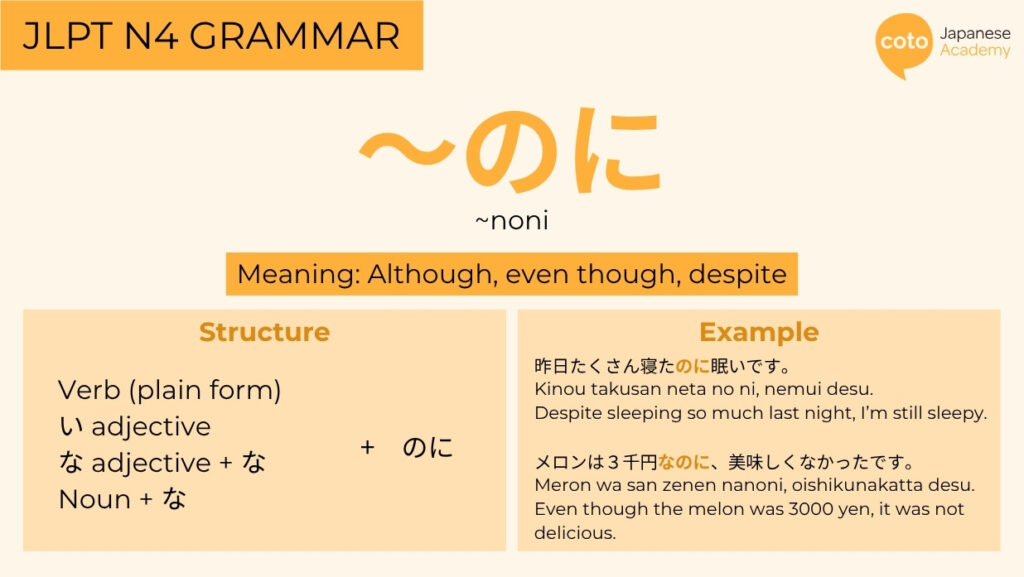
〜のに (~noni) means something similar to “even though,” “despite,” or “although” in English. You often use it to express a contradiction or your surprise at an unexpected outcome. The expression conveys a sense of irony or even disappointment.
The phrase is commonly used in a negative context, usually pairing contradictory statements to convey a sense of disappointment, such as:
ステーキが高いのに、美味しくなかったです。
Suteeki ga takainoni, oishikunakatta desu.
Even though the steak was expensive, it was not delicious.
However, it can be used in a more positive connotation to express an unexpected but pleasant surprise,
ステーキが安いのに、すごく美味しかったです。
Suteeki ga yasuinoni, sugoku oishikatta desu.
Even though the steak was cheap, it was so tasty.
Usually, following 〜のに is a statement that expresses regret or surprise; however, there are cases when it’s quite natural in conversation to leave the sentence ‘unfinished.’ The usage of 〜のに somewhat changes for emotional impact, generally, highlighting an emotion like regret. For example:
傘を持っていけばよかったのに
Kasa o motte ikeba yokattanoni
Should’ve brought an umbrella…
The conditional statement, 持って行けば良かった (motte ikeba yokatta) could be used alone to express how it would’ve been better if you had brought an umbrella. Attaching のに expresses a greater sense of regret, like saying “I really should’ve…” You could describe 〜のに as a rather emotionally loaded expression.
Structure of 〜のに (~noni)
So, you usually attach 〜のに to verbs, adjectives, and even nouns. You can only attach のに to verbs in plain form, for example:
毎日たくさん寝るのに、いつも疲れます。
Mainchini takusan nerunoni, itsumo tsukaremasu.
Although I get a lot of sleep every day, I’m always tired
In the case of both nouns and な-adjectives, you have to add a な; here are some examples using nouns and な-adjectives.
Using 〜のに with Nouns:
犬なのに、何を言っても分かります。
Inunanoni, nani o ittemo wakarimasu.
Even though it’s a dog, it understands everything you say.
Using 〜のに with な-adjectives:
故郷が安全なのに、住みたくないです。
Furusato ga anzen nanoni, sumitakunai desu.
Although my hometown is safe, I don’t want to live there.
| Type | Structure |
|---|---|
| Verb (plain form) | Verb + のに |
| い-Adjective | い-Adjective + のに |
| な-Adjective | な-Adjective + な + のに |
| Noun | Noun + な + のに |
Note that 〜のに itself does not conjugate into past, present, negative, or positive. The word to which 〜のに attaches is what conjugates. Let’s break down how this works with different verb conjugations.
| Form | Plain Form + ので | Meaning |
|---|---|---|
| Present | 雨が降るのに | Although it will rain |
| Past | 雨が降ったのに | Although it rained |
| Negative | 雨が降らないのに | Although it won’t rain |
| Past Negative | 雨が降らなかったのに | Although it didn’t rain |
〜のに (~noni) vs 〜ても (~temo)
The grammar points 〜のに and 〜でも can both mean something like “even though,” but they convey different nuances and emotions. 〜のに deals with real situations that are actually happening or have happened, where 〜ても is generally used to express a hypothetical.
They also differ in emotional nuance; のに carries emotional weight, such as surprise, frustration, regret, or complaint, when reality doesn’t meet expectations. On the other hand, 〜ても is emotionally neutral; it simply states a logical concession with no implied feeling. Here are a couple of examples to demonstrate the differences.
Using 〜のに:
せっかく作ったのに、食べてくれなかった。
Sekkaku tsukattanoni, tabete kurenakatta.
Although I went to the trouble of making it, they didn’t even eat it.
In this statement, you can see how のに describes a real situation that actually happened. Additionally, the use of 〜のに conveys a sense of disappointment that no one ate the food.
Using 〜ても:
雨が降っても、傘を持っていかない。
Ame ga futtemo, kasa o motte ikanai.
Even if it rains, he won’t take an umbrella.
Here, 〜ても is used more as hypothetical rather than describing an actual event. It also doesn’t have any inherent emotional weight and just states a neutral observation.
Example Sentences Using 〜のに
Now, let’s go through some example sentences to really understand how to use 〜のに in actual conversation.
Example 1:
今日はとても寒いのにTシャツを着ています。
Kyou wa totemo samui no ni T-shatsu o kiteimasu.
Even though it’s so cold today, he is wearing a t-shirt.
Example 2:
昨日たくさん寝たのに眠いです。
Kinou takusan neta no ni, nemui desu.
Despite sleeping so much last night, I’m still sleepy.
Example 3:
メロンは3千円なのに、美味しくなかったです。
Meron wa san zenen nanoni, oishikunakatta desu.
Even though the melon was 3000 yen, it was not delicious.
Example 4:
私は1時間前お昼ご飯を食べたのに、お腹が空きました。
Watashi wa ichi jikan maeni ohirugohan o tabetanoni, onaka ga sukimashita.
Although I ate lunch an hour ago, I’m already hungry.
| Kanji / Writing | Furigana | Romaji | English |
|---|---|---|---|
| 今日 | きょう | kyou | today |
| とても | とても | totemo | very, so much |
| 寒い | さむい | samui | cold |
| Tシャツ | ティーシャツ | T-shatsu | t-shirt |
| 着ています | きています | kite imasu | is wearing |
| 昨日 | きのう | kinou | yesterday |
| たくさん | たくさん | takusan | a lot / much |
| 寝た | ねた | neta | slept (past) |
| 眠い | ねむい | nemui | sleepy |
| メロン | メロン | meron | melon |
| 3千円 | さんぜんえん | san zen en | 3,000 yen |
| 美味しくなかった | おいしくなかった | oishiku nakatta | was not delicious |
| 私 | わたし | watashi | I / me |
| 1時間前 | いちじかんまえ | ichi jikan mae | one hour ago |
| お昼ご飯 | おひるごはん | ohiru gohan | lunch |
| 食べた | たべた | tabeta | ate (past) |
| お腹が空きました | おなかがすきました | onaka ga sukimashita | became hungry |
Learn More JLPT Grammar with Coto Academy!
If you want to practice using this JLPT grammar and many others in actual Japanese conversations, nothing beats practicing with a teacher who can offer practical guidance. So, consider signing up with us at Coto Academy!
Why Study at Coto Academy?
Coto Academy has been offering Japanese classes for over 25 years, with campuses in Shibuya, Yokohama, Iidabashi, Minato, Shinjuku, and online. Our courses focus on practical Japanese, so the grammar you learn is designed for real-life use.
We offer part-time, intensive, and fully online lessons to suit your schedule. Start learning Japanese effectively and confidently with Coto Academy today! Fill out the form below for a free level check.
FAQ:
What does 〜のに (~noni) mean?
のに connects two clauses to express “even though” or “despite.” It highlights a contrast where the result is unexpected or disappointing given the premise. It almost always carries an emotional tone, such as surprise, frustration, or regret.
Can 〜のに (~noni) be used for hypothetical situations?
No, the grammar 〜のに requires a real, factual premise. You cannot use volitional statements such as “let’s” with the 〜のに. For hypothetical or general “even if” situations, use ても instead.
Can a sentence end with のに?
Yes, and it is very natural in speech. Leaving the sentence unfinished lets the emotional implication (disappointment, frustration, complaint) hang in the air. Completing the thought can actually sound more blunt.
What is the difference between のに and ても?
のに is used for real situations and carries emotional weight (frustration, regret, surprise). ても is emotionally neutral and used for hypothetical or general “no matter what” situations. If you feel like saying “but!” with feeling, use のに. If you mean “regardless,” use ても.