






The JLPT N4 grammar 〜しよう closely translates to “let’s do!” The grammar is actually the volitional form of する, meaning “to do.” Volitional form is a verb conjugation that is used to express an invitation or suggestion.
So let’s break down what the volitional form is, how it works, and how we can use it in actual Japanese conversation.
Make Sure to Watch Coto Academy’s YouTube Video About 〜しよう (~Shiyou)
Before you continue reading, why not take a moment to watch a quick YouTube lesson with our Japanese teacher, Yuka-sensei:
Meaning of 〜しよう (~shiyou) or 〜よう (~you)
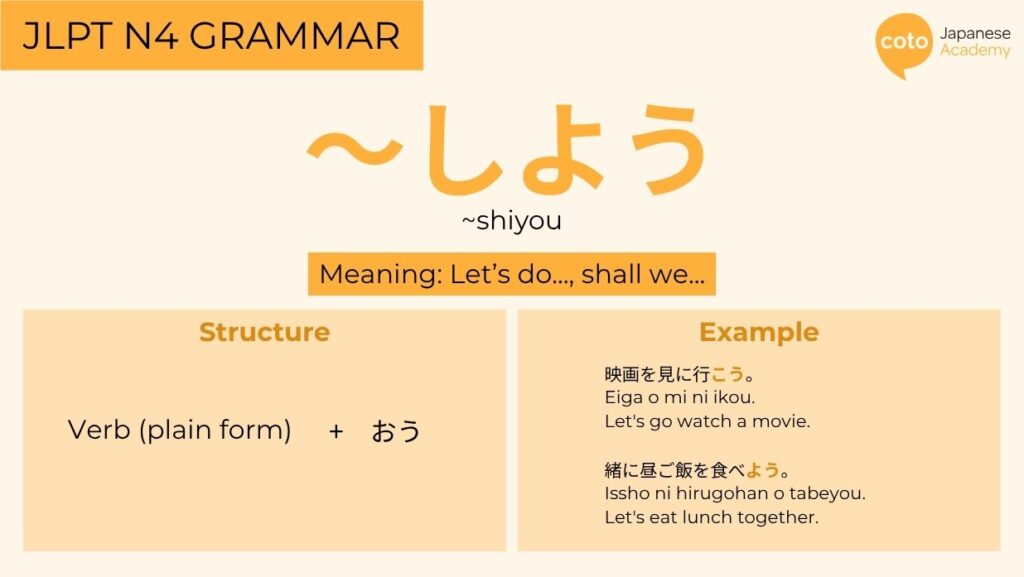
しよう is the verb する (suru) in volitional form, known in Japanese as 意向系 (ikoukei) or 〜よう (~you) form, which is a verb conjugation that conveys an invitation or suggestion. Basically, you use it to ask or request the listener to join you in doing something, usually as a friendly way to say “let’s do…” or “shall we…” The volitional form can be used beyond the verb する, and can be used with virtually any verb.
It’s also a warm and friendly way to agree with someone else’s suggestion, similar to saying “yeah, let’s do it!” Here is an example:
Friend:
週末、うちでバーベキューしない?
Shuumatsu, uchi de baabekyuu shinai?
This weekend, want to have a BBQ at my place?
You:
うん、いいね!しよう!
un, ii ne! shiyou!
Yeah, sounds good! Let’s do it!
So, here しよう, the volitional of する, is being used to express enthusiastic agreement to your friend’s suggestion of having a BBQ at their place.
Friend:
12時はどう?
jyuu ni ji wa dou?
How does 12 o’clock sound?
You:
いいね! 12時から始めようか?
ii ne! jyuu ni ji kara hajimeyou ka?
Great! Let’s start at 12!
In this example, you may notice that the volitional form was phrased as a question. This usage is quite common and can feel a bit less direct or commanding, making the expression feel more suggestive than pushy. While the literal translation of the volitional can be something like “shall we?”, you can sound more inviting or polite by using the volitional form + か? to form a question. This will convey the sentiment of “let’s do!” without seeming forceful!
Structure of 〜しよう (~shiyou) or 〜よう (~you)
The volitional form is a Japanese verb conjugation, so there are 3 different ways to conjugate depending on one of the 3 verb groups: う-verbs, る-verbs, and irregular verbs. So, let’s break down how it works with each group.
Group I – う Verb Endings
For group 1 verbs, also known as う-verbs, the last syllable, which ends with an う (u) sound, is conjugated to おう (ou) sound. So, if a verb ends in く (ku), the character changes to こう (kou) in volitional form. Here’s how it works.
買う(to buy) → 買おう (let’s buy)
行く(to go) → 行こう (let’s go)
遊ぶ(to play) → 遊ぼう (let’s play)
| Dictionary form | Volitional form | English |
|---|---|---|
| 買う (Kau) | 買おう (kaou) | let’s buy |
| 行く (iku) | 行こう (ikou) | let’s go |
| 遊ぶ (asabu) | 遊ぼう (asabou) | let’s play |
Group II – る Verb Endings
Group 2 verbs, or る-verbs, are quite simple to conjugate into volitional form. All you have to do is just replace the る (ru) ending with よう (you). See how it works below:
見る(to see) → 見よう
食べる(to eat) → 食べよう
| Dictionary form | Volitional form | English |
|---|---|---|
| 見る (miru) | 見よう (miyou) | let’s watch |
| 食べる (taberu) | 食べよう (tabeyou) | let’s eat |
Group III – Irregular verbs
Irregular verbs are called irregular since they don’t behave predictably. Luckily, there are mostly just 2 verbs you need to be aware of, so you will just have to memorize how these two conjugate.
する(to do) → しよう (let’s do)
来る(to come) → 来よう (let’s come)
| Dictionary form | Volitional form | English |
|---|---|---|
| する (suru) | しよう (shiyou) | let’s do |
| くる (kuru) | 来よう (koyou) | let’s come |
All these examples of volitional form we just provided are actually in casual form. For example, to say しよう(shiyou) in a more formal form, or basic keigo, would be しましょう (shimashou), which is a more polite way of saying “let’s do…” or rather “shall we do…” However, past, present, or negative conjugation is not relevant to the volitional form, since it expresses a request or a suggestion.
Example Sentences Using 〜しよう (~shiyou)
Now, let’s go through some example sentences to really understand how to use 〜しよう in actual conversation.
Example 1
映画を見に行こう。
Eiga o mi ni ikou.
Let’s go watch a movie.
Example 2
緒に昼ご飯を食べよう。
Issho ni hirugohan o tabeyou.
Let’s eat lunch together.
Example 3:
明日は早く起きよう。
Ashita wa hayaku okiyou.
Let’s wake up early tomorrow.
Example 4:
もっと日本語を勉強しよう。
Motto nihongo o benkyou shiyou.
Let’s study Japanese more.
| Kanji / Writing | Furigana | Romaji | English |
|---|---|---|---|
| 映画 | えいが | eiga | movie, film |
| 見に行こう | みにいこう | mi ni ikou | let’s go to watch |
| 一緒に | いっしょに | issho ni | together |
| 昼ご飯 | ひるごはん | hirugohan | lunch |
| 食べよう | たべよう | tabeyou | let’s eat |
| 明日 | あした | ashita | tomorrow |
| 早く | はやく | hayaku | early |
| 起きよう | おきよう | okiyou | let’s wake up |
| もっと | もっと | motto | more |
| 日本語 | にほんご | nihongo | Japanese language |
| 勉強しよう | べんきょうしよう | benkyou shiyou | let’s study |
Learn More JLPT Grammar with Coto Academy!
If you want to practice using this JLPT grammar and many others in actual Japanese conversations, nothing beats practicing with a teacher who can offer practical guidance. So, consider signing up with us at Coto Academy!
Why Study at Coto Academy?
Coto Academy has been offering Japanese classes for over 25 years, with campuses in Shibuya, Yokohama, Iidabashi, Minato, Shinjuku, and online. Our courses focus on practical Japanese, so the grammar you learn is designed for real-life use.
We offer part-time, intensive, and fully online lessons to suit your schedule. Start learning Japanese effectively and confidently with Coto Academy today! Fill out the form below for a free level check.
FAQ:
What does 〜しよう or the volitional form mean?
The volitional form expresses a suggestion or invitation to do something together — similar to “let’s ~” in English. It can also express the speaker’s own intention or resolve, like “I think I’ll…” or “I will.”
Is the volitional form casual or polite?
The plain volitional (〜おう/〜よう) is casual. For polite situations, add ましょう to the verb stem instead — this is the polite equivalent and safe to use with strangers, teachers, or in formal settings.
Can 〜しよう or the volitional form be conjugated into past or other tenses?
No, the volitional form does not conjugate into past, negative, or other tenses on its own. It exists only in its base form since these other tenses would be relevant, as the grammar form is like a suggestion for a request.