





The grammar pattern ~ていく (te iku) is used to express a change or action that begins now and continues moving forward in time. It combines the て-form of a verb with 行く (iku), which literally means “to go,” giving the overall meaning of something “going on” or “continuing from this point.”
At some point, your Japanese teacher has said that if you study every day, you’ll continuously get better and better at the language. Taking that grammar pattern to mind, you probably want to indicate something that will gradually increase, such as how much time you study Japanese (or any other subject), or the number of hours you work. For that, we recommend that you use 〜ていく.
In this blog, we’ll show you the meaning of ていく, as well as its basic usage. We’ll also show you the difference between ていく and てくる as well. Without further ado, let’s begin!
Want to study Japanese with us?
Make sure to watch our video on ~ていく (~te iku)!
Before you continue reading, why not take a moment to watch a quick YouTube lesson with our teacher, Nami-sensei?
Meaning of ~ていく (~te iku)
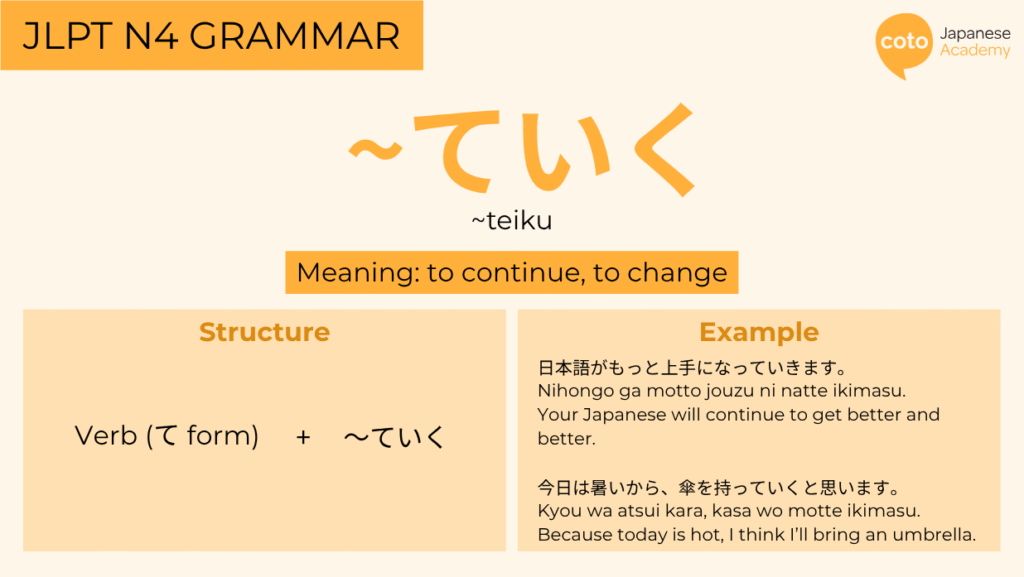
~ていく (~te iku) is a grammar structure that basically indicates gradual change from now to the future. It translates to “to continue” or “to change,” and indicates that something has started and, in turn, will gradually progress. For example, the sentences below indicate gradual change based on the current situation:
毎日勉強すると、日本語がもっと上手になっていきます。
Mainichi benkyou suru to, nihongo ga motto jouzu ni natte ikimasu.
If you study every day, your Japanese will get better and better.
日本に旅行する外国人は増えていくと思います。
Nihon ni ryokou suru gaikokujin wa fuete ikuto omoimasu.
I think there will be more and more foreigners traveling to Japan.
The grammar pattern is also used to indicate physical movement. For example, if you’re about to go out, and the weather forecast says that it’s hot:
今日は暑いから、傘を持っていくと思います。
Kyou wa atsui kara, kasa wo motte iku to omoimasu.
It’s hot today, so I think I’ll bring an umbrella.
Grammar Structure of ~ていく (~te iku)
The sentence structure of ~ていく (~te iku) is:
| Structure | Meaning |
| Verb + ていくVerb + ていきます | To indicate gradual change from one point to another, to indicate “A happened, then this happened.” |
You will need to know the て form in order to conjugate this grammar pattern. For quick reference, just take out the stem and replace it with て, so for example:
- 歩きます (arukimasu) becomes 歩いて (aruite)
- 食べます (tabemasu) becomes 食べて (tabete)
- 読みます (yomimasu) becomes 読んで (yonde)
The difference between 〜ていく (〜te iku) and 〜てくる(〜te kuru)
You might have heard Japanese speakers use ~てくる (tekuru) along with 〜ていく (〜te iku), but is there a difference between the two grammar patterns? We know that いく (iku) means to go and くる (kuru) means to come, but can you use 〜てくる in the same way as 〜ていく?
~てくる indicates physical movement or time that is moving towards you. It’s basically the opposite of ~ていく, as this means that time is moving away from you, or there’s something physically moving away from you:
日本の生活に慣れてきました。
Nihon no seikatsu ni narete kimashita.
They slowly got used to life in Japan, little by little.
教室で椅子を取ってきます。
Kyoushitsu de isu wo totte kimasu.
I’m going to grab a chair from the classroom.
But what if you use both いく and くる in the same sentence? You might have heard someone say the following:
いってきます!
Ittekimasu!
I’m going out (and will come back)!
トイレに行ってくる。
Toire ni itte kuru.
I’m going to the toilet (and will come back).
In the case of the above sentences, the speaker is saying that they will come back after a short period of time. You wouldn’t say きていきます, that would sound strange to the listener. It can be difficult to tell the difference between 〜てくる and ~ていく, but remember that it depends on whether something or time is moving towards you or away from you.
In addition, some verbs can only take 〜てくる. For example, the verbs to see, 見える (mieru), smell, 匂いがする (nioi ga suru), and listen, 聞こえる (kikoeru) are called perception verbs. If you were to use てくる along with these verbs, it describes the feeling of perceiving something.
富士山が見えてきた。
Fuji san ga miete kita.
Mt. Fuji came into view.
音楽が聞こえてくる。
Ongaku ga kikoete kuru.
The music can be heard.
Example Sentences Using ~ていく (~te iku)
Below are more example sentences when you can use ていく:
日本語を読むことに慣れていきます。
Nihongo wo yomu koto ni narete ikimasu.
I’ve gotten used to reading in Japanese.
この資料を先生に持って行ってください。
Kono shiryou wo sensei ni motte itte kudasai.
Please take these materials to the teacher.
More ways to use ~ていく
なっていく (natte iku)
When combining ~ていく with なる, you get this grammar pattern. Use this pattern to describe a change in the state of something. For い adjectives, replace the い with く.
| Type | Structure |
| い adjective | い adjective + く + なっていく |
| な adjective | な adjective + に + なっていく |
好きなことをやったら、もっと嬉しくなっていきます。
Suki na koto wo yattara, motto ureshiku natte ikimasu.
If you do what you love, you’ll become happier.
少し休んで、だんだん元気になっていきます。
Sukoshi yasunde, dandan genki ni natte ikimasu.
Take a short rest, and you’ll gradually feel better.
Conclusion for JLPT N4 Grammar ~ていく (~te iku)
ていく (te iku) can be used to describe something that is gradually changing over time, or something that’s moving away from you. It can be difficult to use this, but with enough practice, you’ll gradually get the hang of this grammar pattern.
Upgrade your Japanese with Coto Academy!
Want to learn more JLPT grammar? Why not take Japanese lessons with Coto Japanese Academy? We’ve been offering practical Japanese courses for over 25 years, with locations in Shibuya, Shinjuku, Minato, Iidabashi, Yokohama, and online. We also offer JLPT preparation courses for those who want to pass the JLPT with flying colors.
Ready to learn with us? Contact us by filling out the form and get a free level check!
FAQ
What does ~ていく mean?
~ていく basically translates to “to continue” or “to change.” This grammar pattern is used to describe gradual change based on the current situation.
What’s the difference between 〜ていく (〜te iku) and 〜てくる(〜te kuru)?
An easy way to tell the difference between the two is the direction the state is going. ていく describes something moving away from you, whereas てくる describes something moving towards you.
Can I also say なってくる (natte kuru) in tandem with なっていく (natte iku)?
Again, this depends on how this grammar pattern ends. For なっていく, you’re describing something that is going to change, but for なってくる, you’re including the endpoint of the forthcoming change.
Read more:
- JLPT N4 ながら (Nagara): How to say “While…” in Japanese
- JLPT N5 〜のが好きです (~no ga suki desu) Meaning & Examples
- JLPT N5 Grammar ~ませんか (Masenka): Meaning, Example, Use
- JLPT N4 Grammar to Know