Need more help with Japanese vocabulary about post offices in Japan? In this cheat sheet, we have listed some common phrases and words for you to use there.
We have included terminology on how to send a Japanese postcard and deliveries.
There are various ways to which one can go about sending an overseas parcel from Japan. International package delivery is mainly split into four ways: EMS, Airmail, SAL and surface mail. Each delivery company is different based on its service and pricing.
Click here for more information more the different mailing methods.
It is important to thank the service staff for helping you by a simple “Arigato gozaimasu (Thank you)” or “Otsukaresama deshita (Thank you for your hard work)“. This is a kind gesture to express gratitude for their efforts.
If you wish to have a short-term study in Tokyo, Check out our 3-month intensive Japanese courses. Also, feel free to send us an inquiry if you have any questions!
Start taking Japanese lessons and master these terminology today!
Need more help with Japanese vocabulary about post offices in Japan? In this cheat sheet, we have listed some common phrases and words for you to use there.
Japan has one of the best postal services in the world, and there are approximately 24,000 post offices in Japan. Post offices in Japan also offer financial services such as banking and insurancethat allow the withdrawal of money using a foreign-issued credit card or cash card.
Japanese post offices are open Monday-Friday 9 am–5 pm for mail and Monday-Friday 9 am–4 pm for other services.
Japanese vocabulary can be difficult to learn, but practice makes perfect. This is part one of the cheat sheet for the Japanese post office vocabulary, so make sure you follow up for part two.
Japanese Post Office Vocabulary Sentence Examples
Here is how you form basic sentences with the terminology:
Example 1:
ゆうじんにはがきをおくるためにゆうびんきょくにいきました。
yūjin ni hagaki wo okuru tame ni yūbinkyoku ni ikimashita.
I went to the post office to send my friend a postcard.
Example 2:
こづつみがとどいたときにはいえにいなかったため、ゆうびんポストにふざいひょうがとどいてました。
kozutsumi ga todoita toki ni ie ni inakatta tame, yūbin posuto ni fuzaihyō ga todoitemashita.
I was not home when my parcel arrived, so a delivery notice was delivered to my mail box.
Japanese Post Office Vocabulary –
Japanese
Pronunciation
Meaning
ゆうびんきょく
yūbinkyoku
Post Office
ポスト
posuto
Mailbox
ふうとう
fūtō
Envelope
はがき
hagaki
Postcard
こづつみ
kozutsumi
Parcel
てがみ
tegami
Letter
いんさつぶつ
insatsubutsu
Printed matter
かきとめ
kakitome
Registered mail
こうくうびん
kōkūbin
Air mail
ふなびん
funabin
Sea mail
ふざいひょう
fuzaihyō
Delivery notice
にもつ
nimotsu
Package
そうりょう
sōryō
Shipping fee
われもの
waremono
Fragile
If you wish to have a short-term study in Tokyo, Check out our 3-month intensive Japanese courses. Also, feel free to send us an inquiry if you have any questions!
Start taking Japanese lessons and master these terminology today!
If you are a new resident to Japan – visiting the Tokyo Regional Immigration Bureau (東京入国管理局) / (Tokyo Immigration Office) is likely something that you will have to do.
In this blog post we hope to answer some of the most frequently asked questions about Immigration in Tokyo and to give you vocabulary that you will need while visiting.
Useful Vocabulary for the Tokyo Immigration Office
Certificate of Eligibility (CoE) –Zairyu Shikaku Nintei Shomeisho – (在留資格認定証明書)
Application for Extension of Period of Stay – Zairyū kikan kōshin kyoka shinsei-sho – (在留期間更新許可申請書)
Application for Change of Status of Residence – Zairyū shikaku henkō kyoka shinsei-sho – (在留資格変更許可申請書)
Application for Permanent Residence – Eijū kyoka shinsei-sho – (永住許可申請書)
Apply for a visa. – Biza o toru – (ビザをとる)
For a Japanese visa to expire – Biza ga kireru – (ビザが切れる)
To update your visa – Biza o koshin suru – (ビザを更新する)
To apply for your visa – Biza o shinseisuru – (ビザを申請する)
Period of Extension – Kikan o encho suru – (期間を延長する)
You may need to ask your manager to take a half-day off when you visit the Tokyo Immigration Office. The Tokyo Regional Immigration Bureau is only open Weekdays during regular business hours. This means that you will have to leave work or take time off.
Here is an example dialogue that will teach you how to ask your manager in Japanese for a half-day off to visit Immigration.
Example Dialogue – (While at work speaking with a colleague about the Immigration Office):
A:もうすぐビザが切れちゃうから、また入管に更新に行かないといけない。 Mōsugu biza ga kire chaukara, mata nyūkan ni kōshin ni ikanaito ikenai.
My visa will expire soon – so I will have to visit immigration to update it.
B: じゃあ、部長に言って半休とった方がいいよ。すごく込むから朝早く行った方がいいって、ジョンさんが言ってた. Jā, buchō ni itte hankyū totta kata ga ī yo. Sugoku komukara asa hayaku itta ho ga ītte, Jon-san ga itteta.
Well then, you better ask your manager for half-day off. John was saying that its better to get there really early because it gets very crowded.
A: うん、そうする。部長になんて言ったらいいかな。 Un,-sō suru. Buchō ni nante ittara ī ka na.
I will do that. What is the best way to ask the director?
B: 「すみません、入管にビザ更新の手続きをしに行かないといけないので、来週半休をいただいてもいいでしょうか。」 Sumimasen, nyūkan ni biza kōshin no tetsudzuki o shi ni ikanaito ikenainode, raishū hankyū o itadaite mo īdeshou ka.
“I’m sorry I have to visit the immigration office to apply for a visa renewal, so may I have a half-day off next week?”
A: ありがとう! Arigatou!
Thanks!
F.A.Q. Tokyo Regional Immigration Bureau
Where is the Tokyo Immigration Office?
(東京入国管理局)
Tokyo Regional Immigration Bureau
5 Chome-5-30 Kōnan, Minato-ku, Tōkyō-to 108-8255
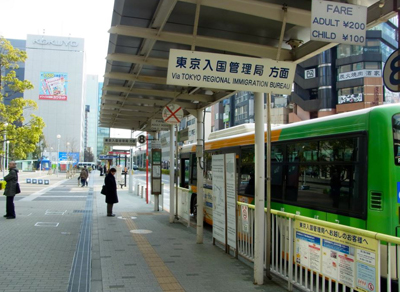
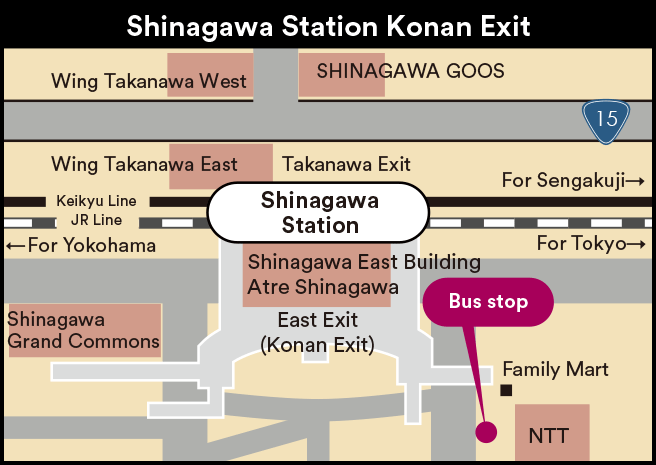
Tokyo Regional Immigration Bureau is located in Konan – and is most easily accessible by Bus from the Konan exit of Shinagawa station. Once you exit from the Konan Side – passing Atre, you will see marked signs directing you to walk left on the elevated walkway and walk down the stairs to the
Where is the bus stop at Shinagawa (品川) Station?
The Tokyo Regional Immigration Bureau Bus is the #8 bus – which can be found by going left on the walkway and taking the stairs down in-front of the family mart from the Konan (East) exit of Shinagawa (品川) Station. You can see how to get there from the image above – as well as the google map below – all of the blue bus icons are different stops and you will see the #8 bus marked as in the photo above.
What time should I arrive?
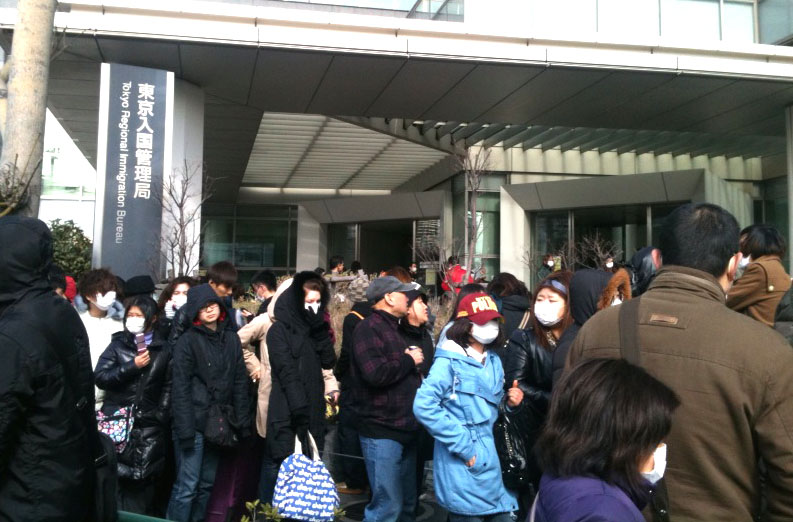
Tokyo Regional Immigration Bureau normally has a line of people waiting for it to open starting from 7:30 most mornings. Mondays and Fridays are especially busy due to it not being open on weekends.
The counters that accept applications for Visa Extensions and Certificate of Eligibility open from 8:30 and the Counters processing visa extensions open from 9:00. Applications are assigned a number and are handled on a first-come-first-serve basis.
Our advice would be to arrive early with all of your documents prepared – and wait outside in the line for early applications. In our experience If you receive a application number lower than 50 – you should not have to wait more than 1 hour to be processed. Line of lucky people waiting for Immigration to open.
What documents do I need for my Japanese Visa application?
We can’t give specific advice because it depends on what you are applying for but generally you will need the following:
Passport Photo (Taken within the past 3 months)
Filled Application Form (Varies based on application type)
Supporting Application Documents (Varies based on application type)
Food! 😉 There is a Family Mart on the first floor of the immigration center – but there is nothing surrounding it – meaning long lines and potentially missed call numbers for your application. We recommend that you bring some water and snacks with you so that you don’t have to wait in a long line at family mart. We would also recommend to bring something to read as wait times are unpredictable.
Are you a expat / foreign professional in Tokyo? Coto Japanese Academy helps many foreign professionals with their Japanese learning. Click below to learn more!
December and January are the busiest times for the Japanese post offices and it all come to one reason: the tradition of New Year‘s postcards (nengajo). And yes, it’s probably the biggest item on the calendar of annual events!
New Year wishes postcard: 年賀状
年賀状 is composed of year 年, congratulations 賀 and 状, meaning circumstances. With the New Year approaching, thoughts wanders towards families, relatives and close ones. The tradition is rooted in history, when people needed to let others, whom they did not often meet, that they were alright.
In spite of Japanese people’s love for smartphones, tablets, and computers, hand written 年賀状 remains a strong tradition. Of course, people can also buy the cards at stationaries or post offices, but making your own is a real pleasure and show how much you’ve thought about the person. Most of the printed postcards will have Chinese zodiac sign of the new year, along with conventional greetings.
Handling postcards the Japanese Way
年賀状 are a yearly challenge for Japanese post office. Indeed, they guarantee the delivery on January 1st for all postcards posted before the end of December. To accomplish such enormous task, special postboxes are installed. Afterwards, workers hired specially for the season will sort all the 年賀状. Postcards will be stored until New Year.
Check out our other blog posts on Japanese New Year:
You’re thinking of sending a 年賀状 to your Japanese friends? Doing your own 年賀状 is the perfect way to demonstrate your handwriting skills. Here a few greetings you could use.
今年もよろしくお願いします。I hope for your favor again in the coming year. This is also one of the ways in which you can wish others a Happy New Year!
(新年)あけましておめでとうございます。 Happiness to you on the dawn [of a New Year]
旧年中はお世話になりました。Thank you for everything you did last year.
ご健勝とご多幸をお祈り申し上げます。Wishing your family good health and happiness.
年始のご挨拶を申し上げます。A New Year’s greeting to you.
We’ve compiled a few greetings words, called 賀詞, suitable for friendly relations. Keep in mind not to use them when you’re writing to your boss or elder.
謹賀新年 Happy New Year
賀正 Happy New Year
初春 Early spring
迎春 Welcome spring
A Last Word
Traditions don’t come without rules. Japanese have better be careful with their address book as one should never send a 年賀状 to someone who lost a family member over the past year. To avoid an impair, the family of the deceased will have to send a mourning card, 喪中葉 to let friends and relatives know not to send a greetings card.
Check out our other blog posts on Japanese New Year:
Coto Japanese Academy is a unique Japanese Language School in Iidabashi Tokyo, we offer relaxed and fun conversational lessons for all levels of Japanese learner. Coto Japanese Academy prides itself on its community atmosphere and fun lessons that focus on creation of opportunities to speak and learn Japanese. If you are interested in studying Japanese in Tokyo – please visit our contact page here.
Many challenges await expatriates in Japan. The small actions of daily life may become mountains to cross, and one of them is dealing with the Japanese post office. Sending a letter might not be difficult, but sending a package can prove to be quite challenging.
Did you know that the Japanese postal system is said to be one of the best in the world? With some information, you will have no problem going to the post office! So let’s learn how to send a package in Japanese!
First of all, let’s check all the types of international mail:
– Surface mail
– Air mail
– SAL (Surface Air Lifted) mail
– EMS
* EMS also includes a pickup service.
The post office serves two major functions (the first being mail and the second being savings and insurance), so be sure to go to the correct service counter. Generally, the first thing you do at the postal office is pick up a numbered ticket at one of the two counters. Use the signs, red for mail and green for savings and insurance, to find the right counter.
Kanji for use at the counters:
郵便 Mail
切手 stamp
貯金 savings
保険 insurance
The invoice includes both Japanese and English, allowing you to fill out the forms in English.
Customer: Kore o Austria made okuritain desu ga.
Post office clerk: Koukuu bin de iidesu ka?
Customer: Dono gurai kakarimasu ka?
Post office clerk: Itsuka gurai desu ne. EMS dato futsu ka de ikimasu yo.
Customer: EMS tte nan desuka?
Post office clerk: Kokusai supiido yuubin to itte, ichiban hayain desu.
Customer: Ikura desu ka?
Post office clerk: EMS dato nisen-happyaku yen, airmail dato sen-happyaku -rokuyuu yen desu.
Customer: Takai desune. Motto yasuku okuritain desu ga.
Post office clerk: SAL bin dato sen-hachiyuu yen desuga, ni-shuu kan gurai kakarimasu.
Customer: Sou desuka. Jaa, koukuu-bin ni shimasu.
Post office clerk: Soredewa kochira no youshi ni hitsuyou jikou o gokinyuu kudasai.
Customer: Eigo de iidesuka?
Post office clerk: Hai, daijyoubu desu.
Customer: I would like to send this to Australia.
Post office clerk: Would airmail be okay?
Customer: How long does it take?
Post office clerk: About five days. It will be there in two days if you use EMS.
Customer: What is EMS?
Post office clerk: It means “Express Mail Service,” and it’s the fastest.
Customer: How much does it cost?
Post office clerk: EMS would be ¥2,800, and airmail would be ¥1,860.
Customer: That’s expensive. I’d like to send it more cheaply.
Post office clerk: SAL mail would be ¥1,080, but it will take about two weeks.
Customer: Is that so? Then I’ll go with airmail.
Post office clerk: Alright, please fill in the required details on this form.
Customer: Is English okay?
Post office clerk: Yes, that would be fine.
Vocabulary & Useful Phrases
航空便 (Kou kuu bin): Air mail
どのぐらいかかりますか (Dono gurai kakari masu ka)? : How long does it take?
___ってなんですか (____tte nan desu ka)? : What is ___?
____だと (A dato…, B dato…): A would be …, and B would be …
もっと安く/早く送りたいんですが (Motto yasuku/ hayaku okuritain desu ga): I’d like to send it more cheaply/quickly
___にします (A ni shimasu): I’ll go with A
用紙 (Youshi): Form
必要事項 (Hitsuyou jikou): Required details
ご記入ください (Go kinyuu kudasai): Please fill out/in
___でいいですか (___de iidesu ka?) : Is ___ okay?
Be careful, you may be forbidden to send things such as food, snacks etc. depending on the country. You can check this directly online.
If you are looking to find a post office near you, here’s how you can ask for directions or check with passers-by as to whether if there is any near you!
Credit CC BY 2.0: nambon
Title: 神宮前六郵便局 source: Flickr
For: How to send a package in Japanese
Coto Japanese Academy is a unique Japanese Language School in Iidabashi Tokyo, we offer relaxed and fun conversational lessons for all levels of Japanese learner. Coto Japanese Academy prides itself on its community atmosphere and fun lessons that focus on creation of opportunities to speak and learn Japanese. If you are interested in studying Japanese in Tokyo – please visit our contact page here.
Are you planning to take the JLPT and wondering how you can apply online in Japan? You are in the right place. This blog will be a thorough guide on how to apply for the JLPT if you are planning to take the test in Japan, step by step. It’s almost that time of the year again when most of us are getting all ready to sign up for the Japanese Language Proficiency Test, otherwise known as the JLPT. In 2026, there are a few important updates to keep in mind — including a new rule that only residents of Japan can take the JLPT in Japan. Tourists and short-term visitors are no longer eligible. With varying difficulty levels from N5 to N1 (with N1 being the most difficult), it is relatively important to start deciding on which level to take on the test date, and if you are eligible. Now, let’s go through how to register for the JLPT in Japan and the key details you should know before signing up!
When is the 2026 JLPT test?
The JLPT in Japan is held twice a year: in July and in December. For 2026, the first JLPT will be held on Sunday, July 5, 2026, and the second JLPT will be held on Sunday, December 6, 2026. This frequency might vary if you are taking the JLPT outside. Either way, these tests are usually held on the first Sunday of July and December.
First JLPT Test in 2026: First week of July
Second JLPT Test in 2026: First week of December
In 2027, you can alsoexpect the tests to take place around early July and early December. Registration usually opens a few months before each test, with exact dates varying depending on your location. It’s best to check the official JLPT website or your local test center for the most accurate information as the dates approach.
When is the application period for the 2026 JLPT?
Registration for the JLPT takes place a few months before the actual test date. The registration period for the July 2026 JLPT is open from March 17 to April 7.
The registration period for the December 2026 JLPT is expected to open in August and close in September 2026—the same timeline typically applies to the December 2027 test as well.
Tourists and short-term visitors are no longer allowed to take the JLPT in Japan
Starting in 2026, Japan no longer allow tourists or short-term visitors to take the JLPT in Japan. Moving forward, the administration will require proof of residency and for applicants to input their residence card (在留カード, zairyuu card) number.
According to the announcement, “The 2026 JLPT is primarily intended for non-native Japanese speakers who are mid-to-long-term residents or special permanent residents.”
People in certain visa categories can apply for the JLPT in Japan, but with a few conditions.
Non-native Japanese speakers who have Japanese nationality
People with permission for provisional stay (residence and contact information must be properly verified)
Those under the Japan–U.S. Status of Forces Agreement or the UN Forces Agreement
Diplomats
Officials
However, if you fall into any of these categories, you’ll need to declare your status during the application process. You may also be asked to provide identification documents, such as your passport, to confirm your nationality or visa status.
According to JEES, this decision comes after a large number of overseas applicants who use invalid phone numbers and contact information, which leads to problems in delivering physical documents, such as the test voucher or score reports, when the JLPT results are out. Because of this, when you are applying online via the MyJLPT portal, you will now have to provide your residence card number and its expiration date.
Study the JLPT with Coto Academy!
Coto Academy students have a higher pass rate than the national average, thanks to our proven JLPT Prep Course. We offer two flexible options: a year-round JLPT course and an intensive 3-month sprint course timed perfectly before test day. Our 3-month, semi-intensive course meets every Saturday for 3 hours, covering everything from high-frequency kanji to the specific logic needed to ace the reading section. What makes these classes stand out is the teachers, who specialize in teaching JLPT. They will give you tips and techniques you simply won’t get from self-study. Join our class today!
You have two options: take the test locally in Japan (only available if you hold a valid Japanese residence card) or in an educational institute overseas. The JLPT is hosted in local institutions in most Southeast Asian countries, North America, Europe, Latin America, the Middle East, Africa, Oceania, and South Asia. However, the frequency of the JLPT might vary, with some hosting the JLPT twice a year and others only once a year. For the full and comprehensive list of overseas institutes that conduct JLPT, head down to the link over here to check if it is an approved institute.
As the location in which you take the JLPT varies, there may be different procedures, windows, or deadlines that you have to take note of. However, the test date still remains the same. For more information on how you would go about applying for the JLPT online or otherwise, please click on any one of the links below:
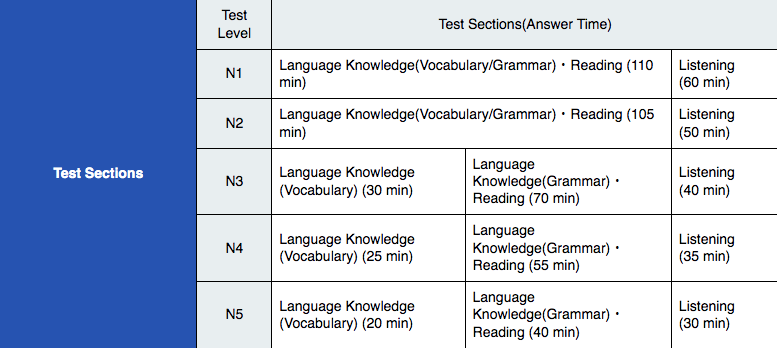
Looking at the test components, JLPT Test Levels N1 to N3 are composed of 3 Components: Reading (60 marks), Vocabulary (60 marks), and Listening (60 marks). As for JLPT Test Levels N4 to N5, there are 2 Components: Japanese Language Knowledge (120 marks) and Listening (60 marks).
If you are unsure of how to prepare for JLPT N2 or N3, click on the links and it will lead you to a guide we came up with some time back!
However, in order to pass, you need to meet 2 conditions:
Score at least 19 marks for any sections with 60 marks obtainable and 38 marks for sections with 120 marks obtainable.
Meet the overall passing grade for the test at each level. Here’s a list of the passing marks:
JLPT Level
Vocabulary/ Grammar)
Reading
Listening
Total Score
N1
19
19
19
100
N2
19
19
19
90
N3
19
19
19
95
JLPT Level
Vocabulary/ Grammar and Reading
Listening
Total Score
N4
38
19
90
N5
38
19
80
How to Apply to the JLPT in Japan Online
If you are living in Japan as a resident (for example, as a student, employee, or dependent), you can take the JLPT in Japan. Applying the JLPT online requires two big steps: creating your MyJLPT account and applying for the JLPT level you want to take.
Part 1: Create Your MyJLPT Account
MyJLPT is a website for people who want to take the Japanese-Language Proficiency Test (JLPT) in Japan. On MyJLPT, you can apply for the test, check your test results, and request a Certificate of Result and Scores online. The website is managed and operated by Japan Educational Exchanges and Services (JEES). Visit this page to start creating your MyJLPT account.
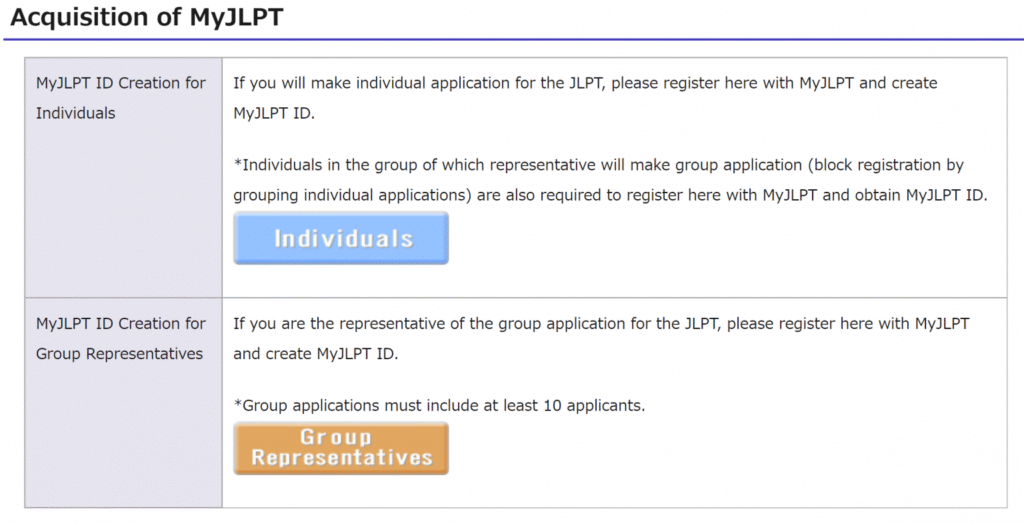
Typically, for most of us, we want to apply for the JLPT as individuals.
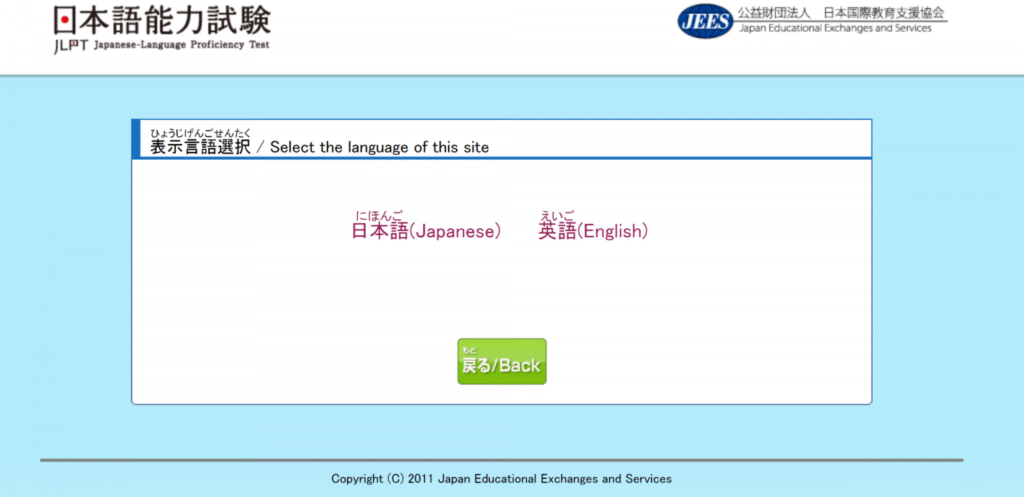
To reduce misunderstanding, we highly recommend selecting English for the language setting.
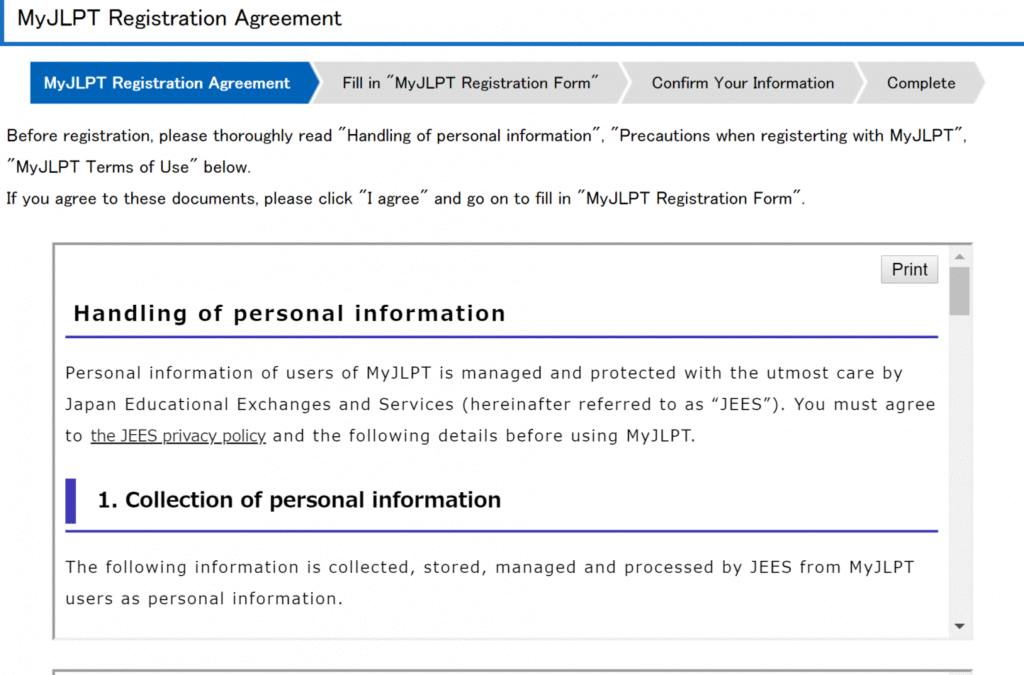
Once you click on your desired language, the site will take you to a long registration agreement. This lists everything from how they handle personal information to the exact eligibility of those who will be able to use MyJLPT.
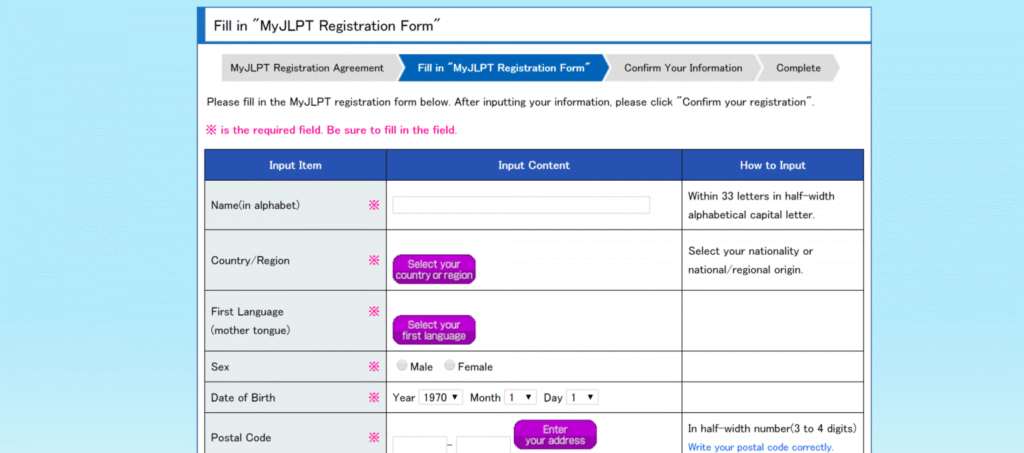
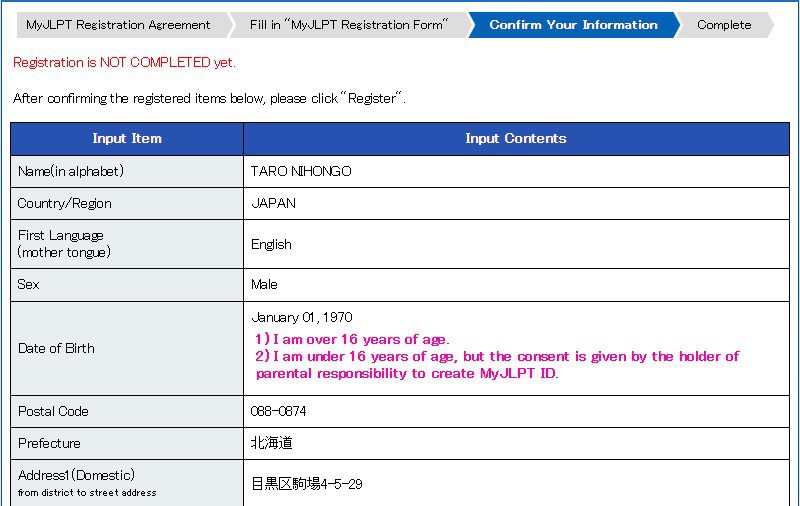
Next, you will fill out all of your personal information. Make sure your name and address match the current address on your residence card, as well as your date of birth. Do not lie. Your information is often used for cross-checking on the day of the test.
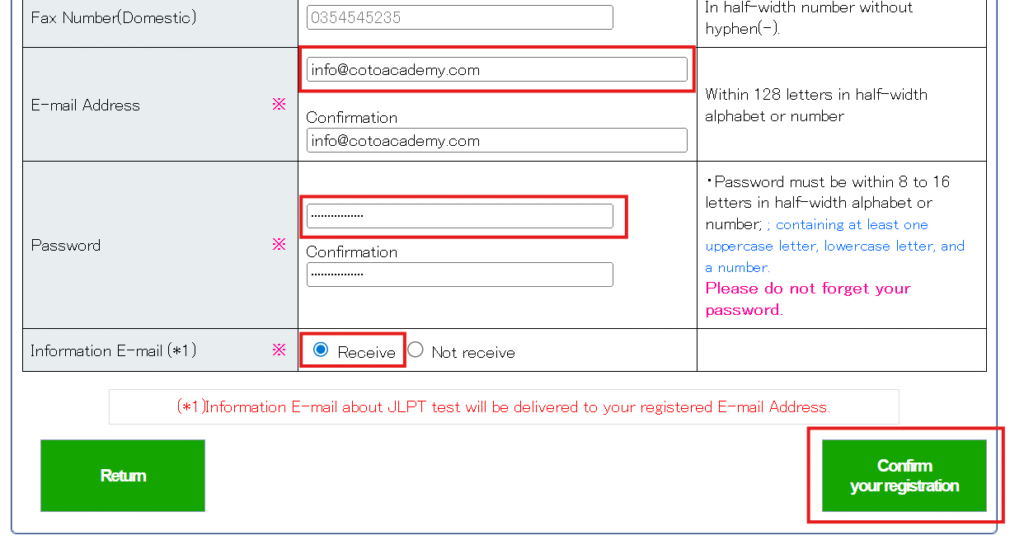
At the bottom of the page, you will set your email and password. Do not forget this information, as it will be used the next time you log in to your MyJLPT page to check your past scores and JLPT records. Finally, we highly recommend that you opt to receive information emails from the JLPT! This will allow them to send you notifications regarding the test. The JLPT administrator does not send a lot of marketing emails, so you will not get spammed!
Finally, confirm your personal information and check your email Inbox for a confirmation email. They will give you your new MyJLPT ID, which you will use to log into your MyJLPT account.
Part 2: Registering for the JLPT Online with your MyJLPT Account
Once you have obtained the MyJLPT ID, you will be asked to complete the online application from your MyJLPT page. You can log back in by going to the official JLPT in Japan website once again. The website itself is more friendly to certain web browsers, and the site recommends that you use Microsoft Edge.
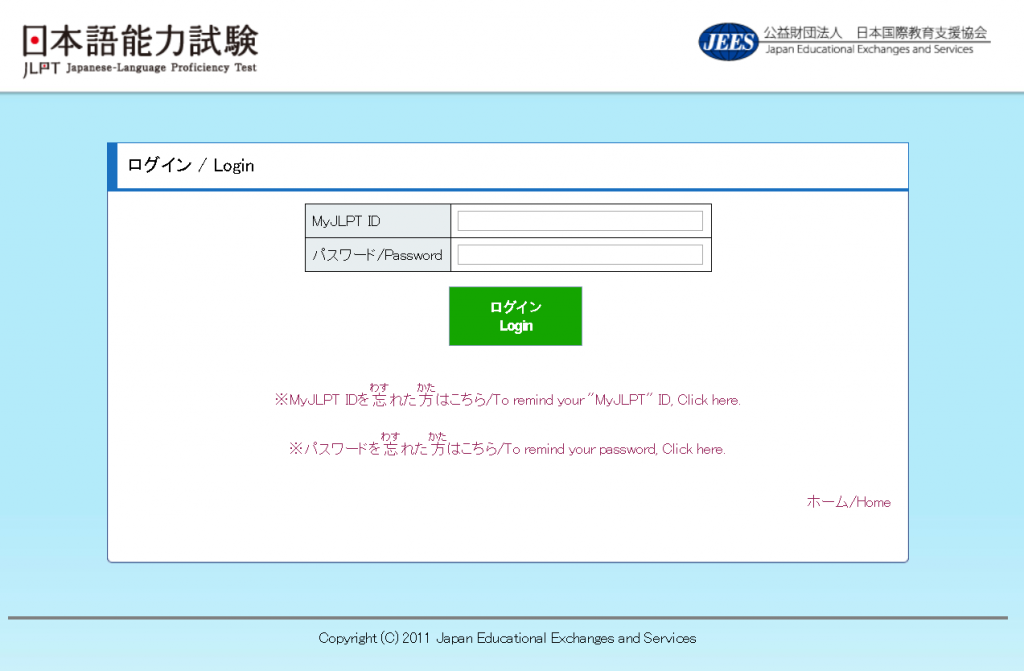
Step 1: Log in to your My JLPT account
First, try to log in to your MyJLPT account. Input your ID (which should be sent to your inbox the moment you finished registration) and the password you set.
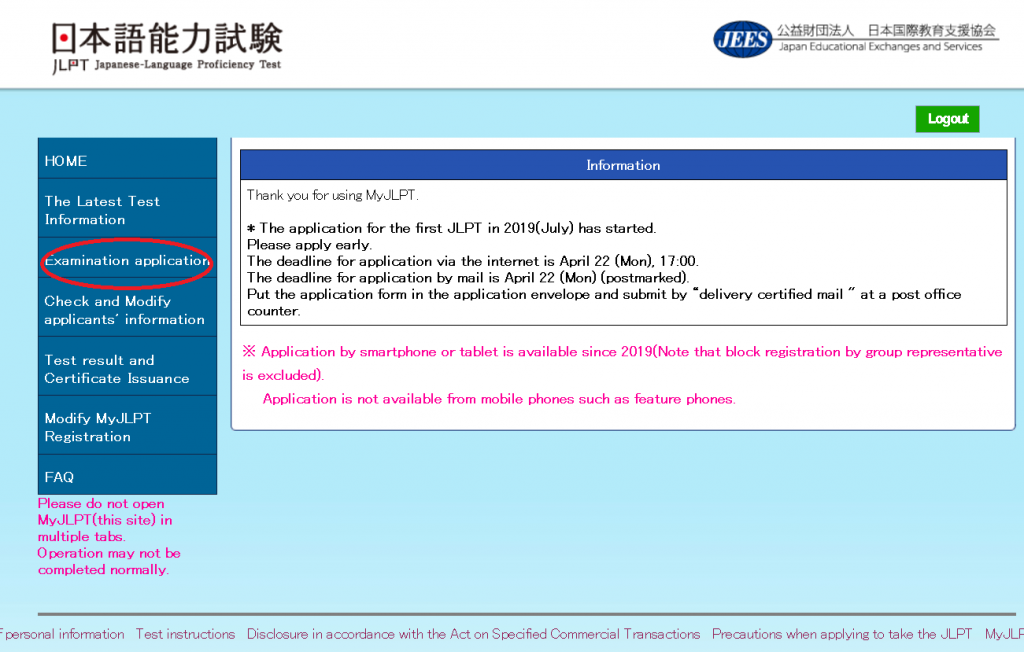
Step 2: Click on “Examination application”
Before you start your application, there’s one important thing to keep in mind!
When you log in to your MyJLPT account, you will only see the test that is currently within the official application period. If the application window is not open yet, the test simply will not appear.
For example, if you log in on March 1, hoping to apply for the July 2026 JLPT, you may not see anything available. Don’t panic! This just means the application period hasn’t started yet. The system will let you know that it is not currently accepting applications.
The best thing to do is check the official announcement dates and come back during the designated application period. Once it opens, you’ll be able to complete your registration without any issues.
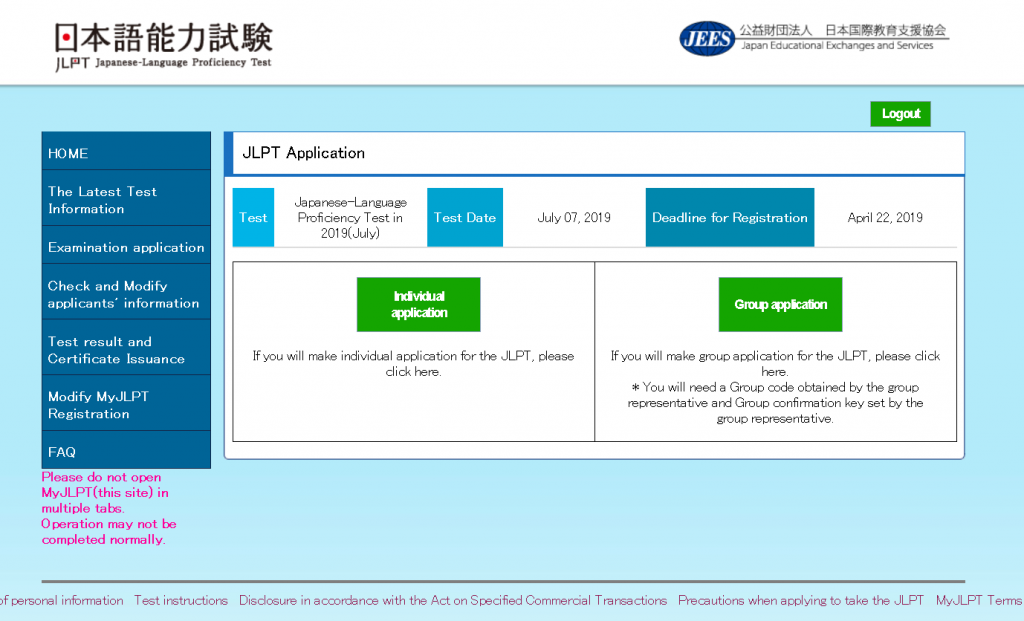
Step 3: Choose your application type
Most of us will apply for the JLPT involuntarily, so select “Individual application”.
Step 4: Sign the agreement to the privacy policy
Next, you’ll be directed to the privacy policy and some important rules. It may look like one of those long pages that make you want to skip reading, but there are a few important things you should know.
For example, the JLPT application fee is not refundable once you have paid it, even if you later decide to cancel your application.
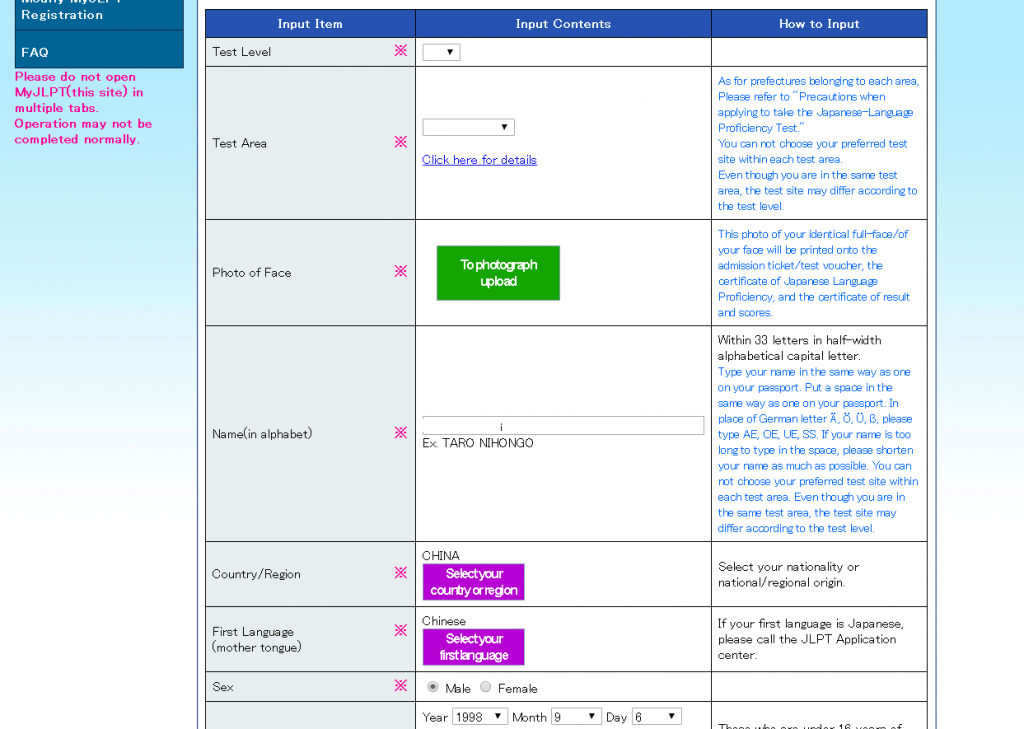
Step 5: Choose your level and fill in the other details required
This is the part where you should double-check everything carefully — especially the city where you want to take the JLPT and the test level you are applying for. Make sure all your information is correct before you move on.
You will also need to upload a clear, full-face passport-style photo. This photo will be used as identification and will appear on your admission ticket, test voucher (which you must bring to the JLPT test center), and your Certificate of Result and Scores. So choose a proper photo that clearly shows your face.
Tip: If you enter the wrong JLPT level or the test area, you can still change your test level or test location during the application period. Just make sure you do it before the deadline, because no changes are allowed after that!
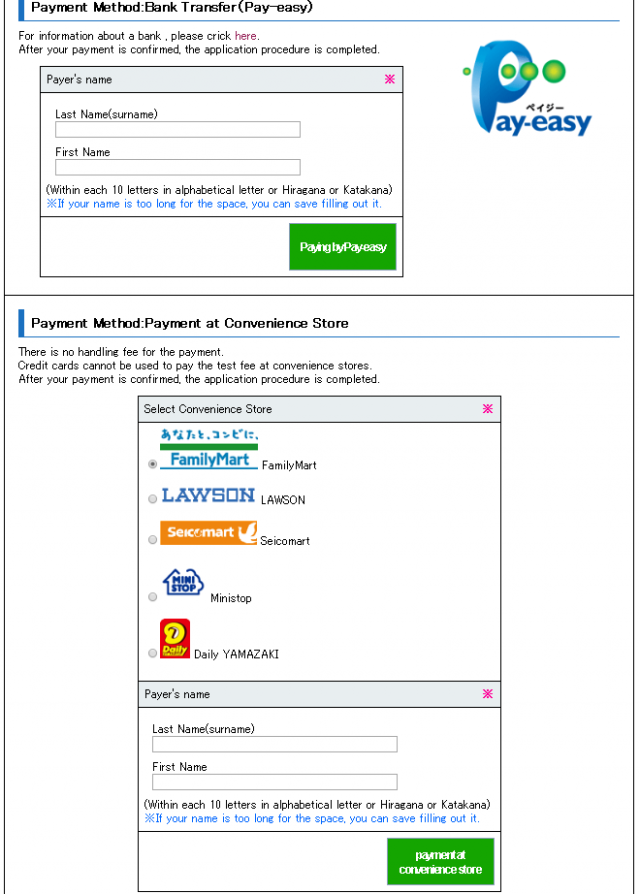
Step 6: Choose Payment type
If you are in Japan, you can pay the test fee through several payment methods: credit card, bank transfer, or payment via the convenience store. Please confirm the available payment methods for countries outside Japan. Generally, a credit card is acceptable.
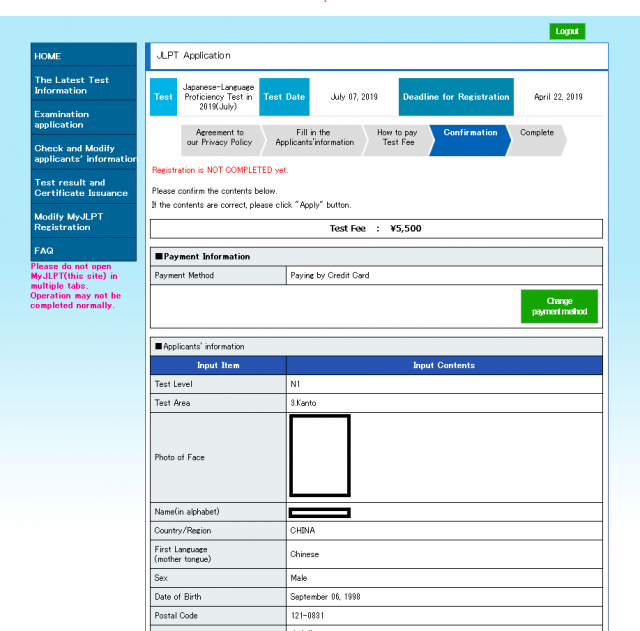
Step 7: Confirm your information
Final step: The application will be completed after confirmation of your information
How Much Does the JLPT Exam Cost?
As of 2025, the JLPT in Japan costs around ¥7,500 in Japan. After completing your application, you must complete payment before your registration will be confirmed.
Test fees may vary based on the location in which you decide to take the test, and can be more expensive overseas. For example, in the USA and Canada, the test fee is around $100.
If you are in Japan, the payment options for the JLPT range from online with a credit card to cash at a convenience store or post office. If you are outside of Japan, the payment method will depend on the test location. From January 17, 2022, a separate fee of 110 yen will be required for a cash payment from a Japan Post Bank ATM. For group applications, a fee of 110 yen will be required for each “payment number”.
The test payment window for December is from early to late September. After making payment, you will be set to receive a Test Voucher, which you will need to bring to your test venue to confirm and verify your status as a participant of the JLPT you have signed up for. Ensure that this slip of paper is well-kept and not lost, as it is very important. With these, remember to bring in some form of identification together with your Test Voucher. With that, take the test, and you’re all good to go.
When Will I Get My JLPT Results?
After all that hard work, just sit back, relax, and give yourself a well-deserved break. Until the time comes, enjoy yourself! But until when? Well, the release of results can vary based on whether you’ve taken the test locally or from an overseas educational institute, but here are some dates you can stay on the lookout for!
Local July Test: Early September
Local December Test: Early February
Overseas July Test: Early October
Overseas December Test: Early March
Note: For Overseas Students, collect your Score Reports and hopefully, a Certificate of Proficiency, at your Local Host Institute. As for Local Students, the Score Reports and Certificates will be mailed to you directly based on the address associated with your MyJLPT Account.
If you have questions about our school or taking JLPT Prep lessons with us, don’t worry. Here’s a link to the FAQ site where you can check to see if it answers any queries you have. With that, we would like to wish you all the best and happy studying!
Start taking Japanese lessons and pass the JLPT exam!
Double your chances of passing the test with Coto Academy’s JLPT Prep Course! Our 3-month, semi-intensive course meets every Saturday for 3 hours, covering everything from high-frequency kanji to the specific logic needed to ace the reading section. Whether you join us in-person in Tokyo or via our online classrooms, you’ll get the expert strategy and peer support needed to walk into the exam with confidence. Seats are limited to keep class sizes small and effective—secure your spot today, and let’s reach your goal together.
Comprehensive Coverage: 3 hours per class covering vocabulary, kanji, grammar, and specialized reading strategies.
Expert Guidance: Small class sizes with instructors who know exactly where students usually stumble.
Flexible Learning: Join us in-person at our Tokyo campus every Saturday, or join from anywhere in the world via our Online sessions.
When is the next JLPT in 2026 and when can I sign up?
For 2026, the first JLPT will be held on Sunday, July 5, 2026, and the second JLPT will be held on Sunday, December 6, 2026.
Where do I apply for the JLPT?
To apply, you will need a MyJLPT account, which you can sign up for here. Once you have an account, you can sign in with your account and start to register.
When do the JLPT results come out?
Depending on when you take the test, the release of the results can differ. In general, you will get your results 2-3 months after the test. Here is when you should look out for your results, depending on when you take the test!
Local July Test: Early September
Local December Test: Early February
Overseas July Test: Early October
Overseas December Test: Early March
I have a question about the JLPT that isn't addressed here. What do I do?
If you have any JLPT-related inquiries, you can visit the JLPT FAQ site. Your answer should be there.
When is JLPT 2026?
The JLPT is held twice a year, typically in July and December. In 2026, you can expect the tests to take place around early July and early December. Registration usually opens a few months before each test, with exact dates varying depending on your location. It’s best to check the official JLPT website or your local test center for the most accurate information as the dates approach.
Although the Japanese monarchy still exists, its role today is largely symbolic—much like the royal family in the United Kingdom. Even so, the Imperial Household continues to observe important traditions, including the celebration of the reigning emperor’s birthday. This occasion is marked by a national holiday known as the Emperor’s Birthday (天皇誕生日, Tennō Tanjōbi).
Under the current emperor, Naruhito, the holiday falls on February 23 each year. The date changes with each new emperor, as it always corresponds to the birthday of the reigning monarch. Since 2020, February 23 has been officially recognized as a public holiday in Japan.
For those hoping to catch a rare glimpse of the monarchy while also exploring the inner grounds of the Imperial Palace, February 23 is an ideal time to visit. The palace grounds are open to the public on the Emperor’s Birthday, offering a unique opportunity to see members of the Imperial Family in person.
What should you do during this national holiday? Let’s read more to find out!
What is the Emperor’s Birthday?
The Emperor’s Birthday, or Tennou Tanjoubi (天皇誕生日), is a national holiday in which they celebrate the reigning Emperor’s birthday. On this occasion, people head to the Imperial Palace to see the Emperor in person, who will give a short address expressing his gratitude to those who visited.
This is one of the only two holidays during the year when the inner grounds of the Palace are open to the public, the other holiday being New Year’s Day.
The Emperor’s Birthday depends on the current reigning emperor. Every time a new emperor ascends, Japan enters a new period. As of 2026, the current Japanese monarch is Emperor Naruhito, whose birthday is on February 23. His ascension to the throne is a bit more unique compared to his predecessors. Traditionally, the Japanese emperor is expected to rule until death.
In 2016, the former emperor, Emperor Akihito, announced via NHK that he was abdicating. An abdication within the Imperial Family had not occurred since Emperor Kokaku in 1817. The process took several years, which involved a bill that would allow Akihito to abdicate, issued by the Cabinet of Japan. Emperor Naruhito became the 126th emperor in 2019, consequently changing the Emperor’s Birthday from December 23 to February 23.
Here’s a breakdown of the different dates the Emperor’s birthday was celebrated:
Period/Emperor
Reign
Birthday
Meiji (明治)
(1868-1912)
November 3rd
Taisho (大正)
(1912-1926)
August 31st (1912-1913) (actual birthday), October 31st (1914-1926)
Showa (昭和)
(1926-1989)
April 29th
Heisei (平成)
(1989-2019)
December 23rd
Reiwa (令和)
(2019-present)
February 23rd
The time period in which an emperor reigned is assigned a specific era; for example, the Showa era and Meiji era are among the most recent. Since 2019, Japan has been under the Reiwa Era. The kanji is written as “令和”, which means “beautiful harmony”. Check out our blog on how to convert a Western year to a Japanese year.
In 2025, Emperor’s Birthday on February 23 falls on a Sunday, so it was observed and turned into a holiday on Monday, February 24. Check the dates of the Emperor’s Birthday from 2026 to 2030 below.
Year
Date
Day of the Week
2026
February 23
Monday
2027
February 23
Tuesday
2028
February 23
Wednesday
2029
February 23
Friday
2030
February 23
Saturday
History of the Emperor’s Birthday
Historically, Japan has always celebrated its Emperor’s birthday. The earliest record is in the 7th century, where the country celebrated Emperor Konin’s reign.
While the Emperor’s Birthday was established during the Meiji Restoration (1868-1912), the public holiday associated with it is a product of Japan’s post-war constitution. It was originally connected to April 29 (the birthday of Emperor Showa), but it moved to December 23 when Emperor Akihito succeeded him. Funnily enough, though, April 29 has remained a public holiday, albeit under a different name: Showa Day, which marks the start of Golden Week.
The Japanese word for the emperor is Tenno (天皇), which literally means “heavenly sovereign”. This fitting description aligns well with the myth of Japan’s first emperor, Jimmu, who was believed to be a descendant of the Sun Goddess, Amaterasu.
Although Emperor Jimmu’s connection to the sun may be ambiguous, the duration of Japan’s monarchy isn’t. The Imperial Family is regarded as the world’s oldest continuous hereditary monarchy, reigning for over 1500 years.
Their crest and official seal are a 16-petaled chrysanthemum (kiku), which appears on the front cover of Japanese passports and on the ¥50 coin.
However, in Japan, the title for the head of state is merely a matter of convention, making the role more similar to that of the Queen of the United Kingdom.
After WWII, the emperor relinquished governmental power and political engagement, becoming “the symbol of the State and of the unity of the people”.
King vs. Emperor?
Most of us are pretty familiar with the terms, king and queen, but out of all 43 countries with a monarchy, Japan is the only country to have an emperor and empress.
So, what is the difference between the two? An emperor can be thought of as the “king of kings”, whilst an empress is the “queen of queens”. It follows that historically, emperors and empresses would possess more power than kings and queens. However, in Japan’s case, the name for the head of the monarch is merely a difference of titles, making the function more similar to the King of the United Kingdom.
How is the Emperor’s Birthday Celebrated?
In the week leading up to the Emperor’s Birthday, many Japanese people send letters to the Emperor. Some of these letters can be personal, as they might have been directly impacted by him.
Every year since the start of the Reiwa Era (with the exception of 2020-2022 due to the COVID-19 pandemic), Emperor Naruhito and Empress Masako, along with other family members, appear at the palace balcony to welcome tens of thousands of people to the Imperial Palace grounds. In turn, the monarchy is greeted by their waving visitors with Japanese flags, before they are ushered into the building for a tour of the inner grounds.
Things to Do During the Emperor’s Birthday in Japan
Of course, a visit to the Imperial Palace is recommended on the Emperor’s Birthday, as access to the inner grounds of the Imperial Palace will be open only on that day. While admission to the Imperial Palace on that day will be free, we recommend that you arrive early, as there will be large crowds of visitors waiting to give the Emperor their well-wishes.
At 9:30 am, the palace gates will be open to the public. Visitors will also be given a Japanese flag to wave around when the Emperor and his family make their first appearance at around 10:20 am at the Chowa-Den Hall balcony. They will then make their second appearance at around 11am, then their third appearance at 11:40am.
In addition, you will also have the opportunity to sign the Greeting Book in the afternoon, located in front of the Imperial Household Agency Building.
If you want to visit the Imperial Palace without taking part in the celebrations, we recommend visiting the East Gardens. However, since the gardens will be closed on the Emperor’s Birthday, we recommend going there a day before.
Conclusion: The Emperor’s Birthday is a Significant Holiday in Japan.
The Emperor is a significant figure in Japan, and as such, his birthday became one of the most important national holidays in the country. Many visitors come to the Imperial Palace in Tokyo to give their congratulations to the Emperor on this occasion.
Unlock Japan’s Culture with Coto Academy
Understanding the legacy of the Emperor’s Birthday is just the beginning. To truly experience Japan, you need the language to match. At Coto Academy, we bridge the gap between cultural history and real-world conversation, giving you the skills to navigate life in Japan with ease.
Join 15,000+ students who have turned their passion for Japan into fluent, confident Japanese. Study Japanese in Shinjuku, Shibuya, Yokohama, or online.
Ready to start? Book your free level check and join us today!
Yes, the Emperor’s Birthday is a national holiday in Japan. If the Emperor’s Birthday falls on a Sunday, then the holiday will be observed on a Monday.
Are things closed on the Emperor’s Birthday in Japan?
Public institutions, such as schools, government buildings, and post offices, are closed on the Emperor’s Birthday. Bank counters will also be closed as well, though most shops will stay open.
What happens in Japan on the Emperor’s Birthday?
The Emperor and his family will make an appearance at the Imperial Palace, where he will give his gratitude to visitors.
What happens on the Emperor's Birthday in Japan?
The main event is the Ippan-sanga (General Public Visit) at the Tokyo Imperial Palace. The Emperor, Empress, and other members of the Imperial Family make several appearances on the palace balcony to greet thousands of well-wishers waving Japanese flags. It is one of only two days a year (the other being January 2nd) when the public is allowed into the inner grounds of the palace. In the afternoon, visitors also have the chance to sign a congratulatory greeting book.
Why is 77 a special birthday in Japan?
The 77th birthday is called Kiju (喜寿), or the “Happy Age.” It is part of the Kanreki (longevity) traditions. It is special because of the way the kanji for “happiness” (喜) is written in cursive style. It looks like the characters for 77 (七十七).
The December 2025 JLPT results have been published on January 30 at 10 am JST. Here is a step-by-step guide on how to check your JLPT results online. The JLPT results are usually available online around two months after the test day. If you want to check your JLPT results online, the test result announcement will be available for a limited time on the JEES website within your MyJLPT portal. With that, we thought we would provide a step-by-step guide to checking your JLPT results.
Keep in mind that during the day, JLPT results are available online; there may be a delay between the announcement date and the results becoming available. You might even encounter a website crash, so it is best to open your results a few hours after the official announcement is made.
For more information and updates, kindly refer to the officialJLPT website.
Study the JLPT Smarter with Coto Academy!
Are you planning to take the JLPT this July or December? While self-study is a great start, the JLPT is notorious for its strict time limits and tricky reading sections.
Let this be your sign to join Coto Academy’s JLPT Prep Course. Coto Academy students have twice the pass rate as the national average, thanks to our provenmethod. We offer two flexible options: a year-round JLPT course and an intensive 3-month sprint course timed perfectly before test day. What makes these classes stand out is the teachers, who specialize in teaching JLPT. They will give you tips and techniques you simply won’t get from self-study. Join our class today!
While you can view your results online immediately, your physical JLPT result certificate will be delivered on a later date for international residents in Japan. You can also issue a transcript, which will be immediately sent after the resulting certificate is received. Students who are in a hurry to get the transcript may apply for an express delivery request.
With that in mind, here is a detailed step-by-step guide to check the results, with screenshots.
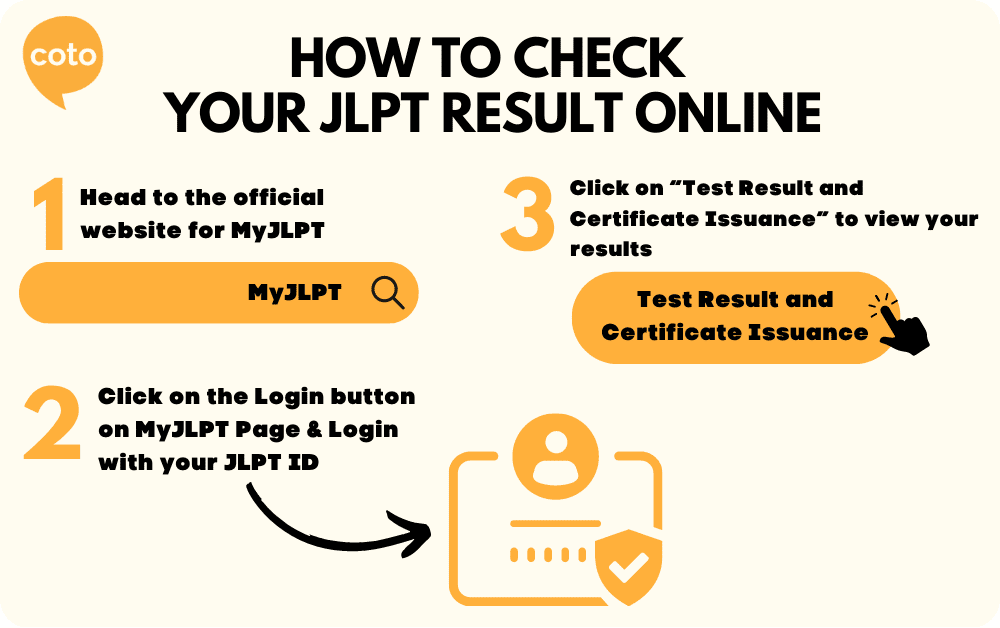
1. Head to the official website for MyJLPT
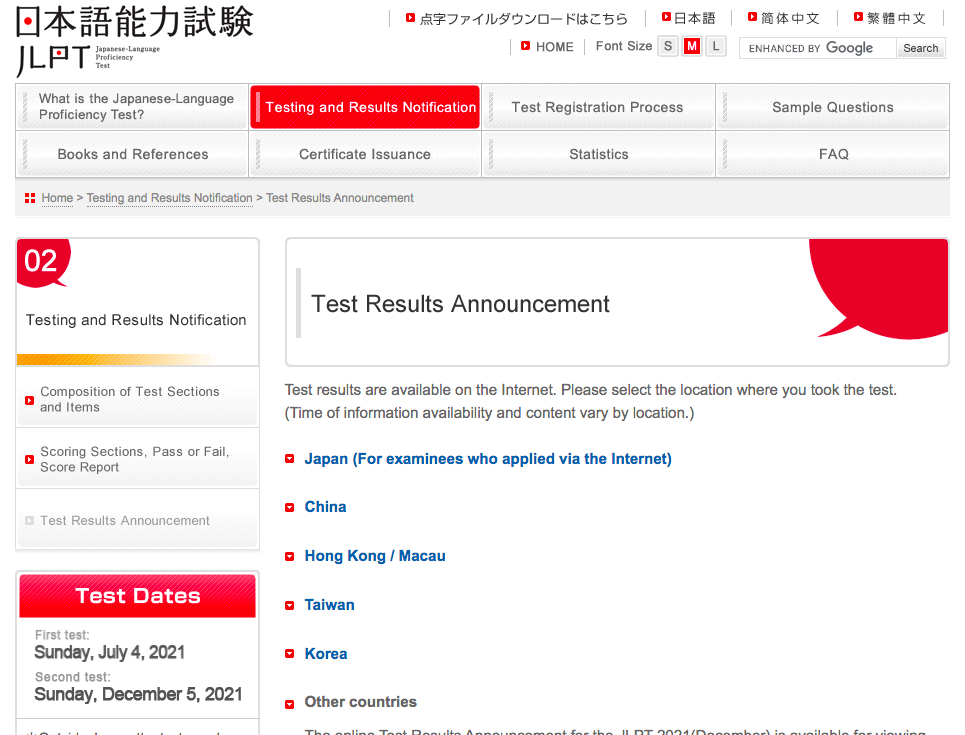
Depending on where you take the JLPT, you must select the appropriate country to be directed to the correct webpage. Putting your MyJLPT ID on the wrong landing page may not be possible. For example, if you are taking the JLPT in Korea, make sure your MyJLPT page domain is set to the correct country!
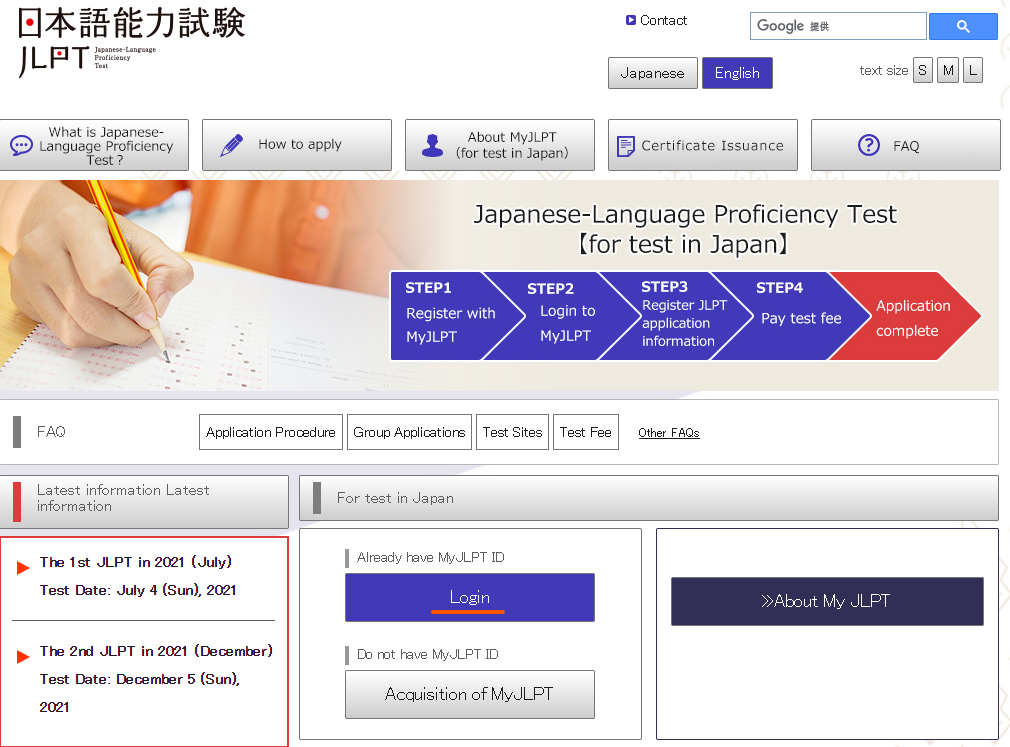
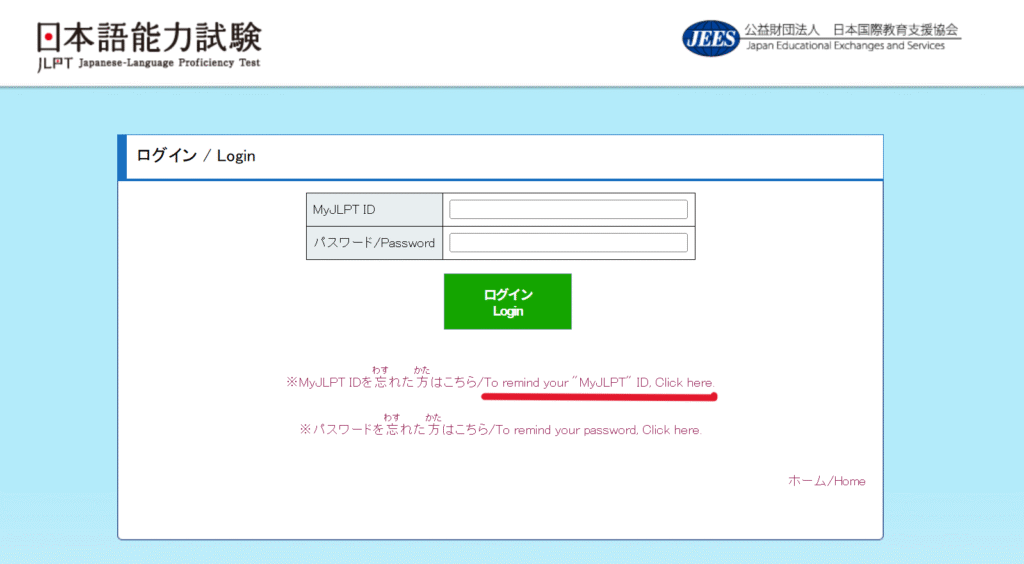
2. Click on the Login button on the MyJLPT Page.
Head to this page to go to the official page for MyJLPT. For test-takers, you should be able to log in to your MyJLPT account, which was created when you applied for the JLPT.
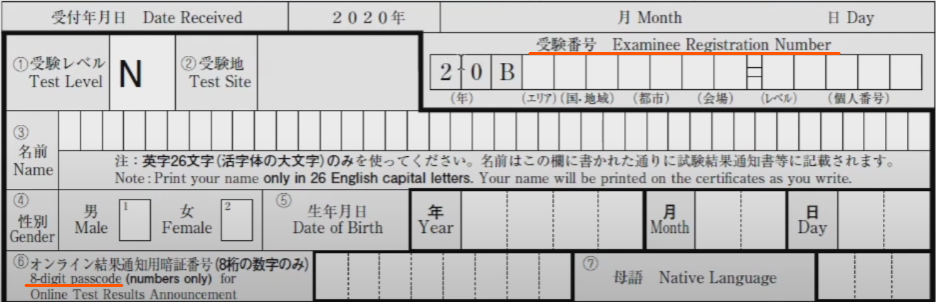
To retrieve your login credentials, you can refer to your application.
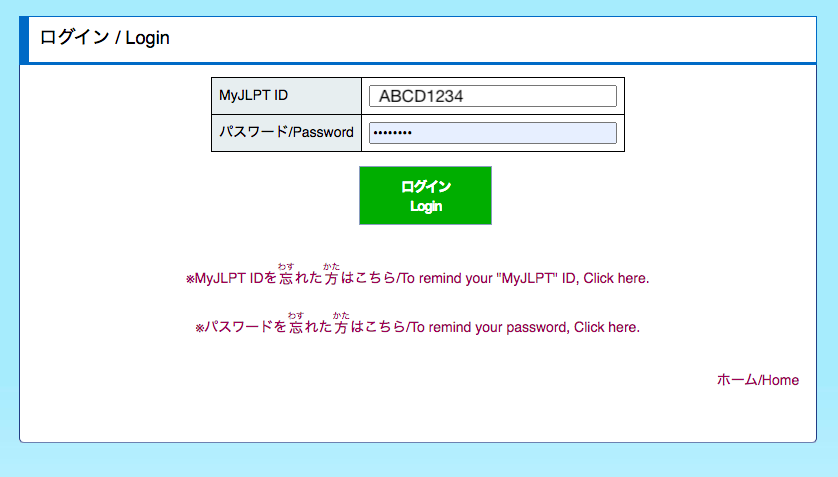
Find your JLPT ID here
Your MyJLPT ID is auto-generated and most likely cannot be changed, so be sure to store it somewhere safe. This same MyJLPT ID will be used for any future JLPT tests you take, so don’t lose it!
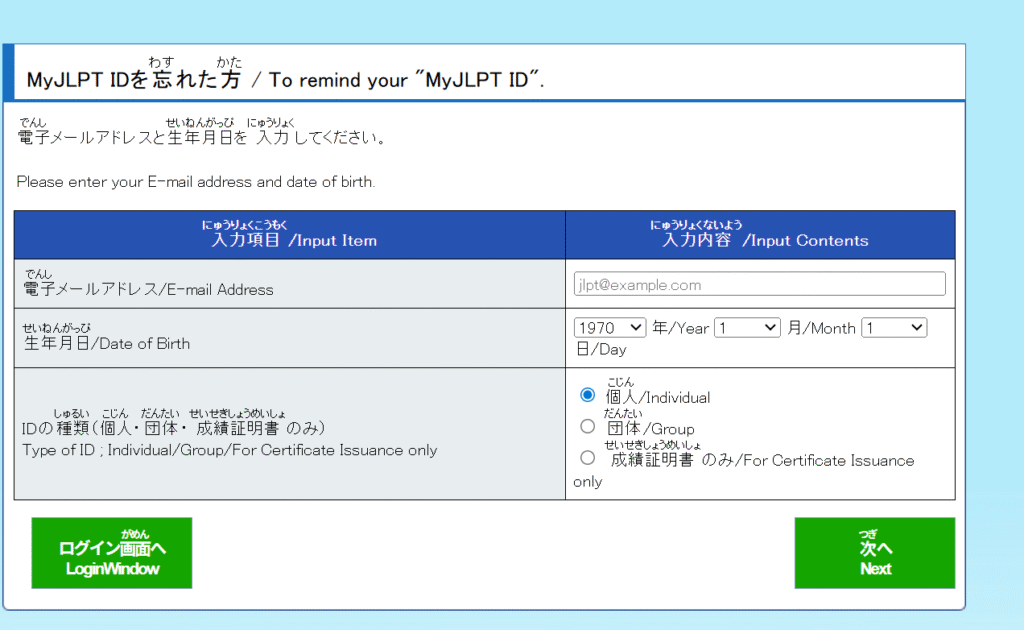
If you forget your MyJLPT ID, you can retrieve it. Simply click the link that says “To remind your MyJLPT ID, click here”.
This will take you to a new page where you’ll need to:
Select the type of application. If you are applying alone, choose 個人 (kojin), meaning “individual.”
Enter the email address you used when registering.
Input your date of birth (which must match the one on your ID).
After that, you will get an email from myjlpt@jees.or.jp to remind you of your MyJLPT ID. You can also reset your password using the same method.
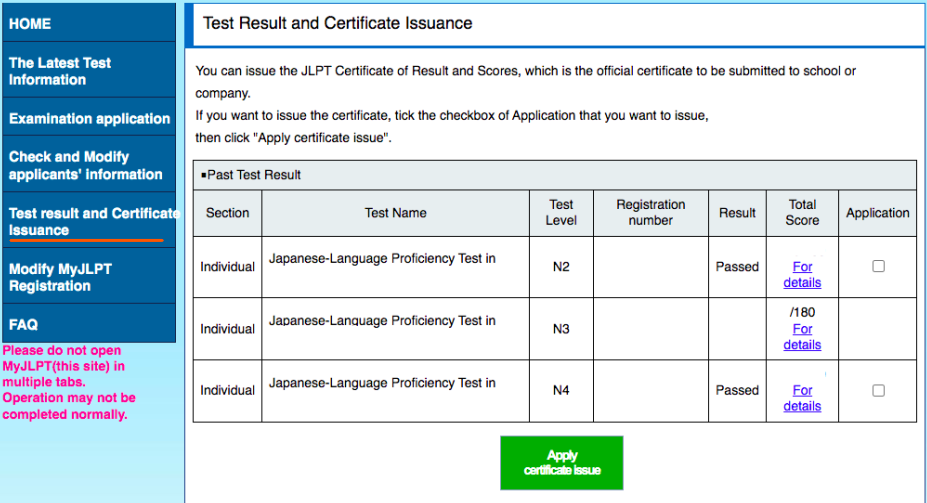
Note: The MyJLPT portal can only be open in one browser tab at a time. If you duplicate the page or open it in multiple tabs, you may encounter an error.
4. Click on “Test Result and Certificate Issuance” to view your results
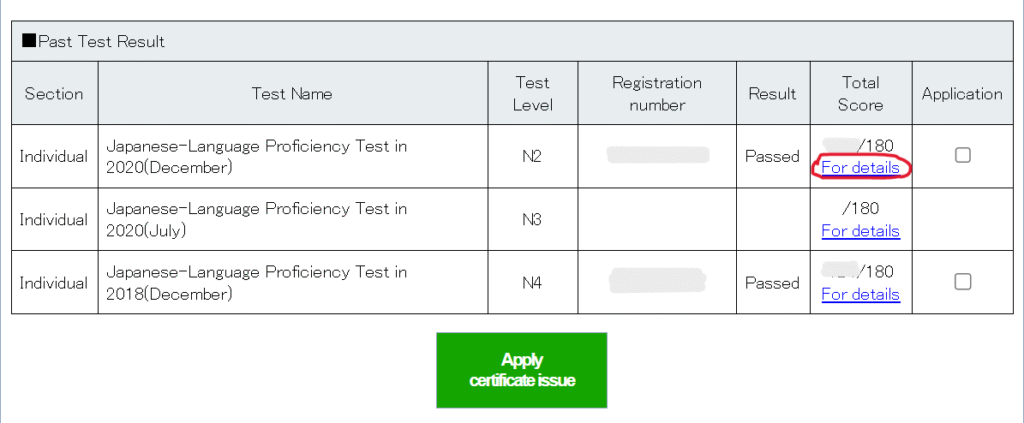
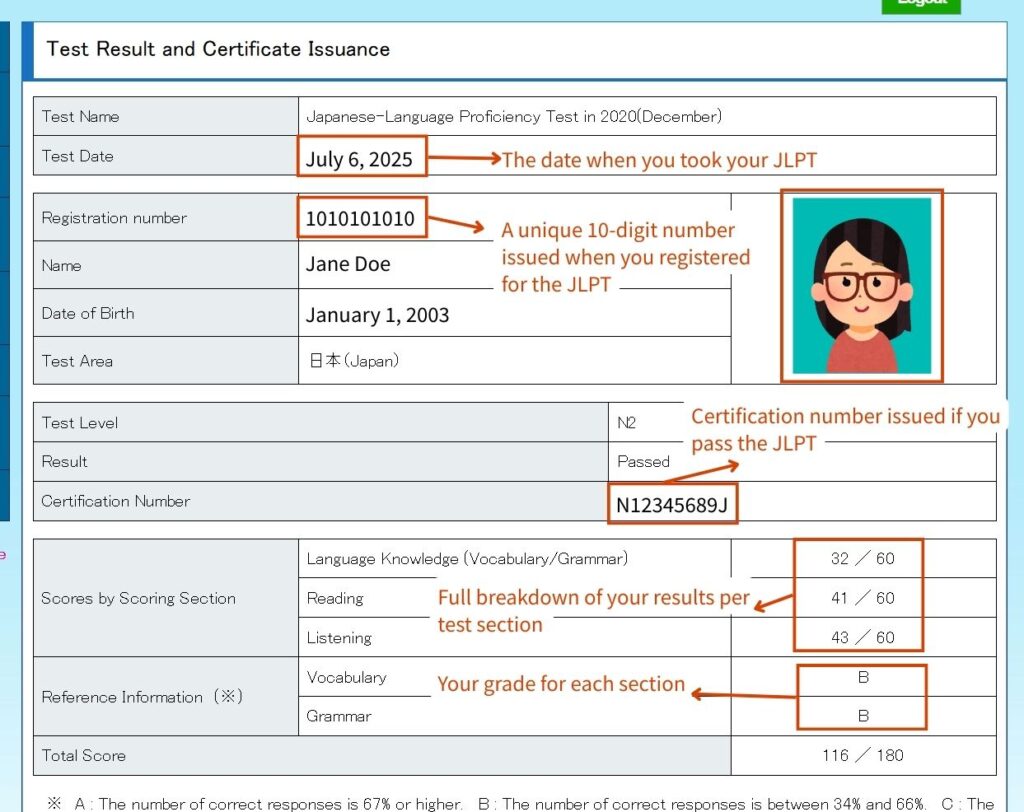
Your results for the JLPT will be immediately available on the Test Result and Certificate Issuance page. Looking at the results is pretty straightforward. A table will display your test level(s), registration number, result, and total score. If you have taken other JLPTs in the past using the same MyJLPT ID and personal information, that record will also be displayed on the same page.
If you passed a test, the result will show “Passed”. Be careful not to get confused—especially if you have taken the same level more than once. For example, if you previously attempted JLPT N3 and failed, but passed it this time, you may see two N3 results: one marked “Failed” and another marked “Passed”.
View your results here
5. View the full breakdown of your score
The score listed on the page is your total score of all test sections. If you want a full breakdown, click the “For details” link.
Once you click that, you will be directed to a page that shows you a clear breakdown of each part of the JLPT result, as well as more detailed information about your registration.
Your basic information, such as your name, date of birth, and test area (where you took your JLPT) will be indicated. Your passport-style photo, which is used to verify your identity during the test day, will also be displayed.
You will also find your registration number, which is a unique 10-digit number given when you registered for the exam. It’s used to identify your application and results.
Your result and certification number. Your certification number is issued only if you pass. This number appears on your official certificate and can be used for verification.
Besides the scores by test section, you will also get grades, which range from A (correct responses are 67% or above), B (correct response is between 34 – 66%), and C (anything below that). This will be shown regardless of whether you passed or failed the test.
Things to Note About Viewing Your JLPT Results
If your test results are not displayed on the ‘Test Result and Certificate Issuance’ screen, don’t panic. Note that they only display results for tests that are applied using your MyJLPT ID. Tests taken before 2012, overseas, or applied by mail will not display their results.
If the test was applied with another MyJLPT ID or the group representative used to block registration, results will also not be displayed.
You can change the address you registered for the JLPT application within the specified period after the test. The period when changes can be made will be announced on the MyJLPT site.
If you move after this period, you must submit a notification of change of address to the post office.
Changes can be made on the ‘Check and Modify applicants’ information’ page. If you require a change after the time period ends, you must mail your updated information to the post office.
What is The Score Required to Pass the JLPT?
For JLPT N1 to N5, one can get scores between 0 and 180 points. Depending on your level, the passing scores also change accordingly.
JLPT Level
Passing marks (Total)
N5
80 out of 180
N4
90 points out of 180
N3
95 points out of 180
N2
90 points out of 180
N1
100 points out of 180
There are also score requirements for individual sections of the test.
For N5 and N4, the sectional passing mark for Listening is 19 points out of 60 points. The passing mark for Language Knowledge (Vocabulary/Grammar) and Reading is 38 points out of 120 points.
For N3, N2, and N1, the sectional passing mark for Language Knowledge (Vocabulary/Grammar), Reading, and Listening is 19 out of 60 points for every section.
Should examinees not meet the required passing mark for any of the sections, they will be deemed to have failed the entire exam. They will also be unable to pass if they miss a test section. No score result will show for the completed test sections on the score report. For more information about the passing scores, click here.
Minimum sectional score for JLPT N3, N2 and N1
JLPT Level
Vocabulary and Grammar
Reading
Listening
Total score
Passing score
Total score
Passing score
Total score
Passing score
N1
19
60
19
60
19
60
N2
19
60
19
60
19
60
N3
19
60
19
60
19
60
Minimum sectional score for JLPT N4 and N5
JLPT Level
Vocabulary, Grammar and Reading
Listening
Total score
Passing score
Total score
Passing score
N4
120
38
19
60
N5
120
38
19
60
About the JLPT 2026
The JLPT 2026 will be held in early July (first test) and early December (second test). The application period will be open between March and April for the first test and August and September for the second test. More details will be announced next year on the MyJLPT website. Individual and Group applications must be completed within the application period as stated.
Understanding JLPT Score Report and Certificate of Proficiency
All JLPT examinees, regardless of whether they pass or fail the test, will receive an official Score Report. Those who pass will also be awarded a Certificate of Proficiency.
In Japan, score reports for the July 2025 test will be mailed in early September, while results for the December 2025 test will be sent in early February 2026.
For examinees outside Japan, results are distributed by local host institutions. Expect to receive your July test report in early October and the December test report in early March 2026.
Ready to Pass the JLPT? Join JLPT Lessons at Coto Academy!
If you’re thinking of taking the JLPT again or aiming for a higher level to boost your career in Japan, give yourself the best possible chance of success. Coto Academy students enjoy a higher pass rate than the national average thanks to our focused JLPT preparation courses.
Join Coto Academy’s highly popular JLPT prep course! Taught in Tokyo by experienced instructors who specialize in the JLPT, this course gives you the strategies, practice tests, and structured study approach to master every part of the exam. With expert guidance and proven methods, you’ll walk into your next JLPT feeling confident and ready to pass.