Want to learn more about hospital-related vocabulary? This cheat sheet focuses on different conditions to tell the doctor about. Taking care of your health should always be a top priority, particularly when you’re away from your home country. Doctor consultations and hospital visits in Japan, however, can be intimidating.
It’s ideal to learn how to inform your symptoms to your doctor to get an accurate diagnosis. Therefore, we have included the pronunciation and meaning of the terms, together with example sentences for you to learn how to communicate successfully during your consultation in the hospital.
Do keep a lookout for your well-being with COVID-19 cases on the rise. The most common symptoms are fever, dry cough and tiredness. Less common symptoms include headache, aches and pains, sore throat, loss of taste or smell, diarrhea, conjunctivitis, rashes on the skin, or discoloration of fingers or toes.
With that being said, symptoms will vary from one person to the next. This is why you must get tested or consult a doctor the moment you feel unwell.
Japanese vocabulary can be difficult to learn, but practice makes perfect. This is part two of our ongoing pharmacy and hospital vocabulary cheat sheet so make sure you continue part one.
Conditions 症状 (しょうじょう shōjō)
Here are some keywords and phrases about the condition:
Japanese
Pronunciation
Meaning
気分が悪い
きぶん わる kibun ga warui
I do not feel well
熱がある
ねつ netsu ga aru
have a fever
体がだるい
からだ karada ga darui
body feels heavy
お腹が痛い
なか いた o naka ga itai
stomach hurts
腰痛
ようつう youtuu
back pain
風邪
かぜ kaze
cold
咳
せき seki
cough
くしゃみ
kushami
sneeze
喉が痛い
のど い nodo ga itai
throat hurts
めまい
memai
dizzy
吐き気がする
は け haki ke ga suru
feel nauseous
嘔吐
おうと outo
vomit
下痢
げり geri
diarrhea
便秘
べんぴ benpi
constipation
Example Sentences
Here is how to apply the terms into sentences:
Example 1:
By saying: ‘〇〇が具合悪いです。’
Pronunciation: ___ga guai warui desu
It means: ‘My ______ does not feel well.’
Example 2:
By saying: ‘昨日からお腹が痛いです。’
Pronunciation: kinou kara onaka ga itaidesu.
It means: ‘My stomach hurts from yesterday.’
Scared to visit a hospital in Japan? Check out this cheat sheet to learn hospital-related vocabulary and boost your confidence in Japanese! Going to the hospital can be quite intimidating, especially when you are not sure half the stuff the medical staffs are saying. That is why we have included the pronunciation and meaning of the vocabulary, along with example sentences, to guide you for a smoother visit to the hospital.
It is a known fact that the Japanese have the highest lifespan expectancy globally due to their healthcare system. With high technological advancement, Japan offers superior medical services to patients.
Japanese vocabulary can be difficult to learn, but practice makes perfect. This is part one of our ongoing pharmacy and hospital vocabulary cheat sheet so make sure you continue part two.
Here is how those words can be used in conversational sentences:
Example 1:
By saying: ‘診察をお願いします。’
Pronunciation: shinsatsu wo onegaishimasu.
It means: ‘I would like to have a medical examination.’
Example 2:
By saying: ‘診察券と保険証を出して、順番にお待ちください。’
Pronunciation: shinsatsu to hokenshou wo dashite, junban ni omachikudasai
It means: ‘Please provide your registration and insurance card and wait for your turn.’
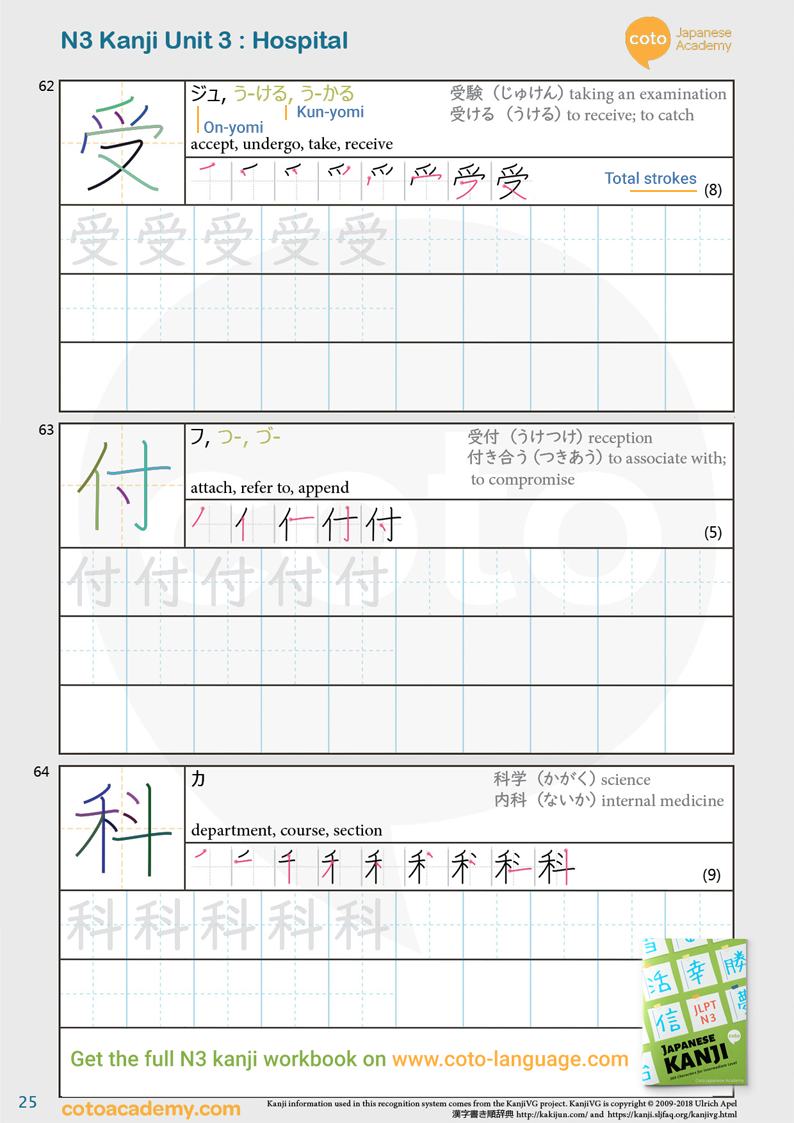
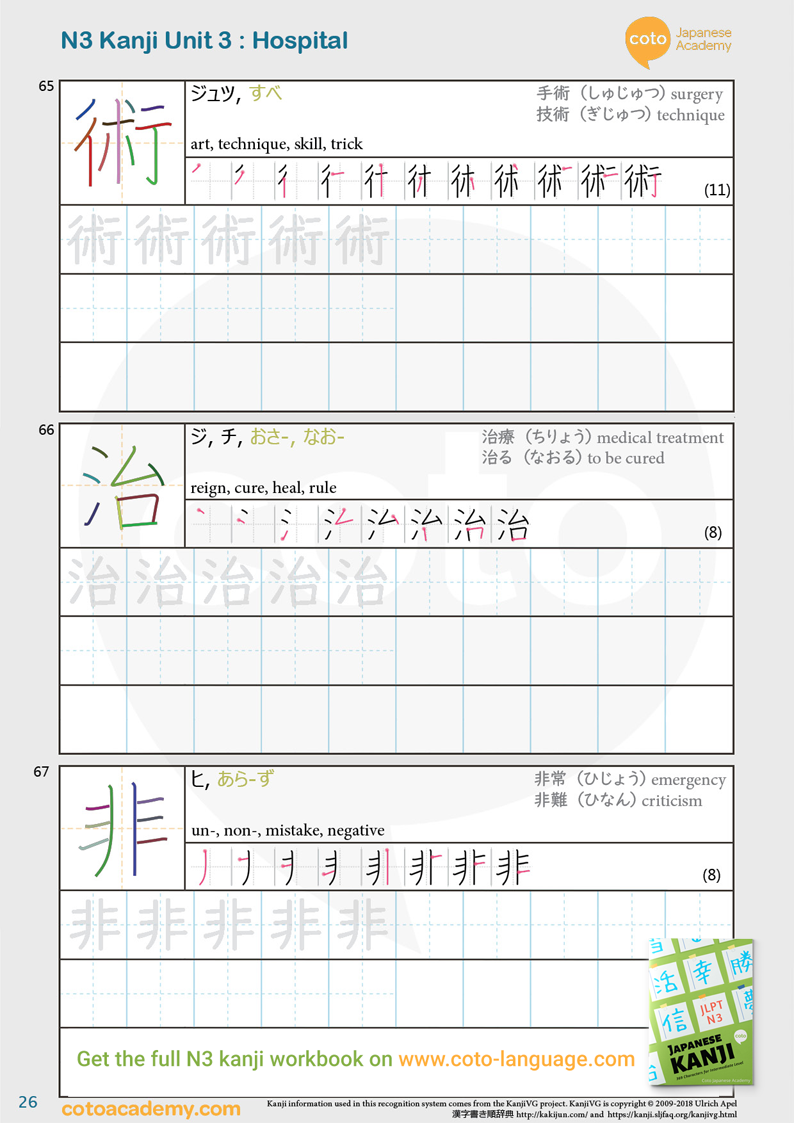
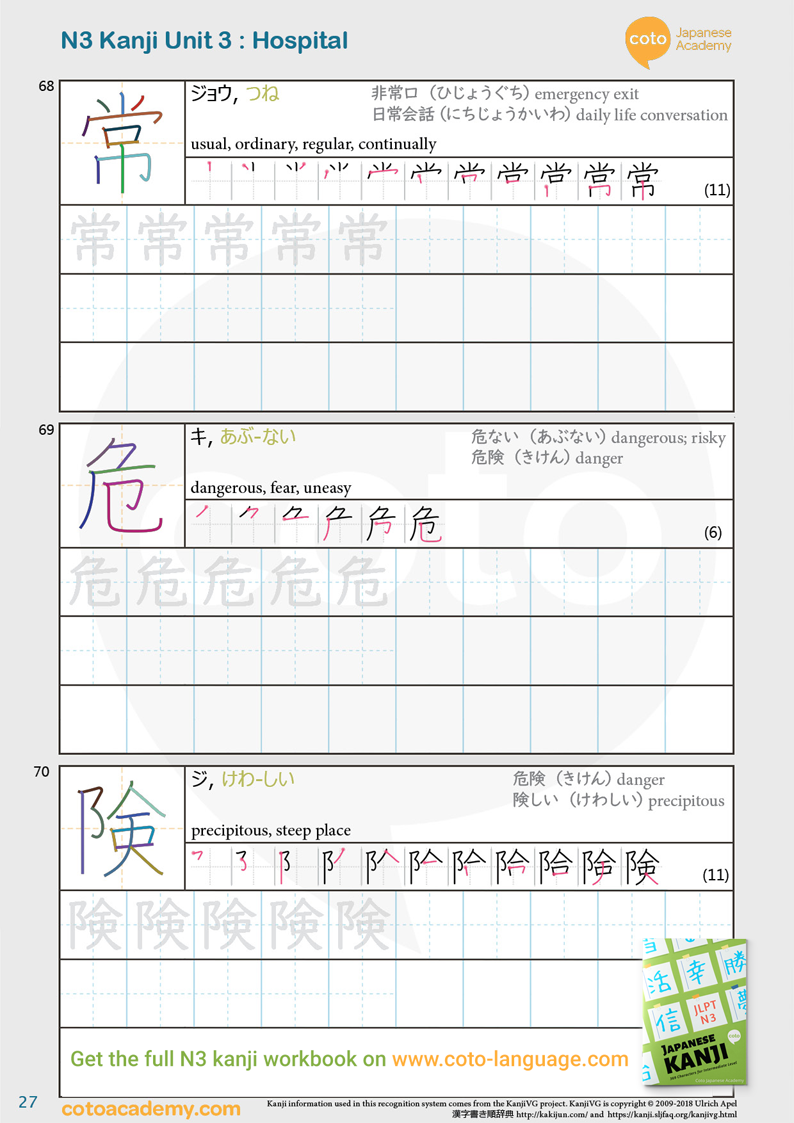
When you feel sick, or if an accident happens to you in Japan, you should go to a clinic or hospital. In this Kanji Worksheet, we will introduce to you some relevant kanji which you can use when you describe symptoms or medical problems.
If you are interested in studying Japanese, find out more about our school by filling out the form below.
What is the first thing that comes to your mind when you think of Japan? For me, it’s definitely the Japanese hospitality! Oshibori! Imagine if you are really cold right now, what would be the thing you yearn for the most? Warmth! That’s right! Especially when you are cold and hungry, you will naturally head to a restaurant. Now imagine, you have just entered a restaurant and sat down. Your hands are cold and you need some time to adjust to the surrounding temperature. What would be something you want the most now? A time machine to make you settle down more quickly? No-no. Something more realistic, more practical, what would it be?
おしぼりOshibori! That’s it! That’s the thing you may be looking for!
Wait, what? Oshibori?
Oshibori is a neatly rolled wet towel that can be warm or cool depending on the weather. On a cold day, the towel would be warm while on a hot day, the towel would be cool. It is served for you to wipe your hands before your meal. Apart from hygiene purposes, it can also help you to settle down quickly, making your dining experience a more comfortable and enjoyable one!
Japan, being a country where customers are highly respected, a good customer service is expected from the industries, not excluding the food industry. Whenever a customer entered and sat down in a restaurant, Oshibori is quickly served to the customer, as an act of welcoming him. Japanese people are usually introverted and not good at expressing themselves. They are not confident in showing their heartfelt thoughts through facial expressions. Hence, Oshibori service would be ideal to show their appreciation towards their customers.
Immediately after you have sat down, a warm Oshibori is served to you. You unrolled the Oshibori and held it with both of your hands. The warmth of the Oshibori can be felt on your icy cold hands. How would you feel at this point in time? Wouldn’t you feel like patronizing this restaurant to enjoy such warming hospitality again?
And… How should I use Oshibori?
Please use it to clean your hands only! During summer, you can be perspiring and hope to cool yourself down with a cool towel. You may have the urge to freshen up by using the Oshibori to wipe your face and neck. Wait, STOP! Before you do so, think about how the Oshibori is washed and reused by the next customer. Would you still want to use the Oshibori knowing that the previous customer used it to wipe his face and neck? Of course not right! Hence, Oshibori is strictly used for hands only!
Oh and do not forget to thank the person who served you the Oshibori!
Just a simple ありがとうございます (arigatou gozaimasu) will do!
Coto Japanese Academy is a unique Japanese Language School in Iidabashi Tokyo, we offer relaxed and fun conversational lessons for all levels of Japanese learner. Coto Japanese Academy prides itself on its community atmosphere and fun lessons that focus on creation of opportunities to speak and learn Japanese. If you are interested in studying Japanese in Tokyo – please visit our contact page here.
An Integral Part of the Japanese Service Industry
You might think “What is Omotenashi?”. With the upcoming Tokyo 2020 Olympics rapidly approaching the word “Omotenashi” is being used by the media a lot more to promote Japanese hospitality. The meaning of Omotenashi goes way deeper than just providing outstanding hospitality as the original meaning is to entertain guests wholeheartedly. One only needs to reside in Japan for a short time to realize just how much attention to detail is paid across many sectors of the service industry. The Japanese proverb 「お客様は神様」(okyakusama wa kamisama) can be translated to “the customer is always right” but many in Japan will prefer the literal translation of “the customer is god”. The extent of this sentiment is highlighted in the service industry, when the sales associates address the customer by adding the honorific “O” and “-sama” to the beginning and end of kyaku (customer)respectively.
Some examples of the Omotenashi that you might experience in Japan are. A taxi driver automatically opens and closes the door for their passengers. A toothpick nicely wedged between the indentation of a pair of wooden chopsticks. Even the umbrella and bag holders placed within hand’s reach at a Japanese ATM. The cleaners of the Shinkansen, bowing to the passengers as they rush to clean the cars is also a famous expression of Omotenashi.
How did Omotenashi come about?
Visiting a Japanese department store opening in the morning is a ceremonial experience displaying Omotenashi at its finest. Every staff bows as you enter. The Japanese sense of hospitality is exemplified by a deeply rooted pride and effort in welcoming visitors to one’s business. Many historians trace the roots of Omotenashi all the way back to the traditional Japanese tea ceremony. The word is most often written in hiragana because there are several ways of writing it with kanji. On one hand omote would derive from the 表 character referring to a surface or carrying of something, while the 成 character consists of the meanings less or to accomplish something. Therefore, if the Japanese exhibit exquisite Omotenashi, they are expected to provide a service without expecting anything in return. On the other hand, Omotenashi would come from the verb “motsu”, 「持つ」, “to have”:
「お持て成し」. (omotenashi) – 親切なおもてなしを、ありがとうございました。(shinsetsuna omotenashi o, arigatōgozaimashita) – Thank you for your kind hospitality. – 心づくしのおもてなしを感謝します。(kokoro-zukushi no omotenashi o kansha shimasu) – Thank you very much for your hearty hospitality.
Conclusion
Finally, among the aspects that define Omotenashi, selflessness and anticipation are easy to highlight. The concept is all about offering the best service without the expectation of a reward. You abandon your interest for the benefit of your guest or your customer. That explains why in Japan, the culture of tipping is not the norm. Last but not least, a core idea of Omotenashi is to anticipate the needs of your guest. One of the best example is the water and the hot towel brought to you as you take your seat in a restaurant. To find out more about Japanese honorifics, check out this page. Click to tweet this article and share it with more Japanese learners!
Coto Academy is a unique Japanese Language School in Iidabashi Tokyo, we offer relaxed and fun conversational lessons for all levels of Japanese learner. Coto Japanese Academy prides itself on its community atmosphere and fun lessons that focus on creation of opportunities to speak and learn Japanese. If you are interested in studying Japanese in Tokyo – please visit our contact page here.
Are you interested in learning more about the Japanese language and culture? Start taking Japanese lessons!
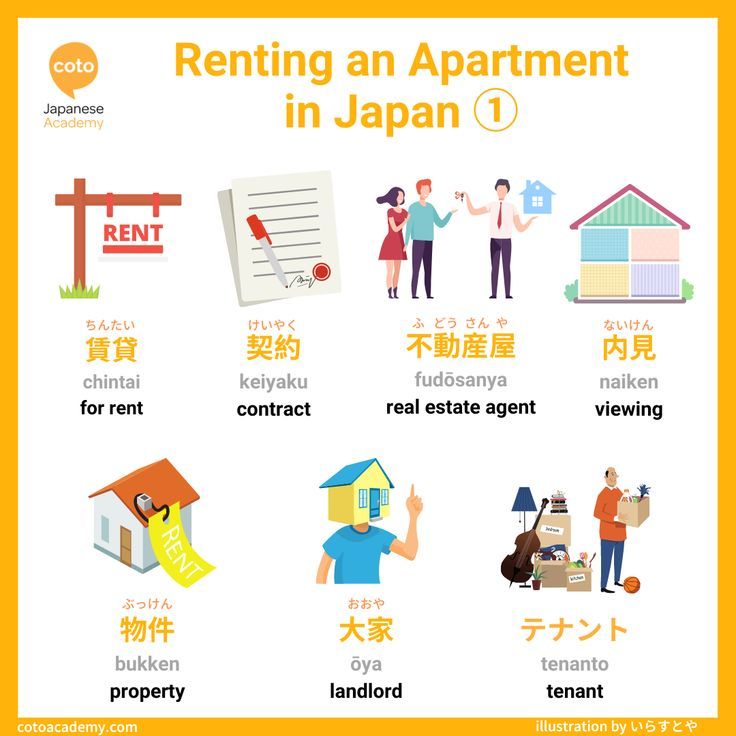
Finding an apartment or a place to live is essential if you want to live in Japan; however, you will need to know some essential Japanese phrases to get the place you want. If you plan to live in Japan, apartments are among the cheapest and most readily available options, but they can be a bit overwhelming at first.
You will need to know how to navigate Japan’s apartment system, including securing guarantors, paying the deposit, and obtaining insurance. While you can find English-speaking agents, your options expand exponentially if you can speak just a bit of Japanese. Keep reading to find out everything you need to know!
Basic Words for Finding an Apartment
So, before we dive into contracts, different types of apartments, rules, and regulations you need to navigate, let’s go through some basic words for Japanese apartments. From different housing types to agencies that’ll find them, here are some essential terms to remember.
English
Japanese
Furigana
Romaji
Apartment
アパート
あぱーと
Apaato
Condomunium
マンション
まんしょん
Manshon
Single-family home
一戸建て
いっこだて
Ikkodate
Real-estate agent
不動産
ふどうさん
Fudousan
Real-estate agency
不動産屋
ふどうさんや
Fudousanya
Apartment listing
物件
ぶっけん
Bukken
You probably noticed that the Japanese word for condo is マンション (Manshon), which is derived from the English term “mansion.” However, マンション in Japanese refers to a multi-floor residential building made of concrete or steel. It translates more closely to “condo” or “apartment” in English.
Generally, they are seen as higher-end, more modern versions of the アパート, so they are usually more expensive and include elevators and electronic security monitors. Whether you want to find an apartment, condo, or single-family home, you can find 不動産屋 (fudousanya) in every district that will find what you’re looking for. However, keep in mind that 不動産屋 (fudousanya) generally focuses on specific areas of whatever city you’re in, especially if you live in a bigger city.
Japanese Terms for Apartment Rent & Initial Fees
Knowing how to ask for the rent and explaining your budget is probably the most important part of finding an apartment. So, here is how you can explain your rent budget in Japanese.
Example:
家賃8万円以内の物件を希望します。 Yachin hachimanen inai no bukken o kibou shimasu. I would like property listings with rent under 80,000 yen.
This is how to ask for an apartment listing within a certain budget. The phrase 以内 (inai) means “under” or “within,” so you can use it to specify a price threshold for the rent, as demonstrated in the example, 家賃8万円以内 (yachin hachiman inai).
Additionally, the rent often determines the initial fees you must pay before moving into the apartment. The majority of these fees are equivalent to around 1 to 3 months of your apartment’s rent.
So, here are the general initial fees you will most likely run into when you get an apartment in Japan:
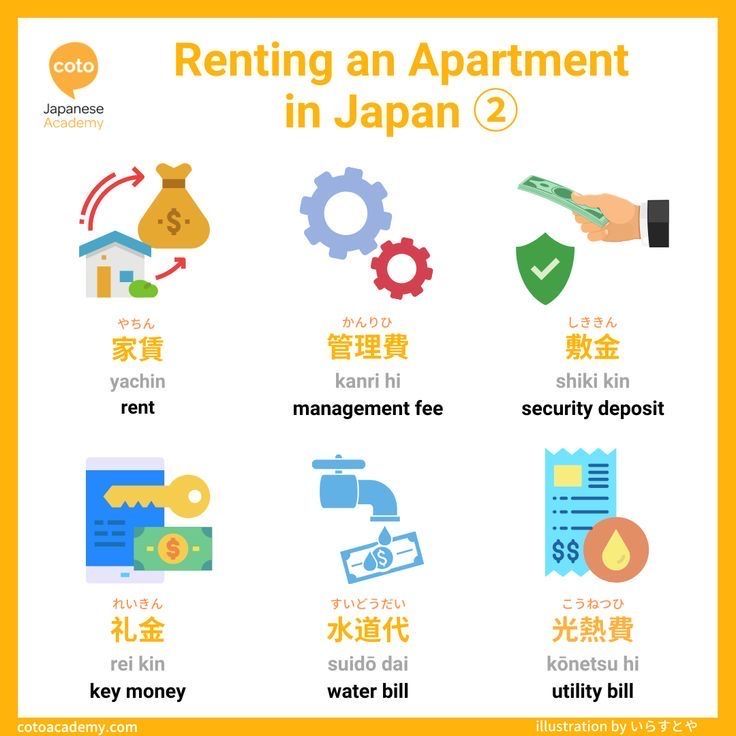
家賃・賃料 (Yachin/chinryou): Monthly rent
初期費用 (Shoki hiyou): Initial fees, which include an accumulation of costs
敷金 (Shikikin): Security Deposit, usually around 1 – 3 months of rent, but is usually returned to you when you end your contract
礼金 (Reikin): “Key Money”, basically gift money you give the renting company. It’s usually around 1 month of rent
管理費 (Kanrihi): Maintenance fees for the shared areas of the apartment building. This is usually paid in the initial fee
仲介手数料 (chuukai tesuuryou): This is the agency commission fee; this only applies if you used a 3rd party agency to help you find an apartment. The fee can be anywhere around 20% to 80% of the rent.
Cleaning Fees
保証金 (hoshoukin): This is the guarantor fee; most often, foreigners need to get a guarantor company that’ll step in if you don’t pay rent. The guarantor fee is usually included in the initial fees, but some guarantors refund it when you move out.
These terms are quite important to remember, as they add up to some of the highest upfront costs you will incur in Japan. Every contract will break down the initial fees and note that not every fee is always included.
So, it’s good to ask which of these initial fees will be included; it’s not uncommon for the 礼金 (reikin) or the 保証金 (hoshoukin) to be deducted. If you’re using an agent, you can directly ask for apartment contracts that don’t require key money or guarantor fees by saying the following.
Example:
礼金がない物件を希望します。 Reikin ga nai bukken o kibou shimasu. I would like property listings that don’t have key money fees.
How Apartment Room Sizes Work in Japan
Now, let’s get into how apartments work in Japan. When you talk with a 不動産 (fudousan), or real estate agent, they will ask you about the size and specifications. In many traditional Japanese apartments, the floor is made up of tatami, or floor mats made of rice straw and straw covering. They are also often used as a standard unit of measuring room sizes in Japan; a single tatami mat, or 帖 (jou), is equivalent to around 1.62 square meters (m2).
Most fudousans or apartment companies will also use m2, but just for your reference, here are some common tatami room sizes corresponding to m2:
2帖: 3.24 m2
3帖: 4.86 m2
4帖: 6.48 m2
5帖: 8.1 m2
6帖: 9.72 m2
7帖: 11.34 m2
8帖: 12.96 m2
9帖: 14.58 m2
10帖: 16.2 m2
Japanese Apartment Size Layouts
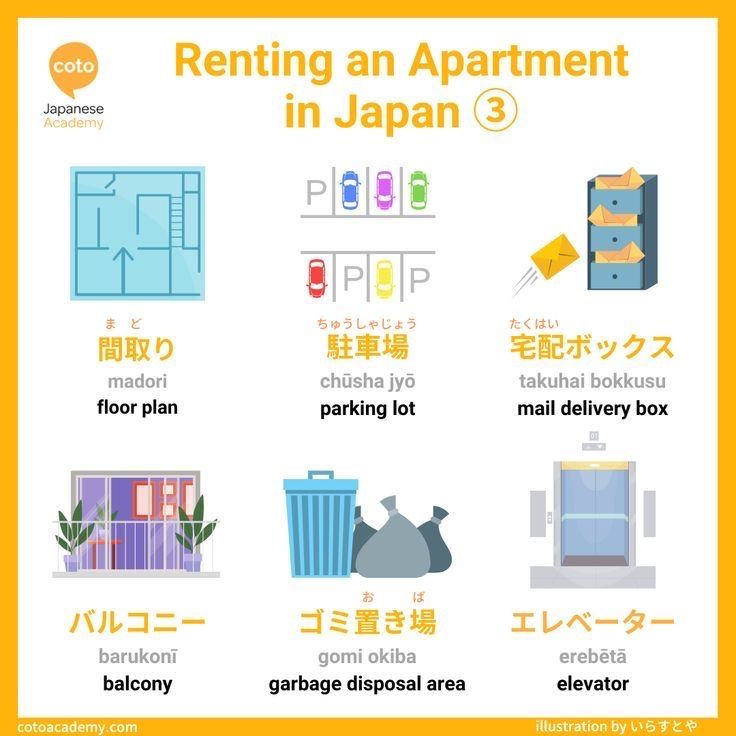
Another size specification to be aware of is 間取り (madori), or floor plan layout, which uses a number to indicate the number of bedrooms, followed by a set of initials. Here is the apartment layout code with 1 bedroom:
1R: stands for “Room,” basically a studio apartment, the smallest type of apartment layout.
1K: means “Kitchen,” indicating the kitchen and bedroom are separated (note that R is not shown for apartments that are 1K and bigger)
1DK: refers to “Dining” and “Kitchen,” indicating that the dining room, kitchen, and bedroom are separated
1LDK: stands for “Living,” “Dining,” and “Kitchen,” meaning that the living room, dining room, kitchen, and bedroom are separated.
So, when you look for an apartment, if you want a 2-bedroom apartment with a separate kitchen and dining space, you can request a “2DK.” Note that you say the numbers in Japanese, but the letters are the same as in English. However, you should note that you cannot specifically ask for only a separate dining or living room.
A room with a separate dining room will also have a dedicated kitchen, and units with separate living rooms will have a dedicated kitchen and dining space. Every type of apartment layout will allow for virtually any number of rooms you want, but generally speaking, 1-4 rooms are the easiest to find.
Other Japanese Apartment Specifications
There are some other important specifications to consider when looking for an apartment in Japan, such as 築年数 (chikunensuu), meaning “building age.” If you want to specify that you are okay with a Japanese apartment building that’s around 20 years old, you can say the following.
Example:
築20年のアパートをお願いします。 Chiku nijuu nen no apaato onegaishimasu. Can you please find me an apartment that was built 20 years ago?
To specify how old you would like the apartment to be, you can use the phrase 築(chiku) + the number of years since it’s been built + 年 (nen). Generally speaking, older apartments are much cheaper than new apartments. But also keep in mind that some buildings are frequently refurbished, so even an older building could look newer and contain more up-to-date technology, yet be cheaper than a newer one.
Another thing to keep in mind is that more often than not, modern buildings have “western-style” rooms. Generally, Japanese apartments are categorized as either “Western,” or 洋室 (youshitsu), or “Japanese” style rooms, or 和室 (washitsu), with the latter usually using tatami rather than wooden floors. Nowadays, western rooms are the most popular type of apartment, even among the Japanese population.
English
Japanese
Furigana
Romaji
Building age
築年数
ちくねんすう
chikunensuu
Built ~years ago
築〜年
ちく〜ねん
chiku ~nen
Western-style room
洋室
ようしつ
youshitsu
Japanese-style room
和室
わしつ
washitsu
Japanese Terms for Apartment Amenities
Another deciding factor for your apartment is the amenities. There are a few things to note about Japanese apartments that might not be too common where you come from. Often, toilets and showers are in a single washroom, which is called a ユニットバス (yunitto basu) in Japanese, so you might need to specify that you want a separate bathroom and shower.
Example:
バス・トイレ別でお願いします。 Basu toire betsu de onegaishimasu. I would like the bathroom and toilet to be separated, please.
In this example, you can request a separate bathroom and toilet by saying バス・トイレ, followed by お願いします (onegaishimasu), a very polite expression for “please.”
These are just a few of many specifications you can ask for, so let’s find out some other key terms to know for amenities:
English
Japanese
Furigana
Romaji
Separate bathroom and toilet
バス・トイレ別
ばす・といれべつ
Basu toire betsu
Autolock
オートロック
おーとろっく
Ootorokku
Video intercom
テレビモニター付きインターホン
てれびもにたーつきいんたーほん
Terebi monitaa tsuki intaahon
Security camera
防犯カメラ
ぼうはんかめら
Bouhan kamera
Pets negotiable
ペット相談
ぺっとそうだん
Petto soudan
Balcony
バルコニー
ばるこにー
Barukonii
Loft
ロフト
ろふと
Rofuto
Aircon
エアコン
えあこん
Eakon
Asking About the Surrounding Areas of Apartments in Japanese
Beyond the apartment itself, the surrounding neighborhood can make a huge difference in your day-to-day life in Japan. Things like how close you are to a supermarket, whether there’s a convenience store nearby for late-night essentials, or if there’s a park for exercise or relaxation are all worth asking about before signing a lease. Here are some key terms to help you describe what you’re looking for in a neighborhood.
English
Japanese
Furigana
Romaji
Surrounding area
周辺
しゅうへん
Shuuhen
Supermarket
スーパー
すーぱー
Suupaa
Convenience store
コンビニ
こんびに
Konbini
Park
公園
こうえん
Kouen
Hospital/clinic
病院
びょういん
Byouin
Nearest station
最寄り駅
もよりえき
Moyori eki
Walking distance
徒歩
とほ
Toho
By bicycle
自転車で
じてんしゃで
Jitensha de
As mentioned earlier, listings often already include a term like 駅徒歩〜分 (eki toho ~fun) to show how many minutes it takes to walk to the nearest station. But if you want to ask an agent directly, or confirm the distance yourself, here are a couple of useful example sentences:
Example:
最寄り駅まで徒歩何分ですか? Moyori eki made toho nanpun desu ka? How many minutes is it on foot to the nearest station?
It might also be useful to ask about other essential places nearby, such as supermarkets, so here is a natural way to ask an apartment agent.
Example:
近くにスーパーはありますか? Chikaku ni suupaa wa arimasu ka? Is there a supermarket nearby?
Terms for Daily Utilities
More often than not, utility fees such as electricity, gas, water, and internet are paid separately, but certain apartments are serviced only by specific utility providers. When you choose an apartment, the real estate company, agent, or building owner will provide details on which service providers you can call to set up your utilities.
But also be on the lookout for apartment contracts that include certain utilities in the rent. It might be worth considering paying slightly more rent, but with more utilities included, and usually it’s fixed. This means that no matter how much you use, the utility included in your monthly rent won’t change.
Of course, there might be an upper limit. For example, it’s common for apartments that include electricity or water in the rent to charge extra if you use more than a certain threshold. It’s more common for sharehouses to include all utilities in the rent than for apartments. But many newer apartment buildings often have internet included in the rent, so you won’t have to make a separate internet contract.
Here are some terms for daily utilities that you should know:
English
Japanese
Furigana
Romaji
Electricity
電気
でんき
Denki
Gas
ガス
がす
Gasu
Water
水道
すいどう
Suidou
Internet
インターネット
いんたーねっと
Intaanetto
Japanese Phrases for Contracts and Leases
Once you’ve agreed to the initial fees, you will need to sign the contract. There are a couple of general contracts that you will likely run into: the 普通借家契約 (futsu shakuya keiyaku), meaning standard lease, and the 定期賃借権 (teikichinshakuken), meaning fixed-term lease. The standard lease is the most common contract type for apartments in Japan, which doesn’t have a set end date.
However, you will need to renew the contract and pay a renewal fee known as 更新料 (Koushinryou). Usually, contract renewals are automatic unless you choose to cancel, and happen once every 2 years or so. However, while contract renewal fees are usually around 1 to 2 months’ rent, they can often vary, so here’s how you can ask about the cost.
Example:
更新料はいくらですか? Koushinryou wa ikura desu ka? How much is the renewal fee?
いくらですか (ikuradesuka) means “how much?”, so you can simply ask the cost of the 更新料 by adding the phrase at the end of the sentence. But if you want to ask for an apartment with no 更新料, then you can say this instead.
Example:
更新料がない物件を希望します。 Koushinryou ga nai bukken o kibou shimasu. I would like property listings without a renewal fee.
English
Japanese
Furigana
Romaji
Lease agreement/rental contract
契約
けいやく
keiyaku
Standard lease
普通賃借権
ふつうちんしゃくけん
futsuuchin shakuken
Fixed-term lease
定期賃借権
ていきちんしゃくけん
teikichin shakuken
Contract renewal
更新料
こうしんりょう
koushin ryou
Do Companies Often Refuse to Rent Apartments to Foreigners?
Unfortunately, it is common for apartment companies to refuse to rent to foreigners due to a negative association with being a “flight risk.” Japanese apartment companies feel there is a risk in renting to foreigners who might just return to their home countries, not pay the fees they owe, or remove the furniture from their apartment unit.
This can be a bit of an issue for apartment companies who would have to pay out of pocket to get rid of the furniture, plus, it usually takes months before they finally realize someone left Japan unannounced. So that means months of accumulated fees left unpaid. However, despite these cases being rather rare, some Japanese companies just don’t want to take the risk.
Another common “reason” for refusing foreigners is communication gaps. Some apartment companies feel that renting to foreigners who don’t speak Japanese will cause more issues and confusion, such as why certain fees or rules might not always translate well. But if you can speak Japanese, this won’t be an issue at all.
Overall, this is a form of discrimination that is mostly unjustified since the vast majority of foreigners don’t suddenly abandon everything and leave. But just a few created a stigma that makes it harder for foreigners to find landlords willing to rent to them. However, we would argue that more apartment companies are becoming willing to rent to foreigners, especially as Japan becomes more accustomed to serving them. Plus, additional measures are in place to prevent people from leaving without paying their fees, which is much fairer than not renting to any foreigner at all.
Conclusion: Learn Japanese Apartment Phrases to Get Your Perfect Apartment!
Finding an apartment in Japan can be tricky, but it’s far from impossible! With just knowing a few handy Japanese expressions and phrases for finding apartments, the process becomes much easier, plus speaking some Japanese might sway more apartment companies to rent to you. However, while agents charge a fee, they can be very helpful in finding apartments, and their fee might even pay for itself since they can help find properties with lower initial fees!
Don’t feel too overwhelmed about finding your perfect apartment in Japan; the process isn’t as daunting as you would expect, and most foreigners end up quite happy with the apartment they find!
Learn Japanese for Finding Apartments at Coto Academy!
If you want to practice using Japanese to navigate apartment hunting in Japan, look no further than Coto Academy! Our classes focus on realistic Japanese that will prepare you for daily life in Japan, whether it’s discussing your apartment preferences and budget requirements, finding a career, or preparing for the JLPT! Whatever your needs are, we have courses that cover every part of the language, as well as courses that specialize in the areas you want to work on!
We have campuses across Tokyo and one in Yokohama, or, if you prefer, we also offer online courses you can take from the convenience of your home, anywhere in the world! Ready to sign up, or just want to chat casually to discuss details? Just fill out the form below, and we will be in touch!
FAQ:
How do you ask about rent in Japanese?
You can ask 家賃はいくらですか? (Yachin wa ikura desu ka?), meaning “How much is the rent?” If you want to specify a budget, you can say something like 家賃5万円以内の物件を希望します (Yachin gomanen inai no bukken o kibou shimasu), meaning “I would like property listings with rent under 50,000 yen.”
Do Japanese apartments have a lot of initial fees?
Yes. Beyond the first month’s rent, most apartments require fees such as 敷金 (shikikin, security deposit), 礼金 (reikin, key money), and sometimes agency fees, which together can add up to several months’ rent upfront. Some newer listings advertise 礼金なし (reikin nashi, “no key money”) to attract renters looking to save on initial costs.
Do Japanese apartments use tatami mats as a standard unit for size?
Yes, room sizes are often measured in 帖 (jou), based on the size of a single tatami mat (about 1.62 m²), even in apartments with western-style flooring. It’s a holdover from traditional room sizing, so it’s useful to know the conversion when comparing listings.
Do Japanese apartment companies often refuse foreigners?
Unfortunately, this can happen. Some landlords and agencies are hesitant to rent to foreign tenants, often due to language barrier concerns or unfamiliarity with guarantor requirements. That said, many agencies specialize in helping foreign residents find housing, and having a Japanese-speaking guarantor or using a guarantor company can make the process significantly smoother.
There are four basic Japanese greetings, or aisatsu (挨拶), that can be used at different times of the day. If you’re starting to learn Japanese, this will be the first thing you’re introduced to. After all, you don’t want to accidentally claim “Good morning” in the middle of the night or say “Have a good rest!” when you wake your friend to start the day.
But beyond that, there are many other ways to say hello in Japanese. Want to know other Japanese greetings besides saying “ohayou gozaimasu” and “konbanwa”? In this article, you’ll learn not only the basic Japanese greetings, but also more intermediate and advanced ways to say “hi” in Japanese different contexts.
1. Ohayou Gozaimasu (おはようございます): Good Morning in Japanese
おはようございます (ohayou gozaimasu) is the polite way to say “good morning” in Japanese and is commonly used until around noon. Having a good command of Japanese greetings is the first step toward building smooth relationships in Japan. Whether you are coming for a short trip or a few years, learning to greet people confidently in Japanese is the key to leaving a good impression.
Of course, knowing how to say good morning is important if you are working with Japanese. The impression you give is largely determined by the morning greetings.
In Japanese, we have a phrase that encourages initiative.
相手より先に! Aite yori saki ni! Be earlier than others (to say it)!
Of course, you might not always be the first to notice a colleague or someone you know in the hallways or the elevators. But if you were to be the first, you should greet the person as soon as you notice her presence. You should care to say ohayou gozaimasu regardless of the person’s rank: whether you encounter your chief or the new intern. Actually, even if you meet someone who never cares to answer back, you should care to say hello anyway.
Greeting a colleague: ○○さん、おはよう。 ○○ san, ohayou.
Greeting your chief: ○○課長、おはようございます。 ○○ kachou, ohayou gozaimasu.
Ohayou gozaimasu is not only a way to say good morning but also to create a certain intimacy and the art of starting a conversation. The most common topic is the weather of the day and the season in general.
Japanese also like to discuss sports, news, and cultural events. These small talks are very useful for creating a nice atmosphere between people, and more than the topic, the conversation itself is the key to getting along with others.
おはようございます。今日も朝から暑いですね。 Ohayou gozaimasu. Kyou mo asa kara atsui desu ne. Good morning. Today too, it is hot from the morning.
おはようございます。昨日のサッカー見ました?すごかったですね。 Ohayou gozaimasu. Kinou no sakkaa- mimashita? Sugokatta desune. Good morning. Did you watch the football last night? It was really great.
おはようございます。昨日はどうもご馳走様でした。 Ohayou gozaimasu. Kinou ha doumo gochisousamadeshita. Good morning. Thank you for yesterday’s feast.
In Japan, especially in the working environment, the importance of greetings is serious. Outside your workplace, if you miss the chance to say ohayou gozaimasu to clients or people who know your company, here’s the Japanese thinking: “the employee of this company did not greet us decently”. Their opinion of the entire company will take a hit!
Another point you might have noticed or heard is that Japanese people bow even when they are on the phone and their interlocutors cannot see them. Bowing is not only a habit but also a way to be respectful at all times and to give a good impression to people around.
How is this greeting used at work?
A: おはようございます。 A: Ohayou gozaimasu. A: Good morning.
B: おはようございます。 B: Ohayou gozaimasu. B: Good morning.
A: 今日はいい天気ですね. A: Kyou wa ii tenki desune. A: The weather is fine today.
B: そうですね。いい天気ですね。 B: Sou desune. Ii tenki desune. B: Yes, the weather is nice.
The unique thing about おはようございます is that it can be used at any hour of the day. You will notice this in a lot of work environments, like your part-time job.
The first thing you need to say as a greeting when you clock into your shift is おはようございます, even if you are doing a late-night shift.
The reason? It’s because, instead of the exclusively “good morning”, you use おはようございます to greet someone new for the first time that day.
2. Konnichiwa (こんにちは): Good Afternoon in Japanese
What does こんにちは (Konnichiwa) mean? こんにちは (konnichiwa) is a standard greeting that means “hello” or “good afternoon,” typically used from late morning to early evening. Usually, it can be used as the Japanese word for saying “hi” or “hello”.
こんにちは(Konnichiwa) is usually written in hiragana, but if you write it in kanji, it’s 今日は, which can also be read as きょうは (kyo wa). This directly translates to “today is”.
Originally, people often greeted each other with:
今日は天気が良いですね Kyou wa tenki ga ii desune. Today, the weather is nice.
今日は暑いですね. Kyou wa atsui desune. Today, it is hot.
Over time, people began to shorten their greetings by cutting off the latter portions, eventually resulting in こんにちは (konnichiwa).
At times, people ask, “What part of speech is こんにちは?”
Is it a noun? Greetings, including おはよう (ohayou), こんにちは (konnichiw) and こんばんは (konbanwa)are not nouns, but interjections. Interjections are words that we use when our hearts are stirred.
For example, look at what someone said when given a flower bouquet. You would say:
わぁー。きれいだなぁ。 Waa! Kirei da naa! Waa, it’s so beautiful!
Another example is someone forgetting their homework.
あっ。宿題を忘れた。 Aa, shukudai o wasureta. Aa, I forgot my homework!
In both cases, the phrase phrases “わぁー” and “あっ” are interjections. Therefore, greetings encompass the stirring of our hearts when we meet someone and the feeling of wanting to communicate with the people we meet.
3. Konbanwa (こんばんは): Good Evening in Japanese
Sounding similar to こんにちは (Konnichiwa), こんばんは (Konbanwa) is the Japanese greeting for “good evening”. According to NHK, the national public broadcasting organization in Japan, こんばんは should be used when the sun has already set and it has gotten dark usually at around 7 pm in summer and in winter time it will be around 5.30 pm.
How to use this Japanese greeting
How you can use “Konbanwa ” is actually similar to how you can use “ohayougozaimasu” in the morning. Besides saying it as a simple greeting, It is a good phrase to start friendly small talk with your friends
For example:
こんばんは!今日のテストどうだった? Konbanwa! Kyounotestodoudatta? Good evening! How was the test today?
こんばんは!今日は一日中雨降っていましたね。 Konbanwa! Kyouwa ichinichijuu amefutteimashitane Good evening! It was raining all day today, wasn’t it?
こんばんは!飲みにいきましょう! konbanwa! Nomini ikimashou! Good evening! Let’s go and have a drink!
4. Oyasumi (おやすみ): Goodnight in Japanese
Generally, the Japanese expression for saying” good night is “おやすみ“(Oyasumi). However, it may be inappropriate to use it sometimes, depending on the situation.
Situation 1: When Someone Is Going to Bed
Similar to you saying “goodnight” when your friend (or someone who is close to you) is going to bed, you can use “Oyasumi” to wish goodnight to your friend. You can also say “oyasumi” to your friend when you are about to sleep. For Example: When you are on the phone with your friend.
そろそろ寝(ね)るね、おやすみ。 Sorosoro nerune, oyasumi I’m about to sleep, goodnight.
おやすみ。 Oyasumi Goodnight.
When your friend says ”oyasumi” to you, you should also reply to your friend with “oyasumi”.
When wishing goodnight to someone superior to you, instead of saying “oyasumi”, you should use the more formal form “おやすみなさい“.
For example, when you are on a business trip with your supervisor, he is going to sleep.
今日はちょっと疲れたから、先に寝るよ, おやすみ。 Kyouwa chotto tsukaretakara, sakini neruyo, oyasumi I will sleep first because I’m a little tired today, goodnight.
はい, おやすみなさい! Hai, oyasuminasai. Sure, goodnight!
Situation 2: When Leaving to Go Home Late at Night
Oyasumi can also be used when it is late at night and someone is leaving to go home. For example, when you and your colleagues are on the last train, your friend is alighting before you.
You can say:
今日は一日お疲れ様でした、おやすみなさい。” Kyowa ichinichi otsukaresamadeshita, oyasuminasai Thanks for your work today, good night.
However, unless you are very close with him/her, do not use “おやすみ (oyasumi)” to someone superior to you as it may be considered impolite. Use the more formal form: “おやすみなさい” instead.
It is rarely the case that some people may find”おやすみなさい” inappropriate to be said to a superior person. This is because, in the strict sense, “おやすみなさい (oyasuminasai)” does not belong to any type of Japanese Keigo.
To avoid trouble, alternatives you can use one of the two:
お疲れ様でした Otsukaresamadeshita. Thank you for your hard work.
今日はありがとうございました Kyouwa arigatougozaimashita. Thank you for today.
5. もしもし (Moshi moshi): Hello (on the phone)
Moshi moshi is a phone-specific greeting in Japanese. It’s used when you answer the phone or when you’re trying to get someone’s attention over the line. It’s casual and never used in face-to-face conversation. You can also use it to check if the other person is still on the line if the connection seems quiet.
Example: もしもし、田中ですが、佐藤さんはいらっしゃいますか? Mosho moshi, Tanaka-san desu ga, Satou-san wa irasshaimasuka? Hello, this is Tanaka. Is Sato-san there?
6. いらっしゃいませ (Irasshaimase): Welcome (to a store)
Irasshaimase is a very polite phrase used by shop and restaurant staff to welcome customers. It’s not typically used in everyday conversation, but you’ll hear it constantly in Japanese stores. It doesn’t expect a response. It’s purely a greeting to acknowledge your presence.
Example: いらっしゃいませ!本日はこちらがセール中です。 Irasshaimase! Honjitsu wa kochira ga seeruchuu desu. Welcome! These items are on sale today.
7. いってきます (Ittekimasu): I’m off / I’ll be back
Ittekimasu is said when leaving home or a familiar place, with the nuance that you’ll be back soon.
Example: いってきます!今日も頑張ります。 Ittekimasu! Kyou mo ganbarimasu. I’m off! I’ll do my best today.8. いってらっしゃい (Itterasshai): Take care / See you later
Itterasshai is the typical reply to ittekimasu, said by the person staying behind. It means “Go and come back safely” and expresses care and encouragement for the person leaving. It’s a warm and common phrase used between family members and close colleagues.
Example: いってらっしゃい!気をつけてね。 Itterasshai! Ki o tsukete ne. Take care! Be safe.
9. ただいま (Tadaima): I’m home
Tadaima is said when returning home or back to a familiar place. It literally means “just now” but functions as “I’m back.” It’s a phrase that signals your return and lets others know you have arrived safely.
Example: ただいま戻りました。 Tadaima modorimashita. I’m back now.
10. おかえり / おかえりなさい (Okaeri / Okaerinasai): Welcome back
Okaeri (casual) and okaerinasai (polite) are used to greet someone who has just returned home. It’s the customary response to tadaima, showing warmth and hospitality. These phrases strengthen bonds within families and communities.
Example: おかえりなさい。今日は早かったですね。 Okaerinasai. Kyou wa hayakatta desu ne. Welcome back. You’re home early today.
11. おひさしぶりです (Ohisashiburi desu): Long time no see
Ohisashiburi desu is used when meeting someone after a long time apart. It’s polite and expresses happiness to see the person again. The casual form hisashiburi can be used among close friends or peers.
Example: おひさしぶりです!お元気でしたか? Ohisashiburi desu! O-genki deshita ka? Long time no see! How have you been?
12. はじめまして (Hajimemashite): Nice to meet you
Hajimemashite is the greeting used when meeting someone for the first time. It shows respect and friendliness. Usually, it’s followed by an introduction of your name and yoroshiku onegaishimasu to express a desire for a good relationship.
Example: はじめまして、ジョンと申します。よろしくお願いします。 Hajimemashite, Jon to moushimasu. Yoroshiku onegaishimasu. Nice to meet you. My name is John. Please take care of me.
13. おつかれさまです (Otsukaresama desu): Thank you for your hard work
Otsukaresama desuis a polite phrase commonly used in workplaces to acknowledge someone’s effort or hard work. It can be said during or at the end of the workday. It helps create a positive and respectful work environment.
Example:
おつかれさまです。先ほどの会議、よかったですね。 Otsukaresama desu. Sakihodo no kaigi, yokatta desu ne. Thank you for your hard work. That meeting earlier went well, didn’t it?
14. お世話になっております (Osewa ni natte orimasu): Thank you for your continued support
Osewa ni natte orimasu is a very formal phrase used mainly in business to express gratitude for someone’s ongoing help or support. It is often used in emails, phone calls, and formal meetings. This phrase helps maintain good professional relationships.
Example: いつもお世話になっております。株式会社〇〇の山田です。 Itsumo osewa ni natte orimasu. Kabushikigaisha 〇〇 no Yamada desu. Thank you for your continued support. This is Yamada from 〇〇 Corporation.
15. おじゃまします (Ojama shimasu): Excuse me for intruding
Ojama shimasu is said when entering someone’s home or private space. It expresses humility and acknowledges that you are entering someone else’s territory. It is a polite way to announce your arrival.
Example: おじゃまします。今日はお招きありがとうございます。 Ojama shimasu. Kyō wa omaneki arigatou gozaimasu. Excuse me for intruding. Thank you for inviting me today.
16. ようこそ (Youkoso): Welcome
Youkoso is a warm and formal way to say “welcome.” It is often used in speeches, signage, or to greet guests warmly. This phrase conveys hospitality and friendliness, making guests feel appreciated.
Example: 日本へようこそ!楽しんでくださいね。 Nihon e youkoso! Tanoshinde kudasai ne. Welcome to Japan! Please enjoy your stay.
Want to learn Japanese beyond basic Japanese greetings?
Whether you’re aiming to master everyday conversations, business Japanese, or prepare for the JLPT, Coto Academy offers flexible and comprehensive courses tailored to your level and goals. We have Japanese language schools in Shibuya, Iidabashi and Yokohama.
With experienced native teachers, small classes, and personalized support, Coto Academy helps you speak confidently and naturally in real-life situations.
FAQ
What are the four basic Japanese greetings?
The four basic Japanese greetings are “Ohayou gozaimasu” (Good morning), “Konnichiwa” (‘Hello’ or ‘Good day’), and “Konbanwa” (‘Good evening’)
How to say thank you for the hard work in Japanese?
お疲れ様, or “otsukare sama”, means “thank you for your hard work.
How to say good morning in Japanese?
Ohayo (おはよう) means “good morning” in Japanese.
What is the difference between Konbanwa and Oyasumi?
Konbanwa is used to greet someone anytime in the evening, but oyasumi is strictly used when you want to go to bed and sleep.
What is the meaning of konnichiwa in Japanese?
In Japanese, konnichiwa means “Hello” or “Good Day” in Japanese. It is used when meeting someone during the day, until the evening.
Knowing how to ask for directions in Japanese could end up being essential to ensure you don’t get lost and navigate Japan while staying safe! However, how do you ask for directions, especially when you can’t read street names or the kanji scattered across shops and buildings?
Navigating new places can be stressful and challenging, especially in a completely different language and in a city like Tokyo, one of the biggest and most densely populated cities in the world. Knowing how to ask for directions in Japanese will be vital in helping you get to your destination stress-free.
In this guide, we’ll walk you through the essential Japanese phrases for asking directions, break down what the responses actually mean, and share some practical tips for getting around confidently — even as a beginner. Let’s get into it.
Basic Phrases to Ask for Where Something is
So, let’s go over some essential “survival” Japanese phrases for asking where your destination is. But first, let’s go through some important words to know:
When you want to ask where something is specifically, you can use this simple phrase using the word どこ (doko) meaning “where”, 〜はどこですか (~wa dokodesuka). The phrase translates directly to “where is…” So, whenever you feel you are getting lost or just having a hard time getting where you need to go, you can use this simple expression to ask locals where something is.
Example:
最寄り駅はどこですか? Moyori eki wa dokodesuka? Where is the nearest station?
2. 〜はどこにあるか知りませんか?(~wo doko ni shirimasenka?): Do you know where…?
This is a polite expression that asks if someone knows where something is. It’s a bit less direct than the first expression by asking if the listener knows where a certain destination is. This probably feels more natural to say since it might feel a bit bold to assume that the listener knows exactly where something is.
Example:
バス乗り場はどこにあるか知りませんか? Basu Noriba wa doko ni aru ka shirimasenka? Do you know where the bus stop is?
3. 〜にどうやて行けばいいですか? (~ni douyate ikeba iidesuka?): How do I go to…?
This is a common expression for asking how to get somewhere. It’s very useful for asking broadly what you need to do to get somewhere, such as the means (bus, train, or walking) and which direction you need to go.
Example:
渋谷駅にどうやて行けばいいですか? Shibuya eki ni douyate ikeba iidesuka? How can I get to Shibuya Station?
4. 〜行きたいんですが。。。(~ikitaindesuga…): I want to go… but…
This is another convenient expression when you want to know where a certain place is. You can say, “〜に行きたい” which translates to “I would like to go to…” or “I’m trying to get to…” The “〜んですが” often precedes a sentence requesting information, implying something like, “I don’t know the way, could you tell me the way?” Since it’s obvious based on context that you don’t know how to get to your desired destination, you can omit the second part. In Japanese, communication tends to be very high context, so omissions or incomplete sentences are quite frequent.
Example: すみません、富士病院にいきたいんですが、・・・。 Sumimasen, fuji-byouin ni ikitaindesuga… Excuse me, I’m trying to get to Fuji Hospital but…
Even though the sentence feels incomplete, the listener will still understand based on context. They could respond with the following:
ここまっすぐですよ。 Koko massugu desuyo. It’s straight down here.
Now that you know how to ask where something is, you need to understand how to ask for directions. It’s important to go over some basic Japanese vocabulary surrounding directions (left, right, straight).
English
Japanese
Furigana
Romaji
Left
左
ひだり
hidari
Right
右
みぎ
migi
Up
上
うえ
ue
Down
下
した
shita
Front
前
まえ
mae
Back
後ろ
うしろ
ushiro
Straight
まっすぐ
まっすぐ
massugu
These are basic words that would be good to know, especially when someone is giving you directions. So here are some example sentences that demonstrate how to use these words in actual conversation.
5. まっすぐ行って、右に曲がってください (massugu itte, migini magatte kudasai): Go Straight, Then Turn Right Please
This is one of many expressions you would probably hear when you’re asking where something is. This phrase gives clear directions using terms directing you where to go, such as “straight, left, or right.”
まっすぐ行って、右に曲がってください。 Massugu itte, migi ni magatte kudasai. Go straight, then turn right.
Compass Directionsin Japanese
It’s also important to know the cardinal directions (north, south, east, and west) in Japanese since most stations, buildings, and maps use these terms. Let’s go through some important words to know.
English
Japanese
Furigana
Romaji
North
北
きた
kita
South
南
みなみ
minami
East
東
ひがし
higashi
West
西
にし
nishi
Northeast
北東
ほくとう
hokutou
Northwest
北西
ほくせい
hokusei
Southeast
南東
なんとう
natou
Southwest
南西
なんせい
nansei
Cardinal directions are useful in Japan, especially in cities where streets and exits are often labeled by compass direction. Train station exits, for example, are frequently marked as 北口 (kita-guchi, north exit) or 南口 (minami-guchi, south exit).
6. 〜の北口はどこですか? (~no kitaguchi wa dou desuka?)
Since public buildings often label entrances and exits with compass directions, you can use this common phrase to ask where the north exit of a specific building is.
Example:
渋谷駅の北口はどこですか? Shibuya eki no kita-guchi wa doko desuka? Where is the north exit of Shibuya Station?
7. 〜南に進むと、目的地に着きます (~minami to susumu to, mokutekichi ni tsukimasu): If You…, You Will Reach Your Destination
This is a common expression people will say when giving you directions. They might use compass directions along with the phrase 目的地に着きます (mokutekini tsukimasu), meaning “you will reach your destination.”
Example:
この道を南に進むと、目的地に着きます。 Kono michi wo minami ni susumu to, mokutekichi ni tsukimasu. If you head south along this road, you will reach your destination.
Phrases for Relative Distance and Time
Knowing words for relative distance and time is a core part of asking for directions in Japanese. Now, let’s go over some useful terminology around distance relative to where you are (is it close, is it far), and the time it would take to commute to different destinations.
English
Japanese
Furigana
Romaji
Here
ここ
ここ
koko
There
そこ
そこ
soko
Over there
あそこ
あそこ
asoko
This way
こち
こち
kochi
That way
あっち
あっち
acchi
Over there/opposite side
向こう
むこう
mukou
Next to
隣 / そば
となり / そば
tonari / soba
Close
近い
ちかい
chikai
Far
遠い
とおい
Tooi
~mins
〜分
〜ふん
~hun
~meters
〜メートル
〜メートル
~meters
Soon
すぐ
すぐ
sugu
Here are some phrases that can help you understand how far away something is and roughly how long it will take to get there, which is very handy when a local is explaining the route to you.
8. 〜何分かかりますか? (~nanpun kakarimasuka): How Long Does it Take To Reach…?
So, if you want to know how close, or approximately, how long it will take to reach a certain destination, you can use this phrase. It closely translates to “how many minutes does it take to…” It uses the Japanese counter for minutes, 〜分 (~pun), along with the phrase かかる (kakaru), meaning “to take (time).”
Example:
駅まで歩いて何分かかりますか? Eki made aruite nan-pun kakarimasu ka? How many minutes does it take to walk to the station?
9. 〜はすぐそこですよ (~wa sugu soko desu yo): It is just right there
This is an expression when someone is telling you how close something is. This phrase is especially common when the place you are discussing is just around the corner, where you could even point in the direction it is. It’s similar to saying “it’s just right there” or “it’ll come up soon.”
Example:
コンビニはすぐそこですよ。 Konbini wa sugu soko desu yo. The convenience store is just right there.
10. 〜はここから遠いですか? (~ wa koko kara tooi desu ka?): Is it far away?
This is a common expression if you want to know whether a specific destination is far relative to where you are at the moment. It is the same as asking “is… far from here?”
病院はここから遠いですか? Byouin wa koko kara tooi desuka? Is the hospital far from here?
Terms for Common Places and Landmarks
Knowing the names of common places and landmarks is crucial, not just for asking where they are, but for understanding the directions you receive. Here are some of the most useful ones to memorize:
English
Japanese
Furigana
Romaji
Station
駅
えき
eki
Intersection / Crossroads
交差点
こうさてん
kousaten
Street/road
道
みち
michi
Apartment
アパート
アパート
apaato
Home / House
家
いえ
ie
Hospital
病院
びょういん
byouin
Museum
博物館 / 美術館
はくぶつかん / びじゅつかん
hakubutsukan / bijutsukan
Library
図書館
としょかん
toshokan
Restaurant
レストラン
レストラン
resutoran
City Hall
市役所
しやくしょ
shiyakusho
Airport
空港
くうこう
kuukou
Train Line
路線
ろせん
rosen
Convenience Store
コンビニ
コンビニ
konbini
Bus Stop
バス乗り場
バスのりば
basu noriba
Traffic Light
信号
しんごう
shingou
Corner
角
かど
kado
Bank
銀行
ぎんこう
ginkou
Post Office
郵便局
ゆうびんきょく
yuubinkyoku
Right-side
右側
みぎがわ
migigawa
Left-side
左側
ひだりがわ
hidarigawa
Just like in your native tongue, using landmarks or common street infrastructure is essential for describing or asking for directions in Japanese. Here are some example sentences using common landmarks and places to help you understand how it’s used in actual Japanese.
11. 交差点を左に曲がると〜 (kousaten o hidari ni magaruto~): If you turn right at the intersection
When you use common street terms such as 交差点 (kousaten), meaning intersection (often going 4 ways), you need to specify which direction you will be taking. So, to say “turn left at the intersection” in Japanese would be 交差点を左に曲がる (kousaten o hidari ni magaru). You use the particle を since you are turning at the intersection, and then the particle に indicates the direction you are heading, so you can use it with directional terms like “left” or “right.”
Example:
交差点を左に曲がると、図書館は右側にあります。 Kousaten wo hidari ni magaru to, toshokan wa migi-gawa ni arimasu. Turn left at the intersection, and the library will be on your right.
You probably noticed how this sentence used the phrase 右側 (migi gawa), meaning “right-side.” Oftentimes, places are also indicated by which side of the street or general area they will be on relative to you. 側 (gawa), which translates closely to “side,” is often used with direction terms like 右 (migi), or right, and 左 (hidari), or left. To say something is on the right side, you can say 右側にあります (migi gawa ni arimasu).
12. 市役所は駅の隣にありますよ (shiyakusho wa eki no tonari ni arimasuyo): The city hall is next to the station
If you’re having a hard time finding a place, people will often use landmarks to help you find your destination relative to other landmarks. For instance, if something is next to the station, they can say something like 駅の隣 (eki no tonari). Just attaching the particle no along with a direction or distance, you can describe the location of something relative to something else. You can say 駅の右 (eki no migi) to say “to the right of the station” or 駅の近い (eki no chikai) to say close to eki.
Example:
市役所は駅の隣にありますよ。 Shiyakusho wa eki no tonari ni arimasu yo. The city hall is right next to the station.
Words About Buildings and Public Structures
It will also be useful to know the words regarding different aspects of building, such as stairs, basements, and elevators.
English
Japanese
Furigana
Romaji
Building
建物
たてもの
tatemono
~floor (e.g. 1st floor)
〜皆
〜かい
〜かい
Basement
地下
ちか
chika
Stairs
階段
かいだん
kaidan
To climb up (stairs, mountain)
上る
のぼる
noboru
To descend (stairs, mountain)
降りる
おりる
oriru
Elevator
エレベーター
えれべーたー
erebeetaa
13. 〜は地下にあります (~wa chika ni arimasu): …is in the Basement.
Often, public buildings have basements where they might have certain services or facilities like bathrooms. So, you’ll often hear staff say something like 〜は地下にあります (~wa chika ni arimasu), which means, “…is in the basement.”
Example:
お手洗いは地下にあります。 Otearai wa chika ni arimasu. The bathroom is in the basement.
14. 階段を上ってから、〜になります。(kaidan o nobottekara, tai ~ni narimasu): Go up the stairs, and you will find..
Whenever you are describing walking up the stairs, you must use the verb 上る (noboru), which means to “go/walk up.” It’s often used to describe walking or climbing up the stairs. To descend something, you can say 下りる (oriru), meaning to “descend/go down.”
Example:
階段を上ってから、タイレストランになります。 Kaidan o nobotte kara, tai resutoran ni narimasu. You will find a Thai restaurant once you climb up the stairs.
How Japanese Streets Work
In order to really understand how to discuss directions in Japanese, it would be good to know how Japanese streets actually work. Japanese streets are organized very differently from what most Westerners are used to. In most Western countries, most streets have names, and buildings are numbered sequentially along them. In Japan, the system is almost the opposite, and understanding that will save you a lot of confusion. So, let’s go over some key points to see how they work.
1. Streets Mostly Don’t Have Names
In Japan, most streets do not have names at all. Instead of thinking in terms of roads, the Japanese addressing system is built around areas and blocks. Only major roads and avenues, such as 国道 (kokudou, national highways) or large named boulevards like 御堂筋 (Midosuji) in Osaka, tend to have names. The smaller streets that make up the vast majority of urban Japan are simply unnamed.
This is why when you ask a local for directions, they will rarely bring up specific street names. Instead, they will use landmarks, intersections (交差点, kousaten), and relative directions to guide you.
2. The Block-Based Address System
Another aspect worth mentioning is that Japanese addresses work from large to small, which is opposite to how it works in a country like the United States. Here’s how it works:
Prefecture (都・道・府・県, to/do/fu/ken): e.g. 東京都 (Tokyo-to) City or Ward (市・区, shi/ku): e.g. 渋谷区 (Shibuya-ku) Neighbourhood (町・丁目, machi/chome): e.g. 神南一丁目 (Jinnan 1-chome) Block number (番, ban): e.g. 5番 Building number (号, gou): e.g. 10号
So a full address might look like: 東京都渋谷区神南一丁目1番1号, which reads from the largest area down to the specific building. This is the opposite of how Western addresses are written, where you start with the building number and street and end with the country.
Within a neighbourhood, buildings are numbered not by their position along a street, but by the order in which they were registered, meaning building number 1 and building number 2 are not necessarily next to each other. This can make finding a specific address surprisingly tricky, even for locals.
Because the address system is not intuitive for finding places on foot, Japanese people have traditionally relied heavily on landmarks and local knowledge for navigation. However, today in the age of the internet, apps like Google Maps and Yahoo! Maps are extremely popular in Japan and have largely solved the navigation problem for both locals and visitors.
If you have access to a smartphone, using a map app with the Japanese address or the name of your destination in Japanese is by far the most reliable way to get around.
4. Train Stations as Anchors
Because streets are hard to navigate by name, train stations (駅, eki) serve as the primary anchor points for location in Japanese cities. Addresses, businesses, and meeting spots are almost always described in relation to the nearest station and which exit to use. Generally, station exits (口, guchi) are written with the cardinal directions, often being written as:
北口 (kita-guchi): North Exit 南口 (minami-guchi): South Exit 東口 (higashi-guchi): East Exit 西口 (nishi-guchi): West Exit
Conclusion: Knowing How to Ask for Directions in Japanese is Essential!
Asking for directions in Japanese can be essential for survival, especially if you get lost and your phone ends up running out of power. Knowing how to ask where to go and understanding common terms for directions can really save you when you’re in a bind! So, try to remember some of these expressions, terms, and phrases to help you navigate Japanese cities and ask for help when needed!
If you want to sharpen your Japanese to ensure you know how to ask for directions, we highly recommend taking Japanese courses at Coto Academy. We focus on practical language skills you can start using right away, whether it’s to engage in conversation for asking for directions, reading maps or street signs, and writing your address.
At Coto Academy, we have a wide range of courses from comprehensive intensive classes to more focused programs, such as conversation or business courses. Fill out the form below to get started!
FAQ
How can you ask where something is in Japanese?
The simplest way is to use 〜はどこですか?(~wa dokodesuka?), placing the name of the place before は. For example, 駅はどこですか?(Eki wa dokodesuka?) means “Where is the station?” For a more polite option, use 〜はどこにあるか知りませんか?(~wa doko ni aru ka shirimasenka?), meaning “Do you know where… is?”
Can you use 行きたい (ikitai) to ask for directions in Japanese?
Yes, this term is very common when asking for directions. 行きたい (ikitai) means “I want to go” and is a natural way to open a request for directions. For example, 渋谷駅に行きたいのですが、どうやって行けばいいですか?(Shibuya eki ni ikitai no desuga, douyatte ikeba ii desuka?) means “I want to go to Shibuya Station, how do I get there?”
What are the compass directions in Japanese?
The four cardinal directions are 北 (kita, North), 南 (minami, South), 東 (higashi, East), and 西 (nishi, West). The intercardinal directions are 北東 (hokutou, Northeast), 北西 (hokusei, Northwest), 南東 (nantou, Southeast), and 南西 (nansei, Southwest).
How do you say different directions in Japanese?
The most common direction words are 左 (hidari, left), 右 (migi, right), まっすぐ (massugu, straight ahead), 前 (mae, front), and 後ろ (ushiro, behind). These are paired with verbs like 曲がる (magaru, to turn) or 進む (susumu, to go forward), for example, 右に曲がってください (migi ni magatte kudasai), “please turn right.”