





Writing an email in Japanese isn’t as overwhelming as it sounds. You just need a few key expressions to maintain proper etiquette, and the rest sort of falls into place. In English, we also follow a set of formalities to show good manners.
You usually start with a greeting like “Dear…” and end with a warm sign-off like “Best Regards,” “Sincerely,” or “Cheers.” Japanese emails are similar; use standard formatting and expressions to make your email feel friendly, professional, and sincere.
So let’s break down how to write an email in Japanese, the right way!
Basic Structure and Format of Japanese E-mails
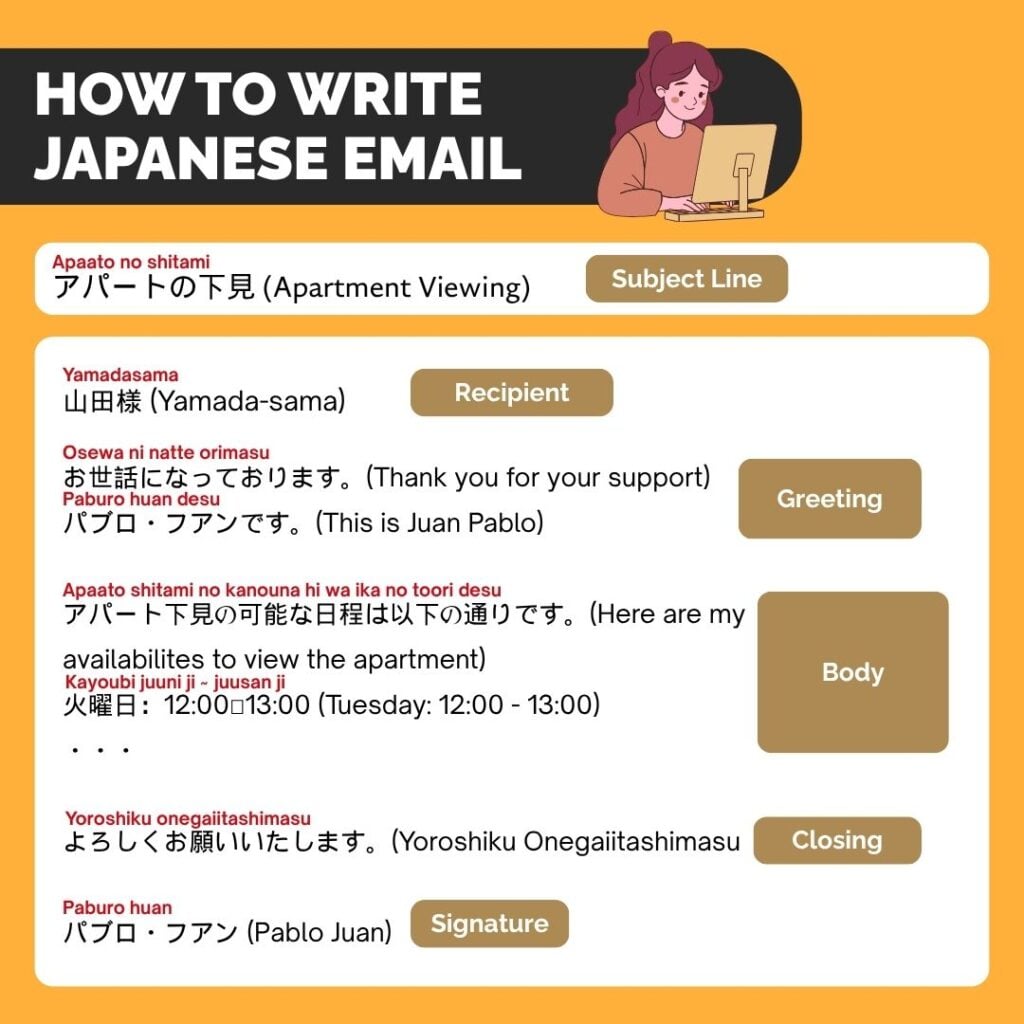
Japanese emails follow a basic structure and format that can vary by level of formality. Japanese business emails have a much more rigid format, and you usually include details like addressing the recipient’s company and department. But for most general emails, both personal and business, this is the common structure you will find:
Top: Recipient name (for business emails, you include their company and department/position)
Introduction/Greeting: Usually includes standard expressions to convey appreciation. You usually mention your name here as well.
Body: Addresses the purpose of the email, whether it’s to apply for a job or to schedule something.
Closing: Sign off with another formal phrase thanking them for their time
Signature: You usually just need your name (for business emails, you usually have a template that includes company information)
For the sake of this blog, we will focus on how to email in Japanese for personal use, and not necessarily for work, which follows Japanese business email standards.
Generally, you will recognize key expressions that are used in just about every Japanese email, whether it’s for business or personal use. But you don’t need to make your personal emails outside of work so rigid, and you can be much more concise. So, let’s break down how to write a Japanese email, starting from the subject line to the sign-off!
Subject lines in Japanese Emails
Subject lines, known as 件名 (kenmei) in Japanese, appear at the top of the email or in your notification. The subject line should summarize what the email is going to be about, like if you’re inquiring about an apartment or if you’re applying to a new job.
Subject lines don’t need to be complicated at all; you can simply write the purpose of the email. Here are some examples.
Example 1:
OOアパート201号室についての問い合わせ
OOapaato 201 goushitsu nitsuiteno toiawase
Inquiring about OO apartment room 201
Example 2:
マーケティングアナリストへの応募
Maaketingu anarisuto eno oubo
Marketing Analyst Application
Addressing the Recipient in Japanese Emails
At the top of the email, you usually address the recipient. While in business emails, you usually have to address the recipient’s company and name; in standard emails, you just simply have to address the person’s name, usually their last name followed by the suffix 〜様 (~sama).
However, if you don’t know the recipient’s name, you could use a polite phrase such as 株式会社 〇〇 御中 (kabushigi gaisha OO onchuu), meaning “To whom it may concern at company OO.” However, Japanese emails generally don’t use standard Japanese greetings like こんばんは (konbanwa) or こんにちは (konnichiwa).
Writing the Greetings in Japanese Emails
There is one phrase you will always use and see in just about every Japanese email you’ll send and receive. This is the key expression you will need to know to greet the recipient:
お世話になっております
Osewa ni natte orimasu
Thank you for your support/assistance
There actually isn’t a good English translation for お世話になっております, but it basically means “Thank you for your constant support.” It’s a very humble keigo phrase you use to thank people for working with you. It literally translates to “I’m in your care,” so you are acknowledging that you are taking up their time and attention. It’s an expression of appreciation, and it’s always used as a formality when you email, send a message, or even call someone.
Afterward, you usually need to introduce yourself or mention who you are. It doesn’t need to be a full-length 自己紹介 (jikoshoukai) or self-introduction. You just need to mention your name (typically last name, then first). If you’re emailing in a professional capacity, you would also need to write your company name. Here are both ways you can write your email introduction.
Example 1:
お世話になっております。
パブロ・フアンです。
Osewa ni natte orimasu
Paburo Huan desu.
I’m grateful for your constant support.
This is Juan Pablo.
Example 2:
いつもお世話になっております。
合同会社グーグルのパブロ・フアンと申します。
Itsumo osewa ni natte orimasu.
Goudou gaisha guuguru no paburo huan to moushimasu.
I’m grateful for your constant support.
I am Juan Pablo from Google LLC.
The second example is more formal since you are introducing your company as well as your name. Also, rather than just saying your name, by adding the keigo phrase と申します (to moushimasu), you are introducing yourself more formally, similar to saying “I am called…”
However, depending on who the recipient of the email is, you might use a different greeting.
Greetings for Someone You’re Contacting for the First Time
If this is your first contact, you could greet the recipient with はじめてご連絡いたします (hajimete gorenraku itashimasu), which translates to “this is my first time contacting you.” It works as a polite greeting when emailing someone for the first time.
Example:
初めてご連絡いたします。
パブロ・フアンと申します。
Hajimete gorenraku itashimasu.
Paburo huan to moushimasu.
This is my first time contacting you.
I am Juan Pablo.
Greetings for Colleagues
When emailing a colleague or teammates, which you will need to do often, you don’t need to be as formal as you would when emailing clients or external partners. Generally, when you email a colleague, you would use the common phrase: お疲れ様です (otsukaresama desu).
There is no English equivalent, but it conveys your appreciation for the listener’s hard work. It’s a common business Japanese expression you use when greeting colleagues or your boss, both in the workplace and over email. It’s also common to follow up the phrase with お世話になっております.
Example:
お疲れ様です。
いつもお世話になっております。
Otsukaresamadesu.
Itsumo osewa ni natte orimasu.
Thank you for your hard work.
I’m grateful for your constant assistance.
Writing the Body in Japanese Emails
Now we finally get to the meat of your email. In the body, you discuss the main purpose of the email, whether it’s to inquire about a new apartment room with your agent, apply for a job position, or even just respond. For most general emails, you can state your purpose or just go straight to the point of your email.
Example 1:
質問があるのですが、入会金はいくらでしょうか?
Shitsumon ga aru no desu ga, nyuukaikin wa ikura deshou ka?
I have a question: how much is the membership fee?
Example 2:
入学要件をおしえていただけますか?
Nyuugaku youken o oshiete itadake masu ka?
So, could you let me know about the admission requirements?
Sometimes, before getting to the point, you might need to write a brief introduction, which varies depending on the email’s purpose. For instance, if the email follows up on a previous conversation or meet-up, you usually thank the recipient for their time before moving into the body.
Example 3:
先ほどは、ありがとうございました。面接可能な日程は以下の通りです。
Saki hodo wa arigatou gozaimashita. Mensetsu kanou na nittei wa ika no toori desu
Thank you so much for your time earlier. Here are my availabilities for the interview.
You’ll often need to make requests in emails, so how do you do that politely in Japanese?
Making Requests in Japanese in Emails
Over email, you’ll frequently need to actually ask for something, whether it’s information, a document, or a favor. Japanese has several set phrases for making polite requests, and the right one depends on how big the favor is and how formal the relationship is.
One of the most common ways to make a request is by using 〜ていただけますか (~te itadakemasu ka), which roughly means “could you do… for me?” It’s a humble, polite way to ask someone to do something without sounding too direct or demanding.
Example:
資料を送っていただけますか?
Shiryou o okutte itadakemasuka?
Could you send me the materials?
However, if you want to email a request to change something already agreed upon, it is better to use an apologetic expression. Asking to make a change could inconvenience the other person, so to convey your awareness of that, you can say, もうしわけありませんが、~ていただけないでしょうか? (Moushiwake arimasen ga, ~shite itadakenai deshou ka?), which means “I’m very sorry, but would it be possible to change…?”
もうしわけありません expresses a deep apology that works perfectly for formal contexts. You can use this phrase with your boss or a client. Additionally, 〜ていただけないでしょうか politely asks if it’s possible to make the request you’re asking.
Example:
もうしわけありませんが、面接の日程を変更していただけないでしょうか?
Moushiwake arimasen ga, mensetsu no nittei o henkou shite itadakenai deshou ka?
Would it be alright if I changed the interview date?
How to Write Final Remarks in Japanese Emails
Just like Japanese emails open with a set greeting, they almost always close with one too. These closing phrases wrap up the email on a polite, appreciative note, and skipping them can make your email feel abrupt, even if the rest is perfectly polite.
The most common closing phrase by far is よろしくお願いします (yoroshiku onegaishimasu). It doesn’t have a direct English equivalent, but it functions like “thank you in advance” or “I appreciate your cooperation,” and you’ll see it at the end of nearly every Japanese email, personal or business.
Example:
ご確認のほど、よろしくお願いいたします。
Gokakunin no hodo, yoroshiku onegaishimasu.
Thank you in advance for your confirmation.
For more formal or business emails, especially ones sent to clients or higher-ups, you can upgrade this to 何卒よろしくお願い申し上げます (nanitozo yoroshiku onegai moushiagemasu). Adding 何卒 (nanitozo), meaning “please” or “by all means,” and switching to the humble keigo form 申し上げます (moushiagemasu) makes the phrase noticeably more formal and respectful.
Example:
今後とも何卒よろしくお願い申し上げます。
Kongo tomo nanitozo yoroshiku onegai moushiagemasu.
I humbly ask for your continued support.
After your closing phrase, you’ll typically add your signature, which includes your name and, for business emails, your company and position. This final structure signals that the email is complete and reinforces the polite, appreciative tone you’ve kept throughout.
Conclusion: Writing Japanese Emails Is Easier than You Think!
While Japanese emails can seem complicated, with lots of formalities, they aren’t too difficult to get used to. Japanese emails tend to use the same phrases, so once you know them, they’re easy to write and understand. So, try to remember some of the key phrases from this blog and write an email completely in Japanese!
Learn to Write Japanese Emails with Coto Academy!
If you really want to master writing a Japanese email like a native, then come learn Japanese at Coto Academy! Our classes go over common expressions you will need to use in emails, daily life, and work. We focus on practical Japanese you can start using right away, whether you’re a complete beginner starting with hiragana or looking to level up your Japanese!
So, visit one of our campuses in Tokyo or Yokohama, or join us online from anywhere around the world! If you want to chat and discuss details, fill out the form below!
FAQ:
What's the most important phrase to know for Japanese emails?
お世話になっております (osewa ni natte orimasu). It’s used in almost every email, business or personal, and works even the first time you’re contacting someone.
How is a Japanese business email different from a personal one?
Business emails follow a much stricter structure, including the recipient’s company and position, formal keigo throughout, and a set closing phrase, while personal emails can be shorter and more casual.
What greeting should I use when emailing a colleague instead of a client?
お疲れ様です (otsukaresama desu) is the standard choice for colleagues and bosses, often followed by お世話になっております for added politeness.
How should I close a Japanese email?
よろしくお願いします is the standard, versatile closing phrase for almost any email. For more formal situations, 何卒よろしくお願い申し上げます adds an extra layer of humility and respect