



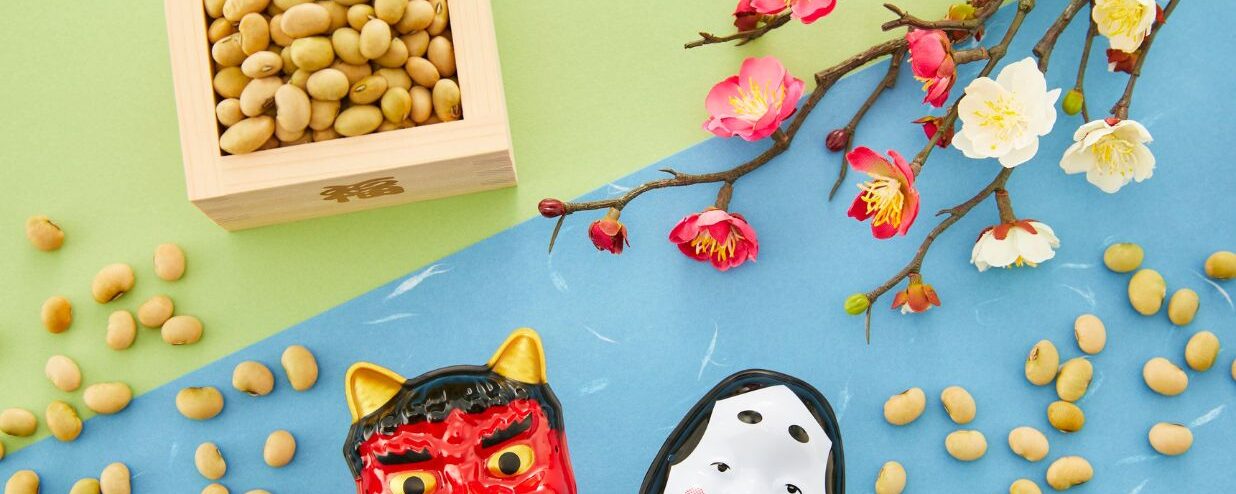


Setsubun is the day before the beginning of spring (according to the old Japanese lunar calendar) when people chase away demons to welcome a new season. It usually falls around February 2, 3, or 4. So while most parts of the world are going crazy over Valentine’s Day, cherry blossoms, or Easter, you’ll find Japanese families throwing scattering beans around their house and decorating their entrances with fish heads and holly tree leaves.
Similar to the lunar new year, a lot of the Setsubun’s cultural practices are aimed at cleansing the previous year and driving out bad fortunes. Above all, it’s a fun way for children to channel their tantrums by throwing beans! Wondering what to do during this time? Check out all you need to know about Setsubun!
What is Setsubun?
The word Setsubun takes up the kanji 節 (setsu, meaning season) and 分 (bun, meaning division). Together, they literally mean ‘seasonal division’. Setsubun (節分) is a traditional Japanese event that marks the change of seasons, right before the start of spring in the old lunar calendar.
Before it became part of Japanese tradition, Setsubun was originally a Chinese custom called “tsuina”. In China and Japan, people believe misfortunes are caused by demons, or 鬼 (oni). When seasons change, people are at their most vulnerable to bad things and diseases, so the practice of purging your house of these demons began. In the eighth century (around the Heian Period), it was adopted in Japan alongside Buddhism.
Traditionally, Setsubun is celebrated in individual households. People would start throwing beans to kick out the demons to avoid famines, diseases, or disasters.The tradition eventually branches out by region and family, too, but you can always observe it at shrines and temples.
Setsubun marks the day before the beginning of a new season. Technically, that means there are four Setsubun celebrations in a year, but in post-Edo times, the day came to be associated with the beginning of spring.
Want to study Japanese with us?
When is Setsubun?
Though the specific date can fluctuate, Setsubun is usually held on February 2, 3, or 4. Setsubun is also not a national holiday. Occasionally, the date might fall on a weekend, such as in 2025 and 2029 when it falls on Sunday and Saturday respectively. However, if it falls on a weekday, you might need to plan your day off beforehand to participate in specific Setsubun’s festivities. Check out below for the exact date for Setsubun up until 2031!
| Year | Day | Date |
|---|---|---|
| 2025 | Sunday | February 2 |
| 2026 | Tuesday | February 3 |
| 2027 | Wednesday | February 3 |
| 2028 | Thursday | February 3 |
| 2029 | Saturday | February 3 |
| 2030 | Sunday | February 3 |
| 2031 | Monday | February 3 |
Traditions Done During Setsubun
1. Bean-throwing ceremony
Setsubun is widely known for one thing: bean-throwing, or mamemaki (豆撒き). The idea here is to throw those beans at wicked demons to purge.
As preparation, Japanese people will roast “lucky” soybeans, known as fukumame (福豆), in a wooden box called asakemasu. It’s the same box that is used to serve sake and nihonshu (Japanese rice wine). The soybeans are then thrown out to the front door — or sometimes, to a real demon.
A family member, usually the father, will dress up as an oni costume or mask, and the children will throw the beans at him while chanting “鬼は外! 福は内! (Oni wa soto! Fuku wa uchi!)” The meaning? “Devils out! Fortune in!”
Some families do it differently. Sometimes, it’s the head of the household — and not the children — to throw the beans outside; the kids will don paper masks and run away from the bean thrower. Some people who want to stick to the convention will pick men or women whose Chinese zodiac matches that year’s Setsubun.
For some households, they’ll chant along “Gomottomo, gomottomo” (“That’s right, that’s right! “). Some regions will use peanuts instead of soybeans, too. Either way, it’s a fun family event. They only need to stick to one rule: they can only throw the beans, and not pull or push the demons.
After the ‘demon’ gets expelled, the demon player will be re-invited into the house as a god, bringing good luck. The whole family gathers together to eat the roasted soybeans that are the same age as they are. They can eat one more bean for more protection.
If you can’t or don’t want to eat the beans, you can also brew them in hot water to make fukucha (福茶), which means “lucky tea”. You can reroast it or add salted kelp and pickled palms to make the broth salty.
Why do Japanese people throw soybeans, specifically? This is because the word mame means both beans and “destroying evil. Homophones play a central part in Chinese and Japanese superstitions. Japanese bitter oranged, called daidai (橙) is part of osechi (traditional tiered box eaten during New Year’s) because it sounds the same as daidai (代々), which means “from generation to generation”. The number ‘4’ is considered bad luck because it’s a homophone for death (“shi”).
Besides that, in the Chinese tradition, soybeans were considered the five most important crops, and they were thought to contain the spirits of all the crops combined. If you need to put two and two together, the kanji for soybean, daizu (大豆) literally means “the big bean”.
Some sources also say that soybeans’ firmness is similar to that of an oni. To roast the bean and make it edible is to ‘conquer’ the evil spirits. Throwing the beans means throwing out evil spirits, and eating them means digesting the demons.
These days, Setsubun isn’t just a family-sized event. Because it’s not a public holiday, most family members will either be at school or work.
In Japanese schools, teachers (or even the principal) might dress up as oni while students throw roasted beans. In bigger cities like Tokyo, temples and priests can perform mamemaki, too.
2. Warding Off Evil: Iwashi and Holly Branch
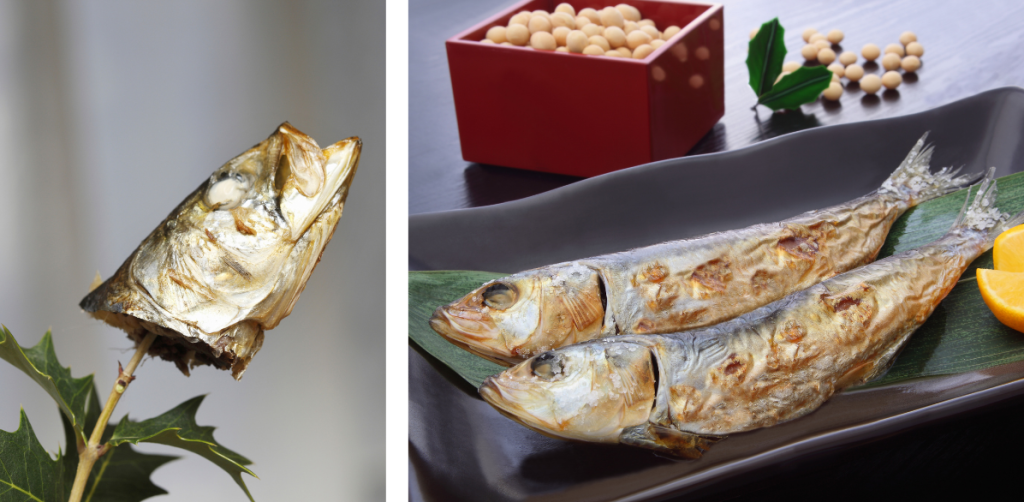
Besides soybeans, people can ward off evil using iwashi (sardines). With a holly branch, which is considered a sacred plant, you pierce the fish through its eyeballs to not-so-subtly symbolize piercing an oni’s eyes.
The sardine heads are then grilled and displayed at the entrance of the house, knotted together and adorned with holly leaves. Because sardines contain a lot of oil, they emit more smoke, which in turn makes the ward more effective.
Some families will hang the fish on the undersides (like porches) of their traditional houses because that location is believed to be vulnerable to demons.
3. Eating Ehomaki: Eating The Fortune
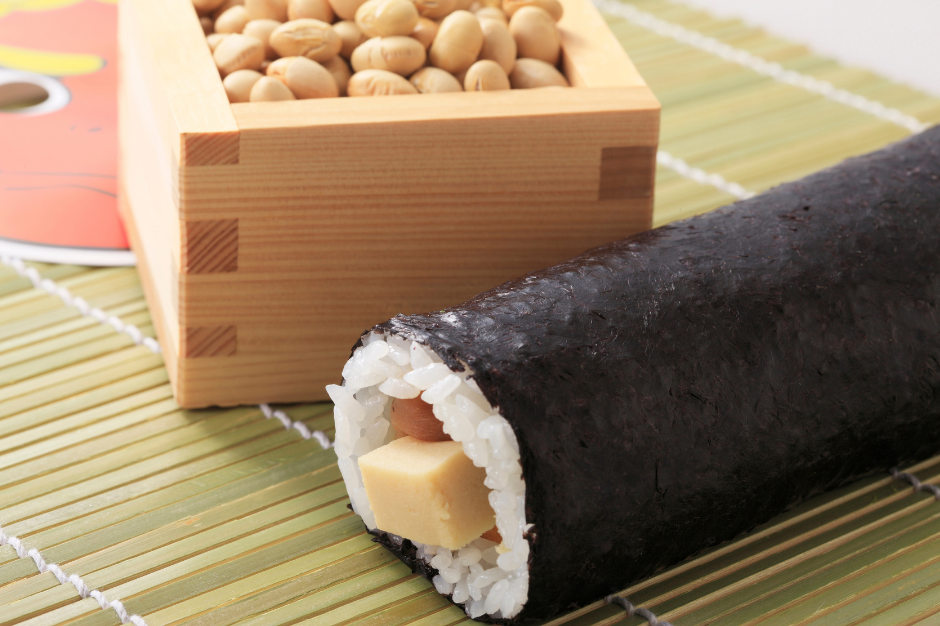
In the recent decade, ehomaki (恵方巻), which means “lucky direction roll,” has become a popular dish to eat during Setsubun nights. ehomaki is an uncut makizushi roll filled with seven ingredients, with the number ‘7’ indicating luck. The ingredients are usually vinegared rice, simmered shiitake mushrooms, cucumber, tamagoyaki (egg roll), and eel.
There’s a special way to eat ehomaki, though. You will need to hold the sushi roll while facing the new year’s lucky compass, which is decided through the zodiac symbol, and eat it in silence.
Take a look at the table below for the ehomaki direction for the upcoming years.
| Year | Direction |
|---|---|
| February 3, 2022 | North-north-west |
| February 3, 2023 | South-south-east |
| February 3, 2024 | East-north-east |
| February 2, 2025 | West-south-west |
| February 3, 2026 | South-south-east |
The tradition originates from Osaka Prefecture, but the store and konbini (convenience store) companies saw it as an opportunity to fill the marketing lull before Valentine’s Day rush, and it gained huge popularity.
Eventually, ehomaki became part of setsubun. You can pre-order them at your local Family Mart or Seven-Eleven.
What to Eat During Setsubun
1. Setsubun Iwashi (節分いわし)
The other bulk of the fish that’s not used to fend off the demon? In some households, it’s eaten as part of the Setsubun meal. After removing the internal organs, you coat the body with salt for around 30 minutes to get rid of excess water and condense the fish’s umami.
2. Peanuts (ピーナッツ)
Particularly in Hokkaido, Tohoku, and Miyazaki, many families swap soybeans with peanuts (or 落花生, pronounced rakkasei) because it’s considered more hygienic. Most of us won’t pick up soybeans from the ground and eat them, but the extra coating of peanut-thick, hard shells gives us ease of mind.
3. Setsubun Soba (節分そば)
Soba is a traditional staple, eaten during celebrations and cultural events. The same can be said about Setsubun. Although probably not popular in Tokyo (or the Kanto area), it’s a custom in Nagano Prefecture and Izumo.
4. Shougazake (生姜酒)
Shougazake is a type of sake brewed with ginger, typically drunk on the night of Setsubun.
Variations of Setsubun Across Japanese Regions
The Setsubun tradition trickled down for centuries, from one region to another. Across Japan, you’ll find variations of Setsubun rituals, chants, and other practices.
In Kyoto, which is the center of Japan’s geisha culture, geisha apprentices will perform a dance and throw roasted soybeans. Other areas will throw small envelopes with money, candies, and gold or silver-foiled soybeans.
Instead of throwing the soybeans, the head of the household — the father, because Japan mostly adopts a patriarchal system — will instead pray with the beans wrapped in his hand. Some families will offer the beans at the kamidana (miniature household altars). After that, they’ll toss it out the door.
There are a few varieties of the chants, too. In Aizuwakamatsu — a town in Fukushima — you will find people shouting, “Oni no medama buttsubuse (鬼の目玉ぶっつぶせ)!” which means “Blind the demon’s eyes.”
In Sensouji temple, you’ll hear “Long life, fortune in!” instead of “Demons out, fortune in!” because they don’t believe in the presence of demons in front of their goddess.

Setsubun Festivals in Tokyo
With Setsubun becoming more of a fun event, the beliefs have been diluted, but the tradition stays. Now, you can observe this bean-scattering ceremony across major demographic points in Japan, with the most being in Tokyo. Shrines and temples will host Setsubun, joined by celebrities.
Besides beans, don’t be surprised to see priests throwing out money, chocolate, or other prizes to the crowd. If you’re in and around Tokyo on February 3, make sure to check out the closest Setsubun festival.
Due to the uncertain (and ongoing) situation with COVID-19, events may be subject to change. We recommend visiting the event’s website for the latest updates.
1. Sensoji Temple at Asakusa
At Sensoji, Tokyo’s most popular Buddhist temple, chants are done differently. No demons can be present in front of the shrine of Kannon, the goddess of mercy. Instead of the usual “Demons out, fortune in,” you’ll hear a prayer for eternal good luck: “Senshuubanzei fukuhauchi (千秋万歳福は内)”, which can be interpreted as “Long life, fortune in!”
After the bean-tossing ritual, you can see Sensoji’s other famous ritual: “Seven Deities of Good Fortune Dance”. Just don’t be surprised if you recognize a public figure cruising around the stage and throwing the beans, too.
Location: 2 -3-1 Asakusa, Taito-ku, Tokyo
2. Zojoji-temple at Shibkoen
The temple will perform the Setsubun nuo-folk ceremony. You can enjoy the bean-tossing session held on the stage while watching children wearing colorful handmade kamishimo (traditional samurai kimono), and men and women will also parade around the venue.
Location: 4-7-35 Shibakoen, Minato-ku, Tokyo
Website: www.zojoji.or.jp/event
3. Toranomon Kotohiragu Shrine
The Setsubun ceremony will begin around 12:30 pm. A priest will sprinkle the “fortune beans” around the shrine, and visitors are welcome to watch.
Location: 1-2-7 Toranomon, Minato-ku, Tokyo
Website: www.kotohira.or.jp/event
4. Atago Shrine
The shrine will perform a ritual to exterminate evil and invite good fortune. If you want to attend, you will need to contact the shrine’s administration office directly.
Location: 1-5-3 Atago, Minato-ku, Tokyo
Website: www.atago-jinja.com/event
5. Tokyo Tower
Although not a shrine or temple, Tokyo Tower still welcomes visitors in its annual Setsubun event. Go up the main deck of the second floor to see the priests from Zojoji Temple giving the beans at oni.
Location: 4-2-8 Shibakoen, Minato-ku, Tokyo
Website: www.tokyotower.co.jp/en
Conclusion
While Setsubun is not a national holiday, it is still widely celebrated by Japanese families, temples, and communities for its strong symbolism. This symbolic and traditional event marks the welcoming of a new season and, in a way, a fresh start, from cleansing away bad fortune to inviting good luck by eating “lucky” rolls like ehomaki.
Want to Immerse Yourself in Japanese Culture? Learn the Language with Coto Academy!
Want to truly immerse yourself in Japanese culture? Learning the language is the key — and Coto Academy is here to help you get there. From understanding seasonal traditions like Setsubun to confidently navigating daily life in Japan, our conversation-focused lessons are designed to help you use Japanese naturally, not just study it.
At Coto Academy, you’ll learn in small classes with professional native teachers who tailor lessons to your goals and level. With campuses in Tokyo and Yokohama, plus flexible online options, we make it easy to start speaking Japanese with confidence from day one. Whether you’re living in Japan or planning your next adventure, Coto Academy helps turn cultural curiosity into real connection.
Fill out the form below if you are ready to learn Japanese with us!
Like what you’re reading and want to explore more Japanese culture? Check out our top picks for you:
Obon: A Japanese Tradition Honoring The Ancestors’ Spirits
New Year’s Day (元日): A Time for Tradition
Culture Day: The Holiday that Commemorates Peace