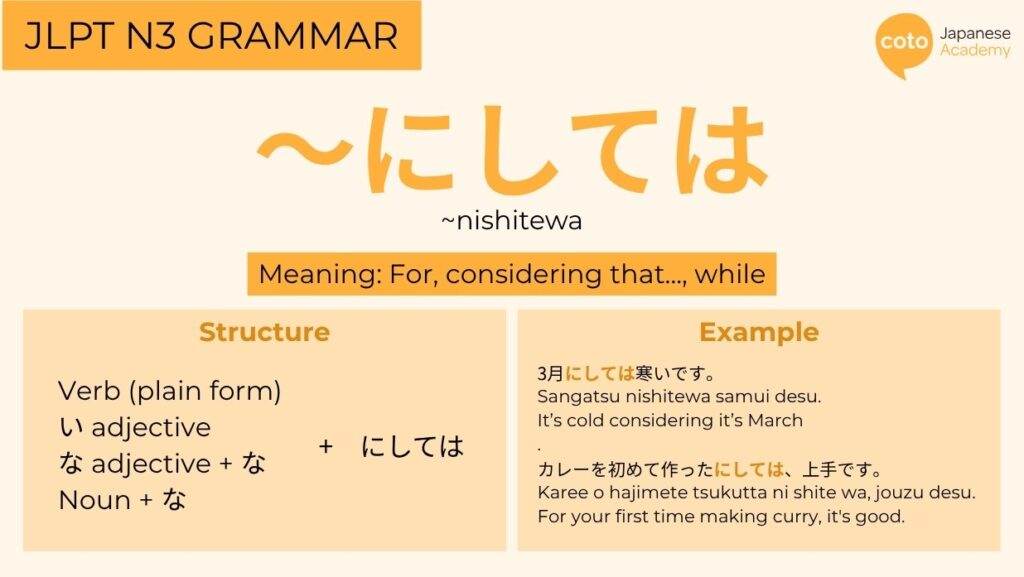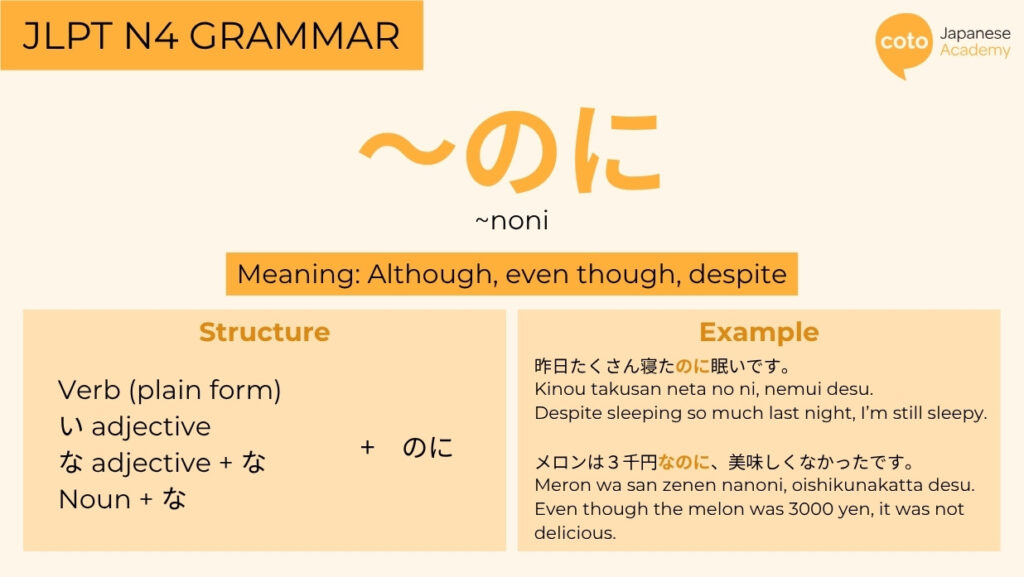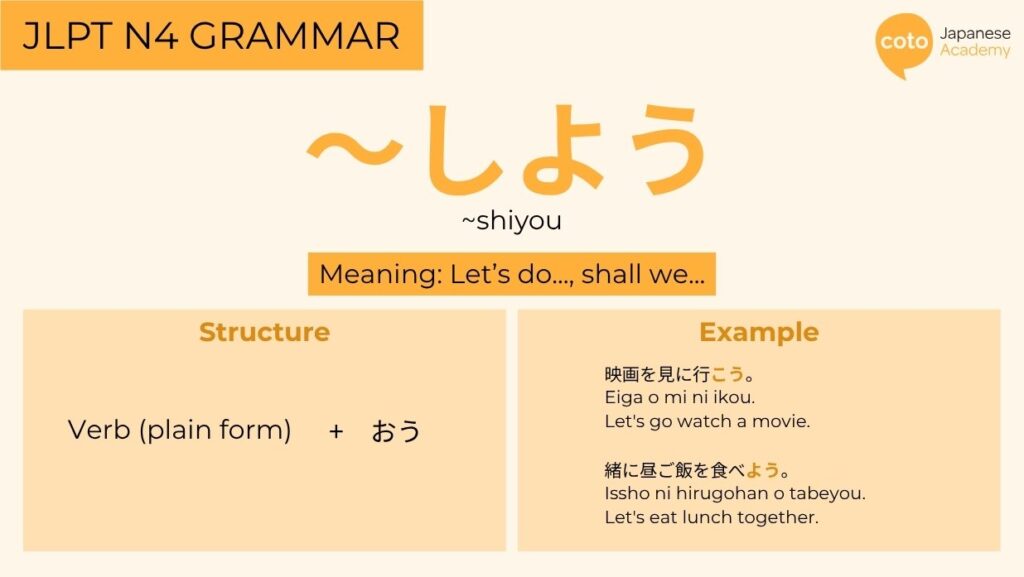

The JLPT N4 phrase, 〜のに (~noni), is often used to contrast two opposing remarks, similar to saying “even though.”  You can use this phrase to express dissatisfaction, surprise, or regret over something unexpected or disappointing.

So, let’s learn how to use this JLPT N4 grammar point by breaking down its meaning, structure, and example sentences. 

Make Sure to Watch Coto Academy’s YouTube Video About  〜のに (~Noni)

Before you continue reading, why not take a moment to watch a quick YouTube lesson with our Japanese teacher, Yuka-sensei:

Meaning of 〜のに (~noni)

〜のに (~noni) means something similar to “even though,” “despite,” or “although” in English. You often use it to express a contradiction or your surprise at an unexpected outcome. The expression conveys a sense of irony or even disappointment.

The phrase is commonly used in a negative context, usually pairing contradictory statements to convey a sense of disappointment, such as:

ステーキが高いのに、美味しくなかったです。
Suteeki ga takainoni, oishikunakatta desu.
Even though the steak was expensive, it was not delicious.

However, it can be used in a more positive connotation to express an unexpected but pleasant surprise,

ステーキが安いのに、すごく美味しかったです。
Suteeki ga yasuinoni, sugoku oishikatta desu.
Even though the steak was cheap, it was so tasty.

Usually, following 〜のに is a statement that expresses regret or surprise; however, there are cases when it’s quite natural in conversation to leave the sentence ‘unfinished.’ The usage of 〜のに somewhat changes for emotional impact, generally, highlighting an emotion like regret. For example:

傘を持っていけばよかったのに
Kasa o motte ikeba yokattanoni
Should’ve brought an umbrella…

The conditional statement, 持って行けば良かった (motte ikeba yokatta) could be used alone to express how it would’ve been better if you had brought an umbrella. Attaching のに expresses a greater sense of regret, like saying “I really should’ve…” You could describe 〜のに as a rather emotionally loaded expression.

Structure of 〜のに (~noni)

So, you usually attach 〜のに to verbs, adjectives, and even nouns. You can only attach のに to verbs in plain form, for example:

毎日たくさん寝るのに、いつも疲れます。
Mainchini takusan nerunoni, itsumo tsukaremasu.
Although I get a lot of sleep every day, I’m always tired

In the case of both nouns and な-adjectives, you have to add a な; here are some examples using nouns and な-adjectives.

Using 〜のに with Nouns:

犬なのに、何を言っても分かります。
Inunanoni, nani o ittemo wakarimasu.
Even though it’s a dog, it understands everything you say.

Using 〜のに with な-adjectives:

故郷が安全なのに、住みたくないです。
Furusato ga anzen nanoni, sumitakunai desu.
Although my hometown is safe, I don’t want to live there.

TypeStructure
Verb (plain form)Verb + のに
い-Adjectiveい-Adjective + のに
な-Adjectiveな-Adjective + な + のに
NounNoun + な + のに

Note that 〜のに itself does not conjugate into past, present, negative, or positive. The word to which 〜のに attaches is what conjugates. Let’s break down how this works with different verb conjugations.

FormPlain Form + のでMeaning
Present雨が降るのにAlthough it will rain
Past雨が降ったのにAlthough it rained
Negative雨が降らないのにAlthough it won’t rain
Past Negative雨が降らなかったのにAlthough it didn’t rain

〜のに (~noni) vs 〜ても (~temo)

The grammar points 〜のに and 〜でも can both mean something like “even though,” but they convey different nuances and emotions. 〜のに deals with real situations that are actually happening or have happened, where 〜ても is generally used to express a hypothetical. 

They also differ in emotional nuance; のに carries emotional weight, such as surprise, frustration, regret, or complaint, when reality doesn’t meet expectations. On the other hand, 〜ても is emotionally neutral; it simply states a logical concession with no implied feeling. Here are a couple of examples to demonstrate the differences.

Using 〜のに:

せっかく作ったのに、食べてくれなかった。
Sekkaku tsukattanoni, tabete kurenakatta.
Although I went to the trouble of making it, they didn’t even eat it.

In this statement, you can see how のに describes a real situation that actually happened. Additionally, the use of 〜のに conveys a sense of disappointment that no one ate the food.

Using 〜ても:

雨が降っても、傘を持っていかない。
Ame ga futtemo, kasa o motte ikanai.
Even if it rains, he won’t take an umbrella.

Here, 〜ても is used more as hypothetical rather than describing an actual event. It also doesn’t have any inherent emotional weight and just states a neutral observation.

Example Sentences Using 〜のに

Now, let’s go through some example sentences to really understand how to use 〜のに in actual conversation.

Example 1:

今日はとても寒いのにTシャツを着ています。
Kyou wa totemo samui no ni T-shatsu o kiteimasu.
Even though it’s so cold today, he is wearing a t-shirt.

Example 2:

昨日たくさん寝たのに眠いです。
Kinou takusan neta no ni, nemui desu.
Despite sleeping so much last night, I’m still sleepy.

Example 3:

メロンは3千円なのに、美味しくなかったです。
Meron wa san zenen nanoni, oishikunakatta desu.
Even though the melon was 3000 yen, it was not delicious.

Example 4:

私は1時間前お昼ご飯を食べたのに、お腹が空きました。
Watashi wa ichi jikan maeni ohirugohan o tabetanoni, onaka ga sukimashita.
Although I ate lunch an hour ago, I’m already hungry.

Kanji / WritingFuriganaRomajiEnglish
今日きょうkyoutoday
とてもとてもtotemovery, so much
寒いさむいsamuicold
TシャツティーシャツT-shatsut-shirt
着ていますきていますkite imasuis wearing
昨日きのうkinouyesterday
たくさんたくさんtakusana lot / much
寝たねたnetaslept (past)
眠いねむいnemuisleepy
メロンメロンmeronmelon
3千円さんぜんえんsan zen en3,000 yen
美味しくなかったおいしくなかったoishiku nakattawas not delicious
わたしwatashiI / me
1時間前いちじかんまえichi jikan maeone hour ago
お昼ご飯おひるごはんohiru gohanlunch
食べたたべたtabetaate (past)
お腹が空きましたおなかがすきましたonaka ga sukimashitabecame hungry

Learn More JLPT Grammar with Coto Academy!

If you want to practice using this JLPT grammar and many others in actual Japanese conversations, nothing beats practicing with a teacher who can offer practical guidance. So, consider signing up with us at Coto Academy!

Why Study at Coto Academy?

Coto Academy has been offering Japanese classes for over 25 years, with campuses in Shibuya, Yokohama, Iidabashi, Minato, Shinjuku, and online. Our courses focus on practical Japanese, so the grammar you learn is designed for real-life use.

We offer part-time, intensive, and fully online lessons to suit your schedule. Start learning Japanese effectively and confidently with Coto Academy today! Fill out the form below for a free level check.

FAQ:

What does 〜のに (~noni) mean?

のに connects two clauses to express “even though” or “despite.” It highlights a contrast where the result is unexpected or disappointing given the premise. It almost always carries an emotional tone, such as surprise, frustration, or regret.

Can 〜のに (~noni) be used for hypothetical situations?

No, the grammar 〜のに requires a real, factual premise. You cannot use volitional statements such as “let’s” with the 〜のに. For hypothetical or general “even if” situations, use ても instead.

Can a sentence end with のに?

Yes, and it is very natural in speech. Leaving the sentence unfinished lets the emotional implication (disappointment, frustration, complaint) hang in the air. Completing the thought can actually sound more blunt.

What is the difference between のに and ても?

のに is used for real situations and carries emotional weight (frustration, regret, surprise). ても is emotionally neutral and used for hypothetical or general “no matter what” situations. If you feel like saying “but!” with feeling, use のに. If you mean “regardless,” use ても.

The JLPT N4 grammar 〜しよう closely translates to “let’s do!” The grammar is actually the volitional form of する, meaning “to do.” Volitional form is a verb conjugation that is used to express an invitation or suggestion.

So let’s break down what the volitional form is, how it works, and how we can use it in actual Japanese conversation.

Make Sure to Watch Coto Academy’s YouTube Video About  〜しよう (~Shiyou)

Before you continue reading, why not take a moment to watch a quick YouTube lesson with our Japanese teacher, Yuka-sensei:

Meaning of 〜しよう (~shiyou) or 〜よう (~you)

しよう is the verb する (suru) in volitional form, known in Japanese as 意向系 (ikoukei) or 〜よう (~you) form, which is a verb conjugation that conveys an invitation or suggestion. Basically, you use it to ask or request the listener to join you in doing something, usually as a friendly way to say “let’s do…” or “shall we…” The volitional form can be used beyond the verb する, and can be used with virtually any verb.

It’s also a warm and friendly way to agree with someone else’s suggestion, similar to saying “yeah, let’s do it!” Here is an example:

Friend:
週末、うちでバーベキューしない?
Shuumatsu, uchi de baabekyuu shinai?
This weekend, want to have a BBQ at my place?

You:
うん、いいね!しよう!
un, ii ne! shiyou!
Yeah, sounds good! Let’s do it!

So, here しよう, the volitional of する, is being used to express enthusiastic agreement to your friend’s suggestion of having a BBQ at their place.

Friend:
12時はどう?
jyuu ni ji wa dou?
How does 12 o’clock sound?

You:
いいね! 12時から始めようか?
ii ne! jyuu ni ji kara hajimeyou ka?
Great! Let’s start at 12!

In this example, you may notice that the volitional form was phrased as a question. This usage is quite common and can feel a bit less direct or commanding, making the expression feel more suggestive than pushy. While the literal translation of the volitional can be something like “shall we?”, you can sound more inviting or polite by using the volitional form + ? to form a question. This will convey the sentiment of “let’s do!” without seeming forceful!

Structure of 〜しよう (~shiyou) or 〜よう (~you)

The volitional form is a Japanese verb conjugation, so there are 3 different ways to conjugate depending on one of the 3 verb groups: う-verbs, る-verbs, and irregular verbs. So, let’s break down how it works with each group.

Group I – う Verb Endings

For group 1 verbs, also known as う-verbs, the last syllable, which ends with an (u) sound, is conjugated to おう (ou) sound. So, if a verb ends in く (ku), the character changes to こう (kou) in volitional form. Here’s how it works.

う(to buy) → おう (let’s buy)
く(to go) → こう (let’s go)
あそぶ(to play) → あそぼう (let’s play)

Dictionary formVolitional formEnglish
買う (Kau)買おう (kaou)let’s buy
行く (iku)行こう (ikou)let’s go
遊ぶ (asabu)遊ぼう (asabou)let’s play

Group II – る Verb Endings

Group 2 verbs, or る-verbs, are quite simple to conjugate into volitional form. All you have to do is just replace the る (ru) ending with よう (you). See how it works below:

る(to see) → よう
べる(to eat) → べよう

Dictionary formVolitional formEnglish
見る (miru)見よう (miyou)let’s watch
食べる (taberu)食べよう (tabeyou)let’s eat

Group III  – Irregular verbs

Irregular verbs are called irregular since they don’t behave predictably. Luckily, there are mostly just 2 verbs you need to be aware of, so you will just have to memorize how these two conjugate.

する(to do) → しよう (let’s do)
る(to come) → よう (let’s come)

Dictionary formVolitional formEnglish
する (suru)しよう (shiyou)let’s do
くる (kuru)来よう (koyou)let’s come

All these examples of volitional form we just provided are actually in casual form. For example, to say しよう(shiyou) in a more formal form, or basic keigo, would be しましょう (shimashou), which is a more polite way of saying “let’s do…” or rather “shall we do…” However, past, present, or negative conjugation is not relevant to the volitional form, since it expresses a request or a suggestion.

Example Sentences Using 〜しよう (~shiyou)

Now, let’s go through some example sentences to really understand how to use 〜しよう in actual conversation.

Example 1

映画を見に行こう。
Eiga o mi ni ikou.
Let’s go watch a movie.

Example 2

緒に昼ご飯を食べよう。
Issho ni hirugohan o tabeyou.
Let’s eat lunch together.

Example 3:

明日は早く起きよう。
Ashita wa hayaku okiyou.
Let’s wake up early tomorrow.

Example 4:

もっと日本語を勉強しよう。
Motto nihongo o benkyou shiyou.
Let’s study Japanese more.

Kanji / WritingFuriganaRomajiEnglish
映画えいがeigamovie, film
見に行こうみにいこうmi ni ikoulet’s go to watch
一緒にいっしょにissho nitogether
昼ご飯ひるごはんhirugohanlunch
食べようたべようtabeyoulet’s eat
明日あしたashitatomorrow
早くはやくhayakuearly
起きようおきようokiyoulet’s wake up
もっともっとmottomore
日本語にほんごnihongoJapanese language
勉強しようべんきょうしようbenkyou shiyoulet’s study

Learn More JLPT Grammar with Coto Academy!

If you want to practice using this JLPT grammar and many others in actual Japanese conversations, nothing beats practicing with a teacher who can offer practical guidance. So, consider signing up with us at Coto Academy!

Why Study at Coto Academy?

Coto Academy has been offering Japanese classes for over 25 years, with campuses in Shibuya, Yokohama, Iidabashi, Minato, Shinjuku, and online. Our courses focus on practical Japanese, so the grammar you learn is designed for real-life use.

We offer part-time, intensive, and fully online lessons to suit your schedule. Start learning Japanese effectively and confidently with Coto Academy today! Fill out the form below for a free level check.

FAQ:

What does 〜しよう or the volitional form mean?

The volitional form expresses a suggestion or invitation to do something together — similar to “let’s ~” in English. It can also express the speaker’s own intention or resolve, like “I think I’ll…” or “I will.”

Is the volitional form casual or polite?

The plain volitional (〜おう/〜よう) is casual. For polite situations, add ましょう to the verb stem instead — this is the polite equivalent and safe to use with strangers, teachers, or in formal settings.

Can 〜しよう or the volitional form be conjugated into past or other tenses?

No, the volitional form does not conjugate into past, negative, or other tenses on its own. It exists only in its base form since these other tenses would be relevant, as the grammar form is like a suggestion for a request.

The grammar pattern ~ていく (te iku) is used to express a change or action that begins now and continues moving forward in time. It combines the て-form of a verb with 行く (iku), which literally means “to go,” giving the overall meaning of something “going on” or “continuing from this point.”

At some point, your Japanese teacher has said that if you study every day, you’ll continuously get better and better at the language. Taking that grammar pattern to mind, you probably want to indicate something that will gradually increase, such as how much time you study Japanese (or any other subject), or the number of hours you work. For that, we recommend that you use 〜ていく.

In this blog, we’ll show you the meaning of ていく, as well as its basic usage. We’ll also show you the difference between ていく and てくる as well. Without further ado, let’s begin!

Want to study Japanese with us?

Make sure to watch our video on ~ていく (~te iku)!

Before you continue reading, why not take a moment to watch a quick YouTube lesson with our teacher, Nami-sensei?

Meaning of ~ていく (~te iku)

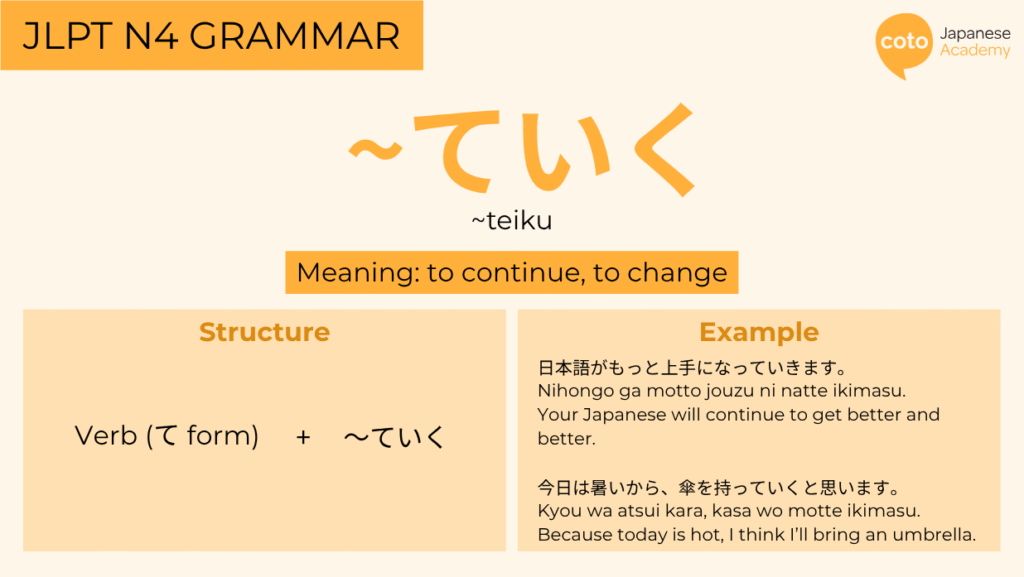
jlpt n4 te iku infographic meaning structure and example

~ていく (~te iku) is a grammar structure that basically indicates gradual change from now to the future. It translates to “to continue” or “to change,” and indicates that something has started and, in turn, will gradually progress. For example, the sentences below indicate gradual change based on the current situation:

毎日勉強すると、日本語がもっと上手になっていきます。
Mainichi benkyou suru to, nihongo ga motto jouzu ni natte ikimasu.
If you study every day, your Japanese will get better and better.

日本に旅行する外国人は増えていくと思います。
Nihon ni ryokou suru gaikokujin wa fuete ikuto omoimasu.
I think there will be more and more foreigners traveling to Japan.

The grammar pattern is also used to indicate physical movement. For example, if you’re about to go out, and the weather forecast says that it’s hot:

今日は暑いから、傘を持っていくと思います。
Kyou wa atsui kara, kasa wo motte iku to omoimasu.
It’s hot today, so I think I’ll bring an umbrella.

Grammar Structure of ~ていく (~te iku)

The sentence structure of ~ていく (~te iku) is:

StructureMeaning
Verb + ていくVerb + ていきますTo indicate gradual change from one point to another, to indicate “A happened, then this happened.”

You will need to know the て form in order to conjugate this grammar pattern. For quick reference, just take out the stem and replace it with て, so for example:

  • 歩きます (arukimasu) becomes 歩いて (aruite)
  • 食べます (tabemasu) becomes 食べて (tabete)
  • 読みます (yomimasu) becomes 読んで (yonde)

The difference between 〜ていく (〜te iku) and 〜てくる(〜te kuru)

You might have heard Japanese speakers use ~てくる (tekuru) along with 〜ていく (〜te iku), but is there a difference between the two grammar patterns? We know that いく (iku) means to go and くる (kuru) means to come, but can you use 〜てくる in the same way as 〜ていく?

~てくる indicates physical movement or time that is moving towards you. It’s basically the opposite of ~ていく, as this means that time is moving away from you, or there’s something physically moving away from you:

日本の生活に慣れてきました。
Nihon no seikatsu ni narete kimashita.
They slowly got used to life in Japan, little by little.

教室で椅子を取ってきます。
Kyoushitsu de isu wo totte kimasu.
I’m going to grab a chair from the classroom.

But what if you use both いく and くる in the same sentence? You might have heard someone say the following:

いってきます!
Ittekimasu!
I’m going out (and will come back)!

トイレに行ってくる。
Toire ni itte kuru.
I’m going to the toilet (and will come back).

In the case of the above sentences, the speaker is saying that they will come back after a short period of time. You wouldn’t say きていきます, that would sound strange to the listener. It can be difficult to tell the difference between 〜てくる and ~ていく, but remember that it depends on whether something or time is moving towards you or away from you. 

In addition, some verbs can only take 〜てくる. For example, the verbs to see, 見える (mieru), smell, 匂いがする (nioi ga suru), and listen, 聞こえる (kikoeru) are called perception verbs. If you were to use てくる along with these verbs, it describes the feeling of perceiving something.

富士山が見えてきた。
Fuji san ga miete kita.
Mt. Fuji came into view.

音楽が聞こえてくる。
Ongaku ga kikoete kuru.
The music can be heard.

Example Sentences Using ~ていく (~te iku)

Below are more example sentences when you can use ていく:

日本語を読むことに慣れていきます。
Nihongo wo yomu koto ni narete ikimasu.
I’ve gotten used to reading in Japanese.

この資料を先生に持って行ってください。
Kono shiryou wo sensei ni motte itte kudasai.
Please take these materials to the teacher.

More ways to use ~ていく

なっていく (natte iku)

When combining ~ていく with なる, you get this grammar pattern. Use this pattern to describe a change in the state of something. For い adjectives, replace the い with く.

TypeStructure
い adjectiveい adjective + く + なっていく
な adjectiveな adjective + に + なっていく

好きなことをやったら、もっと嬉しくなっていきます。
Suki na koto wo yattara, motto ureshiku natte ikimasu.
If you do what you love, you’ll become happier.

少し休んで、だんだん元気になっていきます。
Sukoshi yasunde, dandan genki ni natte ikimasu.
Take a short rest, and you’ll gradually feel better.

Conclusion for JLPT N4 Grammar ~ていく (~te iku)

ていく (te iku) can be used to describe something that is gradually changing over time, or something that’s moving away from you. It can be difficult to use this, but with enough practice, you’ll gradually get the hang of this grammar pattern. 

Upgrade your Japanese with Coto Academy!

Want to learn more JLPT grammar? Why not take Japanese lessons with Coto Japanese Academy? We’ve been offering practical Japanese courses for over 25 years, with locations in Shibuya, Shinjuku, Minato, Iidabashi, Yokohama, and online. We also offer JLPT preparation courses for those who want to pass the JLPT with flying colors.
Ready to learn with us? Contact us by filling out the form and get a free level check!

FAQ

What does ~ていく mean?

~ていく basically translates to “to continue” or “to change.” This grammar pattern is used to describe gradual change based on the current situation.

What’s the difference between 〜ていく (〜te iku) and 〜てくる(〜te kuru)?

An easy way to tell the difference between the two is the direction the state is going. ていく describes something moving away from you, whereas てくる describes something moving towards you.

Can I also say なってくる (natte kuru) in tandem with なっていく (natte iku)?

Again, this depends on how this grammar pattern ends. For なっていく, you’re describing something that is going to change, but for なってくる, you’re including the endpoint of the forthcoming change.

Read more:

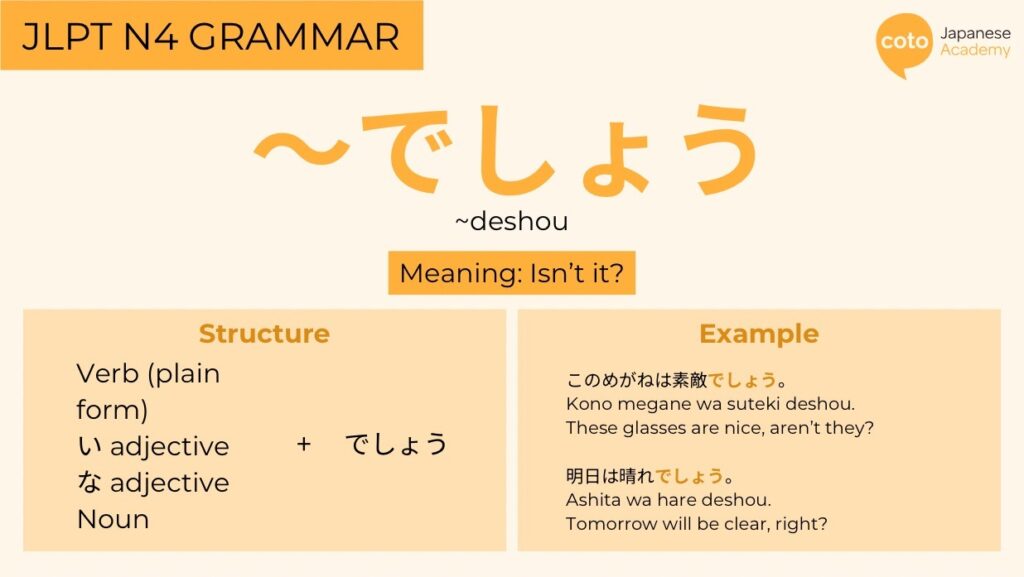
Ever used the Japanese grammar, でしょう (deshou)? Picture this. You recently got these new glasses, and you think they look nice. You want to tell your Japanese friend about your new glasses, but you want them to agree that they look nice. So what do you say when you want your friend to agree with you? You can say 素敵でしょう (suteki deshou), which translates in English to “Aren’t they nice?” 

In Japanese, 〜でしょう (~deshou) is a way to seek agreement on something that you said. 

Grammar patterns such as だろう or じゃない can be used to convey a similar meaning, whether you’re looking for sympathy, speculating, or want to confirm something. But which ones should you use and when? Knowing the difference between these grammar patterns can make or break your Japanese ability, and it can be the difference between sounding fluent and not.  

In this blog post, we’ll show you how to use でしょう (deshou) as well as similar grammar patterns you can use to seek agreement, sympathy, and more. 

Check Out Our Video Lesson on でしょう (Deshou)

Before you dive in, check out our quick video lesson on でしょう with our Japanese teacher, Nami-sensei!

Meaning of でしょう

でしょう is a grammar pattern that is used to seek agreement with the person you’re talking to. For example, you might use this grammar pattern to seek agreement with someone when talking about how expensive the food is at a restaurant:

このレストランの値段は高いでしょう。
Kono resutoran no nedan wa takai deshou.
This restaurant is quite expensive, isn’t it?

You can also use this grammar pattern in other ways:

  • You can use it to sympathize with someone
  • Or to speculate about something based on one’s assumption.

今日は寒かったでしょう。早く入って。
Kyou wa samukatta deshou. Hayaku haitte.
It must have been cold today. Come in quick.

田中さんはお金持ちでしょう。
Tanaka san wa okane mochi deshou.
Tanaka-san is probably rich.

All Functions of でしょう

1. Use でしょう for Speculation

One of the most fundamental uses of でしょう  in Japanese is to express uncertainty or speculation. It’s commonly used when the speaker wants to offer their best guess or interpretation.

However, でしょう  does more than just show uncertainty. It also signals that the speaker is presenting their own opinion or perspective to the listener. Because of this, it can sometimes create a slightly assertive or confident tone.

In other words, even though you’re not 100% certain, you’re still guiding the listener toward your viewpoint.

For example, if you say:

明日は雨が降るでしょう。
Ashita wa ame ga furu deshou.

(It will probably rain tomorrow.)

In this case, you’re offering a considered opinion, perhaps based on a weather forecast or personal judgment.

2. Use でしょう for Showing Shared Understanding

Another common use of でしょう is to seek agreement or confirm shared understanding with the listener.

In this case, the speaker isn’t just expressing uncertainty—they’re inviting the listener to agree with them. It’s similar to saying “right?” or “don’t you think?” in English.

This usage softens the statement and makes it more conversational, helping build a sense of connection between the speaker and the listener.

For example, if you and your friend just watched a great movie, assuming the other person feels the same way, you can say:

この映画は面白いでしょう?

Kono eiga wa omoshiroi deshou?

(This movie is interesting, right?)

3. Use でしょう to Seek Validation

Another important function of でしょう is to show shared understanding by making a thoughtful assumption about the listener’s situation. In many cases, this can feel like confirming information while also expressing empathy.

LAで働いています。
LA de hataite imasu.
I work in LA.

そうなんだ。毎日、通勤大変でしょう。
Sou nan da. Mainichi, tsuukin taihen deshou.
Really? Commuting every day must be tough, right?

In this conversation, 「でしょう」 shows that the second person is making a reasonable guess about the speaker’s situation. At the same time, they present it as something likely true, which creates a sense of empathy and understanding. 

4. Use でしょう to Seek Information

In conversation, でしょう」can also be used to ask questions and seek information. This usage often appears with question words such as なん (what), だれ (who), どこ (where), いつ (when), and なんで (why), and it adds a higher level of politeness and formality to the question.

どなたでしょう?

(Who are you?)

This sounds polite and somewhat formal, often used in situations like answering the phone or speaking to someone whose identity is unclear.

Grammar Structure of でしょう

Below is a basic grammar structure of でしょう as well as its meaning:

StructureMeaning
Noun + でしょうVerb (plain form) + でしょうい adjective + でしょうな adjective + でしょうTo show sympathy, agreement, or speculation

For な adjectives, omit the な at the end before using でしょう. 

Other Alternatives to でしょう

1. だろう (Darou)

だろう can be translated as “probably” or “I assume” as this grammar pattern is used to speculate something based on one’s interpretation. It’s a more casual and assertive way of saying でしょう. You can also use this grammar pattern to confirm or find more information. 

TypeStructure
NounVerbい adjectiveな adjectiveNoun + だろうVerb + だろうい adjective + だろうな adjectve + だろう

今日は雨が降るだろう。
Kyou wa ame ga furu darou.
Today is probably going to rain.

袋に入った物は果物だろう。
Fukuro ni haitta mono wa kudamono darou.
The thing in the bag is probably fruit.

2. じゃない (Ja nai)

Translated as “isn’t it,” it may look like you’re expressing disagreement with this grammar pattern, but like でしょう, you can also use it to seek agreement with someone. However, since you’re asking a question using じゃない, it can sound more blunt. We recommend adding か to the end of the grammar pattern to sound more polite, since it translates as “don’t you think?”

TypeStructure
Phrase Phrase + じゃない + か

これは水じゃない?

Kore wa mizu ja nai?

This is water, isn’t it?

佐藤さんは事務所に来るんじゃないか?

Satou san wa jimusho ni kurun ja nai ka?

Isn’t Satou-san coming to the office?

3. ではないか (De wa nai ka)

This grammar pattern is the more polite version of じゃないか. Only use this grammar pattern when you’re expected to be polite, as it might sound unnatural.

TypeStructure
PhrasePhrase + ではないか

今日は寒いではないか。

Kyou wa samui de wa nai ka.

Today is cold, isn’t it?

三田さんは会社員ではないか。

Mita san wa kaishain de wa nai ka.

Isn’t Mita-san a salaryperson?

4. ね (Ne)

Commonly translated as “isn’t it,” or “right,” this is a sentence-ending particle that is used to look for agreement or confirmation about something. It works similarly to でしょう, 

TypeStructure
SentenceSentence + ね

今日は暑いね。

Kyou wa atsui ne.

Today is hot, right?

昨日のテストは難しかったね。

Kinou no tesuto wa muzukashikatta ne.

Yesterday’s test was quite difficult, wasn’t it?

Conclusion: Use でしょう when you want to seek agreement, sympathy, or speculation

でしょう is a versatile grammar pattern used to seek agreement or sympathy, or when you want to speculate on something. The next time you want to talk about something based on your own assumptions, or whether you want to get someone to agree with you on something, use this grammar pattern!

Interested in improving your Japanese? Learn with Coto Japanese Academy!

If you want to learn beyond these grammar patterns, why not study Japanese with us? With campuses in Shibuya, Yokohama, Iidabashi, Minato, Shinjuku, and online, Coto Academy has been offering lessons focused on practical Japanese for over 25 years. 

We offer part-time, intensive, and fully online lessons to suit your schedule. Fill out the form below for a free level check and start your Japanese learning journey with Coto Academy today!

Want to keep improving your Japanese grammar? Check out more guides and take your skills to the next level.

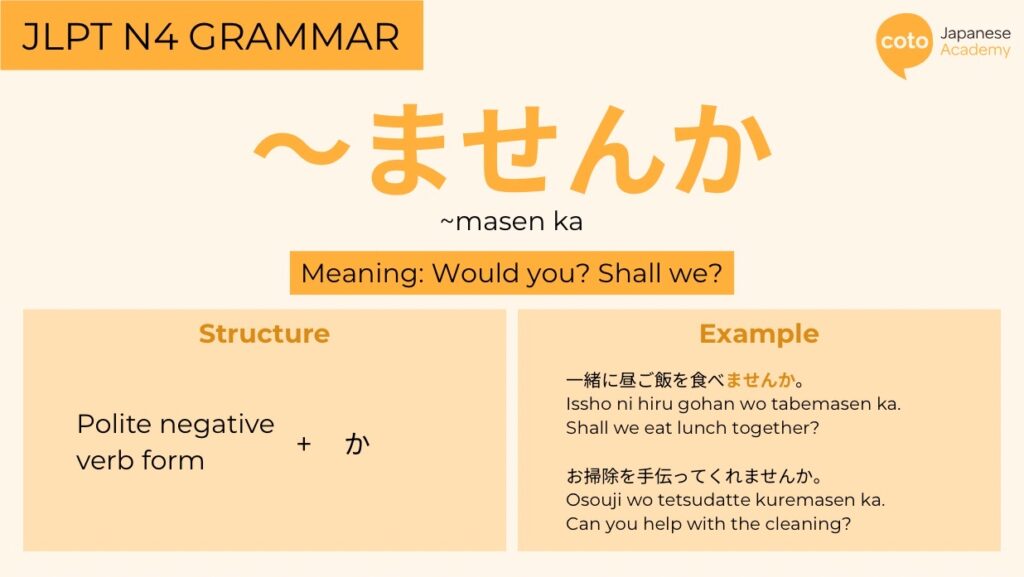
Ever heard a Japanese friend say いっしょに食べませんか? (issho ni tabe masenka) and wanted to respond, or say the same thing yourself? ~ませんか (masen ka) is one of the most natural and polite ways to make suggestions and invitations in Japanese. In this context, 食べませんか (tabemasenka) literally translates as “Won’t you eat?” but naturally means “Would you like to eat?” or “Shall we eat?”

But ませんか isn’t the only pattern worth knowing. Japanese has several similar expressions, like ~ましょうか (mashou ka) and ~ないか (nai ka), each with its own nuance and formality level. Knowing which to reach for is what separates textbook Japanese from real conversation.

In this blog post, we’ll show you how to use this handy grammar pattern, as well as similar grammar patterns you can use to make a suggestion or an invitation. 

Make Sure to Watch Coto Academy’s YouTube Video About 〜ませんか (Masenka)!

Before you continue reading, why not take a moment to watch a quick YouTube lesson with our Japanese teacher, Nami-sensei? 

Meaning of ~ませんか (Masenka)

~ませんか (masen ka) is a grammar pattern used to invite the listener to do something with the speaker. Translated into English, it means “would you like to,” “shall we,” or “will you.” By using this grammar pattern, you’re asking the person to do something with you whilst waiting for a response from them, whether it be an acceptance of the invitation or a rejection.

Difference between ~ませんか (Masenka) and ~ましょうか (Mashouka)

~ませんか (masen ka)~ましょうか (mashou ka)
Core MeaningPolite suggestion or invitationProactive suggestion or offer
Speaker’s StancePassive (leaves the decision to the listener)Active (speaker initiates the action)
Nuance“Would you like to…?”“Shall I / Shall we…?”
Best Used WhenInviting someone into an activity politelyOffering help or proposing the next move

Both ~ませんか (masen ka) and ~ましょうか (mashou ka) are used to make suggestions or invitations in Japanese, but they carry distinct nuances that trip up many learners. So how are they different?

~ませんか leans toward the speaker’s perspective, inviting the listener. It’s polite, a little tentative, and leaves the decision entirely in the other person’s hands, making it ideal for invitations to someone you don’t know well or want to show respect to.

 ~ましょうか, on the other hand, comes from the speaker’s own initiative. It either offers to do something for the listener. For example, if you want to take the initiative to carry heavy luggage, you can say:

Take a look at these two sentences:

一緒に昼ご飯を食べましょうか。
Issho ni hiru gohan wo tabemashou ka.
Shall we eat lunch (together)?

一緒に昼ご飯を食べませんか。
Issho ni hiru gohan wo tabemasen ka.
Would you like to eat lunch (together)?

While both grammar patterns are polite ways to invite the listener to do something, ~ませんか (masenka) is more used for invitations to join the speaker, while ~ましょうか is used to suggest doing something together. In addition, compared to ~ませんか, which sounds softer, ~ましょうか sounds more assertive.

In the case of ましょうか, you’re showing the listener that you’re willing to do something with the listener before they agree to do it with you. This grammar pattern is usually used when you want to help someone with a task, such as carrying someone’s bag:

荷物を持ちましょうか。
Nimotsu wo mochimashou ka.
Shall I carry your bags?

For ませんか, you’re respecting the listener’s opinion, which means you’re waiting for an answer from them. When you’re using this grammar pattern, it suggests that you’re waiting for the listener’s response. 

Want to study Japanese with us?

Grammar structure of 〜ませんか

Below are the common structures in which 〜ませんか (masenka) is commonly used:

StructureMeaning
Verb ます+ ませんかTo invite someone to do something

For group 1 verbs (such as 買う, 行く) or group 2 verbs (such as 食べる or 見る), the grammar pattern is as follows:

Verb + ませんか

If you’re using this grammar pattern for irregular verbs (ex. する, くる), the grammar pattern is as follows:

Verb (stem) + ませんか

JLPT N5 〜ませんか Example sentences

As mentioned before, you can use this grammar pattern to invite someone to do something with you. For example:

ゆみさん、一緒に映画を見ませんか。
Yumi san, isshoni eiga wo mimasenka.
Yumi-san, would you like to watch a movie (together)?

一緒に昼ごはんを食べませんか。
Issho ni hiru gohan wo tabemasen ka.
Would you like to have lunch together?

私の家に遊びに行きませんか。
Watashi no ie ni asobi ni ikimasen ka.
Do you want to come to my place?

映画を見ませんか。
Eiga wo mimasen ka.
Do you want to watch a movie?

Alternatives to ~ませんか (Masenka)

While ~ませんか is your go-to for polite invitations, Japanese gives you several other patterns to express suggestions, each with its own level of formality, nuance, and social weight. Here is a breakdown of the most useful alternatives.

1. 〜ましょうか (mashou ka)

As we discussed, this is another way to ask someone to do something with you. Unlike ~ませんか, which puts the decision in the listener’s hands, ~ましょうか comes from the speaker’s proactive intention to act. It feels slightly more assertive

2. ~ないか (nai ka)

This is the casual way of saying ~ませんか. You can use this grammar pattern when you’re with friends or family. The nuance is more direct and relaxed than ~ませんか. It drops the formality entirely, so while it sounds natural among close friends, using it with a superior or stranger would come across as blunt or even disrespectful. 

TypeStructure
Verb (ない form)Verb + ないか

今年の夏、一緒にビーチに行かないか?
Kotoshi no natsu, isshoni biichi ni ikanai ka?
Want to go to the beach together this summer?

新しいレストランへ食べに行かないか?
Atarashii resutoran e tabe ni ikanai ka?
Want to eat at this new restaurant?

3. ~たらどう (tara dou)

This can be translated into English as “why don’t you” or “you should do this.” Unlike ~ませんか, which is used to invite someone to do something together, ~たらどう is directed entirely at the listener as a piece of advice — the speaker is not included in the action. Use it with care, as it can easily sound condescending or preachy if the relationship or tone isn’t right.

TypeStructure
Verb (たform)Verb + たらどう
Verb + たら

疲れたら、早く寝たらどうか。
Tsukaretara, hayaku netara dou ka.
If you’re tired, why don’t you sleep early?

試験に失敗したら、もっと勉強したらどうか。
Shiken ni shikkaku shitara, motto benkyou shitara dou ka.
If you fail the exam, why not study a bit more?

4. 〜てくれない (~te kurenai)

This grammar point is used when you ask the listener to do something for you, making it different from ~ませんか, which is an invitation to do something together. The focus here is on a favour or request directed at the other person. You can also convert this to the polite forms くれませんか (kuremasen ka) or もらえませんか (moraemasen ka) when speaking to someone you don’t know well. Be careful not to use 〜てくれ on its own, as it drops all politeness and can sound demanding or rude.

Be careful not to say 〜てくれ as it might come off as rude.

TypeStructure
Verb (て form) Verb (ないで)Verb + てくれないVerb + てもらえない

日本語を教えてくれませんか。
Nihongo wo oshiete kuremasen ka.
Would you please teach me Japanese?

出かけたら、コンビニで弁当を買ってくれない?
Dekaketara, konbini de bentou wo katte kurenai?
If you go out, would you buy me a bento at the convenience store?

Conclusion

The grammar ませんか (masenka) is handy when you want to invite someone to do something with you. Try using this grammar pattern the next time you want to grab a meal, check out a new place of interest, or even when you want to help someone with a certain task!

Learn More JLPT Grammar with Coto Academy!

Coto Academy has been offering Japanese classes for over 25 years, with campuses in Shibuya, Yokohama, Iidabashi, Minato, Shinjuku, and online. Our courses focus on practical Japanese, so the grammar you learn is designed for real-life use.

We offer part-time, intensive, and fully online lessons to suit your schedule. Start learning Japanese effectively and confidently with Coto Academy today! Fill out the form below for a free level check. 

FAQ

What does ませんか mean?

ませんか (masen ka) means “will you,” or “would you” in Japanese. This grammar point is used to ask someone to do something with you, while respecting their opinion. 

How do you use ませんか in a sentence?

Use this grammar pattern when you want to suggest doing something with the listener, such as inviting them out for lunch.

What’s the difference between ませんか and ましょうか?

When you’re using ましょうか (mashou ka), it implies that you’re willing to take on that action before the listener has a chance to respond, whereas ませんか (masen ka) implies that you respect the listener’s opinion or response. 

Want to keep improving your Japanese grammar? Check out more guides and take your skills to the next level.

When learning Japanese, you may hear someone mention something unfamiliar using the grammar pattern という (to iu). This expression is commonly used to connect two nouns and introduce or explain a name, term, or concept. In English, it often translates to phrases like “called,” “known as,” or “something called…”

In this lesson, we’ll explore how という works, how it connects nouns, and look at several example sentences to help you understand how it’s used in everyday Japanese.

Make Sure to Watch Coto Academy’s YouTube Video About という!

Before you continue reading, why not take a moment to watch a quick YouTube lesson with our Japanese teacher, Nami-sensei? 

Meaning of という

Meaning of という

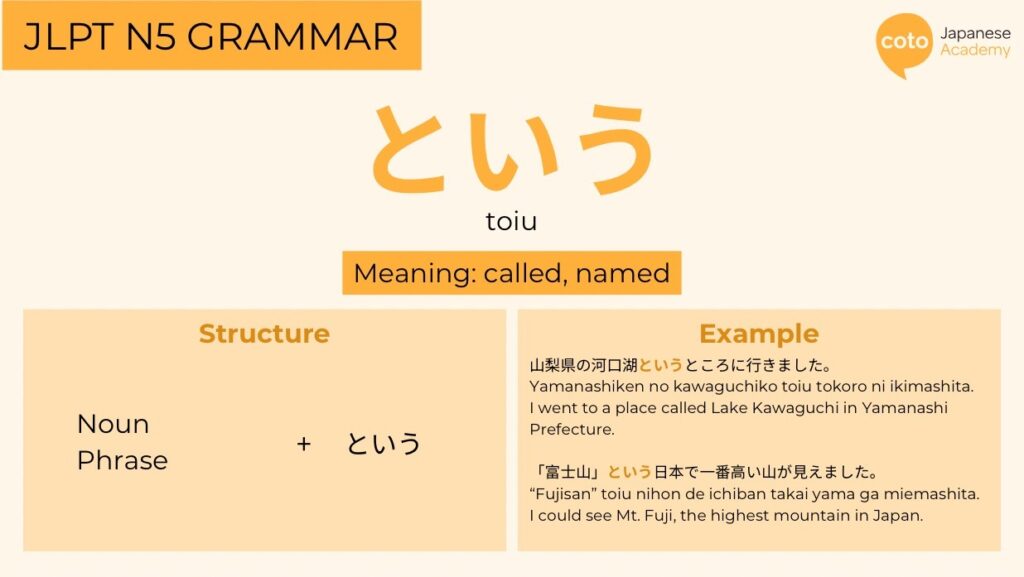
という is a way to define something, someone, or some place that isn’t known to the listener. It connects two nouns in order to introduce, explain, or identify something by name. It often translates into English as “called,” “known as,” or “something/someone called…”.

This is unlike its most basic usage, which is to indicate what someone says or said. For example:

ご飯を食べる前に、「いただきます」と言います。

Gohan wo taberu mae ni, “itadakimasu” to iimasu.

Before we eat, we say “itadakimasu.” 

Although 言う (iu) means to ‘say something’, it actually implies that the listener doesn’t know about the information the speaker is talking about, and requires knowledge that isn’t known to them yet. 

It is commonly used when:

  • Introducing a name
  • Explaining a term or concept
  • Referring to something someone said
  • Describing a category or type

You shouldn’t use this grammar point to define things that are common knowledge; for example, a place like Tokyo or food like sushi; everyone knows what Tokyo or sushi is. Only use this grammar point for things that aren’t common knowledge. 

Grammar Structure of という 

Below are the common structures in which という is used.

StructurePatternMeaning
Noun + という + NounN + という + NA noun called/known as something
Clause + という + NounSentence + という + NA noun described by a clause
Noun + というN + というSomething called/known as
Sentence + というSentence + というIt is said that / the statement that

In simple terms, という works like a label or explanation marker. It links information (a name, phrase, or sentence) to a noun so that it can be described or identified.

For beginners, the most common and easiest pattern is:

Noun + という + Noun

Note that という is usually not used as a complete sentence by itself. It typically connects a word, phrase, or clause to a noun, so it needs to be followed by another word to complete the idea!

日本という国が好きです。
Nihon to iu kuni ga suki desu.
I like the country called Japan.

Here, 日本という describes 国 (country), so the sentence continues and becomes complete.

Because of this, という is usually part of a larger phrase, rather than ending a sentence on its own.

Want to study Japanese with us?

JLPT N5 という Example Sentences

Now that you know how to form sentences using this structure, let’s explore a few example sentences that use という (to iu).  As mentioned before, you can use this grammar pattern to define or explain something, someone, or some place that might be unknown to the listener. For example:

私は先週、山梨県の河口湖というところに行きました。

Watashi wa senshuu, yamanashi ken no kawaguchiko to iu tokoro ni ikimashita.

Last week, I went to a place called Lake Kawaguchi in Yamanashi Prefecture.

「富士山」という日本で一番高い山が見えます。

“Fuji san” toiu ichiban takai yama ga miemasu.

I can see Mt. Fuji, the highest mountain in Japan. 

You can also use といいます (to iimasu) to introduce something that the listener doesn’t know about. 

この場所は日本語で何といいますか。

Kono basho wa nihongo de nanto iimasu ka.

What do you call this place in Japanese?

温泉の名前は「ゆらり」といいます。

Onsen no namae wa “yurari” to iimasu.

The name of the hot spring is called “Yurari.” 

More ways to use という

1. ということ (toiu koto)

ということ (toiu koto) is a grammar pattern that is used to convert a phrase into a noun. It can be translated to “A is said to be.” 

TypeStructure
Verb (casual form)Noun + だな adjective + だい adjectivePhrase + ということ

来月帰国するということは本当ですか。

Raigetsu kikokusuru toiu koto wa hontou desu ka.

Is it true you’re going back to your country next month?

2. ということだ (toiu koto da)

This can be translated in English as “I heard that,” “Rumor has it that,” or “It means that.” Use this grammar pattern to talk about something that you heard from another person. 

TypeStructure
Verb (plain form)Noun (だ)な adjective (だ)い adjectivePhrase + ということだ

佐藤さんと木下さんは、結婚したということだ。

Satou san to Kinoshita san wa, kekkonshita toiu koto da. 

Rumor has it that Satou-san and Kinoshita-san got married. 

このイベントは中止されるということだ。

Kono ibento wa chuushi sareru toiu koto desu.

I heard that the event got cancelled.

3. というのは (toiu no wa)

Use this grammar pattern to define or explain something that isn’t known to the listener. It can be translated as “the meaning of A is B,” or “A, that is to say B.”

TypeStructure
Phrase/nounPhrase/noun + というのは + definition/explanation/reason

「自販機」というのは自動販売機の略です。

“Jihanki” toiu no wa jidouhanbaiki no ryaku desu.

“Jihanki” is short for vending machine. 

「あざす」というのは「ありがとうございます」の短くした言い方です。

“Azasu” toiu no wa “arigatou gozaimasu” no mijikakushita iikata desu.

“Thanks” is a shortened way to say “thank you very much.” 

4. というと (toiu to)

This grammar point can be translated to “speaking of…” in English. Use it in response to remind the speaker of something related to the topic being discussed earlier, or to provide more information on the subject.

TypeStructure
NounNoun + というと

仕事というと、山田さんが仕事を辞めるのを聞いたことがありますか。

Shigoto to iu to, Yamada san ga shigoto wo yameru no wo kiita koto ga arimasu ka.

Speaking of work, did you hear that Yamada-san is leaving their job?

日本料理というと、かけうどんが一番です。

Nihon ryouri toiu to, kakeudon ga ichiban desu.
Speaking of Japanese cuisine, Kake Udon is the best.

Conclusion

という can be useful for explaining information that others might not know about, whether it be talking about a niche place you want to introduce others to, a person of interest, or something that listeners might not be aware of. Try using it the next time you want to talk about your favorite things!

Learn More JLPT Grammar with Coto Academy!

Coto academy has been offering Japanese classes for over 25 years, with campuses in Shibuya, Yokohama, Iidabashi, Minato, Shinjuku, and online. Our courses focus on practical Japanese, so the grammar you learn is designed for real-life use.

We offer part-time, intensive, and fully online lessons to suit your schedule. Start learning Japanese effectively and confidently with Coto Academy today! Fill out the form below for a free level check. 

FAQ

What does という (toiu) mean?

という (toiu) means to “say something,” but in this context, this means to describe, define, or explain something that isn’t known to the listener. 

How do you use という (toiu) in a sentence?

You can use という to define or explain something to the listener, for example, when you’re describing a place that isn’t common knowledge, or a food not everyone knows about.

When should you not use という (toiu)?

Don’t use という when the place, thing, or someone you’re defining or explaining is common knowledge.

You may be interested in:

If you need to provide a reason or explanation for an action, you can use the JLPT N5 grammar, 〜ので (~node). It is similar to saying “because…” in English. It is often used to make a cause-and-effect statement, such as “since A, then B.” 

Essentially, you can use 〜ので to logically connect 2 statements, similar to grammar 〜から(~kara). Let’s learn how to use this JLPT N5 grammar point by breaking down its meaning, structure, and example sentences.

Make Sure to Watch Coto Academy’s YouTube Video About 〜ので (~node)

Before you continue reading, why not take a moment to watch a quick YouTube lesson with our Japanese teacher, Yuka-sensei:

Meaning of 〜ので (~node)

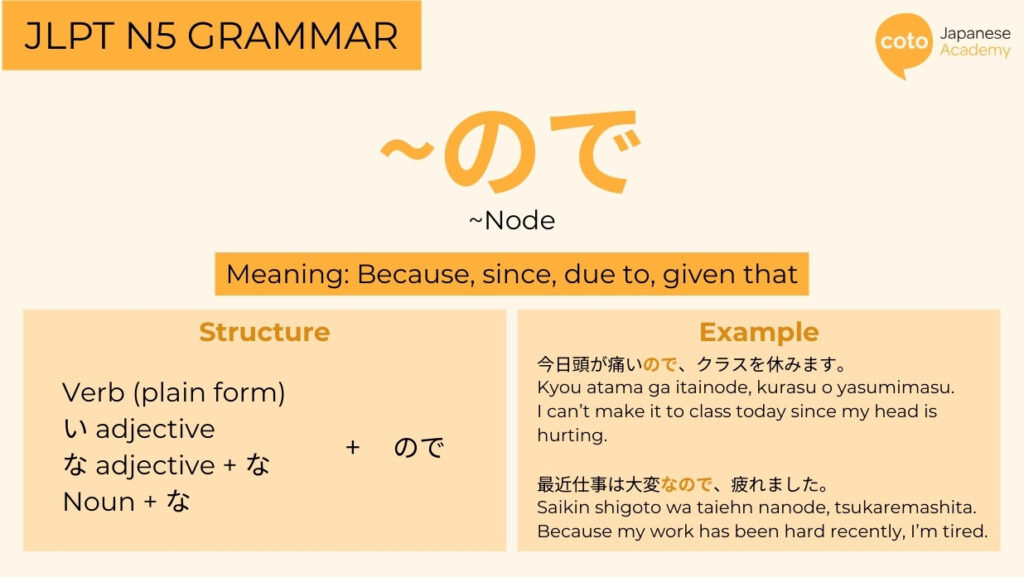
Infographic of the JLPT N5 grammar 〜ので (~node) showing its meaning, structure and example sentences.

〜ので is a way to provide a reason or reasoning for something. It also establishes a logical connection between two separate statements. It’s similar to the expression, 〜から (~kara), but has a more formal nuance. Generally, you use this expression to explain “why”, establish a cause-and-effect, and even give an excuse. 〜ので most closely translates to the following:

  • Because of
  • Given that
  • Since
  • Due to

JLPT N5 〜ので Sentence Structure

Unlike the English expressions “because” or “since,” which are used before the reason, 〜ので is used after providing the reason. For example, in English you might say “Because I’m busy, I won’t go to the party,” which in Japanese would be:

いそがしいので、パーティーに行きません。
Isogashii node, paatii ni ikimasen.
Because I’m busy, I won’t go to the party.

You can think of 〜ので as being between two separate statements and connecting them logically, like a glue sticking 2 things together. So, 〜ので attaches at the end of the first statement, providing the reason. Specifically, it attaches to the last word of the reason statement. This word can be a noun, verb, or adjective.

TypeStructure
Verb (plain form)Verb + ので
い-Adjectiveい-Adjective + ので
な-Adjectiveな-Adjective + な + ので
NounNoun + な + ので

Note that 〜ので itself does not conjugate into past, present, negative, or positive. The word to which 〜ので attaches is what conjugates. Let’s break down how this works with different verb conjugations.

FormPlain Form + のでMeaning
Present雨が降るのでBecause it will rain
Past雨が降ったのでBecause it rained
Negative雨が降らないのでBecause it won’t rain
Past Negative雨が降らなかったのでBecause it didn’t rain
Volitional雨が降ろうのでBecause it should rain

Difference Between 〜ので (~Node) and 〜から (~Kara)

As mentioned, 〜ので is similar to the grammar 〜から, which are both used to provide a reason or reasoning for something. They are largely used for the same purpose, with the only difference being the context in which they are used.

1. ので is more formal 

One key difference between “から” and “ので” is that “から” is more casual, while “ので” is more polite and even objective. You can use から in everyday conversation with family and friends. However, neither of these expressions would feel out of place or rude in either formal or casual situations and are commonly used in both.

For example, a speaker might say:

雨が降っているから行きません。
Ame ga futte iru kara ikimasen.
I won’t go because it’s raining.

In contrast, ので sounds softer and more polite, and it is often used in formal situations or when speaking respectfully. It presents the reason in a more objective or explanatory way, as in:

雨が降っているので行きません。
Ame ga futte iru node ikimasen.
I won’t go because it is raining. 

Because of this nuance, learners often use から in everyday speech with friends and family, while ので is preferred in polite conversations, such as when speaking to teachers, colleagues, or customers.

2. ので carries an apologetic nuance

ので has a bit of apologetic nuance, pairing well with phrases like すみません (sumimasen) meaning “excuse me” or “sorry.” This expression is preferred when apologizing or providing a reason to your boss or anyone in a formal capacity.

Another difference between ので and から  lies in where the emphasis is placed. から tends to emphasize the speaker’s own judgment, decision, or action. 

Let’s take a look at the two examples below.

時間がないからタクシーで行きます。
Jikan ga nai kara takushii de ikimasu.
I will take a taxi because I don’t have time.

Here, the speaker is clearly stating their personal reason and decision. In contrast, ので emphasizes the situation or circumstances rather than the speaker’s choice. 

時間がないのでタクシーで行きます。
Jikan ga nai node takushii de ikimasu.
I will take a taxi because I don’t have time.

In the second example, the focus is on the situation of not having enough time. This makes the explanation sound softer and less self-centered, as if the circumstances naturally lead to the result, as if to say that the circumstances are responsible for the result.

3. Use から for future predictions

When giving reasons for predictions or assumptions about the future, Japanese speakers generally prefer から rather than ので. から appears when expressing predictions about the future using だろう or its polite form でしょう. I

This is because だろう and でしょう express the speaker’s assumption, guess, or prediction about something that has not happened yet. Since から naturally connects to the speaker’s reasoning or judgment, it fits well with statements that involve personal predictions or speculation. 

For example, you might say:

雨が降りそうだから、試合は中止になるだろう。
Ame ga furisoudakara, shiai wa chuushi ni naru darou.
Because it looks like it will rain, the game will probably be canceled.

Using ので in this type of sentence would sound unnatural because ので tends to present the reason as a more objective fact or established situation

Example Sentences Using 〜ので (~Node)

Let’s take a look at some example sentences to really understand how to use the JLPT N5 grammar point, 〜ので (~node)

Example 1:

今日頭が痛いので、クラスを休みます。
Kyou atama ga itainode, kurasu o yasumimasu.
I can’t make it to class today since my head is hurting.

Example 2:

雨が降っているので、出かけません。
Ame ga futte iru node, dekakemasen.
Because it’s raining, I won’t go out.

Example 3:

最近仕事は大変なので、疲れました。
Saikin shigoto wa taiehn nanode, tsukaremashita.
Because my work has been hard recently, I’m tired.

Example 4:

今日は日曜日なので、銀行は休みです。
Kyou wa nichiyoubi na node, ginkou wa yasumi desu.
Since today is Sunday, the bank is closed.

Example 5:

すみません、少し疲れたので、先に帰ってもいいですか。
Sumimasen, sukoshi tsukareta node, saki ni kaette mo ii desu ka?
I’m so sorry, but since I’m a bit tired, may I go home first?

Conclusion

〜ので is a very useful expression you can use to provide a reason or cause for something, and can even be used to apologize. So, try using it next time you speak Japanese to really understand how it works and ingrain it into your Japanese arsenal! 

Learn More JLPT Grammar with Coto Academy!

If you want more practice using this phrase and many others in real Japanese conversations with a teacher who can offer practical guidance, sign up with us at Coto Academy.

Coto Academy has been teaching Japanese for over 25 years, with campuses in Shibuya, Yokohama, Iidabashi, Minato, and online. Our courses focus on practical Japanese, so the grammar you learn is designed for real-life use.

We offer part-time, intensive, and fully online lessons to suit your schedule.  Ready to get started? Fill out the form below to contact us!

FAQ:

What does 〜ので mean?

〜ので is used to explain a reason or cause for something. It can be translated to “because,” “since,” or “due to.”

How is 〜ので different from 〜から?

〜ので is quite similar to 〜から since they are both used for explaining a reason or cause. But they differ in nuance with 〜ので being softer and even a bit apologetic, often being used with expressions like すみません (sumimasen), meaning “excuse me.” 〜から is a bit more direct and often used for giving personal reasons. However, neither of these expressions is considered rude and can be used in both formal and casual situations.

Can 〜ので be used to make requests?

〜ので is often used to politely explain the reason before making a request. For example, if you need a friend to tell you how to get somewhere, you can say 道が分からないので、教えてください (michi ga wakaranai node, oshiete kudasai), which means, “because I don’t know the way, please tell me.”

You may be interested in:

To ask someone not to do something in Japanese, you typically use the JLPT N5 grammar pattern 〜ないでください (naide kudasai).  It is similar to saying “please do not do (something)” in English and is a polite way to request that someone refrain from an action, though it can also be framed as an instruction, advice, or recommendation. 

Basically, using ないでください, you are asking a person not to perform a certain action. It is the opposite of 〜てください, which is used to ask someone to do something.

Let’s learn how to use this JLPT N5 grammar point by breaking down its meaning, structure, and example sentences.

Make Sure to Watch Coto Academy’s YouTube Video About 〜ないでください (~Naide Kudsai)

Before you continue reading, why not take a moment to watch a quick YouTube lesson with our Japanese teacher, Yuka-sensei:

Meaning of 〜ないでください (~Naide Kudasai)

Infographic showing the meaning, structure, and examples of the JLPT N5 grammar: 〜ないでください (~naide kudasai)

〜ないでください (naide kudasai) is a way of politely asking or requesting someone not to do something. Since it includes the phrase ください (kudasai), meaning “please”.

Although 〜ないでください is technically a polite form, it often carries a commanding tone. In Japanese culture, which values indirectness for the sake of harmony, using this in the wrong context can be an unintentional social blunder. For example, if you are speaking to a superior, such as a boss or a teacher, using 〜ないでください can sound overly direct or even bossy.

Generally, you use this expression in the following situations:

1. To kindly request that someone refrain from something

This is the most common “supportive” use of the phrase. It is often used when you are looking out for someone’s well-being or asking for a small favor that benefits them or the relationship.

無理をしないでください
Muri o shinaide kudasai
Don’t push yourself too hard.

2. Giving precautions or warnings

This usage is preventative. It’s meant to ensure someone’s safety or to prevent a mistake from happening before it’s too late.

忘れないでください 。
Wasurenaide kudasai.
Please don’t forget.

3. As a softer way of denying or not giving permission

Instead of saying a flat “no” (which is very rare and often rude in Japanese), this form is used to steer someone away from an action they are about to take.

For example, if a friend is visiting your house and wants to open the window, but the AC is on, you can say:

窓を開けないでください 。
Mado o akenaide kudasai.
Please don’t open the window.

3. To prohibit

On signs or in official announcements, the “politeness” of kudasai functions more like a formal rule than a personal request.

ここにゴミを捨てないでください
Koko ni gomi o sutenaide kudasai
Please do not litter here.

Read more: Difference Between Kudasai and Onegiashimasu

Want to study Japanese with us?

How to Form  〜ないでください (~Naide Kudasai)

〜ないでください is actually a grammar pattern consisting of two parts.

  1. The first part 〜ないで (~naide) is the verb conjugation into negative て-form. 
  2. The second part,ください (kudasai), is a polite way of making a request, similar to saying “please.”  

Here is how it’s structured in actual sentences.

TypeStructure
Verb (negative)Verb (negative stem) + ないでください

Since 〜ないでください (naide kudasai) already has part of the negative verb suffix, you will only need to attach the verb stem in negative form. For example,

聞く (kiku) → 聞 (kika) + ないでください (naide kudasai) → 聞ないでください (Please don’t listen)

If you don’t know how to conjugate a verb into its negative form, here is a quick breakdown of how to conjugate different verbs into negative form and then use them with in 〜ないでください:

Dictionary FormNegative FormExampleEnglish
撮る (toru)撮らない (toranai)撮らないでください (toranaide kudadsai)Please don’t take (picture)
食べる (taberu)食べない (tabenai)食べないでください (tabenaide kudasai)Please don’t eat
話す (hanasu)話さない (hanasanai)話さないでください (hanasaide kudasai)Please don’t talk
捨てる (suteru)捨てない (sutenai)捨てないでください (sutenaide kudasai)Please don’t throw away
開ける (akeru)開けない (akenai)開けないでください (akenaide kudasai)Please don’t open

Casual Form of 〜ないでください (Naide Kudasai)

In casual conversation with friends, family, or people of equal or lower social status, you can simply omit ください (kudasai). This transforms a polite request into a casual “don” (think of it as removing the word “please”). 

行かないで。
Ikanaide.
Don’t go. 

In even more informal contexts, adding the exclamative particle ね (ne) at the end is very common. This makes the “don’t” sound much softer. It changes “Don’t do it” to “Don’t do it, okay?” or “Make sure you don’t, right?”

忘れないでね
Wasurenaide ne
Don’t forget, okay?

Examples of 〜ないでください (~Naidekudasai)

Let’s explore a few examples to get a feel for how 〜ないでください works in Japanese. We will go through common examples in everyday conversation and public signs.

In Everyday Conversation

ここで写真を撮らないでください。
Kokode shashin o toranaide kudasai
Please don’t take photos here.

教室で食べないでください。
Kyoushitsu de tabenaide kudasai.
Please don’t eat in the classroom.

大きい声で話さないでください。
Ookii koe de hanasaide kudasai.
Please don’t speak loudly.

In Public Signs

ゴミを捨てないでください。
Gomi o sute naide kudasai. 
Please don’t throw away trash.

ドアを開けないでください。
Doa o kakenaide kudasai.
Please don’t open the door.

Vocabulary List

Check out all the new words in the example sentences above, and try to remember new vocabulary alongside today’s Japanese grammar

JapaneseFuriganaReadingMeaning
ここここkokohere
写真しゃしんshashinphoto
撮るとるtoruto take (a photo)
教室きょうしつkyoushitsuclassroom
食べるたべるtaberuto eat
大きいおおきいookiibig / loud
こえkoevoice
話すはなすhanasuto speak
ゴミごみgomitrash/garbage
捨てるすてるsuteruto throw away
ドアどあdoadoor
開けるあけるakeruto open
〜ない〜ないnainegative form
でくださいでくださいde kudasaiplease do ~

Similar Grammar and Alternatives to ないでください (Naidekudasai)

When you need to move beyond the standard 〜ないでください, you have two directions: one that is much stricter/formal (prohibition) and one that is much softer/humble (requests).

1. 〜てはいけません (~Te wa ikemasen)

Meaning: “You must not…” or “It is forbidden.”

This is the standard polite way to express a strong prohibition. While it ends in the polite ~masen, the meaning is not a request; it is a rule. It is used when there is no choice in the matter.

ここでタバコを吸ってはいけません。
Koko de tabako o sutte wa ikemasen
You must not smoke here.

2. 〜な (~Na)

Meaning: “Don’t!” (Command)

This is the dictionary form of a verb followed by the particle な. Despite its short length, it is the most aggressive and blunt way to tell someone not to do something.

You might hear it used by a father to a child in a moment of danger, or by characters in high-stakes movies. For instance, “動くな!” (Ugoku na!) means “Don’t move!” and carries a very commanding, almost barked tone.

3. 〜ないでいただけますか (~Naide itadakemasu ka)

Meaning: “Could you please not…?”

This is the most common way to be “more polite” than ~naide kudasai in a social or professional setting and keigo. By turning the request into a question, you are technically asking the other person if they would be willing to “grant you the favor” of not doing something.

Learn More JLPT Grammar with Coto Academy!

Next time you read a sign with 〜ないでください (~naide kudasai) on a sign, you know it’s asking not to do something! But if you want to practice using this JLPT grammar and many others in actual Japanese conversations, nothing beats practicing with a teacher who can offer practical guidance. So, consider signing up with us at Coto Academy!

Why Study at Coto Academy?

Coto Academy has been offering Japanese classes for over 25 years, with campuses in Shibuya, Yokohama, Iidabashi, Minato, Shinjuku, and online. Our courses focus on practical Japanese, so the grammar you learn is designed for real-life use.

We offer part-time, intensive, and fully online lessons to suit your schedule. Start learning Japanese effectively and confidently with Coto Academy today! Fill out the form below for a free level check.

FAQ:

What does 〜ないでください mean?

〜ないでください means “Please don’t do (something).” By adding this phrase to the end of a verb (negative form), you are politely asking them to refrain from something or to decline permission. It’s often on signs to communicate that something is not permitted.

Is 〜ないでください considered polite?

It is generally considered to be polite, being widely used in everyday conversation, public announcements, signs, and classroom settings. It’s similar to saying “please do not…” However, it can still be considered direct, so it might not always be the best in certain situations, like with your boss.

What is the casual version of 〜ないでください?

By dropping ください (kudasai), meaning “please,” you can make the expression more casual. For example, 食べないで (tabenaide), or “don’t eat,” would be considered more informal. For something very casual and to express a stronger demand, you can say 食べな (tabena), or “no eating!” But note this expression is rather rud

You might also like: