





The first thing you’ll do when you arrive in Japan is get something to eat, but there’s one problem: how do you actually order food in Japanese at a restaurant? If you want to dine at your local sushi restaurant or order a beer at an izakaya (Japanese bar), knowing how to order in Japanese will make your life much easier, rather than resorting to pointing and hand charades.
So, how do restaurants work in Japan, and what should you be aware of? Let’s find out the best expressions to politely order your desired dish or drink at a restaurant in Japan.
What You’ll Hear When You’re in a Restaurant in Japan
When you first enter a restaurant, you will be greeted with an enthusiastic いらっしゃいませ (irrashaimase), which means “Welcome!” You don’t need to necessarily respond, but if you wish, you can say a simple Japanese greeting like こんにちは (konnichiwa) in return. Then, depending on the restaurant, you may have to order at the counter or, in many ramen shops, order the ramen from a vending machine that issues a ticket you give to the staff.
But usually, if it’s a dine-in restaurant, where you order at the table, the staff will ask you how many people are in your party. This is one of the most common expressions you might hear:
何名様ですか?
Nanmei sama desuka?
How many people?
So, this expression uses a Japanese counter for counting people, 名 (mei). With the word 何 (nan) meaning “what” or, in this case, “how many,” the phrase 何名 (nanmei) means “how many people?” The suffix 様 (sama) is added to make the phrase more formal, showing the customer greater regard.
Now, let’s break down how you can respond.
How to Say the Number of People (Japanese Person Counters)
To say how many people you are eating with, you may need to remember a few Japanese numbers. On top of that, you would need to conjugate to the correct counter. You could simply attach the counter 名 (mei). For example, this is what you could reply to staff asking how many people you are with.
Example:
スタッフ:いらっしゃいませ!何名様ですか?
Sutaffu: Irrashaimase! Nanmei samadesuka?
Staff: Welcome! How many people are you with?
あなた:2名です。
Anata: ni mei desu.
You: There are 2 of us.
So, if you already know the Japanese numbers, you just have to attach 名 to them. However, keep in mind that for 4, you would say “yonmei” and not “shimei,” and for 7, it would be nanamei rather than shichimei. Also, this isn’t the only counter you can use for people; you can use the 〜人 (~nin) counter, which translates to “~person/people.”
You can simply add the Japanese number plus the counter 〜人; for instance, for three, or さん (san); you would only need to say さん人 (san nin). However, note that the pronunciation differs for one and two. For one, you would say hitori, and for two, you would say futari. Here is how to use the 〜人 counter to indicate how many people you are with.
Example 2:
スタッフ:いらっしゃいませ!何名様ですか?
Sutaffu: Irrashaimase! Nanmei samadesuka?
Staff: Welcome! How many people are you with?
あなた:2人です。
Anata: futari desu.
You: 2 people.
Both counters will essentially express the same thing, so you can use either one. Take a look at our table showing the Japanese numbers from 1 to 10, along with how to say them in hiragana and romaji using the 〜名 and 〜人 counters.
| Numbers | Kango (Basic Numbers) | 〜名 People Counter | 〜人 People Counter |
|---|---|---|---|
| 1 | いち (ichi) | いちめい (ichimei) | ひとり (hitori) |
| 2 | に (ni) | にめい (nimei) | ふたり (futari) |
| 3 | さん (san) | さんめい (sanmei) | さんにん (sannin) |
| 4 | し (shi) / よん (yon) | よんめい (yonmei) | よんにん (yonnin) |
| 5 | ご (go) | ごめい (gomei) | ごにん (gonin) |
| 6 | ろく (roku) | ろくめい (rokumei) | ろくにん (rokunin) |
| 7 | しち (shichi) / なな (nana) | ななめい (nanamei) | ななにん (nananin) |
| 8 | はち (hachi) | はちめい (hachimei) | はちにん (hachinin) |
| 9 | きゅう (kyuu) / く (ku) | きゅうめい (kyuumei) | きゅうにん (kyuunin) |
| 10 | じゅう (juu) | じゅうめい (juumei) | じゅうにん (juunin) |
Getting the Waiter’s Attention in Japan
So, after you’re seated, you will often hear the waiter say something like the following:
お決まりになりましたら、お呼びください。
Okimari ni narimashitara, oyobi kudasai.
When you’ve decided on your order, please let us know.
Some restaurants have a button you can press a button to call staff; this is especially common at yakiniku restaurants. However, you often will have to call the staff yourself. To do this (respectfully) is just to simply say すみません (sumimasen), which translates to “excuse me!”
When it’s crowded and difficult for staff to see you, this すみません is a very polite and respectful way to get their attention, even if you have to raise your voice over the noise. Alternatively, you can also gesture to the staff that you’re ready to order by either making eye contact or raising your hand.
Basic Expressions for Ordering at a Restaurant in Japanese
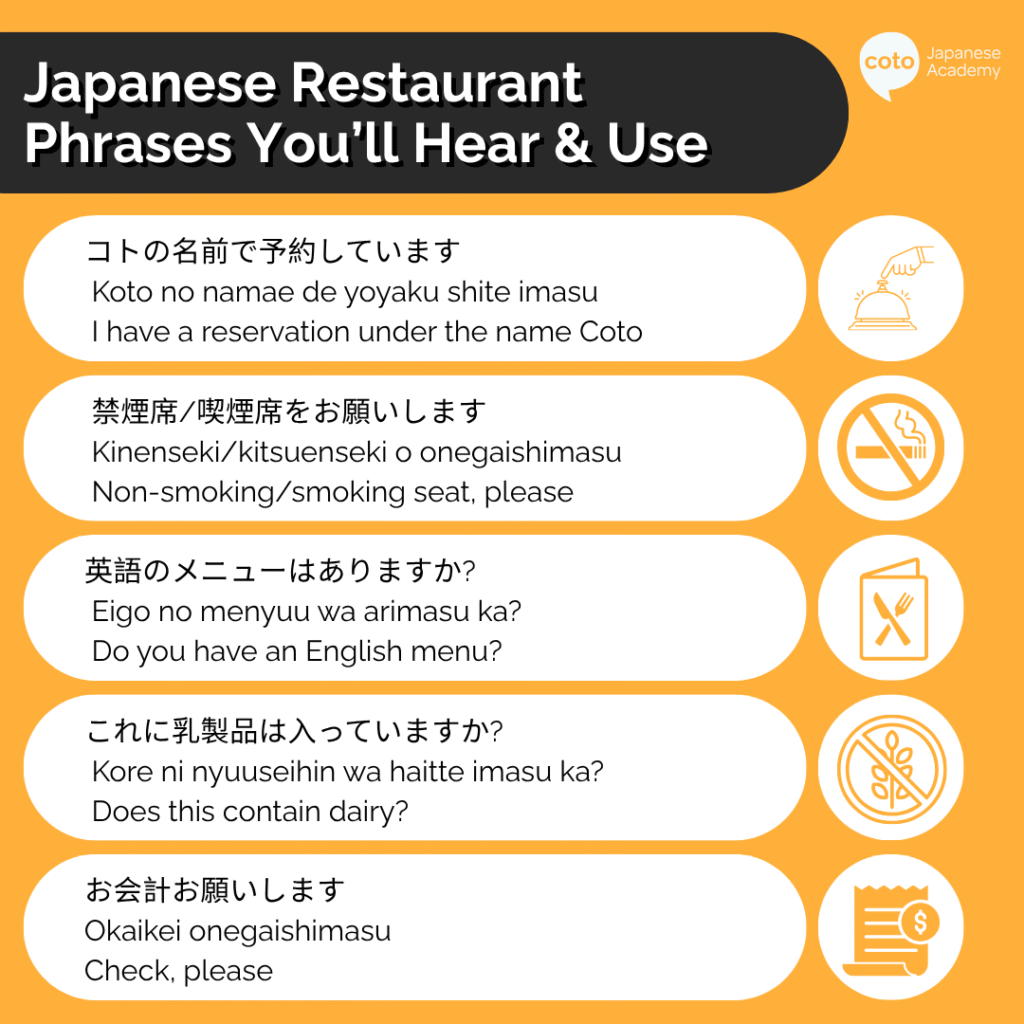
Now, let’s actually get into ordering food in Japanese. Whether you have to order at the counter or at the table, the basic expression you use doesn’t change much. You just simply need to say the food you want plus お願いします (onegaishimasu) or ください (kudasi), which both mean something similar to “please” in Japanese. The easiest way to order is to simply point to the item you want on the menu and say, “This, please.”
これをお願いします。
Kore o onegaishimasu.
I’ll have this, please.
これをください。
Kore o kudasai.
I’ll have this, please.
Both of these expressions are polite and respectful ways to place your order in Japanese. And if you know how to say the specific item you want, all you have to do is replace これ (kore)! For instance, if you want to order a tempura shrimp udon, you can say this.
Example:
スタッフ:ご注文どうぞ。
Sutaffu: gochumon douzu.
Staff: Feel free to let me know your order.
あなた:エビ天うどんをお願いします。
Anata: Ebi ten udon o onegaishimasu.
You: I’ll have the shrimp tempura, please.
Expressing Quantity when Ordering at a Restaurant in Japanese
However, it’s helpful to include the quantity of the item you want; just as with people, you have to conjugate numbers for food quantities. To express the number of food items, you can use the general counter 〜つ, which uses the 和語 (wago) pronunciation and is similar to ひとり (hitori) and ふたり (futari) from the 〜人 counter. The difference is that every number from 1 to 10 is conjugated differently, rather than the first two.
Example:
お茶を1つお願いします。
Ocha o hitotsu onegaishimasu.
I’ll have 1 tea, please.
Since 〜つ is a general counter, you can use it to indicate the number of drinks as well. You usually place the quantity after the particle を (o), which is used for indicating the object of the sentence: tea or お茶 in this case.
| Numbers | Wago (〜つ Counter) |
|---|---|
| 1 | ひとつ (hitotsu) |
| 2 | ふたつ (futatsu) |
| 3 | みっつ (mittsu) |
| 4 | よっつ (yottsu) |
| 5 | いつつ (itsutsu) |
| 6 | むっつ (muttsu) |
| 7 | ななつ (nanatsu) |
| 8 | やっつ (yattsu) |
| 9 | ここのつ (kokonotsu) |
| 10 | とお (too) |
Ordering Multiple Items at a Restaurant in Japanese
So, how do you order multiple items at once?
You can simply list them, or add と (to), which means “and” in Japanese. Rather than repeating onegaishimasu for every item, you can list each item and say お願いします at the end. Here is how you can do this, even while ordering for more than 1 person.
Example:
チーズバーガーを2つ、コーラとビールを1つずつお願いします。
Chiizu baagaa o futatsu, koora to biiru o hitotsu zutsu onegaishimasu.
We’ll have 2 cheeseburgers, a cola, and beer, please.
To order multiple types of items, like food and drinks, you can start with one type, like food, and indicate the quantity, then you can list the drinks. Since you’re ordering two different drinks, you use と to say コーラとビール or “cola and beer.” You probably noticed that ずつ (zutsu) was added after 1つ, which basically just means “each.” So, 1つずつ just means “1 each”.
Wondering how to order and customize coffee at a cafe in Japan? Check out our blog: How to Order and Customize Your Coffee in Japanese
How to Make Common Food and Drink Requests in Japanese
Now, let’s quickly go over some common things you might need to ask when eating at a restaurant in Japan, such as asking for seconds or just some more water. Here are some natural expressions you can use.
1. Asking for Water in Japanese
Water is not always served automatically at restaurants in Japan, the way it might be in other countries. Some places bring it as a matter of course, while others wait for you to ask. Either way, knowing how to ask for water naturally is a handy expression to have ready.
The most natural and widely used way to ask is:
お水を1つお願いします。
Omizu o hitotsu onegaishimasu.
Could I have some water, please?
As with the other expressions on this list, you can use お願いします to respectfully ask for some water. To sound more natural, if you are looking for cold water, you can substitute omizu (お水) with ohiya (お冷).
2. Asking for Another Round in Japanese
Whether it is another serving of rice, a refill of your drink, or an extra portion of a side dish, おかわり (okawari) is the expression you need. It is a very natural and widely understood word that works across all kinds of restaurants and situations.
ビールのおかわりをください。
Biiru no okawari o kudasai.
Another beer, please.
Note that you can also use お願いします in this expression; ください and お願いします are interchangeable in most of these examples. It is worth noting that at many teishokuya and casual restaurants in Japan, rice refills are actually free of charge, so do not be shy about asking for おかわり!
3. How to Ask for Takeout in Japanese
If you would like to take your food home or have leftover food packaged up, there are a couple of natural ways to express this depending on the situation.
Ordering takeout from the start:
テイクアウトでお願いします。
Teikuauto de onegaishimasu.
For takeout, please.
テイクアウト (teikuauto) is the widely understood loanword for takeout and is used at the vast majority of restaurants across Japan. You will often see it written on signs or menus as well. But you might need to be aware that some Japanese restaurants might not let you take out leftovers, but it never hurts to ask. In which case, you can say the following.
残りを持ち帰りにしてもらえますか?
Nokori o mochikaeri ni shite moraemasu ka?
Could you pack up the rest for me to take home?
持ち帰り (mochikaeri), which literally means “taking home,” is the more traditionally Japanese expression for taking food away and is slightly warmer and more natural sounding in a sit-down restaurant context than テイクアウト.
Expressing Dietary Restrictions & Allergies when Ordering in Japanese
Allergies and dietary restrictions are among the most important things to specify when you eat out in Japan, let alone in any country. So, in Japanese, you can directly ask the service staff if an ingredient you can’t eat is in the dish you want to order.
Example:
これにはピーナッツが入っていますか?
Kore niwa piinattsu ga haitte imasuka?
Are there any peanuts in here?
This example works well if you want to point to specific menu items. The phrase 入っています (haitte imasu) basically means “is included,” so you’re literally asking whether peanuts are included in the dish. Usually, the staff will respond with one of the following:
いいえ、ピーナッツは入っていません。
Iie, piinatsu wa haitte imasen.
No, there aren’t any peanuts.
はい、ピーナッツが入っています。
Hai, piinattsu ga haitteimasu.
Yes, there are peanuts.
So, if the staff says peanuts (or any ingredient you’re asking about) are in fact in the dish you want to order, you will need to make it clear that you strictly cannot consume that ingredient. So, if it’s an allergy, you can say this.
Example
ピーナッツアレルギーがあるのですが、ピーナッツが入っていないメニューはありますか?
Piinattsu arerugii ga aru no desu ga, piinattsu ga haitte inai menyuu wa arimasu ka?
I have a peanut allergy. Do you have any menu items that don’t contain peanuts?
The term アレルギー (arerugii) means “allergy,” and is actually taken directly from English, so hopefully that’ll make it easier to remember! To say you have an allergy, you can use the verb ある (aru), meaning “to have.”
The second phrase directly asks whether there are any items on the menu that don’t contain peanuts. The phrase ピーナッツが入っていないメニュー (piinatsu ga haitte inai menyuu) is a negative version of 入っている (haitteiru) from earlier and attaches it to メニュー (menyuu) or “menu,” short for “menu items.”
If you want to know more terms for allergens and ingredients, read our blog: How To Read Japanese Nutrition & Food Labels
Asking for the Bill in Japanese
There is actually a Japanese hand gesture for requesting the bill: cross your index fingers to make a small “x.” This is a great non-verbal way to let staff know you’re ready for the bill, especially when it’s crowded and noisy. But you can also use a common phrase with the term, お会計 (okaikei), which means “bill.” Here is a polite expression you can use.
Example:
すみません、お会計お願いします。
Sumimasen, okaikei onegaishimasu.
Excuse me, can I get the check, please?
You can use すみません to get the wait staff’s attention. Then, to ask for the bill, simply attach お願いします (onegaishimasu) to お会計 to politely ask for the bill. That’s it, pretty easy, right? If you really enjoyed your dish, you can yell out ごちそうさまでした! (gochisousama deshita!), meaning something like “thank you for the delicious meal!” right before leaving.
Read more: How to Ask for the Bill in Japanese
Types of Restaurants in Japan and General Customs of Ordering in Japanese
As in any other country, there are a variety of restaurants in Japan, from fast-casual to formal full-course restaurants. We will just go over a general overview of typical restaurants you will run into in Japan:
1. 居酒屋 Izakaya
Izakayas are essentially the Japanese equivalent of pubs, where you order shareable food to pair with alcoholic beverages. Most izakayas are known for the large selection of drinks, including cocktails, sours, and beer. However, don’t underestimate the food; there are plenty of izakayas known for incredible dishes ranging from Japanese comfort food to international cuisines like Thai.
2. 定食屋 Teishokuya
Teishokuya are casual, no-frills restaurants that specialize in 定食 (teishoku) or “set meals”, which typically consist of a main dish, rice, miso soup, and a small side dish or pickles, all served together at a fixed price. They are the Japanese equivalent of a home-cooked meal out, simple, hearty, and affordable
3. ファミレス Famiresu
ファミレス (Famiresu) is a contraction of ファミリーレストラン (famirii resutoran), meaning “family restaurant,” and refers to casual, family-friendly chain restaurants similar to diners in the Western world. Popular chains include ガスト (Gusto), サイゼリヤ (Saizeriya), and デニーズ (Denny’s Japan). They are known for their wide-ranging menus, which cover everything from pasta and pizza to Japanese dishes and desserts, making them a reliable option for groups with varied tastes.
4. 焼肉 Yakiniku
焼肉 literally means “grilled meat” and refers to the Japanese style of barbecue, where you grill your own meat and vegetables at a gas or charcoal grill at your table. You order cuts of meat, typically beef, pork, or offal, along with vegetables and dipping sauces, and grill everything yourself to your own liking. Many offer all-you-can-eat options called 食べ放題 (tabehoudai), which are great value if you have a big appetite.
5. 鉄板焼き Teppanyaki
Teppanyaki just refers to a cooking style in which food is prepared on a large iron griddle, often right in front of you. Unlike yakiniku, where you cook the food yourself, at a 鉄板焼き restaurant, a skilled chef cooks your meal tableside, which is part of the experience itself. Dishes typically include steak, seafood, and vegetables, and the theatrics of watching a chef at work make it a popular choice for special occasions. While they can range from casual to formal, they tend to be on the pricier side.
6. 懐石 Kaiseki
Kaiseki is Japan’s most refined and prestigious style of dining — a multi-course meal that showcases seasonal ingredients prepared with extraordinary care and technique. Each course is carefully chosen to reflect the season, the region, and the chef’s artistry, and meals are typically served in a traditional setting with meticulous attention to presentation. Kaiseki restaurants are generally formal, and reservations are usually required well in advance,
So, ordering food will differ from restaurant to restaurant. Many casual dine-in and ファミレス (famiresu) restaurants will likely have you order on a tablet or via a QR code you scan on your phone. More often than not, there is an option to switch the menu to English.
But it’s still common to order your food directly from the waiter, in which case you’ll need a few key phrases in your back pocket. Luckily, most phrases are very simple and just require remembering a few polite expressions. And you can always point at the menu if you’re not sure how to say the food you want. Many of us who have been in Japan for years will come across dishes with kanji that we are not too sure about, so even after all these years, we are not embarrassed to point at the item we want.
Conclusion: Try Ordering at a Restaurant in Japanese!
Ordering at a restaurant in Japanese might seem overwhelming, but it really only includes a few simple phrases like お願いします! (onegaishimasu!). When it comes to allergies or dietary restrictions, just remember the ingredients you can’t eat and kindly let the staff know. Next time you’re at a restaurant in Japan, try to order your food and drinks in Japanese! It’ll help your order go more smoothly and let you express what you want more efficiently!
Practice Ordering in Japanese at Coto Academy
If you want to practice ordering at a restaurant in Japanese, as well as other essential expressions for everyday life, join Coto Academy! We have professional Japanese teachers who can coach you to fluency by helping you use more natural phrases like a native speaker. We offer a variety of courses, including conversation-focused, JLPT, and comprehensive language classes.
Whatever your goals or needs, we have them! We have campuses in Shinjuku, Shibuya, Minato, Iidabashi, and Yokohama. But if you’re not in Japan, feel free to join us online from anywhere around the world! Ready to sign up, or just want to get in touch to find more? Fill out the form below!
FAQ:
How do you order in a Japanese restaurant?
The simplest and most natural way to place an order is to say the item you want, followed by お願いします (onegaishimasu), which means “please.” This works in virtually any restaurant setting, from casual to formal, and is the safest, most universally understood way to make a request.
How do you ask for another round in Japanese?
Use おかわり (okawari), which means “refill” or “another round,” followed by お願いします. You can say おかわりお願いします on its own for a general refill, or specify the item beforehand for a more specific one.
How do you ask for takeout in Japanese?
Simply say テイクアウト (teikuauto), or “takeout,” followed by お願いします. This is widely understood at virtually any restaurant in Japan and is often all you need to say. You can also use the phrase お持ち帰り (omochi kaeri), which means the same thing but sounds a bit more natural, and perhaps warmer in a sit-down setting.
How do you say I have an allergy in Japanese?
The natural way to express an allergy is 〜のアレルギーがあります (~ no arerugii ga arimasu) meaning “I have a ~ allergy”, followed by 〜なしでできますか? (~ nashi de dekimasu ka?) which means “is it possible to make it without ~?” to ask for the ingredient to be removed.