






Have you ever been stuck in a situation where you wanted to compliment someone, but didn’t know how to express it naturally in Japanese? Knowing how to homeru (褒める) — the Japanese word for “to praise” or “to compliment” — is one of the simplest ways to make friends and form genuine connections. But getting the nuance right matters: the wrong phrasing can send an entirely different message.
So, let’s go over some of the most useful expressions for giving compliments naturally in Japanese, and learn how to spread a little kindness in another language!
The Culture of Complimenting in Japan vs Other Countries
Generally, modest or even indirect praise is considered a genuine compliment in Japanese rather than upfront flattery, which is more common in other languages like English. That said, compliments are given all the time in Japanese. While more subtle than in English, compliments are a great way to express kindness and even respect to someone.
The Japanese cultural emphasis on humility shapes how compliments are given and received. When complimenting, you want to avoid overdoing it, especially when praising a person’s appearance. Plus, Japanese social hierarchy should be kept in mind; the way you would compliment a friend might feel out of place when complimenting a senior colleague or boss.
When receiving compliments, it is preferable to show humility by lightly rejecting them. So, let’s go through how complimenting works in different situations and some common phrases you can use.
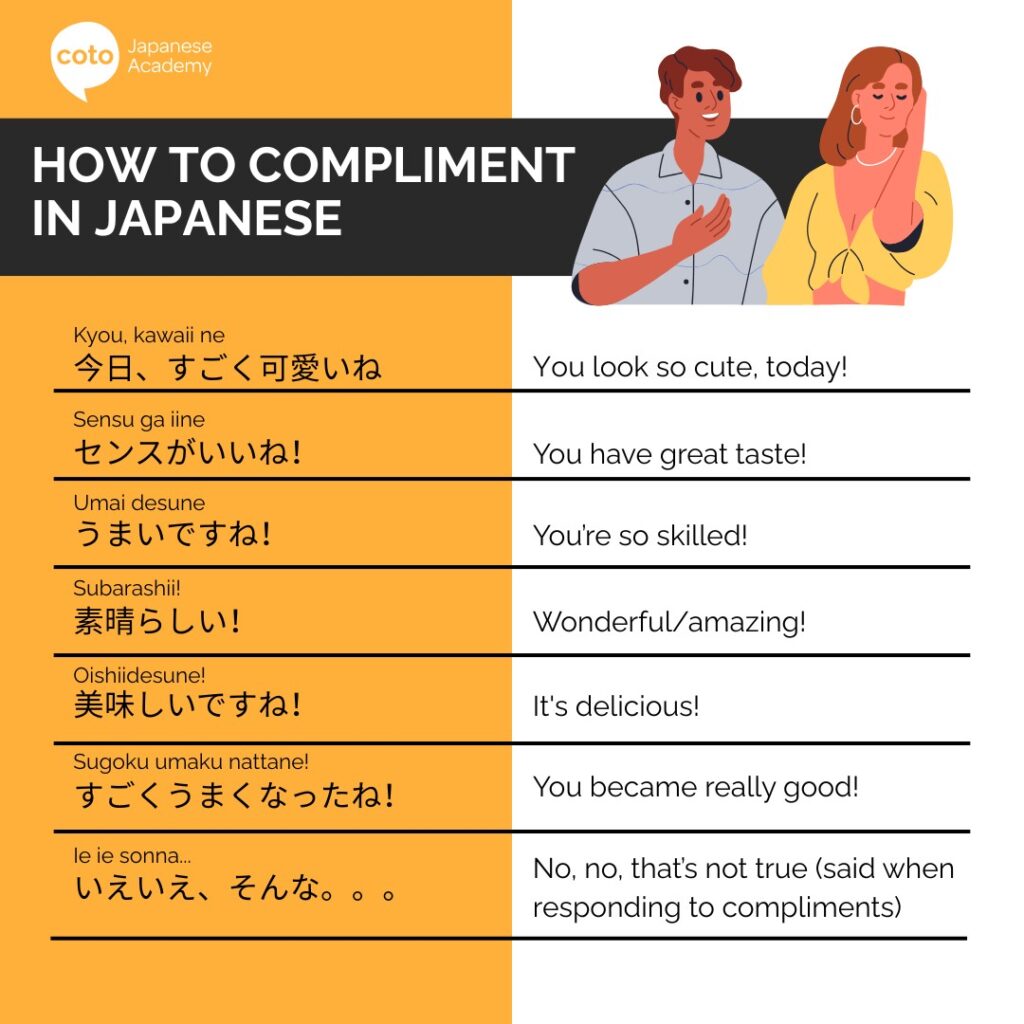
Complimenting Appearance in Japanese
When sharing kind words about a person’s appearance, be mindful of sensitivity to ensure your intentions come across as complimentary rather than a pick-up line. Similar to other languages, commenting on a person’s facial features or body can very easily cross a boundary, especially between opposite genders.
So, it’s generally safer to compliment a person’s choice of clothing, haircut, or style, rather than innate characteristics like physical features. But, compliments like 可愛い (kawaii) are common and very safe to generally compliment someone’s whole appearance. It often translates to “cute”; however, it has a much broader application in describing something you admire. Note that the nuance is a bit feminine, so people often use the word かっこいい (kakkoii), meaning “cool” or “handsome,” for men. Let’s go through some common phrases you can use to compliment someone’s appearance:
Example 1:
今日、すごく可愛いね!
Kyou, sugoku kawaii ne!
You look really cute today!
A simple and very natural compliment that works well in casual settings between friends. Adding 今日 (kyou), meaning “today,” makes it feel spontaneous and genuine rather than rehearsed.
Example 2:
新しい髪型、かっこいいね!
Atarashii kamigata, kakkoii ne!
Your new haircut looks really cool!
Commenting on a haircut rather than physical features keeps the compliment safe and natural, and かっこいい is the go-to word for complimenting men in Japanese.
Example 3:
いつもおしゃれだよね、センスがいいね!
Itsumo oshare da yo ne, sensu ga ii ne!
You’re always so stylish, you have great taste!
センスがいい (sensu ga ii) meaning “good sense” or “great taste” is a wonderful compliment in Japanese and one that feels particularly thoughtful, as it acknowledges the person’s own choices rather than just their appearance.
Example 4:
今日、すごく素敵だね!
Kyou, sugoku suteki da ne!
You look wonderful today!
素敵 (suteki) meaning “wonderful” or “lovely” is a warm, versatile compliment that works in a wide range of situations and for any gender. It is enthusiastic without being overly forward, making it one of the safest and most natural appearance compliments you can give.
Complimenting Skills in Japanese
If you are particularly impressed with someone’s abilities, it’s always great to let them know, whether you want to encourage them or just spread kindness. So, when it comes to complimenting someone’s skills in Japanese, you often use the word 上手 (jouzu), which means “good” or “skilled.”
Depending on the context, you could use 強い (tsuyoi) instead, meaning “strong,” to praise someone’s skills in sports, video games, or something competitive. Expressing your admiration for one’s abilities is very common in Japanese, so here are some phrases you could use to do just that:
Example 1:
日本語が上手ですね!どのくらい勉強しましたか?
nihongo ga jouzu desu ne! Dono kurai benkyou shimashita ka?
Your Japanese is really good! How long have you been studying?
This is probably one of the most common compliments foreigners receive in Japan. Following it up with a genuine question makes it feel natural and opens up a conversation.
Example 2:
テニスがめちゃくちゃうまいね!どのくらいやってるの?
Tenisu ga mechakucha umai ne! Dono kurai yatteru no?
You’re so good at tennis! How long have you been playing?
めちゃくちゃ is a very casual and natural way to add emphasis in everyday speech with friends or family. It’s actually a Kansai-ben phrase, but people all over the nation use it. Also, this example shows how 強い (tsuyoi) fits more naturally than 上手 (jouzu) in a competitive context.
Example 3:
絵がすごくうまいだね!才能がある!
E ga sugoku umai da ne! Sainou ga aru ne!
You’re so good at drawing! You’re really talented!
才能がある (sainou ga aru), meaning “to have talent,” is a wonderful addition to a skill compliment, as it goes beyond just praising the result and acknowledges the person’s natural ability.
Example 4:
さすが!やっぱり違うね!
Sasuga! Yappari chigau ne!
As expected of you! You really are something else!
さすが is a very natural Japanese expression that you use whenever someone has lived up to or exceeded the high expectations you already had of them.
Complimenting Work or Effort in Japanese
Rather than just expressing admiration for results or innate abilities, complimenting is an excellent way to encourage people and show you recognize their efforts. In Japanese, this is one of the most important uses of complimenting, especially in work or activities where improvement and growth should be recognized.
One of the most common phrases people use is 頑張りましたね (ganbarimashita ne), which means “you did your best.” It is the past tense of 頑張る (ganbaru), meaning “to do my best,” plus adding ね gives the expression warmth. If you want to express how someone has grown, expressions like 上手になりました (jouzu ni narimashita), meaning “became skilled at” or 強くなりました (tsuyoku narimashita), meaning “became strong” both communicate how someone has grown. Let’s go through some examples of how to compliment one’s growth and effort.
Example 1:
今日はよく頑張りましたね!本当にすごかったです!
Kyou wa yoku ganbarimashita ne! Hontou ni sugokatta desu!
You really did your best today! That was truly impressive!
よく (yoku) adds extra warmth to 頑張りましたね (ganbarimashitane) rather than just saying “you did your best,” it feels more like “you really, truly gave it your all.”
Example 2:
日本語が上手になりましたね!最初の頃と全然違う!
Nihongo ga jouzu ni narimashita ne! Saisho no koro to zenzen chigau!
Your Japanese has really improved! You’re completely different from when you first started!
最初の頃と全然違う (you’re completely different from when you first started) is a very natural compliment that feels specific and genuine rather than generic.
Example 3:
最近、めちゃくちゃ強くなりましたね!練習の成果が出てますよ!
Saikin, mechakucha tsuyoku narimashita ne! Renshuu no seika ga detemasu yo!
You’ve gotten incredibly strong lately! All that practice is really paying off!
練習の成果が出ている (renshuu no seika ga dete iru) meaning “the results of your practice are showing” is a particularly meaningful phrase as it directly connects the person’s effort to their improvement.
Example 4:
プレゼン、素晴らしかったですね!
Purezen, ga subarashikatta desune!
Your presentation was wonderful!
The phrase 素晴らしい (subarashii) is a very common expression for communicating how impressive someone’s work is.
Complimenting Someone’s Food or Cooking
You probably heard of the phrase, 美味しい (oishii), meaning delicious, and it’s great for expressing how good the food you’re eating tastes. However, if you want to offer your compliments to the chef, there are ways to express your appreciation for their skills directly. So, let’s go through some common expressions for complimenting and describing the flavors of food and the cooking skills of the person making them.
Example 1:
このラーメン、スープにすごく深みがあって美味しいね!
Kono raamen, suupu ni sugoku fukumi ga atte oishii ne!
This ramen is so good, the soup has such a rich depth of flavor!
深みがある (fukumi ga aru), meaning “has depth,” is a wonderful expression for complimenting flavor and shows a more sophisticated appreciation of cooking.
Example 2:
味付けがちょうどいいね!濃すぎず、薄すぎず、完璧だよ。
Ajitsuke ga choudo ii ne! Kousugizu, ususugizu, kanpeki da yo.
The seasoning is just right! Not too strong, not too light, it’s perfect.
味付けがちょうどいい (the seasoning is just right) is a very natural and specific compliment that shows you are paying attention to the cooking itself, rather than just saying it tastes good. The term, 完璧 (kanpeki), meaning perfect, wraps up the compliment very neatly.
Example 3:
料理が本当に上手ですね!レストランで働けるんじゃないですか?
Ryouri ga hontou ni jouzu desu ne! Resutoran de hatarakeru n ja nai desu ka?
You are truly such a great cook! You could work at a restaurant, couldn’t you?
By directly saying that the person is good at cooking or 料理が上手ですね, you are complimenting their cooking skills directly. The second phrase, レストランで働けるんじゃないですか?meaning “you could work at a restaurant” adds even more flattery, saying their skills are at a professional level.
Need to know the words for ingredients and nutrition in Japanese? Check out our blog: How To Read Japanese Nutrition & Food Labels
Romantic or Flirting Compliments
Probably even more than appearance, complimenting a crush draws a fine line between something genuine and something that sounds like a pick-up line. So, to avoid seeming like you’re doing nanpa (picking up girls in Japanese), let’s explore how to compliment someone you admire while being classy and respectful.
Example 1:
優しいよね、なんか話しやすくて助かってる。
Yasashii yo ne, nanka hanashiyasukute tasukatteru.
You’re so kind — I really appreciate how easy you are to talk to.
話しやすい (hanashiyasui), meaning “easy to talk to,” is a particularly meaningful compliment in the context of a crush, as it conveys genuine comfort and connection. 助かってる (tasukatteru), which can mean “ it really helps me” or “I really appreciate it,” adds a layer of vulnerability that feels sincere.
Example 2:
今日の服、すごく似合ってるね。
Kyou no fuku, sugoku niattteru ne.
Today’s outfit really suits you.
似合っている (niatteiru), meaning “it suits you” or “looks good on you,” is one of the most tasteful compliments about appearance in Japanese because it focuses on how well something fits the person rather than commenting directly on their physical features.
Example 3:
一緒にいると楽しい!
Issho ni iru to tanoshii!
It’s so fun being with you!
This is a simple and common expression you can use to genuinely express how much you enjoy spending time with someone, especially your crush.
Speaking of complimenting a crush, read our blog to learn how to ask someone on a date in Japanese!
How to Respond to Compliments in Japanese
In Japanese, it is very common to compliment, and you will eventually be on the receiving end of them, so you might be wondering what’s the best way to respond naturally. Even in English, responding to praise with something like “thank you” can sound a bit conceited, as if you feel you are deserving of the person’s admiration. So, as you can imagine, this would be an even bigger no-no in Japan, a culture that places immense emphasis on humility.
Generally, you lightly reject compliments whenever you receive them and express that their words of praise are untrue. Even if you (and everyone else) know that perhaps you’re the best performer in your team, company, or club, you still should deny the praise anyway. Here are some expressions you can use whenever you’re receiving compliments:
Example 1:
いえいえ、そんな。。。
Ie ie, sonna…
No, not at all / that’s not true at all.
This is one of the most common and natural responses to praise. The phrase, いえいえ (ie ie) is a warm, gentle way to dismiss praise that sounds more natural than a flat いいえ (no). It works in virtually any situation, from being praised for your Japanese ability to your cooking or work performance.
Example 2:
いえいえ、全然まだまだですよ。
Ie ie, zenzen mada mada desu yo
No, no, I still have a long way to go.
まだまだ (mada mada), which means “still not there yet” or “I have a long way to go,” is an essential expression that communicates humility while also showing a growth mindset. It’s a very versatile phrase you can use to say that you still have room for improvement, in just about any context.
Example 3:
ありがとうございます。でも、チームみんなのおかげです。
Arigatou gozaimasu. Demo, chiimu no minna no okage desu.
Thank you very much. But it is really all thanks to everyone on the team.
This expression is perfect for responding to compliments in a work context. The phrase, 〜のおかげ, means “thanks to,” is great for redirecting praise to the team, which also reflects the Japanese culture for collaboration. So, be sure to keep this in your arsenal of Japanese business phrases.
Conclusion: Giving Compliments is Natural & Common in Japanese
Japanese people are no strangers to giving compliments; it’s a deep part of showing respect and admiration for others, and in a work setting, it may even convey their collaborative mindset. So, try to remember some of these compliments to naturally and genuinely praise somebody, and hopefully make their day. Nothing feels better than sharing positivity, so why not do it in another language, like Japanese!
Learn to Give Compliments Naturally in Japanese with Coto Academy!
If you really want to praise and express admiration for someone naturally, while coming across as genuine, take our conversation-focused courses at Coto Academy! Our classes will ensure you understand the nuances of Japanese that will go a long way toward helping you express yourself effectively.
We have a variety of programs focusing on different aspects of the language, from preparing for the JLPT to building comprehensive skills. We have campuses in Tokyo and one in Yokohama, or you can join us online from anywhere around the world. If you’re ready to sign up or you just want to learn more, fill in the contact form below!
FAQ:
How do you compliment someone in Japanese?
Some of the most common compliment words are 可愛い (kawaii, meaning cute), かっこいい (kakkoii, meaning cool), おしゃれ (oshare, meaning stylish), and 素敵 (suteki, meaning wonderful/nice). Adding ね at the end softens the compliment and makes it sound more natural in conversation.
How do you compliment food in Japanese?
The most natural expression is 美味しい (oishii, meaning delicious). To compliment the cook directly, 料理が上手ですね (ryouri ga jouzu desu ne, you’re such a good cook) is warm and widely used. Always finish a meal with ごちそうさまでした as a culturally important expression of gratitude.
How do you compliment a person's skills in Japanese?
The go-to word is 上手 (jouzu, meaning skilled), which works for most abilities. For competitive contexts like sports or games, 強い (tsuyoi, meaning strong) sounds more natural. To acknowledge growth, 上手になりましたね (you have really improved) is encouraging and meaningful.
What is the best way to respond to compliments in Japanese?
Humility is key in Japanese; accepting praise too directly can come across as conceited. The most natural response is to gently deny the compliment with そんなことないですよ (that’s not true) paired with まだまだです (I still have a long way to go). In a work setting, deflecting credit with 〜のおかげです (it’s all thanks to ~) is both humble and culturally appropriate.