






When you’re just starting to learn Japanese, which kanji should you learn first? We would argue that, besides the easiest kanji, you should learn the ones that appear most often in real life, too. This series of logographic Chinese characters is used in the Japanese writing system, which even advanced Japanese learners often struggle with. The Japanese language is considered one of the most challenging languages to learn, and for many, kanji is the biggest reason.
Still, learning and knowing kanji is important. To be considered “fluent” in Japanese, learners are expected to know the Joyo kanji, a list of over 2,000 commonly used characters officially designated by the Japanese Ministry of Education. Even native speakers spend years in school mastering them.
In this guide, we will introduce the most basic kanji that beginners typically encounter. By the end, however, you might realize that the first hundred are just the beginning.
What is Kanji?
Kanji (漢字) are the logographic characters used in the Japanese writing system, originally borrowed from Chinese. Kanji were imported from China over a thousand years ago and gradually adapted to Japanese. While some characters kept their original Chinese meaning, others evolved unique Japanese interpretations.
Unlike hiragana or katakana, which are phonetic scripts representing sounds, each kanji represents a meaning or concept.
Phonetically, there are two types of kanji readings:
- Onyomi. This is the “Chinese-style” reading, often used in compound words.
- Kunyomi. This is the “Japanese-style” reading, often used when the kanji stands alone.
A Better Way to Learn Kanji: Radicals
Kanji radicals, or bushu (部首・ぶしゅ), are the building blocks of kanji characters. Think of them like small LEGO pieces that come together to form a larger figure.
Some radicals are kanji on their own and can be combined to create other kanji. For example, the radical 木 represents “tree,” and when you stack three of them together to form 森 (mori), it means “forest.”
Radicals can also provide clues about a kanji’s meaning, so you might be able to guess the meaning even if you’ve never seen the character before. For example, the radical 氵, a variant of 水 (water), often indicates that a kanji is related to water or liquids. If you encounter kanji like:
- 洗う
- 海
Even if you don’t know their meanings yet, you can infer they are connected to water. 洗う (arau) means “to wash,” and 海 (umi) means “ocean.”
Learning radicals makes reading and writing kanji much easier. This is why many learning tools, such as WaniKani, rely on kanji radicals to help learners memorize characters more effectively.
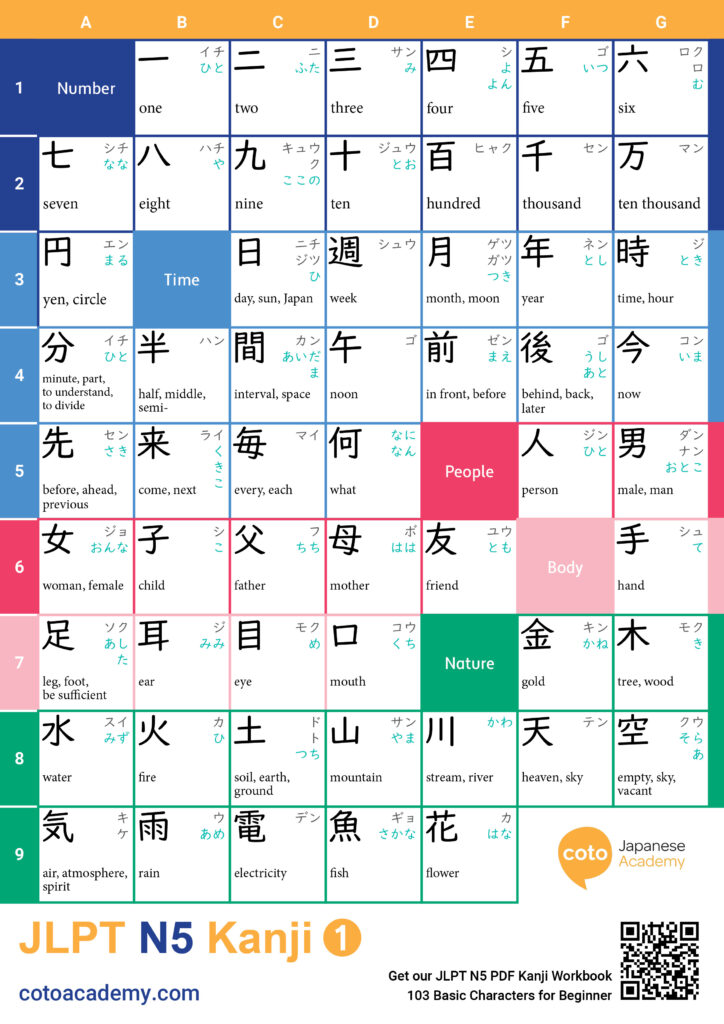
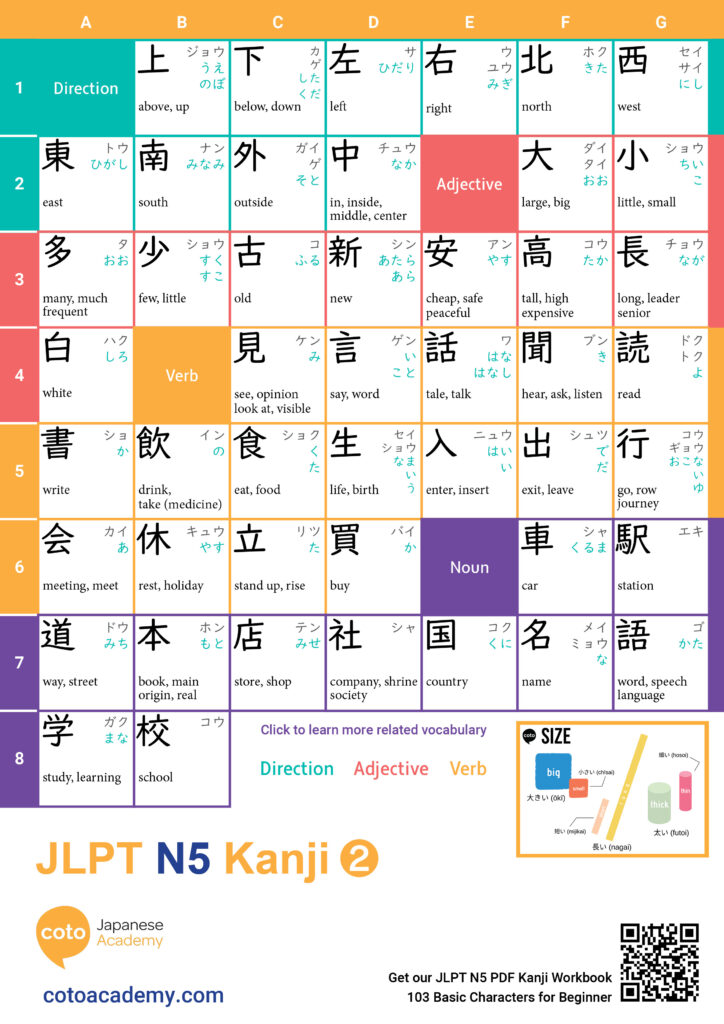
Download Basic Kanji Chart
Before you continue scrolling, you can master the essential kanji characters with free basic kanji charts! These charts organize all kanji by theme and include both readings and meanings. For easy access, you can download them as images to your phone or laptop and use them for review anytime.
Don’t forget, if you want to truly learn Japanese, study at Coto Academy! Coto offers immersive Japanese language courses with experienced teachers, small class sizes, and practical learning that helps you speak, read, and write confidently.
Below, we have compiled tables listing all the basic kanji. Since these are fundamental characters, they are mostly at the JLPT N5 level, with some reaching JLPT N4. The table shows 100 essential kanji for JLPT N5 learners, including each kanji’s readings in both kun’yomi and on’yomi.
1. Basic Kanji Related to Numbers
Typically, kanji numbers are used in real life, mostly in formal, legal, or financial contexts like contracts, checks, or traditional events. For everyday purposes such as shopping, texting, or clocks, Arabic numerals (1, 2, 3…) are far more common.
| Kanji | Meaning | Kun’yomi | On’yomi |
|---|---|---|---|
| 一 | One | Hito | Ichi |
| 二 | Two | Futa | Ni |
| 三 | Three | Mi | San |
| 四 | Four | Yo | Shi |
| 五 | Five | Itsu | Go |
| 六 | Six | Mu | Roku |
| 七 | Seven | Nana | Shichi |
| 八 | Eight | Ya | Hachi |
| 九 | Nine | Kokonoka | Kyuu |
| 十 | Ten | Too | Juu |
| 百 | Hundred | — | Hyaku |
| 千 | Thousand | — | Sen |
| 万 | Ten Thousand | — | Man |
| 円 | Yen, Circle | Maru | En |
Read More: How to Count Numbers in Japanese
2. Kanji Related to Time
| Kanji | Meaning | Kun’yomi | On’yomi |
|---|---|---|---|
| 週 | Week | — | Shuu |
| 日 | Day, Sun, Japan | Hi | Nichi / Jitsu |
| 月 | Month, Moon | Tsuki | Getsu / Gatsu |
| 年 | Year | Toshi | Nen |
| 時 | Time, Hour | Toki | Ji |
| 分 | Minute, Part | — | Fun / Bun |
| 半 | Half, Middle | — | Han |
| 間 | Interval, Space | Aida / Ma | Kan |
| 午 | Noon | — | Go |
| 前 | In Front, Before | Mae | Zen |
| 後 | Behind, Back, Later | Ato / Ushiro | Go / Kou |
| 今 | Now | Ima | Kon |
| 先 | Before, Ahead | Saki | Sen |
| 来 | Come, Next | Kuru / Ki | Rai |
| 毎 | Every, Each | — | Mai |
| 何 | What | Nani | Ka / Nan |
Read More: How to Tell The Time in Japanese
3. Kanji Related Family and Friends
| Kanji | Meaning | Kun’yomi | On’yomi |
|---|---|---|---|
| 人 | Person | Hito | Jin / Nin |
| 男 | Male, Man | Otoko | Dan / Nan |
| 女 | Woman, Female | Onna | Jo |
| 子 | Child | Ko | Shi |
| 父 | Father | Chichi | Fu |
| 母 | Mother | Haha | Bo |
| 友 | Friend | Tomo | Yuu |
4. Kanji Related to Body Parts
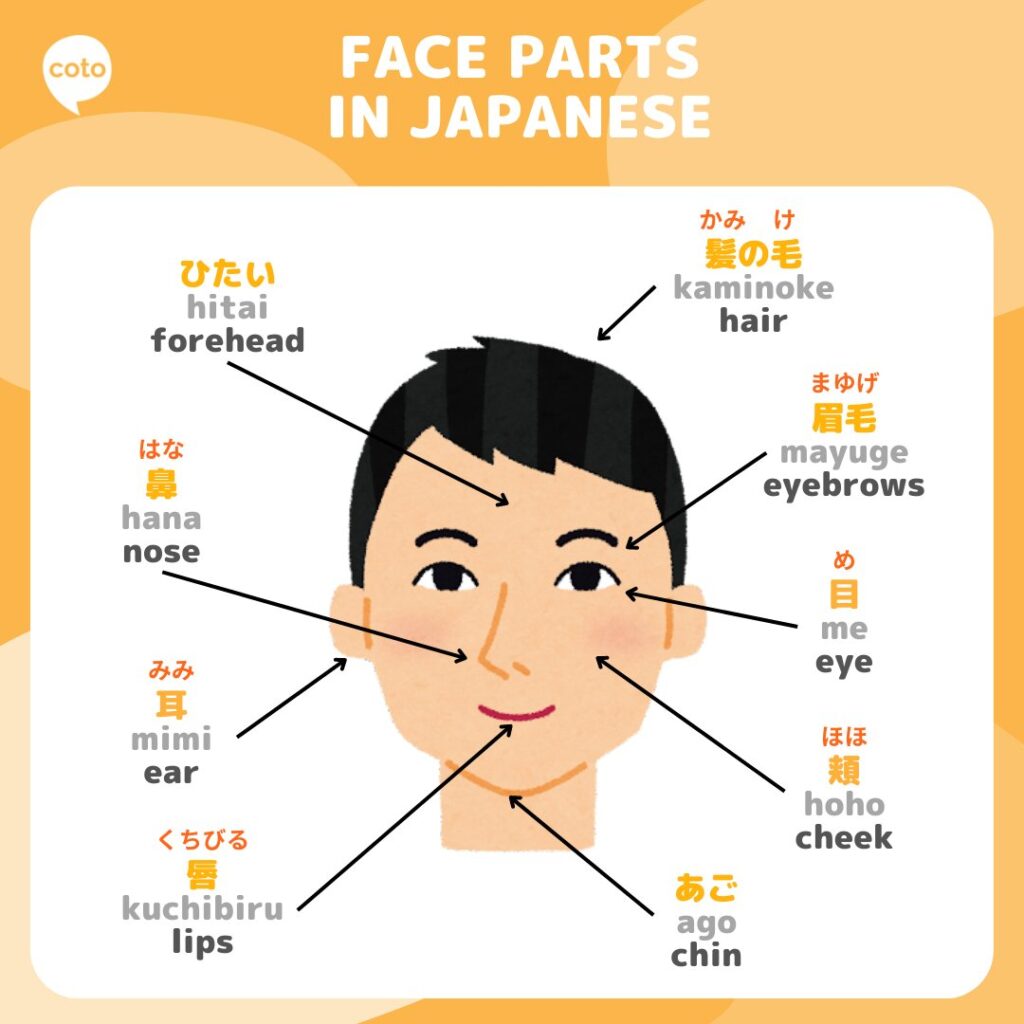
| Kanji | Meaning | Kun’yomi | On’yomi |
|---|---|---|---|
| 顔 | Face | Kao | Gan |
| 体 | Body | Karada | Tai / Tei |
| 手 | Hand | Te | Shu |
| 足 | Leg, Foot | Ashi | Soku |
| 耳 | Ear | Mimi | Ji |
| 目 | Eye | Me | Moku / Boku |
| 口 | Mouth | Kuchi | Kou / Ku |
| 鼻 | Nose | Hana | Bi |
Read More: Body Parts in Japanese
5. Kanji Related to Nature
| Kanji | Meaning | Kun’yomi | On’yomi |
|---|---|---|---|
| 金 | Gold | Kane | Kin / Kon |
| 木 | Tree, Wood | Ki | Moku / Boku |
| 水 | Water | Mizu | Sui |
| 火 | Fire | Hi | Ka |
| 土 | Soil, Earth | Tsuchi | Do / To |
| 山 | Mountain | Yama | San / Zan |
| 川 | River, Stream | Kawa | Sen |
| 天 | Heaven, Sky | — | Ten |
| 空 | Empty, Sky | Sora / A | Kuu |
| 気 | Air, Spirit, Atmosphere | — | Ki / Ke |
| 雨 | Rain | Ame | U |
| 電 | Electricity | — | Den |
| 魚 | Fish | Sakana | Gyo |
| 花 | Flower | Hana | Ka |
7. Kanji Related to Position
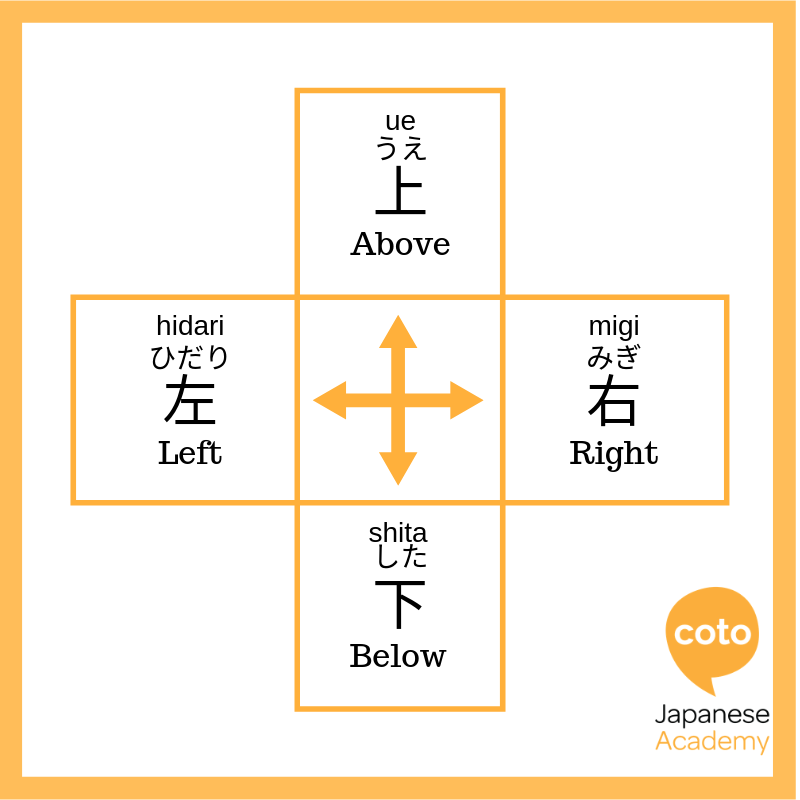
| Kanji | Meaning | Kun’yomi | On’yomi |
|---|---|---|---|
| 大 | Big, Large | Oo | Dai / Tai |
| 小 | Small, Little | Chiisai / Ko | Shou |
| 多 | Many, Frequent | Oo | Ta |
| 少 | Few, Little | Sukunai / Suko | Shou |
| 古 | Old | Furu | Ko |
| 新 | New | Atara / Arata | Shin |
| 安 | Cheap, Safe, Peaceful | Yasu | An |
| 高 | Tall, High, Expensive | Taka | Kou |
| 長 | Long, Senior, Leader | Naga | Chou |
| 白 | White | Shiro | Haku |
Read More: Positions in Japanese
8. Adjectives
| Kanji | Meaning | Kun’yomi | On’yomi |
|---|---|---|---|
| 大 | Big, Large | Oo | Dai / Tai |
| 小 | Small, Little | Chiisai / Ko | Shou |
| 多 | Many, Frequent | Oo | Ta |
| 少 | Few, Little | Sukunai / Suko | Shou |
| 古 | Old | Furu | Ko |
| 新 | New | Atara / Arata | Shin |
| 安 | Cheap, Safe, Peaceful | Yasu | An |
| 高 | Tall, High, Expensive | Taka | Kou |
| 長 | Long, Senior, Leader | Naga | Chou |
| 白 | White | Shiro | Haku |
Read More: Basic Adjectives You Need to Know
9. Verbs
| Kanji | Meaning | Kun’yomi | On’yomi |
|---|---|---|---|
| 見 | See, Opinion | Mi | Ken |
| 言 | Say, Word | I / Koto | Gen |
| 話 | Talk, Tale | Hanashi | Wa |
| 聞 | Hear, Listen, Ask | Kiku | Bun / Mon |
| 読 | Read | Yomu | Doku / Toku |
| 書 | Write | Kaku | Sho |
| 飲 | Drink, Take (Medicine) | Nomu | In |
| 食 | Eat, Food | Taberu / Kuu | Shoku / Jiki |
| 生 | Life, Birth | I / U / Haeru | Sei / Shou |
| 入 | Enter, Insert | Hairu / Ireru | Nyuu |
| 出 | Exit, Leave | Deru / Dasu | Shutsu / Sui |
| 行 | Go, Journey | Iku / Yuku | Kou / Gyou |
| 会 | Meet, Meeting | Au | Kai |
| 休 | Rest, Holiday | Yasumu | Kyuu |
| 立 | Stand, Rise | Tatsu | Ritsu / Ryuu |
| 買 | Buy | Kau | Bai |
Read More: Basic Japanese Verbs to Know
10. Noun
| Kanji | Meaning | Kun’yomi | On’yomi |
|---|---|---|---|
| 車 | Car | Kuruma | Sha |
| 駅 | Station | — | Eki |
| 道 | Street, Way | Michi | Dou |
| 本 | Book, Origin, Real | Moto | Hon |
| 店 | Store, Shop | Mise | Ten |
| 社 | Company, Shrine, Society | Yashiro | Sha |
| 国 | Country | Kuni | Koku |
| 名 | Name | Na | Mei / Myou |
| 語 | Word, Speech, Language | Kataru | Go |
| 学 | Study, Learning | Manabu | Gaku |
| 校 | School | — | Kou |
Kanji Compounds
One thing about kanji is that they often do not stand alone. When you combine two or more kanji characters, you create a kanji compound, or 熟語 (jukugo). These compounds form words with new, nuanced meanings and are usually read using on’yomi (Chinese readings). They often define nouns, actions, or concepts, such as 読書 (どくしょ, dokusho, “reading books”) or 缶詰 (かんづめ, kanzume, “canned goods”).
Kanji compounds frequently combine characters that are similar, opposite, or descriptive. For example, when the kanji 今 (now) is combined with 週 (week), it forms 今週 (こんしゅう, konshuu), meaning “this week.” Even if you don’t know the exact meaning, recognizing parts of the kanji can give you helpful hints.
Tips to Learn Kanji
1. Practice writing and its stroke orders
Nowadays, most people learn kanji through Japanese learning apps or on their phones. As you go to work in Japan or enter university, the need to write kanji by hand has become less common. However, we still recommend learning kanji the traditional way: by practicing writing.
Following the correct stroke order is an effective method that not only helps you memorize the characters more easily but also ensures your handwriting is correct.
2. Spaced repetition
Of course, it is always beneficial to combine the traditional “old-school” method with modern learning systems. Spaced repetition is one of the most effective techniques for memorization. For example, apps like Anki offer multiple Japanese kanji decks. As a learner, you can review characters at intervals, which apparently encourages long-term retention.
3. Prioritize consistency over bulk memorization
Speaking of long-term retention, it is far more effective to study kanji consistently every day rather than trying to memorize a large number of characters in a single session. By this, we mean cramming all your kanji the night before a big test day, like the JLPT (in fact, this is one of the worst ways to study Japanese).
Short, daily practice, whether writing by hand or reviewing with spaced repetition apps, helps reinforce memory and prevents burnout. Over time, this steady approach leads to deeper understanding and recall, making your kanji learning more sustainable and enjoyable.
Read More: How to Learn Kanji Effectively
Master Kanji the Smart Way with Coto Academy!
Although kanji is one of the biggest hurdles in learning Japanese, at Coto Academy, you can join Japanese classes designed to help you master kanji and apply it in real-life situations.
Our classes are available in Tokyo, Yokohama, and online, so you can learn from anywhere. Beyond just memorizing kanji, our courses focus on practical application, helping you use kanji in daily life, conversations, emails, and professional settings. With experienced teachers and a supportive learning environment, Coto Academy makes learning kanji both effective and enjoyable!
Ready to get started? Fill out the form below for a free Japanese level check.
FAQ
How can I practice writing kanji effectively?
Writing kanji by hand while following the correct stroke order helps with memorization and improves handwriting. Short, consistent practice sessions are more effective than occasional bulk study.
Can I learn kanji without writing them by hand?
While apps and online tools are useful, practicing writing kanji by hand reinforces memory and understanding. Combining traditional writing with modern tools like Anki for spaced repetition is ideal.
How long does it take to learn basic kanji?
Learning depends on your schedule and consistency. With daily practice, most beginners can master the basic 100 kanji in 1-2 months. Intensive courses or immersive study can accelerate this process.
Can I learn kanji online?
Yes! Many platforms, including Coto Academy, offer online classes that teach kanji along with practical application in speaking, reading, and writing.