





Learning how to introduce yourself in Japanese, known as 自己紹介 (jikoshoukai), is one of the first things you should learn, especially if you plan to visit or live in Japan. If you want to meet new people, start conversations, or make a good first impression, learning how to do a proper self-introduction in Japanese is the perfect place to start.
One of the first things you will do, the second you land in Japan, is introduce yourself, whether you’re coming for school, work, or just to meet friends. So, what is customary when introducing yourself in Japan, and how do you condense everything about yourself into just one or two minutes?
Keep reading to find out how to do a proper Japanese jikoshoukai step by step!
Starting A Conversation with a Warm Greeting
Whether you are preparing to introduce yourself in Japanese to a curious crowd of classmates or an interviewer, saying hello first is very important! Depending on the time of day, you may say ohayou gozaimasu, konnichiwa, or konbanwa. Do you know the difference? If not, you can simply state はじめまして“hajimemashite,” which is often translated to “nice to meet you”. But the truth is there isn’t a great English equivalent, since the literal translation is closer to “beginnings.”
Check Out Our Video on How to Introduce Yourself in Japanese
Watch our video breaking down how to do a proper jikoshoukai or self-introduction in Japanese!
Self-Introduction (Jikoushoukai 自己紹介): Introducing Your Name
You can politely say your name with the verb です (desu), as in ジョンです (Jon desu), meaning “I am John.” You can also use the verb 言います (iimasu), meaning “to say.” In this case, you would say ジョンと言います (Jon to iimasu), meaning “I am called John.”
However, in formal contexts such as for Japanese interviews, you would use more polite sentence structures and word conjugations. Note that Japanese people are used to giving their family name first and their given name second.
Casual
Here are some examples of how you can introduce your name in very casual scenarios, like with people your age or meeting friends of friends.
Example 1:
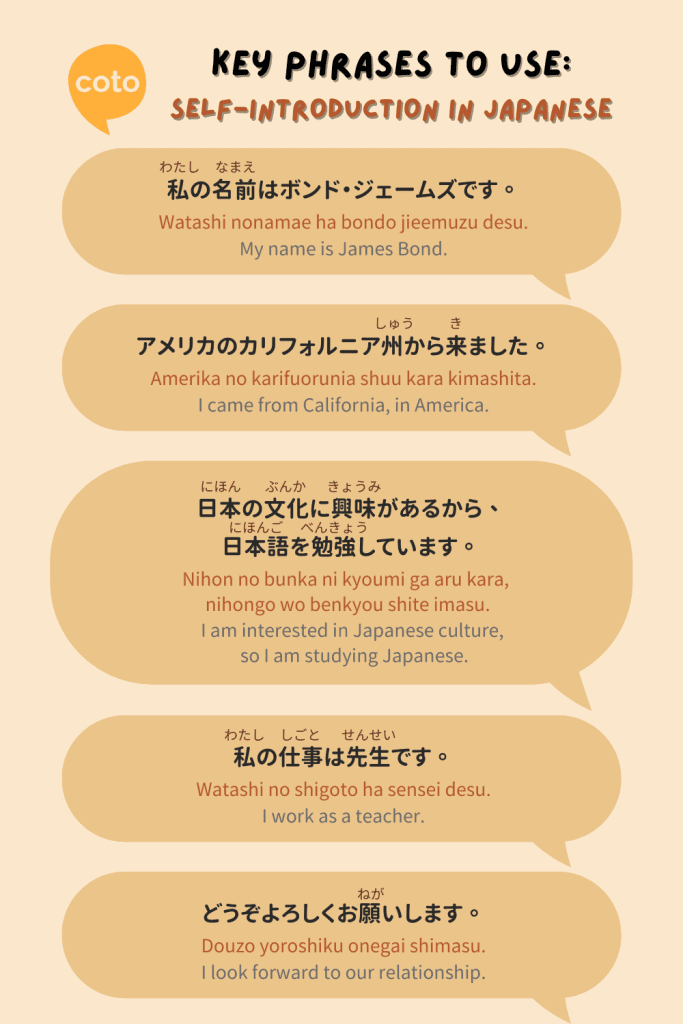
私の名前はボンド・ジェームズです。
Watashi no namae wa bondo jieemuzu desu.
My name is James Bond.
Note that this first example comes across a little stiff, especially in casual situations. It’s a bit of a mouthful, so most people opt for the following expression.
Example 2:
ボンド・ジェームズです。
Bondo, jieemuzu desu.
I am James Bond.
Polite
This an expression you can use in a circumstance that’s a bit less casual but not necessarily formal. This could be ideal when meeting peers or colleagues.
Example:
ボンド・ジェームズと言います。
Bondo, jieemuzu to iimasu.
My name is James Bond.
Formal
This expression is ideal for very formal situations like when you’re meeting your boss for the first time or when doing an interview.
Example:
ボンド・ジェームズと申します。
Bondo, jieemuzu to moushimasu.
I am James Bond.
Where Are You From? ご出身はどちらですか?
Being a foreigner in Japan constantly stimulates the imagination of the Japanese. Whether you are from Spain, Germany, or Australia, they will more likely assume an exotic origin and be surprised to hear the truth. So the next step in your jikoshoukai is to introduce your country and, eventually, your city! Note that if you are an American and wish to specify your home state, you will have to use the word shuu (州, しゅう).
Example 1:
イギリス(のロンドン)から来ました。
Igirisu (no rondon) kara kimashita.
I came from London, England.
Example 2:
アメリカのカリフォルニア州から来ました。
Amerika no karifuorunia shuu kara kimashita.
I came from California, in America.
You can also tell where you are from with the word for origins 出身 (shusshin), or an even easier way would be to give your nationality by adding 人 (jin) after a country’s name.
Example 1:
マドリッド出身です。
Madoriddo shusshin desu.
I am from Madrid.
Example 2:
パリ出身です。
Pari shusshin desu.
I am from Paris.
Example 3:
ドイツ人です。
Doitsu jin desu.
I am German.
Example 4:
インドネシア人です。
Indoneshia jin desu.
I am Indonesian.
Why Do You Study Japanese? どうして日本語を勉強しているんですか?
This is a common question you might be asked, especially if you came here to study, so it might be good to discuss this while you introduce yourself. Not only will the Japanese be flattered, but they will be eager to know why you are studying their language. If you are confident enough, you can speak about how long you have studied Japanese, how, where, etc.
Example 1:
日本の文化に興味があって、日本語を勉強しています。
Nihon no bunka ni kyoumi ga atte, nihongo wo benkyou shite imasu.
I am interested in Japanese culture, so I am studying Japanese.
Example 2:
字幕なしでアニメを見たいから、日本語を勉強しています。
Jimaku nashi de anime o mitaikara, nihongo o benkyou shite imasu.
I study Japanese because I want to watch anime without the help of subtitles.
Why Are You In Japan? どうして日本に来たんですか?
It is common and usually very much appreciated if you include why you came to Japan in the first place when introducing yourself in Japanese. There could be a variety of reasons that might have led you to live in Japan, but if you can briefly mention one of them, it would make self-introduction even more interesting. Whether you are in Japan for a short stay out of pure curiosity or a longer commitment, here are some expressions you can use:
Example 1:
日本語を勉強するために日本に来ました。
Nihongo wo benkyou suru tame ni nihon ni kimashita.
I came to Japan to study Japanese.
Example 2:
日本で働きたいから、日本に来ました。
Nihon de hatarakitaikara, Nihon ni kimashita.
I came to Japan because I want to work here.
Example 3:
旅行できました。
Ryoko de kimashita.
I came to travel.
Example 4:
卒業旅行できました。
Sotsugyo ryoko de kimashita.
I came for the graduation trip.
Example 5:
新婚旅行できました。
Shinkon ryoko de kimashita.
I came because of my honeymoon.
Introducing Your Occupation? 日本で何をしていますか?
Whether you are a student or working in a job, the “occupation” has an essential place in Japanese culture. Discussing what you are doing is a usual part of Japanese self-introductions. Students can specify that they are studying at a University, school, or even region.
Example 1:
大学/学校で勉強しています。
Daigaku /gakkou de benkyou shite imasu.
I am studying at a university/school.
Example 2:
(大)学生です。
(dai) gakusei desu.
I am a (university) student.
We put the 大 (dai) in parentheses, which when attached to 学生 means “university student”, since you don’t always need to specify the type of student you are. You can simply state you are a student.
If you are working, here are some examples of occupations you might say that you are currently working in.
Example 1:
エンジニアです。
Enginia desu.
I work as an engineer.
Example 2:
英語の先生です。
Eigo no sensei desu.
I am an English teacher.
Example 3:
日本の会社で働いています。
Nihon no kaisha de hataraite imasu.
I’m working for a Japanese Company.
Example 4:
外資系の会社で働いています。
Gaishikei no kaisha de hataraite imasu.
I’m working for a global company.
Depending on your level, you can always give a more detailed jikoshoukai explaining what you are studying or exactly doing at your workplace.
Introducing Interests and Hobbies
Talking about your hobbies always adds a nice personal touch to your jikoshoukai that just lets people know a bit more about who you are; it’s even appreciated in formal self-introductions. If you are meeting new people, sharing your passions in Japanese is always enjoyable. You can speak about your hobbies and what you like in various ways, but the two easiest ones are the expression to like (好き, suki) and the word hobby (趣味, shumi).
Example 1:
料理好きです。
Ryouri suki desu.
I like cooking.
Example 2:
趣味はスポーツです。
Shumi ha supottsu desu.
My hobby is sports.
Example 3:
趣味は漫画を読むことです。
Shumi ha manga wo yomu koto desu.
My hobby is to read manga.
The Final Step: よろしく Yoroshiku!
The Japanese expression yoroshiku onegaishimasu is challenging to translate into other languages, especially in English. It can be used in a wide variety of circumstances in Japanese, but you usually end your jikoushokai with this phrase.
In the context of wrapping up your self-introduction, it basically communicates that you look forward to the relationship with your new friends, colleagues, or even managers. Depending on who you’re talking to, you should amp up the formality of the phrase, so here’s how you can do that.
Casual
The most casual way to use this expression is just to simply say よろしく! (yoroshiku) which is best used when meeting a friend of a friend or perhaps people who are your age or younger.
Example:
よろしく!
Yoroshiku!
Nice to meet you!
Polite
Whenever you’re meeting people for the first time, the safest choice is to say よろしくお願いします (yoroshiku onegaishimasu), which includes the phrase お願いします (onegaishimasu), which translates to “please.” This expression is very respectful and can be used in both formal and somewhat casual interactions.
This is the most common way of ending a self-introduction since it’s very polite and works in just about every situation when meeting people.
Example:
どうぞよろしくお願いします。
Douzo yoroshiku onegai shimasu.
I look forward to our relationship.
Formal
This is the most formal usage of the phrase, and it’s often used when meeting people in professional settings, such as with your manager or during an interview. This version incorporates keigo, which is a very formal form of language in Japanese.
Example:
今後もどうぞよろしくお願い致します。
Kongo mo douzo yoroshiku onegai itashimasu.
I look forward to our relationship from now on.
Note that よろしくお願いいたします is also a very common Japanese business expression that is used outside of self-introductions. You often use it whenever you’re asking colleagues for a favor or wrapping up meetings with clients to show how you’re interested in continuing to work with them.
Example of a Full Japanese Self-introduction
Now that we’ve learned the key parts of a 自己紹介 (jikoshoukai), let’s put everything together into a cohesive, natural self-introduction.
Casual Jikoshoukai
This form of self-introduction is perfect for everyday or casual settings, such as introducing yourself to new classmates or new friends that your friends know.
はじめまして、〇〇です。
アメリカから来ました。東京で日本語を勉強しています。
趣味は映画を見ることとカフェ巡りです。
よろしくお願いします!
Hajimemashite, 〇〇 desu.
Amerika kara kimashita. Toukyou de nihongo o benkyō shiteimasu.
Shumi wa eiga o miru koto to kafe meguri desu.
Yoroshiku onegaishimasu!
Nice to meet you, I’m 〇〇.
I’m from the U.S. I’m studying Japanese in Tokyo.
My hobbies are watching movies and visiting cafes.
Looking forward to getting to know you!
Formal Jikoshoukai
This jikoshoukai is used when you are introducing yourself to a manager, client, or prospective employer during your job interview.
本日はお時間をいただき、ありがとうございます。
〇〇と申します。
アメリカ出身で、大学では国際関係を専攻いたしました。
卒業後は貿易会社で2年間勤務しておりました。
日本の企業文化に興味があり、貴社で新しい挑戦ができればと思っております。
本日はどうぞよろしくお願いいたします。
Honjitsu wa ojikan o itadaki, arigatou gozaimasu.
〇〇 to moushimasu.
Amerika shusshin de, daigaku de wa kokusai kankei o senkou itashimashita.
Sotsugyou-go wa boueki gaisha de ni-nenkan kinmu shite orimashita.
Nihon no kigyou bunka ni kyoumi ga ari, kisha de atarashii chousen ga dekireba to omotte orimasu.
Honjitsu wa douzo yoroshiku onegai itashimasu.
Thank you very much for your time today.
My name is 〇〇.
I’m from the U.S. and studied international relations at university.
After graduating, I worked at a trading company for two years.
I’m very interested in Japanese corporate culture and hope to take on new challenges at your company.
I look forward to speaking with you today.
Free Jikoshoukai Infographics
Etiquette
Proper etiquette is essential for Japanese culture. When introducing yourself in Japanese, your manner should be professional and appropriate.
Japanese people usually do not shake hands in professional settings, so it is usually best to bow instead. People generally bow once at the beginning and the end of their jikoshoukai.
Handshakes are sometimes okay for casual interactions. Make sure to “read the air” of the situation to see if they are appropriate.
In many professional settings, it is best to keep your hands at your sides while you talk. Avoid crossing your arms, if possible!
In business settings, you might also encounter exchanging business cards or meishi 名刺. Here is what you should do:
- Prepare Your Meishi in Advance: Before the meeting, ensure your meishi are in a cardholder and accessible. This shows organization and respect for the person you are meeting.
- Present Your Card with Both Hands: Hold your meishi to face the recipient, allowing them to read it easily. Extend it towards them with both hands, typically with the thumb and forefinger of each hand at opposite corners of the card.
- Introduce Yourself (Jikoshoukai): As you present your card, briefly introduce yourself.
- Receiving a Meishi: When someone offers you their meishi, accept it with both hands. It is polite to express your gratitude and acknowledge the receipt:
- Review the Meishi: After receiving it, take a moment to look at the card carefully. Show interest and respect for the information provided.
- Properly Store the Meishi: After examining it, place it in your cardholder or a respectful location, not in your pants pocket or anywhere informal.
If you are having a meeting with the person after changing the name card, you should place it on the table on the right or left side during the meeting!
Here are some blogs about Japanese manners you may be interested in checking out:
- Japanese Etiquette and Cultural Norms
- Re-れー礼儀(れいぎ)
- Japanese Etiquette: “After You”, どうぞ、お先に (Douzo Osaki ni)
Now You Can Introduce Yourself in Japanese!
Now, you are ready to give a proper Japanese 自己紹介 jikoshoukai! Always remember that a self-introduction with a group of friends or with your new boss will be different. You can be casual with people your age, but should always be formal in a business environment or with people you don’t know very well.
Learn to Do Jikoshoukai with Confidence with Coto Academy!
Learn how to introduce yourself with confidence in Japanese at Coto Academy! We offer conversation-focused courses that won’t have you just memorizing phrases from a textbook but will actually help you develop a real intuition for natural spoken language. We offer courses that cover every essential Japanese skill, JLPT, or business classes! Whatever your needs are, we have it!
We have campuses in Tokyo and Yokohama, or feel free to join us online from anywhere around the world! Fill out our contact form below for a free consultation if you want more details!
Be even more prepared to give a strong and polite self-introduction for a job interview! Need more tips on job interviews? Read the following blogs!
- How to Write a Japanese resume + Free PDF template
- A Guide to Self-Introductions in Japanese Job Interviews
- Most Common Japanese Job Interview Questions (And How to Answer Them)
FAQ
How to say nice to meet you in Japanese?
“Hajimemashite” (はじめまして) is the most common way to say “Nice to meet you” in Japanese.
What are the two common phrase to introduce yourself?
You can use two common phrases:
- “[Name] to mōshimasu” (〇〇と申します) – This is a more formal and humble way to introduce your name.
- “[Name] desu” (〇〇です) – This is the most straightforward way to say “My name is…”
How to introduce where I am from?
You can use the phrase “〇〇から来ました” (〇〇からきました) where “〇〇” is the name of your country or region. For example, “Nihon kara kimashita” means “I am from Japan.”
What to keep in mind when doing self-introduction?How to start a self-introduction in Japan?
Generally, you start with a greeting, followed by your name, where you are from, and occupation. You can also add information about your hobbies or interests.
What to keep in mind when doing self-introduction?
Yes, there are a few things to keep in mind:
- Humble language: Using humble language can show respect and humility, especially in formal settings.
- Bowing: Bowing is a common gesture of respect in Japanese culture. A slight bow is usually sufficient for a casual introduction.
- Eye contact: While maintaining eye contact is essential in many cultures, in Japan, it’s considered polite to avoid prolonged eye contact, especially with people of higher social status.
What are some polite phrases to say please?
Some polite phrases you can use are:
- “Douzo yoroshiku” (どうぞよろしくお願いします) – This is a more polite way to say the same thing.
- “Yoroshiku onegaishimasu” (よろしくお願いします) – This phrase is used to ask for kind treatment or cooperation.