



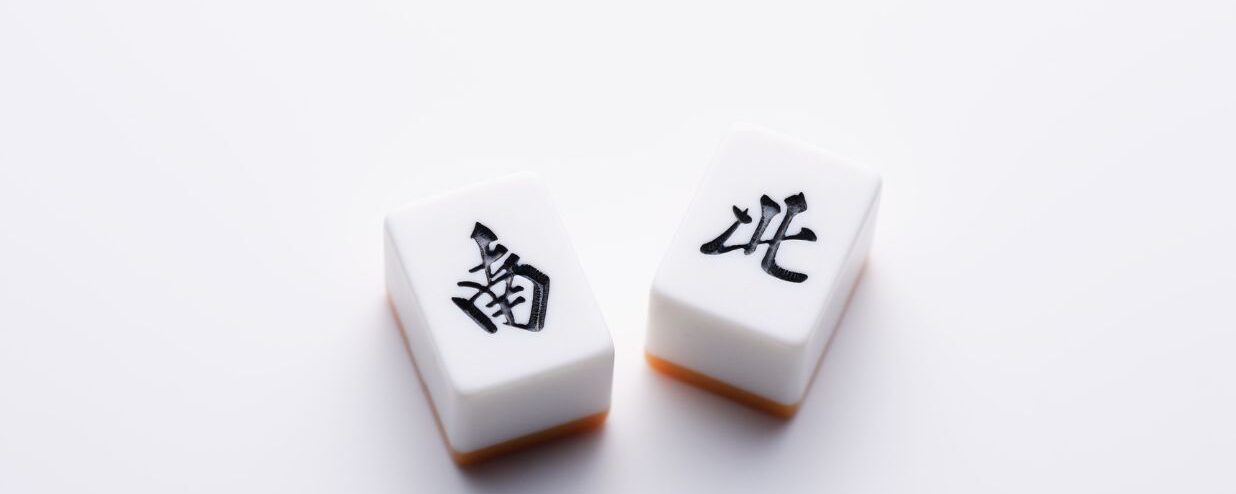


It’s overwhelming to think about all the unique kanji you have to remember; however, there’s a little secret to making kanji much easier to remember called radicals. Let’s say it’s our radical solution to remembering kanji — no pun intended. Radicals are basically the building blocks of kanji; while there are seemingly endless amounts of unique characters, they are all combinations of radicals.
Just remembering some of the most common radicals will allow you to memorize — and understand — thousands of kanji with a fraction of the effort and time. So, let’s break down how radicals work and how you can use them to remember kanji.
What Are Kanji Radicals?
Kanji radicals, or bushu (部首・ぶしゅ), are essentially components that make up a single kanji character; they can be thought of as a smaller part of a whole. Some radicals are kanji on their own and can be used to form other kanji. For example, 木 (ki) means tree on its own, but can be used as a radical. When combined with another radical, say 一 (ichi), meaning one, you create the character 本 (hon), meaning book.
木 (ki) + 一 (ichi) = 本 (hon)
But many kanji radicals cannot be used by themselves and must be used in conjunction with other radicals to form a kanji. For example, the radical, 儿, interpreted as “legs”, is only used as a component. So, you can use this radical in conjunction with other radicals or kanji, like 口 (kuchi), meaning mouth, to make the character, 兄, meaning older brother.
儿 + 口 (kuchi) = 兄 (ani)
Radicals are the common parts you can find in different kanji. While every kanji is unique, generally, there are a limited number of common radicals that you can quickly start to recognize. So, they are convenient patterns you can use to remember different kanji.
If you need to review Japanese writing systems, check out our blog: Japanese Writing System Explained: Kanji, Hiragana, and Katakana.
Why Should You Study Kanji Radicals?
Studying kanji radicals is helpful because radicals are like tiny building blocks that make up big kanji characters. When you learn the small pieces first, the big characters don’t feel so scary anymore. It’s easier to remember them because you can see how the parts fit together.
Radicals can also give you clues about what a kanji means, so you can sometimes guess the meaning even if you’ve never seen it before. Learning radicals makes reading and writing kanji much easier and a lot more fun.
Types of Kanji Radicals
There are 7 types of radicals categorized by their position, including left, right, upper left, bottom left, bottom, top, or middle.
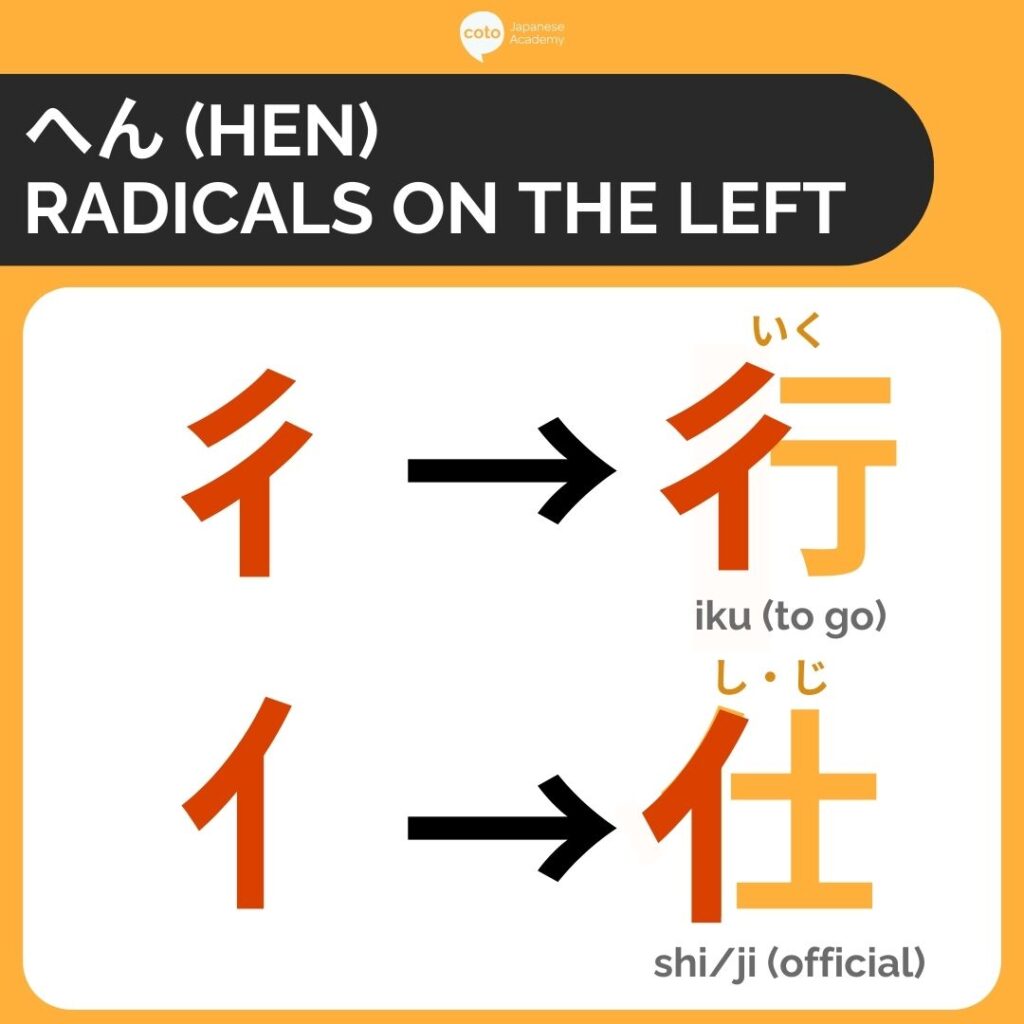
1. へん: Left
へん (hen) are radicals positioned to the left of the character. Certain radicals have specific forms when placed to the left, such as 人 (hito), or person, written as 亻 when positioned to the left of other elements.
Example 1:
彳in 行く(iku): to go
Example 2:
亻(person) in 仕 (shi): official or civil service
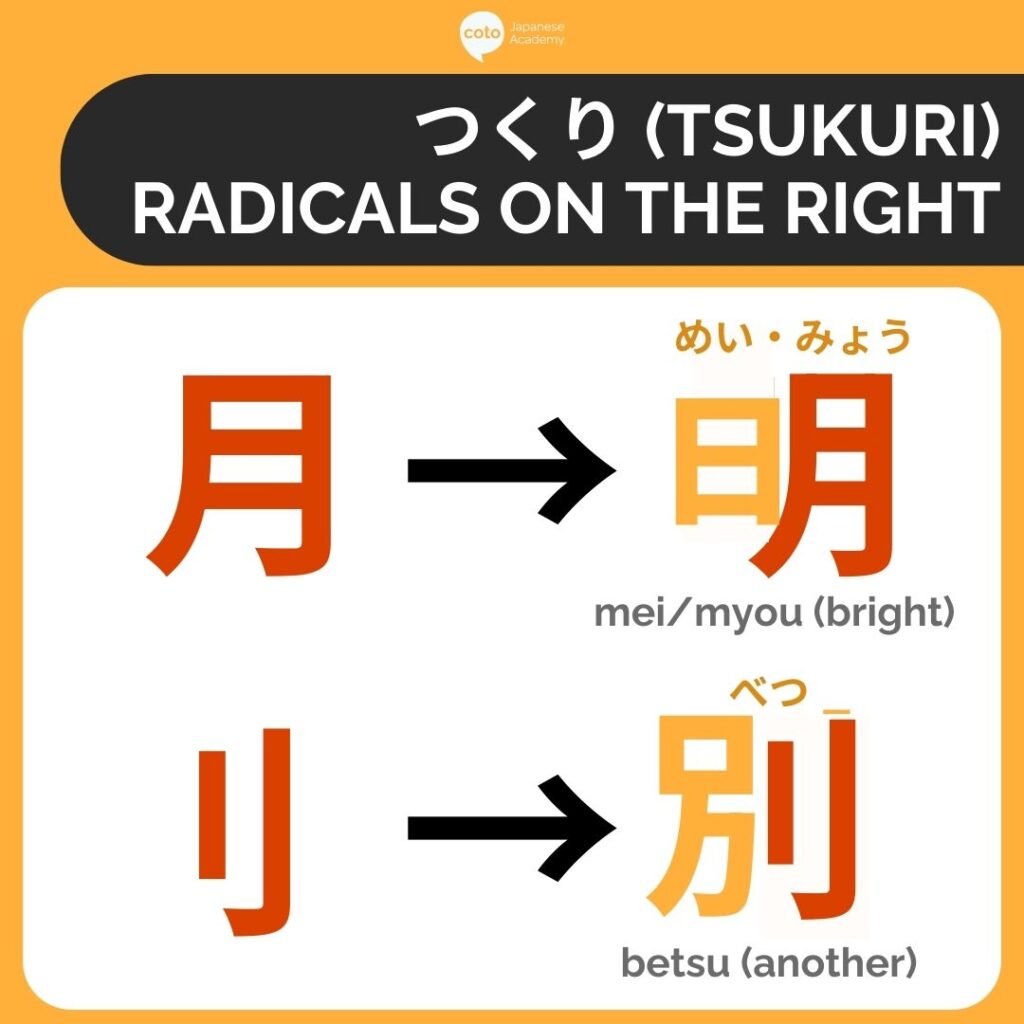
2. つくり: Right
つくり (tsukuri) are radicals positioned to the right. Similar to left radicals, つくり radicals are often altered. For example, 刀 (katana), or sword, becomes 刂 when written to the right of other elements.
Example 1:
刂(sword) in 別 (betsu): another
Example 2:
月(moon) in 明 (mei or myou): bright
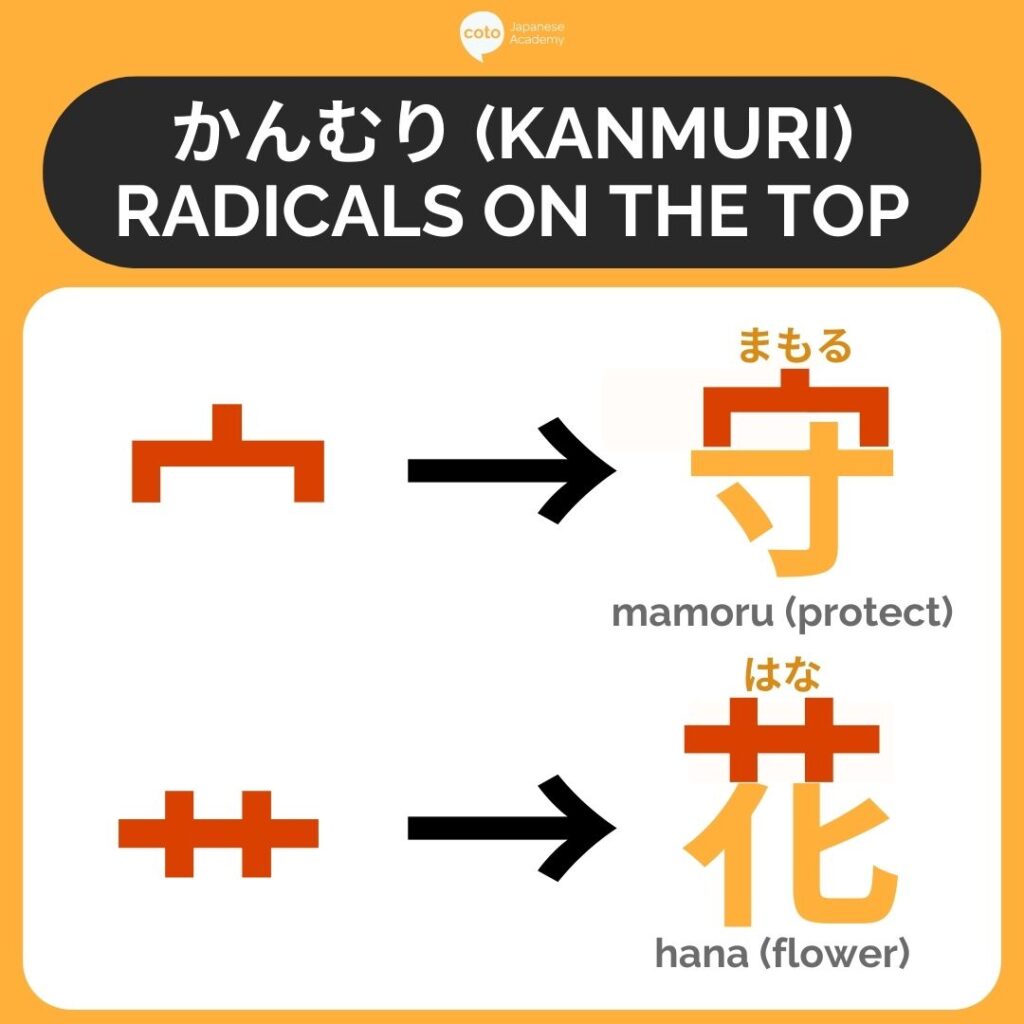
3. かんむり: Top
かんみり (kanmuri) are radicals positioned at the top.
Example 1:
宀 (roof) in 守る (mamoru): to protect
Example 2:
艹 (grass) in 花 (hana): flower
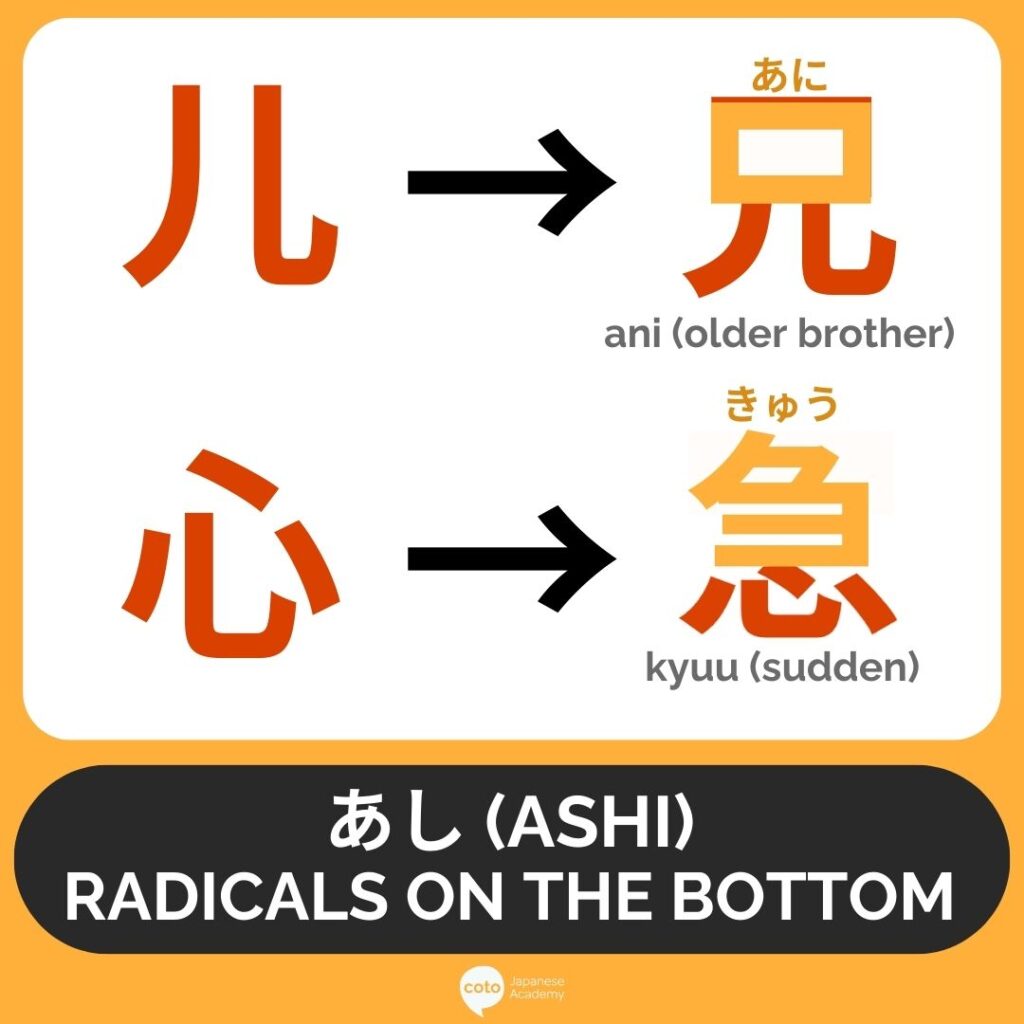
4. あし: Bottom
あし (ashi) are radicals positioned at the bottom.
Example 1:
儿 (legs) in 兄 (ani): older brother
Example 2:
心 (kokoro) in 急 (kyuu): sudden
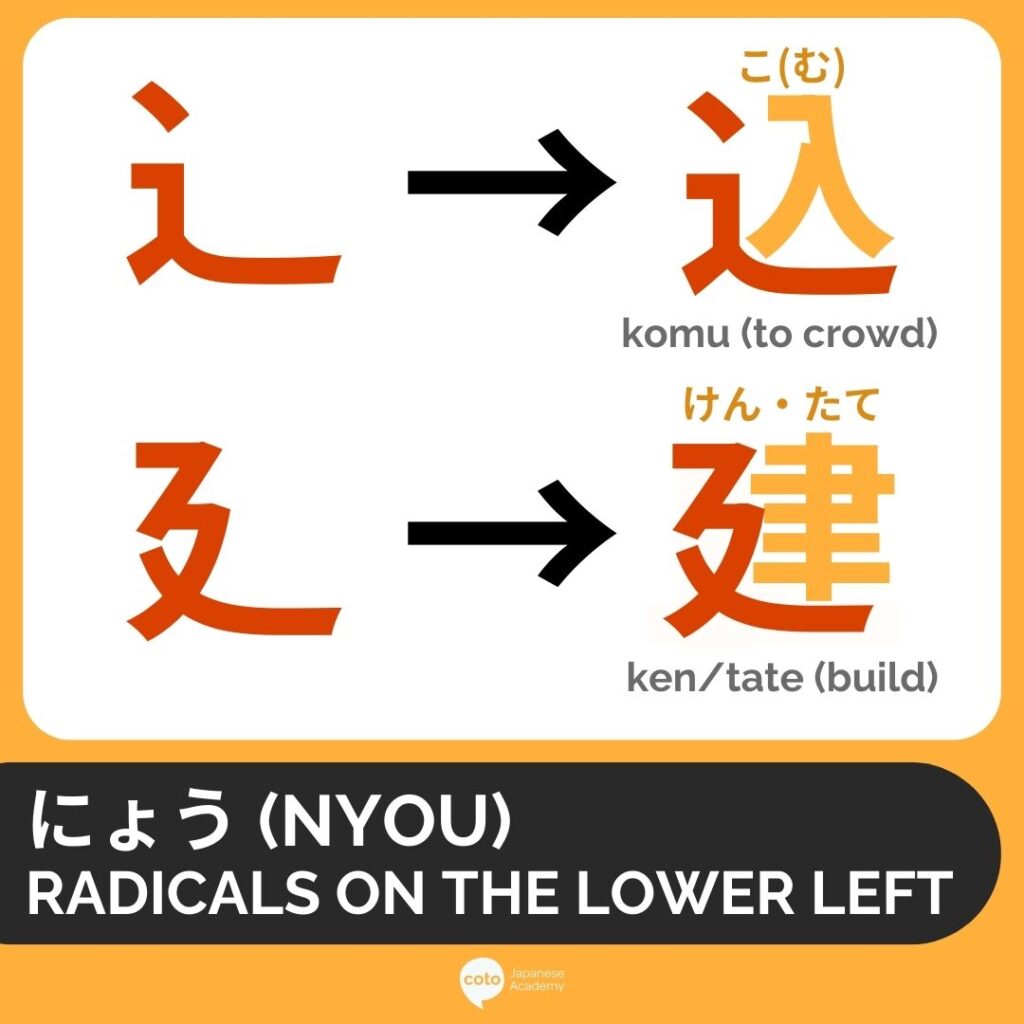
4. にょう: Lower Left
にょう (nyou) are radicals positioned at the bottom left.
Example 1:
⻌ (walk) in 込む (komu): to crowd
Example 2:
廴 (long stride) in 建 (ken or tate): build
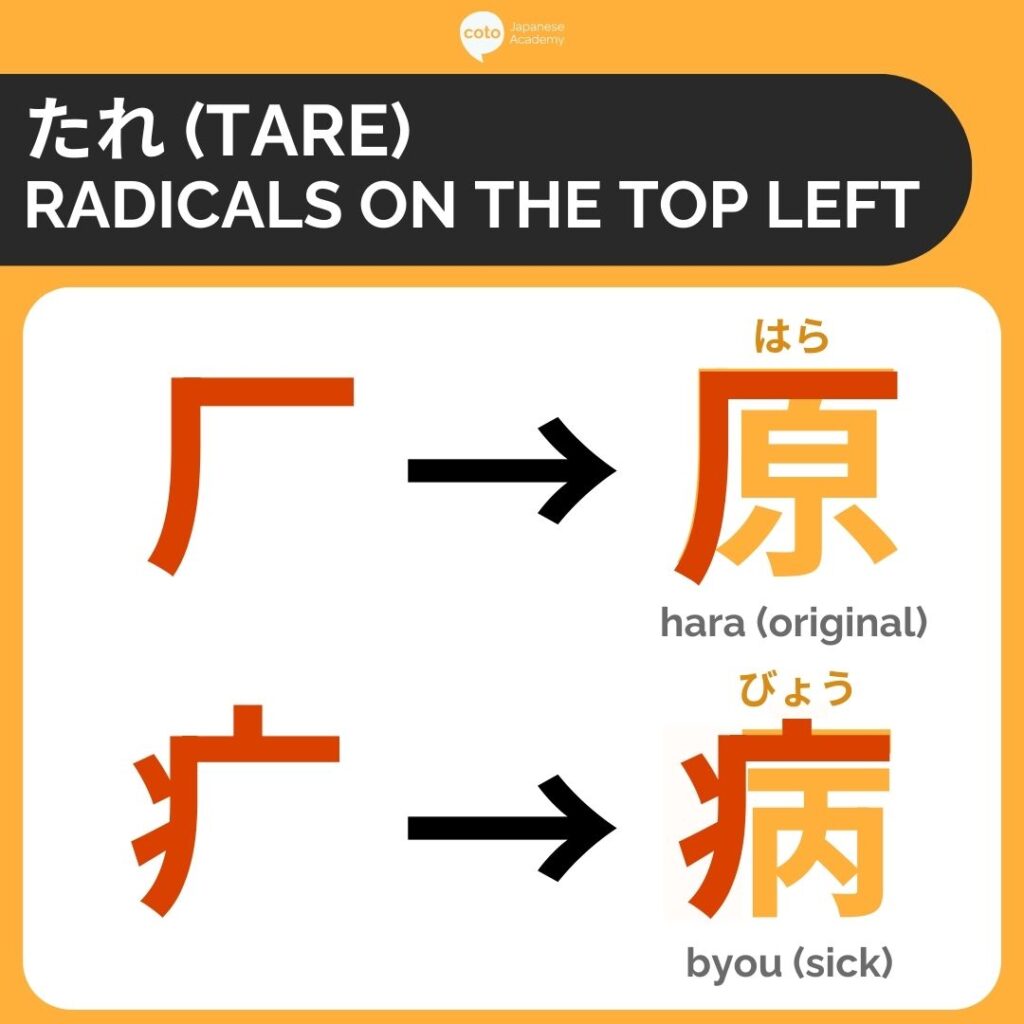
5. たれ: Upper Left
たれ (tare) are radicals located in the upper left.
Example 1:
厂 in 原 (hara): original
Example 2:
疒 in 病 (byou): sick
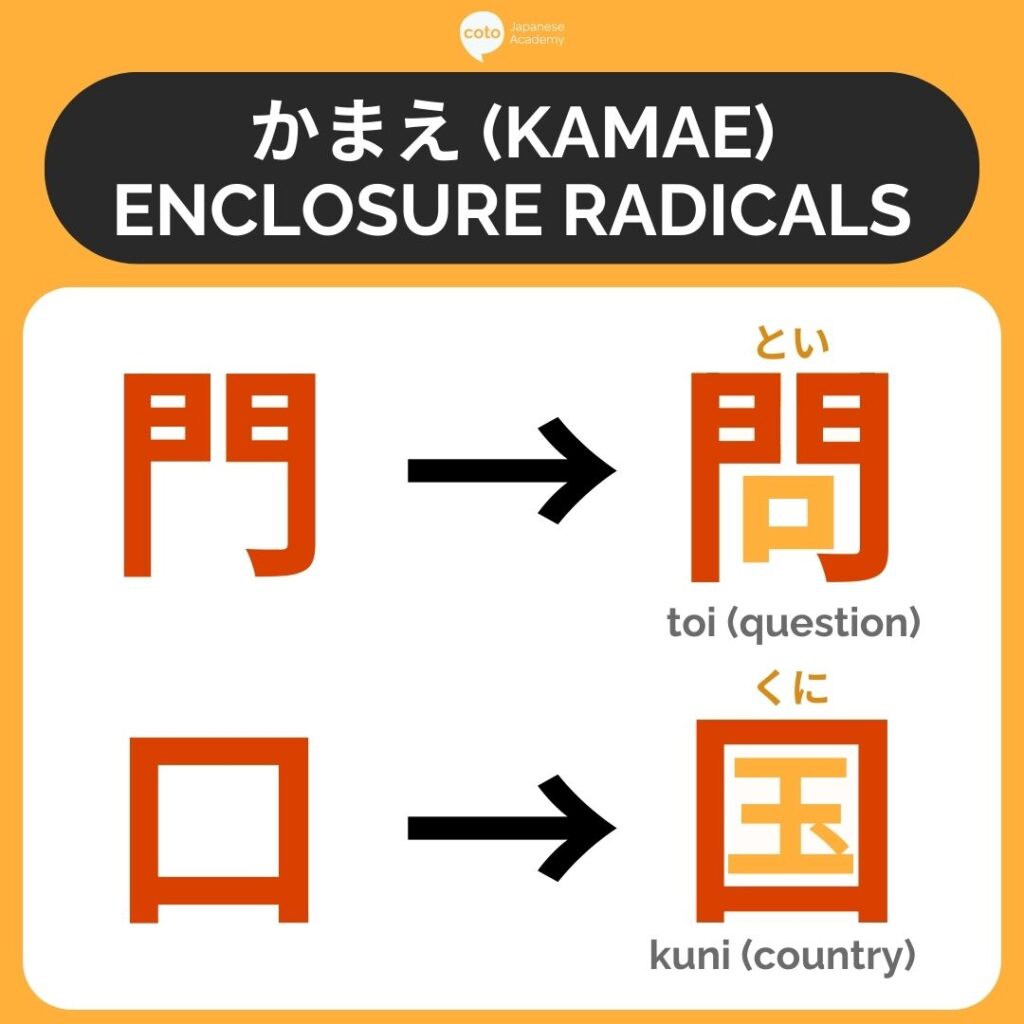
6. かまえ: Enclosure
かまえ are radicals that enclose other characters.
Example 1:
門 (gate) in 問 (toi): question
Example 2:
口 (mouth) in 国 (kuni) country
Understanding Radical Variants
As you may have noticed, many radicals transform based on their position in the kanji character. For example, 人 (hito) becomes 亻when placed to the left. This is so the kanji character can feel more balanced. Often, radicals are simplified so they can fit neatly into the kanji character.
It may be confusing at first, but don’t sweat! They are the same character, just with a simplified variation. Here is a table of some of the most common radical variations you will run into.
| Radical (Full Form) | Variant | Meaning | Common Position | Example |
|---|---|---|---|---|
| 水 | 氵 | water | left | 海, 洗 |
| 心 | 忄 | heart/emotion | left | 急, 性 |
| 心 | ⺗ | heart | bottom | 想 |
| 手 | 扌 | hand | left | 持, 打 |
| 言 | 訁 | speech | left | 話, 読 |
| 食 | 飠 | food | left | 飲, 館 |
| 金 | 釒 | metal | left | 鉄, 銀 |
| 糸 | 纟 | thread | left | 紙, 結 |
| 犬 | 犭 | animal | left | 独, 猫 |
| 示 | 礻 | altar/spirit | left | 社, 礼 |
| 衣 | 衤 | clothing | left | 被, 製 |
| 刀 | 刂 | sword | right | 別, 列 |
Strokes in Kanji vs Radicals
Kanji can get very complex, with many consisting of countless strokes. Strokes are counted by the number of times you have to lift your pen to complete writing a character. All Kanji follow a specific order of strokes, which generally go from left to right and top to bottom, and following the correct order will generally amount to a certain number of strokes. However, radicals are much simpler, consisting of fewer strokes. Which makes kanji a lot easier to remember.
For example, the kanji 忘れる (wasureru), or “to forget”, is 7 strokes, but it’s only 2 radicals: 亡 (na) or “gone” and 心 (kokoro) meaning “heart”. So, if you remember these radicals, the kanji will be much easier to remember:
亡 (na) + 心 (kokoro) = 忘 (bou/wasu)
亡 only has 3 strokes, and 心 has around 4, which makes these radicals much easier to remember than characters with 7 or even more strokes directly.
Ways to Remember Radicals & Kanji
While radicals don’t have the same stroke counts as full kanji characters, they can really add up, with some radicals having up to 12 strokes. This might make radicals, themselves, difficult to remember. But unlike kanji, where every unique “word” has its own character, radicals are commonly found in each kanji, almost like letters. While letters in English represent specific sounds, radicals are associated with different meanings or even pictographic images.
So, you can try to use the meanings or their associated images of radicals as mnemonic tricks to help you remember them!
1. Use The Meaning of Radicals to Remember Kanji
As we keep mentioning, radicals are the roots of kanji and so their meanings actually relate to the meaning of the kanji itself. Let’s take a look at a few examples to demonstrate what we mean.
Example 1:
水(mizu) also written as氵, meaning “water”, appears in:
- 海 (umi) meaning “the sea”
- 洗 (sen) meaning “wash”
Both of these kanji are related to water, therefore, the character 氵, is used.
Example 2:
心 (kokoro) also written as忄, meaning heart appears in:
- 急 (kyuu), which means “hurry”
- 感 (kan), or “feeling”
You can think of how your heart beats when you’re hurrying or how you feelings are felt in the heart.
Example 3:
手 (te) also written as 扌, meaning hand, appears in:
- 持つ (motsu) which means “to hold.”
Since you have to hold things with your hand, it’s obvious why 扌is present in this kanji.
Example 4:
金 (kin) also written as 釒, meaning “metal”, appears in:
- 鉄 (tetsu) which means “iron”
- 銀 (gin) which means “silver”
Both of these characters are words for elements involving metal.
2. Use Radicals to Create Simple Visual Stories
Most radicals, and by extension kanji, have their simplistic images, but many times it might be difficult to see how the current characters look anything like their associated meanings. So, it might help to create some stories based on the meanings and their symbols.
Example:
木 (ki) means tree, which looks like a trunk with branches, and 人 (hito) means person, so you can think of the kanji character, 休み (rest) as:
休 (rest) = person (亻) leaning on a tree (木)
3. Give Radicals Personality
Instead of thinking of radicals as abstract symbols, try treating them like characters to help you remember them.
Example 1:
女 (woman) + 子 (child) → 好 (woman + child), this character means “like,” so you can think of it as the “love” a woman has for her child.
Example 2:
立 (stand) + 木 (tree) + 見 (see) → 親 (parent). So, you can think of this character as concerned parents standing on top of a tree to watch their child.
4. Use Shape-Based Mnemonics (Not Just Meaning)
Some radicals are easier to remember by their shape rather than their meaning. This is especially true for kanji whose shapes have nothing to do with their meanings.
Example 1:
广 → looks somewhat like a roof hanging over something, think of a “building” such as in the kanji character 店 (mise) meaning store, which, of course, has a roof.
Example 2:
辶 → looks like someone walking, or just movement in general. This makes it easier to remember kanji characters like 込む (komu), meaning to crowd, or 逃げる (meaning to escape).
Whether or not the shapes and the actual meanings of the radical align does not matter. Just using any shape to help you remember them best is the goal!
The Most Common Radicals to Know
So, what are the most common radicals you should know? We provided a list of the most common radicals you will likely need to know for writing common kanji. We organized each table by the number of strokes of the radical.
Each table will show the different variants of each radical, their readings in furigana, romaji, position (left, right, top, bottom, bottom left, enclosure, or just single), and example kanjis the radicals are found.
After memorizing these common radicals, see how much easier it is to remember kanji by checking out our list of 100 Basic Kanji Every Beginner Should Know.
1 Stroke Radicals
| Radical | Variant | Furigana | Romaji | Meaning | Position | Example |
|---|---|---|---|---|---|---|
| 一 | — | いち | ichi | one | single | 一, 三, 本 |
| 丨 | — | ぼう | bou | line | single | 中 |
| 丶 | — | てん | ten | dot | single | 丸 |
| 丿 | — | の | no | slash | single | 久 |
| 乙 | — | おつ | otsu | second | various | 九 |
| 亅 | — | はねぼう | hanebou | hook | right | 了 |
2 Stroke Radicals
| Radical | Variant | Furigana | Romaji | Meaning | Position | Example |
|---|---|---|---|---|---|---|
| 人 | 亻 | ひと | hito | person | left | 体, 休 |
| 儿 | — | にんにょう | ninnyou | legs | bottom | 兄 |
| 冂 | — | どうがまえ | dougamae | open box | enclosure | 同 |
| 冖 | — | わかんむり | wakammuri | cover | top | 冠 |
| 刀 | 刂 | かたな | katana | sword | right | 列 |
| 力 | — | ちから | chikara | power | right | 動 |
| 匕 | — | さじ | saji | spoon | right | 化 |
| 十 | — | じゅう | juu | ten | top | 千 |
| 卩 | ⺋ | ふしづくり | fushizukuri | seal | right | 却 |
3 Stroke Radicals
| Radical | Variant | Reading | Romaji | Meaning | Position | Example |
|---|---|---|---|---|---|---|
| 土 | — | つち | tsuchi | earth | left | 地 |
| 女 | — | おんな | onna | woman | left | 好 |
| 子 | — | こ | ko | child | left | 字 |
| 宀 | — | うかんむり | ukanmuri | roof | top | 家 |
| 山 | — | やま | yama | mountain | left | 島 |
| 彳 | — | ぎょうにんべん | gyouninben | step | left | 後 |
| 艹 | ー | くさかんむり | kusakanmuri | grass | top | 花 |
| ⻌ | 辶 | しんにょう | shinnyou | walk | bottom-left | 道 |
| 廴 | — | えんにょう | ennyou | long stride | bottom-left | 延 |
4 Stroke Radicals
| Radical | Variant | Reading | Romaji | Meaning | Position | Example |
|---|---|---|---|---|---|---|
| 心 | 忄 | こころ | kokoro | heart | left/bottom | 思, 急 |
| 手 | 扌 | て | te | hand | left | 持 |
| 水 | 氵 | みず | mizu | water | left | 海, 洗 |
| 火 | 灬 | ひ | hi | fire | bottom | 熱, 然 |
| 木 | — | き | ki | tree | single | 林, 校 |
| 日 | — | ひ | hi | sun | single | 明, 時 |
| 月 | — | つき | tsuki | moon | left | 服, 期 |
| 王 | — | おう | ou | king | left | 現, 球 |
| 犬 | 犭 | いぬ | inu | dog | left | 独 |
5-6 Stroke Radicals
| Radical | Variant | Reading | Romaji | Meaning | Strokes | Position | Example |
|---|---|---|---|---|---|---|---|
| 目 | — | め | me | eye | 5 | left | 見 |
| 石 | — | いし | ishi | stone | 5 | left | 破 |
| 示 | 礻 | しめす | shimesu | altar | 5 | left | 社 |
| 禾 | — | のぎ | nogi | grain | 5 | left | 秋 |
| 皮 | ー | けがわ | kegawa | skin | 5 | right | 披, 彼 |
| 糸 | 纟 | いと | ito | thread | 6 | left | 紙 |
| 耳 | — | みみ | mimi | ear | 6 | left | 聞 |
| 肉 | ⺼ | にく | niku | flesh | 6 | left | 背 |
| 虫 | — | むし | mushi | insect | 6 | left | 蛇 |
| 衣 | 衤 | ころも | koromo | clothing | 6 | left | 被 |
7-8 Strokes Radicals
| Radical | Variant | Reading | Romaji | Meaning | Strokes | Position | Example |
|---|---|---|---|---|---|---|---|
| 言 | 訁 | こと | koto | speech | 7 | left | 話 |
| 貝 | — | かい | kai | shell/money | 7 | left | 買 |
| 足 | — | あし | ashi | foot | 7 | bottom | 路 |
| 車 | — | くるま | kuruma | vehicle | 7 | single | 転 |
| 酉 | — | とり | tori | wine | 7 | left | 酒 |
| 金 | 釒 | かね | kane | metal | 8 | left | 鉄 |
| 雨 | — | あめ | ame | rain | 8 | top | 電 |
| 青 | — | あお | ao | blue | 8 | single | 情 |
| 門 | — | もん | mon | gate | 8 | enclosure | 開 |
9-12 Stroke Radicals
| Radical | Variant | Reading | Romaji | Meaning | Strokes | Position | Example |
|---|---|---|---|---|---|---|---|
| 食 | 飠 | しょく | shoku | food | 9 | left | 飲 |
| 首 | — | くび | kubi | neck | 9 | top | 道 |
| 馬 | — | うま | uma | horse | 10 | single | 駅 |
| 高 | — | たかい | takai | tall | 10 | top | 高 |
| 魚 | — | さかな | sakana | fish | 11 | single | 鮮 |
| 鳥 | — | とり | tori | bird | 11 | single | 鳴 |
| 黒 | — | くろ | kuro | black | 11 | single | 墨 |
| 啇 | — | てき | teki | divide | 11 | top | 商 |
| 無 | — | む | mu | nothing | 12 | bottom/full | 無, 舞 |
| 黄 | — | き | ki | yellow | 12 | single | 横 |
Conclusion: Radicals Make it Easier to Remember Kanji
Kanji can feel endless and overwhelming, but radicals break them down into smaller parts that are easier to remember and are used in kanji repeatedly. While there still seems to be a lot to remember, they are still much fewer than kanji, but even radicals are made up of other radicals! As you start to remember them, you will start pick up on common patterns, how the same radicals are used in different characters.
If you really want to learn kanji with more structure to reach your goals, we highly recommend taking Japanese classes with trained instructors who can tailor to your needs at Coto Academy. We offer practical Japanese courses that teach how to read and write kanji as well as practical language in daily conversation.
We have a new campus opening in Shinjuku, in addition to our current campuses located in Shibuya, Iidabashi, Minato, and Yokohama! And if you’re not nearby, you can take classes online! We offer a variety of courses that can adapt to your schedule and level. So, what are you waiting for? Sign up below!
FAQ
What are kanji radicals?
Kanji radicals (部首・ぶしゅ・bushu) are the building blocks of kanji. A radical is a component inside a kanji that is traditionally used to classify the character in dictionaries. Radicals often give clues about meaning and sometimes hint at category (like water, hand, speech, etc.).
How many kanji radicals are there?
Traditionally, there are 214 classical radicals, based on the Kangxi dictionary system from China. However, not all 214 radicals are commonly used today, with most people typically encountering 100 or fewer regularly. So, while 214 is the official traditional number, you don’t need to memorize all of them to read Japanese.
Do radicals have meaning?
Yes, most radicals have meanings associated with them, especially since many of them stand as kanji on their own. For example, 木 (ki) means tree or even 氵(mizu) means water and is used with water-related kanji characters. However, not every radical clearly reflects modern meaning. Some serve more structural or historical roles.
How many radicals can a single kanji have?
Traditionally, each kanji is assigned one official radical for dictionary classification. However, a kanji visually contains multiple components that operate as radicals. For example: 語 contains 言 (speech) and 五 (five). From a learning perspective, it’s helpful to think of kanji as being made up of multiple meaningful parts, even if only one is technically the radical by dictionary standards.
Should I learn radicals before starting to learn kanji?
Learning radicals before kanji can definitely help, but we recommend learning them side by side. By learning radicals alongside your kanji studies, you will start to pick up on more characters more effortlessly. New kanji will feel less different since you will be accustomed to some of the radicals that make them up. Also, remember, many radicals are also kanji themselves.
You might be interested in reading: