






In Japanese, just like any other language, saying “you” or addressing someone properly is one of the most important basics. However, there are multiple ways to address others, with many words that mean “you” in Japanese, and the trickiest part is using the right word in the right context while being polite and respectful.
While most of these words refer to one word, “you” in English, the wrong word can be considered rude or offensive in Japanese. That’s why it is important to understand what context is appropriate for addressing someone correctly. For example, you probably want to avoid calling your boss something like “darling” in Japanese.
But worry not! It’s not as overwhelming as it seems, so let’s find out how you can respectfully address others in Japanese!
Polite Ways to Say “You” in Japanese
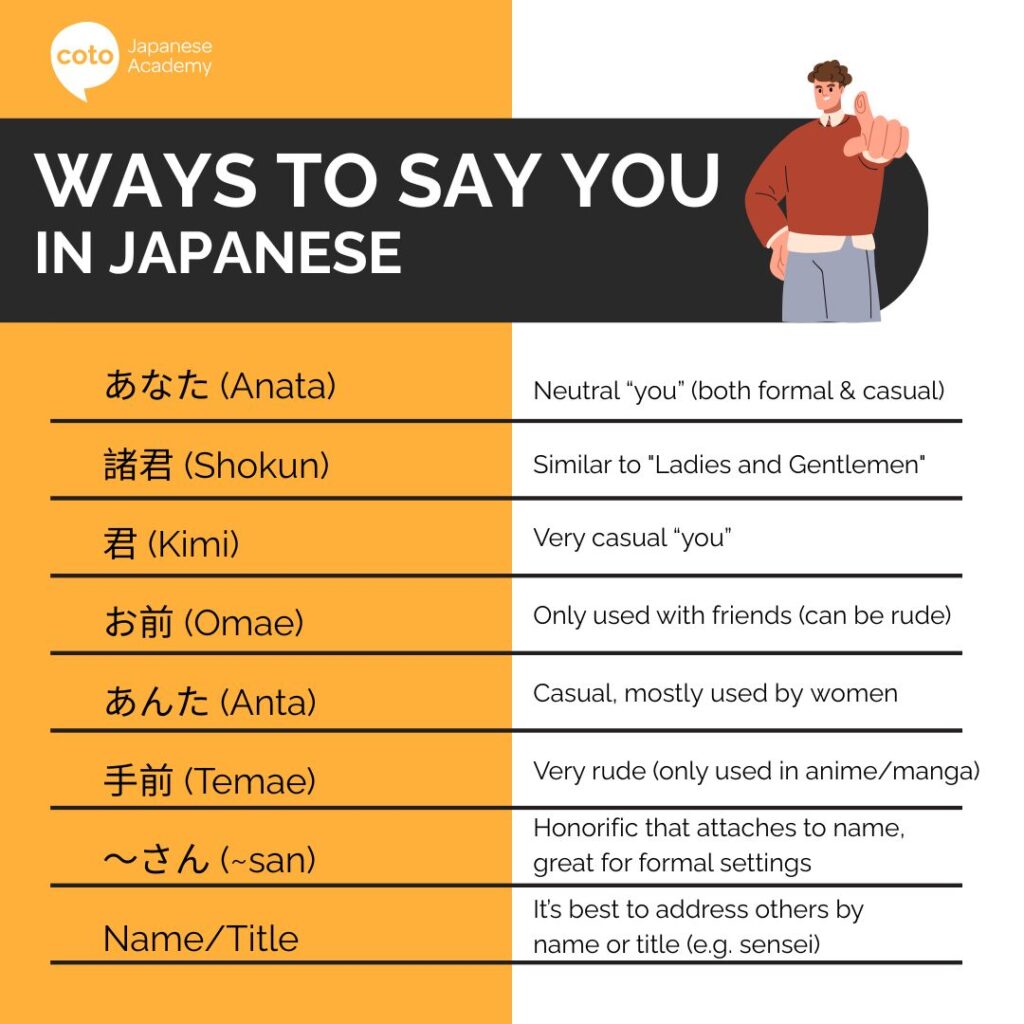
1. 貴方 (あなた) Anata
Found in textbooks, あなた (anata) is the most basic word for ‘you.’ It is usually used by strangers who do not know the name or anything else about the person they are addressing. It can also mean “darling” when used by wives to address their husbands. Because of that, it is inappropriate to call someone you know あなた, such as your boss.
Directly referring to people as あなた can also come across as direct and rude. Japanese culture tends to value indirectness since it’s seen as less direct and more respectful. This might be why passive voice is more common in Japanese compared to English. So, the most respectful way to refer to someone is to drop the “you” altogether, but we will discuss how you can do that in a bit.
Note that the kanji, 貴方, is rarely used; usually it is written in hiragana as あなた.
2. 諸君 (しょくん) Shokun
諸君 literally translates to “you people,” which sounds a bit rude in English, so it more closely conveys something like “ladies and gentlemen.” It is a very polite way of addressing a group of people.
Casual Ways to Say “You” in Japanese
3. 君 (きみ) Kimi
Occasionally used to address others, 君 can be considered condescending if used in inappropriate situations. 君 is meant to be used by people of a higher status than those below them, such as adults to children and teachers to students. It can also be used to represent intimacy romantically, such as in 君の名は (Kimi no Na wa) Your Name, a romance anime. Thus, it is also a word used by couples.
4. お前 (おまえ) Omae
Commonly used between friends in informal situations, it is rude to address someone outside of your social circle お前. Being a masculine word, it is also used romantically by husbands to address their wives.
5. あんた Anta
A shortened form of 貴方, it is also considered less formal. Previously used to address people of a higher status, it is considered disrespectful today. Mostly used by women and people in a close social circle in informal conversations.
Rude Ways to Say “You” in Japanese (Should Avoid Saying)
6. 手前 (てまえ) Temae
This is a very rude word that is hardly used by anyone in real life, though it can be commonly found in Japanese media like manga and anime. You often see fictional characters use it to address others when they are angry or even want to insult them. You would rarely hear it being used in actual Japanese conversation, even in a heated argument.
If you do happen to use it, people might find it kind of funny or just out of place and think you watch too many cartoons. Overall, we wouldn’t recommend using this term at all.
7. 己 Onore
Similar to 手前, it is mostly seen only in Japanese media used to curse at others. However, depending on context, onore can also mean ‘oneself’ or ‘myself’.
8. 貴様 (きさま) Kisama
Even though it used to be a respectful term, it is now considered very rude to address someone as 貴様 and is mostly only used in Japanese media; you might recognize it from popular Japanese video game characters like Kazuya or Heihachi. It is an extremely derogatory word, often used by powerful villains or kings who think themselves above others.
Dialects
Different regions in Japan have their own dialects, and some words can have different meanings depending on where they are spoken. Here are some examples.
- あんた Anta: In Kinki (Western Japan), it is a friendly and endearing word, but in Kanto (Eastern Japan), it is considered rude and insulting
- わい Wai: Depending on the region, it can mean either ‘I’ or ‘You.’
- 自分 (じぶん) Jibun: Kansai dialect that means ‘You’ depending on the context. Originally, it means ‘I’.
- きさん Ki san: Kyushu dialect that is a variation of 貴様 (きさま) but is considered less rude and not used against enemies
Most Common Ways to Say “You” in Japanese
In Japan, more often than not, people address each other through context where they completely omit pronouns such as “you”. It might be weird when translated into another language like English, but this is how Japanese is naturally spoken.
When people address each other, they do so using the other person’s name, title, or position. Many Japanese people use this in formal and informal conversations, depending on the context. Honorifics are added behind their names as a form of politeness and respect.
Besides “you”, there are other ways to say “I” or “myself” in Japanese, including ore, boku and watashi. Read our blog to find more: How to Refer to Yourself in Japanese
When in Doubt, Alternative Ways of Saying “You” in Japanese
Luckily, most Japanese people don’t use “you” as it’s often unnecessary, and it might be better not to since it can be seen as rather rude. So, when in doubt, just don’t say “you” at all.
Instead, here are a few easier ways to avoid unnecessary glares and question marks.
Use their honorifics
9. さん (San)
さん is an honorific title which translates to “Mr”, “Mrs”, “Miss”, and “Ms ” in English. It is a polite way to address someone and the most common since it is neutral and widely applicable to just about any situation.
10. ちゃん (Chan)
ちゃん (chan) is used by people familiar with one another. It communicates a sense of cuteness and is usually used to refer to young women, close friends, children, lovers, or pets. It’s generally used to express endearment to someone.
11. くん (Kun)
A male honorific is generally used to refer to men and by superiors addressing those below them. It is not a very polite honorific and is only used between men and women who are close.
Want to learn more about Japanese honorifics? Also, check out our more complete guide on Japanese honorific titles!
12. さま (Sama)
さま is the most formal honorific and is a higher version of さん. It is only used in specific situations, such as addressing Japanese deities or customers. It is a form of Japanese Keigo that is commonly used in the Japanese workplace.
Formal Japanese can be confusing and complex; so check out our guide to learn everything you need to know: Japanese Keigo ( Formal Japanese).
Addressing Someone with their First Name, Last Name, or Title
13. Last name
Using the last name alone is usually done in a casual and friendly context, such as between classmates. It is considered impolite to call someone by their last name alone; thus, honorifics are added. For instance, with your manager, it is better to use their last name along with the suffix, 〜さん (~san).
14. First name
First-name basis is considered a big deal to Japanese people. The rule of thumb is this: never address them by their first name unless they allow it. People usually use first names when they are family members, friends, or romantic partners. Among colleagues of the same level, usually a suffix is used, even if it’s 〜ちゃん (~chan), since using a first name alone can feel a bit cold.
15. Title
It is also common to address others by their titles, especially when you need to express respect to someone of higher status.
- 先生 (せんせい). Sensei isn’t just for teachers. Rather, view it as a title. Whenever you’re talking or addressing doctors, lawyers, authors, artists, or politicians, always add “sensei” after their last name.
- 先輩 (せんぱい). Use senpai to talk to your seniors, be it at school or the workplace.
- 社長 (しゃちょう) Shacho, which translates to president.
Conclusion: Addressing Others in Japanese Usually Doesn’t Involve “You”
In Japanese, it is often best to avoid saying “you” at all. It’s common in Japanese to omit certain words, especially subject terms like “you.” It may feel unnatural at first, but Japanese people will easily understand who you are referring to based on context. But in cases when referring to the listener is completely unavoidable, you can refer to their name with a suffix (san, sama, etc.) or title, especially when you want to show respect to the person you’re talking to!
Learning Japanese? Make It Easy with Coto Academy
Want to learn how to refer to others naturally like a native? Join Coto Academy to learn Japanese you won’t get from the textbook! Our courses immerse you in actual Japanese conversation that you would use in real life. We aim to have you develop an intuition for how natural language sounds and reads rather than just memorizing endless words and phrases.
Coto Academy is one of Japan’s leading language schools, with campuses in Shibuya, Yokohama, Iidabashi, Minato, and a fully online school. We offer flexible Japanese lessons, whether you’re looking for intensive, part-time, or online courses, so you can reach your language goals faster.
FAQ:
Is it rude to say "you" in Japanese such as "anata"?
Using words for “you” like anata can come across as direct and slightly rude in Japanese. The Japanese language tends to value indirect communication, so it’s better to avoid using “you” in Japanese. You can either drop the pronoun or just use the person’s name or title.
Does Kimi and Anata mean "you" in Japanese?
Yes, both kimi and anata both mean “you” in Japanese. Anata is seen as more neutral, whereas kimi is usually used by adults to address someone younger, like children. Kimi can also be used between couples.
What words should you avoid using for "you"?
You should generally avoid using the word お前 (omae), which is considered pretty rude but can be used playfully with friends you are close to. The terms 手前 (temae) and 貴様 (kisama) should never be used, since they are seen as extremely rude and rather cartoony or even embarrassing. They are rarely used in actual Japanese conversation despite how common they seem to be in anime and manga.