





Out of all Japanese particles that exist, the particle を (pronounced “o”) might be one of the most straightforward. The を particle is used to make a word the direct object of the sentence or the thing that is acted upon by the verb. There is no direct equivalent in English since the language doesn’t use particles to indicate the object or subject of the sentence.
So let’s explore how the を (o) particle works, its structure, and example sentences.
What is The Particle を (O)?
を is a Japanese particle that designates the direct object, the word that is affected by the verb. For instance, let’s look at a simple sentence:
魚を食べる
sakana o taberu
I eat fish
The particle を makes 魚 (sakana), or fish, the direct object, meaning it’s the object being acted upon. In this case, it tells us that the fish is the subject. You can think of を as a grammatical tool that turns words into the things that verbs affect in the sentence.
Is を Pronounced as “Wo” or “O”?
を is pronounced as o, as in “ohio.” But you might be wondering why you often see を being written as “wo” in English. This is because to input を on a keyboard using the Roman alphabet, you have to type “wo”. If you have typed in Japanese on a Roman alphabet keyboard, you probably know that some characters need to be typed differently from how they are actually pronounced.
Pronunciation:
を → o
Inputting on a Roman character keyboard:
wo → を
Generally, even in modern Japanese speeches, Japanese speakers prefer to spell it out as “o”. The “wo” pronunciation can sometimes be heard in songs, but it is often used to add emphasis, much like in Japanese, where singers sometimes exaggerate the “R” vowels into “L”.
Structure of The Particle を (O)
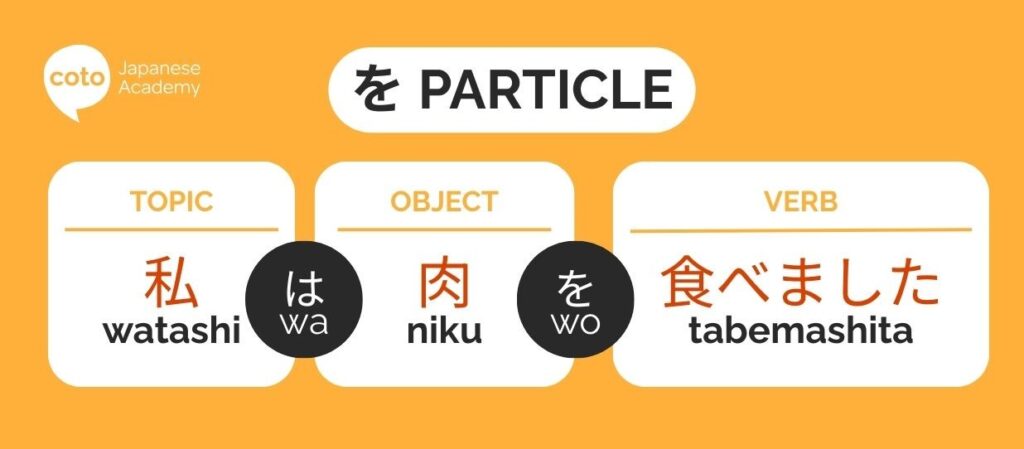
を is the only Japanese hiragana character that can only be used as a particle. In most cases, を attaches nouns in a sentence to designate them as the direct object. Take a look at the breakdown below:
| Type | Structure |
| Noun | Noun + を |
Usually, verbs come after を, following this typical sentence pattern:
Noun + を + verb
Example:
テレビを見る。
Terebi o miru。
I watch TV.
Changing Word Order with を
You are probably used to Japanese grammar, a typical order that generally goes as follows: subject → object → verb. However, it’s actually common to change the word order to create emphasis while still conveying the same meaning.
For example:
私がハンバーガーを食べた
Watashi ga hanbaagaa o tabeta
I ate a hamburger
While this is a typical sentence structure in Japanese, grammar in Japanese is quite flexible and can be reordered like the following:
ハンバーガーを私が食べた
Hanbaagaa o watashi ga taberu
The hamburger, I ate it.
Despite the rearrangement of the words, “I ate a hamburger” is still clearly expressed. But, of course, the choice to rearrange the words might work to emphasize the subject or the object in certain contexts.
Using を (O) at the End of the Sentence
It’s also common to use を at the end of a sentence as well, without saying a verb. Often, the verb is dropped since the meaning of the sentence is obvious based on the context. Let’s take a look at a couple of examples to understand how it works.
Example 1:
何を?
Nani o?
Of what?
This is a common question to ask when someone doesn’t specify. For instance, if someone says,昨日面白い映画を見た (omoshiroi eiga o mita) or “I watched an interesting movie yesterday,” you could respond with, 何を (nani o).
Example 2:
良いお年を
Yoi otoshi o
To a good new year!
This is a common Japanese New Year expression that roughly translates to “to a good new year.” The full expression includes the verb お迎えください (omukae kudasai).
Want to study Japanese with us?
Using を With Transitive vs Intransitive Verbs
One of the most common hurdles for new Japanese learners is deciding when to reach for the particle を (o) and when to let it go. The secret lies in the relationship between the subject and the action. To master this, we have to look at the world through the lens of transitive versus intransitive verbs.
Keep in mind that を can only be used with a transitive verb. Think of a transitive verb (他動詞; tadoushi) as an “active” force. These verbs require a direct object because someone or something is performing an action upon something else.
Take the verb 開ける (akeru), meaning “to open.” When you physically reach out and move a door, you are performing a transitive action. In Japanese, you would say:
Transitive Verb:
ドアを開ける
Doa o akeru
Open the door
On the flip side, we have intransitive verbs (自動詞; jidoushi). These verbs describe a state of being or a change that occurs naturally, without focusing on who started it. When using these, the direct object effectively disappears and becomes the subject of the sentence.
However, when it comes to intransitive verbs where there is no specified direct object, を is omitted. This is because を can only be used with verbs. For instance, if you walk into a room and notice a door is already in the process of opening, you use the intransitive counterpart 開く (aku). Instead of using を, you switch to the subject particle が, resulting in:
Intransitive Verbs:
ドアが開く
Doa ga aku
The door opened
In this sentence, が is used instead of を, marking how ドア or “the door” became the subject when an intransitive verb is used.
This is not to be confused with passive voice, where direct objects are still used with verbs like “eaten” or 食べられる (taberareru). Rather, intransitive verbs turn direct objects into subjects, which is why the Japanese particle changes. Let’s take a look at an example.
を vs Other Particles
Often, it feels like different particles can be used in similar situations, causing tons of confusion around deciding the correct particle to use. So, let’s explore how を is used compared to a couple of other particles.
1. を vs から (Kara)
を and から (kara) surprisingly have some overlap, specifically when discussing leaving a place. Say, you want to describe leaving your house. Which one should you use? Well, it actually depends on whether you are exiting or starting from your house.
Using を
When using を, the focus will be from the perspective of leaving your house.
家を出る。
Ie o deru.
I leave the house.
Using から
When using から, the focus will be from the perspective of coming from your house.
家から出る。
Ie kara deru.
I come from my house.
2. を vs で (De)
を and で can also have some confusing overlap since sometimes you can use these particles to describe walking in a park, for example. But both of these particles express different situations.
Using を
When using を, you are describing the action of walking through a route rather than being at a location.
公園を歩く。
Kouen o aruku.
Walk through a park.
Using で
When using で, you are describing the location where an action is happening.
公園で歩く。
Kouen de aruku.
Walk in the park.
3. を vs は (Wa)
In a certain context, the particle は can replace を, but with a catch: when は (wa) replaces を (o), the meaning of your sentence shifts from a simple statement of fact to one of emphasis or contrast. In Japanese grammar, this is called topicalization. You are taking the “object” and promoting it to the “topic.”
Basically, you use を when you want to tell someone what you are doing as it is. You can replace it with は when you want to single out an object to compare it to something else or to emphasize that this is the specific thing you are talking about.
Why? When you switch to は, you are signaling to the listener: “Regarding this specific thing (as opposed to other things), here is the deal.”
肉を食べます。
Niku o taberu
I eat meat.
When you replace the particle を with the same sentence, you add a new layer of context behind it.
肉は食べます。
Niku wa taberu
I eat meat (Speaking of meat, I eat it).
We also swap to は when an object has already been brought up in conversation. If the object is what everyone is already looking at, it is no longer just an “object”. It is the topic
For instance, when your colleague is asking you about a report, they might ask:
レポートはどうですか?
Repooto wa dou desu ka?
How is the report?
In this case, when you want to answer, using を would feel slightly disconnected, like you’re introducing the report for the first time. Using は acknowledges that “the report” is the star of the current conversation.
レポートは書きました。
Repooto wa kakimashita.
As for the report, I wrote it.
Examples Sentences with を
Let’s take a look at some example sentences using を in different situations to really understand how this grammar tool works in actual spoken Japanese. Before that, check out the full vocabulary that appears in today’s examples at the table below.
| Kanji / Writing | Furigana | Romaji | English |
|---|---|---|---|
| 毎日 | まいにち | mainichi | every day |
| 日本 | にほん | nihon | Japan |
| 雑誌 | ざっし | zasshi | magazine |
| 読む | よむ | yomu | to read |
| 大学 | だいがく | daigaku | university |
| 経済 | けいざい | keizai | economics |
| 勉強する | べんきょうする | benkyō suru | to study |
| 公園 | こうえん | kōen | park |
| 歩く | あるく | aruku | to walk |
| 階段 | かいだん | kaidan | stairs |
| 上る | のぼる | noboru | to go up; climb |
| 橋 | はし | hashi | bridge |
| 上 | うえ | ue | above; on top |
| たいてい | — | taitei | usually |
| 朝 | あさ | asa | morning |
| 家 | いえ | ie | house; home |
| 出る | でる | deru | to leave |
1. Direct Object (Most Common Use)
This is the most common and important use of を. It clearly expresses what you eat, read, watch, make, and much more.
Example:
毎日、日本の雑誌を読む。
Mainichi, nihon no zasshi o yomu.
I read Japanese magazines every day.
2. With する (Suru) Verbs
When you use nouns with the verb する (suru), meaning “to do,” they become verbs. So, を marks what you’re doing.
勉強をする
Benkyou o suru
to study
However, in casual speech, を is often dropped to make the expression shorter, essentially transforming it into a single verb: 勉強をする (drop を) → 勉強する. This allows you to add other objects without making the sentence feel convoluted.
Example:
大学で経済を勉強している。
Daigaku de keizai o benkyou shite iru.
I am studying economics at university.
4. Using を for Movement Through Space
を can also mark the place an action moves through, not just an object. You may think the particle で plays a similar role; however, で expresses destination. When using を, you express movement along a route or path, rather than the destination.
This includes not only places like parks or roads, but also directional paths such as up, down, across, and along. Let’s take a look at some examples to get a better idea.
Example 1:
新宿の公園を歩く。
Koen o aruku.
I walk through the park in Shinjuku.
Example 2:
階段を上る。
Kaidan o noboru.
I go up the stairs.
Example 3:
橋の上を歩く。
Hashi no ue o aruku.
I walk across the bridge.
5. Using を with Leaving a Place
を is also used to describe leaving a place by pairing it with verbs like 出る (deru), which means “to leave.” You might be thinking that this is very similar to how the particle から (kara) is used. You’re completely right; however, there are some differences in nuance.
You can think of using を to simply describe leaving a place. But when using から (kara), you are describing leaving or coming from a place.
Example:
たいてい、朝の9時から家を出る。
Taitei, asa no ku ji kara ie o deru.
I usually leave the house at 9 in the morning.
Conclusion
を (o) is an essential particle that is used to designate the word that is being affected by the verb in the sentence. It’s one of the building blocks of Japanese and is useful for letting the listener know, for instance, that you are eating the apple, りんごを食べる (ringo o taberu / I eat the apple), and not the other way around, りんごは食べる (ringo wa taberu / the apple eats)!
Learn Japanese with Coto Academy!
To really get a better idea of how to use を correctly in Japanese conversation, you should practice as much as possible. So, we highly recommend taking Japanese classes with us at Coto Academy, where we teach practical Japanese from practical everyday phrases to how to read and write Japanese you will see in everyday life.
We will soon be opening a campus in Shinjuku and already have campuses in Shibuya, Minato, Iidabashi, and Yokohama. But, if you’re not in Japan, no worries! We also offer online classes! No matter where or how you decide to learn with us, we offer both intensive and flexible courses, which can be tailored to your Japanese level or your specific language goals. Sign up below to get started!
FAQ
What does the particle を mean in Japanese?
The particle を marks the direct object of a verb, or the word that is being affected by the verb. For example, 本を読む (hon o yomu), or read a book. を makes the word 本 (hon), or book, the direct object that is being “read” by the subject.
Is を always used for objects?
While its primary use is for designating objects, を can also be used for movement, which may not necessarily be an object. For instance, when describing a path or space you move through, you can say 公園を歩く(koen o aruku) or “to walk through the park.”
Can I drop を in casual speech?
It is quite common to drop を in casual conversation, for example, rather than saying ご飯を食べる (gohan o taberu), or I eat food, you can instead say ご飯食べる (gohan taberu).
Do all verbs use を?
No, not all verbs use を; some verbs use other particles like が, に, or で instead, based on the situation. For example, 日本語が分かる (nihongo ga wakaru), which means “to understand Japanese,” uses が, rather than を.
Want to learn more about Japanese particles? Read our guide on:
- Guide to Japanese Particle の (No): Functions, Use, Examples
- Beginner’s Guide to Japanese Particles
- Why Do We Pronounce Ha as Wa in Japanese?