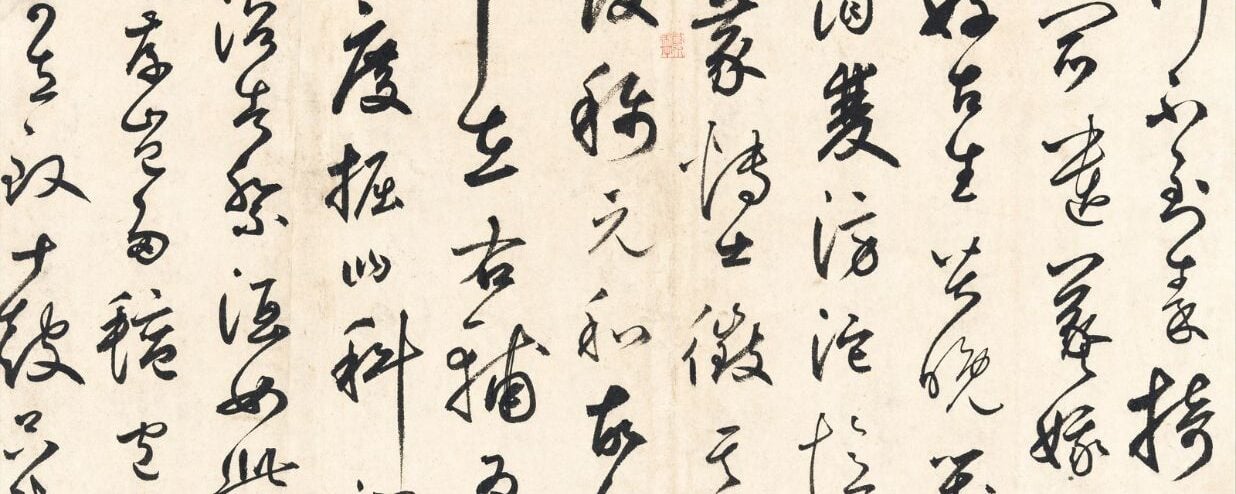


If you have ever read Japanese manga or novels, you might have noticed that the text is arranged vertically instead of horizontally. Even more unusual, you read from right to left instead of left to right. This is the Japanese vertical writing system, or 縦書き (Tategaki, “vertical writing”). It’s still the standard in novels, manga, newspapers, and many shop signs.
The interesting thing is that the right-to-left reading order still applies when you read the translated version. A lot of people get confused, and some even ask: why do Japanese people read vertically? This guide shows you how to read it: where to start on the page, how to move between columns, and how numbers and punctuation behave.
What is Vertical Writing?
Vertical writing, known as 縦書き (tategaki), is read from top to bottom, starting on the right of the page/document. This is essentially the opposite of English, which is written horizontally from left to right.
Nowadays, Japanese largely uses horizontal writing for everyday needs like emails and business documents, but vertical writing is still common in novels, manga, and newspapers.
Why Did Japan Adopt a Vertical Writing System?
Vertical orientation was the standard for Japanese writing, and the system was largely influenced by ancient Chinese writing. Chinese was written vertically because characters were often carved on oracle bones or written on thin strips of bamboo. This vertical style made its way to Japan and became widespread around the 4th or 5th century. Over time, these characters came to be known as kanji, the characters we know today.
For most of Japanese history, everything was written vertically, until around the Meiji Restoration in 1868. Japan adopted horizontal writing from the West, and it quickly became widespread. At first, Japanese was written horizontally from right to left, which matched the order of vertical columns.
It was not until after WWII that horizontal writing from left to right took hold and became the new standard. This doesn’t mean Japanese doesn’t use vertical writing, as it’s still the norm in many common media, such as manga, magazines, and newspapers. But according to a report by Mainichi, more than 30% of Japanese people do not read vertical writing daily, likely because more and more people read on electronics such as smartphones, which mostly use horizontal writing.
Horizontal writing may be the new norm, but traditional vertical writing isn’t going anywhere either. But is writing Japanese horizontally the exact same as English?
Does Japan Use Horizontal Writing Now?
Horizontal writing, known as 横書き (yokogaki), can refer to both left-to-right (hidari yokogaki) and right-to-left (migi yokogaki) writing orientations. Today, the vast majority of horizontal Japanese text is written from left-to-right, which is exactly the same as English. Most modern documents are written in this way, from official diplomatic reports to most school papers and textbooks.
Social media, emails, official documents, job resumes, and contracts are also all written horizontally, making it the more common standard. However, it’s quite common to mix both horizontal and vertical writing for either aesthetic reasons or to save on space. Newspapers frequently use horizontal headers while the body itself is written vertically.
Japanese is unique in its heavy use of both horizontal and vertical writing, but reading vertically can be confusing for first-time learners.
How to Read Japanese Vertical Writing
Manga, newspapers, novels, calligraphy, poetry, and formal letters all still use vertical writing.
All vertical texts essentially follow the same rules:
- Read starting from the top right, then read each character vertically to the bottom
- Move left to the next line, starting from the top again
Pretty simple, right? But it can get confusing since Japanese writing often mixes both vertical and horizontal formats. No matter what, horizontal text is always read and written left to right, and vertical is always read and written right to left. Let’s take a look at a few examples to better understand how it works.
1. Reading Manga in Japanese
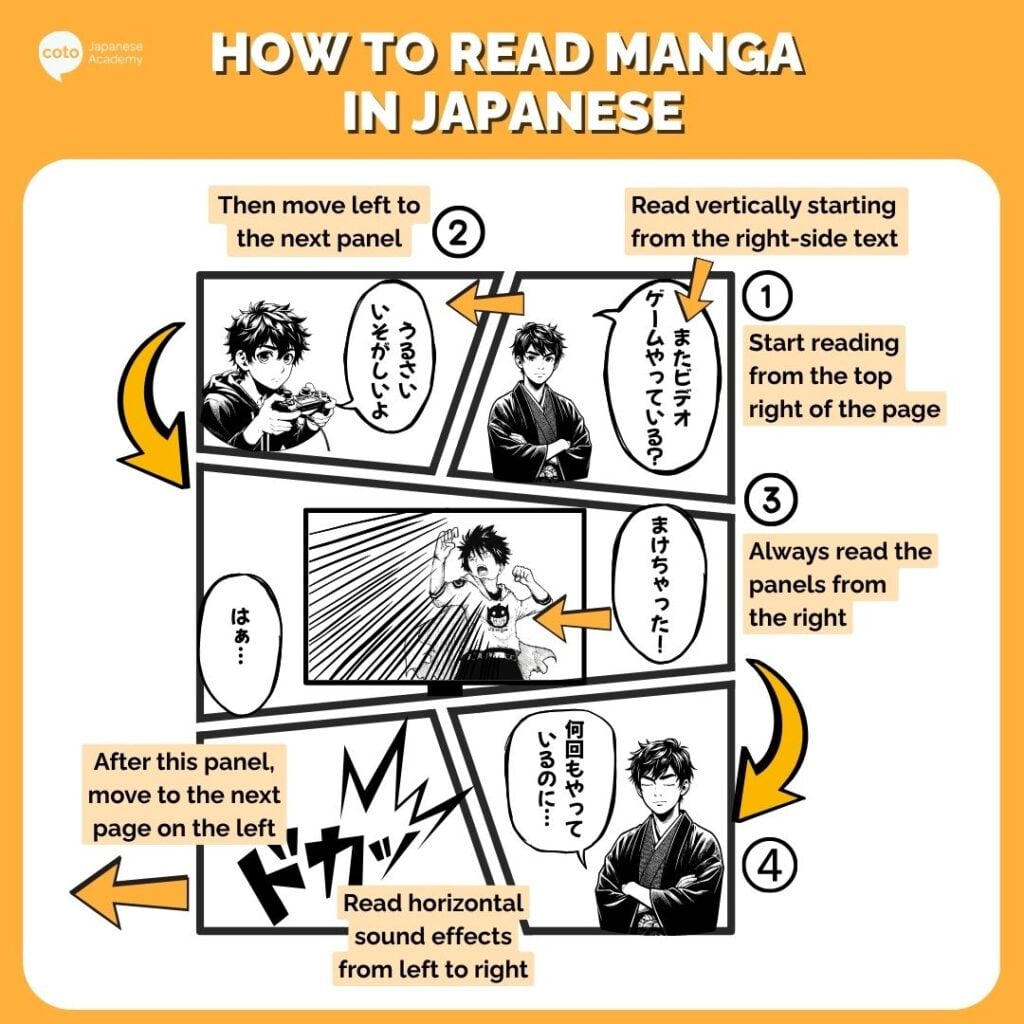
If you’ve read manga before, you know they always start at the top right, then move left. Understandably, with all the panels of differing shapes and sizes, reading manga can be a bit jarring if you’re not used to it. But reading from panel to panel is essentially the same as the text: you start from the very right and move left.
When you complete one row of panels, you move down to the next row. But be sure to start from the rightmost panel. However, if you’re an avid manga reader, you probably know how panels can be very fluid and flexible, with artwork being drawn across different panels and even pages. You just have to try to understand the flow of the art, and you’ll probably be able to understand where to start reading from there! Just always start with the rightmost speech bubbles within any given panel!
So, if you haven’t read manga in Japanese, this is where it starts to differ from its English translations. Within speech bubbles, Japanese text is always vertical, even though you might sometimes see manga sound effects outside the bubbles written horizontally. All vertical text within the speech bubbles is read from top to bottom, starting from the rightmost column. You then read the next line from the top.
Any sound effects (usually text outside the speech bubbles) you come across that are horizontal are always read from left to right, just like in English.
2. Reading Newspapers and Magazines in Japanese
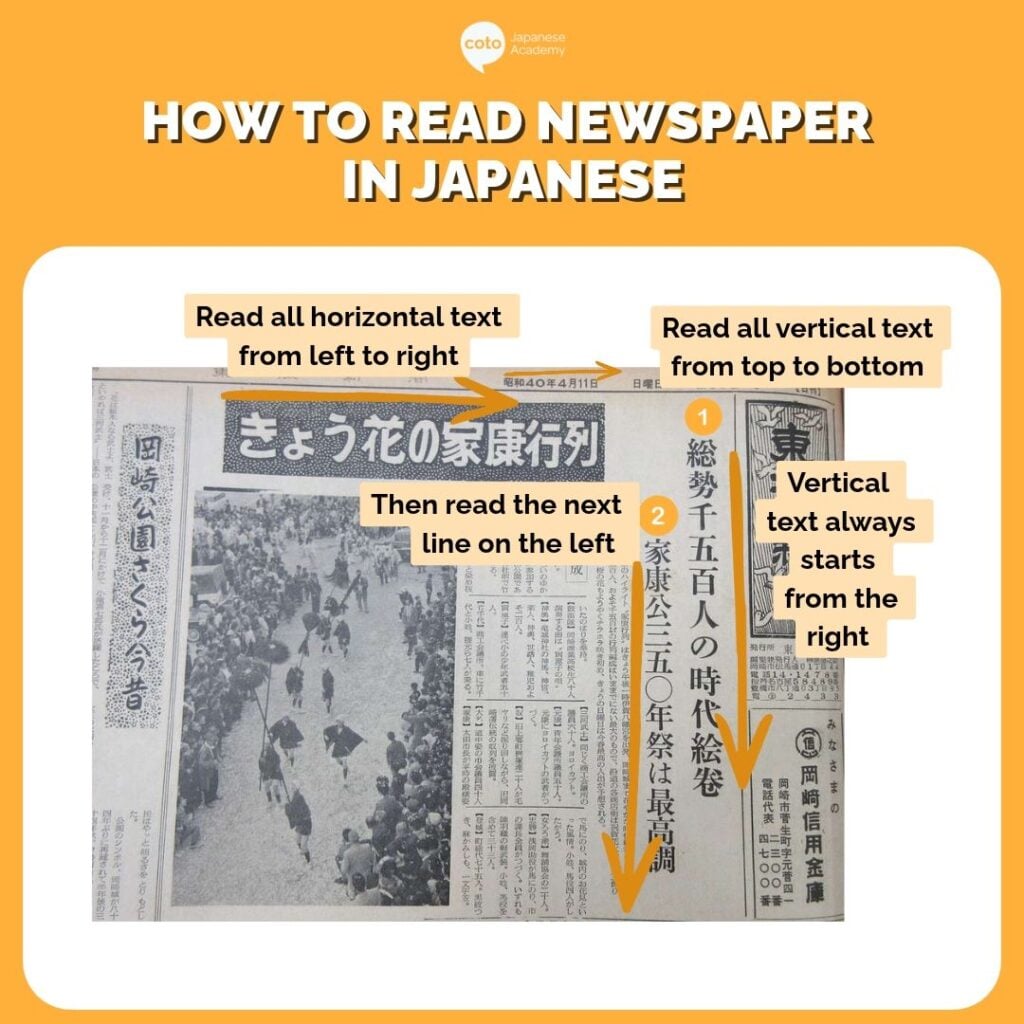
Newspapers and certain magazines are among the places where vertical writing is still alive and well. In most Japanese newspapers, the article text is laid out in narrow vertical columns that you read from top to bottom, then move on to the next column to the left. The front page of a paper begins at the top right corner, so you read the first article there before moving left across the page.
Headlines can be a little trickier, since they can be vertical or horizontal depending on the article and its layout. A horizontal headline above a block of vertical text is very common. When this happens, read the headline from left to right, then go back to the top right and read the body text vertically. If an article has a vertical headline, it generally sits to the right of its body text, so you read it first.
Magazines work in a similar way, though the layout can be much more flexible. Many magazines mix vertical and horizontal text on the same page, often with large images, captions, and text boxes. Since the layout is meant to be eye-catching, it can be harder to tell where to start. A good rule is to look at the biggest text first, then follow the direction of the lines: if the characters stack from top to bottom, read vertically, and if they line up from left to right, read horizontally.
One more tip: Japanese books and magazines that use vertical text open from the right side. That means the front cover is on what we would consider the back, and you flip the pages from left to right. If you pick up a Japanese book and it feels like you’re starting from the back, you’re doing it right!
How to Write Vertical Text in Japanese
If you want to write vertically, the same rules apply as when reading: start at the top right, write each character downward, then move to the next line on the left. Traditional Japanese writing paper, called 原稿用紙 (genkou youshi), is a great way to practice, since it has a grid of squares that shows you where each character goes. It’s also what many Japanese students use for essays in school.
Punctuation and other marks change slightly when writing vertically:
- The period (。) and comma (、) go in the top right of the character’s box, instead of the bottom right as in horizontal writing.
- The long vowel mark (ー) turns into a vertical line (|), since it follows the direction of the text.
- Corner brackets (「」) rotate to match the direction. The opening bracket moves to the top right and the closing bracket to the bottom left.
- Small kana, like ゃ, ゅ, ょ, and っ, are written toward the top right of their box.
- Numbers are usually written with kanji (一, 二, 三) instead of digits in vertical writing, so something like 2025年 would be written as 二〇二五年.
Typing Vertical Text on Your Computer
If you’re typing on a computer, you can write Japanese vertically in a few programs. In Microsoft Word, you can change the text direction under the Layout tab and choose vertical. Many Japanese word processors, like Ichitaro, also have built-in vertical writing.
However, many websites and apps don’t support vertical text, which is a huge reason why horizontal writing is so common online.
Conclusion: Vertical Writing is Japan’s Traditional Form of Writing
Vertical writing is the traditional form of written Japanese that’s still thriving today, found across Japanese newspapers, magazines, manga, and much more! While horizontal writing is more common in the modern day, especially as most online platforms and apps only support horizontal orientation, vertical writing is still essential to learn! It’s a huge part of written Japanese and traditional culture; it may even help preserve Japan’s traditions and customs.
Learn How to Read and Write in Japanese with Coto Academy!
Want to read manga, novels, and newspapers the way they were meant to be read, from top to bottom and right to left? Join Coto Academy to build the reading and writing skills you need to handle both horizontal and vertical Japanese with confidence, from kana and kanji to everyday writing.
We offer conversation courses, JLPT preparation, and comprehensive intensive classes that cover everything from reading and writing to speaking. You can study at one of our campuses in Tokyo or Yokohama, or join us online from anywhere in the world. Ready to sign up, or just want to have a casual chat? Fill out the form below, and we’ll be in touch!
FAQ:
What is vertical writing in Japanese called?
It’s called 縦書き (tategaki). Horizontal writing is called 横書き (yokogaki
How do you read vertical Japanese text?
Start at the top right, read each character downward, then move to the next column on the left and start from the top again. Horizontal text is read from left to right, just like English.
Why was Japanese originally written vertically?
The Japanese writing system was heavily influenced by ancient Chinese writing, which was written vertically on materials like thin strips of bamboo. Vertical writing was the standard for most of Japanese history, until horizontal writing spread around the Meiji Restoration and became the norm after WWII.
Is Japanese still written vertically today?
Yes. Vertical writing is still common in manga, novels, newspapers, magazines, calligraphy, poetry, and formal letters. Horizontal writing is more common for emails, social media, resumes, contracts, and business documents.
Can vertical and horizontal writing be used together?
Yes, it’s common to mix them. Newspapers often use horizontal headlines above vertical body text, and manga speech bubbles are written vertically even though sound effects may appear horizontally in the panels.