




To achieve fluency, you need to memorize a set of 2,136 kanji called Joyo Kanji, and to make things harder, many can look misleadingly similar. It’s all too easy for Japanese learners to mistake a kanji character for another. But don’t worry! There are subtle details to look for, and in many cases you can tell the correct character based on context.
So, let’s go over some of the most notorious characters for their confusingly close similarities and how we can easily differentiate them!
Japanese Kanji Basics and Radicals and Why Many Look So Similar
Before we get into our top list of similar kanji, it might be helpful to know how kanji are actually made up of smaller parts, known as radicals. Even though every kanji character is unique, most characters use familiar radicals, which can make them easier to remember; on the other hand, they can be confusing since they can end up looking very similar!
For instance, many kanji characters use common radicals such as 人 (hito). It usually looks like this, 「亻」, in its radical form. So, you can find the hito radical in the characters 休 (yasu) and 体 (karada), which also share the radical 木 (ki) or “tree”. Thus they end up looking quite similar, except 体 has the 「一」 (ichi) radical.
More difficult kanji just have more radicals, and there’s a higher chance 2 different kanji will share similar radicals. But don’t worry, it’s not as hard as it seems, and you will see that despite their aesthetic similarities, the meanings couldn’t be more different, making them easy to differentiate based on context.
Top 10 Most Similar Japanese Kanji Characters
In order not to confuse 2 of the same kanji, it’s important to notice the subtle details, and sometimes it can be as subtle as different stroke lengths.
1. 土 (Do) vs 士 (Shi)
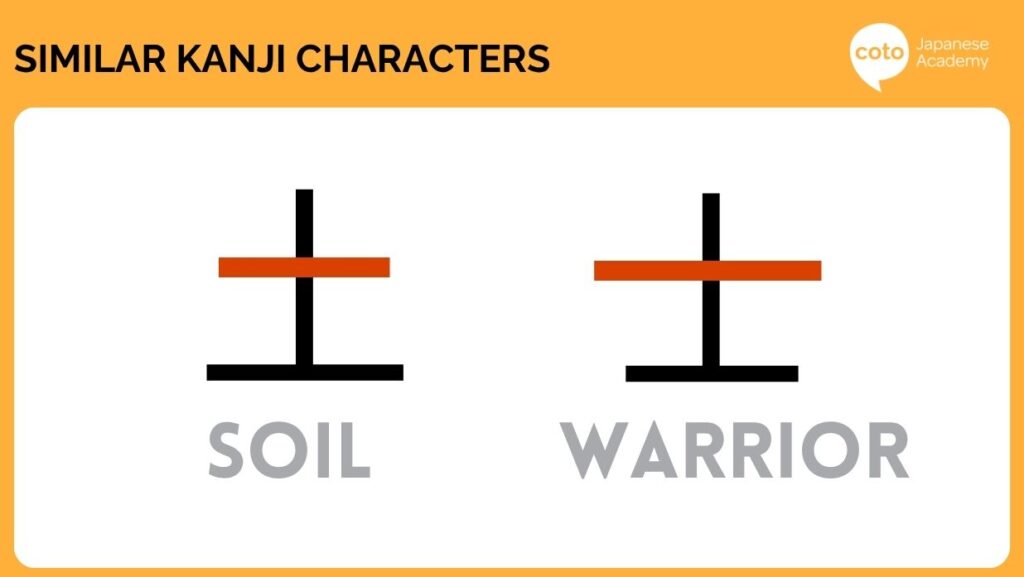
The only difference between these 2 kanji is stroke length, which can be very confusing. While it’s best to remember the difference when writing or reading them, they have very different meanings. 土 (do) means “soil” and 士 (shi) means “warrior” or “high-standing man.”
So, it’s quite easy to understand from context, even if you confuse the 2 kanji. Usually, you see 土 being used for 土曜日 (doyoubi), meaning “Saturday,” while 士 is often used in words like 武士道 (bushidou), which means “way of the warrior.”
2. 辛い (Karai) and 幸せ (Shiawase)
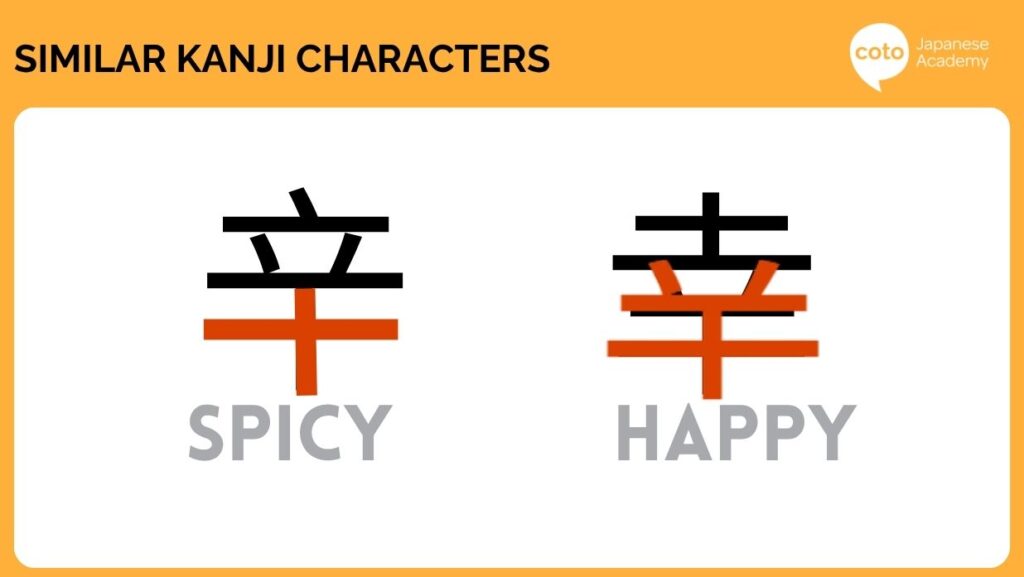
The kanji characters 辛い (karai/zurai) and 幸せ (shiawase) are often mistaken for each other because they look so similar. They differ by a single stroke at the top, which is enough to confuse Japanese learners. The good news is that these 2 characters have very different meanings, so you can tell them apart by context.
Depending on the pronunciation, 辛い (karai) means “spicy,” while 辛い (tzurai) means “hard” or “painful.” 幸せ (shiawase) means “happiness,” so almost the opposite of 辛い (tzurai).
3. 玉 (Tama) vs 王 (Ou)
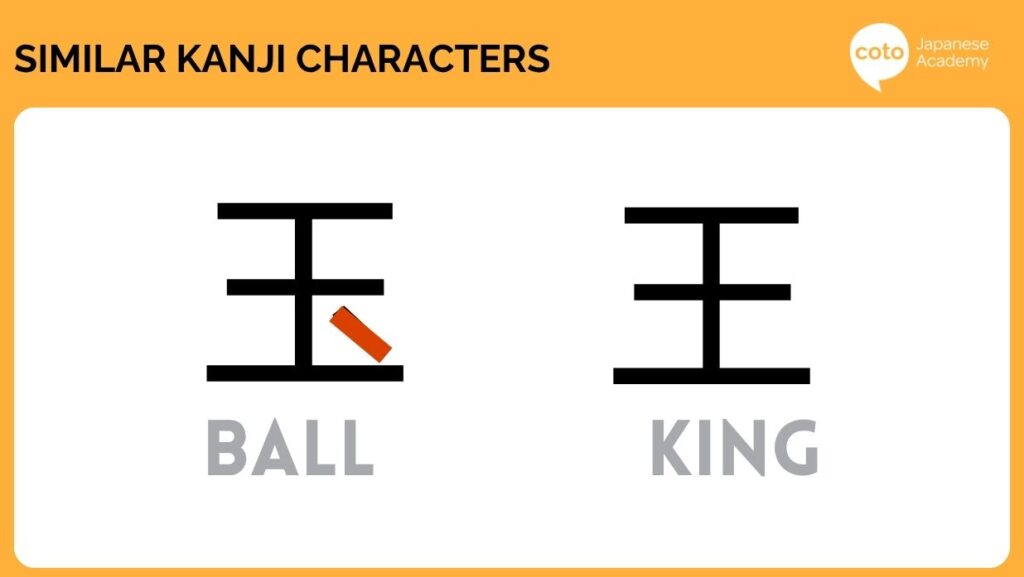
Another pair of very similar kanji is 玉 (tama) and 王 (ou), differentiated only by a tiny stroke「丶」known as a 点 (ten) in Japanese. But these two characters have completely different meanings, so context makes them easy to distinguish. 玉 means “ball” while 王 (ou) means “king.”
4. 未 (Mi) vs 末 (Matsu)
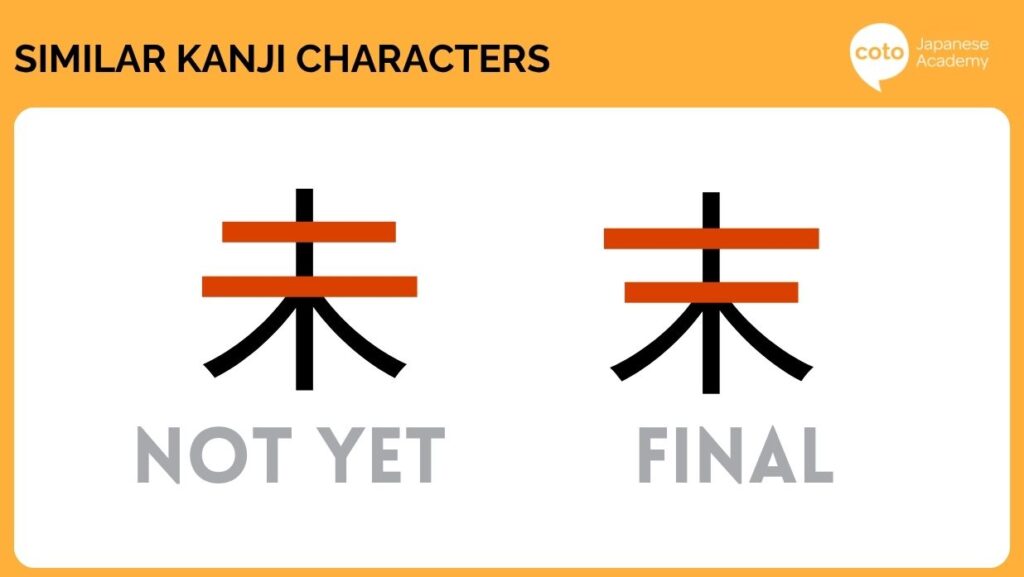
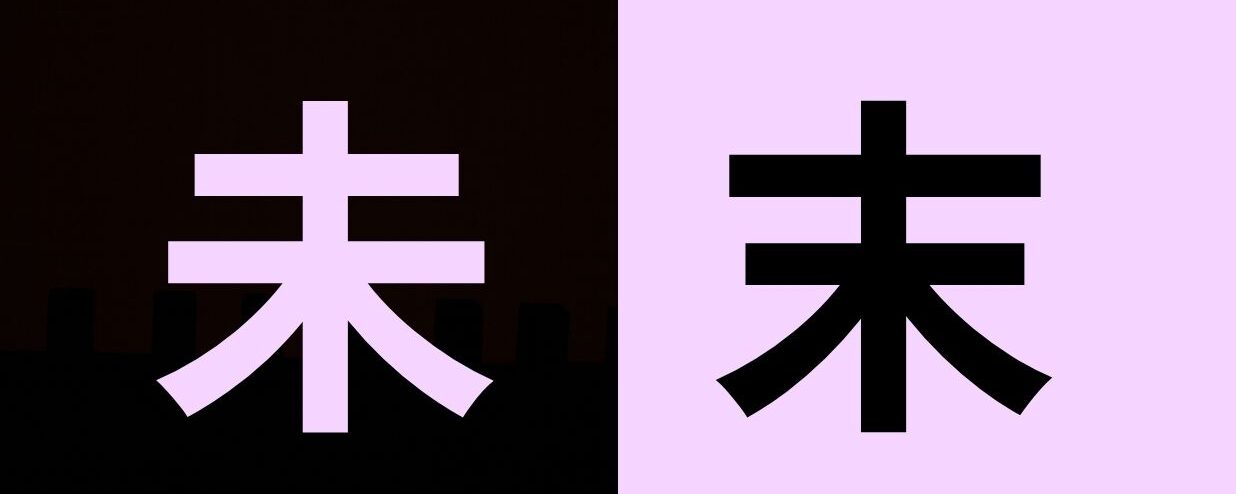
These two kanji look almost identical at a glance, and the only difference is stroke length. In 未 (mi), the top horizontal stroke is shorter than the one below it. In 末 (matsu), it’s the opposite; the top stroke is the longer of the two. It’s a subtle detail, but once you notice it, you won’t mix them up again.
Fortunately, their meanings are worlds apart. 未 means “not yet,” while 末 means “end” or “final.” You’ll often see 未 in words like 未来 (mirai), meaning “future,” while 末 shows up in 週末 (shuumatsu), meaning “weekend,” or 末期 (matsugo), meaning “final stage.”
5. 比 (Kuraberu) vs 北 (Kita)
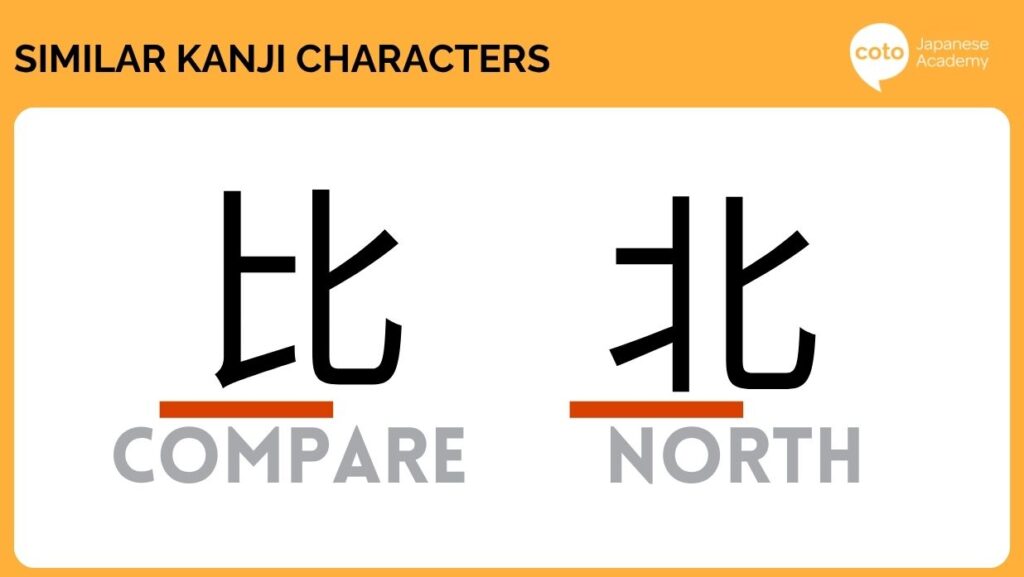
比 (kuraberu) and 北 (kita) can look like near mirror images of each other, and in a way, they are. Both characters are made up of two similar-looking halves, but the balance between them is what sets them apart. In 比, the two halves look almost identical, giving the character a neat, symmetrical look. In 北, the left half sits a little taller and is shaped slightly differently, throwing off that symmetry.
Despite the resemblance, their meanings couldn’t be more different. 比べる (kuraberu) means “to compare,” while 北 (kita) means “north.” You’ll find 比 in words like 比較 (hikaku), meaning “comparison,” and 北 in 北海道 (Hokkaido), Japan’s northernmost island.
6. 受(Uke) vs 愛(Ai)
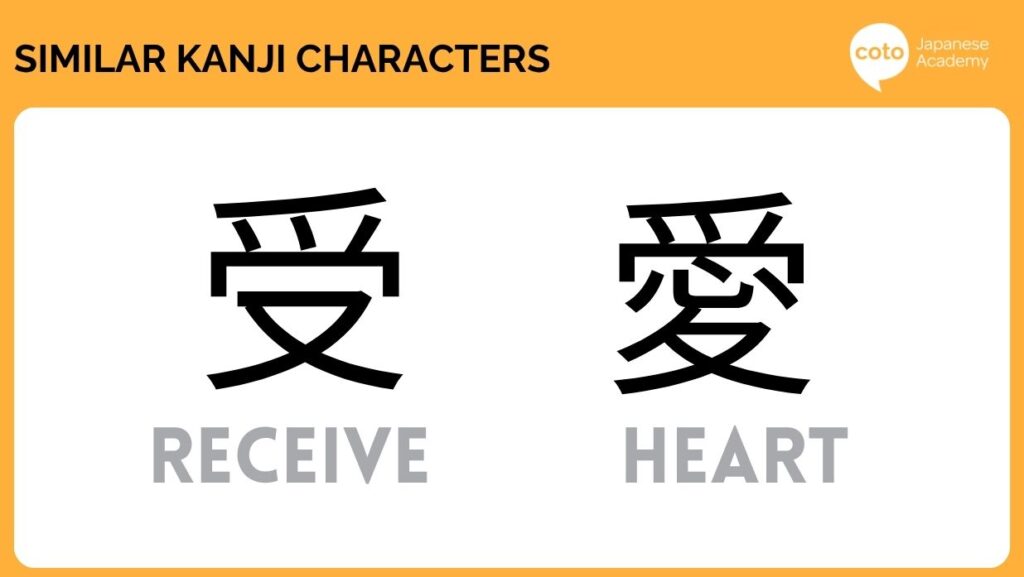
受る (ukeru) and 愛 (ai) share the same “crown” shape on top (爪, originally representing claws or reaching hands), which is exactly why learners often mix them up. Here’s a handy way to remember the difference, though: 愛 has a heart (心) tucked right in the middle of it, which makes sense since it means “love”! 受, on the other hand, finishes with 又, a simple hand shape, with no heart in sight.
Meaning-wise, 受ける means “to receive,” while 愛 means “love.” You’ll come across 受 in everyday words like 受付 (uketsuke), meaning “reception desk,” and 愛 in words like 愛情 (aijou), meaning “affection.”
7. 持 (Mochi) vs 待 (Machi) vs 侍 (samurai)
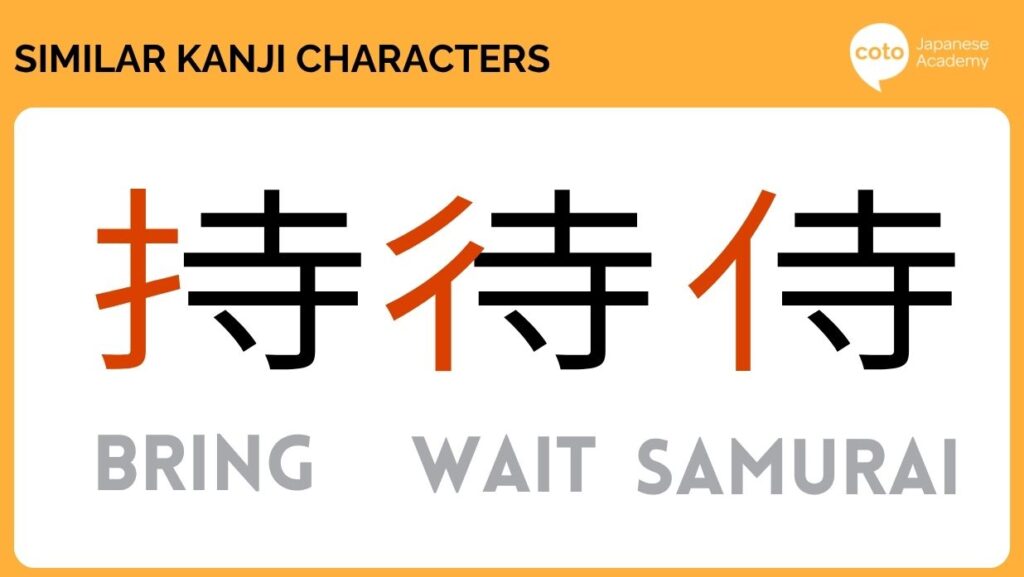
This trio is a great example of how kanji sharing the same “base” can end up with totally different meanings depending on which radical is attached to it. All three characters share 寺 (tera), which originally meant “temple,” but each one pairs it with a different radical on the left side.
持つ (motsu) uses 扌, the hand radical, which makes sense since it means “to hold” or “to have.” 待つ (matsu) uses 彳, a radical associated with movement and roads, fitting for a word that means “to wait.” And 侍 (samurai) uses 亻, the person radical, referring to a warrior who served and attended to a lord.
So next time you spot 寺 in a kanji, take a closer look at what’s attached to it that little radical makes all the difference!
8. 問 (Mon) vs 間 (Aida) vs 聞 (Kiku) vs 開 (Hiraku) vs 閉 (Shimeru)
All five of these characters share a common outer radical, 門 (mon), meaning “gate.” So, the trick to differentiating these characters is by looking at what’s tucked inside the gate. Let’s go through each of these characters.
- 問 (mon/toi) has the radical 口 (kuchi) inside, which translates to “mouth.” Since 問 actually means “question,” you can think of this character like someone using their mouth to ask the gate a question.
- 間 has 日 (hi), meaning “sun,” inside, like sunlight slipping through the gap of a gate, giving us “interval” or “between.”
- 聞 has 耳 (mimi), meaning “ear,” inside, giving us “to hear” or “to listen.”
- 開 has two hands (廾) pushing a bar aside, giving us “to open.”
- 閉 has 才, representing a wooden bar across the gate, giving us “to close.”
Once you know what to look for, you’ll never mix up these kanji characters again. You’ll spot 問 in words like 質問 (shitsumon), meaning “question,” 間 in 時間 (jikan), meaning “time,” 聞 in 新聞 (shinbun), meaning “newspaper,” 開 in 開ける (akeru), meaning “to open,” and 閉 in 閉める (shimeru), meaning “to close.”
9. 大 (Dai) vs 犬 (Inu) vs 太 (Futoi)
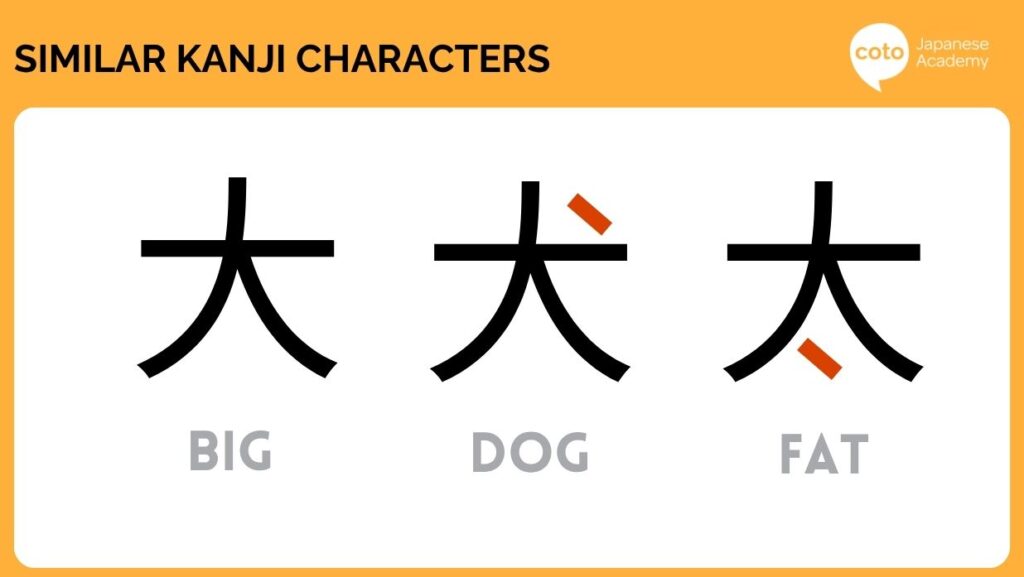
These are classics that trip up almost every beginner at some point. All three characters start from the same base, 大 (dai), meaning “big,” which itself looks like a person standing with arms and legs stretched out wide (think a sumo wrestler). Add a single dot or 点, and the meaning changes completely depending on where it goes.
犬 (inu) adds a 点 near the upper right, close to the arm, like a little tail or ear sticking out, giving us some vague image of a “dog.” 太 (futoi) adds the dot in between the legs, changing the meaning of the character to “fat” or “thick.”
Context makes these easy to sort out even if the 点 placement slips your mind for a second. You’ll see 大 in words like 大きい (ookii), meaning “big,” 犬 in 子犬 (koinu), meaning “puppy,” and 太 in 太る (futoru), meaning “to gain weight,” or 太陽 (taiyou), meaning “sun
10. 電 (Den) vs 雷 (Kaminari) vs 雪 (Yuki)
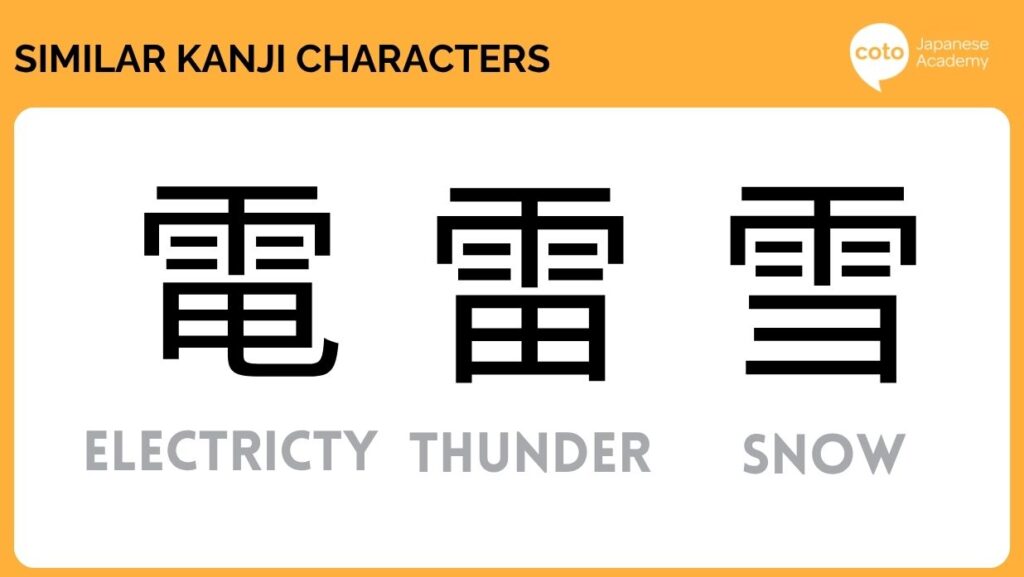
These three characters share the same top radical, 「雨 」, which means “rain.” 電 (den) and 雷 (kaminari) look almost identical except for the umbrella, 乚, at the bottom of 電, meaning “electricity.” While it’s hard to explain why this character came to mean electricity, you can think of the umbrella at the bottom as an electrical cord.
雷 means “thunder,” “lightning,” or “thunderstorm,” which, if we break down the radicals, makes a bit of sense. 雨, the radical/character for rain, plus 田 (ta) meaning “rice field”; you can think of a thunderstorm pouring over a rice field.
雪 (yuki) means “snow”, and differs from the other 2, since its bottom radical is ヨ, which might not have a meaning on its own. But it does resemble a hand, so you can think of snow as rain you can hold and form with your hand.
Conclusion: Similar Japanese Kanji Are Easy To Differentiate by Context!
Although many kanji can look strikingly similar, their meanings are always different enough that they aren’t easily confused in context. You probably won’t think the word for “happy”: 幸せ (shiawase) means “spicy” or “painful” despite how similar it looks to 辛い (karai/zurai). Don’t worry, as you keep reading and writing kanji, you will just develop a natural sense of which is right and wrong, similar to how you know to spell words correctly!
Master Reading and Writing Kanji at Coto Academy!
If you really want to master reading and writing in Japanese like a native, join Coto Academy! We offer classes focused on helping you master reading and writing kanji for daily life, reading books like manga, or smashing the JLPT! We have courses for any of your Japanese language goals, whether it’s so you can read Japanese novels or engage in conversations fluently.
So, visit one of our campuses in Tokyo or Yokohama, or join us online from anywhere around the world! Ready to sign up with us, or just want to have a quick chat for more details? Simply fill out the form below!
Similar Japanese Kanji FAQ:
Why do so many kanji look alike?
Most kanji are built from smaller parts called radicals, and many characters reuse the same ones. Two kanji can share almost every stroke and still mean completely different things.
What's the easiest way to tell similar kanji apart?
Look for the one small difference: a stroke length, an extra dot, or a swapped radical. For example, 玉 (tama, “ball”) and 王 (ou, “king”) differ by a single dot, or 点 (ten) in Japanese.
Do I need to memorize every lookalike pair?
Not really; context does most of the work. Since these kanji almost always show up in totally different words, the sentence around them usually makes the meaning obvious.
Is there a trick to remembering the differences?
Yes, look at what’s added or changed and try to link it to the meaning. Like how 愛 (ai, “love”) has a heart (心) hidden inside it, while its lookalike 受 (uke) doesn’t.
What should I do if I still mix two kanji up?
Write them side by side a few times and say the readings out loud. Handwriting practice makes the small differences stick much faster than just reading them.
Other Blogs You May Be Interested:
- How to Describe Food Flavors & Textures in Japanese
- 30 Japanese Onomatopoeia Your Sensei Never Taught You
- 30 English Loanwords That Come From the Japanese Language
- The Best Way to Learn Kanji Effectively in 8 Steps
