



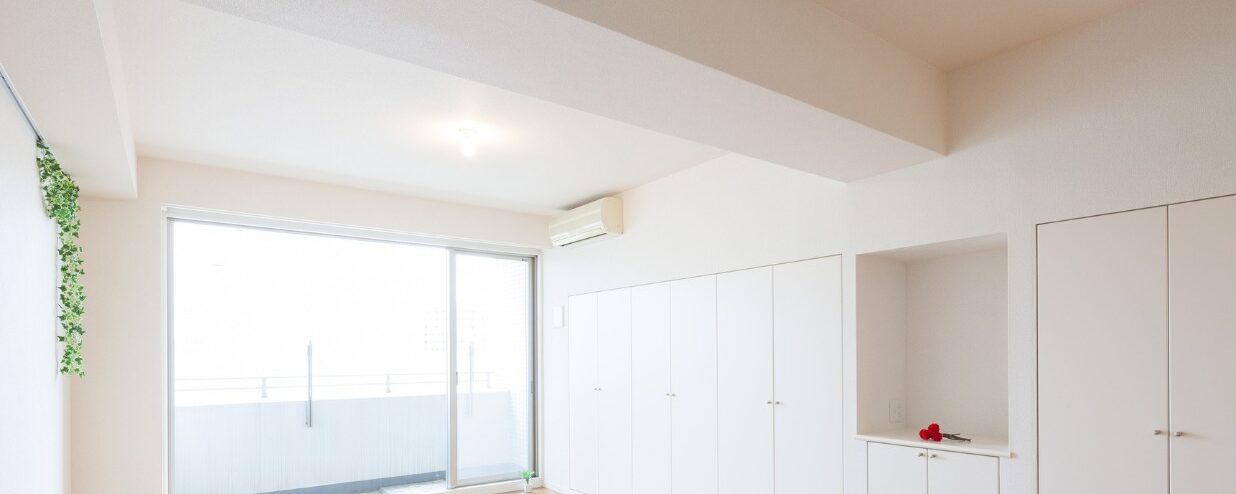


Finding an apartment or a place to live is essential if you want to live in Japan; however, you will need to know some essential Japanese phrases to get the place you want. If you plan to live in Japan, apartments are among the cheapest and most readily available options, but they can be a bit overwhelming at first.
You will need to know how to navigate Japan’s apartment system, including securing guarantors, paying the deposit, and obtaining insurance. While you can find English-speaking agents, your options expand exponentially if you can speak just a bit of Japanese. Keep reading to find out everything you need to know!
Basic Words for Finding an Apartment
So, before we dive into contracts, different types of apartments, rules, and regulations you need to navigate, let’s go through some basic words for Japanese apartments. From different housing types to agencies that’ll find them, here are some essential terms to remember.
| English | Japanese | Furigana | Romaji |
|---|---|---|---|
| Apartment | アパート | あぱーと | Apaato |
| Condomunium | マンション | まんしょん | Manshon |
| Single-family home | 一戸建て | いっこだて | Ikkodate |
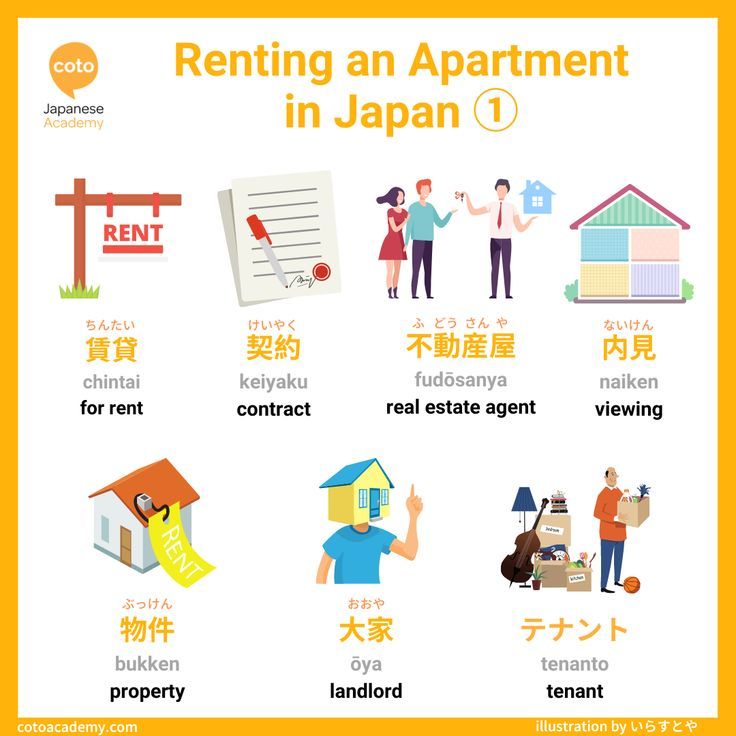
| Real-estate agent | 不動産 | ふどうさん | Fudousan |
| Real-estate agency | 不動産屋 | ふどうさんや | Fudousanya |
| Apartment listing | 物件 | ぶっけん | Bukken |
You probably noticed that the Japanese word for condo is マンション (Manshon), which is derived from the English term “mansion.” However, マンション in Japanese refers to a multi-floor residential building made of concrete or steel. It translates more closely to “condo” or “apartment” in English.
Generally, they are seen as higher-end, more modern versions of the アパート, so they are usually more expensive and include elevators and electronic security monitors. Whether you want to find an apartment, condo, or single-family home, you can find 不動産屋 (fudousanya) in every district that will find what you’re looking for. However, keep in mind that 不動産屋 (fudousanya) generally focuses on specific areas of whatever city you’re in, especially if you live in a bigger city.
Japanese Terms for Apartment Rent & Initial Fees
Knowing how to ask for the rent and explaining your budget is probably the most important part of finding an apartment. So, here is how you can explain your rent budget in Japanese.
Example:
家賃8万円以内の物件を希望します。
Yachin hachimanen inai no bukken o kibou shimasu.
I would like property listings with rent under 80,000 yen.
This is how to ask for an apartment listing within a certain budget. The phrase 以内 (inai) means “under” or “within,” so you can use it to specify a price threshold for the rent, as demonstrated in the example, 家賃8万円以内 (yachin hachiman inai).
Additionally, the rent often determines the initial fees you must pay before moving into the apartment. The majority of these fees are equivalent to around 1 to 3 months of your apartment’s rent.
So, here are the general initial fees you will most likely run into when you get an apartment in Japan:
- 家賃・賃料 (Yachin/chinryou): Monthly rent
- 初期費用 (Shoki hiyou): Initial fees, which include an accumulation of costs
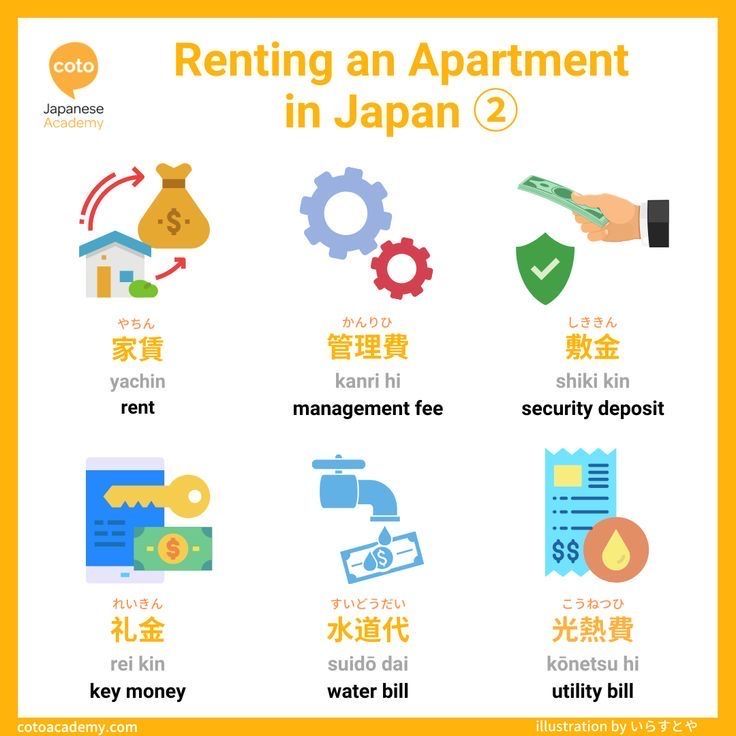
- 敷金 (Shikikin): Security Deposit, usually around 1 – 3 months of rent, but is usually returned to you when you end your contract
- 礼金 (Reikin): “Key Money”, basically gift money you give the renting company. It’s usually around 1 month of rent
- 管理費 (Kanrihi): Maintenance fees for the shared areas of the apartment building. This is usually paid in the initial fee
- 仲介手数料 (chuukai tesuuryou): This is the agency commission fee; this only applies if you used a 3rd party agency to help you find an apartment. The fee can be anywhere around 20% to 80% of the rent.
- 保証金 (hoshoukin): This is the guarantor fee; most often, foreigners need to get a guarantor company that’ll step in if you don’t pay rent. The guarantor fee is usually included in the initial fees, but some guarantors refund it when you move out.
These terms are quite important to remember, as they add up to some of the highest upfront costs you will incur in Japan. Every contract will break down the initial fees and note that not every fee is always included.
So, it’s good to ask which of these initial fees will be included; it’s not uncommon for the 礼金 (reikin) or the 保証金 (hoshoukin) to be deducted. If you’re using an agent, you can directly ask for apartment contracts that don’t require key money or guarantor fees by saying the following.
Example:
礼金がない物件を希望します。
Reikin ga nai bukken o kibou shimasu.
I would like property listings that don’t have key money fees.
How Apartment Room Sizes Work in Japan
Now, let’s get into how apartments work in Japan. When you talk with a 不動産 (fudousan), or real estate agent, they will ask you about the size and specifications. In many traditional Japanese apartments, the floor is made up of tatami, or floor mats made of rice straw and straw covering. They are also often used as a standard unit of measuring room sizes in Japan; a single tatami mat, or 帖 (jou), is equivalent to around 1.62 square meters (m2).
Most fudousans or apartment companies will also use m2, but just for your reference, here are some common tatami room sizes corresponding to m2:
- 2帖: 3.24 m2
- 3帖: 4.86 m2
- 4帖: 6.48 m2
- 5帖: 8.1 m2
- 6帖: 9.72 m2
- 7帖: 11.34 m2
- 8帖: 12.96 m2
- 9帖: 14.58 m2
- 10帖: 16.2 m2
Japanese Apartment Size Layouts
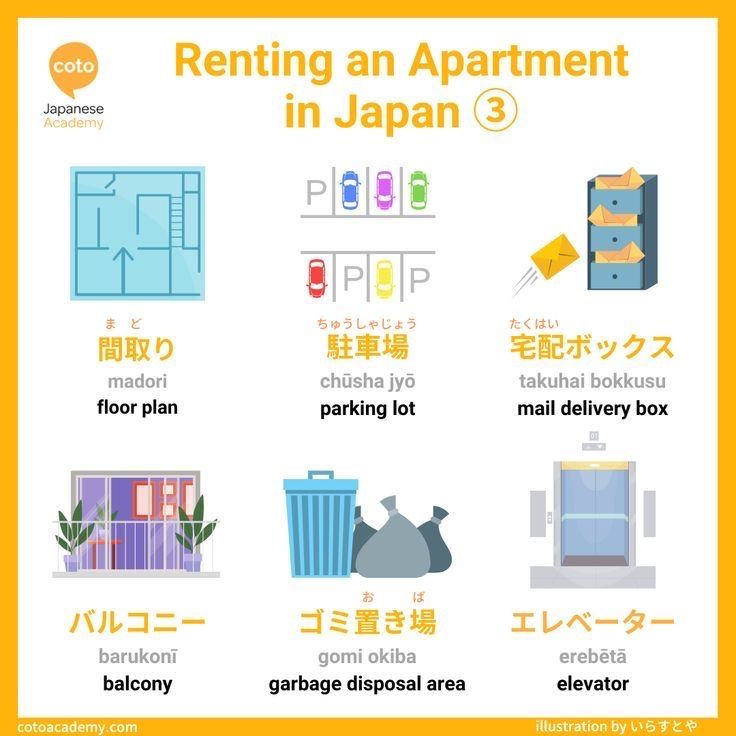
Another size specification to be aware of is 間取り (madori), or floor plan layout, which uses a number to indicate the number of bedrooms, followed by a set of initials. Here is the apartment layout code with 1 bedroom:
- 1R: stands for “Room,” basically a studio apartment, the smallest type of apartment layout.
- 1K: means “Kitchen,” indicating the kitchen and bedroom are separated (note that R is not shown for apartments that are 1K and bigger)
- 1DK: refers to “Dining” and “Kitchen,” indicating that the dining room, kitchen, and bedroom are separated
- 1LDK: stands for “Living,” “Dining,” and “Kitchen,” meaning that the living room, dining room, kitchen, and bedroom are separated.
So, when you look for an apartment, if you want a 2-bedroom apartment with a separate kitchen and dining space, you can request a “2DK.” Note that you say the numbers in Japanese, but the letters are the same as in English. However, you should note that you cannot specifically ask for only a separate dining or living room.
A room with a separate dining room will also have a dedicated kitchen, and units with separate living rooms will have a dedicated kitchen and dining space. Every type of apartment layout will allow for virtually any number of rooms you want, but generally speaking, 1-4 rooms are the easiest to find.
Other Japanese Apartment Specifications
There are some other important specifications to consider when looking for an apartment in Japan, such as 築年数 (chikunensuu), meaning “building age.” If you want to specify that you are okay with a Japanese apartment building that’s around 20 years old, you can say the following.
Example:
築20年のアパートをお願いします。
Chiku nijuu nen no apaato onegaishimasu.
Can you please find me an apartment that was built 20 years ago?
To specify how old you would like the apartment to be, you can use the phrase 築(chiku) + the number of years since it’s been built + 年 (nen). Generally speaking, older apartments are much cheaper than new apartments. But also keep in mind that some buildings are frequently refurbished, so even an older building could look newer and contain more up-to-date technology, yet be cheaper than a newer one.
Another thing to keep in mind is that more often than not, modern buildings have “western-style” rooms. Generally, Japanese apartments are categorized as either “Western,” or 洋室 (youshitsu), or “Japanese” style rooms, or 和室 (washitsu), with the latter usually using tatami rather than wooden floors. Nowadays, western rooms are the most popular type of apartment, even among the Japanese population.
| English | Japanese | Furigana | Romaji |
|---|---|---|---|
| Building age | 築年数 | ちくねんすう | chikunensuu |
| Built ~years ago | 築〜年 | ちく〜ねん | chiku ~nen |
| Western-style room | 洋室 | ようしつ | youshitsu |
| Japanese-style room | 和室 | わしつ | washitsu |
Japanese Terms for Apartment Amenities
Another deciding factor for your apartment is the amenities. There are a few things to note about Japanese apartments that might not be too common where you come from. Often, toilets and showers are in a single washroom, which is called a ユニットバス (yunitto basu) in Japanese, so you might need to specify that you want a separate bathroom and shower.
Example:
バス・トイレ別でお願いします。
Basu toire betsu de onegaishimasu.
I would like the bathroom and toilet to be separated, please.
In this example, you can request a separate bathroom and toilet by saying バス・トイレ, followed by お願いします (onegaishimasu), a very polite expression for “please.”
These are just a few of many specifications you can ask for, so let’s find out some other key terms to know for amenities:
| English | Japanese | Furigana | Romaji |
|---|---|---|---|
| Separate bathroom and toilet | バス・トイレ別 | ばす・といれべつ | Basu toire betsu |
| Autolock | オートロック | おーとろっく | Ootorokku |
| Video intercom | テレビモニター付きインターホン | てれびもにたーつきいんたーほん | Terebi monitaa tsuki intaahon |
| Security camera | 防犯カメラ | ぼうはんかめら | Bouhan kamera |
| Pets negotiable | ペット相談 | ぺっとそうだん | Petto soudan |
| Balcony | バルコニー | ばるこにー | Barukonii |
| Loft | ロフト | ろふと | Rofuto |
| Aircon | エアコン | えあこん | Eakon |
Asking About the Surrounding Areas of Apartments in Japanese
Beyond the apartment itself, the surrounding neighborhood can make a huge difference in your day-to-day life in Japan. Things like how close you are to a supermarket, whether there’s a convenience store nearby for late-night essentials, or if there’s a park for exercise or relaxation are all worth asking about before signing a lease. Here are some key terms to help you describe what you’re looking for in a neighborhood.
| English | Japanese | Furigana | Romaji |
|---|---|---|---|
| Surrounding area | 周辺 | しゅうへん | Shuuhen |
| Supermarket | スーパー | すーぱー | Suupaa |
| Convenience store | コンビニ | こんびに | Konbini |
| Park | 公園 | こうえん | Kouen |
| Hospital/clinic | 病院 | びょういん | Byouin |
| Nearest station | 最寄り駅 | もよりえき | Moyori eki |
| Walking distance | 徒歩 | とほ | Toho |
| By bicycle | 自転車で | じてんしゃで | Jitensha de |
As mentioned earlier, listings often already include a term like 駅徒歩〜分 (eki toho ~fun) to show how many minutes it takes to walk to the nearest station. But if you want to ask an agent directly, or confirm the distance yourself, here are a couple of useful example sentences:
Example:
最寄り駅まで徒歩何分ですか?
Moyori eki made toho nanpun desu ka?
How many minutes is it on foot to the nearest station?
It might also be useful to ask about other essential places nearby, such as supermarkets, so here is a natural way to ask an apartment agent.
Example:
近くにスーパーはありますか?
Chikaku ni suupaa wa arimasu ka?
Is there a supermarket nearby?
Terms for Daily Utilities
More often than not, utility fees such as electricity, gas, water, and internet are paid separately, but certain apartments are serviced only by specific utility providers. When you choose an apartment, the real estate company, agent, or building owner will provide details on which service providers you can call to set up your utilities.
But also be on the lookout for apartment contracts that include certain utilities in the rent. It might be worth considering paying slightly more rent, but with more utilities included, and usually it’s fixed. This means that no matter how much you use, the utility included in your monthly rent won’t change.
Of course, there might be an upper limit. For example, it’s common for apartments that include electricity or water in the rent to charge extra if you use more than a certain threshold. It’s more common for sharehouses to include all utilities in the rent than for apartments. But many newer apartment buildings often have internet included in the rent, so you won’t have to make a separate internet contract.
Here are some terms for daily utilities that you should know:
| English | Japanese | Furigana | Romaji |
|---|---|---|---|
| Electricity | 電気 | でんき | Denki |
| Gas | ガス | がす | Gasu |
| Water | 水道 | すいどう | Suidou |
| Internet | インターネット | いんたーねっと | Intaanetto |
Japanese Phrases for Contracts and Leases
Once you’ve agreed to the initial fees, you will need to sign the contract. There are a couple of general contracts that you will likely run into: the 普通借家契約 (futsu shakuya keiyaku), meaning standard lease, and the 定期賃借権 (teikichinshakuken), meaning fixed-term lease. The standard lease is the most common contract type for apartments in Japan, which doesn’t have a set end date.
However, you will need to renew the contract and pay a renewal fee known as 更新料 (Koushinryou). Usually, contract renewals are automatic unless you choose to cancel, and happen once every 2 years or so. However, while contract renewal fees are usually around 1 to 2 months’ rent, they can often vary, so here’s how you can ask about the cost.
Example:
更新料はいくらですか?
Koushinryou wa ikura desu ka?
How much is the renewal fee?
いくらですか (ikuradesuka) means “how much?”, so you can simply ask the cost of the 更新料 by adding the phrase at the end of the sentence. But if you want to ask for an apartment with no 更新料, then you can say this instead.
Example:
更新料がない物件を希望します。
Koushinryou ga nai bukken o kibou shimasu.
I would like property listings without a renewal fee.
| English | Japanese | Furigana | Romaji |
|---|---|---|---|
| Lease agreement/rental contract | 契約 | けいやく | keiyaku |
| Standard lease | 普通賃借権 | ふつうちんしゃくけん | futsuuchin shakuken |
| Fixed-term lease | 定期賃借権 | ていきちんしゃくけん | teikichin shakuken |
| Contract renewal | 更新料 | こうしんりょう | koushin ryou |
Do Companies Often Refuse to Rent Apartments to Foreigners?
Unfortunately, it is common for apartment companies to refuse to rent to foreigners due to a negative association with being a “flight risk.” Japanese apartment companies feel there is a risk in renting to foreigners who might just return to their home countries, not pay the fees they owe, or remove the furniture from their apartment unit.
This can be a bit of an issue for apartment companies who would have to pay out of pocket to get rid of the furniture, plus, it usually takes months before they finally realize someone left Japan unannounced. So that means months of accumulated fees left unpaid. However, despite these cases being rather rare, some Japanese companies just don’t want to take the risk.
Another common “reason” for refusing foreigners is communication gaps. Some apartment companies feel that renting to foreigners who don’t speak Japanese will cause more issues and confusion, such as why certain fees or rules might not always translate well. But if you can speak Japanese, this won’t be an issue at all.
Overall, this is a form of discrimination that is mostly unjustified since the vast majority of foreigners don’t suddenly abandon everything and leave. But just a few created a stigma that makes it harder for foreigners to find landlords willing to rent to them. However, we would argue that more apartment companies are becoming willing to rent to foreigners, especially as Japan becomes more accustomed to serving them. Plus, additional measures are in place to prevent people from leaving without paying their fees, which is much fairer than not renting to any foreigner at all.
Looking for the best areas to live in Tokyo? Check out our blog: Best Neighborhoods to Live in Tokyo
Conclusion: Learn Japanese Apartment Phrases to Get Your Perfect Apartment!
Finding an apartment in Japan can be tricky, but it’s far from impossible! With just knowing a few handy Japanese expressions and phrases for finding apartments, the process becomes much easier, plus speaking some Japanese might sway more apartment companies to rent to you. However, while agents charge a fee, they can be very helpful in finding apartments, and their fee might even pay for itself since they can help find properties with lower initial fees!
Don’t feel too overwhelmed about finding your perfect apartment in Japan; the process isn’t as daunting as you would expect, and most foreigners end up quite happy with the apartment they find!
Learn Japanese for Finding Apartments at Coto Academy!
If you want to practice using Japanese to navigate apartment hunting in Japan, look no further than Coto Academy! Our classes focus on realistic Japanese that will prepare you for daily life in Japan, whether it’s discussing your apartment preferences and budget requirements, finding a career, or preparing for the JLPT! Whatever your needs are, we have courses that cover every part of the language, as well as courses that specialize in the areas you want to work on!
We have campuses across Tokyo and one in Yokohama, or, if you prefer, we also offer online courses you can take from the convenience of your home, anywhere in the world! Ready to sign up, or just want to chat casually to discuss details? Just fill out the form below, and we will be in touch!
FAQ:
How do you ask about rent in Japanese?
You can ask 家賃はいくらですか? (Yachin wa ikura desu ka?), meaning “How much is the rent?” If you want to specify a budget, you can say something like 家賃5万円以内の物件を希望します (Yachin gomanen inai no bukken o kibou shimasu), meaning “I would like property listings with rent under 50,000 yen.”
Do Japanese apartments have a lot of initial fees?
Yes. Beyond the first month’s rent, most apartments require fees such as 敷金 (shikikin, security deposit), 礼金 (reikin, key money), and sometimes agency fees, which together can add up to several months’ rent upfront. Some newer listings advertise 礼金なし (reikin nashi, “no key money”) to attract renters looking to save on initial costs.
Do Japanese apartments use tatami mats as a standard unit for size?
Yes, room sizes are often measured in 帖 (jou), based on the size of a single tatami mat (about 1.62 m²), even in apartments with western-style flooring. It’s a holdover from traditional room sizing, so it’s useful to know the conversion when comparing listings.
Do Japanese apartment companies often refuse foreigners?
Unfortunately, this can happen. Some landlords and agencies are hesitant to rent to foreign tenants, often due to language barrier concerns or unfamiliarity with guarantor requirements. That said, many agencies specialize in helping foreign residents find housing, and having a Japanese-speaking guarantor or using a guarantor company can make the process significantly smoother.
