






Ever heard the seemingly endless stream of slang from kids born after 2010 and wondered what the Japanese equivalent of Gen Alpha slang sounds like? Recently, Gen Alpha slang has been taking the internet by storm, so you might need to learn it to keep up with your friends and interact with Japanese digital spaces. Gen Alpha is a generation that grew up with digital spaces, so their trends, including new catchy phrases, spread across the internet and enter everyday conversation faster than ever before.
So, what is Japanese Gen-Alpha slang exactly? And is it completely different from Gen Z slang? Let’s find out the most common Gen Alpha slang you need to know!
What is Gen-Alpha? And What’s Japanese Gen-Alpa Slang?
Gen Alpha is defined as the demographic cohort born between 2010 and 2024, succeeding Gen Z. They are known for growing up in a period of unprecedented technological advancement, with access to smartphones, tablets, and the most expansive internet we’ve ever had. So, Gen Alpha spent their whole lives with social media as part of their normal lives. As a result, Gen Alpha around the world developed unique slang that spreads more quickly than ever.
So, Japanese Gen Alpha is no exception; they have their own unique slang, heavily influenced by the time period and currently influencing youth language as well. Similar to Japanese Gen Z slang, many Gen Alpha terms stem from how language evolves in digital spaces, such as shortened words and the mimicking of sounds or symbols used in texting or online commenting.
They are heavily inspired by English borrowings, so much of Japanese Gen Alpha slang could consist of katakana or even full English letters. Additionally, there is significant overlap between Gen Alpha and Gen Z expressions, especially since Gen Alphas are still quite young, but we will try to focus on more recent Gen Alpha slang you might come across.
Japanese Gen Alpha Slang Terms Everyone Is Using
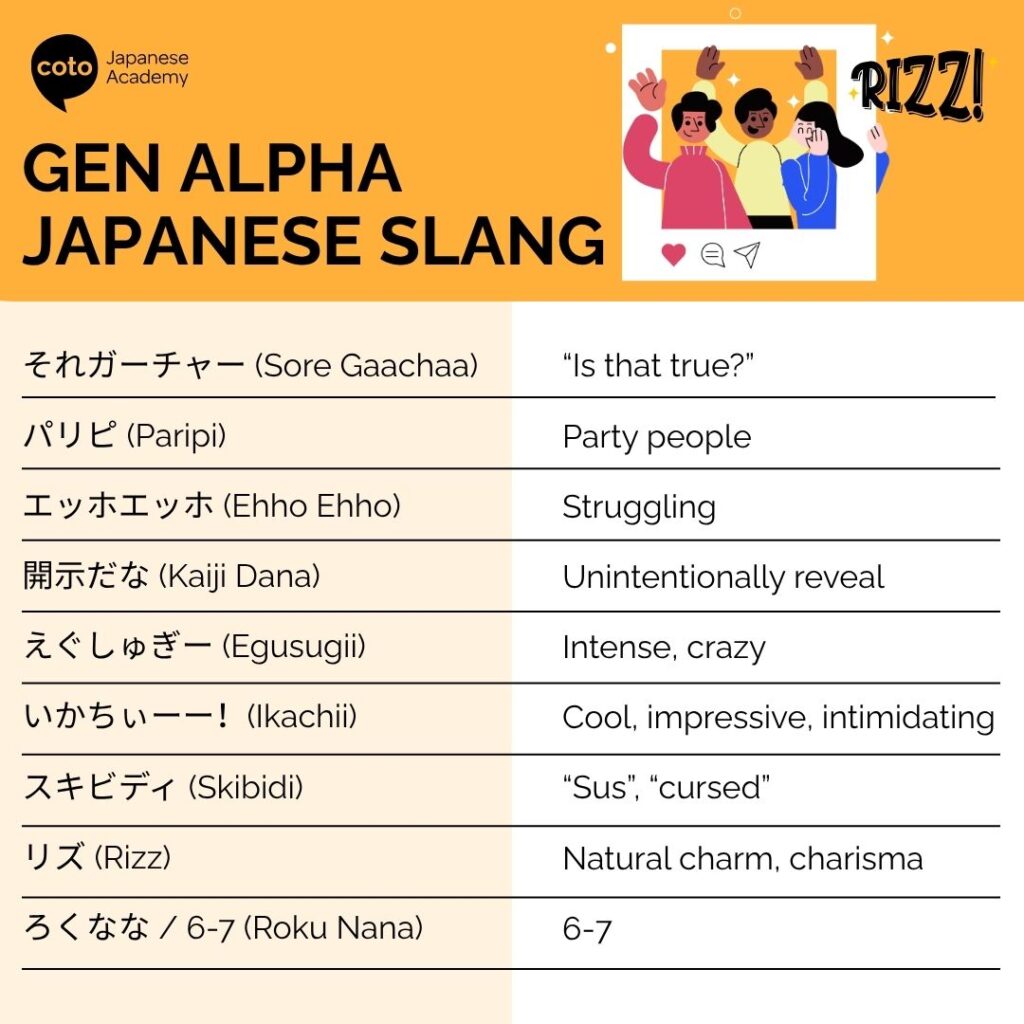
1. それガーチャー (Sore Gaachaa)
This is a super popular catchphrase that means “Oh, really, is that true?” or “Sorry!” It derives from the Japanese slang term がち (gachi), which can be translated as “really?” This phrase became popular through its use by celebrities and influencers, and quickly spread as a catchy phrase people like to use in comments and conversations across social media.
It’s often followed up with a kansai ben-inspired phrase, ほんまゴメンやで (honma gomenyade), which means something close to “so sorry.” People use the whole phrase, それガーチャー? ほんまゴメンやで, as a casual way to apologize to friends or family.
Example:
友人:いつ来るの?もう20分待っているよ!
Yuujin: Itsu kuruno? Mou 20 pun matte iru yo!
Friend: When are you coming? I’ve been waiting for 20 minutes already!
あなた:それガーチャー?ほんまゴメンやで!後2分だよ!
Anata: Sore gaachaa? Honma gomen yade! Ato ni hun da yo!
You: Is that so? So sorry! I’ll be there in 2 minutes!
2. パリピ (Paripi)
パリピ is a katakana shortening of “party people,” used to describe someone who loves going out, socializing, and living life to the fullest. It is used to describe the kind of person who is always at events, always having fun, and always the life of the party. While it originally carried a slightly exaggerated, over-the-top connotation, it has evolved into a more general, affectionate way to describe someone with an outgoing, energetic personality.
Example:
友人:田中くん、また今週末もクラブ行くの?
Yuujin: Tanaka-kun, mata konshuumatsu mo kurabu iku no?
Friend: Tanaka, are you going to the club again this weekend?
あなた:あいつほんとパリピだよね。
Anata: Aitsu honto paripi da yo ne.
You: He’s such a party animal, isn’t he?
3. エッホエッホ (Ehho Ehho)
エッホエッホ is one of the most distinctly Gen Alpha expressions on this list. It’s a Japanese onomatopoeia that mimics the sound of someone huffing and puffing while working hard or struggling through something. You usually use it to express that you are putting in a lot of effort, grinding through something difficult, or simply going all out. It has a playful, slightly self-deprecating tone that makes it a fun and relatable way to describe working hard without taking yourself too seriously.
Example:
友人:最近どう?
Yuujin: Saikin dou?
Friend: How have you been lately?
あなた:テスト勉強でエッホエッホしてるよ。
Anata: Tesuto benkyou de ehho ehho shiteru yo.
You: I’m grinding away at exam prep right now.
4. 開示だな (Kaiji Dana)
開示 (Kaiji) literally means “disclosure” or “revealing information,” and 開示だな is Gen Alpha slang for calling someone out or exposing something. It’s similar to saying “exposed” or even “Freudian slip” in English. You usually use it when someone unintentionally reveals something about themselves, or when the truth about a situation comes to light. It has a slightly teasing, gotcha-style tone and is commonly used in online comments and reactions.
Example:
友人:あのゲーム全然やったことないって言ってたけど、さっきルール全部説明してたじゃん。
Yuujin: Ano geemu zenzen yatta koto nai tte itteta kedo, sakki ruuru zenbu setsumei shiteta jan.
Friend: You said you had never played that game, but you just explained all the rules.
あなた:開示だな。
Anata: Kaiji dana.
You: Exposed!
5. えぐしゅぎー (Egusugii)
えぐしゅぎー is an energetic, exaggerated version of えぐい (egui), which is already widely used Gen Alpha and Gen Z slang meaning “intense,” “crazy,” or “insane.” The addition of すぎ (sugi — too much / over the top) and the elongated ー at the end ramps up the intensity, making it feel even more emphatic and expressive. It is used to react to something that is just too much — whether that is something impressive, shocking, or overwhelmingly good or bad.
Example:
友人:このゲームのラスボス、倒すのに3時間かかったよ。
Yuujin: Kono geemu no rasubosu, taosu no ni san jikan kakatta yo.
Friend: It took me three hours to beat the final boss of this game.
あなた:えぐしゅぎー!!
Anata: Egusugii!!
You: That’s absolutely insane!!
6. いかちぃーー!(Ikachii)
いかちぃ is a term used to express that something or someone is incredibly cool, impressive, or intimidating in the best possible way. It carries a sense of awe and admiration, like something is so impressive it almost feels overwhelming. It is similar in feeling to 神 (kami), but with a more visceral energy. The elongated いーー adds extra emphasis and enthusiasm, which is very characteristic of how Gen Alpha uses slang in text and online comments.
Example:
友人:あの選手、試合で5点も決めたんだって!
Yuujin: Ano senshu, shiai de go ten mo kimeta n datte!
Friend: Apparently, that player scored 5 goals in the match!
あなた:いかちぃーー!さすがだね!
Anata: Ikachii!! Sasuga da ne!
You: That’s so sick!! As expected of them!
Western Gen Alpha Slang in Japanese
One of the most fascinating things about Japanese Gen Alpha slang is how quickly Western internet culture crosses over and gets absorbed into everyday Japanese youth language. Thanks to platforms like TikTok and YouTube, certain English Gen Alpha terms have gone viral in Japan and are now used regularly by Japanese teenagers, often written in katakana and sometimes blended with Japanese grammar. Here are some of the most common ones.
7. スキビディ (Skibidi)
Originally from the viral Skibidi Toilet series on YouTube, スキビディ has taken on a life of its own in Japanese Gen Alpha culture. It is used to describe something chaotic, bizarre, or completely unhinged, similar to how “sus” or “cursed” are used in internet culture. It can be used as a compliment, a light insult, or simply a reaction to something deeply weird.
Example:
友人:先生が授業中に急に踊り出したんだよ。
Yuujin: Sensei ga jugyou chuu ni kyuu ni odori dashita n da yo.
Friend: The teacher suddenly started dancing in the middle of class.
あなた:え、完全にスキビディじゃん。
Anata: E, kanzen ni skibidi jan.
You: What, that’s completely unhinged.
9. リズ (Rizz)
リズ comes directly from the English Gen Alpha term “rizz,” meaning natural charm, charisma, or the ability to attract people effortlessly. In Japanese, it is used in exactly the same way, often as a noun or as part of Japanese grammatical patterns. It is commonly used to compliment someone who is naturally charming or smooth in social situations.
Example:
友人:あの人、初対面なのにすぐみんなと仲良くなってたね。
Yuujin: Ano hito, shomen na noni sugu minna to nakayoku natteta ne.
Friend: That person got along with everyone straight away, even though it was their first time meeting them.
あなた:わかる、リズあるよね。
Anata: Wakaru, rizz aru yo ne.
You: I know, they’ve got serious rizz.
10. ろくなな / 6-7 (Roku Nana)
ろくなな is also lifted directly from the Western Gen Alpha internet phrase “6 7,” which has its origins in the drill rap song “Doot Doot (6 7)” and in social media memes of its use with professional basketball player LaMelo Ball, who is 6 ft 7 in tall. It became a viral meme when a teenager named Maverick Trevillian yelled “6-7” during a basketball game, making the hand gesture, where you alternate lifting your hands, that later became inseparable from the phrase.
When people use the phrase, it actually means “average” or “just good enough”, but it is generally used with a bit of irony. It was directly adopted by Japanese Gen Alpha culture and is used for the exact same reasons.
Example:
友人:新しくできたカフェ、どうだった?
Yuujin: Atarashiku dekita kafe, dou datta?
Friend: How was that new café that just opened?
あなた:まあ、ろくなな
Anata: Maa, roku nana
You: Ahh, 6-7 (while doing the viral gesture)
Should You Use These Slang Terms?
While Gen Z and Gen Alpha slang are not officially part of Coto Academy’s curriculum, our teachers and staff often enjoy discussing them with students. This naturally raises the question: should you actually use these terms?
We like to compare this to using Gen Z slang in English if you’re from an older generation, such as a millennial or Gen X. Language naturally spreads across generations, and plenty of millennials use Gen Z slang. The bigger factor is how you use it.
Slang usually feels natural when you’ve picked it up organically from friends, coworkers, social media, or younger relatives. Using it occasionally, rather than trying to fit it into every sentence, also helps. Most importantly, you should understand what the expression means and the situations where it’s appropriate to use it.
On the other hand, slang can come across as awkward if you overuse it, use it incorrectly, or try too hard to sound trendy. Like any language, it’s best to let these expressions become a natural part of your vocabulary over time.
That said, we still recommend giving these expressions a try. They can be a great way to break the ice, start a conversation, and connect with native speakers. Ask your Japanese teacher or Japanese friends about the latest slang. They’ll often be happy to explain it, and it can be a fun way to gain a deeper understanding of Japanese language and culture.
Conclusion: Keep Up with Gen Alpha Slang to Enter Japanese Digital Spaces
Knowing Gen Alpha slang will help you navigate the Japanese online landscape, since so many internet and texting slang now consist of phrases from the latest generation! However, unlike older Japanese slang, which generally evolved slowly through regional dialects or subcultures, Gen Alpha slang moves incredibly fast, often going from a viral comment or TikTok video to everyday conversation within days. Don’t let that discourage you. By consistently engaging with Japanese digital spaces, you will start to catch on to the latest trends, just as you would in English!
Learn to Speak Japanese Naturally with Coto Academy!
Learning Japanese slang, especially Gen Alpha slang, will be essential for keeping up with Japanese internet trends! So, join Coto Academy to learn natural conversational Japanese so you can speak like a native and navigate social media in Japanese! We offer a variety of courses, including conversation-focused, JLPT prep, and comprehensive classes that cover everything from reading and writing to speaking!
We offer a flexible course schedule that can align with a time that works best for you! So please drop by one of our campuses in Shibuya, Shinjuku, Minato, Iidabashi, or Yokohama. Or you can join us online from anywhere around the world. Are you ready to sign up, or would you prefer to contact us to learn more? Just fill out the form below!
FAQ:
What slang do Japanese Gen Alpha use?
Japanese Gen Alpha slang is a fast-moving mix of shortened words, onomatopoeia, English loanwords, and Western internet memes that have crossed over into Japanese youth culture. Some of the most commonly used terms include えぐしゅぎー (egusugii) meaning “that’s insane,” or slang borrowed from English, such as リズ (rizu) or “Rizz.”
Is there a difference between Japanese Gen Alpha and Gen Z slang?
The line between the two is quite blurry. Since the oldest Gen Alpha are still teenagers, they have not yet had enough time to develop an entirely distinct slang vocabulary. As a result, a lot of what Japanese Gen Alpha use today was originally popularised by Gen Z, with terms like エモい, それな, and ぴえん all having Gen Z roots. The clearest differences tend to be in the Western internet memes Gen Alpha has adopted.
Why does so much Japanese Gen Alpha slang come from English?
Japanese Gen Alpha grew up with global social media platforms as a core part of daily life, meaning they are constantly exposed to English-language content from creators around the world. Western internet memes and slang terms spread rapidly through TikTok and YouTube, and Gen Alpha in Japan adopts and adapts them into Japanese almost in real time.