





Do you know your chances of passing the JLPT? The average JLPT pass rate in 2025 was 35.06% across all levels (N5 to N1) for both Japan and overseas. However, this figure should be taken with caution, as pass rates vary significantly across JLPT levels and between examinees in Japan and those overseas.
For example, did you know that under 25% of Japanese-Language Proficiency Test examinees in Japan passed level N1 in July 2025? That statistic isn’t meant to scare you, but it is important to know when preparing for the test; there are many ways to help ensure that you are one of the lucky few able to pass all 5 levels.
So, if you are taking the JLPT soon and want to know what your chances are, or just the overall pass rate, this article will discuss the official JLPT pass rates for levels N5 through N1, the difference between Japan-based and overseas preparation, and what the pass rate means for preparing students.
What is the JLPT, and Why Does Passing It Matter?
The JLPT is a standardized exam administered by the Japan Foundation and Japan Educational Exchanges and Services (JEES) to test non-native Japanese speakers and measure their skill with the language. It is divided into five levels, with N5 being a basic introduction and N1 requiring native-level proficiency.
Passing the JLPT is a surefire way to show that you truly want to succeed in Japanese society. It’s a necessity for a number of Japanese universities, it helps in the visa application process, and it can open all kinds of opportunities in business and in life. Plus, you get the personal satisfaction of understanding another language as well as a native speaker.
The exam is divided into three sections: reading, listening, and language knowledge (vocabulary, grammar). Besides having to pass the minimum overall grade, you need to achieve a minimum score in each section.
What is the Overall JLPT Pass Rate?
According to an analysis by the team at Coto Academy using official statistics published by the Japan Language Testing Association, the average JLPT pass rate across all levels (N5–N1) in 2025 was 35.06%, based on approximately 1.65 million examinees combined in Japan and overseas. This is down from 37.11% in 2024.
| Period | Total | No. of Examinees | Number of Examinees Who Passed | Pass Rate |
| 2025 | Total | 1,645,713 | 576,989 | 35.06% |
| July | 769,229 | 279,407 | 36.32% | |
| December | 876,484 | 297,582 | 33.95% | |
| 2024 | Total | 1,470,989 | 545,838 | 37.11% |
| July | 680,453 | 269,432 | 39.60% | |
| December | 790,536 | 276,406 | 34.96% |
The JLPT is administered twice a year, in July and December, with the December session typically attracting more examinees. While the July test often has a slightly higher overall pass rate, this is largely because it has fewer candidates rather than because the exam is easier.
As shown in the table above, the average JLPT pass rate varies between the July and December sessions, as well as from year to year. In general, the larger number of examinees in December contributes to a slightly lower overall pass rate, although factors such as candidate ability and exam performance also influence the final results.
Overseas vs Japanese Test Takers: Which Has a Higher JLPT Pass Rate?
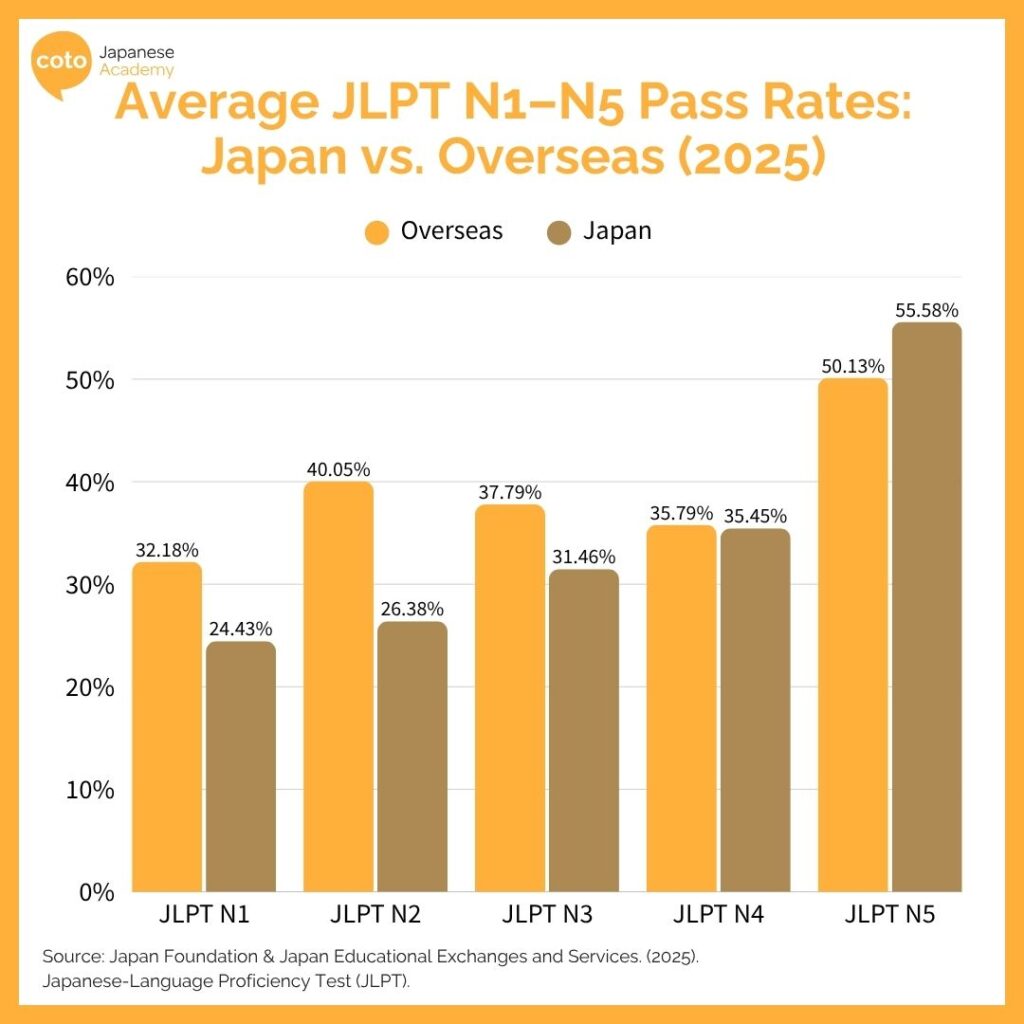
Excluding JLPT N5, overseas JLPT examinees achieved pass rates that were, on average, about 7% points higher than those of examinees in Japan in 2025. The largest gap was at JLPT N2, where the overseas pass rate exceeded Japan’s by 13.7% points, while N4 showed almost no difference between the two groups.
Why do overseas JLPT test takers tend to achieve a higher pass rate, then? The biggest reason is likely self-selection. Many overseas learners take the JLPT voluntarily and often wait until they feel confident they can pass. In Japan, however, many international students and foreign workers take the exam because it is required for university admissions, graduation, scholarships, job applications, or visa-related purposes, even if they are not fully prepared.
| JLPT Level | Pass Rate of Test Takers Overseas | Pass Rate of Test Takers in Japan |
|---|---|---|
| JLPT N1 | 32.18% | 24.43% |
| JLPT N2 | 40.05% | 26.38% |
| JLPT N3 | 37.79% | 31.46% |
| JLPT N4 | 35.79% | 35.45% |
| JLPT N5 | 50.13% | 55.58% |
Another factor is the number of candidates. Japan has a much larger testing population, including many first-time test takers and students attempting higher levels before they are ready. Overseas candidates, by comparison, may be more selective about which level they register for, leading to higher pass rates.
Want to increase your chances of passing the next JLPT? At Coto Academy, our expert instructors have helped students achieve a pass rate of 75% — that is more than double the national average of 35%. Join our comprehensive 3-month JLPT preparation course and study with a proven program designed for success.
How Many People Take the JLPT Every Year?
| Year | No. of Applicants |
|---|---|
| 2025 | 1,940,852 |
| 2024 | 1,718,943 |
| 2023 | 1,481,023 |
| 2022 | 932,518 |
| 2021 | 807,581 |
| 2020 | 424,147 |
| 2019 | 1,362,167 |
| 2018 | 1,168,000 |
| 2017 | 1,027,111 |
| 2016 | 866,294 |
| 2015 | 750,252 |
| 2014 | 681,893 |
| 2013 | 650,882 |
| 2012 | 651,062 |
| 2011 | 697,398 |
| 2010 | 703,685 |
| 2009 | 901,968 |
| 2008 | 660,381 |
| 2007 | 632,480 |
| 2006 | 533,189 |
| 2005 | 419,823 |
| 2004 | 355,423 |
| 2003 | 320,987 |
| 2002 | 286,169 |
| 2001 | 270,852 |
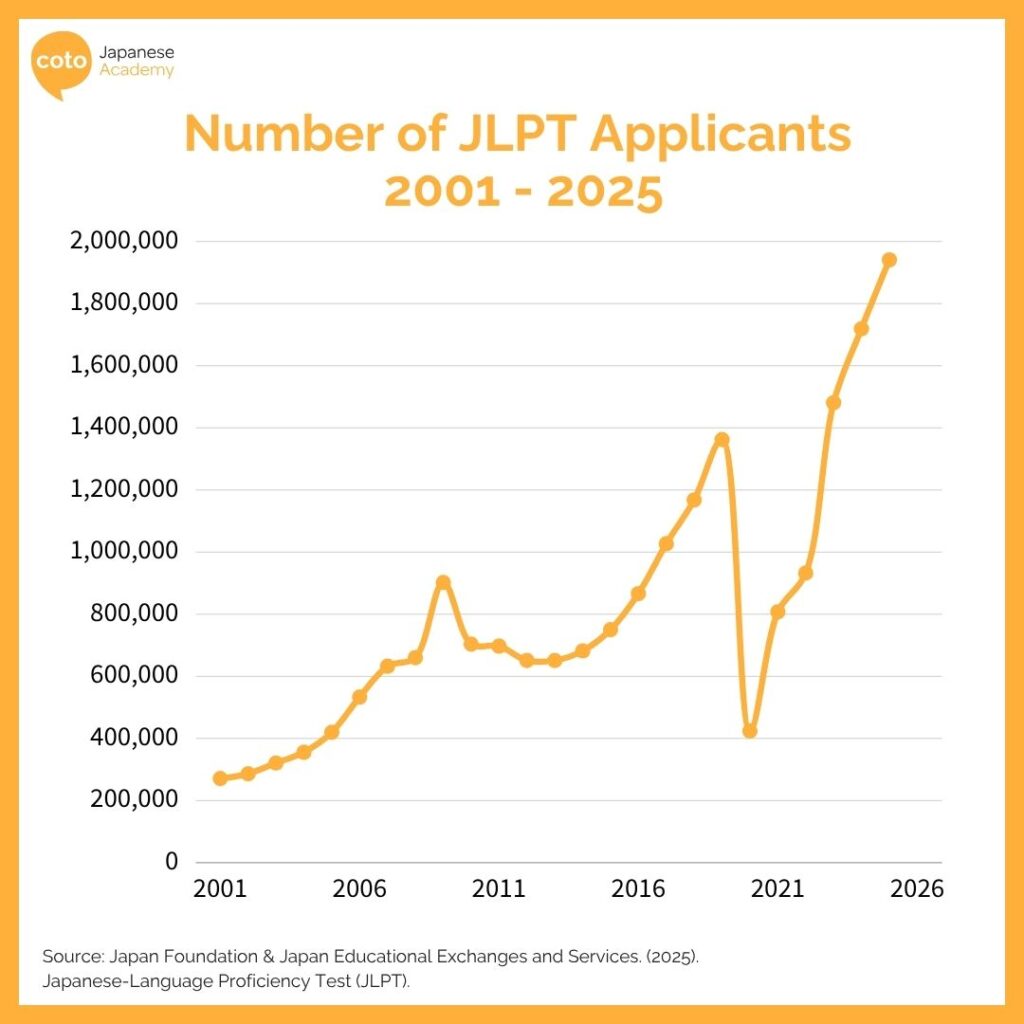
In 2025, the JLPT recorded a record 1.94 million applicants, the highest in the exam’s history. The number of people taking the JLPT has grown dramatically over the past two decades, rising from around 271,000 applicants in 2001 to nearly 2 million in 2025. This is more than a sevenfold increase.
The only major decline occurred during the COVID-19 pandemic, when applicant numbers dropped sharply in 2020 and 2021 due to test cancellations and travel restrictions. Since 2022, however, demand has rebounded strongly, with each year setting a new record for JLPT registrations.
It is also important to note that since 2026, only Japanese residents are allowed to take the JLPT in Japan.
Read more: How to Check Your JLPT Results
Average JLPT Pass Rates by Level
| JLPT Level | Pass Rate |
|---|---|
| JLPT N5 | 50.47% |
| JLPT N4 | 35.64% |
| JLPT N3 | 34.37% |
| JLPT N2 | 33.42% |
| JLPT N1 | 28.94% |
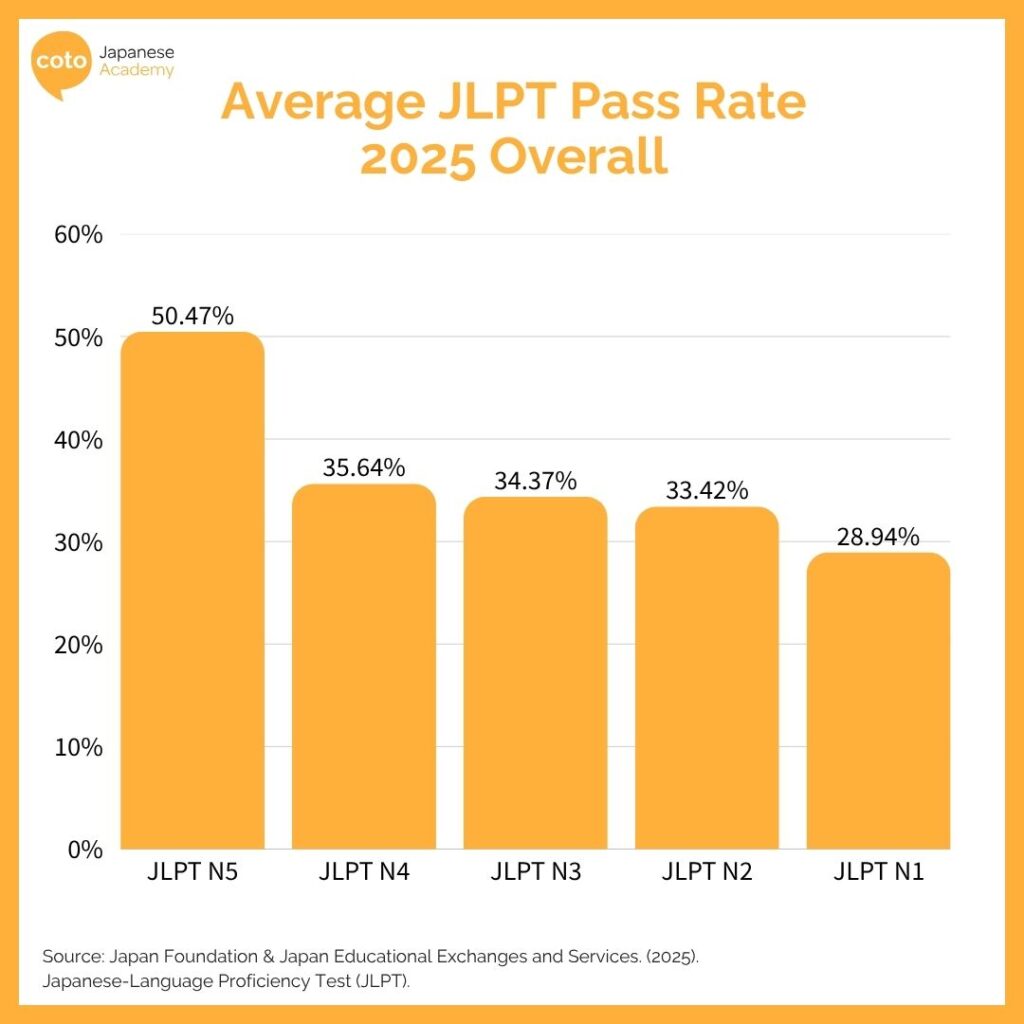
Because the JLPT becomes progressively more difficult from N5 to N1, pass rates vary considerably between levels. Beginner levels such as N5 and N4 generally have the highest proportion of successful candidates, while the advanced levels are significantly more challenging.
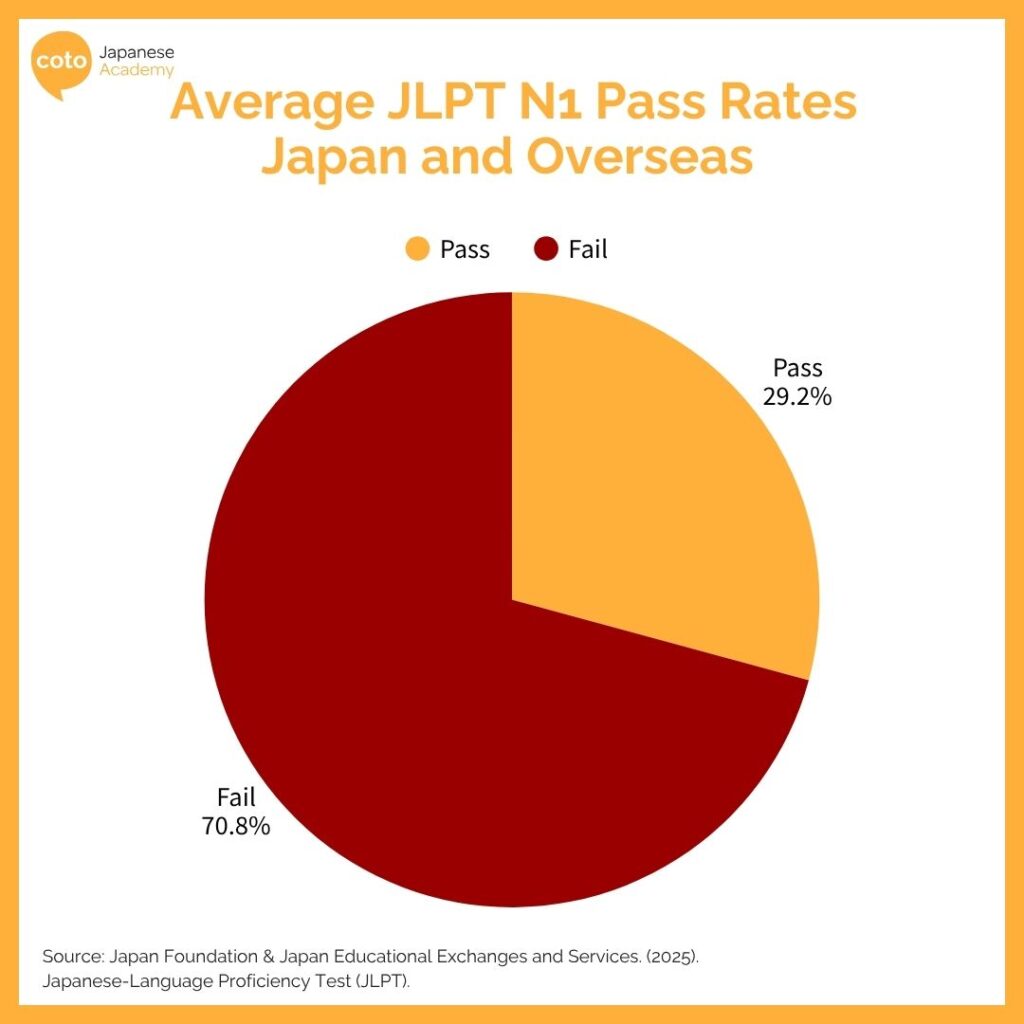
In 2025, JLPT N5, the beginner level, had the highest pass rate at 50.47%, followed by N4 at 35.64% and N3 at 34.37%. Pass rates dropped further for the advanced levels, with N2 at 33.42% and N1 — the most difficult level, requiring near-native proficiency — at just 28.94%. Combining examinees in Japan and overseas, more than half of N5 candidates passed, while only about 29% passed N1, making it the hardest level to clear.
JLPT N5 Pass Rate
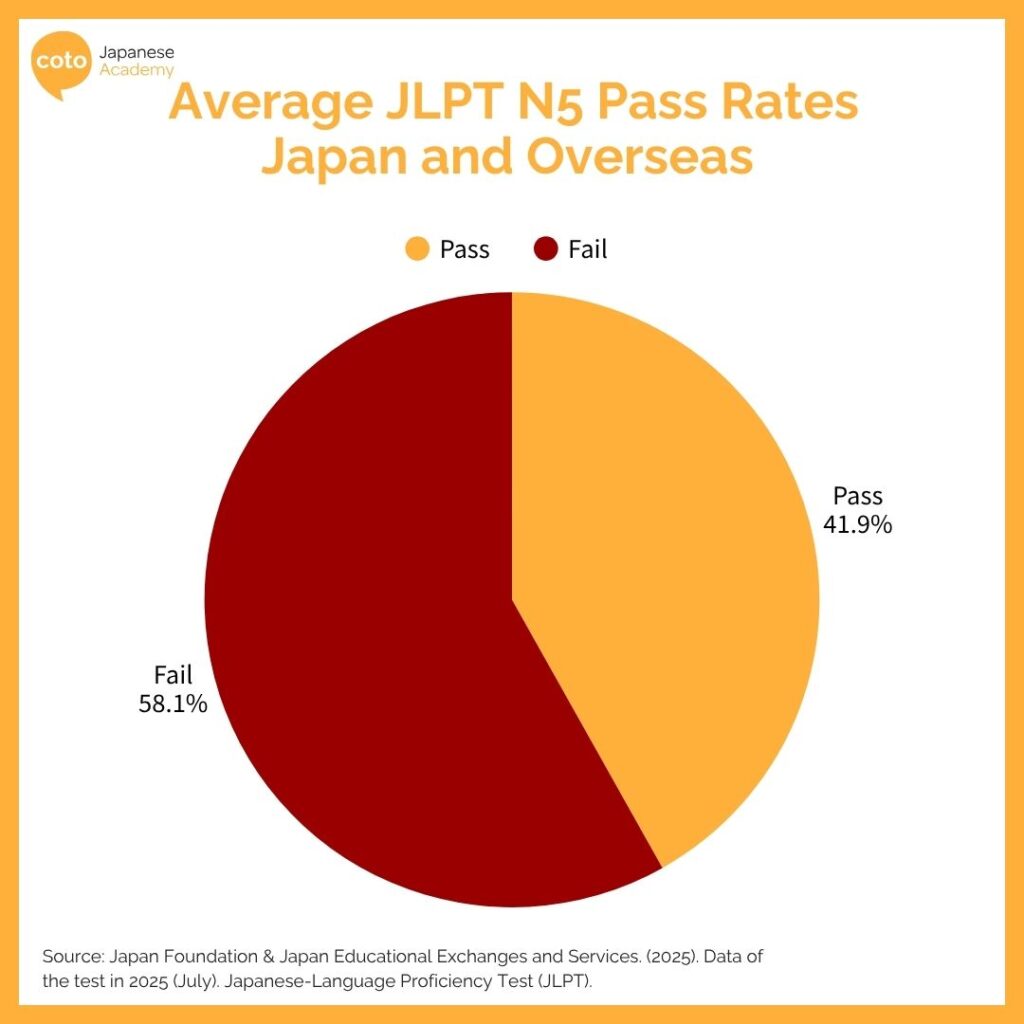
| Date | Pass Rate in Japan | Pass Rate in Japan |
|---|---|---|
| July 2025 | 57.79% | 50.26% |
| December 2025 | 53.50% | 50.03% |
JLPT N5 has the highest pass rate of all due to the relative simplicity of the material. Overall, the JLPT N5 pass rate is 50.47% in 2025. Around 50% of overseas students passed JLPT N5 in 2025, while about 55.8% of Japan-based students passed in 2025.
It focuses on basic Japanese words and phrases, simple conversations, and around 100 kanji. Studying overseas offers more opportunities to practice basic Japanese in day-to-day contexts, whether that means asking for directions to a train station or ordering a coffee. Because of the greater number of practice opportunities, Japan-based learners tend to have an easier time with N5.
Read more: Ultimate Guide to Passing JLPT N5
JLPT N4 Pass Rate
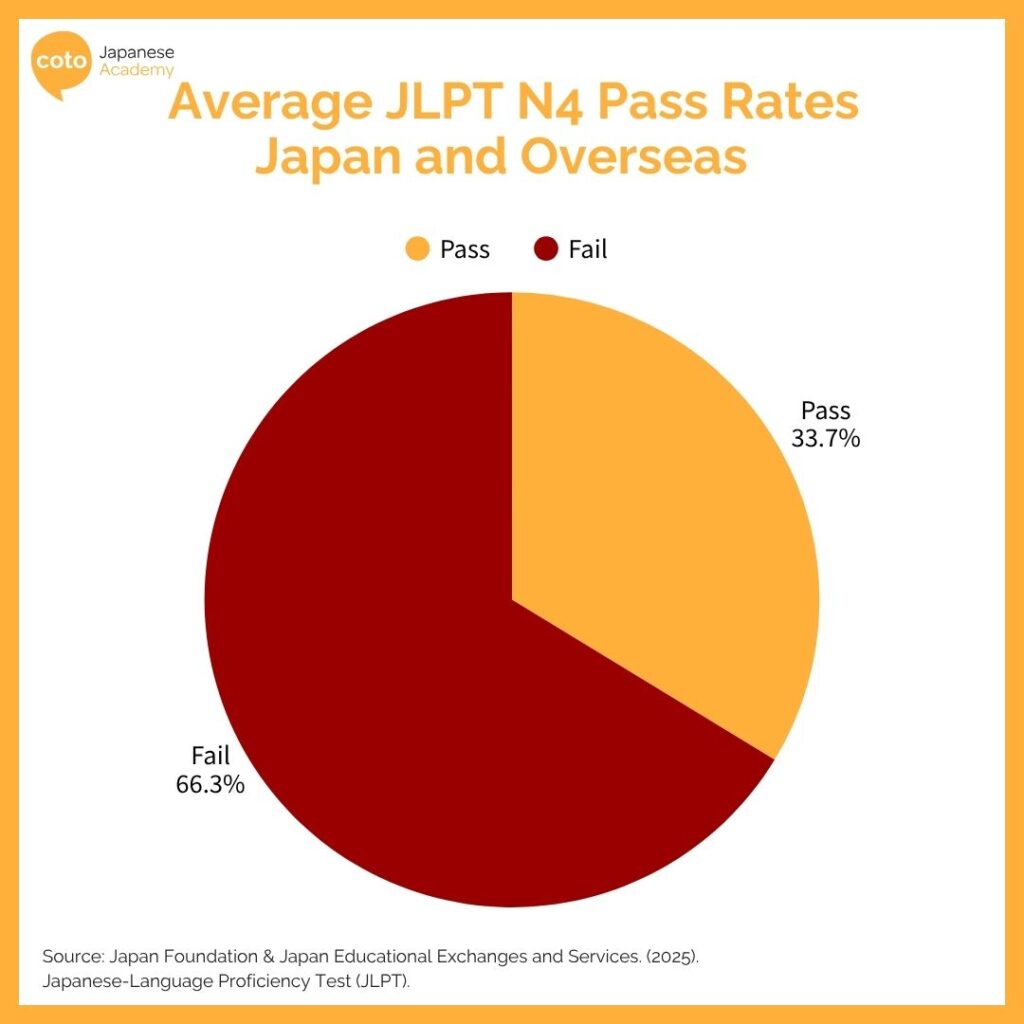
| Date | Japan Pass Rate | Overseas Pass Rate |
|---|---|---|
| July 2025 | 37.66% | 36.24% |
| December 2025 | 33.61% | 35.35% |
While it’s still fairly accessible, there is a noticeable gap in the JLPT N4 pass rate compared to N5. In 2025, the average pass rate for JLPT N4 is 35.64%. 36% of overseas students passed in July and December. Around 37% of students in Japan passed in July, and around 34% passed in December.
JLPT N4 introduces approximately 300 new kanji, along with more complex grammar structures.
Read more: Ultimate Guide to Passing the JLPT N4 Exam
JLPT N3 Pass Rate
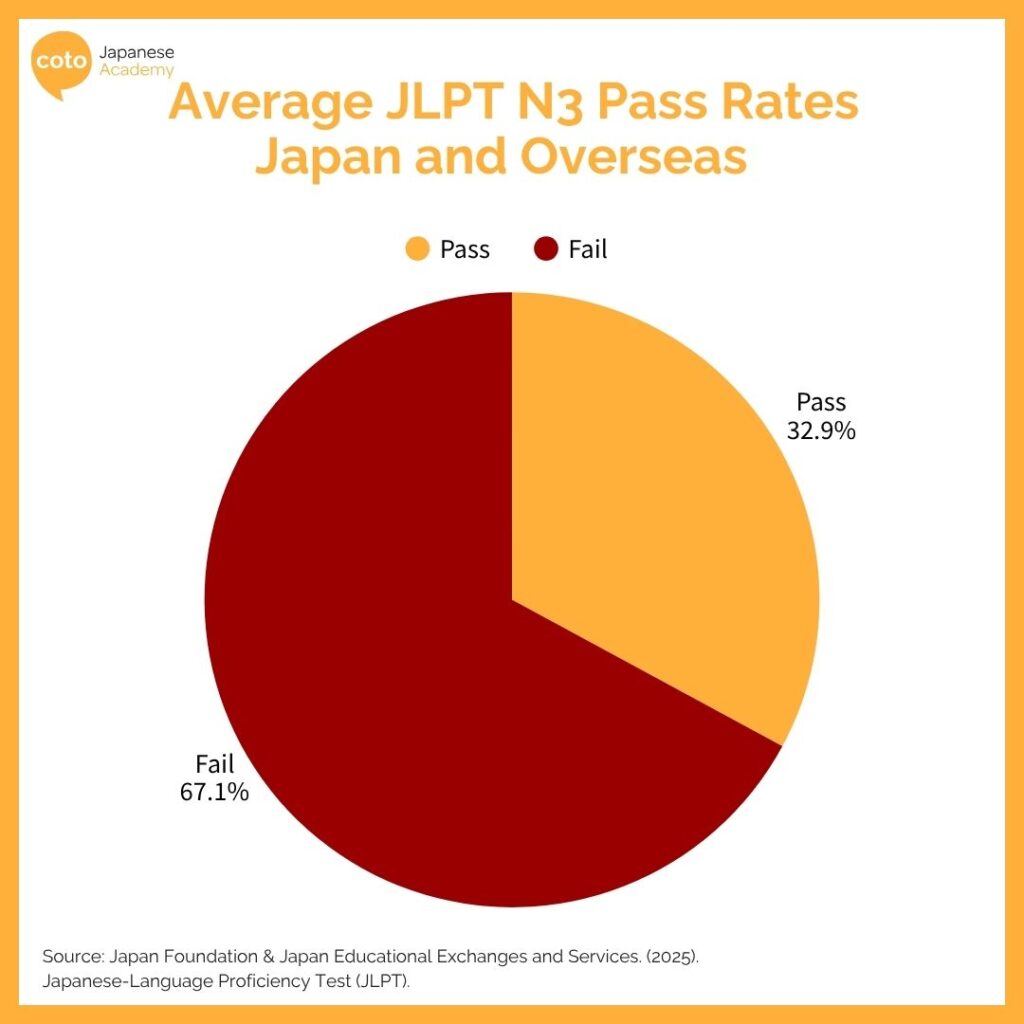
| JLPT Level | Japan Pass Rate | Overseas Pass Rate |
|---|---|---|
| July 2025 | 37.93% | 38.08% |
| December 2025 | 26.18% | 37.51% |
JLPT N3 is often described as the first major hurdle to progress, with a noticeable spike in difficulty compared to N4. Interestingly, however, higher percentages of students passed N3 than N4 in 2025. Around 38% of JLPT N3 test takers in overseas and Japan combined passed the test.
On average, in 2025, the pass rate for JLPT N3 overall is 34.37%. In December 2025, around 37% of overseas students passed, while 26% of Japan-based students passed. Once again, this split is primarily due to more students opting to prepare overseas.
N3 is the bridge between beginner and intermediate Japanese, testing your understanding of media and newspapers. The jump in vocabulary and grammar from N4 is quite steep compared to the difference between N4 and N5.
Read more: Ultimate Guide to Passing the JLPT N3 Exam
JLPT N2 Pass Rate
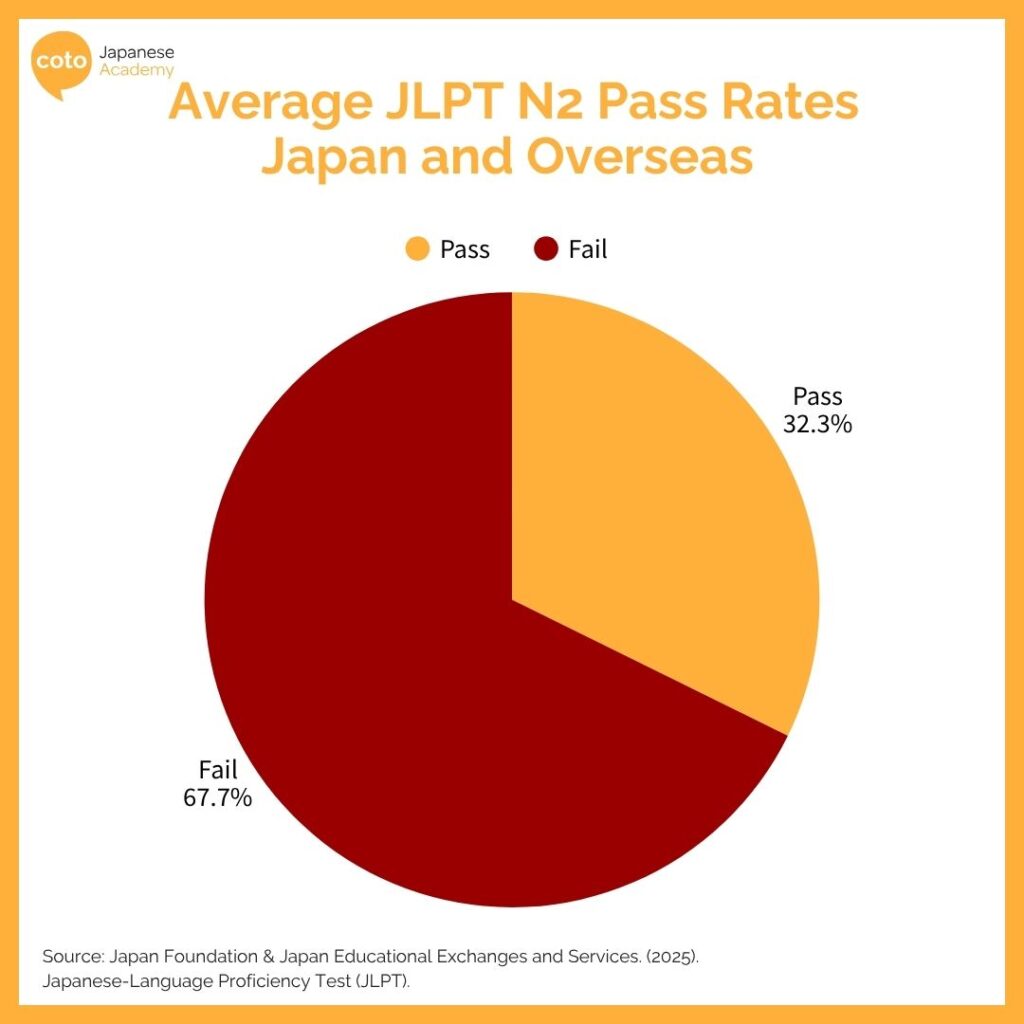
| JLPT Intake | Japan | Overseas |
|---|---|---|
| July 2025 | 39.15% | 27.65% |
| December 2025 | 40.88% | 25.44% |
JLPT N2 is considered the minimum level required for work and study visas in Japan. With that in mind, the lower pass rate compared to N3 makes sense. It measures your ability to understand Japanese in media and business scenarios, requiring an understanding of about 600 words and 1,000 Kanji.
27% of Japan-based learners passed in July 2025; 10% less than the number of passing N3 students. Meanwhile, only 25% of Japan-based students passed in December. Around 40% of overseas students passed during both sessions.
Read more: Ultimate Guide to Passing the JLPT N2 Exam
JLPT N1 Pass Rate
| JLPT Intake | Japan Pass Rate | Overseas Pass Rate |
|---|---|---|
| July 2025 | 24.87% | 30.14% |
| December 2025 | 24.04% | 34.16% |
JLPT N1 is the ultimate challenge, with the lowest pass rate of all the levels. It requires near-native knowledge of the Japanese language and is the most sought-after rank in professional and academic scenarios.
During both the July and December 2025 sessions, only around 24% of Japan-based students achieved N1 proficiency. Meanwhile, 30% of overseas students earned an N1 rank in July and 34% in December.
Read More: Ultimate Guide to Passing the JLPT N1 Exam
What Do These Pass Rates Mean for You?
Don’t be discouraged by the low national pass rate! These numbers are a reflection of the test’s difficulty, but they aren’t the ceiling for a prepared student. Keep in mind that the per-section scoring system allows you to pass overall while failing a section, but in order to be certified, you’ll need to pass every individual section.
In order to go into the JLPT prepared, it is highly recommended that you attend timed mock exams – these are not optional! These practice tests will help you practice time management under pressure and identify areas where you’re struggling. From there, you can alter your studying to make sure you’re confident with every section of the exam.
3 Steps to Drastically Increase Your Chances of Passing the JLPT
As the statistics show, the JLPT is a challenging hurdle. However, with the right strategy, you can maximize your likelihood of success. Here are three critical approaches to implementing in your study routine:
1. Study Months in Advance
The vast scope of the JLPT—spanning thousands of vocabulary words, complex grammar patterns, reading comprehension, and fast-paced listening—cannot be mastered through last-minute cramming. Designing a structured study schedule months in advance allows you to steadily build a solid foundation without burning out.
2. Do Lots of Mock Exams
Familiarity breeds confidence. To excel on test day, it is vital to take numerous timed mock exams. Practicing under real test conditions helps you internalize critical time-management strategies, condition your mental stamina, and expose your weak areas so you can patch them before the real thing.
3. Study the JLPT with Coto Academy
While preparing for the JLPT outside of Japan is completely valid, living and studying in Japan gives you an immense advantage. Constant exposure to daily local life naturally opens up endless opportunities to read and speak in real-world scenarios.
Furthermore, studying in Japan grants you access to structured, specialized language institutions like Coto Academy. By enrolling in our proven programs, you aren’t just guessing how to study. You are tapping into a system that boasts an 74.76% student pass rate, which is more than double the national average (35.06%).
As long as you are motivated to pass the exam, leverage the best available resources, and embrace the challenge, you too can become JLPT-certified. With Coto’s methodology behind you, you might just be the tipping point that raises the national average next year!
Ready to begin preparing for the JLPT? Check out Coto Academy’s JLPT Preparation Courses today!
FAQ
What is the hardest JLPT level to pass?
N1 is the most difficult level of the JLPT. It requires “near native” proficiency and will test your knowledge of complex, formal Japanese. Compared to N2, it requires much more memorization and understanding of the nuances of the language. You will need to master thousands of Kanji and the type of vocabulary used in newspapers and formal reports; you will also need to be able to understand rapid and unclear Japanese speech during the listening portion of the test.
How many people pass the JLPT N2 each year?
Roughly 65 thousand students pass the JLPT N2 each year; that being said, that number is only around 35% of all applicants. It is considered the minimum level required to work in Japan.
Is the JLPT pass rate different in Japan and overseas?
Yes, the pass rate is different between Japanese and overseas students. While students in Japan tend to have higher pass rates in the beginner courses, the more difficult levels see fewer students passing; however, a higher number of students opt to study overseas, explaining the discrepancy.
How can I improve my JLPT pass rate?
Passing the JLPT is heavily reliant on your understanding of vocabulary and grammar in context. Make sure to study these topics appropriately. Additionally, take advantage of practice exams to get a better understanding of the types of questions you will be asked at each level of the JLPT.