





When traveling around Japan, you will most likely be primarily using the Japanese public transportation system, like the trains. However, if the trains have stopped for the night or you need to get around quickly, a taxi is your best option.
Taxis are readily available throughout Japan’s cities. They’re known to be the cleanest in the world, and it’s much cheaper to hail a taxi than to pay for a ride-sharing vehicle online. The car door opens automatically for you, and the driver usually wears a suit and white gloves.
That being said, Japanese taxi drivers may not speak English, and there are some important rules to follow. How do you hail a taxi, and what phrases should you use? This guide will teach you a few essential gestures and phrases to memorize in order to get you traveling smoothly.
How to Hail a Taxi in Japan
Understanding Taxi Signs in Japan
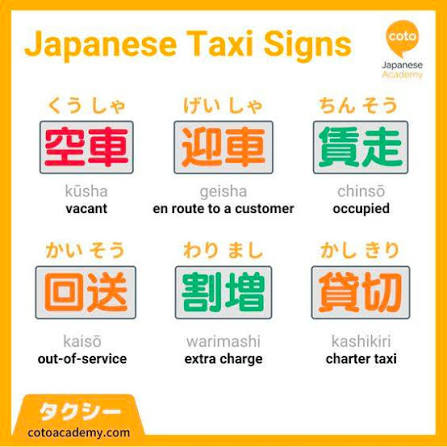
Taxis in Japan have a light/sign that indicates whether they are available to pick up new passengers. When you see a taxi with the kanji “空車 (kuusha)”, this means the car is vacant and able to be hailed. If a taxi displays 賃走 (chinsou), it means the taxi is occupied and already carrying a passenger.
Check out below some other common Japanese taxi signs.
| Japanese | Reading | Meaning / Action |
| 空車 | kuusha | Taxi is available |
| 回送 | kaisou | Taxi is unavailable / out of service |
| 迎車 | geisha | Ignore unless you booked a taxi. This taxi is going to pick up a passenger |
| 賃走 | chinsou | Someone is already inside. Taxi is occupied |
Raise your hand/arm

To hail a taxi from a street corner, step onto the edge of the street and wave or raise your hand to get the driver’s attention. It may help to look directly at the driver while doing so.
From here, the driver will put on his hazard lights and pull over the vehicle. The doors open automatically, so no need to open them yourself – just wait until the backseat is ready to enter.
Roadside vs. taxi stands
In areas with heavy pedestrian traffic, near airports and train stations, and possibly outside hotels, you may find a taxi stand. There will usually be a row of taxis already present and ready to serve travelers.
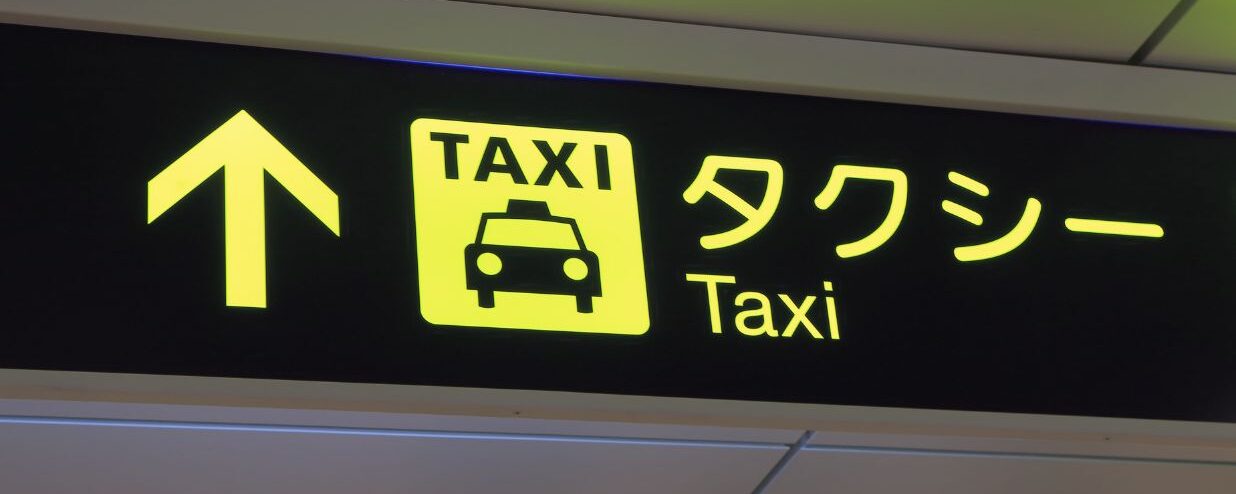
Look for signs marked with “Taxi” in English or the katakana “タクシー”. A long line of taxis is also likely a sign that a stand is nearby.
Make sure to board the taxi at the front of the line instead of the one closest to you. This ensures a smooth exit from the taxi stand and prevents a difficult parallel parking maneuver.
Let’s Watch a Video of a Taxi Conversation in Japan
You might hear different conversations when you successfully hail a taxi in Japan. Check out our video featuring Coto staff member Naka-san and another member of our staff to see what they might say when calling for a taxi in Japan.
Person A (Customer)
すみません。
Sumimasen.
Excuse me.
Person B (Taxi Driver)
はい、どうぞ。どちらまで行かれますか。
Hai, douzo. Dochira made ikaremasu ka?
Yes, of course. Where would you like to go?
Person A (Customer)
新宿駅までお願いします。
Shinjuku-eki made onegaishimasu.
To Shinjuku Station, please.
Person B (Taxi Driver)
新宿駅ですね。こちらの道でよろしいですか。
Shinjuku-eki desu ne. Kochira no michi de yoroshii desu ka?
Shinjuku Station, right? Is this route okay?
Person A (Customer)
はい、大丈夫です。
Hai, daijoubu desu.
Yes, that’s fine.
Person B (Taxi Driver)
お待たせしました。到着です。
Omatase shimashita. Touchaku desu.
Thank you for waiting. We’ve arrived.
Person A (Customer)
ありがとうございます。いくらですか。
Arigatou gozaimasu. Ikura desu ka?
Thank you. How much is it?
Person B (Taxi Driver)
千二百円です。
Sen nihyaku-en desu.
It’s 1,200 yen.
Person A (Customer)
ありがとうございます。
Arigatoo gozaimasu.
Thank you very much.
Key Phrases When You Are Riding a Taxi in Japan
While Japanese taxis are incredibly convenient, many drivers may not speak any English. In order to ensure a smooth ride, make sure to memorize the following phrases:
Getting in and stating your destination
After entering a 空車 (kuusha), you can immediately tell the driver where you would like to go. Like taxis in many countries, you simply state your destination.
Use this simple phrase:
(Place name) までお願いします。
(Place name) made onegai shimasu.
For example, if you would like to go to Shibuya 109, you can say:
渋谷109までお願いします。
Shibuya 109 made onegai shimasu.
The driver will understand and take you to Shibuya 109.
If you are going to a smaller location, hotel, restaurant, or place that the driver may not recognize, you can provide the address instead.
Japanese taxi drivers are familiar with using addresses, so having the destination written in Japanese or showing it on a map app can make communication easier.
Japanese addresses are written in the opposite order from many Western countries. They go from larger area to smaller area:
Postal code → Prefecture → City/Ward → District → Block → Building number → Building name → Room number
For taxi rides, you usually do not need to read the entire address aloud. The easiest method is to show the driver the destination on your phone or provide the address in Japanese.
Asking the driver to stop
Once you have arrived, say:
ここでおろしてください。
Koko de oroshite kudasai
When translated, koko de means “here,” oroshite means “to drop off,” and kudasai means “please.” The driver will understand and stop at your requested location.
You can also say “ここでいいです (Kokode ii desu)” which means, “Here is okay,” once you’ve reached your destination.
Paying and saying thanks
Taxi drivers in Japan usually accept multiple forms of payment, including IC cards, international credit cards, and cash.
Once you arrive at your destination and complete payment, thank the driver by saying:
ありがとうございます。
Arigatou gozaimashita.
This means “Thank you very much.”
One convenient feature of taxis in Japan is that payment is often very easy. For digital payments, you can usually select your preferred payment method on the screen in front of you. Cash is also accepted, and taxi drivers typically carry change.
If you need a receipt — for example, for company reimbursement — ask before exiting:
領収書お願いします。
Ryoushuusho onegai shimasu.
Receipt please.
Taxi Etiquette
If you are familiar with American or European taxis, Japanese taxi etiquette is quite different. Make sure to keep these points in mind before hailing one yourself.
1. Japanese taxis have automatic doors
The backseat doors of Japanese taxis are controlled by the driver and will open automatically. Once the car you’ve hailed has pulled over, you will know if you are clear to enter once the door is open.
2. Payment methods
Almost every taxi in major urban areas will accept cashless payments, like an IC card or a credit card. You can also pay cash but make sure to pay with smaller bills. Drivers may not have exact change for a ¥10,000 bill.
There are also multiple taxi payment apps, such as Taxi App Go, that make paying more seamless. Fares will be charged automatically once the ride ends if you book using one of these apps.
You will need to pay a base fare of around ¥500 or ¥750, and the price will increase based on distance and time traveled. You may also encounter late-night surcharges if you are traveling after midnight.
3. Tipping taxi drivers
Unlike the U.S., Japanese taxi drivers will not expect tips. Tipping in general is not customary and usually not expected in Japan.
How Do Taxis in Japan Calculate Their Fares?
Most taxis in Japan use a meter to calculate the fare. Prices vary depending on the region (they are typically cheaper in rural areas). In Tokyo, the fare is typically around ¥500–¥600 for the first fixed distance (usually about 1–1.3 km). After the initial distance, the fare usually increases by around ¥100 every 250–300 meters. If the taxi is moving below a certain speed, the fare may increase based on time instead of distance.
Note that taxis in Japan also impose a surcharge for late-night and very early morning rides. This is typically between 10 pm and 5 am.
Choosing Between Hailing a Taxi and Using Taxi Apps
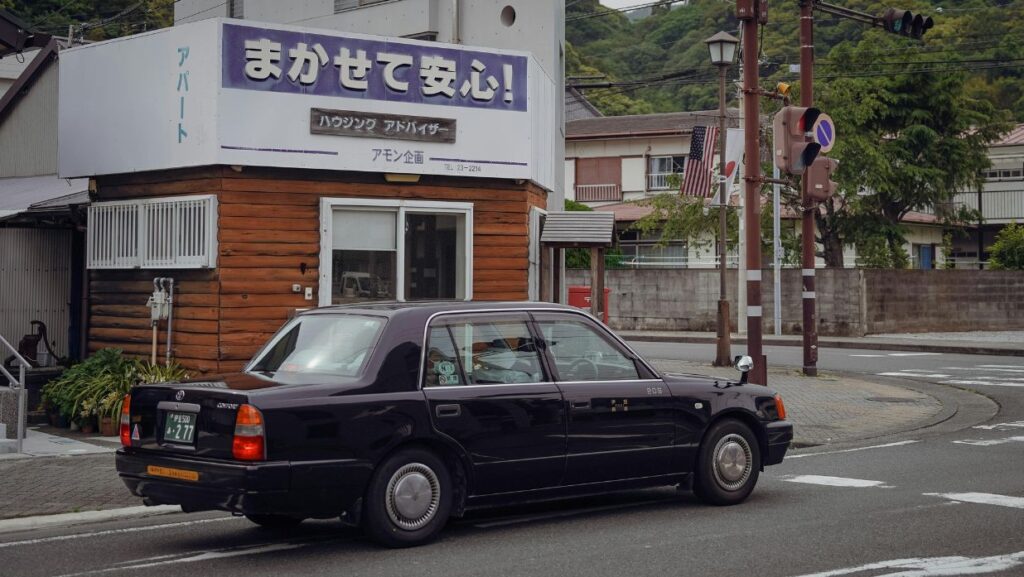
While hailing taxis and using stands are simple and convenient, many apps are also available to find quick transportation.
When to use each
If you aren’t confident in your Japanese or are confused about navigation, an app might be your best option. These apps offer cashless payment but may feature variable pricing or include extra fees.
If you are in a high-traffic area, hailing a taxi is very easy. Just look for the red “空車” light on the vehicle’s dashboard.
Taxi stands are available at most major train stations and airports. If you see one, simply wait in line and enter the first taxi in the queue once you reach the front.
Popular taxi apps in Japan
The most popular taxi app in Japan is GO, but DiDi, S.Ride, and Uber are also good choices. You can pay for your ride directly through these apps if you preload a credit card, which is convenient if you don’t have cash or enough balance on an IC card.
Just keep in mind that during periods of heavy traffic, bad weather, or after midnight, prices may be higher than usual. These apps feature “variable pricing”, which adds extra fees onto the usual fare. However, you are also guaranteed transportation by paying these fees, so whether or not it’s worth it is up to you.
Common Mistakes
As easy as the taxi system in Japan is to navigate, remember to avoid these simple mistakes to ensure everything goes well for you.
Remember not to try to open or close the doors yourself, as these are controlled remotely by the driver. Trying to open them yourself might damage the remote system, or worse: irritate the driver.
During rush hour, it might be smarter to take a train instead of a taxi. Since fares are based on time, you could end up paying a much higher price than necessary while stuck in traffic.
Smoking and eating are also forbidden in the backseat of a taxi. These cars serve many travelers each day, and nobody wants to be stuck in a smoky taxi or one with spilled food all over. Plus, Japanese taxi drivers are proud of the cleanliness of their cars; don’t make more work for them by making a mess.
Finally, there’s no need to tip the driver. They might even hand any additional money back to you.
Conclusion
With these tips in mind, you’ll be cruising around Japan easily. Enjoy traveling in the world’s cleanest taxis!
Do you want to be able to have a conversation with your driver and learn more about what working in transportation is like in Japan? Learn how to communicate in Japan with Coto Academy! If you’d like to learn conversational and business Japanese from anywhere in the world, including our own Tokyo and Yokohama campuses, fill out the form below to sign up today!
FAQ
How do I hail a taxi on the street in Japan?
Walk up to the corner, hold your hand out and wave, and make eye contact with the driver. An available taxi will have a red light on the dashboard, and the driver will pull over and open the doors automatically.
Can you use Uber in Japan?
Yes, but many other taxi apps are available. The most popular app for finding taxis in Japan is GO.
How can I pay for my taxi in Japan?
Taxi drivers accept payments through apps like GO or DiDi, but they also accept IC/credit card payments and cash.
Should I take a taxi or a train in Japan?
It depends on the situation. During periods of heavy traffic, it might be smarter to take a train or walk to your destination. However, if you have a lot of luggage or it’s late at night and the trains have stopped running, you should take a taxi.
How much should I tip my taxi driver in Japan?
You should not tip your taxi driver in Japan. They will not accept it and might hand the money back.