






Have you ever wondered how Valentine’s Day is celebrated in Japan? While we all associate Valentine’s Day with romantic dinners and roses, things take a unique turn in Japan! Forget men giving chocolates; in Japan, on February 14, women give chocolates to their loved ones. This does not always have to be their romantic partner. It could be their friends, colleagues, and family. But how did this practice originate?
In this article, we’ll show you the origins of this romantic holiday, what kinds of chocolate are given, and even recommendations on what to do and where to go with that special someone on Valentine’s Day in Japan. We’ll even throw in a recipe for how to make homemade chocolate for the love of your life as well!
Origins of Valentine’s Day in Japan
There are a few popular origin stories of Valentine’s Day. One popular theory involves the Kobe-based confectioner Morozoff in the 1930s, when they began selling chocolates in heart-shaped boxes. However, the holiday didn’t catch on with the Japanese public; instead, it was popular among the expat community.
Another popular origin story of Valentine’s Day in Japan dates back to the late 1950s and early 1960s. To fill that marketing lull, companies such as the chocolatier Mary’s began marketing heart-shaped chocolates as a way for women to confess their feelings.
Why Do Women Give Chocolate to Men on Valentine’s Day in Japan?

The reason Japanese women give chocolate to men on Valentine’s Day stems from a marketing mistranslation by the Japanese confectionery company Morinaga in the 1960s. At the time, Japan did not celebrate Valentine’s Day or have many romantic holidays. In the United States, New Year’s Day is followed by Valentine’s Day, St. Patrick’s Day, and Easter, creating a steady cycle of monthly celebrations. This is something that didn’t really exist in Japan back then.
Spotting a new market opportunity, the confectionery company Morinaga introduced Valentine’s Day as an American chocolate-giving tradition. Tapping into American culture, they thought it was clever to simply translate English slogans into Japanese.
Due to an unfortunate translation mistake, “Giving chocolates on Valentine’s Day is a way for men to express love to women,” turned into “Giving chocolates on Valentine’s Day is a way for women to express love to men.”
This is something that was frowned upon at that time, as women were expected to interact passively (instead of being the ‘aggressor’) in a relationship. However, the marketing message was a success, and it became a tradition.
Not only is it normal now for women to confess in Japan, but it’s heavily commercialized. You’ll see scenes in anime and manga that depict girls saying, “大好きだ (I really like you).” Chocolate sellers and department stores make huge profits every February from selling elaborate Valentine’s Day sweets. But despite the large displays of chocolate, people have also turned to making homemade chocolate.
Want to study Japanese with us?
Valentine’s Day in Japan vs. Other Countries
While Valentine’s Day is universally considered a romantic holiday, here in Japan, it’s usually women giving gifts to their significant others, unlike in other countries, where men are the ones giving gifts and planning the perfect date. In addition, chocolate is the main gift given on Valentine’s Day in Japan, as flowers are not commonly given.
Unlike in Western countries, White Day is primarily celebrated in Japan, though countries such as China, South Korea, and Taiwan also celebrate White Day.
Read More: How to Say I Love You in Japanese
How Japanese People Celebrate Valentine’s Day Today
Today, the tradition of women giving chocolate to men still stands; however, recently, more women have been buying Jibun-choco for themselves. Especially for those without a romantic partner, Jibun-choco can be an excellent way to show self-love, as they can splurge on expensive chocolates.
When it comes to giving giri-choco, ‘obligation chocolate’, fewer people are taking part in this practice. This could be due to the stress it places on the givers, who need to spend a lot of money on chocolates to give to their male bosses and coworkers. Similarly, this adds stress to recipients, who might feel obligated to give back to their female coworkers on White Day.
Recently, there has been a trend of women buying 推しチョコ (oshi-choco), roughly translated as “chocolate for your favorite.” This trend involves taking and posting pictures of chocolates alongside merchandise of their favorite idol group member or fictional character. This trend has become so popular that confectioners have even started making Oshi-choco products, including boxes in specific colors!
Types of Valentine’s Day Chocolate in Japan

Most of the time, you will see large displays of chocolates in department stores and grocery stores in Japan during the month of January. Some popular stores you can visit to get gifts are Isetan (伊勢丹), Marui (丸井), and Mitsukoshi (三越). While Valentine’s Day isn’t just a day for romantic love, not all chocolates are viewed the same. Women are expected to give chocolates to their coworkers, classmates, friends, and families.
Depending on the relationships they have, chocolates are divided into several types. There are also different kinds of meanings behind the chocolates given.
1. 本命チョコ (Honmei-choco)
本命 or honmei can be translated as “true feelings” in English. Honmei chocolate is a symbol of true love and is offered to a boyfriend or husband. Women will often prepare the chocolate by themselves, investing time and effort. This gesture represents the effort that you’re willing to put in for that special someone. The honmei chocolate also serves as a way to confess feelings to a loved one.
Honmei chocolate is typically specialty chocolate that is fancier and costs more than regular chocolate. Instead of buying them in chocolate stores, some women will instead make them at home.
Throughout the past years, confectionery shops have also started selling special molds and DIY confectionery boxes for those who do not have much time to make homemade chocolate from scratch, yet still want to give it a try. This is the true love offering reserved for your special someone. Think homemade masterpieces or premium chocolates.
2. 義理チョコ (Giri-choco)
Giri-choco, which is “obligation chocolate,” is given to friends, colleagues, and bosses out of social courtesy. The term 義理 or giri means “obligation”.
Giri chocolate is usually simple and cheap, like what you would get at a supermarket. Still, because ‘friends’ and ‘colleagues’ are a broad group of people, the total cost can be quite expensive.
Giri chocolate is given from women to their male acquaintances, bosses, distant family members, or work colleagues. In Japan, the custom of gift-giving is extremely important. However, this normalized expectation can feel like a heavy social obligation.
Women might be manipulated to feel guilty if they can’t afford (or simply don’t want) to buy chocolates for their coworkers. To avoid any sexual harassment or power abuse, a lot of offices have banned this practice.
3. 友チョコ (Tomo Choco): Friendship Chocolate
Tomo comes from the word tomodachi, which means “friend” in Japanese. Tomo Chocolate is given amongst female friends as gratitude for the friendship.
It is usually not only given as gifts, but these friends would spend time with each other during that particular day by having a meal together and sharing the chocolate with each other. This is usually very popular among high school girls.
Tomo Chocolate may not necessarily be chocolate, but can also be baked goods such as cookies and cakes.
4. 自分チョコ (Jibun Choco): Self Chocolate
Jibun choco (自分 meaning “self”) is chocolate that you buy for yourself. Many women often feel stressed and unappreciated during this day in Japan because of the burden of buying these gifts for others, primarily men.
To compensate, they would often instead just buy chocolate for themselves as a well-deserved little treat.
5. 逆チョコ (Gyaku Choco): Reverse Chocolate
Gyaku chocolate, also known as “reverse chocolate,” is a new type of gift-giving. It is usually gifted by men to women on Valentine’s day which is not typically seen in Japan.
Nowadays, we can count at least more types of given chocolate, each with its own meaning:
- 百合チョコ (Yuri-choco): Chocolate given from a woman to another woman.
- 自分チョコ (Jibun-choco): Self-love chocolates! There is a growing trend of women treating themselves to delicious treats.
- 逆チョコ (Gyaku-choco): Reverse chocolate, when a man gives chocolate to a woman on Valentine’s Day. This trend isn’t as well-known, however.
- ホモチョコ (Homo-choco): Chocolate given from one man to another.
White Day vs. Valentine’s Day in Japan
One month after Valentine’s Day’s chocolate frenzy, Japan celebrates another unique event: ホワイトデー (Howaito Dee), or White Day. While February 14th sees women taking the lead with chocolate gifts, March 14th offers men a chance to reciprocate the affection or obligation!
On White Day, you will see men giving chocolates and sweets to women, though other popular gifts include fashion items and accessories. As a rule of thumb, it’s generally expected that men give triple the worth of gifts to the recipient. This rule is known as 三倍返し (さんばいかえし), or sanbai-kaeshi.
What to Do and Where to Go on Valentine’s Day in Japan
Aside from giving chocolates, this is also an excellent opportunity to spend time with your significant other, and asking them out on a date in Japan is easy! We have some recommendations on what to do and where to go on this special day:
1. Go on a romantic dinner date
This is a classic choice for those who love to splurge on their significant other. What’s more romantic than taking your special someone to a nice restaurant where you both can wine and dine on some yummy food? There are so many dinner options available in Japan that it’s difficult to choose just one!
We recommend going to restaurants with Valentine’s Day promotions, such as at the Grand Hyatt Hotel in Tokyo, though there are cheaper options available as well.
2. Take in the city skyline at night together
What could be better than viewing the city skyline together on Valentine’s Day? Many skyscrapers in Japan offer breathtaking views, such as Tokyo Tower, Tokyo Skytree, and Harukas 300 in Osaka. Generally, admission times go until 10 pm, ensuring you’ll get the best night views of the city with your date. Some towers have cafes on the top floors, so you can grab a drink or a snack while enjoying the city lights and landmarks together!
3. See the winter illuminations
Surprisingly, there are still some winter illuminations running from December through the end of February! Some illuminations, such as the ones in Tokyo Snow Dome City and Yebisu Garden Place, are still on display, so this is a perfect chance for you and your date to walk around the city at night and admire the lights. Can it get more romantic than holding hands and walking around the city under the winter lights? Check out our favorite winter illumination spots in Tokyo.
4. Go to a chocolate fair
Planning to buy novelty chocolate together? Why not take your significant other to a chocolate fair? Many chocolate fairs in Japan showcase both local and international chocolate brands, where not only do you get to buy chocolate, but you can also sample exclusive sweets made with chocolate! Here are a few recommendations for chocolate fairs in Japan:
- Isetan Shinjuku Salon du Chocolat 2026 (Tokyo)
- HILLS SWEETS SELECTION 2026 (Tokyo)
- Takashimaya Amour du Chocolat 2026 (Tokyo, Osaka, Yokohama, Kyoto)
- HANKYU Valentine’s Chocolate Expo 2026 (Osaka)
- Chocolat Promenade 2026 (Nagoya)
How to Make Homemade Chocolate
If you want to challenge yourself with some sweet homemade chocolate, here is what you need to do
Ingredients
- Chocolate bar (dark milk or white, depending on your preference): Choose high-quality chocolate with at least cocoa butter content for the best results
- Cooking oil (vegetable or canola): A little oil helps prevent the chocolate from scorching
- Optional: Toppings of your choice
Steps
- Prepare your mold: You can use silicone molds, candy molds, ice cube trays, or even small paper cups lined with plastic wrap. Make sure they are clean and dry
- Melt the chocolate: Break the chocolate bar into small pieces and place them in a heatproof bowl. Set the bowl over a pot of simmering water, making sure the bowl doesn’t touch the water. Avoid letting water get into the chocolate, as this can cause it to seize
- Stir gently: Keep stirring until the chocolate is melted and smooth. Remove the bowl from the heat and stir in a little cooking oil (about ½ teaspoon ) until thoroughly combined
- Add your mix-ins: If using, add your chosen mix-ins now and stir gently to distribute them evenly
- Pour the chocolate: Carefully pour the melted chocolate into your prepared molds. Fill each mold almost to the top
- Refrigerate: Place the molds in the refrigerator for an hour or until the chocolate is set
- Unmold and Wrap it Up: Once set, gently pop the chocolates out of the molds, wrap your delicious homemade creations, and package them for your loved one
Chocolate Recommendations
In Japan, the most common chocolate bought during Valentine’s Day is
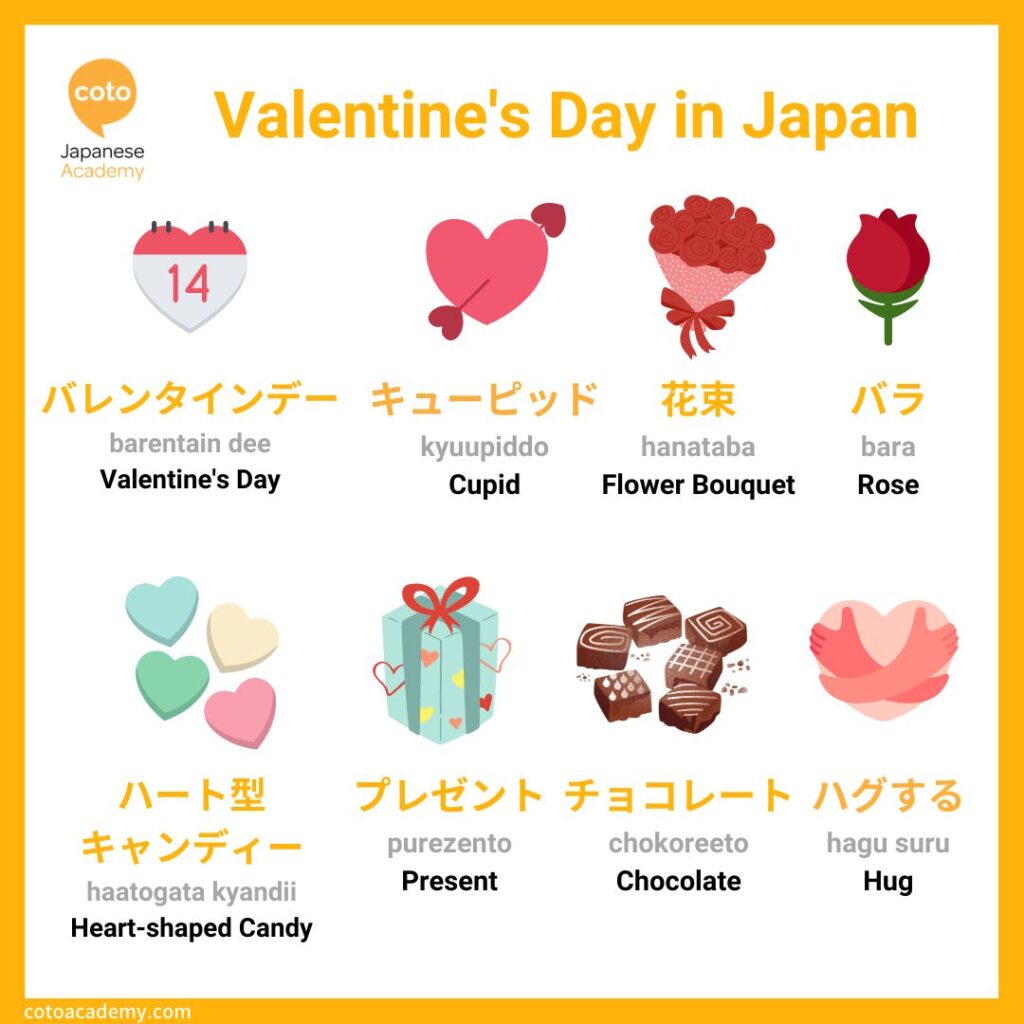
- ハート型のチョコレート (Haato-gata no chokoreeto): Heart-shaped Chocolate
- チョコレートトリュフ (chokoreetotoryufu): Chocolate truffles
- イチゴチョコ (ichigo choko): Chocolate-covered strawberries
- チョコレートの詰め合わせ (chokoreeto no tsumeawase): Chocolate assortment
- 生チョコレート(namachokoreeto): Nama Chocolate
Conclusion
Valentine’s Day in Japan is a great blend of imported tradition and unique local culture. Even if you are not celebrating it with a partner, the different types of Valentine’s Day chocolate in Japan mean you can make this day a celebration of love with your friends — and even yourself!
If you want to dive deeper into Japanese culture and gain the language skills needed to navigate romantic holidays or professional social cues, join us at Coto Academy. Our brand-new Shinjuku campus offers flexible, conversation-focused lessons that help you move beyond the textbook and into real-life interactions.
FAQ
Do men give gifts on Valentine's Day in Japan?
Typically, no. On Valentine’s Day, it’s usually the women giving chocolates to the men, though men giving women Gyaku-choco, reverse chocolate, is a thing, albeit not as popular.
Do I have to participate in Giri-choco?
No! The pressure is decreasing, and many companies ban it to avoid unwanted advances. Choose what feels comfortable for you.
What kind of chocolate is popular?
Anything goes! From classic truffles to trendy matcha flavors, personalize it to match the recipient.
Are there any other Valentine's Day traditions?
Couples might go on dates, exchange messages, or enjoy special Valentine’s Day menus at restaurants.
What if I’m single on Valentine’s Day?
You can still participate in giving Tomo-choco to your friends, or even Jibun-choco to yourself! You can even join singles’ events in your area to find love! Valentine’s Day doesn’t have to be lonely.
Is Valentine’s Day romantic in Japan?
Just like Valentine’s Day all over the world, it’s regarded as a romantic holiday in Japan. You will often see couples go on dates, give gifts, and more.
How much do I need to spend on chocolate?
You don’t have to buy extremely expensive chocolate if it’s going to take a lot out of your wallet. Of course, you want to make sure you get the best chocolate for your recipients, but it’s best to spend within your budget on Valentine’s Day.
What should foreigners do on Valentine’s Day in Japan?
If you have a significant other from Japan, consider making them an Honmei-choco to show your love and appreciation for them. You might also want to take them out on a date if you want to go the extra mile.