






Notice me, senpai. Why did the term senpai become so popular outside of Japan? Most people who have never set foot in Japan, let alone studied Japanese, are well aware of the word senpai (先輩), which is often easily read as sempai. You have probably seen variations of “I hope senpai will notice me” online. This line doesn’t come from any specific anime or manga; rather, it was picked up by users on social media or fan blogs to play on tropes of romance between senpai and kohai (後輩).
So, this internet trend shows that many non-Japanese speakers understand that senpai means superior or senior. However, the internet meme also implies that a kohai has a romantic infatuation with their sempai. Due to them seeming more experienced and mature, a power asymmetry is created that the kohai must overcome, driving them to ask or hope for the senpai’s attention. This type of senpai/kohai dynamic is popular in certain Japanese anime and pop culture.
I would argue that similar tropes are popular in other nations, such as the United States, since crushing on someone who is a grade level above is not uncommon. But, equivalent terms like senior or superior are not common in English, especially as a way to address someone. This is likely why the word, senpai, caught on since it’s much more frequent, and you could actually call someone senpai. However, the term is not inherently romantic.
In this article, I am diving deep into the meaning and cultural phenomena behind senpai.

What is The True Meaning of Senpai and Kohai?
Senpai (先輩). The word has a bit of nuance since it’s used in different social contexts. But breaking down senpai 先輩 means breaking it down to two kanji characters. 先(sen) means before, prior, or former. The next kanji, 輩 means mate or comrade. Thus, the word mainly refers to someone who is:
- Older, more experienced, in a higher social position, etc., regardless of age.
- Have entered the same school or workplace earlier (and there is a culture of approaching them with polite manners and speech).
A higher level of the term senpai used to address someone much more senior than you is daisenpai (大先輩).
Daisenpai is used for those who are much older, have a lot more experience, or are significantly more senior. It is sometimes used to describe someone who is an alumnus of your school or university. This term is not as common, and you never use it in the secnd person, unlike sempai.
What about kohai (後輩)? 後(ko) in the word 後輩, kohai, means ‘after’. Thus, the word refers to those ‘who come after’ the senpai in any given situation. The word refers to the following:
- People who are younger, less experienced, or in a lower social position in relation to the senpai.
- It is not really used to address someone but rather as a way of describing someone, for example, 「たけしは私の後輩です。」“Takeshi is my kohai.”
When Is The Word Senpai Used In Japan?
In English-speaking internet culture and anime memes, “Senpai” is often used in a romantic context (“I hope senpai notices me”). However, in real-life Japan, it is purely functional and respectful. Just like the common honorifics -san, -chan, and -kun, you can use -senpai as a suffix attached directly to a name. Using it to your boss or a senior student is a standard sign of good manners, not necessarily an expression of affection!
Senpai in School Environment
Generally speaking, senpai is not used until junior high school to address classmates who are in higher grade levels. Oftentimes, there is a senpai and kohai tension where the kohai must maintain optics of their senpai and be on their best behavior whenever they are around. This is mostly the case for both junior high and high schools, but the relationship is at its strictest in club activities.
Bukatsu (部活)
In bukatsu or school extracurricular clubs/circles, such as baseball, basketball, soccer, Kendo, and so on, the hierarchical relationship between kohai and senpai can be at its most rigid. Ordinarily, members who have joined earlier are considered senpai, regardless of skill level. Kohai must give their utmost respect and may even need to address them as senpai, either alone or with their last name, like “Yoshida-senpai,” for instance.
Certain clubs may have stricter customs regarding activities kohai must do for the club and their senpais, such as having to clean before and after club activities. It is also customary for kohai to use 敬語(keigo) with their sempai.
Senpai in Work Environment
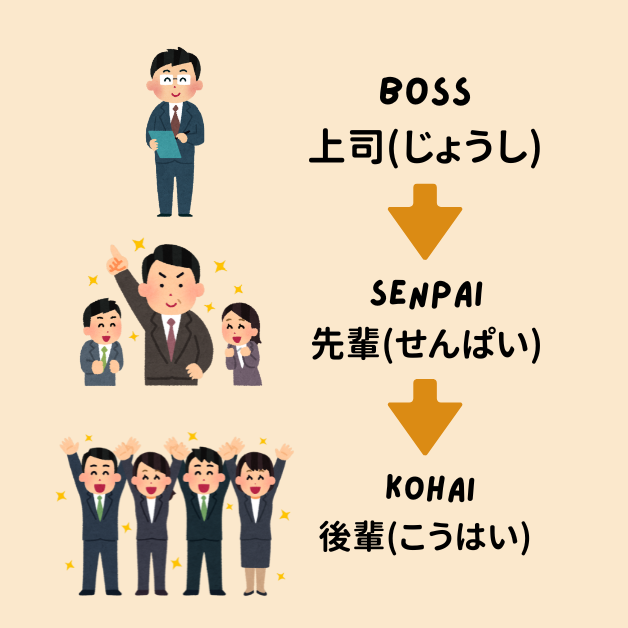
Once you become a working adult, senpai takes on a role more about looking after their juniors, and the relationship isn’t as rigid as it was for students. When called “senpai,” many people feel a sense of responsibility to raise and look after their kohai.
However, it is possible for 2 people working at the same company to both consider each other as senpai. In many cases, this is because one started working at the company first, while the other is older in age. But age is less of a factor in who is a senpai in this day and age.
Traditionally, Japanese employees stay in one company for their whole career. So, when you join as a 新卒 (shinsotsu), or newly graduated hire, you would be the youngest in the company. Promotions were given for longer stays rather than for individual accomplishments. As a result, senpai were almost always older and stayed in the company longer. But, as work attitudes change, the age and social dynamics reshape as well. Now it’s not uncommon for younger but more experienced employees to be working at the same company as someone who is older.
In the current work culture, experience in the company or industry is what determines a senpai rather than age. Unlike school, you also don’t often address someone as sempai; it’s more common to use it when speaking about them to someone else. Overall, companies are getting even more relaxed about hierarchies and are even adopting flatter structures. So, in more and more companies in Japan, the necessity of knowing who your senpai is is less of a concern.
Interestingly, while the senpai-kohai dynamic remains an important part of traditional Japanese culture, it often shifts once you enter a professional corporate structure. In modern workplaces, once a younger staff member is promoted, the relationship transitions from social seniority to a formal reporting line. In this context, the senior becomes the joushi (上司), or supervisor, while the team members they manage are referred to as buka (部下), meaning subordinates or direct reports.
Other Circumstances Where You Use Senpai
Senpai and kohai relationships do exist outside of work or school since the word can describe anyone who is more senior in virtually any field. Certain activities, such as martial arts, may require you to be aware of who your sempai is. Most Japanese martial arts use a belt ranking structure. This creates a very easy-to-understand system where the person whose belt is higher would be your sempai. Within the higher ranks, the concept of senpai/kohai is not too important, but you should respect those with more experience.
You wouldn’t ever need to call someone sempai, but you would treat them with higher regard by using more respectful language and listening diligently to their advice. Like work, the concept of senpai is not so rigid, and their role is more about guiding their less experienced kohai.
How to Use the Term “Senpai” in Japanese
Now that we’ve cleared up the “romantic” misconceptions often seen in pop culture, it’s clear that senpai and kohai are primarily functional tools for navigating Japanese society. Now, let’s shift our focus to a linguistic perspective and look at how these terms actually function within the Japanese language.
1. Calling Someone “Senpai.”
The first is to use -senpai as a formal suffix attached to their surname, such as “Yoshida-senpai.” This clearly acknowledges their seniority and your role as their junior.
However, in a professional corporate environment, the social lines often soften. It is equally common for working adults to use the standard honorific -san, as in “Yoshida-san.” This maintains a professional distance while still showing appropriate respect, making it a versatile choice in the office.
2. As Its Own Now
The second way is to directly refer to someone as “sempai” without attaching their name. This is because 先輩 itself is an actual noun. What’s important to pay attention to is not just what you call someone but also expressing respect toward them.
For example, when someone asks you how well you get along with your senpai, if you don’t feel like mentioning their name, you an say:
先輩と仲良くしています。
Senpai to nakayoku shite imasu.
I get along well with my senpai.
There isn’t a need to use honorific language, but it’s wise to at least use polite forms such as 「です」 “desu” and 「ます」 “masu.” If you do so, your senpai will be happy to teach you about the job.
However, there are some people whose relationship with their seniors is more like “coworkers,” even if they call them “sempai” as a hierarchical formality. When compared with the boss, it’s a much closer relationship. Sempai might be seen as warm and encouraging, especially when your boss is giving you a hard time.
3. Describing Someone as Senpai or Kohai
Most of the time, sempai is used to describe who someone is in relation to you. Such as saying:
山本さんは仕事の先輩で、はるとは後輩です。
Yamamoto-san wa shigoto no senpai de, Haruto wa kouhai desu.
Yamamoto-san is my senpai from work, and Haruto is my kohai.
チームの中には2人の先輩がいます。
Chiimu no naka ni wa futari no senpai ga imasu.
My team has 2 senpais.
In Japanese, the word is pretty flexible (outside of school); you can use it as a descriptor for anyone who has more experience in any field. You can also refer to someone as sempai who has more industry experience, マーケティング業界の先輩 (“marketing industry senpai”), even if you have been in the same company longer.
4. As a Second-Person Pronoun
In Japanese, the word senpai also functions as a respectful second-person pronoun. While English speakers often rely on “you,” Japanese speakers prefer to address people by their titles. Using “Senpai” on its own allows you to refer directly to your senior without the need for a name or the potentially abrasive pronoun anata.
The same thing can’t be applied the other way around for the term kohai (後輩) . Because kohai is a neutral descriptor rather than a respectful title, addressing a junior directly as “Kohai” can come across as condescending, as it overemphasizes their lower social standing. To maintain a natural and polite tone, always address your juniors by their name, followed by -san or -kun.
5. As a First-Person Pronoun
What about using senpai as a first-person pronoun? In short, it’s actually not common to use senpai as a way to say “I” in Japanese. The one exception where you can hear someone refer to themselves is in anime or a very specific, playful, or flirtatious context. In this case, the speaker is intentionally being “cheesy” or acting like a protective older sibling figure. In a real-world office or school setting, however, doing this would likely be met with confused stares or seen as a joke that didn’t quite land.
先輩に任せて!
Senpai ni makasete!
Leave it to your senpai!
Final Thoughts: Do Japanese Use “Senpai” Often Anymore?
As a rigid term strictly used whenever you’re speaking or referring to someone who is senior to you, it is not common at all. However, more flexible and casual usage of the word is very common. You would often say it when you like to express respect to someone who has more experience than you. You could say, 「先輩なので、はやてさんから学びたいです。」” I would like to learn from you, Hayate, because you are my sempai”.
If you’re curious about how senpai is used in real dialogue or anime, and something doesn’t quite make sense, it’s easy to translate with tools like Quillbot a phrase or sentence to get a clearer feel for the nuance.
When it comes to work colleagues, though it could depend on the company, most people view each other as fellow coworkers, and maintaining a rigid senpai/kohai relationship is rarely observed. Even referring to other colleagues as sempai in the 3rd person is becoming less common. It is still a useful term and can be an easy and respectful way to describe people who have more experience than you.
Ready to Start Your Japanese Learning Journey?
So what’s next? Learn how to speak Japanese and go beyond just knowing how to use “senpai.” You might want to know more about how to form sentences or expand your vocabulary.
Kickstart your journey with Coto Academy, where fun, conversation-focused classes are designed for beginners. Choose from intensive, part-time, or online Japanese courses tailored to help you reach your goals faster!
Want to study Japanese with us?
FAQ
What is the meaning of Senpai?
Senpai means senior or superior. It refers to someone who could be older, more experienced, or in a higher social position.
Does Senpai mean dad, father, or father figure?
No, senpai does not mean father nor imply any type of father figure dynamic. It does not inherently carry additional connotation beyond just senior or upperclassmen.
Can I call a girl Senpai? Is there a female version of senpai?
Yes, you can call or refer to females as senpai. The term senpai is not gendered.
Is it Senpai or Sensei?
Senpai is not the same as sensei. Sensei means “teacher,” while senpai means “senior”. In a school setting, a senpai would be an upperclassman. In the workplace, they are colleagues who joined before you.
Is Senpai respectful?
Yes, the term is considered respectful and is used to express or acknowledge that someone is older or more experienced. You often speak to someone who is your senpai with more respectful language in Japanese.