






To ask someone not to do something in Japanese, you typically use the JLPT N5 grammar pattern 〜ないでください (naide kudasai). It is similar to saying “please do not do (something)” in English and is a polite way to request that someone refrain from an action, though it can also be framed as an instruction, advice, or recommendation.
Basically, using ないでください, you are asking a person not to perform a certain action. It is the opposite of 〜てください, which is used to ask someone to do something.
Let’s learn how to use this JLPT N5 grammar point by breaking down its meaning, structure, and example sentences.
Make Sure to Watch Coto Academy’s YouTube Video About 〜ないでください (~Naide Kudsai)
Before you continue reading, why not take a moment to watch a quick YouTube lesson with our Japanese teacher, Yuka-sensei:
Meaning of 〜ないでください (~Naide Kudasai)
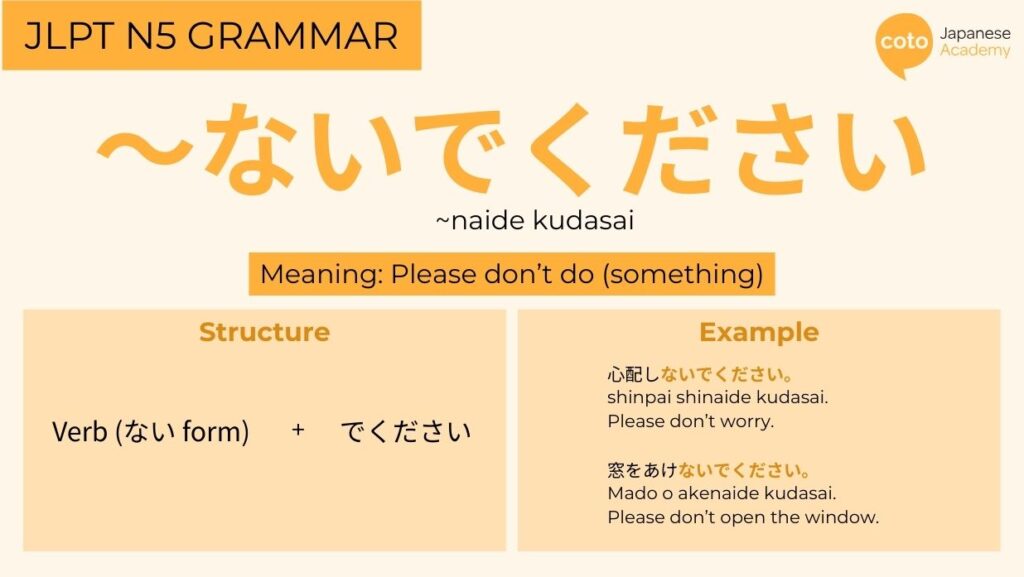
〜ないでください (naide kudasai) is a way of politely asking or requesting someone not to do something. Since it includes the phrase ください (kudasai), meaning “please”.
Although 〜ないでください is technically a polite form, it often carries a commanding tone. In Japanese culture, which values indirectness for the sake of harmony, using this in the wrong context can be an unintentional social blunder. For example, if you are speaking to a superior, such as a boss or a teacher, using 〜ないでください can sound overly direct or even bossy.
Generally, you use this expression in the following situations:
1. To kindly request that someone refrain from something
This is the most common “supportive” use of the phrase. It is often used when you are looking out for someone’s well-being or asking for a small favor that benefits them or the relationship.
無理をしないでください
Muri o shinaide kudasai
Don’t push yourself too hard.
2. Giving precautions or warnings
This usage is preventative. It’s meant to ensure someone’s safety or to prevent a mistake from happening before it’s too late.
忘れないでください 。
Wasurenaide kudasai.
Please don’t forget.
3. As a softer way of denying or not giving permission
Instead of saying a flat “no” (which is very rare and often rude in Japanese), this form is used to steer someone away from an action they are about to take.
For example, if a friend is visiting your house and wants to open the window, but the AC is on, you can say:
窓を開けないでください 。
Mado o akenaide kudasai.
Please don’t open the window.
3. To prohibit
On signs or in official announcements, the “politeness” of kudasai functions more like a formal rule than a personal request.
ここにゴミを捨てないでください
Koko ni gomi o sutenaide kudasai
Please do not litter here.
Read more: Difference Between Kudasai and Onegiashimasu
Want to study Japanese with us?
How to Form 〜ないでください (~Naide Kudasai)
〜ないでください is actually a grammar pattern consisting of two parts.
- The first part 〜ないで (~naide) is the verb conjugation into negative て-form.
- The second part,ください (kudasai), is a polite way of making a request, similar to saying “please.”
Here is how it’s structured in actual sentences.
| Type | Structure |
| Verb (negative) | Verb (negative stem) + ないでください |
Since 〜ないでください (naide kudasai) already has part of the negative verb suffix, you will only need to attach the verb stem in negative form. For example,
聞く (kiku) → 聞か (kika) + ないでください (naide kudasai) → 聞かないでください (Please don’t listen)
If you don’t know how to conjugate a verb into its negative form, here is a quick breakdown of how to conjugate different verbs into negative form and then use them with in 〜ないでください:
| Dictionary Form | Negative Form | Example | English |
|---|---|---|---|
| 撮る (toru) | 撮らない (toranai) | 撮らないでください (toranaide kudadsai) | Please don’t take (picture) |
| 食べる (taberu) | 食べない (tabenai) | 食べないでください (tabenaide kudasai) | Please don’t eat |
| 話す (hanasu) | 話さない (hanasanai) | 話さないでください (hanasaide kudasai) | Please don’t talk |
| 捨てる (suteru) | 捨てない (sutenai) | 捨てないでください (sutenaide kudasai) | Please don’t throw away |
| 開ける (akeru) | 開けない (akenai) | 開けないでください (akenaide kudasai) | Please don’t open |
Casual Form of 〜ないでください (Naide Kudasai)
In casual conversation with friends, family, or people of equal or lower social status, you can simply omit ください (kudasai). This transforms a polite request into a casual “don” (think of it as removing the word “please”).
行かないで。
Ikanaide.
Don’t go.
In even more informal contexts, adding the exclamative particle ね (ne) at the end is very common. This makes the “don’t” sound much softer. It changes “Don’t do it” to “Don’t do it, okay?” or “Make sure you don’t, right?”
忘れないでね
Wasurenaide ne
Don’t forget, okay?
Examples of 〜ないでください (~Naidekudasai)
Let’s explore a few examples to get a feel for how 〜ないでください works in Japanese. We will go through common examples in everyday conversation and public signs.
In Everyday Conversation
ここで写真を撮らないでください。
Kokode shashin o toranaide kudasai
Please don’t take photos here.
教室で食べないでください。
Kyoushitsu de tabenaide kudasai.
Please don’t eat in the classroom.
大きい声で話さないでください。
Ookii koe de hanasaide kudasai.
Please don’t speak loudly.
In Public Signs
ゴミを捨てないでください。
Gomi o sute naide kudasai.
Please don’t throw away trash.
ドアを開けないでください。
Doa o kakenaide kudasai.
Please don’t open the door.
Vocabulary List
Check out all the new words in the example sentences above, and try to remember new vocabulary alongside today’s Japanese grammar
| Japanese | Furigana | Reading | Meaning |
|---|---|---|---|
| ここ | ここ | koko | here |
| 写真 | しゃしん | shashin | photo |
| 撮る | とる | toru | to take (a photo) |
| 教室 | きょうしつ | kyoushitsu | classroom |
| 食べる | たべる | taberu | to eat |
| 大きい | おおきい | ookii | big / loud |
| 声 | こえ | koe | voice |
| 話す | はなす | hanasu | to speak |
| ゴミ | ごみ | gomi | trash/garbage |
| 捨てる | すてる | suteru | to throw away |
| ドア | どあ | doa | door |
| 開ける | あける | akeru | to open |
| 〜ない | 〜ない | nai | negative form |
| でください | でください | de kudasai | please do ~ |
Similar Grammar and Alternatives to ないでください (Naidekudasai)
When you need to move beyond the standard 〜ないでください, you have two directions: one that is much stricter/formal (prohibition) and one that is much softer/humble (requests).
1. 〜てはいけません (~Te wa ikemasen)
Meaning: “You must not…” or “It is forbidden.”
This is the standard polite way to express a strong prohibition. While it ends in the polite ~masen, the meaning is not a request; it is a rule. It is used when there is no choice in the matter.
ここでタバコを吸ってはいけません。
Koko de tabako o sutte wa ikemasen
You must not smoke here.
2. 〜な (~Na)
Meaning: “Don’t!” (Command)
This is the dictionary form of a verb followed by the particle な. Despite its short length, it is the most aggressive and blunt way to tell someone not to do something.
You might hear it used by a father to a child in a moment of danger, or by characters in high-stakes movies. For instance, “動くな!” (Ugoku na!) means “Don’t move!” and carries a very commanding, almost barked tone.
3. 〜ないでいただけますか (~Naide itadakemasu ka)
Meaning: “Could you please not…?”
This is the most common way to be “more polite” than ~naide kudasai in a social or professional setting and keigo. By turning the request into a question, you are technically asking the other person if they would be willing to “grant you the favor” of not doing something.
Learn More JLPT Grammar with Coto Academy!
Next time you read a sign with 〜ないでください (~naide kudasai) on a sign, you know it’s asking not to do something! But if you want to practice using this JLPT grammar and many others in actual Japanese conversations, nothing beats practicing with a teacher who can offer practical guidance. So, consider signing up with us at Coto Academy!
Why Study at Coto Academy?
Coto Academy has been offering Japanese classes for over 25 years, with campuses in Shibuya, Yokohama, Iidabashi, Minato, Shinjuku, and online. Our courses focus on practical Japanese, so the grammar you learn is designed for real-life use.
We offer part-time, intensive, and fully online lessons to suit your schedule. Start learning Japanese effectively and confidently with Coto Academy today! Fill out the form below for a free level check.
FAQ:
What does 〜ないでください mean?
〜ないでください means “Please don’t do (something).” By adding this phrase to the end of a verb (negative form), you are politely asking them to refrain from something or to decline permission. It’s often on signs to communicate that something is not permitted.
Is 〜ないでください considered polite?
It is generally considered to be polite, being widely used in everyday conversation, public announcements, signs, and classroom settings. It’s similar to saying “please do not…” However, it can still be considered direct, so it might not always be the best in certain situations, like with your boss.
What is the casual version of 〜ないでください?
By dropping ください (kudasai), meaning “please,” you can make the expression more casual. For example, 食べないで (tabenaide), or “don’t eat,” would be considered more informal. For something very casual and to express a stronger demand, you can say 食べな (tabena), or “no eating!” But note this expression is rather rud
You might also like: