





Ever heard a Japanese friend say いっしょに食べませんか? (issho ni tabe masenka) and wanted to respond, or say the same thing yourself? ~ませんか (masen ka) is one of the most natural and polite ways to make suggestions and invitations in Japanese. In this context, 食べませんか (tabemasenka) literally translates as “Won’t you eat?” but naturally means “Would you like to eat?” or “Shall we eat?”
But ませんか isn’t the only pattern worth knowing. Japanese has several similar expressions, like ~ましょうか (mashou ka) and ~ないか (nai ka), each with its own nuance and formality level. Knowing which to reach for is what separates textbook Japanese from real conversation.
In this blog post, we’ll show you how to use this handy grammar pattern, as well as similar grammar patterns you can use to make a suggestion or an invitation.
Make Sure to Watch Coto Academy’s YouTube Video About 〜ませんか (Masenka)!
Before you continue reading, why not take a moment to watch a quick YouTube lesson with our Japanese teacher, Nami-sensei?
Meaning of ~ませんか (Masenka)
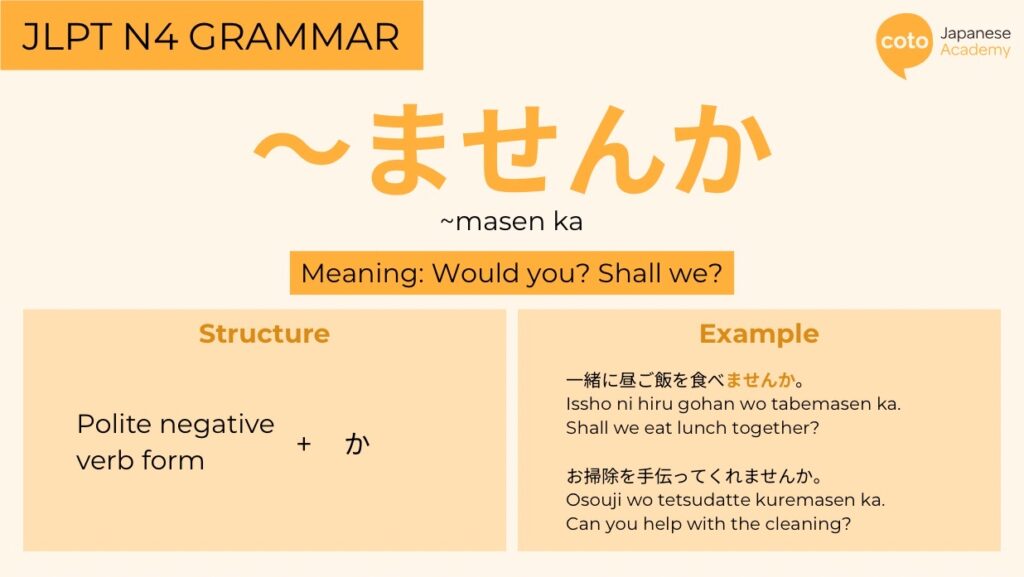
~ませんか (masen ka) is a grammar pattern used to invite the listener to do something with the speaker. Translated into English, it means “would you like to,” “shall we,” or “will you.” By using this grammar pattern, you’re asking the person to do something with you whilst waiting for a response from them, whether it be an acceptance of the invitation or a rejection.
Difference between ~ませんか (Masenka) and ~ましょうか (Mashouka)
| ~ませんか (masen ka) | ~ましょうか (mashou ka) | |
| Core Meaning | Polite suggestion or invitation | Proactive suggestion or offer |
| Speaker’s Stance | Passive (leaves the decision to the listener) | Active (speaker initiates the action) |
| Nuance | “Would you like to…?” | “Shall I / Shall we…?” |
| Best Used When | Inviting someone into an activity politely | Offering help or proposing the next move |
Both ~ませんか (masen ka) and ~ましょうか (mashou ka) are used to make suggestions or invitations in Japanese, but they carry distinct nuances that trip up many learners. So how are they different?
~ませんか leans toward the speaker’s perspective, inviting the listener. It’s polite, a little tentative, and leaves the decision entirely in the other person’s hands, making it ideal for invitations to someone you don’t know well or want to show respect to.
~ましょうか, on the other hand, comes from the speaker’s own initiative. It either offers to do something for the listener. For example, if you want to take the initiative to carry heavy luggage, you can say:
Take a look at these two sentences:
一緒に昼ご飯を食べましょうか。
Issho ni hiru gohan wo tabemashou ka.
Shall we eat lunch (together)?
一緒に昼ご飯を食べませんか。
Issho ni hiru gohan wo tabemasen ka.
Would you like to eat lunch (together)?
While both grammar patterns are polite ways to invite the listener to do something, ~ませんか (masenka) is more used for invitations to join the speaker, while ~ましょうか is used to suggest doing something together. In addition, compared to ~ませんか, which sounds softer, ~ましょうか sounds more assertive.
In the case of ましょうか, you’re showing the listener that you’re willing to do something with the listener before they agree to do it with you. This grammar pattern is usually used when you want to help someone with a task, such as carrying someone’s bag:
荷物を持ちましょうか。
Nimotsu wo mochimashou ka.
Shall I carry your bags?
For ませんか, you’re respecting the listener’s opinion, which means you’re waiting for an answer from them. When you’re using this grammar pattern, it suggests that you’re waiting for the listener’s response.
Want to study Japanese with us?
Grammar structure of 〜ませんか
Below are the common structures in which 〜ませんか (masenka) is commonly used:
| Structure | Meaning |
| Verb | To invite someone to do something |
For group 1 verbs (such as 買う, 行く) or group 2 verbs (such as 食べる or 見る), the grammar pattern is as follows:
Verb + ませんか
If you’re using this grammar pattern for irregular verbs (ex. する, くる), the grammar pattern is as follows:
Verb (stem) + ませんか
JLPT N5 〜ませんか Example sentences
As mentioned before, you can use this grammar pattern to invite someone to do something with you. For example:
ゆみさん、一緒に映画を見ませんか。
Yumi san, isshoni eiga wo mimasenka.
Yumi-san, would you like to watch a movie (together)?
一緒に昼ごはんを食べませんか。
Issho ni hiru gohan wo tabemasen ka.
Would you like to have lunch together?
私の家に遊びに行きませんか。
Watashi no ie ni asobi ni ikimasen ka.
Do you want to come to my place?
映画を見ませんか。
Eiga wo mimasen ka.
Do you want to watch a movie?
Alternatives to ~ませんか (Masenka)
While ~ませんか is your go-to for polite invitations, Japanese gives you several other patterns to express suggestions, each with its own level of formality, nuance, and social weight. Here is a breakdown of the most useful alternatives.
1. 〜ましょうか (mashou ka)
As we discussed, this is another way to ask someone to do something with you. Unlike ~ませんか, which puts the decision in the listener’s hands, ~ましょうか comes from the speaker’s proactive intention to act. It feels slightly more assertive
2. ~ないか (nai ka)
This is the casual way of saying ~ませんか. You can use this grammar pattern when you’re with friends or family. The nuance is more direct and relaxed than ~ませんか. It drops the formality entirely, so while it sounds natural among close friends, using it with a superior or stranger would come across as blunt or even disrespectful.
| Type | Structure |
| Verb (ない form) | Verb + ないか |
今年の夏、一緒にビーチに行かないか?
Kotoshi no natsu, isshoni biichi ni ikanai ka?
Want to go to the beach together this summer?
新しいレストランへ食べに行かないか?
Atarashii resutoran e tabe ni ikanai ka?
Want to eat at this new restaurant?
3. ~たらどう (tara dou)
This can be translated into English as “why don’t you” or “you should do this.” Unlike ~ませんか, which is used to invite someone to do something together, ~たらどう is directed entirely at the listener as a piece of advice — the speaker is not included in the action. Use it with care, as it can easily sound condescending or preachy if the relationship or tone isn’t right.
| Type | Structure |
| Verb (たform) | Verb + たらどう Verb + たら |
疲れたら、早く寝たらどうか。
Tsukaretara, hayaku netara dou ka.
If you’re tired, why don’t you sleep early?
試験に失敗したら、もっと勉強したらどうか。
Shiken ni shikkaku shitara, motto benkyou shitara dou ka.
If you fail the exam, why not study a bit more?
4. 〜てくれない (~te kurenai)
This grammar point is used when you ask the listener to do something for you, making it different from ~ませんか, which is an invitation to do something together. The focus here is on a favour or request directed at the other person. You can also convert this to the polite forms くれませんか (kuremasen ka) or もらえませんか (moraemasen ka) when speaking to someone you don’t know well. Be careful not to use 〜てくれ on its own, as it drops all politeness and can sound demanding or rude.
Be careful not to say 〜てくれ as it might come off as rude.
| Type | Structure |
| Verb (て form) Verb (ないで) | Verb + てくれないVerb + てもらえない |
日本語を教えてくれませんか。
Nihongo wo oshiete kuremasen ka.
Would you please teach me Japanese?
出かけたら、コンビニで弁当を買ってくれない?
Dekaketara, konbini de bentou wo katte kurenai?
If you go out, would you buy me a bento at the convenience store?
Conclusion
The grammar ませんか (masenka) is handy when you want to invite someone to do something with you. Try using this grammar pattern the next time you want to grab a meal, check out a new place of interest, or even when you want to help someone with a certain task!
Learn More JLPT Grammar with Coto Academy!
Coto Academy has been offering Japanese classes for over 25 years, with campuses in Shibuya, Yokohama, Iidabashi, Minato, Shinjuku, and online. Our courses focus on practical Japanese, so the grammar you learn is designed for real-life use.
We offer part-time, intensive, and fully online lessons to suit your schedule. Start learning Japanese effectively and confidently with Coto Academy today! Fill out the form below for a free level check.
FAQ
What does ませんか mean?
ませんか (masen ka) means “will you,” or “would you” in Japanese. This grammar point is used to ask someone to do something with you, while respecting their opinion.
How do you use ませんか in a sentence?
Use this grammar pattern when you want to suggest doing something with the listener, such as inviting them out for lunch.
What’s the difference between ませんか and ましょうか?
When you’re using ましょうか (mashou ka), it implies that you’re willing to take on that action before the listener has a chance to respond, whereas ませんか (masen ka) implies that you respect the listener’s opinion or response.
Want to keep improving your Japanese grammar? Check out more guides and take your skills to the next level.