





For many foreign residents in Japan, permanent residency (PR), or 永住 (eijuu), is one of the main goal of their long-term plans. It ends the need to renew a residence permit on certain visa types. But new guidelines starting in April 2027 will make applications and screening tighter than before.
Japan’s Immigration Services Agency revised its Guidelines for Permission for Permanent Residence on October 1, 2026. Most of the new rules apply to applications filed on or after April 1, 2027. They cover Japanese language ability, income, pension, time spent outside Japan, and family and residence factors. If you plan to apply for permanent residency, here is what is changing and when.
Key points:
- Foreigners applying for permanent residency from April 2027 will be subject to updated requirements and rules. Most revised rules apply to applications filed from April 1, 2027.
- Japanese ability at roughly B1 level or above will be considered, with exceptions.
- Income and pension standards are stricter, and the income rules apply earlier than the rest.
- Long absences from Japan, spouse and child residence, and your current period of stay are all part of the review.
What Are The Major Changes in Japan’s Permanent Residency Application?
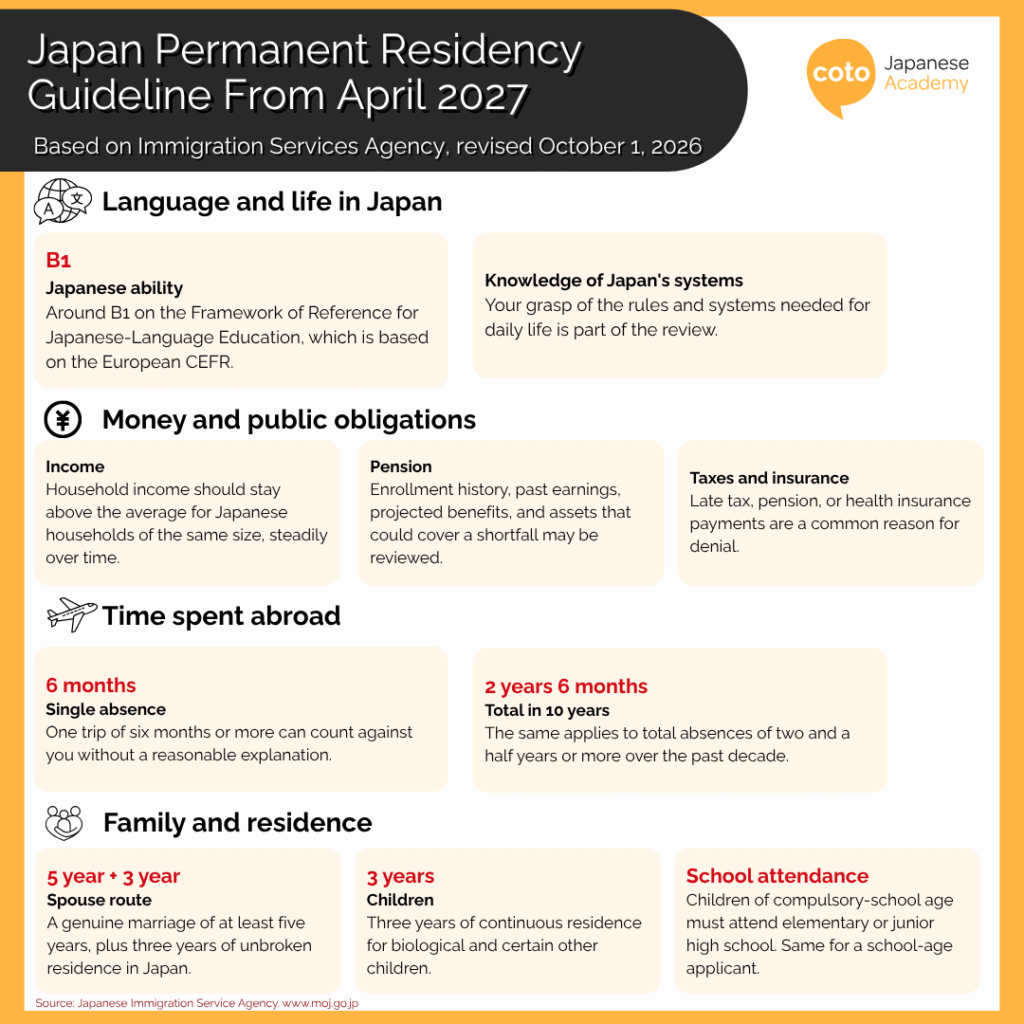
The revision gives more specific guidance on the factors the Immigration Services Agency considers when deciding whether to grant permanent residence. We recommend that you check the official Japanese Immigration Services Agency for the most accurate guidelines.
However, we want to reiterate that these factors are guidelines, and not necessarily a checklist. Satisfying one or all of them will automatically guarantee approval.
1. Japanese-language ability
The biggest change is the new requirement to show Japanese skills at around B1 or higher on the Framework of Reference for Japanese-Language Education, a scale based on the European CEFR.
In general, B1-level Japanese proficiency sits somewhere between a high JLPT N3 and a low JLPT N2. Like many language requirements for visa applications, the JLPT is not the only way to prove it, although it is the most common because it is the most widely accepted. On JLPT N3, a total score of 104 or higher maps to B1. On N2, a total score of 90 to 111 maps to B1. By those numbers, a high N3 score or an N2 score would land at B1 or above.
2. Income
Officials check that your household earns more than the average Japanese household of the same size, and that it does so steadily over time. Surprisingly, there is not a single minimum amount applies to everyone.
3. Pension
Your pension record may be reviewed, including your enrollment history, past earnings, projected benefits, and any savings or assets that could make up for a projected shortfall.
4. Time outside Japan
Spending six months or more abroad in one stretch, or two and a half years or more in total over the past 10 years, can count against you if you have no good reason for it.
5. Spouse route
You need a real marriage that has lasted at least five years, plus at least three years of unbroken residence in Japan.
6. Biological children and certain other children
Three or more years of unbroken residence in Japan is required.
7. Current period of stay
As a rule, you must hold the longest period of stay available for your visa status. A transitional measure covers some applicants who currently hold a three-year period.
8. Japan’s systems and rules
Your understanding of the systems and rules needed for life in Japan is considered.
9. School-age children
If you are raising a child of compulsory-school age, that child must be attending elementary or junior high school. The same requirement applies if the applicant is of school age.
Which Rules Apply to You?
The exact timeline for when these new guidelines are categorized into three layers. Applications filed by March 31, 2026 fall under the previous guidelines. Applications filed from April 1, 2026 through March 31, 2027 mostly stay under the old rules, with one big exception: the revised income and public-burden provisions also apply to applications filed on or after April 1, 2026 that were still pending on October 1, 2026, and to anything filed after that through March 31, 2027. Applications filed on or after April 1, 2027 fall under the revised guidelines in full.
So do not assume an application filed before April 2027 will be judged the old way entirely. The income rules may catch you earlier
What is B1-level Japanese?
B1 sits roughly between a high JLPT N3 and a low JLPT N2.
The JLPT administrator, JEES, Linking the JLPT Total Score to the CEFR Level, publishes a guide that maps total scores to these levels. On JLPT N3, a total score of 104 or higher maps to B1. On N2, a total score of 90 to 111 maps to B1. By those numbers, a high N3 score or an N2 score would land at B1 or above.
Does that mean you need JLPT N2? Not according to the guideline. It names the B1 benchmark under the Framework of Reference for Japanese Language Education, and it does not say every applicant must pass the JLPT. Until the agency names an accepted way to prove your level, do not assume a specific JLPT result will be required or enough on its own.
The reasoning for this new guideline is that the Japanese government expects permanent residents to build a long-term base in Japan, so it treats language ability as one factor in whether you can adapt to your community and live without significant difficulty.
However, B1 is not assessed the same way for everyone. The government recognizes cases where it may not be necessary. This includes highly skilled foreign professionals, their family members, applicants who received at least six years of elementary or secondary education under Japan’s School Education Act, and children of permanent residents who meet the guideline’s conditions.
What minimum income and pension do I need to contribute to qualify?
While there is no single fixed minimum income, the Japanese government assesses whether your household income consistently exceeds the average for Japanese households of the same size. For pension, it may look at your enrollment history, past income, expected benefits, and any financial assets that could cover a shortfall.
What can be scrutinized during your permanent residency application
1. Long absences from Japan
A single trip abroad of six months or more, or total absences of two years and six months or more in the previous 10 years, can generally count against you if there is no reasonable explanation.
2. Late tax or pension payments
Japanese immigration authorities look closely at late payments of taxes, pension contributions, and health insurance. Late payments are a common reason PR applications get denied, because meeting public obligations is a key part of the screening.
Can you apply for PR with a 3-year period of stay after April 2027?
Yes, in some cases. The old rule treated a three-year period of stay as the longest authorized period. For applications filed from April 1, 2027, that is no longer automatic. The longest authorized period of stay for your current status of residence is one of the factors considered, and a transitional measure protects certain applicants who already hold a three-year period.
If you file by March 31, 2027, a three-year period of stay is still treated as the longest authorized period.
If you file on or after April 1, 2027, a limited transitional measure applies if you meet all three conditions. You held a three-year period of stay on March 31, 2027. You file your first permanent residence application on or after April 1, 2027. You receive a decision on that application between April 1, 2027 and the expiration date of that three-year period of stay.
If all three are met, you may still be treated as holding the longest authorized period for the purposes of the guideline.
Conclusion
This guideline is part of the Japanese government’s most recent tightening of immigration rules, and we recommend you check the latest official news from immigration, as things may change. If you are considering applying for Japanese permanent residence, check your filing date, your Japanese level and your income record now, and confirm details with the Immigration Services Agency before you apply.
FAQ
When do the new permanent residency rules start?
Japan’s Immigration Services Agency revised its Guidelines for Permission for Permanent Residence on October 1, 2026. Most of the new rules apply to applications filed on or after April 1, 2027.
Do the new rules apply if I file before April 2027?
Mostly no, but there is one big exception. The revised income and public-burden provisions also apply to applications filed on or after April 1, 2026 that were still pending on October 1, 2026, and to anything filed after that through March 31, 2027. Do not assume an application filed before April 2027 will be judged entirely under the old rules.
What Japanese level do I need to apply for Permanent Residence in Japan?
The guideline expects roughly B1 on the Framework of Reference for Japanese-Language Education, which is modeled on the CEFR. B1 sits between a high JLPT N3 and a low JLPT N2.
Who is exempt from the B1 expectation?
Highly skilled foreign professionals and their family members, applicants who received at least six years of elementary or secondary education under Japan’s School Education Act, and children of permanent residents who meet the guideline’s conditions.
Do late tax or pension payments matter when I am applying for Permanent Residence in Japan?
Yes. Immigration authorities look closely at late payments of taxes, pension contributions, and health insurance. They are a common reason for denial, because meeting public obligations is a key part of the screening.