






Japanese proverbs, or ことわざ (kotowaza), are a great way to improve your language skills with more figurative speech. Exploring outside the typical methods of memorizing kanji and vocabulary, kotowaza can teach you how to use more nuanced phrases.
Plus, they can help you dive deeper into Japanese culture. Kotowaza paint a picture of different situations and reflect Japanese culture as well as hundreds of years of history. This is what makes them so interesting to read and hear.
Ready to learn more words of wisdom? Here are 35 Inspiring Japanese proverbs that will inspire you to improve your life. We have included example sentences as well so you can understand how to use these sayings!
For more Japanese practice, check our Intensive Japanese Classes at Coto Academy! Sign up for our courses and start practicing right away!
What Does Kotowaza Mean in Japanese?
The Japanese word ことわざ (kotowaza / 諺) means “proverb” or “saying.” It refers to a traditional phrase or expression that conveys a truth, piece of wisdom, or moral lesson.
Kotowaza, given its long history, uses a lot of kanji, so read our blog to find the most effective apps to study them: Learning kanji from apps.
Japanese proverbs can speed up your study process by exposing you to new vocabulary, figurative language, and metaphors — and maybe even gain valuable wisdom.
Types of Japanese Proverbs
Like anywhere else, there’s not one type of proverb in Japan. However, Japanese proverbs are boxed into three types, each heavy in history, culture, and traditional values.
1. Iinarawashi (言い習わし)
Iinarawashi is a short saying derived from the kanji 言 (say, speech) and 習 (learn). So, it basically means words of wisdom or short sayings.
2. Yojijukugo (四字熟語)
True to its name (四字 meaning four letters), yojijukugo idioms consist of four kanji characters. A lot of Japanese proverbs are taken from Chinese proverbs. Because this particular type uses kanji, it can be hard for beginners to remember them.
3. Kanyouku (慣用句 )
You can think of kanyouku as the longest type of Japanese proverb. They are idiomatic words or phrases that are meant to be interpreted figuratively rather than literally.
For instance, 口が軽い (kuchi ga karui) literally means “light mouth”, but the implied meaning is “can’t keep a secret”.
35 Japanese Proverbs and Their Meanings
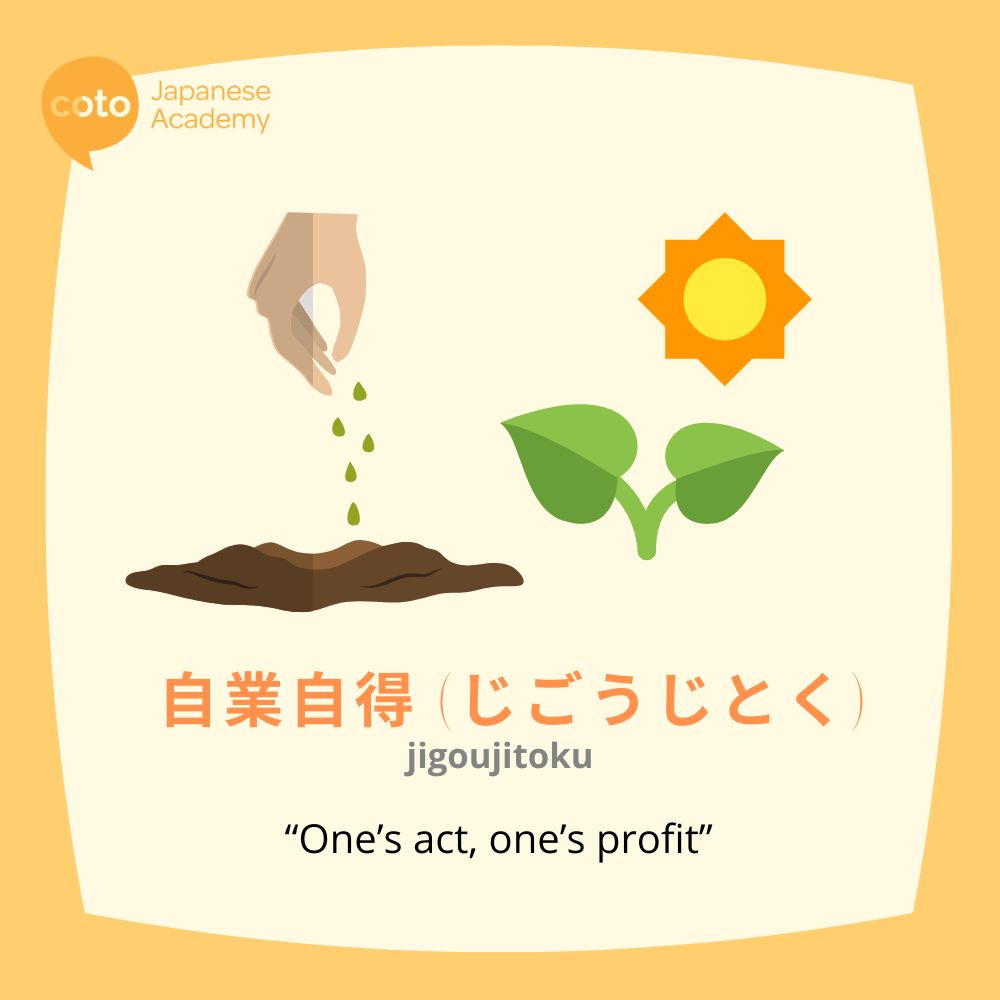
1. Jigoujitoku 自業自得
2. koketsu ni irazunba koji o ezu 虎穴に入らずんば虎子を得ず
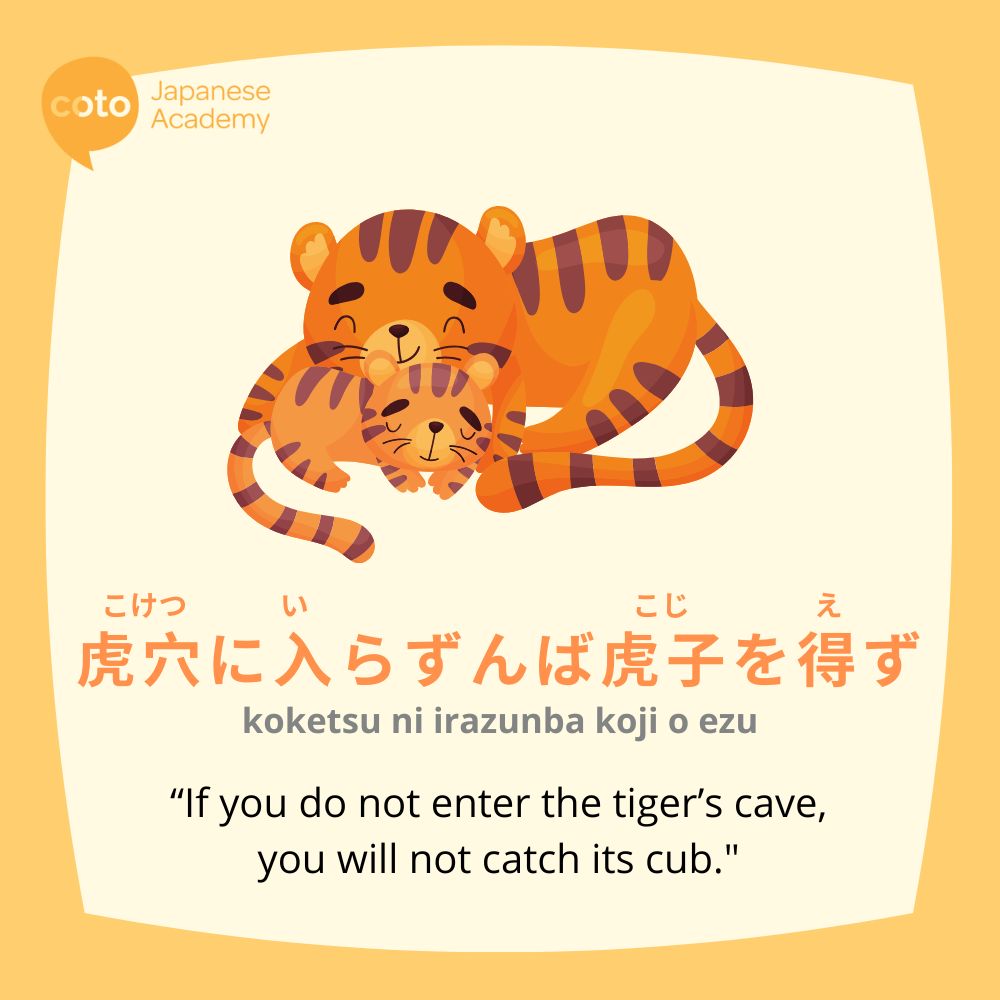
Pronunciation: koketsu ni irazunba koji o ezu
Translation: “If you do not enter the tiger’s cave, you will not catch its cub.”
Meaning: You can’t do anything without risking something / Nothing ventured, nothing gained
Example Sentence:
- 諺にもある通り虎穴に入らずんば虎子を得ずだ。
As the saying goes, “Nothing ventured, nothing gained.”
Don’t forget to learn Japanese to understand more proverbs!
Japanese proverbs aren’t just clever phrases — they reflect the wisdom, values, and humor of Japanese culture. So why not pick one or two that resonate with you and try using them in your next conversation or journal entry? The more you use them, the more natural they’ll feel. Practice Japanese with Coto Academy’s fun and flexible part-time Japanese lessons or intensive Japanese course!
3. saru mo ki kara ochiru 猿も木から落ちる
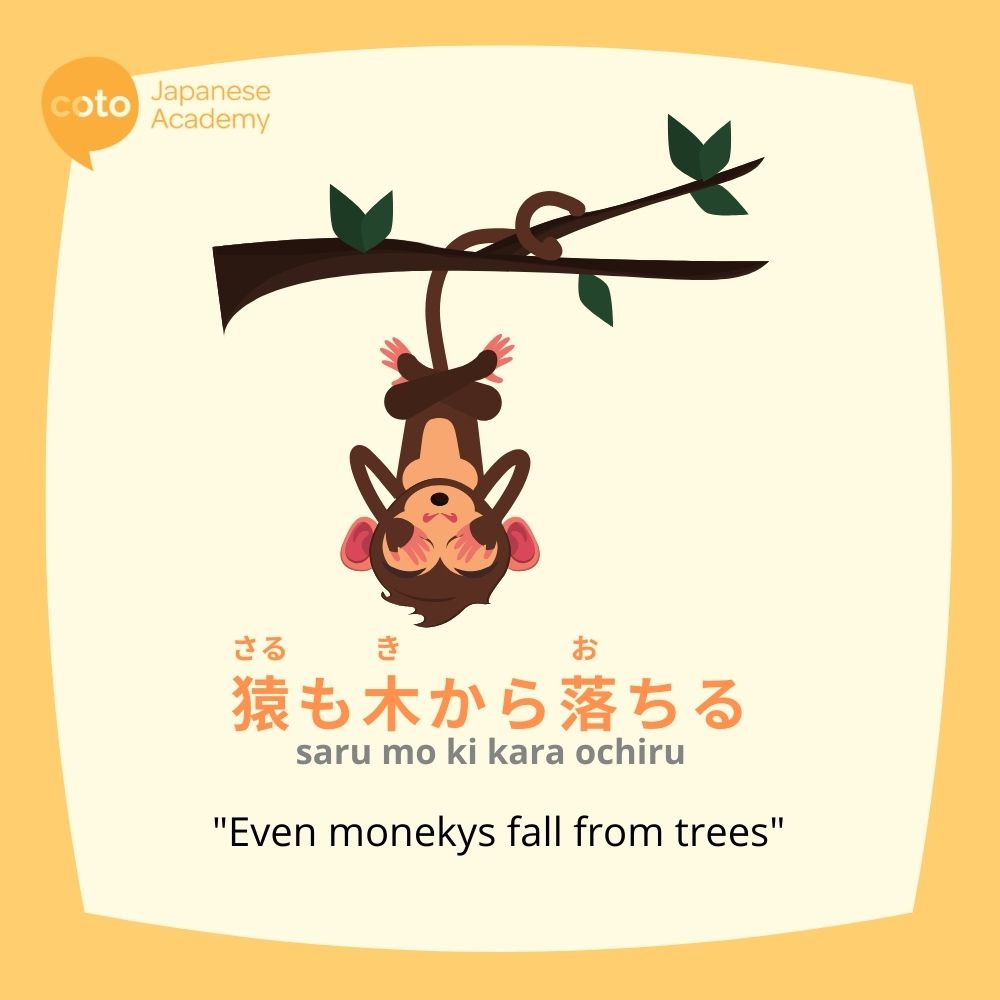
Pronunciation: Saru mo ki kara ochiru
Translation: “Even monkeys fall from trees”
Meaning: Even skilled experts can make a mistake / Nobody’s Perfect
Example Sentence:
- 諺にも猿も木から落ちるというけど、あんなに頭のいい国語の先生が、字を間違えたな んて信じられない。
As they say, “Even monkeys fall from trees,” but it is hard to believe that such a brilliant Japanese teacher would mess up such a character.
4. Kouin ya no gotoshi 光陰矢の如し
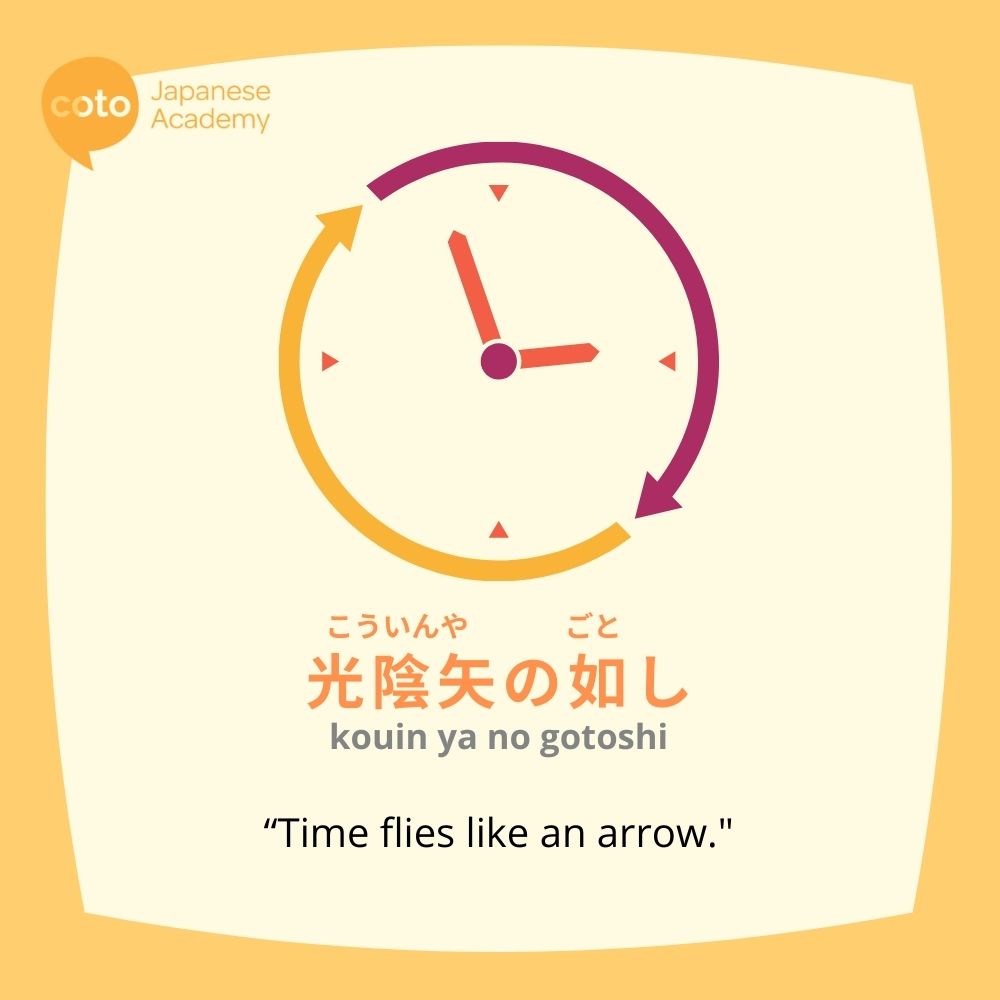
Pronunciation: kouin ya no gotoshi
Translation: “Time flies like an arrow.”
Meaning: Life is short / Time and tide wait for no man
Example Sentence:
- 人々が光陰矢の如しと言うのをよく耳にする。
We often hear people say that time flies.
5. Fukusui bon ni kaerazu 覆水盆に返らず
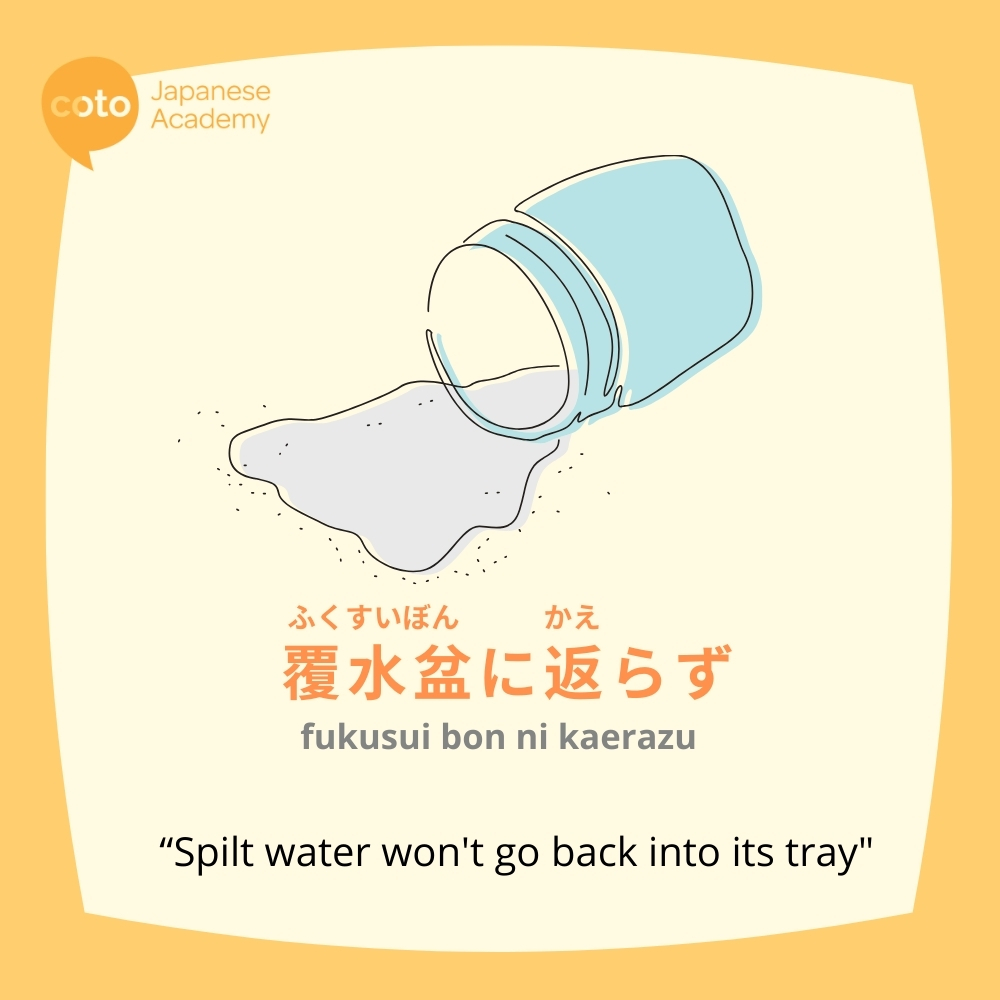
Pronunciation: fukusui bon ni kaerazu
Translation: “Spilt water won’t go back into its tray”
Meaning: What’s done is done / It is no use crying over spilled milk
Example Sentence:
- 諺に、覆水盆に返らずと言う。
The proverb says that what is done cannot be undone.
6. Ashita wa ashita no kaze ga fuku 明日は明日の風が吹く
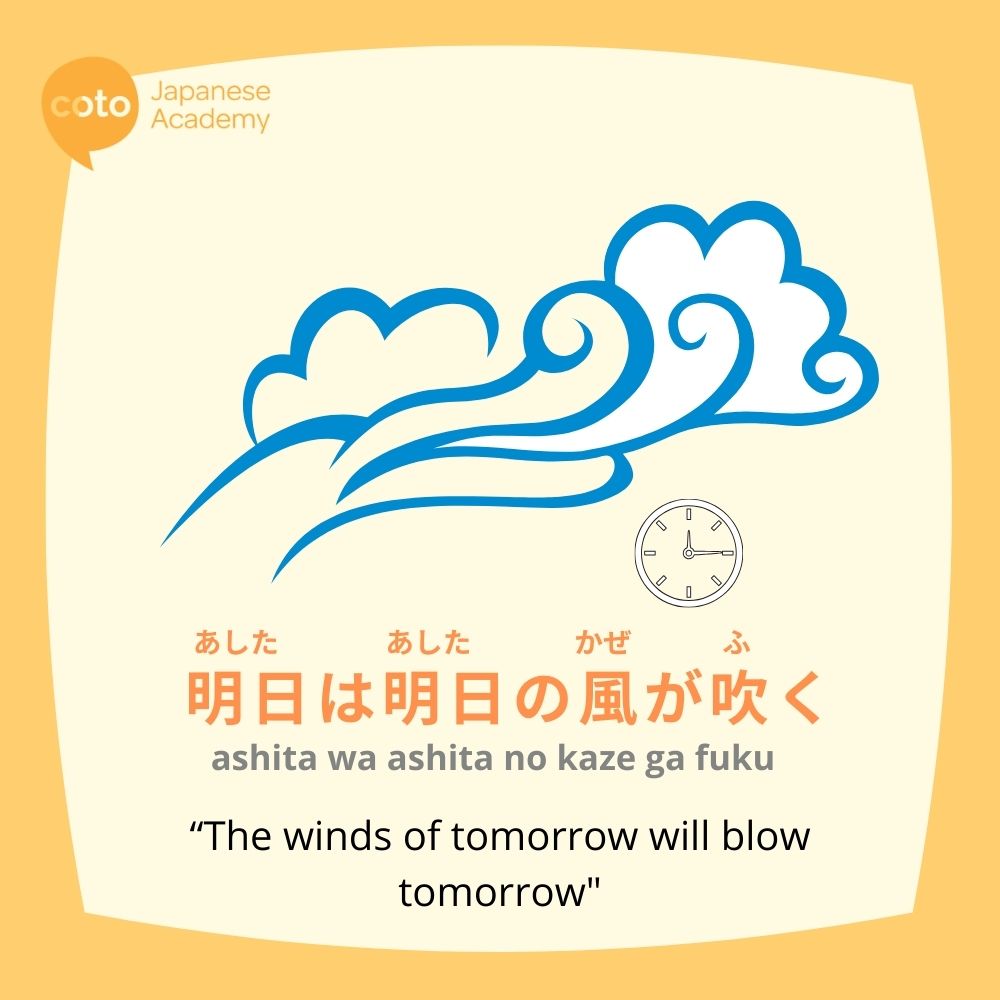
Pronunciation: ashita wa ashita no kaze ga fuku
Translation: “The winds of tomorrow will blow tomorrow”
Meaning: Do not be worried about your bad situation because things change over time
Example Sentence:
- 今日は今日の風が吹き、明日は明日の風が吹く。
Tomorrow is another day.
7. Nana korobi ya oki 七転び八起き
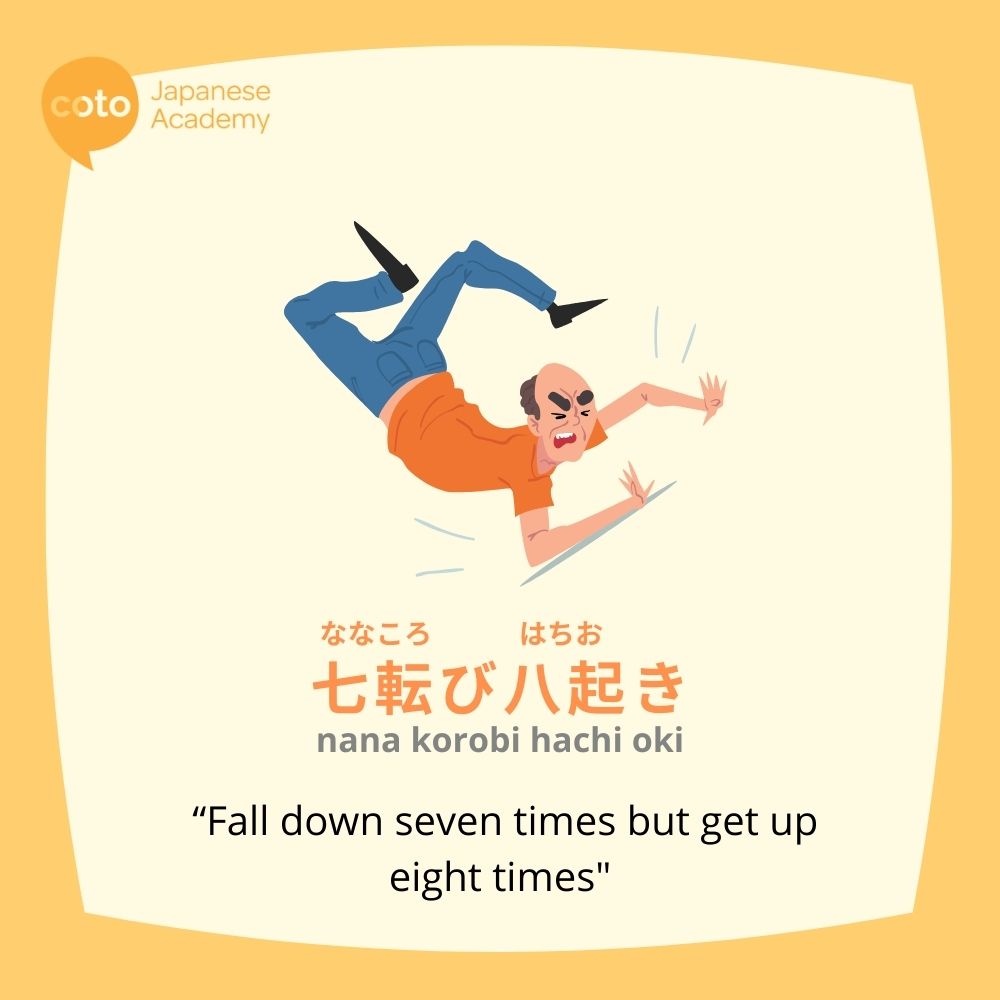
Pronunciation: nana korobi ya oki
Translation: “Fall down seven times but get up eight times”
Meaning: If at first you don’t succeed, try and try again / Don’t give up
Example Sentence:
- 人生は七転び八起き。転んでもまた立ち上がる。くじけずに前を向いて歩いていこう。
Tomorrow is another day. Even if you fall down, you will get up again. Don’t be discouraged, just keep walking forward.
8. kiyomizuno butai kara tobioriru 清水の舞台から飛び降りる
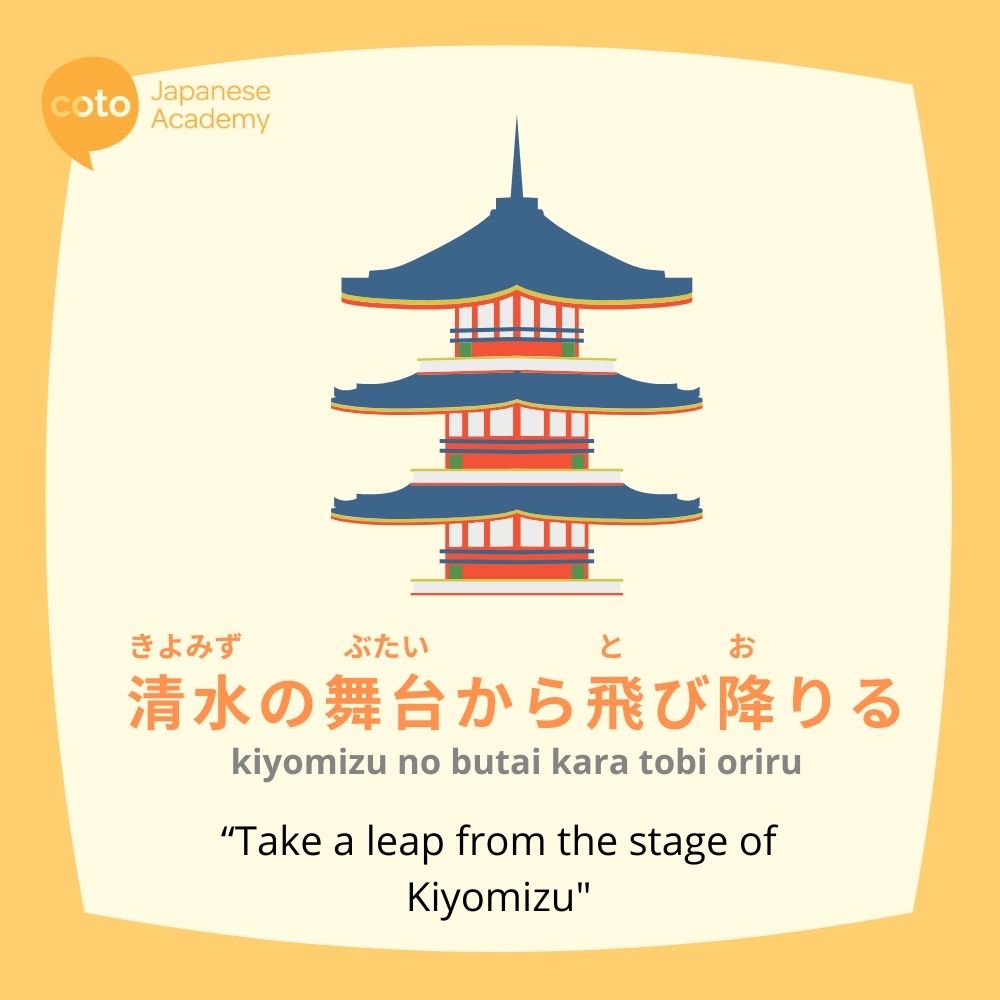
Pronunciation: kiyomizuno butaikara tobioriru
Translation: “Take a leap from the stage of Kiyomizu”
Meaning: Make a resolution/ To take the plunge
Example Sentence:
- 清水の舞台から飛び降りる気持ちでダイヤの指輪を買った
I am going to take a big chance buying a diamond ring.
9. ame futte ji katamaru 雨降って地固まる
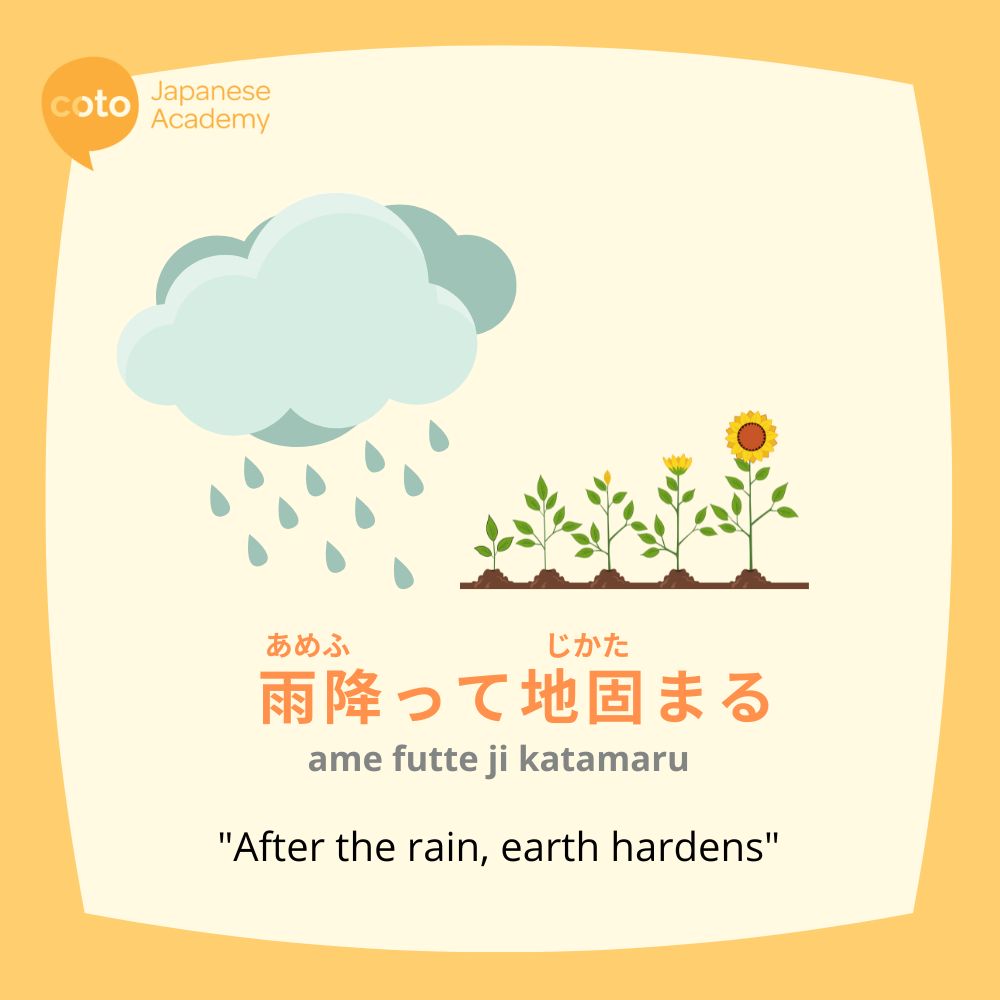
Pronunciation: ame futte ji katamaru
Translation: “After a storm comes a calm”
Meaning: Adversity strengthens the foundations / A relationship often gets closer after a quarrel.
Example Sentence:
- いろいろトラブルもあったけど、雨降って地固まるってことになってほしいね。
We’ve been through a rough patch but I hope it will have made us stronger.
10. sannin yoreba monjuno chie 三人寄れば文殊の知恵
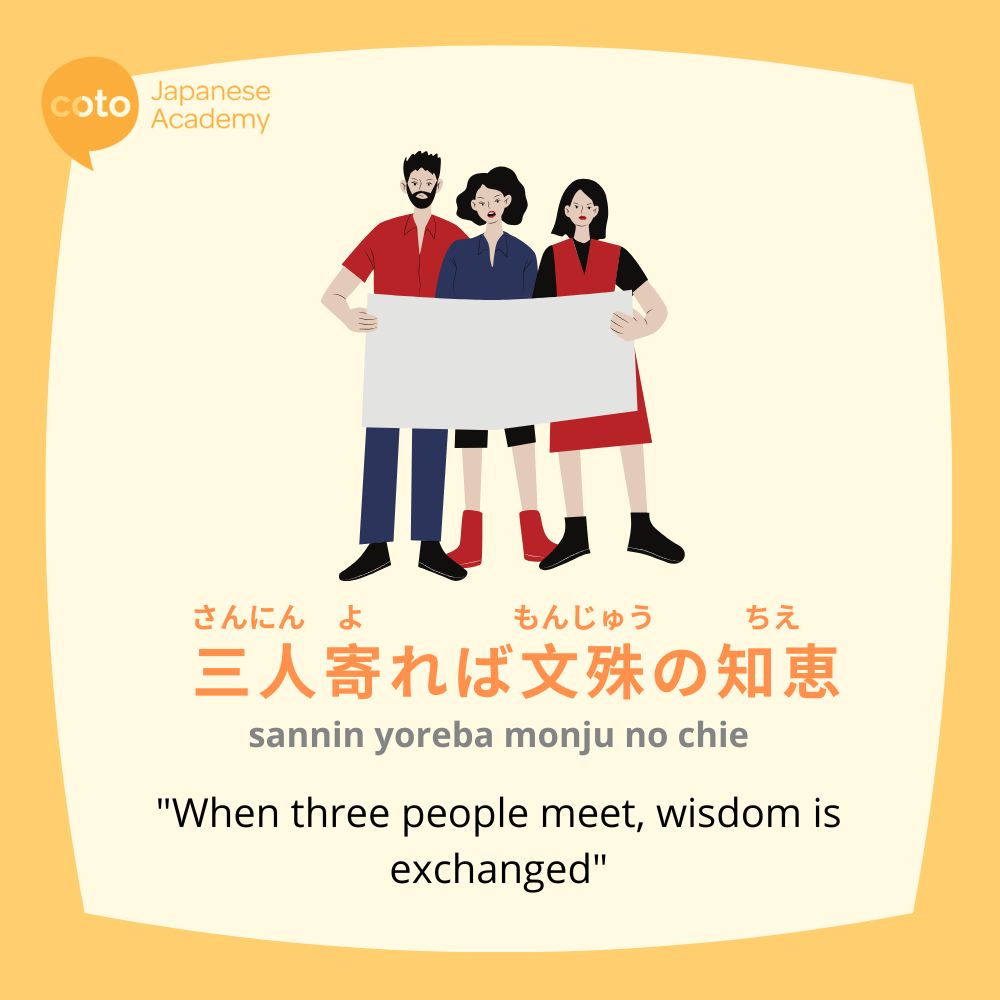
Pronunciation: sannin yoreba monju no chie
Translation: “When three people meet, wisdom is exchanged”
Meaning: The more people you have, the more ideas you will get through the discussion (same as “Two heads are better than one”).
Example Sentence:
- 三人寄れば文殊の知恵って言うだろ。みんなで考えれば、いい案が浮かぶかもしれないよ。
Let’s all think on this together and we might be able to come up with some good ideas. They say two heads are better than one.
11. ingaouhou 因果応報
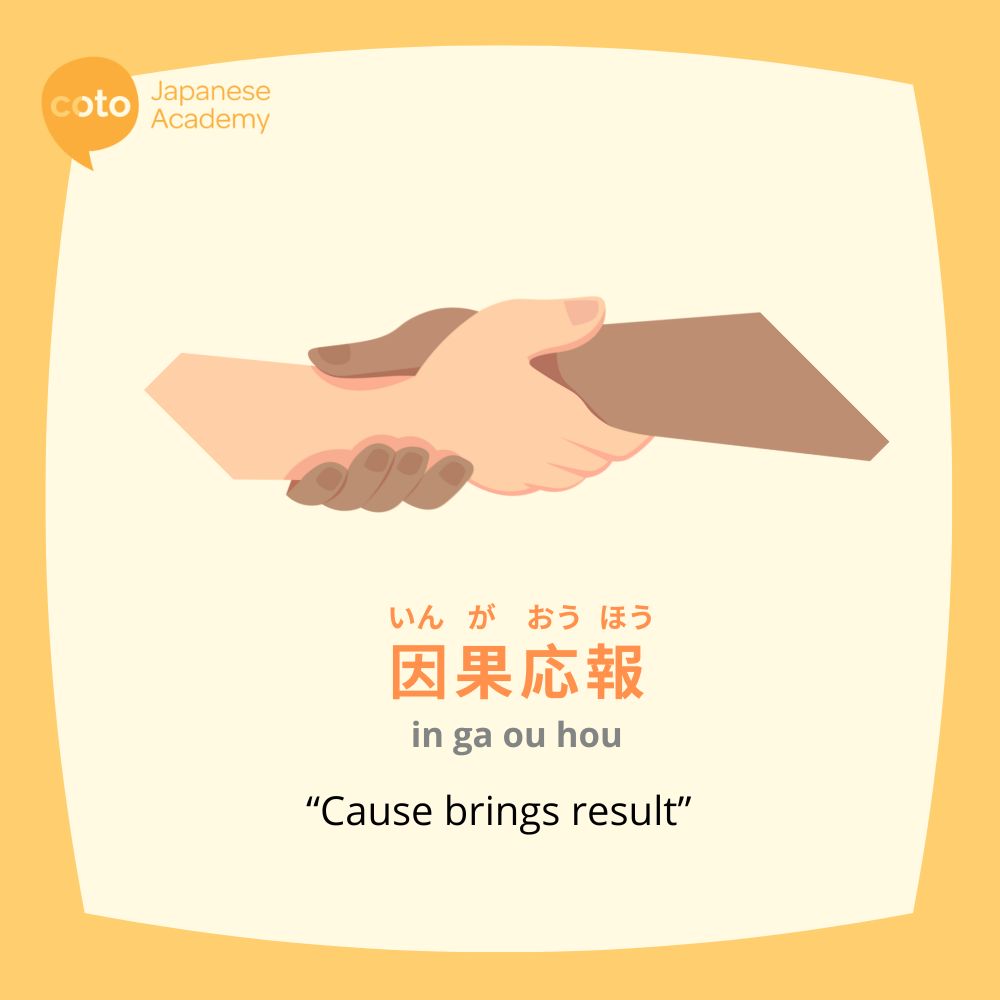
Pronunciation: ingaouhou
Translation: “Cause brings result”
Meaning: What goes around comes around
Example Sentence:
- 彼は昔ひどいイジメっ子だったので、今は困った時に助けてくれる本当の友達がいない。因果応報だね。
He does not have real friends now to help when he’s in trouble because he was a terrible bully in the past. It is “what goes around comes around.
12. onaji kama no meshi o kuu 同じ釜の飯を食う
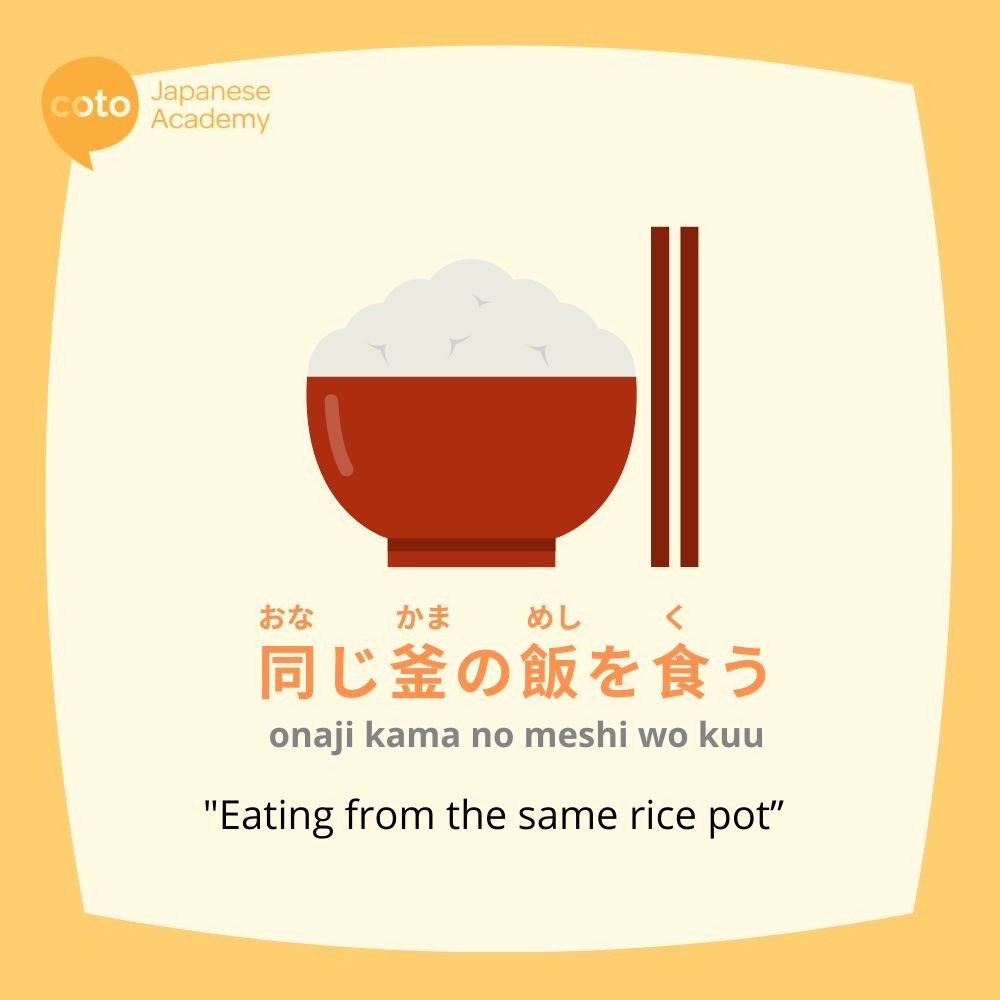
Pronunciation: onajikama no meshi o kuu
Translation: “Eating from the same rice pot”
Meaning: Strengthening the sense of belonging by eating the same meals
Example Sentence:
- たかしとケンタは同じ釜の飯を食った仲だ。
Takashi and Kenta have a very close friendship.
13. neko ni koban 猫に小判
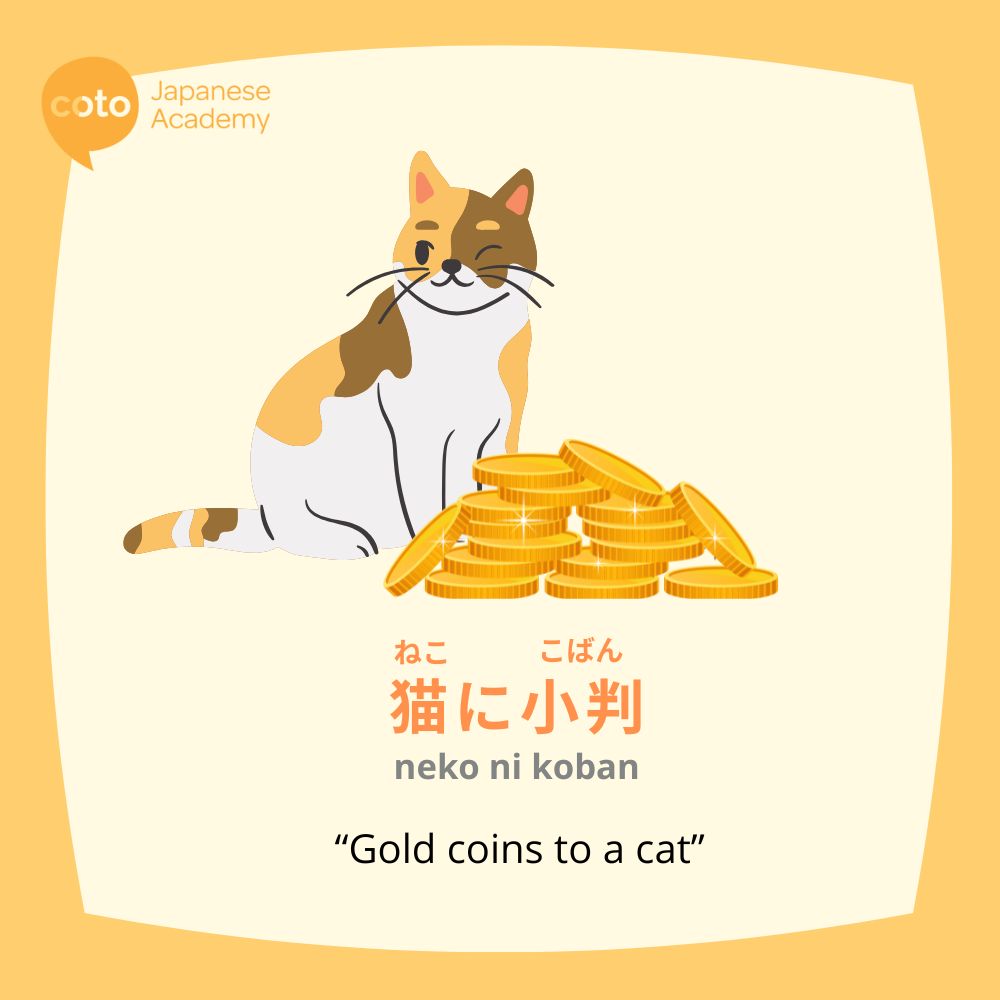
Pronunciation: neko ni koban.
Translation: “Gold coins to a cat”
Meaning: Don’t offer things to those who are incapable of appreciating them.
Example Sentence:
- 宝石に興味のない人にダイヤモンドをあげても、猫に小判だ
For someone who has no interest in precious stones, even giving that person a diamond would be casting pearls before swine.
14. nito o oumono wa itto mo ezu 二兎を追う者は一兎をも得ず
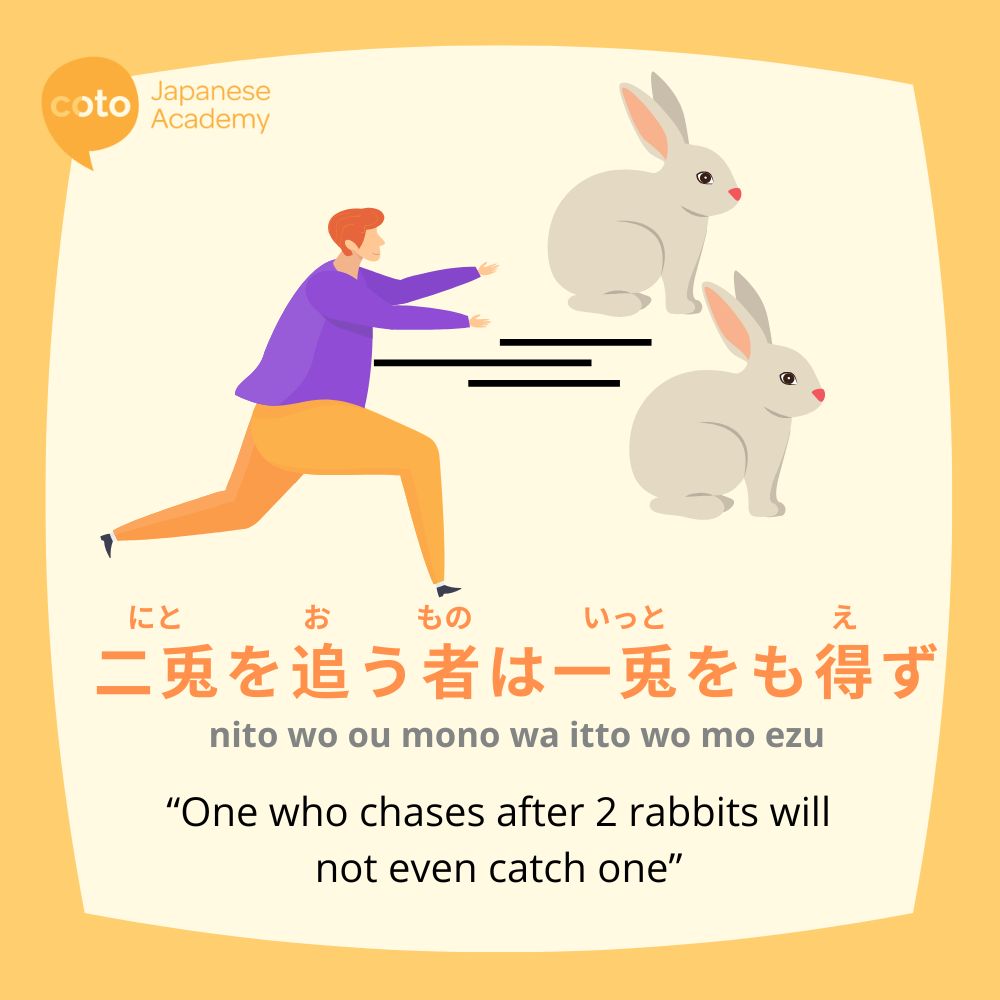
Pronunciation: nito o oumono wa itto mo ezu
Translation: “One who chases after 2 rabbits will not even catch one”
Meaning: You cannot do two things successfully at the same time.
Example Sentence:
- 二兎を追う者は一兎をも得ずだよ。一つずつ着実にやり遂げよう!
It says, “Those who chase after two rabbits will not even catch one.” Let’s steadily accomplish one thing at a time!
15. hito no furi mite wagafuri naose 人のふり見てわがふり直せ
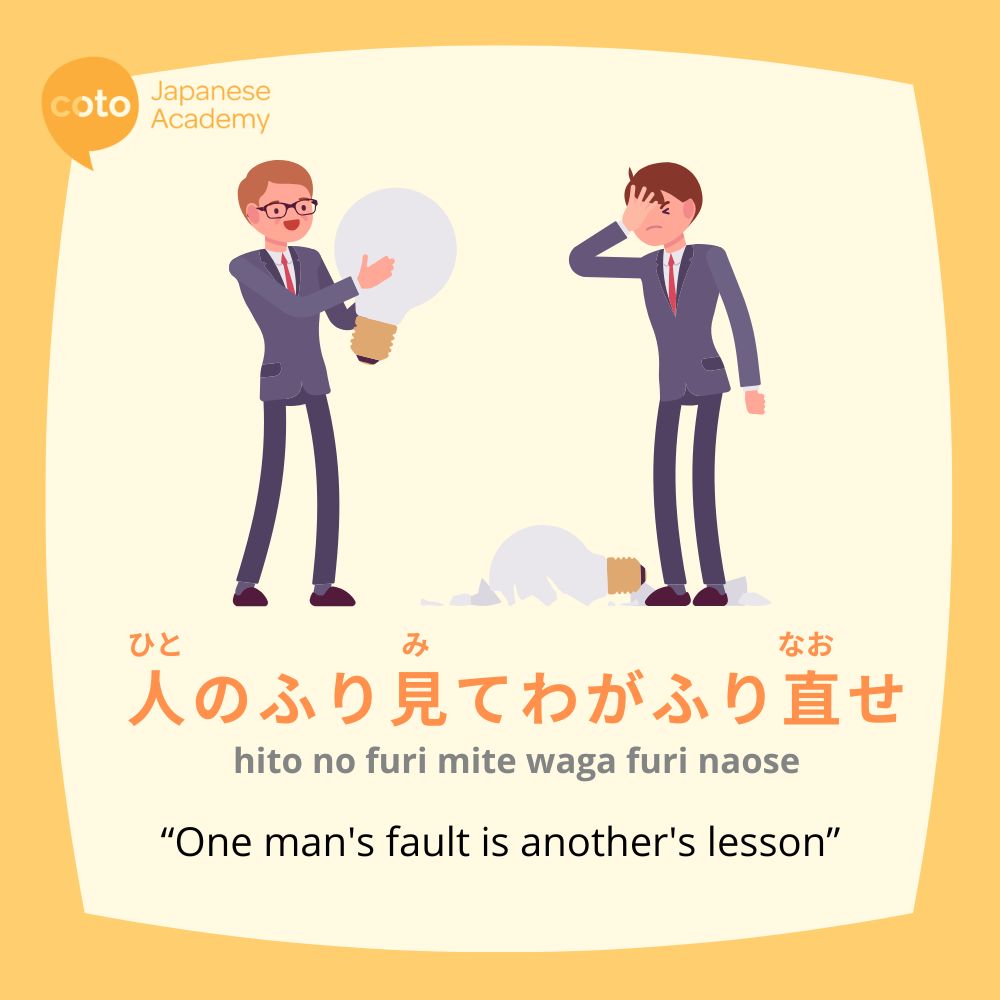
Pronunciation: hito no furi mite waga furi naose
Translation: “One man’s fault is another’s lesson”
Meaning: See other’s behavior and correct yours.
Example Sentence:
- 友達の言動を批判する暇があったら、人のふり見てわがふり直せだよ
If you have time to criticize the behavior of your friend, watch his behavior and correct your own behavior.
16. hana yori dango 花より団子
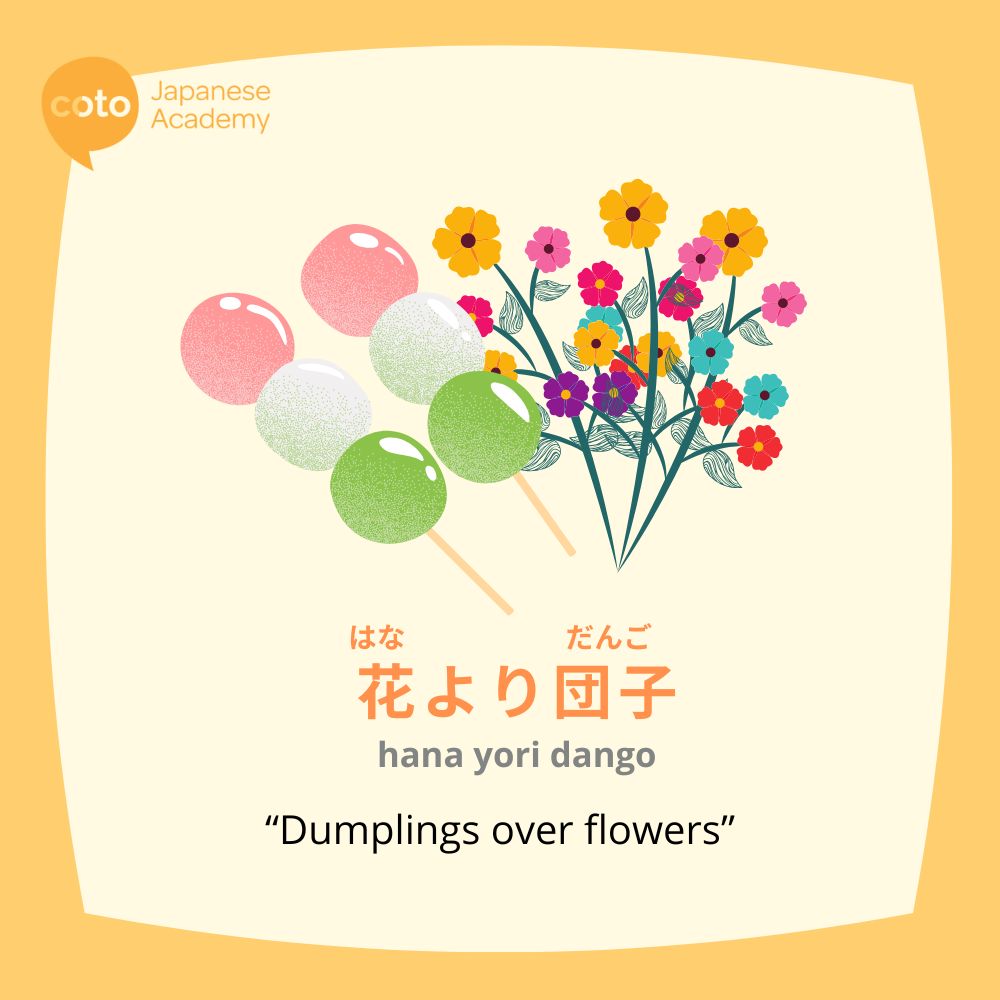
Pronunciation: hana yori dango
Translation: “Dumplings over flowers”
Meaning: People are more interested in the practical than the aesthetic
Example Sentence:
- 我が家は花より団子なので、桜の名所よりおいしい店の方がいいんです
Because our house is a “dumpling over flowers”, it’s more of a delicious restaurant than a place for sakura viewing.
17. kuchi ha wazawai no moto 口は災いの元
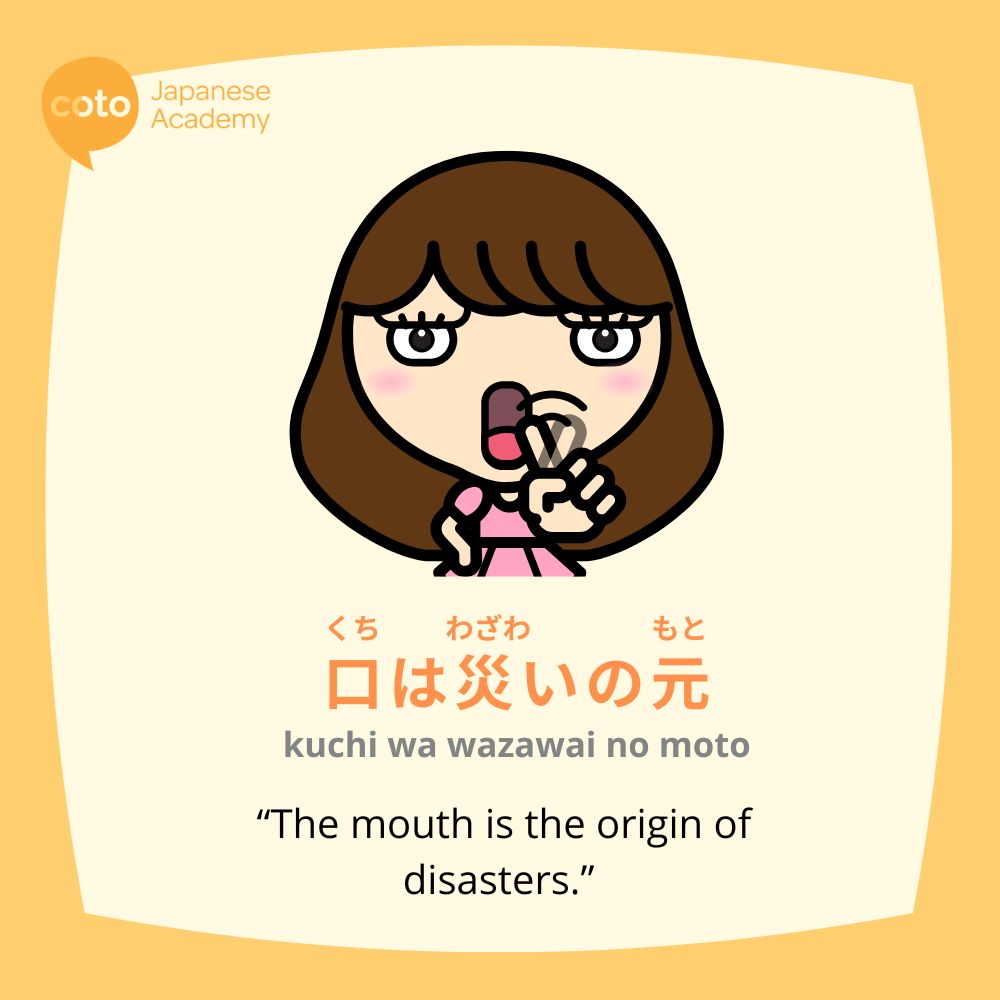
Pronunciation: kuchi wa wazawai no moto
Translation: “The mouth is the origin of disasters.”
Meaning: Careless remarks will invite trouble for yourself, so watch your mouth.
Example Sentence:
- 人の悪口を言うと良いことないよ。口は災いの元だよ!
There’s nothing good about talking ill of someone. It says, “Out of the mouth comes evil!”
18. shoshin wasuru bekarazu 初心忘るべからず
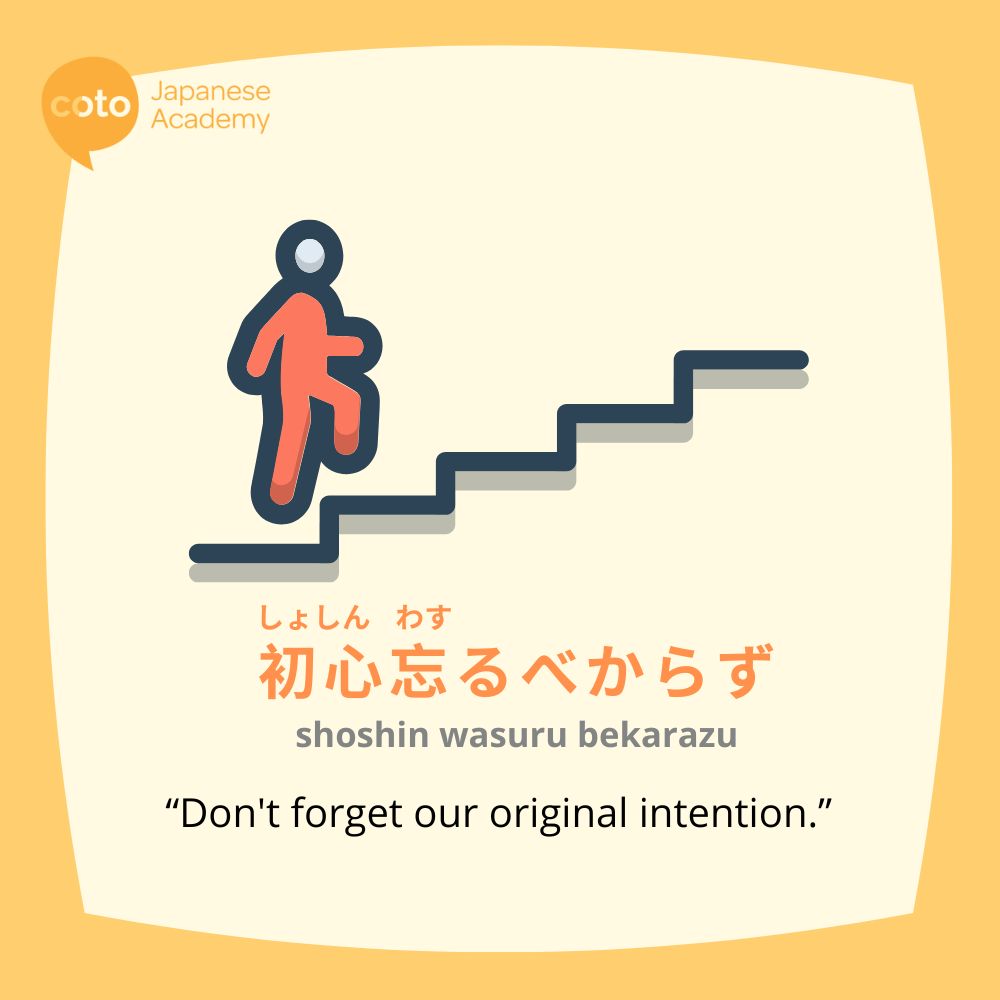
Pronunciation: shoshin wasuru bekarazu
Translation: “Don’t forget our original intention.”
Meaning: Never forget the original enthusiasm when you try new things
Example Sentence:
- 一度成功しても、初心忘るべからずで、気を抜かないように
As it says, “Don’t forget beginner’s spirit,” don’t lose focus even if you once succeeded.
19. en no shita no chikaramochi 縁の下の力持ち
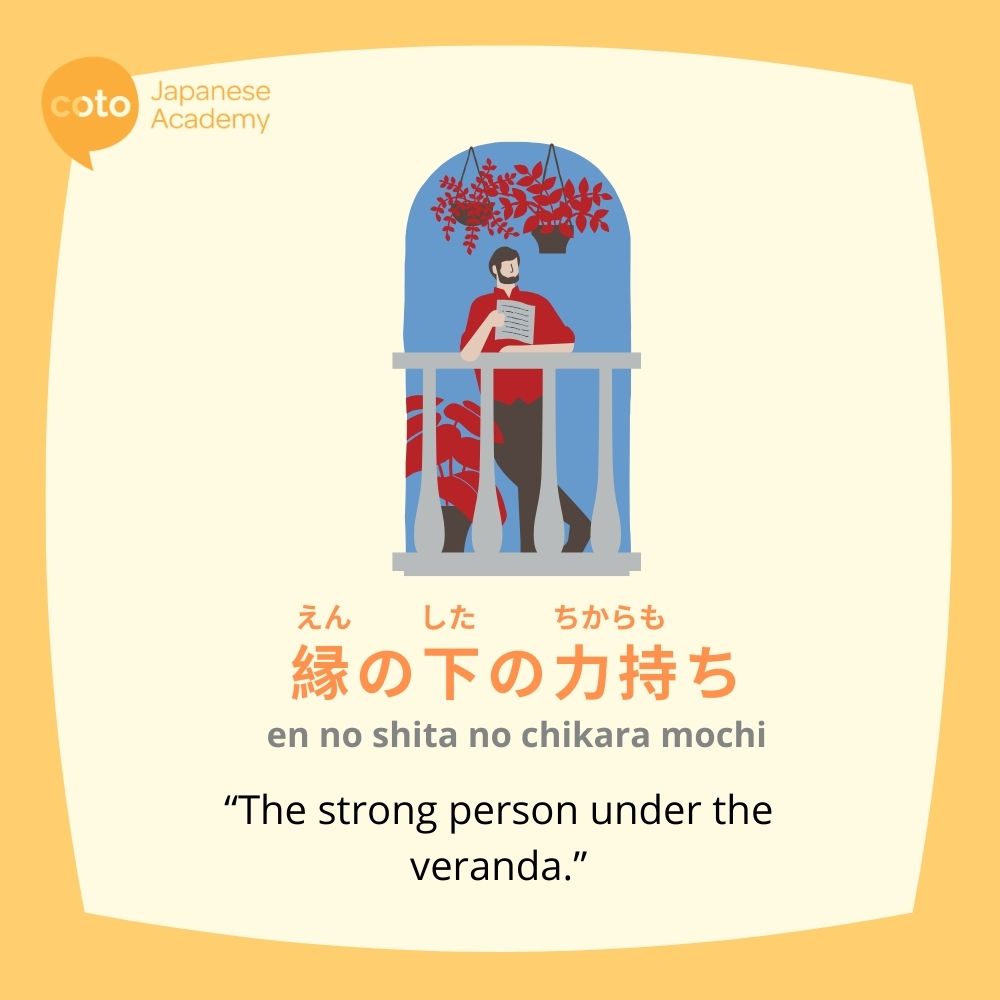
Pronunciation: en no shita no chikaramochi
Translation: “The strong person under the veranda.”
Meaning: Unsung hero / Someone who does a thankless task
Example Sentence:
- 彼は縁の下の力持ちだ
He is an unsung hero.
20. chiri mo tsumoreba yama to naru ちりも積もれば山となる
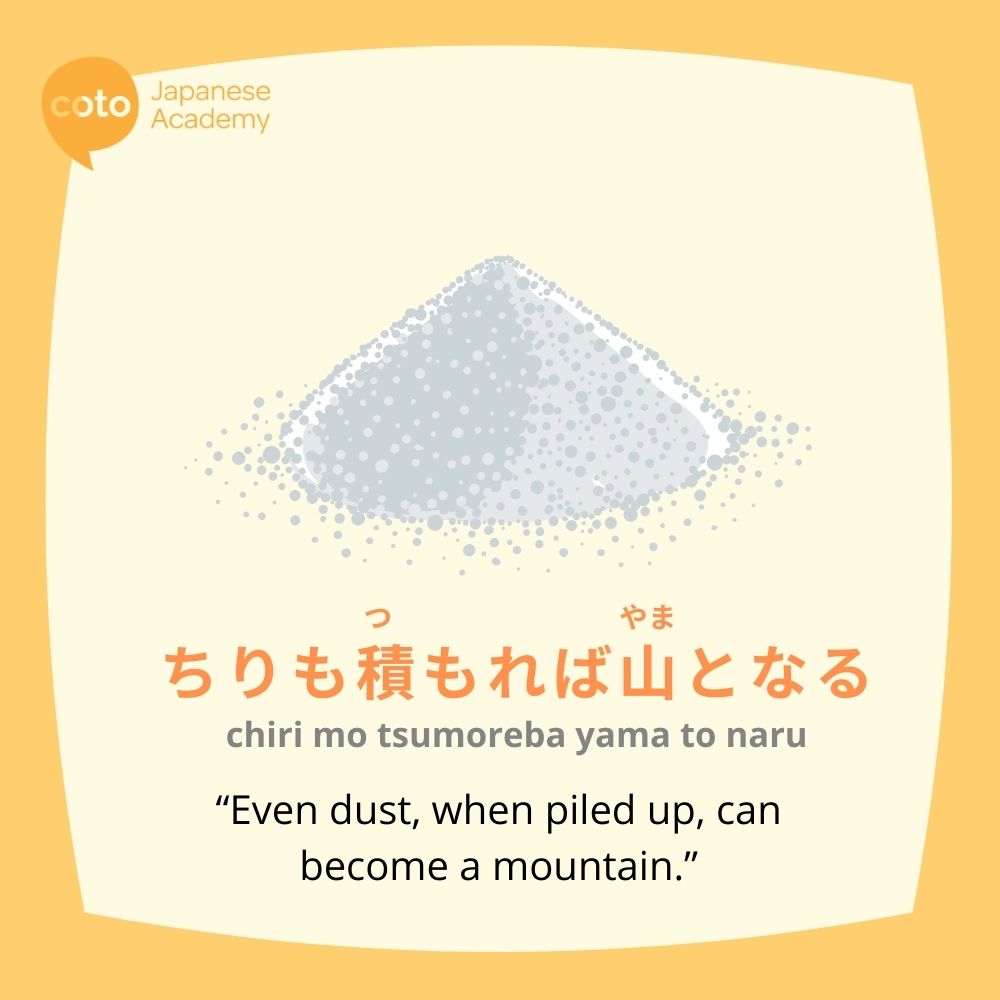
Pronunciation: chiri mo tsumoreba yama to naru
Translation: “Even dust, when piled up, can become a mountain.”
Meaning: Many a little makes a mickle / Just small effort does make a difference
Example Sentence:
- ちりも積もれば、山となるというからね。
As they say, even dust when piled up becomes a mountain.
21. uogokoro areba mizugokoro 魚心あれば水心
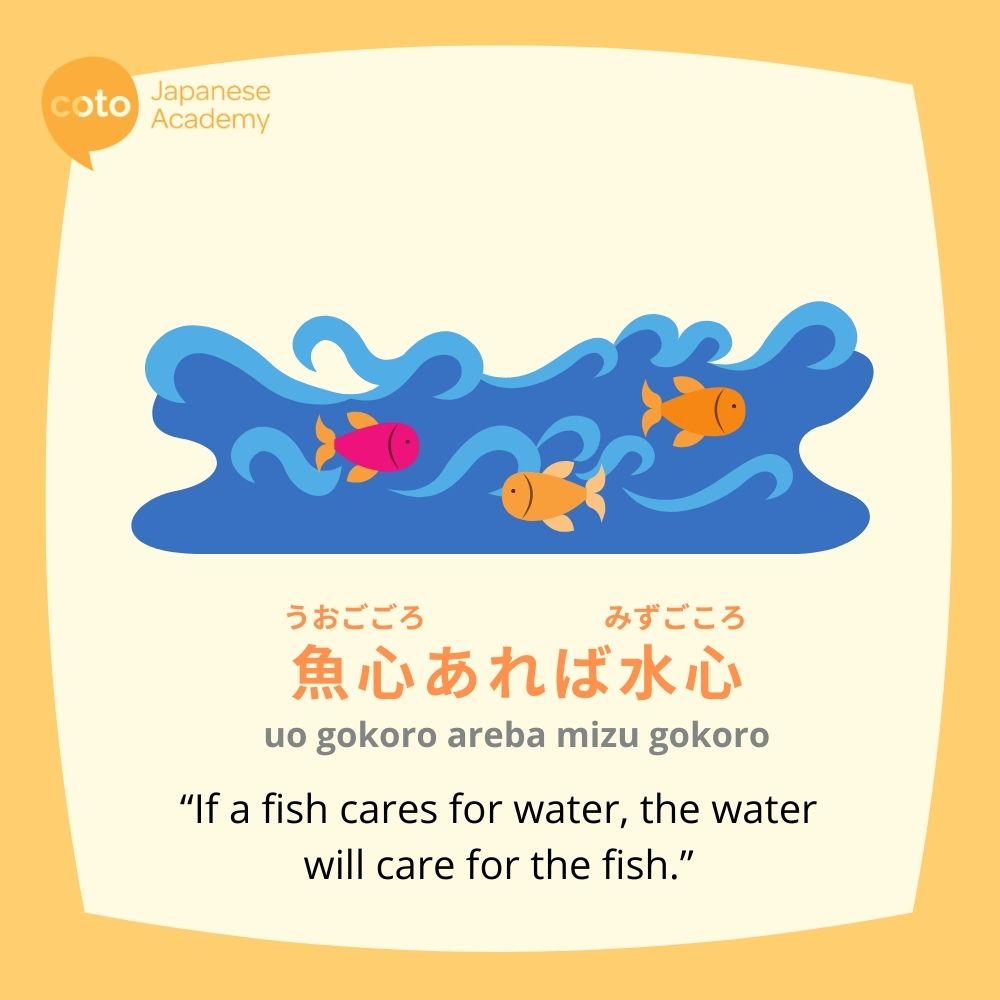
Pronunciation: uogokoroareba mizugokoro
Translation: “If a fish cares for water, the water will care for the fish.”
Meaning: If you do a favor for somebody, you will get a favor in return / You scratch my back and I’ll scratch yours
Example Sentence:
- 魚心あれば水心あると言う通り、陽気な男の人があっと言う間に近所の人と仲良くなった
As it is said, if the fish has a heart, the water will also have a heart. Thus the cheerful man was on good terms with the neighbors in the blink of an eye.
22. toudai moto kurashi 灯台下暗し
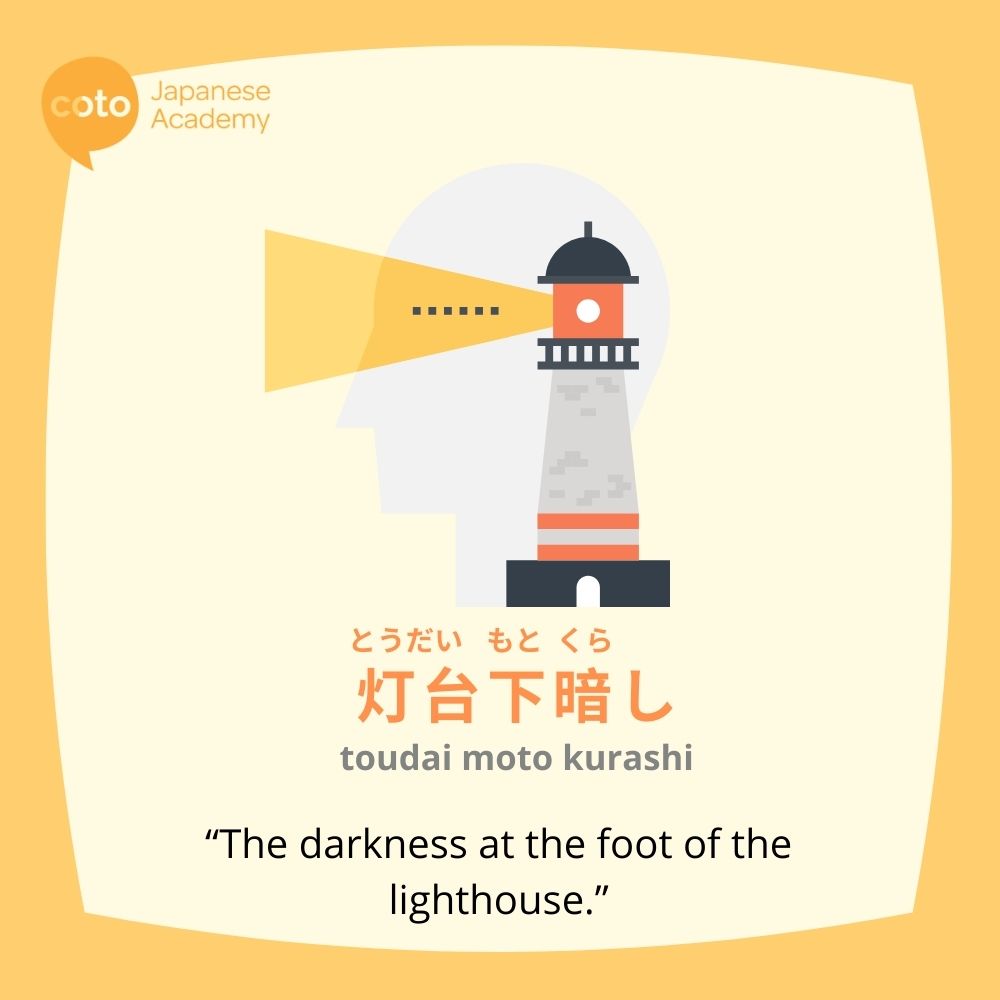
Pronunciation: toudai moto kurashi
Translation: “The darkness at the foot of the light fixture.”
Meaning: It’s hard to see what is under your nose.
Example Sentence:
- 会社の金を盗んだのは社長の秘書だった。まさに灯台下暗しだ。
It was the president’s secretary who stole the company’s money. It’s hard to see what’s under their nose. .
23. kachou fuugetsu 花鳥風月
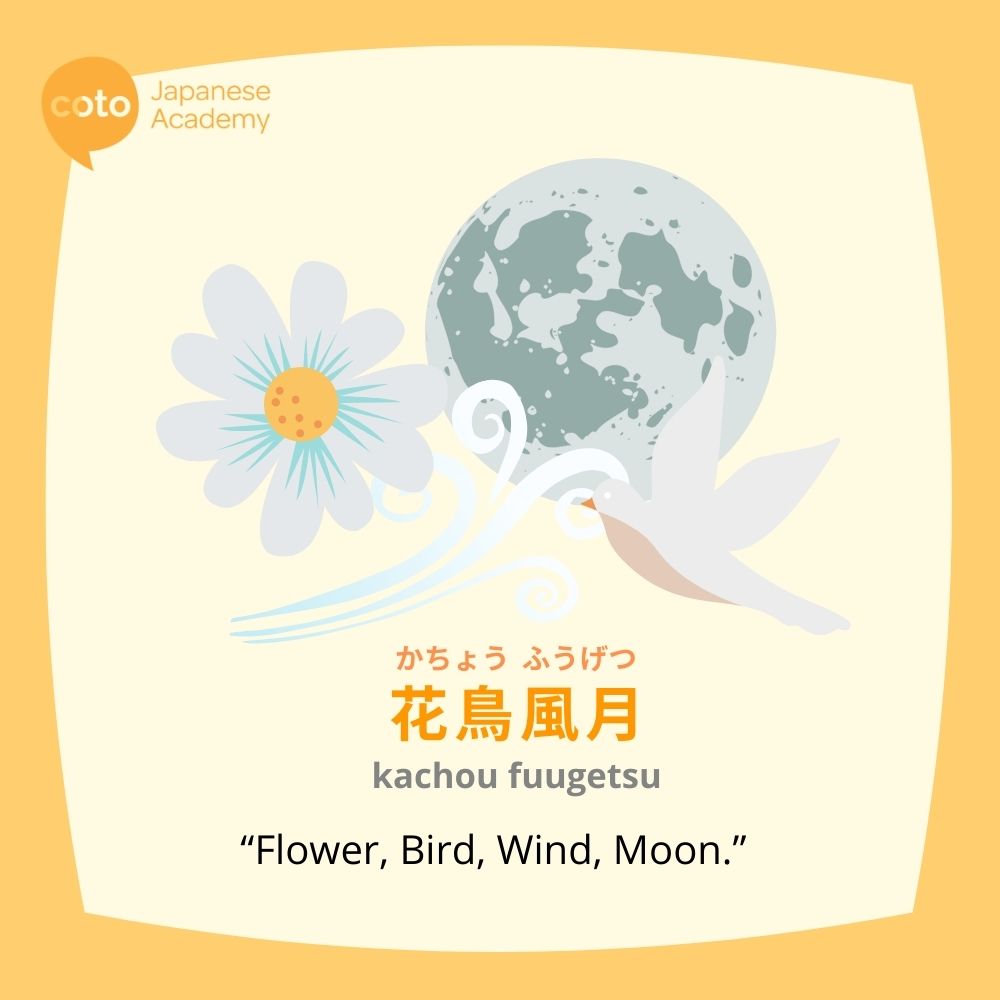
Pronunciation: kachou fuugetsu
Translation: “Flower, Bird, Wind, Moon.”
Meaning: Experience the beauties of nature, and in doing so learn about yourself.
Example Sentence:
- 花鳥風月を楽しむために都会を離れた
I’m leaving the city to enjoy the wonders of nature.
24. ku areba raku ari 苦あれば楽あり
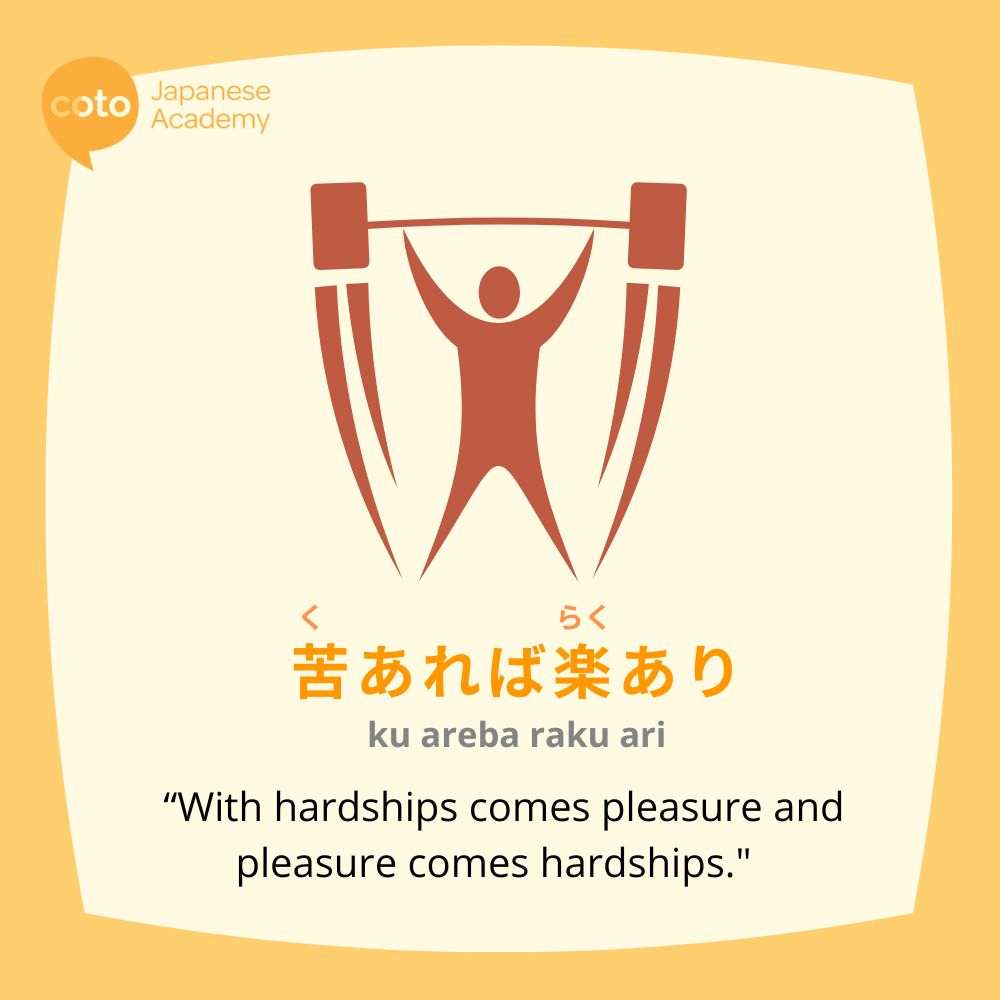
Pronunciation: Ku areba raku ari
Translation: “With hardships comes pleasure and pleasure comes hardships.”
Meaning: No Pain No Gain
Example Sentence:
- 人生、苦あれば楽あり! 若いうちは苦労をたくさんした方がいい。
Life is “no pain, no gain”! You should work hard a lot when you are young.
25. ichigo ichie 一期一会
Pronunciation: ichigo ichie
Translation: “Once in a lifetime encounter.”
Meaning: Enjoy every encounter to the fullest
Example Sentence:
- 旅先での素敵な出会いは、まさ一期一会にだ。
A wonderful encounter on a trip is truly a “once-in-a-lifetime meeting.”
26. senri no michi mo ippo kara 千里の道も一歩から
Pronunciation: senri no michi mo ippo kara
Translation: “A journey of a thousand miles begins with a single step.”
Meaning: It takes a series of steps to achieve success
Example Sentence:
- 語学の習得は簡単ではないけれど、千里の道も一歩から。小さな積み重ねが大切です。
Mastering a language is not easy, but a journey of a thousand miles begins with a single step. The accumulation of small steps is important.
27. warau kado niwa kitaru 笑う門には福来たる
Pronunciation: warau kado niwa fuku kitaru
Meaning: Laughter and smiles will bring happiness and fortune
Translation: “Good fortune and happiness will come into the house of those who smile.”
Example Sentence:
- 日本に笑う門には来たるということわざがあるように、和やかにお正月の食卓を皆で囲むことが一番で、それで十分です。
Remember the saying “Fortune comes to those who smile”; this means that the most important thing is that everyone comes together to the table for the New Year’s holidays.
28. mizu ni nagasu 水に流す
Pronunciation: mizu-ni-nagasu
Meaning: Forgive and forget
Translation: “The water flows.”
Example Sentence:
- スージーは物事を水に流すことができない性分だ。
Susie is so constituted that she cannot forgive and forget things.
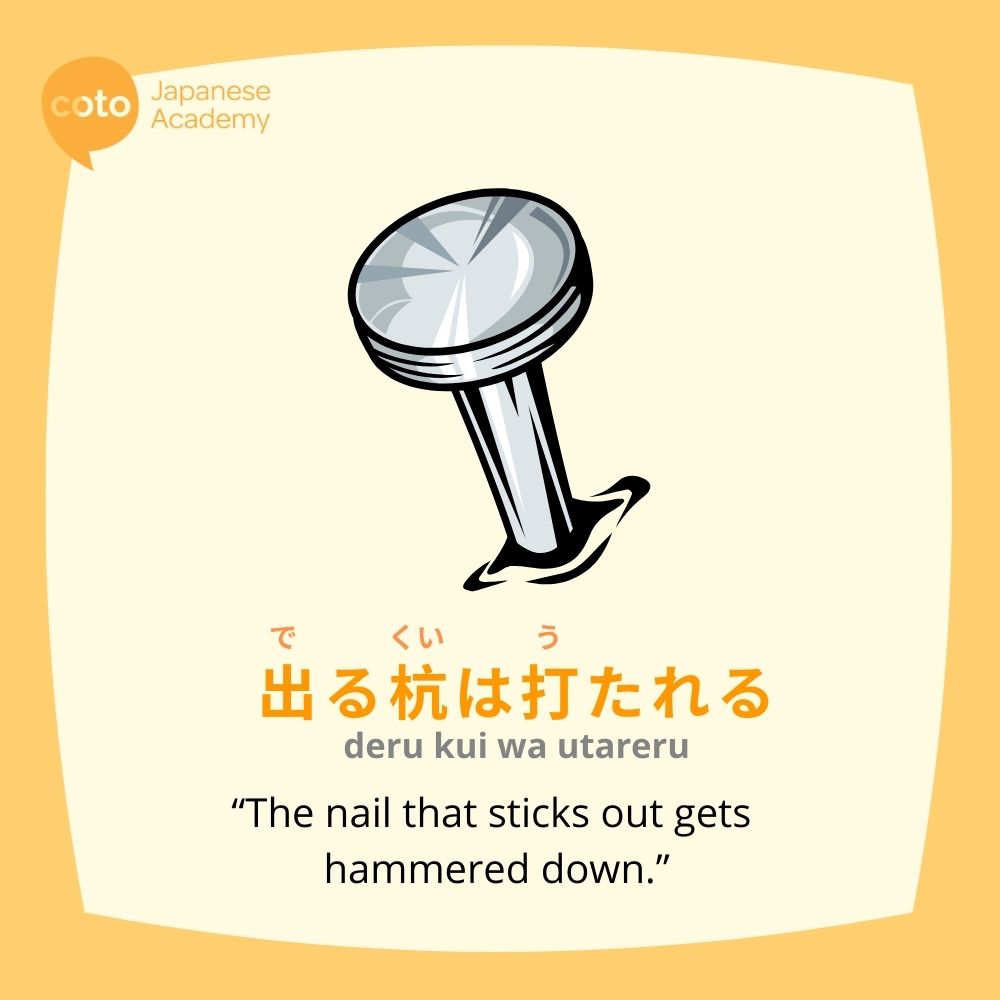
29. deru kui wa utareru 出る杭は打たれる
Pronunciation: deru kui wa utareru
Meaning: People who stick out too much get punished
Translation: “The nail that sticks out gets hammered down.”
Example Sentence:
- 出る杭が打たれる会社じゃ、大きな成長は望めないね。
A company that stifles innovation can’t hope to grow very much.
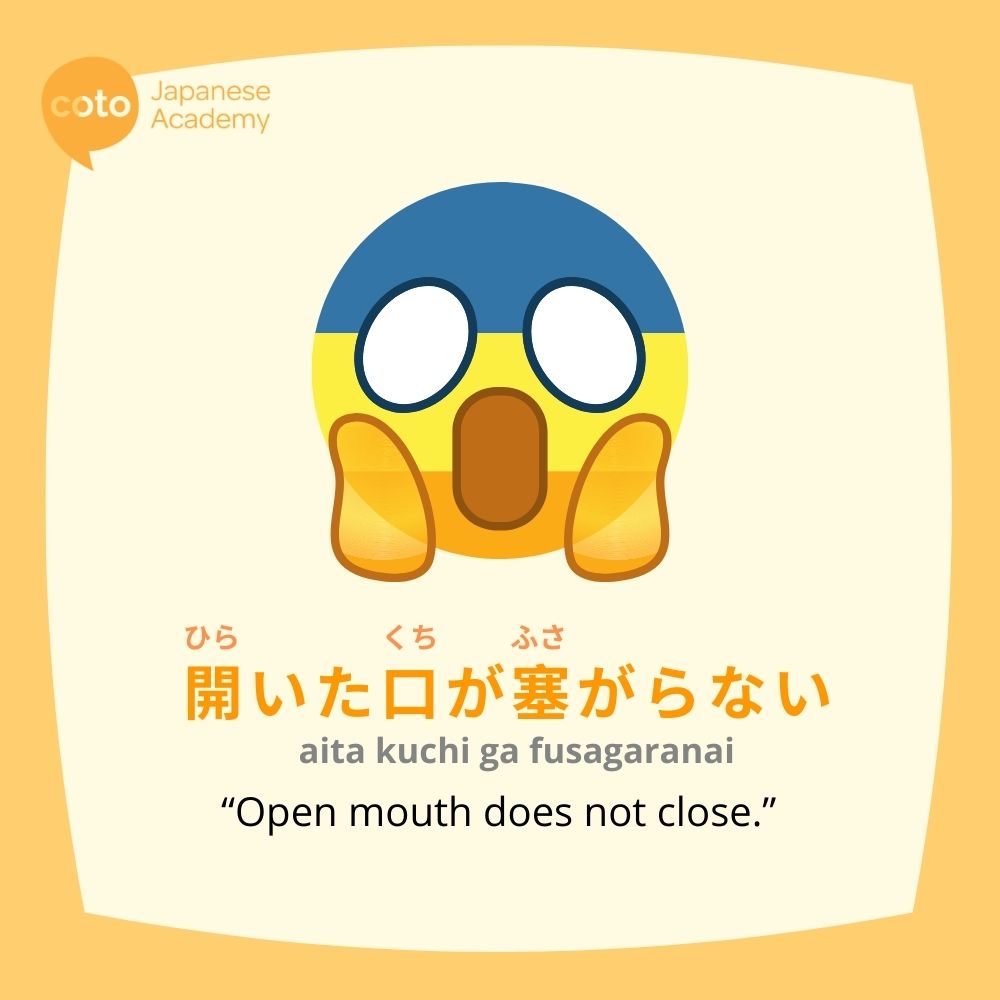
30. aita kuchi ga fusagaranai 開いた口が塞がらない
Pronunciation: aita kuchi ga fusagaranai
Meaning: Someone’s words or behavior are appalling and beyond understanding, and you’re lost for words
Translation: “Open mouth does not close.”
Example Sentence:
- 彼の失礼な返事には開いた口が塞がらなかった
We were taken aback by his rude reply.
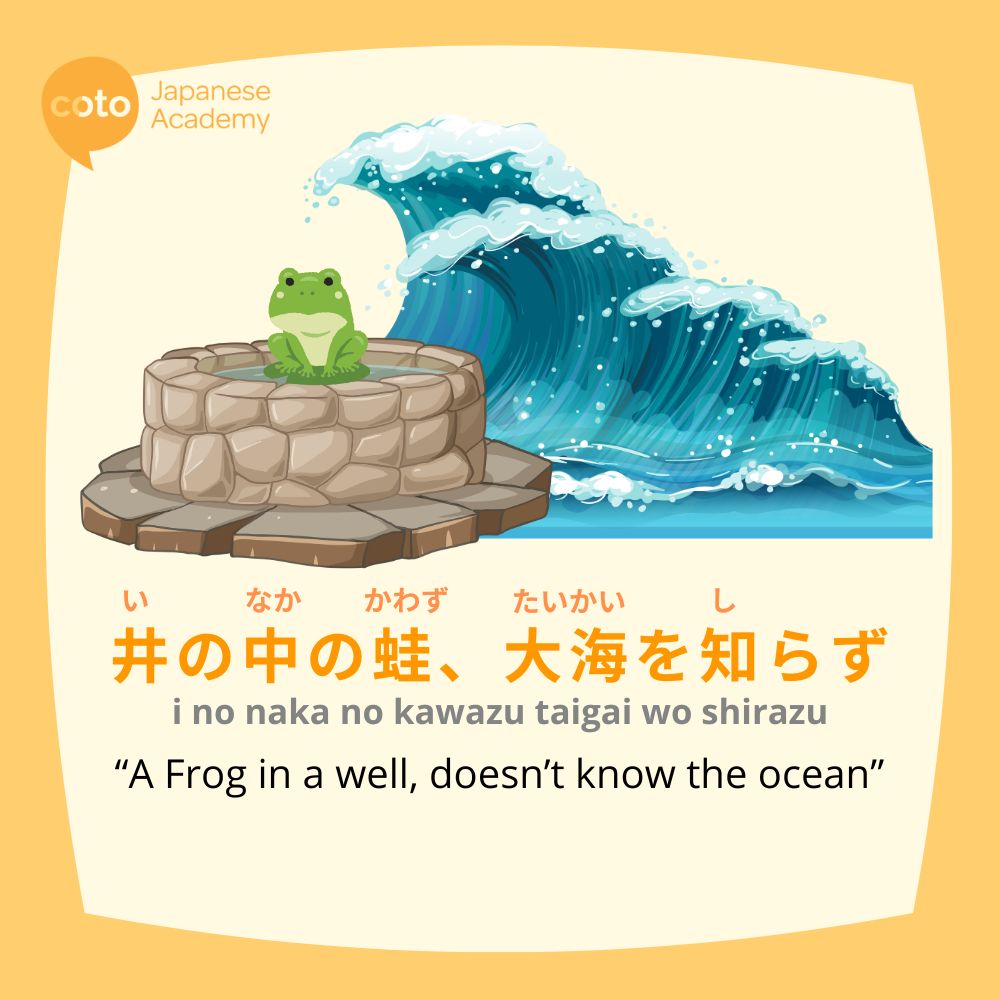
31. I no naka no kawazu, taikai wo shirazu 井の中の蛙大海を知らず
Pronunciation: i no naka kawazu, taikai wo shirazu
Meaning: People who don’t expose themselves to a variety of experiences will have a narrow world view.
Translation: “A frog in a well doesn’t know the vast greatness of the ocean.”
Example Sentence:
- 故郷から出たことがない人は、「井の中の蛙、大海を知らず」と言えるかもしれません。
People who never left their hometown can be described as “frogs in a well who don’t know the vastness of the ocean.
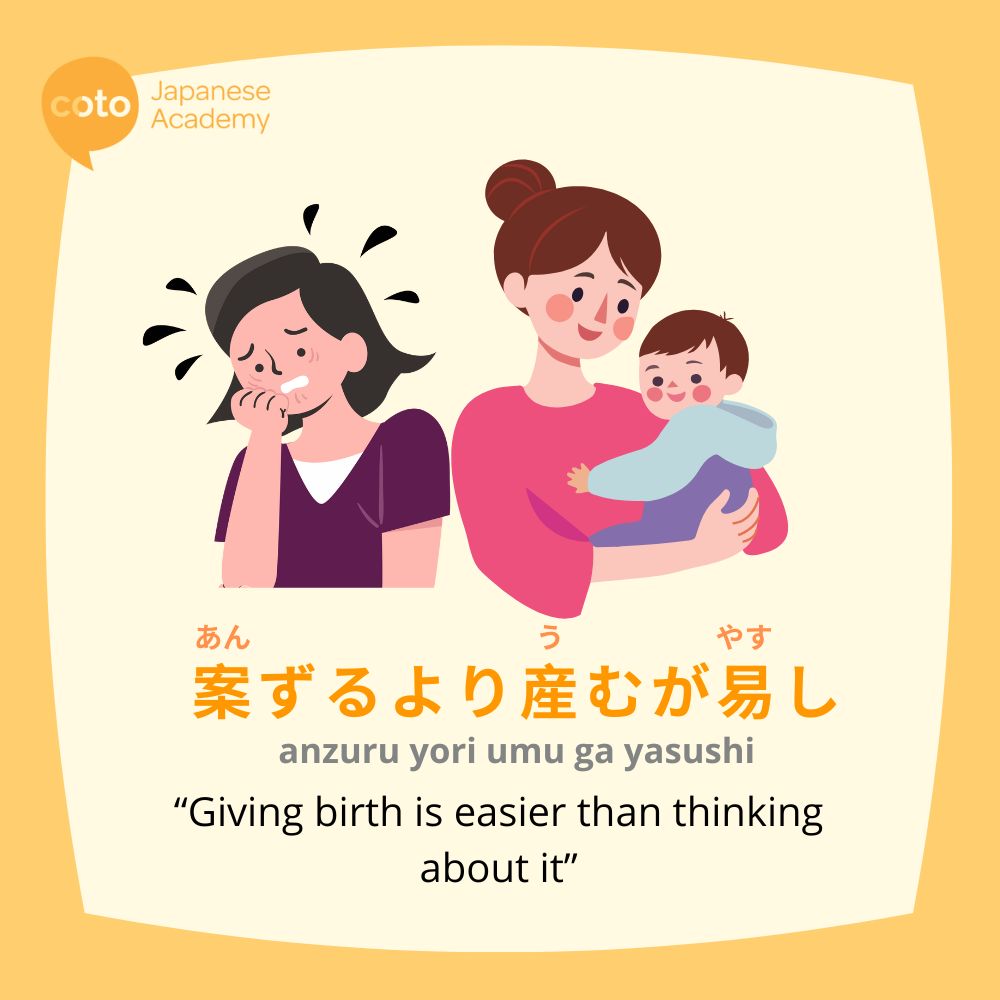
32. Anzuru yori umuga yasushi 案ずるより産むが易し
Pronunciation: anzuru yori umuga yasushi
Translation: “Giving birth is easier than worrying about it.”
Meaning: Doing the actual task is not as difficult as you might think. Don’t worry or stress about the future.
Example Sentence:
- A:ここ最近ずっとテストのことが心配で眠れなかったけど、終わってみれば大したことじゃなかったかも。
- B:それは、よかったじゃない!まさに、案ずるより産むが易し、だね!
A: I was so worried about the test that I wasn’t able to sleep, however, when I finished, it didn’t seem like a big deal.
B: That’s good isn’t it!? Doing is easier than worrying about it, right!
33. Minu ga hana 見ぬが花
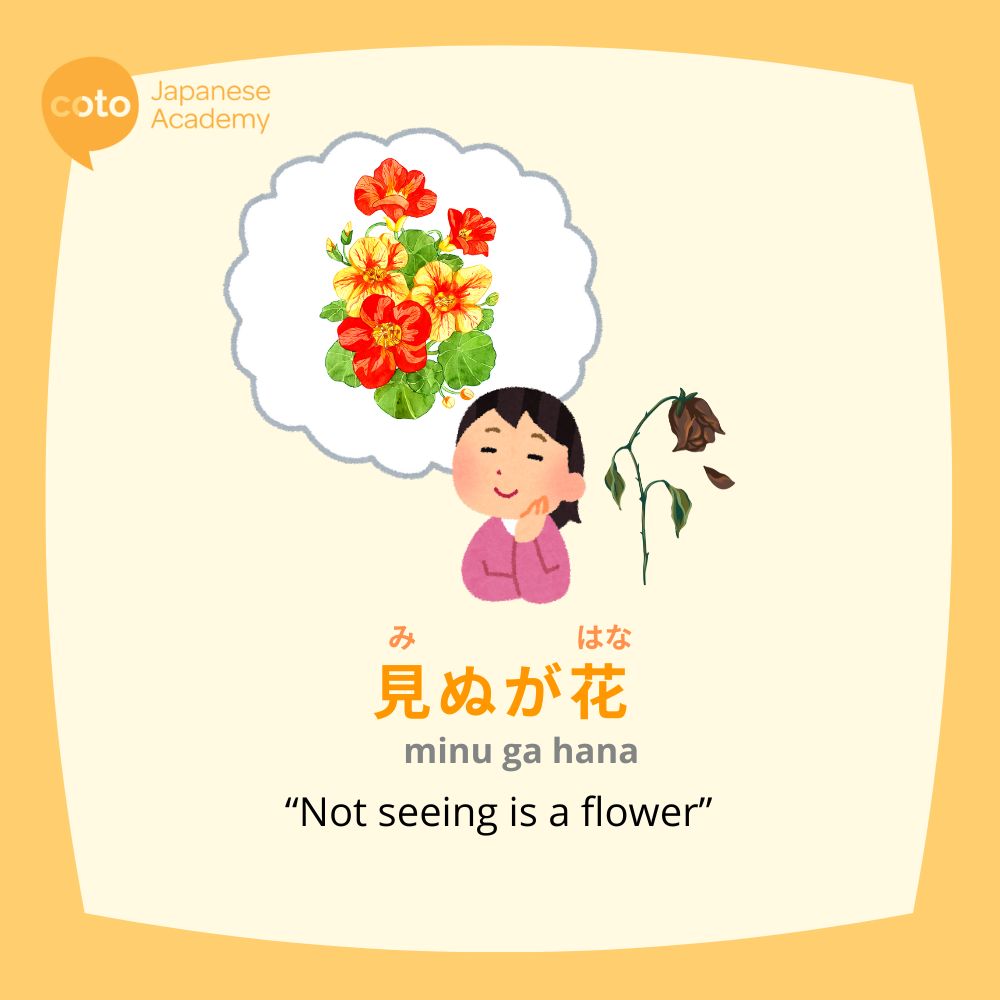
Pronunciation: minu ga hana
Meaning: Your imagination is often better than reality; ignorance is bliss
Translation: “Not seeing is a flower”
Example Sentence:
- A:この前、偶然、芸能人を空港でみかけたんだけど。
- B:で、どうだった?かっこよかった?
- A:ううん。思ったより普通の人だった。
- B:そうか。見ぬが花だね。
A: I saw a famous celebrity at the airport..
B: How was it? Were they cool?
A: Not really, they were more normal than I thought.
B: Is that so? Well nothing is ever as good as we imagine (not seeing is a flower).
34. Uma no mimi ni nenbutsu 馬の耳に念仏
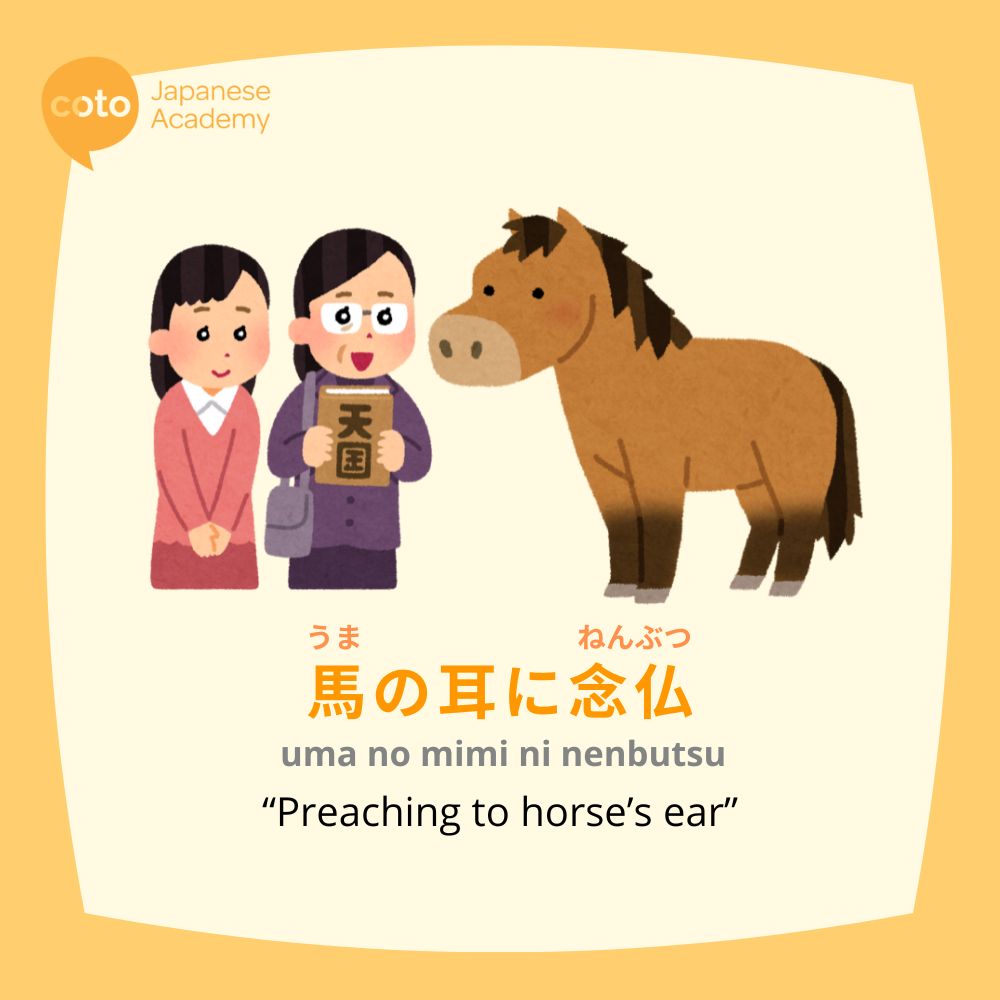
Pronunciation: uma no mimi ni nenbutsu
Meaning: Giving advice or convincing someone who doesn’t listen or understand is futile.
Translation: “Preaching to a horse’s ear”
Example Sentence:
- 私の息子は遊びたい盛りなんだから、いくら勉強しろったって、そんなの馬の耳に念仏だよ。
My son is at an age where he just wants to play, so no matter how much I tell him to study, it’s like preaching to a horse’s ear.
35. Tsuki to suppon 月とすっぽん
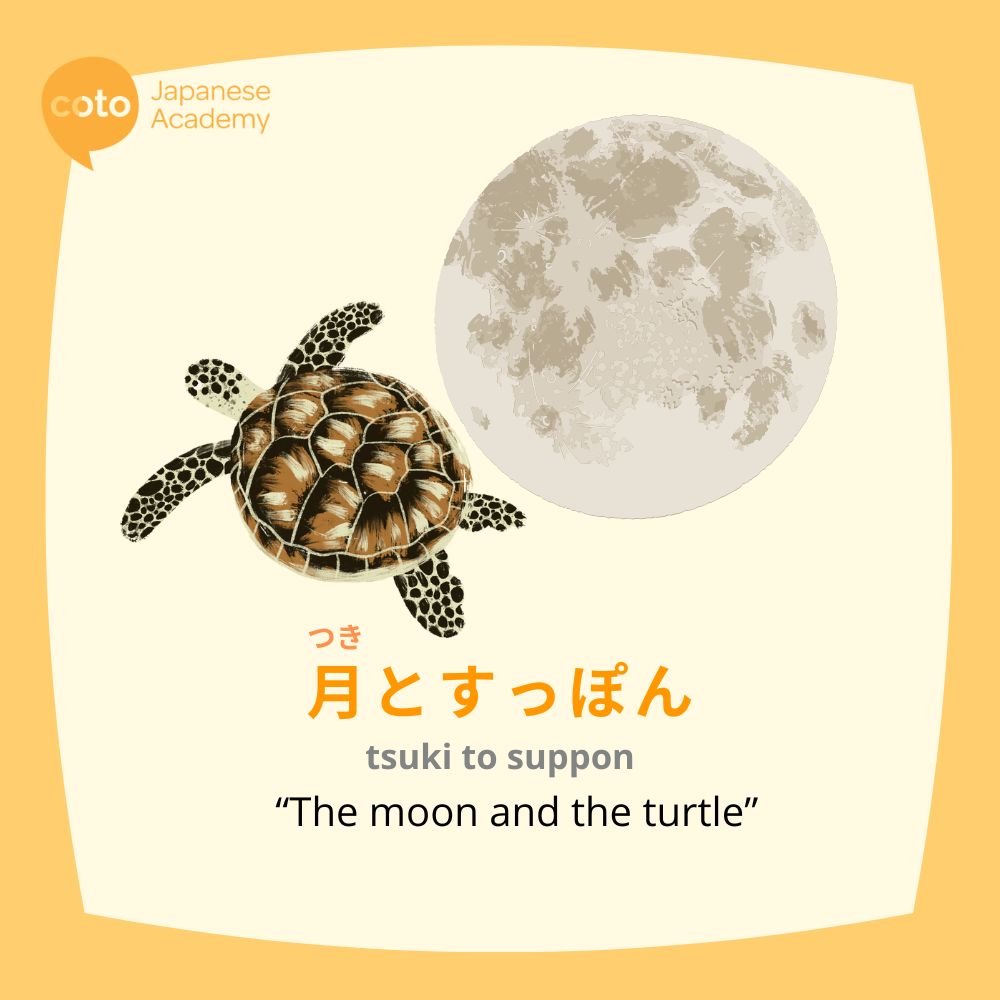
Pronunciation: tsuki to suppon
Meaning: Despite the roundness of the turtle and moon, they are incomparable in every other way.
Translation: “The moon and the turtle”
Example Sentence:
My sister is pretty, intelligent, and sociable. Comparing me to her would be like the moon and the turtle.
- 姉は美人で賢く社交的。それに比べて私は…月とスッポンですよ。
36. Buta ni shinju 豚に真珠
Pronunciation: buta ni shinju
Meaning: Something of high quality is being wasted on someone who can’t appreciate its value.
Translation: Pearls to a pig.
Example Sentence:
- 彼に高級なワインをあげても、味の違いがわからないから豚に真珠だよ。
Even if you give him expensive wine, he can’t tell the difference in taste, so it’s like giving pearls to a pig.
37. Ishi no ue ni mo san nen 石の上にも三年
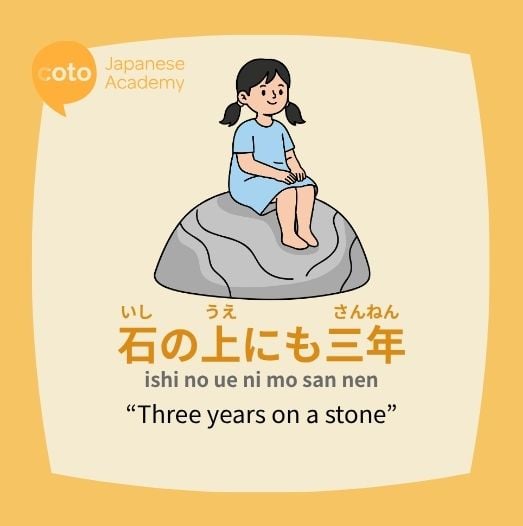
Pronunciation: ishi no ue ni mo san nen
Meaning: Perseverance pays off.
Translation: Three years on a stone.
Example Sentence:
- 石の上にも三年と言うから、今の仕事をもう少し頑張ってみよう。
They say “three years on a stone,” so I’ll try to stick with my current job a little longer.
38. Tana kara botamochi 棚からぼたもち
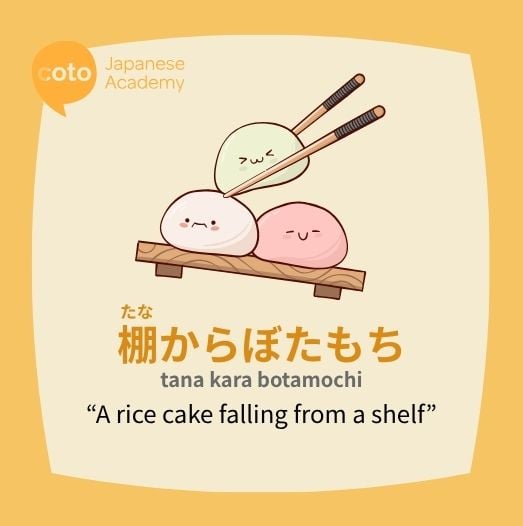
Pronunciation: tana kara botamochi
Meaning: Unexpected good fortune.
Translation: A rice cake falling from a shelf.
Example Sentence:
- 宝くじに当たったなんて、まさに棚からぼたもちだね。
Winning the lottery is exactly like a rice cake falling from a shelf!
39. Isogaba maware 急がば回れ
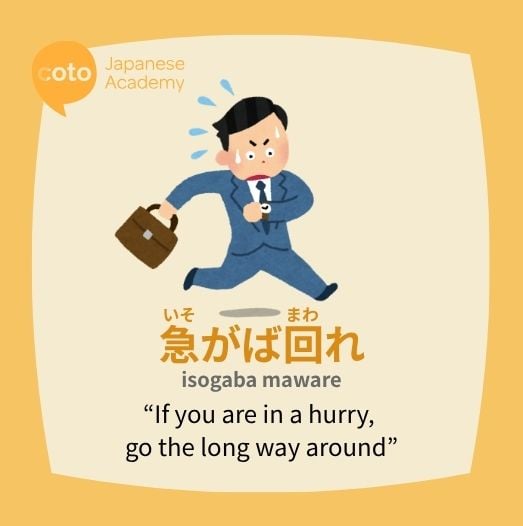
Pronunciation: isogaba maware
Meaning: Haste makes waste. Taking a known, safe route is often faster in the end than taking a risky shortcut.
Translation: If you are in a hurry, go the long way around.
Example Sentence:
- 近道は道が悪いから、急がば回れで大通りを行こう。
The shortcut is in bad condition, so let’s remember “haste makes waste” and take the main road.
40. Gou ni itte wa gou ni shitagae 郷に入っては郷に従え
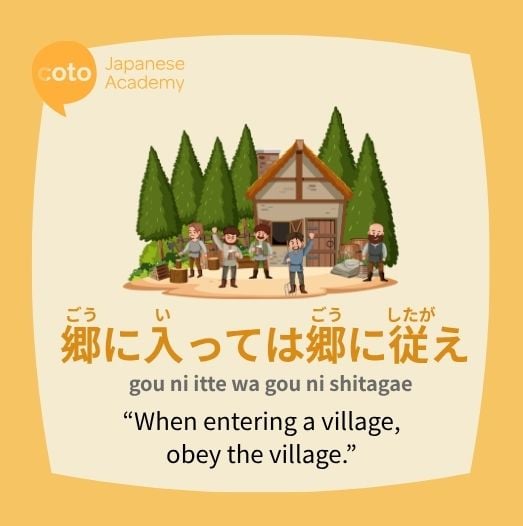
Pronunciation: gou ni itte wa gou ni shitagae
Meaning: When in Rome, do as the Romans do. It highlights the importance of adapting to local customs and rules.
Translation: When entering a village, obey the village.
Example Sentence:
- 海外に行ったら、郷に入っては郷に従えで、現地のルールを守るべきだ。
When you go abroad, you should do as the Romans do and follow the local rules.
41. Nou aru taka wa tsume o kakusu 能ある鷹は爪を隠す
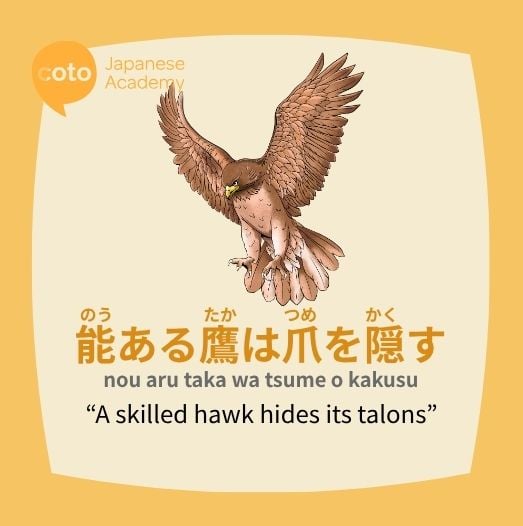
Pronunciation: nou aru taka wa tsume o kakusu
Meaning: The wise do not show off. Truly capable or talented people do not feel the need to boast about their abilities.
Translation: A skilled hawk hides its talons.
Example Sentence:
- 彼は普段静かだけど、実はピアノの名手なんだ。能ある鷹は爪を隠すというやつだね。
He’s usually quiet, but he’s actually a master pianist. It’s a classic case of the skilled hawk hiding its talons.
42. Juu nin to iro 十人十色
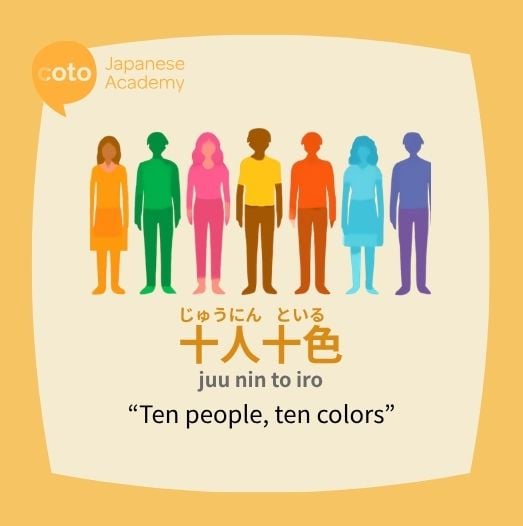
Pronunciation: juu nin to iro
Meaning: To each their own. Everyone has their own unique tastes, preferences, and personality. Translation: Ten people, ten colors.
Example Sentence:
- 好きな音楽のジャンルは十人十色だ。
When it comes to favorite music genres, it’s “ten people, ten colors” (to each their own).
43. Kawaii ko ni wa tabi o saseyo 可愛い子には旅をさせよ

Pronunciation: kawaii ko ni wa tabi o saseyo
Meaning: Tough love. If you truly care about a child, you should let them experience the hardships of the world.
Translation: Send a beloved child on a journey.
Example Sentence:
- 息子を一人暮らしさせるのは心配だけど、可愛い子には旅をさせよと言うしね。
I’m worried about letting my son live alone, but as they say, you must send a beloved child on a journey.
44. Kaeru no ko wa kaeru 蛙の子は蛙
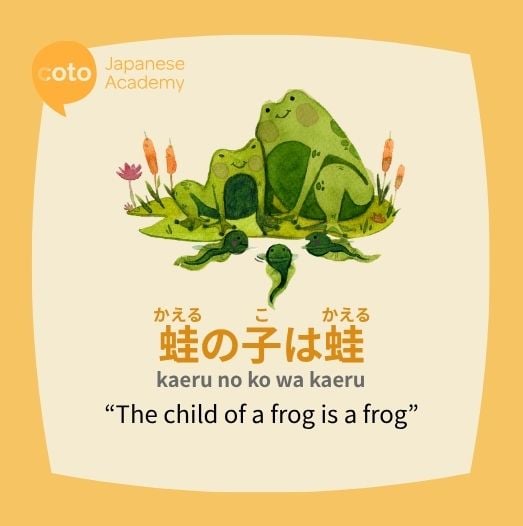
Pronunciation: kaeru no ko wa kaeru
Meaning: Like father, like son; the apple doesn’t fall far from the tree. Children tend to inherit the traits of their parents.
Translation: The child of a frog is a frog.
Example Sentence:
- 息子も父親と同じで野球ばかりしている。やっぱり蛙の子は蛙だ。
The son is just like his father, playing baseball all the time. The child of a frog really is a frog.
45. Donguri no seikurabe どんぐりの背比べ
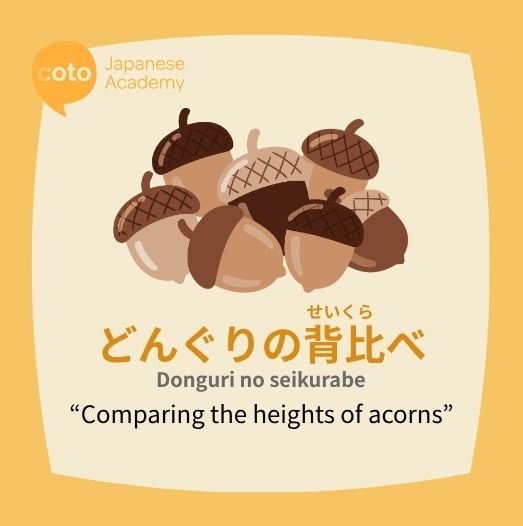
Pronunciation: donguri no seikurabe
Meaning: Not much difference between them. Used when a group of people or things are all about the same (usually mediocre) level, making a comparison pointless.
Translation: Comparing the heights of acorns.
Example Sentence:
- 彼らの成績はみんな似たようなもので、どんぐりの背比べだ。
Their grades are all pretty similar; it’s like comparing the heights of acorns.
46. Kabe ni mimi ari, shouji ni me ari 壁に耳あり障子に目あり
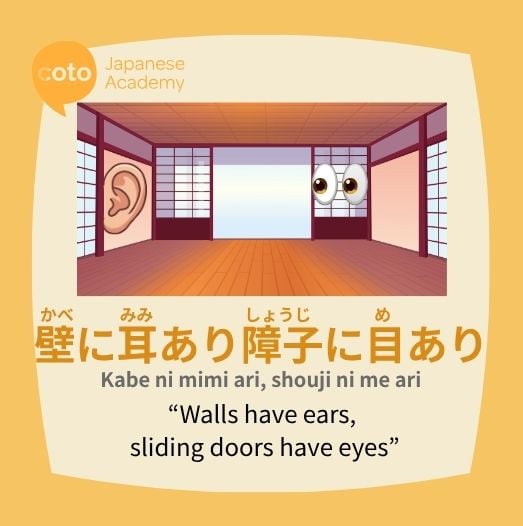
Pronunciation: kabe ni mimi ari, shouji ni me ari
Meaning: Secrets have a way of leaking out. You never know who is listening or watching, so be careful what you say and do.
Translation: Walls have ears, sliding doors have eyes.
Example Sentence:
- ここではあまり大きな声で話さないほうがいい。壁に耳あり障子に目ありだからね。
We shouldn’t speak too loudly here. Walls have ears and sliding doors have eyes, you know.
47. Kusatte mo tai 腐っても鯛
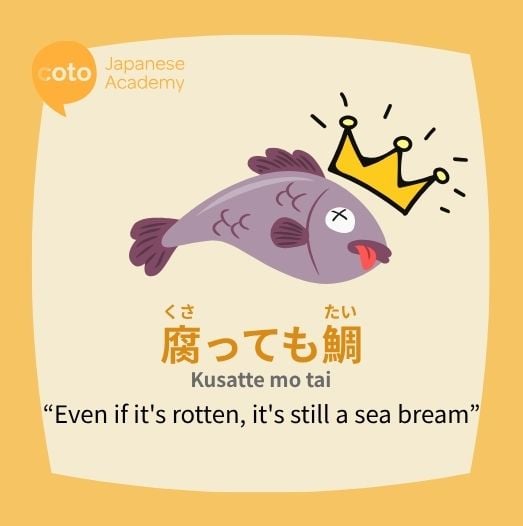
Pronunciation: kusatte mo tai
Meaning: True quality doesn’t degrade. The sea bream (tai) is considered a premium fish in Japan. This means that something or someone of high quality or birth retains their underlying worth even if their circumstances decline.
Translation: Even if it’s rotten, it’s still a sea bream.
Example Sentence:
- 古くなってもあのブランドの車は乗り心地がいい。まさに腐っても鯛だ。
Even though it’s old, that brand’s car still rides beautifully. It truly is a sea bream, even if it’s rotten.
48. Zen wa isoge 善は急げ
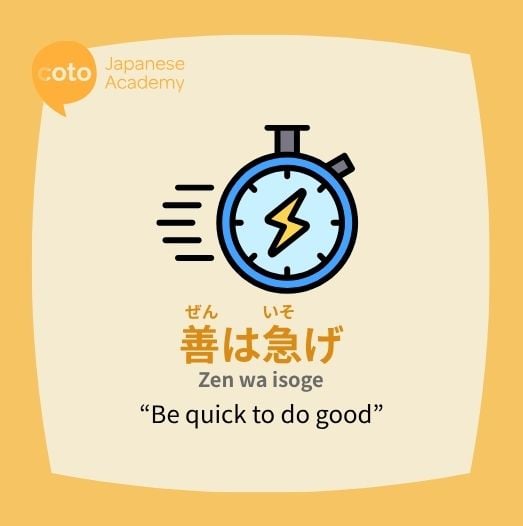
Pronunciation: zen wa isoge
Meaning: Strike while the iron is hot. If you have a good idea or opportunity, you should act on it immediately without hesitation.
Translation: Be quick to do good.
Example Sentence:
- そのプロジェクトに興味があるなら、善は急げで今すぐ応募しなさい。
If you’re interested in that project, remember to strike while the iron is hot and apply right now.
49. Tonbi ga taka o umu 鳶が鷹を産む
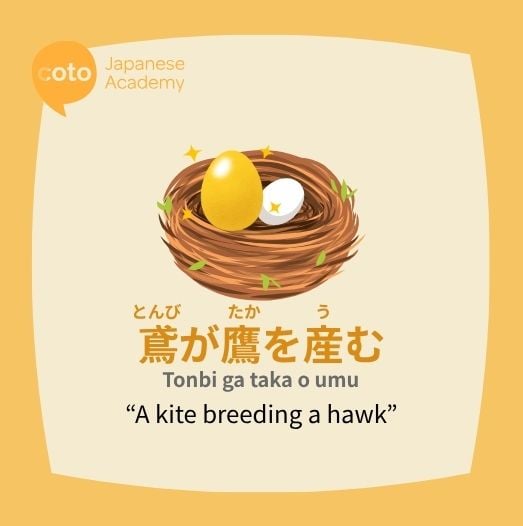
Pronunciation: tonbi ga taka o umu
Meaning: An exceptional child born to ordinary parents.
Translation: A kite breeding a hawk.
Example Sentence:
- 両親は運動が苦手なのに、息子がオリンピック選手になるなんて、まさに鳶が鷹を産むだ。
His parents are terrible at sports, yet their son became an Olympic athlete; it’s truly a kite giving birth to a hawk.
50. Baka ni tsukeru kusuri wa nai 馬鹿につける薬はない
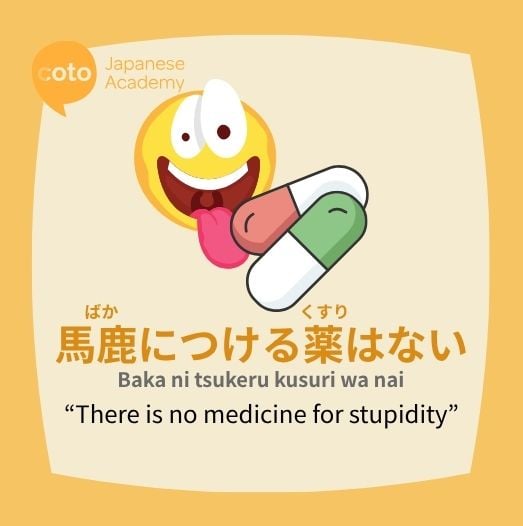
Pronunciation: baka ni tsukeru kusuri wa nai
Meaning: Some people just won’t change or learn from their mistakes, and there is no cure for foolishness.
Translation: There is no medicine for stupidity.
Example Sentence:
- 彼はまた同じ詐欺に引っかかったの?本当に馬鹿につける薬はないね。
He fell for the same scam again? There really is no cure for a fool.
Conclusion: Try To Remember The Japanese Proverbs!
Japanese proverbs are a great way to get exposed to traditional Japanese culture and how to use more figurative, dynamic, and even poetic language. Oftentimes when we study Japanese, we stick to a very literal way of speaking. So, kotowaza can actually teach you how metaphors, similes, or idioms are used in Japanese, which helps you better understand humor and natural conversational Japanese. Challenge yourself by remembering at least 10 from this list of common proverbs and impress people with your wise words!
Want to Learn Japanese?
If you need a place to practice Japanese conversation, look no further than Coto Academy! We offer a wide variety of both in person and online classes that can match your needs and level.
What are the most popular Japanese proverbs?
There are many common proverbs, but some of the most popular include 「猿も木から落ちる」“sarumo ki kara ochiru”, 「二兎を追う者は一兎をも得ず」“nito o oumono wa itto mo ezu”, and much more, especially from the list above.
What is a Japanese proverb for luck?
The proverb, 「笑う門には福来たる」“warau kado niwa fuku kitaru” translates to “good fortune comes to the homes of those who laugh”. This saying means that good luck is drawn to people who are happy.
What is a Japanese proverb for inspiration?
There are a lot of proverbs for inspiration, but one of the most popular is 「ちりも積もれば山となる」“Dust accumulated will become a mountain”. The meaning is that small steps will lead to huge progress so in the end it’ll be worth it to not give up!
How do you say proverbs in Japanese?
In Japanese, a proverb is called ことわざ (kotowaza). It’s a short, memorable saying that conveys a message or wisdom, often based on cultural values or experiences.
Are proverbs often used in Japanese?
Yes, proverbs are often said in Japanese. Oftentimes, proverbs are shortened, since saying the whole thing is not always necessary.
For example, the Japanese often say “i no naka kawazu (a frog in a well)” instead of the whole idiom. It’s similar to when we simply say in English, “when in Rome”.
Interested in learning more Japanese phrases? Check out our popular articles on:
- 19 Japanese Swear Words You Should Not Use
- 23 Japanese Tongue Twisters to Test Your Pronunciation
- 4 Basic Japanese Greetings: Ohayou, Konnichiwa, Konbanwa and Oyasumi