






If you are a resident in Japan planning to renew your visa or change your status of residence anytime soon, there’s a change coming that’s worth noting.
On Tuesday, August 25, 2026, the Japanese government decided to raise fees for foreign nationals who renew or change their status of residence in Japan. The renewal fee will rise to up to ¥75,000 from a uniform ¥6,000, effective October 1, 2026. The Cabinet approved the move, in line with a revision to the Immigration Control Act.
Japanese immigration policies change frequently. We recommend referring to the official Immigration Services Agency of Japan under the Ministry of Justice for the most up-to-date information.
Updated Fee for Application for Extension of Period of Stay and Change of Status of Residence in Japan
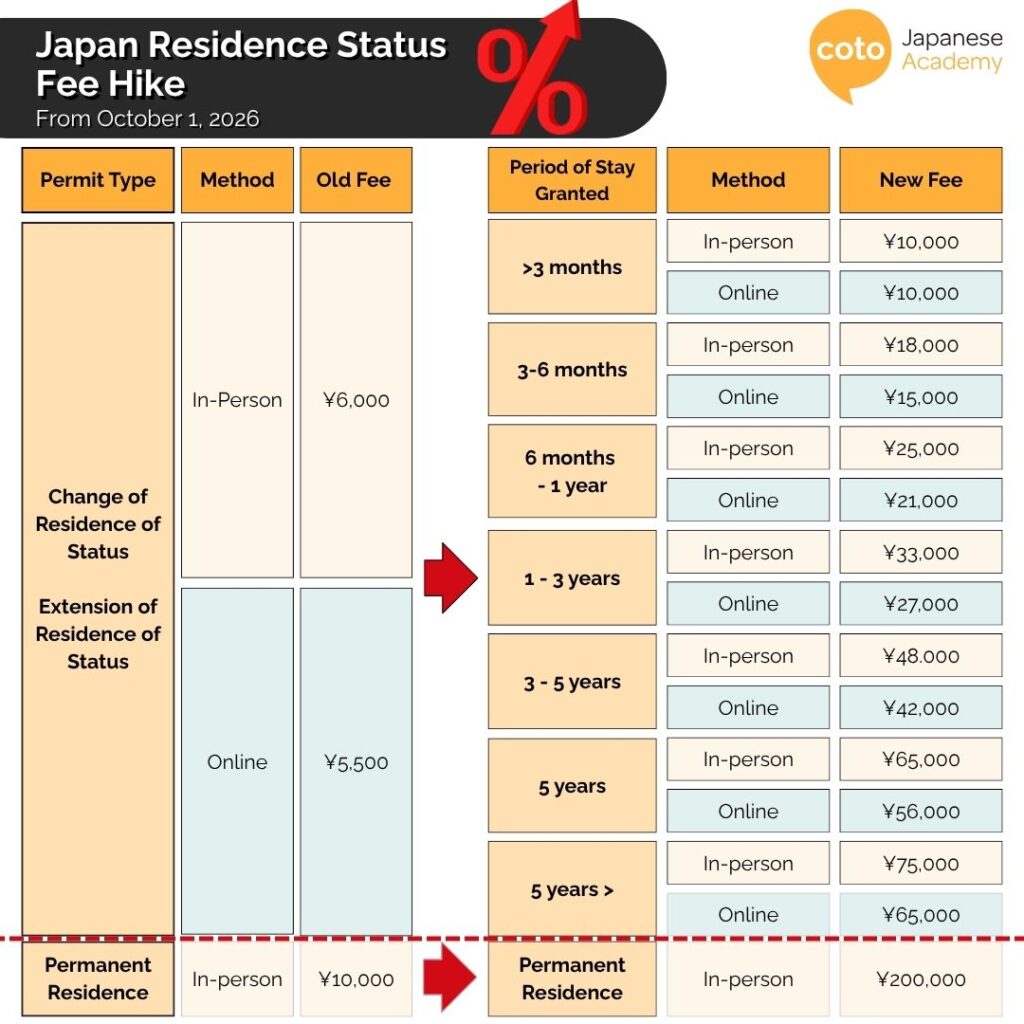
Until September 30, 2026, the fees for extending a period of stay or changing a status of residence remain a flat rate of ¥6,000 for in-person counter applications and ¥5,500 for online submissions, regardless of the duration granted. Foreign residents can typically be granted periods of stay ranging from 3 months to 5 years.
Starting October 1, 2026, Japan is replacing this flat-rate system with a tiered pricing model based on the duration of stay granted, reaching up to ¥75,000 for periods exceeding five years. The government is introducing a significantly reduced fee for applicants who apply online. Those who submit their application digitally can save up to ¥10,000 compared to filing in person at their local immigration bureau.
Old Fee Schedule (Prior to October 1, 2026)
| Application Type | Submission Method | Standard Fee |
| Change or Extension of Status | In-Person (Counter) | ¥6,000 |
| Change or Extension of Status | Online Application | ¥5,500 |
| Permanent Residence | In-Person (Counter) | ¥10,000 |
New Fee Schedule (Effective October 1, 2026)
| Permit Type | Period of Stay Granted | In-Person Fee | Online Fee |
|---|---|---|---|
| Change or Extension of Residence Status | Up to 3 months | ¥10,000 | ¥10,000 |
| 3 – 6 months | ¥18,000 | ¥15,000 | |
| 6 months – 1 year | ¥25,000 | ¥21,000 | |
| 1 – 3 years | ¥33,000 | ¥27,000 | |
| 3 – 5 years | ¥48,000 | ¥42,000 | |
| 5 years | ¥65,000 | ¥56,000 | |
| Over 5 years | ¥75,000 | ¥65,000 | |
| Permanent Residence | Permanent | ¥200,000 | N/A |
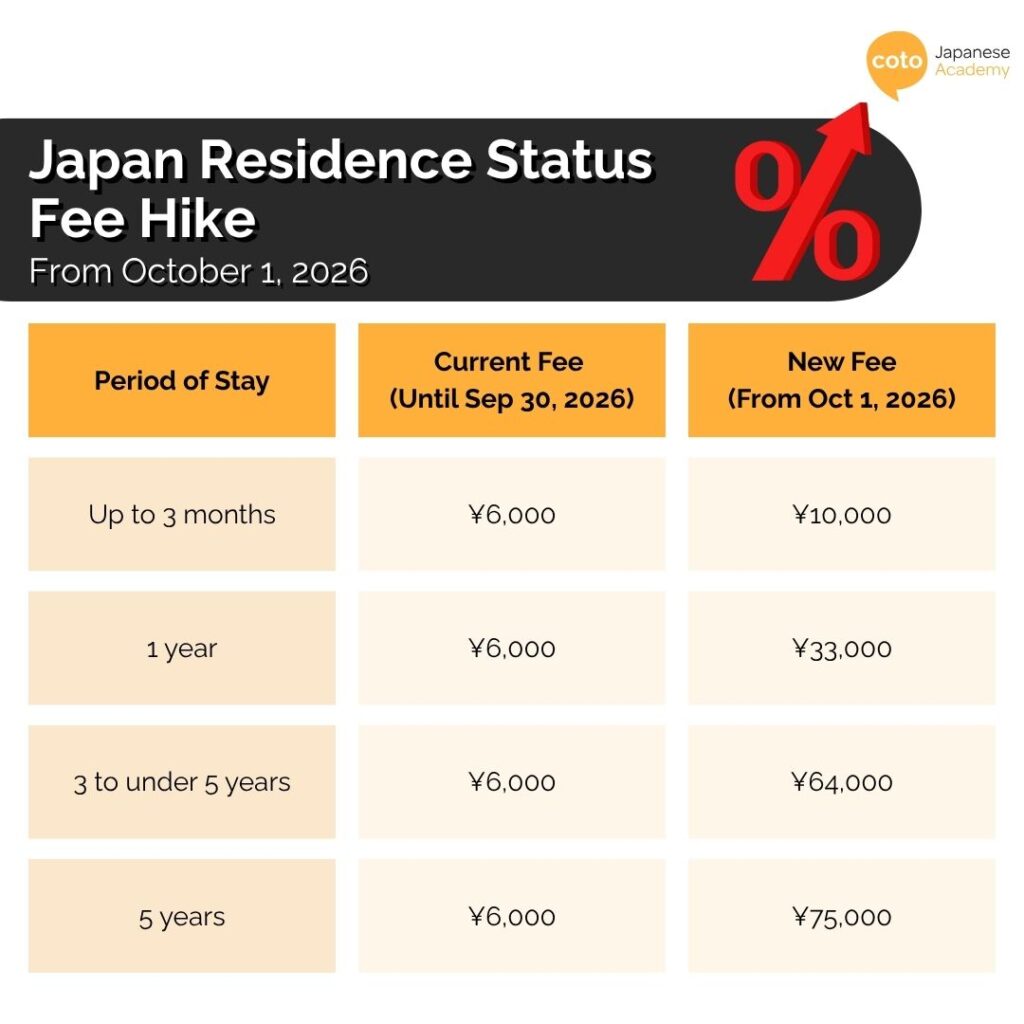
Under the new policy, fees scale substantially based on the period granted: short stays under three months are priced at ¥10,000 (both in-person and online), stays between three and six months cost ¥18,000 in person or ¥15,000 online, and six-month to one-year extensions rise to ¥25,000 in person or ¥21,000 online. For longer durations, a one- to three-year permit requires ¥33,000 in person or ¥27,000 online, a three- to five-year permit costs ¥48,000 in person or ¥42,000 online, five-year permits cost ¥65,000 in person or ¥56,000 online, and extensions exceeding five years reach up to ¥75,000 in person or ¥65,000 online.
Permanent Residence applications will see the most dramatic increase, surging twentyfold from a flat ¥10,000 to ¥200,000
This comes as part of a broader line of immigration policy changes, including the new requirement to prove Japanese language ability for the most common professional working visa, tightened requirements around applying for permanent residence, and increased fees across other types of temporary visas.
Fee Reductions for Specific Applicants
To support vulnerable applicants facing severe financial hardship—including designated refugees—the Immigration Services Agency is providing reduced fee caps of ¥10,000 for temporary stay extensions and ¥20,000 for Permanent Residence applications.
The Immigration Services Agency’s reduced fee is allowed for people who meet two conditions: financial hardship equivalent to public assistance welfare levels, and a need for humanitarian consideration.
Now, the scope has since expanded to include:
- Foreign nationals who single-handedly raise the biological children of Japanese nationals or special permanent foreign residents
- Cases where denying residency would be considered inhumane
Fee-reduction requests must be filed in person, as the online system cannot process discount claims.
How to Pay for Your Residence Permit Application
With this drastic fee increase, the Immigration Services Agency of Japan has also provided some recommendations regarding the purchase of revenue stamps
Paying for In-Person Applications with Revenue Stamp
If you are applying directly at an immigration counter, you will continue paying your fees using standard revenue stamps (shunyu inshi) with cash. However, because the new tiered fee model varies based on the exact period of stay you are granted, on-site convenience stores at local immigration offices may quickly run out of specific stamp denominations.
To save time and avoid long lines, the Japanese government explicitly recommends that you check the approved duration listed on your official notification postcard, go to a post office beforehand to buy the exact stamp amount required, and bring the minimum number of stamps needed to your final appointment.
Paying for Online Applications
Applying through the Online Residence Application System eliminates the need for revenue stamps altogether. Under revised regulations, online payments are now managed by a designated third-party payment vendor.
Once your application is approved, you can complete your payment at a local convenience store register, through standard bank transfers, or via internet banking for a completely cashless experience. Keep in mind that a small third-party processing fee might apply to digital transactions.
Is the New Fee Based on When I Apply or When I Pay?
The revised fee structure is determined entirely by when you apply (the official application acceptance date), not when your permit is granted or paid for.
The new fees apply strictly to foreign nationals who submit their application for an extension of stay, change of status, or permanent residency on or after October 1, 2026.
This means that if the Immigration Services Agency officially accepts your application on or before September 30, 2026, the old fee will apply. For example, you will pay ¥6,000 for an extension or change of status of residence, or ¥10,000 for an application for permanent residence, even if your application is approved after October 1, 2026.
Because of this rule, immigration offices are expected to see a massive surge in applicants during the last few weeks of September. If your visa renewal or status change window falls around this time, it is strongly recommended that you prepare your documents early and apply a few weeks before the October 1 cutoff date!
How Does This Compare to Other Countries
Even after the increase, Japan’s fees remain on the lower end globally for a work-visa change of status or extension.
For example, extending a Skilled Worker visa from inside the United Kingdom, depending on length, ranges from £885–£1,751. This is separate from the annual healthcare surcharge of around £1,035/year. A standard H-1B visa in the United States costs between $2,225 and $3,500 in base government fees, though new proposals from the Department of Homeland Security include a major $103,265 supplemental fee for new applicants.
Which Visa Types Are Affected?
The fee change applies broadly to Change of Status of Residence and Extension of Period of Stay applications, meaning it covers essentially every status of residence category, not just work visas. The fee is based on the length of the new period of stay.
Some visa that falls under this price hike include:
- Work visas, including the Engineer/Specialist in Humanities/International Services. Other work categories (Specified Skilled Worker, Instructor, Business Manager) are included.
- Spouse visas
- Dependent visas
- Student visas
- Any other status of residence
Permanent Residency is the exception, with the application fee increasing separately from ¥10,000 to ¥200,000.
What You Can Do
If your residence status expires around October 1, consider applying for an extension earlier. You can generally apply for an extension of your period of stay up to three months before your expiration date, so you may be able to submit your application as early as July.
Applying online can also be cheaper than applying in person through the Immigration Services Agency of Japan’s Online Application System, though you will need a device that is compatible with scan your My Number Card.
To apply online, you will need:
- A My Number Card with an embedded IC chip and photo
- A smartphone with NFC capability to read your My Number Card
- The required documents for your application
FAQ
When will Japan’s new residence status fees take effect?
The new fees for residence status extensions and changes are scheduled to take effect in October 2026.
Can I apply to extend my residence status before the new fees take effect?
Yes. If you are eligible to apply before October 2026, applying earlier may allow you to pay the current fee.
Will the fee for changing my residence status also increase?
Yes. Japan is also increasing the fees for applications to change residence status.
Read more Japanese government, immigration, and visa-related news:
- Japan Requires JLPT N2 for Work Visa in 2026 (What We Know)
- Japan May Expand JLPT Testing From 2027: What to Know
- What to Know About Japan’s New Foreign Worker System Starting 2027