





As the importance of the JLPT grows and the number of applicants rises, Japan’s government is preparing to rethink how the Japanese Language Proficiency Test (JLPT) is administered. For the fiscal year 2027, the government is currently considering measures such as offering more JLPT test sessions per year, introducing an online testing option, or adding a new level to the JFT-Basic test. These would make the exam more frequent, more flexible, and easier to access, both in Japan and abroad.
Continue reading to find out more about what might change, the current state of the JLPT, and why it may be one of the most important certificates to have if you’re planning to move to or stay in Japan.
What Might Change with the JLPT in 2027?
The government will review the procedures for testing the Japanese-language proficiency of foreign nationals, with a particular focus on expanding access to the JLPT. Two measures are on the table: increasing the number of times the exam is offered each year, and introducing an online testing format.
The goal is to ensure that foreign workers and residents have consistent, reliable opportunities to prove their language ability, rather than waiting months (or in some countries, a full year) for the next available test date.
As a first step, relevant ministries and agencies have been asked to estimate demand for intermediate-level testing during fiscal year 2026. This data will feed into a report that the Regulatory Reform Promotion Council is compiling this month.
From there, fiscal year 2027 is expected to bring concrete proposals, including:
- More JLPT test sessions per year
- An online testing option
- A new level has been added to the JFT-Basic test, expanding the range of proficiency it can certify
The proposal has mostly been met with a positive reaction so far, except for online testing, where users have generally expressed concerns about cheating.
Why the JLPT Can’t Keep Up With Demand
1. Rising Number of Applicants Each Year
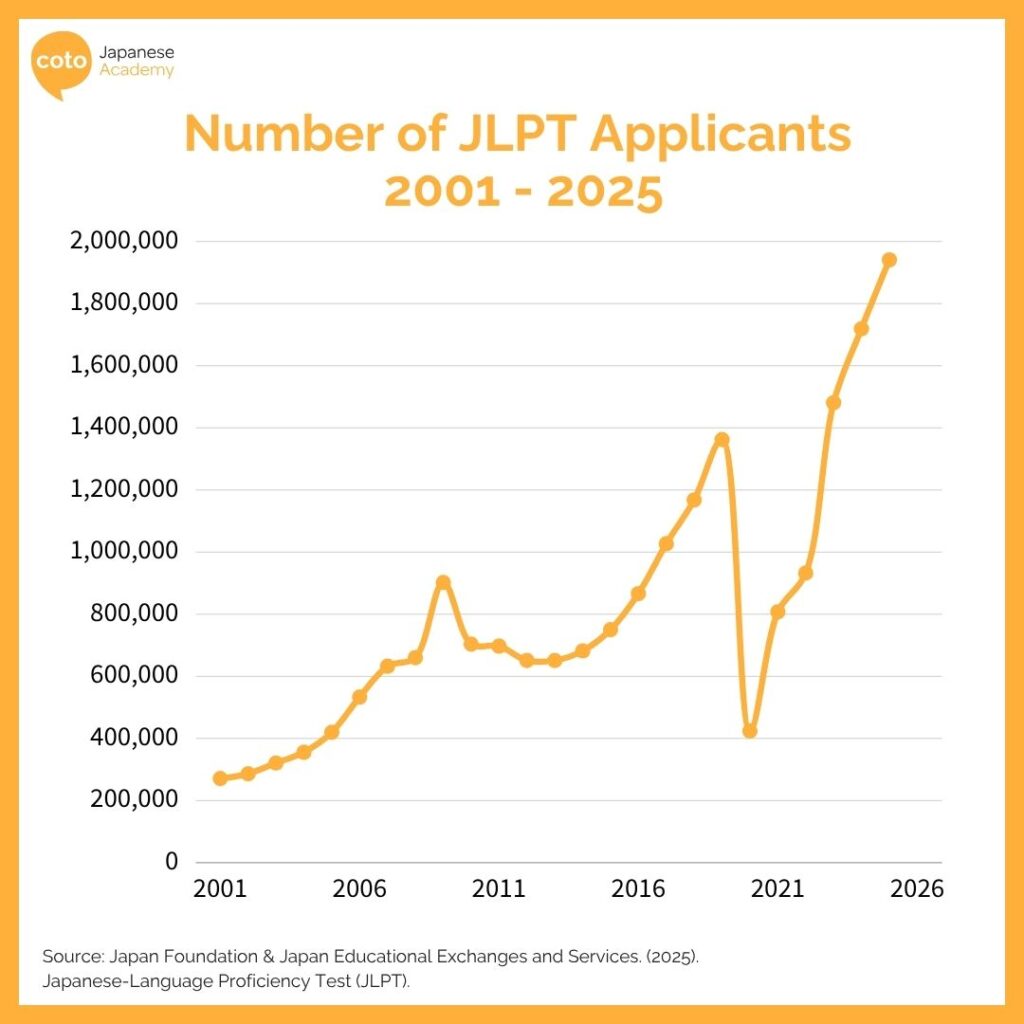
According to the Japan Educational Exchanges and Services (JEES), the organization that officially administers the JLPT, the test drew a record 1.9 million applicants worldwide in 2025. Aside from a pandemic-driven dip in 2020 and 2021, registrations have climbed every year since. The growth accelerated sharply in 2023, when applicant numbers jumped by a staggering 59% in a single year.
Yet that growth is now colliding with limited capacity. Registration for the July 2026 JLPT filled up and closed within a few weeks of opening. In some countries, the JLPT is still offered only once a year. With an average pass rate of only around 35%, test-takers who fail will only be able to retake it the next year.
2. Frequency of JLPT Exams
As of 2026, the JLPT in Japan is held only twice a year: once in July and again in December. In a few countries where the test is administered, it’s even held once a year.
The contrast with other Japanese language exams is stark. The BJT (Business Japanese Proficiency Test), for instance, can be taken year-round. Because it’s a computer-based test (CBT), there are no fixed seasonal dates, and test-takers can simply book a slot when they’re ready. Other popular language proficiency tests follow a similar model: TOEIC, which tests English, is offered monthly and includes an online option.
Against that standard, the JLPT’s current format, limited sessions, in-person only, once or twice a year in many locations, looks increasingly out of step with how many test-takers actually need to use it.
Adding more JLPT dates, not just in Japan, but in other countries as well, could make the test accessible to everyone, especially now that the JLPT in Japan can only be taken by residents.
The Rising Demand for JLPT Certificates
While the JLPT has long been the primary accepted certificate among universities, companies, and even the Japanese government, several policy changes now underway or on the horizon are set to push demand for JLPT certification even higher.
1. JLPT N5 Certificate to fulfill 150-hour Study Requirement for Language School Students
International applicants to a Japanese-language school are typically required to demonstrate at least 150 hours of prior Japanese study. In many cases, JLPT N5 is the most commonly accepted certificate for meeting this requirement.
Yet students are also bound by a strict application timeline. Intakes typically open in April and October, with some schools also offering January and July intakes. This makes JLPT N5 registration something students need to plan strategically.
2. JLPT N5 – N3 Certificate for Technical Interns
In 2024, Japan passed legislation to overhaul its Technical Intern Training Program (TITP), replacing it with a new framework called the Employment for Skill Development System, set to take effect on April 1, 2027.
Under the new system, foreign workers will need to demonstrate basic Japanese ability (JLPT N5, or equivalent coursework) before they can begin work. From there, there’s a defined pathway forward: first to Specified Skilled Worker No. 1 (SSW1) — a status for workers with a moderate skill level, capped at five years and generally without the right to bring family — and eventually to Specified Skilled Worker No. 2 (SSW2), reserved for more experienced, higher-skilled workers, which allows unlimited visa renewals and lets workers bring a spouse and children to Japan. It also provides them with the possibility of applying for permanent residency later on.
So what does this mean for the JLPT? Under TITP, workers could get by without ever taking a Japanese proficiency test. The new system closes that gap: JLPT N5 becomes a baseline requirement just to start working, and JLPT N3 is on track to become the bar for long-term career progression through SSW2.
3. JLPT N2 Certificate for Common Japanese Work Visa
As of April 15, 2026, the Engineer/Specialist in Humanities/International Services visa — one of the most common work visas for foreign nationals in Japan — now requires language-proficiency documentation of JLPT N2 or equivalent in certain cases.
The requirement applies to applicants whose sponsoring company falls into category 3 or 4 — Japan’s immigration classification for smaller or newer companies. Category 3 covers most small and mid-sized businesses, while Category 4 covers companies with no filing history, typically those less than a year old or hiring a foreign employee for the first time.
If the applicant’s role also centers on interpersonal work that relies on language ability — translation, interpretation, front-desk, or customer-facing roles, for example — they must now submit proof of Japanese proficiency equivalent to JLPT N2 or CEFR B2.
Why This Matters for Learners and Employers
More frequent JLPT administration, additional levels, and greater accessibility directly affect two groups whose numbers are growing fast:
Foreign workers and students in Japan. More testing windows mean less pressure to plan a career or study timeline around a single annual exam date — and less risk of a missed opportunity turning into a year-long delay.
Employees at Japanese companies overseas. For multinational teams working with Japanese colleagues and clients, easier access to JLPT certification makes it more practical to build language ability into ongoing professional development, rather than treating it as a one-shot hurdle.
The Bottom Line
With applicant numbers in 2025 nearly seven times higher than they were two decades ago in 2001, and new immigration and employment policies set to raise the stakes on intermediate-level certification, the pressure to modernize testing — more sessions, online formats, expanded levels — is only going to grow.
For now, the changes are still under review, with concrete proposals expected in fiscal year 2027. But for anyone planning their JLPT timeline around study, work, or visa requirements, it’s a space worth watching closely.
Preparing for JLPT? Double Your Chances of Passing the Test with Coto Academy
With JLPT requirements becoming more central to studying, working, and building a long-term life in Japan, having a JLPT certification is more important than ever.
Pass the JLPT with confidence with JLPT preparation classes at Coto Academy. Our JLPT preparation courses are designed to help you build real, practical Japanese ability alongside exam-specific strategy, so you’re ready with confidence on test day. Explore our JLPT courses and find the class that fits your level and goals. In the past, our expert instructors have helped students achieve a pass rate of 75%—more than double the national average of 35%.
FAQ
Is the JLPT changing in 2026 or 2027?
Not yet. Japan’s government is reviewing the exam’s administration, with concrete proposals expected in fiscal year 2027 — including more test sessions, online testing, and a new JFT-Basic level.
Can anyone take the JLPT in Japan, or only residents?
As of 2026, the JLPT in Japan is primarily for mid- to long-term residents and special permanent residents. Short-term visitors without a valid residence card aren’t eligible.
What is changing for the JLPT in 2027?
Nothing has been finalized yet, but Japan’s government is reviewing how the exam is administered, with concrete proposals expected in fiscal year 2027. Under consideration: more test sessions per year, an online testing option, and a new level added to the JFT-Basic test.