



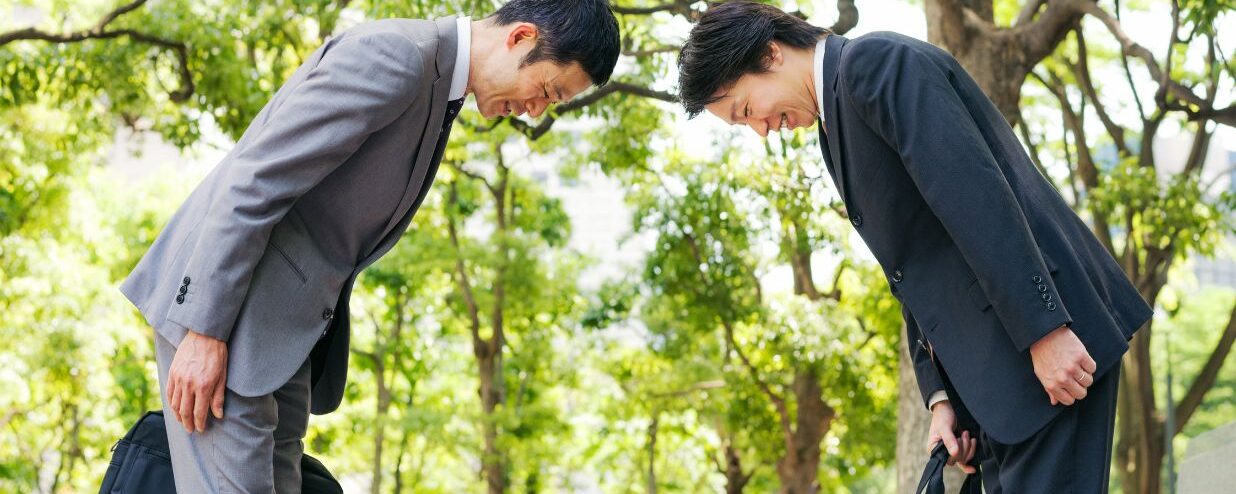


You may have seen a movie or TV show set in Japan where characters greet each other by bowing. However, when doing it yourself, you might feel a bit awkward and think, “Am I doing something wrong?” You don’t want to be disrespectful while trying to be respectful, after all. So, how should you correctly bow in Japan? How low should you bow?
For centuries, Japanese natives have used bowing as a demonstration of respect towards others. There are many situations in which a bow is an appropriate and polite gesture. This article will discuss when (and when not to) bow, how to bow correctly, different types of bows, and mistakes to avoid in order to display proper etiquette.
What is Bowing in Japan?
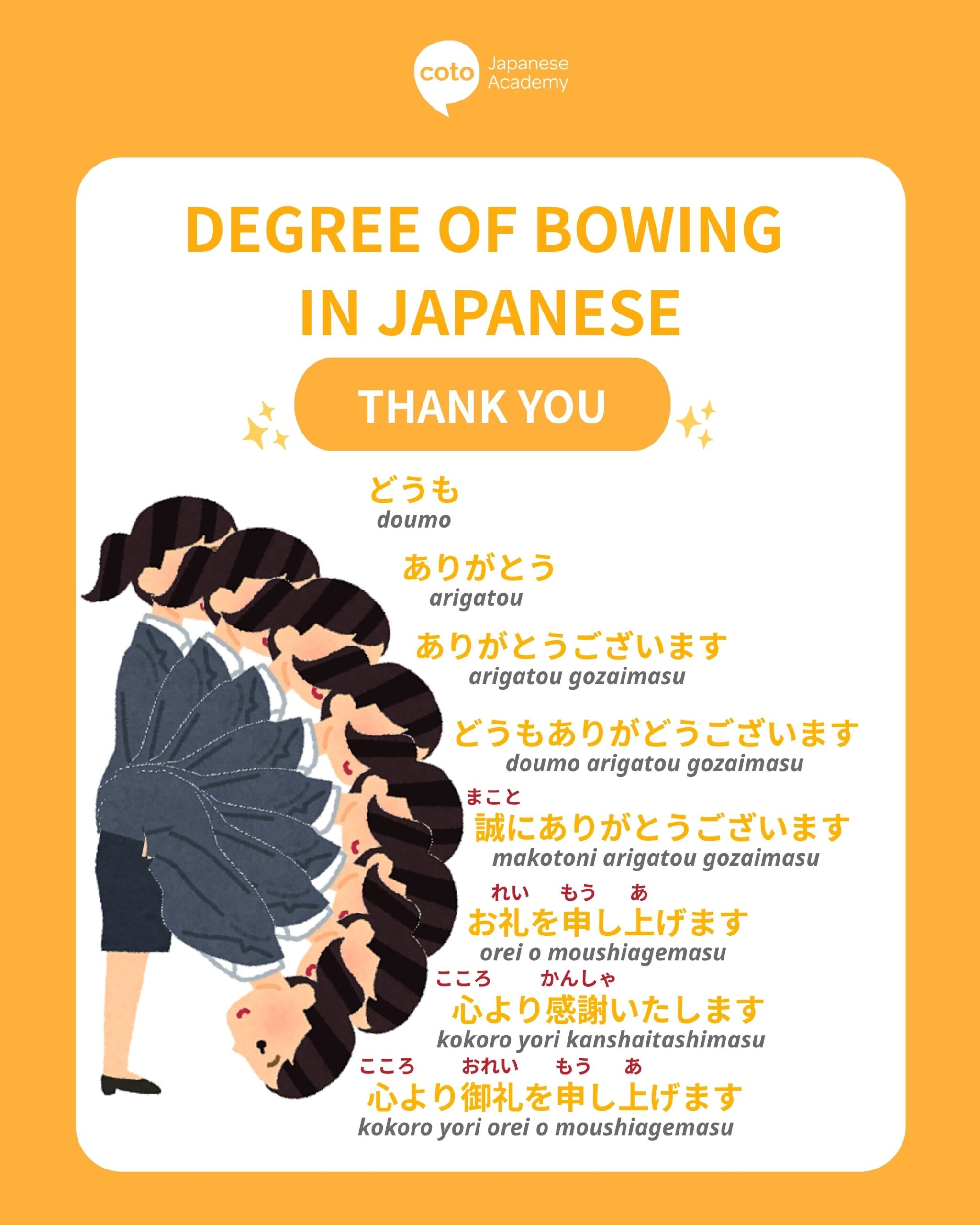
In Japan, ojigi (お辞儀) is a unique gesture of respect, gratitude, and apology. Bowing is based on Buddhist rituals and samurai etiquette. The bow varies in angle and duration depending on the context, your social status relative to the other person, and the depth of the situation.
The Japanese word ojigi itself was derived from the homophone お時宜 (ojigi), which originally meant “the opportune timing to do something.” It didn’t come to specifically denote the act of bowing in its contemporary sense until the late Edo period, when samurai bowing etiquette spread to the common population.
. While other countries have their own traditions of bowing, it isn’t nearly as common or embedded in daily life as it is in Japan. People bow when receiving an item, when apologizing after accidentally bumping into someone, or even as part of a greeting when saying yoroshiku onegaishimasu.
When Should You Bow in Japan?
The key thing to remember about bowing is that when somebody bows to you, you bow back. This is a basic sign that you’re polite, similar to a smile or a verbal “hello”.
Bowing is also an all-purpose gesture. It’s appropriate as a greeting, a show of thanks, and an apology. It can also be used to confirm understanding; if you’ve just been given a set of directions, you can bow to confirm you know what to do, and you’re about to get started.
Bowing is often a component of religious practices, such as praying at shrines. Before passing through a torii gate, bow deeply to pay respect to the deity of the shrine. When you finish your visit, bow once more as a thank-you in Japanese.
In the unlikely event you enter a sparring session, bowing is also a way to initiate combat during martial arts. This shows that you are grateful for the opportunity to train with your sparring partner.
When Should You Not Bow in Japan?
When bowing, you must make sure you are standing still and not speaking. Walking or talking while bowing is considered insincere or even sarcastic. Maintaining eye contact during a bow is seen as aggressive, so make sure to look downward and slightly ahead of you.
Additionally, make sure you aren’t putting your palms together while bowing. This is reserved for prayer; instead, keep your arms at your side if you are male and loosely clasped in front of you if you are female.
Types of Bows in Japan
There are three common variations of bowing used for specific situations. Depending on context, the proper type of bow will be one of the following three:
1. Eshaku
Written as 会釈, eshaku is a casual bow. It’s most appropriate when greeting close friends or briefly acknowledging an acquaintance. Eshaku involves bending at the torso about 15 degrees, briefly but not speedily.
2. Keirei
Keirei is used as a show of respect in formal situations. This is the type of bow used in business scenarios, such as a job interview in Japan, or when addressing a boss or superior. It’s a deeper bow than eshaku, requiring a 30-to-45-degree bend at the waist. How deeply you bow indicates the amount of respect being shown – keep that in mind when greeting an elder!
3. Saikeirei
Saikerei is the most formal and respectful of the three styles; in fact, “saikeirei” (最敬礼) literally translates to “the most respectful”. It is used exclusively during highly solemn and sincere situations.
When meeting royalty or government officials, deeply apologizing for a major mistake, or offering a prayer at a Shinto or Buddhist temple, a saikeirei bow is necessary. In order to avoid looking insincere, you must bend 45-to-70 degrees at the waist and hold the position for 3 seconds (or longer, depending on the severity of the mistake you’re apologizing for!)
In extreme situations, an even deeper bow called “dogeza” may be necessary. This is a full-on, forehead-on-the-floor kneeling bow. Only do this in a situation of extreme guilt or desperation! It’s never done in day-to-day situations and is to be used as a last resort! Unless your life is about to irreversibly change for the worse, do not perform a dogeza bow.
How to Bow in Japan
Now that you know about specific types of bows, you need to make sure you’re bowing correctly. Bowing incorrectly or half-heartedly communicates that you don’t respect whoever you’re addressing, so it’s important to keep your posture and the position of your hands and eyes in mind.
1. Posture
Step one: Make sure to breathe inward. Lean your upper body forward, breathe out when you’re at the appropriate angle (remember: 15 degrees for eshaku, 30-to-45 degrees for keirei, 45-to-70 degrees for saikeirei), and breathe in again while standing up straight.
Keep your shoulders relaxed during the process to avoid stiffening up, and remember to breathe. A purposeful, intentional inhale will help you maintain your posture without even thinking about it.
2. Hand Position
Hand placement during a bow is based primarily on gender. For men, the arms should be kept straight down at one’s sides. Your palms should be planted on your thighs, and during the bend, they will naturally slide down near the knees. For females, it is okay to clasp your hands slightly in front of your lower abdomen, one palm over the other hand.
Once again, remember not to fold your hands or hold them together while bowing towards another person. This placement is meant specifically for prayer at religious sites, and may come across as inappropriate or even mocking.
3. Eye Contact
It may feel awkward to not make eye contact with whoever you’re bowing to, but this can be interpreted as a sign of aggression. On the opposite end, looking away communicates that you are bowing as a show of peace and vulnerability.
While bowing, a good trick is to find a spot on the ground a few meters from your feet and focus your eyes on that while bending downward.
Common Mistakes People Make When Bowing
We’ve discussed a few common mistakes people often make while bowing, but as a refresher: Make sure not to bow with your palms together (that’s for shrines), don’t look somebody directly in the eyes while bowing, and make sure the angle of the bow is situationally appropriate.
One thing Coto Academy students often get wrong is bowing by swinging their hips back. Instead, hinge forward at the hips and match the bow’s depth to the situation: 15 degrees for casual greetings, 30 degrees for polite business interactions, and 45 degrees for deep apologies.
However, those unfamiliar with bowing may run into these additional mistakes:
- Bowing too short: this could come across as insincere. Make sure that you remember how deep to bow, and never bend less than 15 degrees.
- Bowing too deeply: Overly dramatic bowing is seen as rude. The goal is to learn and respect local customs, not make fun of them.
- Bowing and talking at the same time: it’s hard to understand anything you’re saying. Make sure to finish speaking before bowing.
- Bowing and shaking hands at the same time: it feels awkward and looks silly. Make sure to bow before shaking hands.
Bowing vs Handshakes in Japan
On the subject of shaking hands, when should you bow, and when should you shake hands with someone in Japan? Unlike what American businessmen have likely come to expect, handshakes are not the default greeting in Japanese professional settings. In general, physical contact is not the way Japanese people greet each other; even in business settings, people exchange business cards in a practice known as meishi koukan, instead of shaking hands.
It may be hard to break a habit, but when visiting Japan, you should primarily stick to bowing in formal settings. Realistically, the only time you will shake hands is when a Japanese person initiates and sticks a hand out first.
However, many Japanese businessmen understand that foreigners may be unfamiliar with bowing culture and won’t expect perfect etiquette out of the gate. During international meetings, you may end up shaking hands and then bowing, or vice versa. That being said, non-Japanese visitors should be prepared to bow in order to convey that they want to respect local practices.
Conclusion
While bowing may seem more complicated than you expected, there’s no need to worry. It may be different from what you’re used to, but it isn’t harder.
Bowing to a Japanese native comes as naturally as a handshake or a hug might be to a Westerner. As long as you remember who you’re bowing to and act accordingly, you’ll have no trouble fitting in.
Not sure what to say after bowing? Learn how to communicate in Japan with Coto Academy! If you’re interested in learning conversational and business Japanese from anywhere in the world, including our own Tokyo and Yokohama campuses, fill out the short form below to sign up!
FAQ:
Why do people bow in Japan?
Bowing is a physical demonstration of respect and gratitude. People in Japan bow to greet each other, apologize, and show respect to superiors.
Where do I look when I bow?
Remember not to make direct eye contact while bowing. Instead, look 3 to 4 meters at the ground ahead of you.
How far do I have to bend while bowing?
If you’re bowing casually to a close friend, only bend 15 degrees. If you’re addressing somebody in a professional setting, bend 30 to 45 degrees. If you’re in a situation where you need to show complete sincerity, bow 45 to 75 degrees.
Read more:
Japanese Hand Gestures and What They Mean
What is Aizuchi? Japanese Filler Words
Japanese Swear Words You Shouldn’t Use