






In Japan, you might run into plenty of situations where you will need to say “I don’t understand,” especially if you’re just starting to learn Japanese. The most common and straightforward way to say “I don’t understand” in Japanese is わからない (wakaranai) in casual speech, or わかりません (wakarimasen) in its polite form. But Japanese actually has several phrases for expressing confusion or a lack of understanding, each suited to slightly different situations.
So, how do you say “I don’t understand” in Japanese? There are actually several phrases that communicate that you don’t understand something, and each is used in different contexts and situations. Let’s explore the most common phrases you should know.
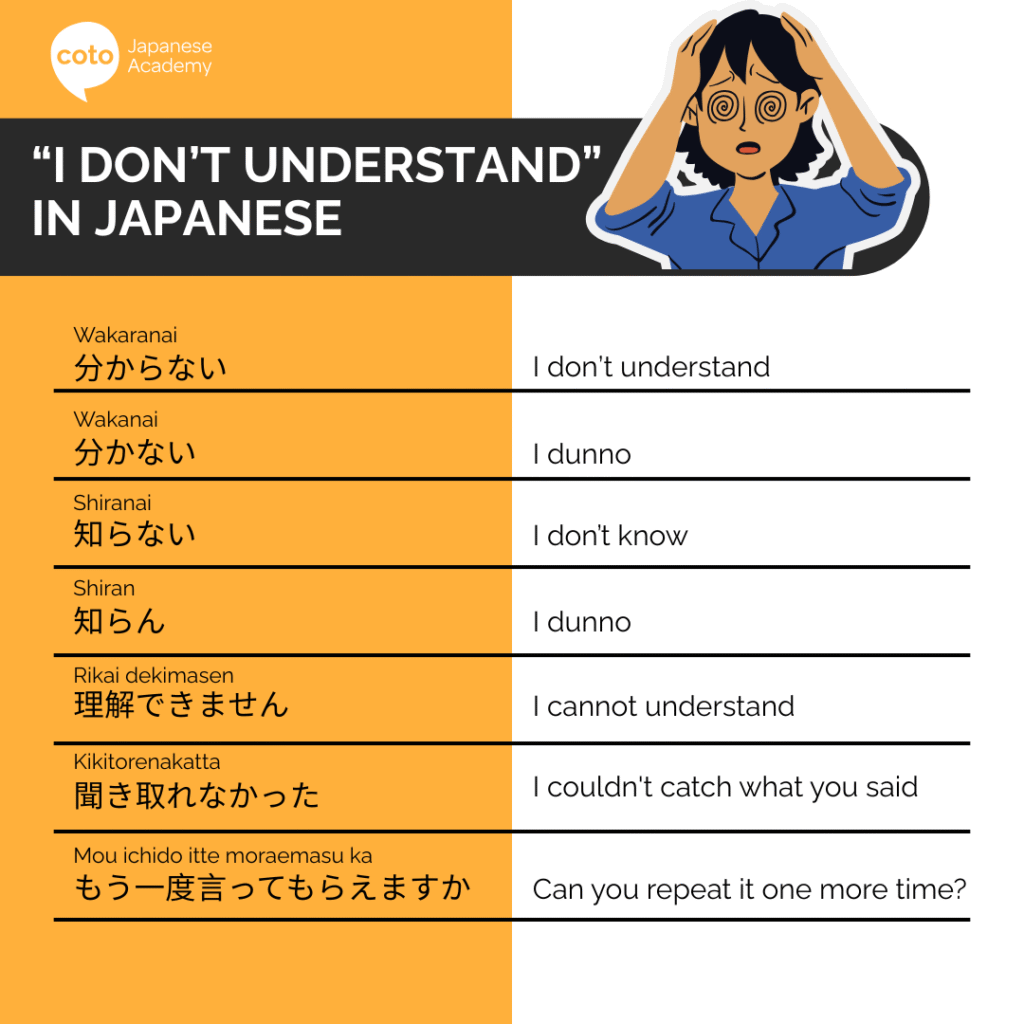
1. 分からない (Wakaranai): I Don’t Understand
The phrase 分からない (wakaranai) is perhaps the first phrase you would learn for “I don’t understand” or “I don’t know” in Japanese. It is a negative conjugation of the phrase 分かる (wakaru), meaning “to understand.” So, in the negative form, 分からない, the expression becomes “I don’t understand.”
You can use this expression for most situations where you need to say “I don’t understand.” For instance, if you want to say you don’t understand Japanese:
日本語が分かりません。
Nihongo ga wakarimasen.
I don’t understand Japanese.
This is a polite expression for saying that you don’t understand Japanese, especially since it uses 分かりません (wakarimasen), which is a keigo form of 分からない. As a response, you can actually drop everything else and simply say 分かりません (wakarimasen).
You can use 分からない for not just communicating that you don’t speak Japanese, but also for anything someone might ask that you just don’t have the answer to. You can basically use it to say “I don’t know” or that you’re not sure. Let’s go through a common situation you could likely run into.
Example:
友達:カフェはどこですか?
Tomodachi: kafe wa doko desuka?
Friend: Where is the cafe?
あなた: 分からない。
Anata: Wakaranai.
You: I don’t know.
So, you can use this phrase whenever you don’t know the answer to someone’s question as well. But it can sound a bit dismissive, or even rude. So, you can dress the phrase up with other apologetic expressions like ごめんなさい (gomennasai) or even すみません (sumimasen). They both can translate to “sorry” or “excuse me,” to communicate consideration for the listener. You can also add ちょっと (chotto), which can mean “a bit” or “little,” to soften the expression.
ごめんなさい、ちょっと分かりません。
Gomennasai, chotto wakarimasen.
I’m sorry, I’m not too sure/I don’t really know.
2. 分かんない (Wakkanai): I Dunno
Whenever you overhear natives speaking, you probably hear them say 分かんない (wakannai) instead of 分からない. Well, you heard them right! This is a very casual way of saying わからない, dropping the ら syllable, shortening the phrase to be a bit more convenient.
Example:
友達: そのレストラン美味しい?
Tomodachi: sono resutoran oishii?
Friend: Is that restaurant good?
あなた: 分かんない
Anata: wakannai
You: Don’t know
3. 分からん (Wakaran): Dunno
There’s actually another common expression for casual settings: 分からん (wakaran). This time, the last sounds あい (ai) are dropped to shorten the phrase. It is used in generally the same situations as 分かんない (wakanai):
Example:
パスコンのパスワードが分からんよ!
Pasucon no pasuwaado ga wakaranyo!
I don’t know the password to the computer!
In both of these examples, the language is very casual, without any keigo (です or ます form). In this context, 分かんない and 分からん feel friendly and appropriate. However, it would feel very out of place to say either of these expressions in a more formal setting. You often say these phrases with your friends, family, and people you’re close to.
4. 知らない (Shiranai): I Don’t Know
知らない (shiranai) is another common way to say “I don’t understand,” but it translates more closely to “I don’t know” in English. 知らない is the negative conjugation of 知る (shiru), which means “to know.” Often, you can use 知らない in many of the same situations as 分からない (wakaranai).
Example:
友達:映画はいつですか?
Tomodachi: eiga wa itsudesuka?
Friend: When is the movie?
あなた:知らない/分からない。
Anata: Shiranai/wakaranai.
You: I don’t know.
In this context, 知らない and 分からない are virtually interchangeable. However, they still both can communicate different nuances, so they aren’t necessarily equivalent. Let’s take a look at an example to demonstrate how they’re different:
Example:
友達: ゼルダというビデオゲームを知っていますか?
Tomodachi: Zeruda toiu bideo geemu o shitte imasuka?
Friend: Do you know about the video game called Zelda?
あなた:知りません。
Anata: Shirimasen.
You: I don’t know.
You probably noticed that the example uses 知りません (shirimasen), the formal form of 知らない. Generally, when people ask if you know about something, they will use the term 知る (shiru). This is the nuanced difference between 知る or 分かる. Often 知る can be used to express factual things you “know about,” more so than 分かる.
However, when it comes to situational uncertainty, like expressing that you’re unsure where your friend might be, using 知らない can sound a bit cold, as if you don’t care. So, in these circumstances, 分からない would be preferable since it somewhat communicates that you’re unsure but willing to figure it out.
5. 知らん: I Dunno
People often shorten 知らない to 知らん (shiran), dropping the last あい (ai) sounds, similar to 分からん (wakaran). It is often used as a casual response to something someone is asking you. It’s generally used in very casual or friendly settings, like with friends or family, but it’s best to avoid using this phrase in formal situations.
Example:
友達:グリーンカリーの作り方を知っているの?
Tomodachi: guriin karii no tsukuri kata o shitte iru no?
Friend: Do you know how to make green curry?
あなた:知らん。
Anata: shiran.
You: No idea.
In this example, 知らん is being used to just casually express that you don’t know how to make green curry. It’s similar to how you might respond to friends in English, with expressions like “no idea” or “not sure.”
6. 理解できません (Rikai Dekimasen): I Can’t Understand
Another phrase worth knowing is 理解できない (rikai dekinai), which translates to “I can’t understand” in English. 理解 (rikai) means “understanding” or “comprehension,” and できない (dekinai) means “cannot do.” So together, the phrase expresses that you are unable to understand something.
While 分からない (wakaranai) is the more common, everyday phrase for “I don’t understand,” 理解できない tends to carry a slightly stronger nuance; it suggests that something is difficult to grasp or process, rather than simply not knowing. You might use it when something is genuinely hard to comprehend, like a complex concept or situation.
Example:
この説明は理解できない。
Kono setsumei wa rikai dekinai.
I can’t understand this explanation.
In a more polite or formal context, you would swap できない for できません (dekimasen), giving you 理解できません (rikai dekimasen):
Example:
先生の説明が理解できません。
Sensei no setsumei ga rikai dekimasen.
I can’t understand the teacher’s explanation.
Using 理解 in Other Expressions
理解 (rikai) is also a flexible word that you’ll hear in several related expressions. For instance, 理解する (rikai suru) simply means “to understand,” and you can use it to express that you do understand something.
Example:
理解しました。
Rikai shimashita.
I understand. / I got it.
This is actually a fairly common phrase in professional or formal settings, such as in the workplace, to confirm that you’ve understood instructions or information. It carries a more deliberate and considered tone than simply saying 分かりました (wakarimashita), which is the more casual, everyday equivalent.
You might also come across ご理解 (go-rikai), which is the honorific form of 理解. This is frequently used in formal written Japanese, such as in business emails or official notices.
Example:
ご理解のほど、よろしくお願いいたします。
Go-rikai no hodo, yoroshiku onegai itashimasu.
Thank you for your understanding.
This is a very set phrase and one you’ll see often in formal correspondence in Japan, so it’s a useful one to recognize even if you don’t use it yourself right away.
Other Japanese Expressions for “I Don’t Understand”
In Japanese, there are plenty of other expressions you can use whenever you don’t catch something. In many cases, it might be better to ask someone to repeat something or just directly ask what something means rather than just frankly saying you don’t understand or know. So, here are some handy phrases to keep at your disposal.
1. もう一度お願いします (Mou Ichido Onegaishimasu): One More Time Please
Whenever you missed something that someone said, or just didn’t understand something, it might be useful to ask them to repeat what they said. Rather than just directly saying 分からない, asking someone to repeat what they said will be more productive, especially if they are guiding you through something important, such as when you visit the city hall. Here is a common expression you can use to politely ask someone to repeat themselves.
Example:
すみません、もう一度お願いします。
Sumimasen, mou ichidou onegaishimasu.
Excuse me, can you say it one more time, please?
This is a very polite way to ask someone to repeat themselves that works perfectly for formal settings. もう一度 translates directly to “one more time,” and お願いします (onegaishimasu) is a polite expression for “please.” Generally, after you say this, people will slow down or try to speak more clearly the second time around. But in case they don’t, here is how you can ask them to slow down their speaking a notch.
Example:
もう少しゆくりでお願いします。
Mou sukoshi yukuri de onegaishimasu.
A little slower, please.
Here, the expression もう少し translates to “a little more,” and ゆくり (yukuri) means “slow.” Then, the particle で (de) attaches to ゆくり. So, everything taken together means “a little slower” plus お願いします (onegaishimasu) meaning “please,” makes the whole expression more polite.
But you might be running into words you never heard before, and some of them might be important to know, so how would you ask what they mean…
2. 〜は何ですか?・〜どういう意味ですか?(~wa nandesuka / ~douiu imidesuka?): What is…/What Does… Mean?
Often, you might need to ask directly what a word or phrase means to proceed with essential tasks you need to do. Let’s go through a couple of common expressions that will come in handy.
A simple and versatile way to ask “What is…?” is the expression: 〜は何ですか? (~wa nan desu ka?) You can slot almost any word or phrase in front of は to ask what it is.
Example:
すみません、「住民票」は何ですか?
Sumimasen, “juuminhyou” wa nan desuka?
Excuse me, what is a “juminhyou” (Resident’s Record Certificate)?
This is a straightforward and polite way to ask about an unfamiliar word. It works well in most everyday situations, whether you’re at a restaurant, a shop, or just having a conversation.
Another expression you can use is 〜どういう意味ですか? (~dou iu imi desuka?). This phrase digs a little deeper, asking “What does… mean?” rather than just “What is…?” Here, どういう (dou iu) means “what kind of” or “how do you say,” and 意味 (imi) means “meaning.” So together, the phrase is literally asking “What kind of meaning does this have?”
Example:
「お手柔らかに」はどういう意味ですか?
“Oteyawaraka ni” wa dou iu imi desuka?
What does “oteyawaraka ni” mean?
Both expressions are polite and perfectly appropriate for formal settings, so don’t hesitate to use them when you’re lost for words. In casual settings with friends or people you’re comfortable with, you can shorten 〜どういう意味ですか? to simply 〜どういう意味?(~dou iu imi?), dropping the です and か to make it feel more relaxed:
Example:
これってどういう意味?
Kore tte dou iu imi?
What does this mean?
Knowing how to ask what something means is just as valuable as knowing how to say you don’t understand. Rather than letting an unfamiliar word slip by, these expressions let you stay engaged in the conversation and keep learning in real time.
分からない (Wakaranai) vs 知らない (Shiranai): What is the difference?
If you’ve been studying Japanese for a while, you’ve probably used both わからない (wakaranai) and しらない (shiranai) at some point. They both translate to “I don’t know” in English, but shiranai (知らない) means you have no awareness of something, while wakaranai (わからない) means you can’t understand or figure something out.
1. Shiranai (知らない): “I have no information about this.”
Shiranai comes from the verb 知る (shiru), meaning “to know” in the sense of being aware of or having information about something. You use it when something is simply unknown to you: a person you’ve never met, a place you’ve never heard of, a fact nobody told you.
For example, say you are in a group of acquaintances, and your friend points to someone and asks if you know them. Having never met them, you will say:
あの人を知らない。
Ano hito o shiranai.
I don’t know that person.
2. Wakaranai (わからない): “I can’t figure this out.“
Wakaranai comes from the verb 分かる (wakaru), meaning “to understand” or “to be able to grasp.” You use it when you have some context but can’t work out the answer, or when something isn’t clear to you.
Using the same example, imagine you’re watching someone do something so absurd you can’t quite comprehend it:
あの人が分からない
Ano hito ga wakaranai
I don’t understand that person.
Here, you know exactly who they are. You’re not unfamiliar with them. You simply cannot wrap your head around what they’re doing. That’s the key difference: wakaranai is about comprehension, not awareness.
Which one should you use in conversation?
In everyday Japanese, wakaranai is the more common catch-all response when someone asks you something, and you’re stumped. If a friend asks for directions and you have no idea, わからない is natural.
But if someone asks whether you know a particular person, restaurant, or song, shiranai is the right call, because the question is about awareness, not comprehension.
A quick rule of thumb: if you could swap “I don’t know” for “I’m not aware of that,” use shiranai. If you could swap it for “I can’t figure that out” or “I don’t understand,” use wakaranai.
Conclusion: Learning to Say “I Don’t Understand” in Japanese is Essential
It is essential in any language, let alone Japanese, to learn how to properly express that you don’t know or understand something. Generally, 分からない or 分かりません work perfectly in many situations when you need to say you’re not sure about something. Just remember, it never hurts to admit that you don’t understand what someone is telling you! It’s a completely normal part of learning a new language, and in fact, natives say these expressions all the time!
But if you want to really learn how to express uncertainty when you need to (or reduce the number of times you say 分からない), take Japanese lessons with us at Coto Japanese Academy! We offer conversation-focused courses that will prepare you for daily life in Japan, and we have campuses in Shinjuku, Shibuya, Iidabashi, Minato, and Yokohama. But if you’re not in the Tokyo area, we also offer lessons completely online! Sound good to you so far? Fill out the form below to get started!
FAQ for I Don’t Understand in Japanese:
How do you say "I don't understand" in Japanese?
The most common phrase is 分からない (wakaranai), meaning “I don’t understand,” or 分かりません (wakarimasen) in more polite settings. To express something stronger, like you’re having trouble comprehending, you can say 理解できない (rikai dekinai), meaning “I can’t understand.”
What is the difference between 分からない and 知らない?
Both can often be used interchangeably, but 分からない expresses uncertainty and implies a willingness to figure something out, while 知らない means more specifically that you lack knowledge of something. In some contexts, 知らない can sound a little cold, making 分からない the friendlier choice.
What does 分かんない (wakannai) mean?
It means the same as 分からない, but is a casual, shortened version where native speakers drop the ら (ra) syllable. You’ll hear it often among friends and family, but avoid it in formal situations.
What are some other expressions you can say instead of 分からない?
You can ask someone to repeat themselves with もう一度お願いします (mou ichido onegaishimasu), ask them to slow down with もう少しゆっくりお願いします (mou sukoshi yukkuri onegaishimasu), or ask what a word means with どういう意味ですか?(dou iu imi desuka?).
