






Spring in Japan is known for the beautiful pink foliage, but also winds of yellow mists dispersing pollen and causing nationwide hay fever, or 花粉症 (kafunshou). Enjoying the sakura viewing in Tokyo, let alone living comfortably, during Japan’s peak pollen season, is close to impossible when you are being plagued by incessant sneezes, itchy eyes, and congestion so strong that you feel like your nostrils have been glued together.
So, how do you not just survive the hay fever season, but thrive? The weather is perfect, and the views of the pink canopies should not be missed! Let’s go through the types of kafunsho in Japan, when pollen count is highest, and how you can reduce hay fever as much as possible!
What is Kafunshou?
Kafunshou (花粉症) literally translates to “pollen illness” and refers to hay fever, a seasonal allergic reaction that has become one of Japan’s most widespread health issues. It is most commonly triggered by pollen from Cryptomeria japonica (sugi, often called Japanese cedar) and Japanese cypress (hinoki), two native tree species.
Symptoms include relentless sneezing, runny nose, nasal congestion, and intensely itchy, watery eyes.
How Did Hay Fever Start?
The root cause is a well-documented case of post-war policy backfiring over time. Shortly after World War II, reforestation policies resulted in large forests of cedar and cypress trees, which were planted as an important resource for the construction industry.
However, as inexpensive lumber imported from abroad came to dominate the housing market, these trees were left standing in the mountains without being harvested, allowing pollen to disperse freely on the wind.
Peak pollen production occurs in trees 30 years and older, and by 2000, more than 60% of cryptomeria trees had reached that age.
The crisis has spawned an entire industry of masks, anti-pollen glasses, air purifiers, and medications, and the government continues investing heavily in developing low-pollen tree varieties to address the problem at its source.
Types of 花粉症 (Kafunshou) or Hay Fever in Japan
There are primarily 2 different types of 花粉症 (kafunshou) in Japan during the spring season, since around 70% of Japan’s planted forests are cedar and cypress.
1. 杉 (Sugi) or Cedar
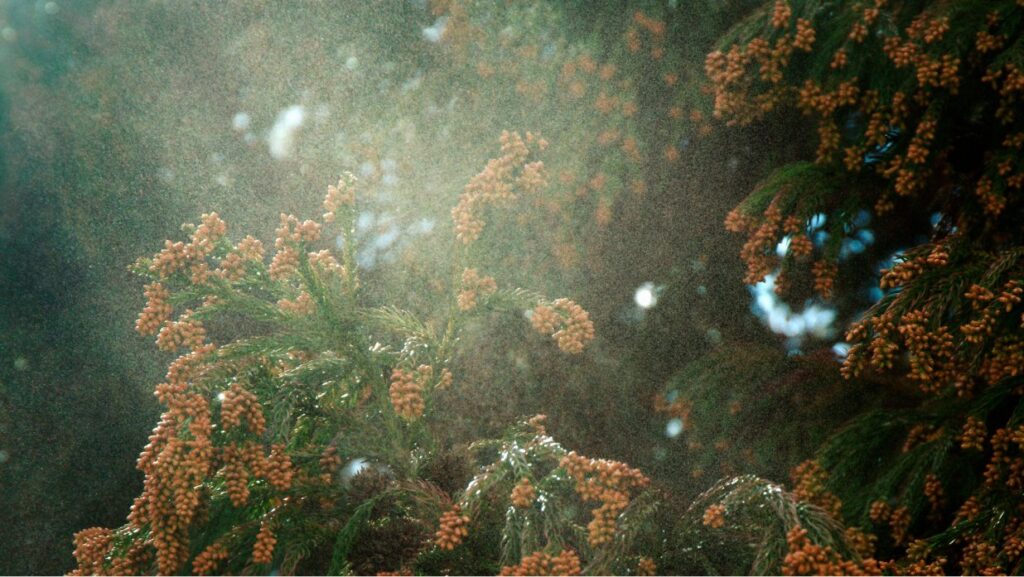
Cedar, also known as 杉 (sugi) in Japanese, is one of the biggest culprits for hay fever in Japan. It causes symptoms such as a runny nose, congestion, and itchy eyes in over 40% of the Japanese population. Cedar pollen tends to disperse in early Spring.
2. 檜 (Hinoki) or Cypress
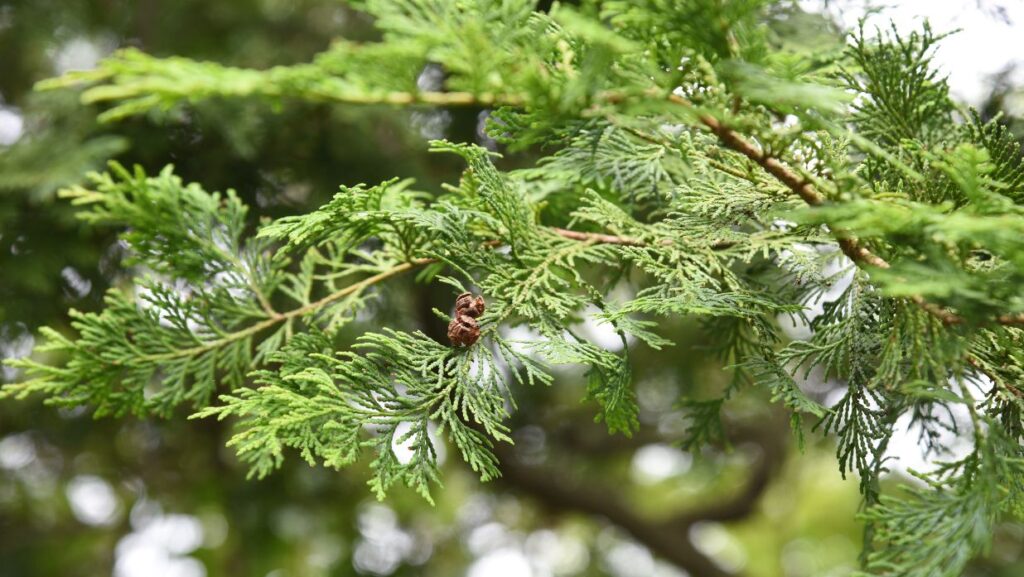
檜 (hinoki), or cypress, usually follows cedar and is another major culprit for hay fever in Japan. It is known to cause more severe symptoms than cedar, especially since they tend to overlap, leading to a stronger allergic reaction in those sensitive to both.
When is Hay Fever in Japan? Kafunshou Forecast
| City | Sugi | Sugi Intensity | Hinoki | Hinoki Intensity |
|---|---|---|---|---|
| Fukuoka | Early – late February | Average | Mid – late March | Avg |
| Hiroshima | Mid February – early March | Average | Mid Marxh – early Apr | Avg |
| Osaka | Mid February – mid March | Avg–High | Mid Marxh – early Apr | Avg |
| Nagoya | Early February – mid March | Average | Mid March – early April | Avg |
| Tokyo | Mid February – mid March | High | Mid March – early April | High |
| Kanazawa | Late February – mid March | High | Late March – early April | High |
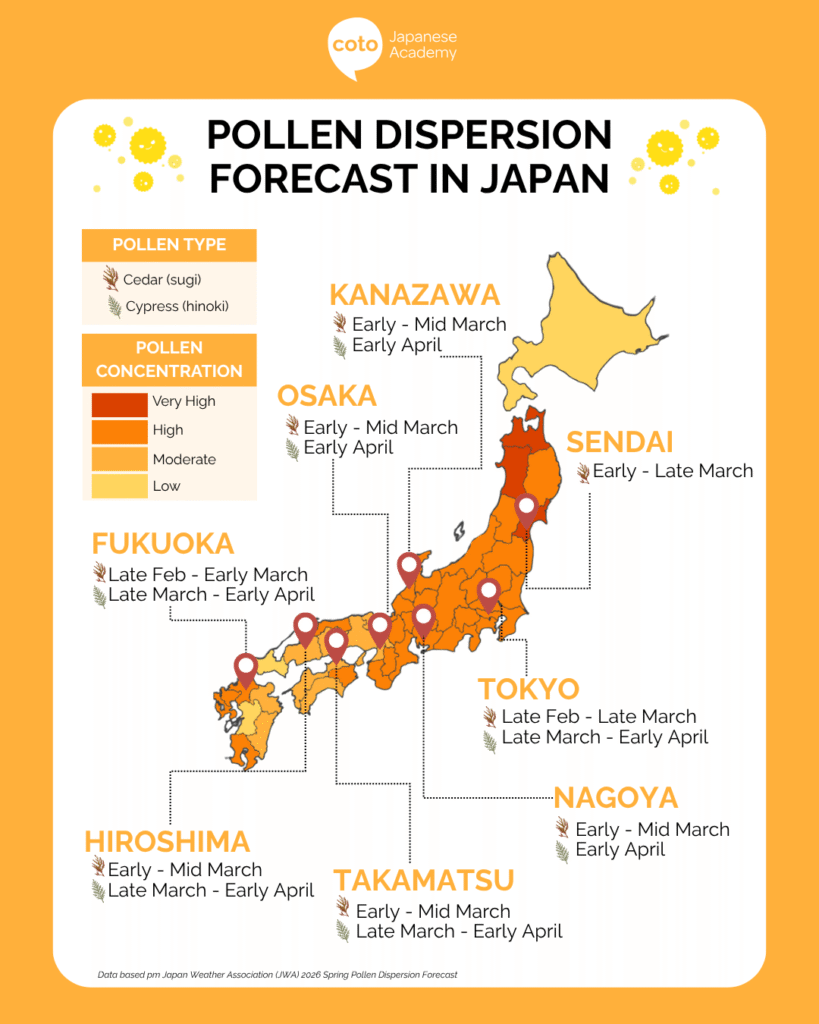
Take a look at the map below to see when pollen disperses across Japan. The map also shows which areas tend to have the highest pollen concentrations.
Cedar Pollen Forecast in Japan
Cedar pollen tends to start around early Spring and peaks during mid-spring. So, the cedar pollen period is generally from around mid-February to the end of March in the eastern and northern parts of Japan, which includes the Tokyo area. Cedar pollen will likely peak around mid to late March. For the Southern areas of Japan, the cedar pollen starts around early March and ends around mid-March.
Cypress Pollen Forecast in Japan
Cypress pollen starts spreading after cedar; however, there is often an overlap between the two allergens. Generally, the cypress period in the east (including Tokyo) is from late March to early April. In the southern part of Japan (including Kyushu), the forecast period is from late March to early April.
Pollen Concentration Across Japan
Areas with a higher prevalence of cedar and cypress trees will have a higher concentration of pollen. According to the Japan Weather Association, pollen concentration is very high in Sendai, high in Nagoya, and slightly high in Tokyo. However, in the southern regions of Japan (such as Hiroshima, Osaka, and Fukuoka), pollen concentrations tend to be lower.
Additionally, smog and concrete buildings in big cities can also contribute to the higher concentration of pollen. So, rural areas may have lower pollen counts and better air quality overall, since they have less pollution, which could exacerbate allergic reactions and even asthma.
How Does 花粉症 (Kafunshou) or Hay Fever Affect Japan?
As mentioned, hay fever affects around 42% of the population, which means close to half of the population has moderate to severe symptoms such as a stuffy nose, irritable eyes, relentless sneezing, and even fevers. This leads to a spike in hospital clinic visits and sick leaves, resulting in less productive offices and, at times, higher health care costs.
The Japanese government had even started describing the hay fever season as a national crisis or even a social issue, citing the post-war policies of planting cypress and cedar trees. Now, these trees dominate human-planted forests, which consist of 10 million hectares across Japan. They now make up over 70% of all trees in these plantations. After years of these forests being left unchecked, the aging trees started releasing swaths of pollen that now afflict the whole Japanese population.
As a result, the Japanese government started tackling hay fever by directly targeting the source of the pollen, the man-made forest of cedar and cypress trees. The Japanese government plans to replace massive amounts of these trees with low-pollen cedar. However, these initiatives will take years to finish, so for the time being, what can we do to mitigate hay fever symptoms and go outside when the weather is nice, and the sakuras are blooming?
Japanese Hay Fever Medication
There are a variety of medicines in Japan that you can take to mitigate your hay fever symptoms. You can generally find these medications at most 薬や (kusuri ya), or drugstores, which are found all over the country. Usually, they have a big sign that says 薬 (kusuri), so they are not hard to find. But what medicines should you look for when you get there?
Check out our blog, breaking down how to navigate pharmacies in Japan!
1. アンティヒスタミン (Anti Hisutamin): Anti-Histamin Medication

Japanese drugstores likely carry brands you’ll recognize, such as Claritin, which is クラルチン (kurarushin), and Allegra, which is アレグラ (aregura). Both of these brands are great because they reduce symptoms without making you sleepy. Of course, you can find Japanese alternatives to these medicines, so when you’re at the clinic to get an effective allergy medicine, you should look for ones that include an ingredient called an antihistamine or アンティヒスタミン (anti hisutamin).
2. 目薬 (Megusuri): Eye Drops
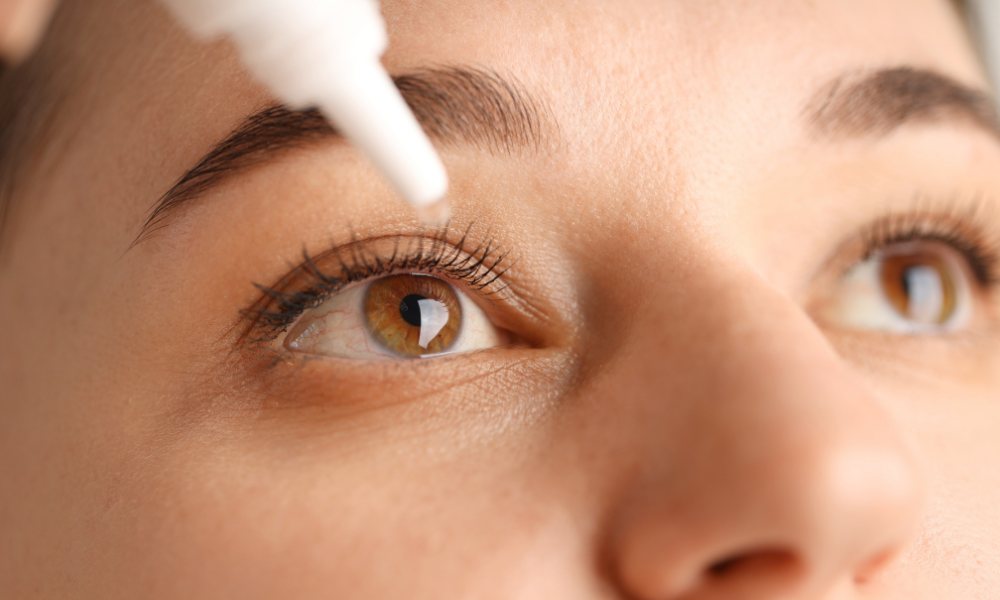
目薬 (mekusuri) or eye drops are a must to get rid of the extreme itchiness and irritation your eyes suffer during this season. These symptoms are one of the most debilitating since, in many cases, they can make it more difficult to focus at work or school, and are definitely very uncomfortable. So, every pharmacy in Japan carries eye drops, but be sure to find those that specifically target 花粉症 (kafunshou) symptoms. Some popular hay fever eye drops include: ロートアルガード (rooto arugaado), アイリスAGガード (airisu AG gaado), and アレジフェンス (areji fensu).
You can get these eye drops over the counter and commonly use them for hay fever; however, if your symptoms are more severe, you can get steroid eye drops or prescription eye drops from a doctor.
3. 点鼻薬 (Tenbiyaku) or 鼻スプレー (Hana supuree): Nasal Spray

To directly target nasal congestion, every medicine store and pharmacy offers a variety of nasal sprays. The most common over-the-counter sprays include anti-histamines and ingredients that help reduce inflammation and stuffiness. More powerful sprays contain a type of steroid that is effective at improving symptoms over time with consistent use. Common brands include Nasonex and Nasal αAR 0.1%, both available over the counter and considered very effective.
However, if these brands aren’t right for you, you can visit a clinic and tell a doctor about your symptoms so they can prescribe a specific nasal spray that would be more effective.
Can You Go to a Japanese Clinic for Hay Fever?
If you are living in Japan and enrolled in the national health insurance system, we recommend you go to a Japanese clinic if your hay fever symptoms are severe. This is because the medicine is more effective, and you end up paying less since around 70% of your med fees are covered by insurance!
Most general clinics, which in Japanese is called クリニック (kurinikku), allow you to make reservations or even just walk in to consult with a doctor who can prescribe specialized medication that will be more effective for severe or specific symptoms. You can get prescription medicine for all the medicines we mentioned above, including pills with anti-allergy substances, nasal sprays, and eye drops.
I know clinics are often associated with charging crazy bills, and so you might think it might not be worth it. But if you live in Japan and have health insurance, visiting a clinic will be surprisingly cheap. Even if you don’t have health insurance, you might be surprised to see how low the costs of receiving healthcare can be in Japan. Additionally, getting medication from a clinic tends to be cheaper than buying medicine from pharmacies. It may seem counterintuitive, but the Japanese healthcare system is quite cost-effective.
How to Mitigate Your Hay Fever Symptoms
1. Avoid Going Outdoors and Change Whenever You Do
Try to stay indoors as much as possible on days when pollen levels are especially high. To keep your house pollen-free, keep doors and windows closed and use air conditioning that preferably has filters for allergens and dust.
Of course, you will have to leave your house sometimes for work, errands, and the demands of everyday life. So, whenever you do leave your home, try to change your clothes as soon as you enter your house. The pollen will stick to your clothes and may trigger your hay fever symptoms, along with the fact that you could be spreading allergens all over your home. Try to change, wash your clothes, and avoid air drying outdoors if possible. When not possible, shaking and patting your clothes before bringing them back in can be an effective way to remove the pollen.
2. Travel to Low Cedar Area
Plan your vacation around the peak pollen forecast and try to visit low pollen areas in Japan. This might be a weird idea, but not all areas of Japan observe high concentrations of pollen, so if you have some spare PTO, why not explore Japan during this season? Regions such as Hokkaido and Okinawa are especially low in pollen for cedar and cypress. These are both some of the most popular destinations to visit in Japan, so perhaps your hay fever will give you the perfect excuse to get away to Hokkaido or Okinawa this Spring.
Want to travel in Japan during Spring? Check out our Travel Guide: What To Do In Japan In April!
3. Building Immunity to Cedar and Cypress Pollen
Certain clinics also provide immunotherapy treatment, which is meant to help your body build immunity to the allergens in pollen rather than just treat the symptoms. This is the most effective, if not the only, way of “curing” your allergies. However, immunotherapy often spans a long time frame, around 2-3 years of consistent shots or pills before your body’s immune system builds a tolerance for the allergens.
While this is the most proven method of building lasting tolerance, until the treatment is finished, you will still experience allergy symptoms. So, for that time, treating the symptoms would make your life much more comfortable.
4. Other Proven Methods to Mitigate Allergy Symptoms
There are many methods people use to help protect their faces, especially their nose and eyes, from gaining too much exposure to pollen. Some of them include:
- Wearing a face mask helps prevent inhaling pollen
- Wearing glasses can really help prevent pollen from getting to your eyes and causing irritation
- Using face sprays can be helpful for preventing pollen from sticking to your skin.
Tips for People with Asthma During Hay Fever
If you have asthma coupled with hay fever allergies, you probably already know how the pollen can trigger asthma symptoms. It’s actually quite common for people with asthma to also have hay fever since the two are highly correlated. This might be due to the fact that allergens can cause inflammation and respiratory issues.
So, it’s best to always have your asthma medication along with hay fever medicine like the ones we mentioned earlier. Additionally, keeping track of high pollen days and avoiding exposure to pollen as much as possible is highly recommended.
Useful Japanese Words Related to 花粉症 (kafunshou) or Hay Fever
If you are in Japan during the hay fever season, it’s helpful to know some basic vocabulary. From general terminology and common symptoms to pharmacy items and clinic types, these words can make daily life much easier. Take a look at the table below:
| Japanese | Reading | Meaning |
|---|---|---|
| 花粉症 | Kafunshou | Hay fever |
| 花粉 | Kafunshou | Pollen |
| スギ花粉 | Sugikafun | Cedar pollen |
| ヒノキ花粉 | Hinokikafun | Cypress pollen |
| アレルギー | Aruregii | Allergy |
| くしゃみ | Kushami | Sneezing |
| 鼻水 | Hanamizu | Runny nose |
| 鼻づまり | Hanazumari | Stuffy nose |
| 目のかゆみ | Menokayumi | Itchy eyes |
| 涙 | Namida | Watery eyes |
| のどのかゆみ | Nodo no kayumi | Itchy throat |
| 咳 | Seki | Cough |
| 薬 | Kusuri | Medicine |
| 飲み薬 | Nomi gusuri | Oral medicine |
| 点鼻薬 | Tenbyaku | Nasal spray |
| 目薬 | Megusuri | Eye drops |
| マスク | Masuku | Mask |
| 耳鼻科 | Jibika | ENT clinic |
| 内科 | Naika | General medicine |
| 診察 | Shinsatsu | Medical consultation |
| 処方箋 | Shohousen | Prescription |
| 花粉情報 | Kafunjouhou | Pollen information |
| 飛散 | Hisan | Dispersion |
| 飛散量 | Hisanryou | Pollen count |
Need to know more useful words and phrases for this Spring? Check out our blog: Cherry Blossom & Spring Vocabulary in Japanese!
How to Read 花粉症 (Kafunshou) or Pollen Forecast in Japanese Weather App
If you’re in Japan during hay fever season, I recommend downloading a local weather app like tenki.jp or Yahoo! Weather Japan.
These apps provide much more detailed daily-life info than typical apps and come with seasonal features. As you know, Japanese people tend to dry their clothes outside, so these apps provide information like laundry conditions and pollen levels. Reading them is also easy.
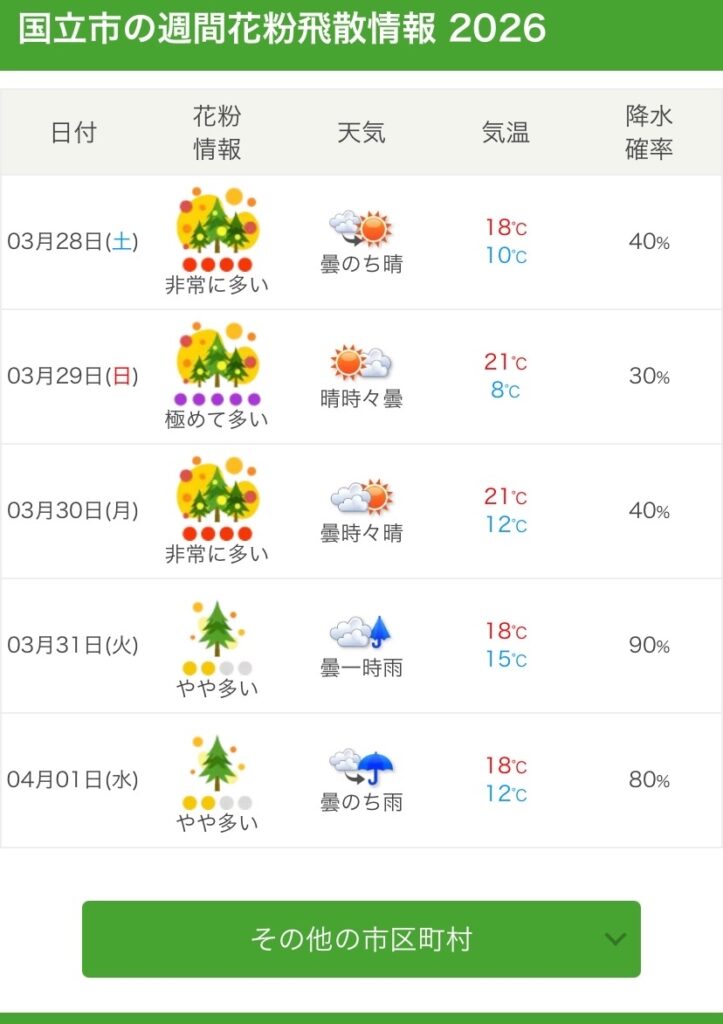
Typically, pollen forecast terms indicate whether pollen levels are low, slightly high, or extremely high. The common range is as follows:
| Japanese | Reading | Meaning |
|---|---|---|
| 少ない | Sukunai | Low |
| やや多い | Yayaooii | Slightly high |
| 多い | Ooii | High |
| 非常に多い | Hijou ni ooii | Very high |
| 極めて多い | Kiwamete ooii | Extremely high |
Here is how to read the pollen forecast in your weather app, step-by-step:
- Check today’s level on your weather app. Look for labels such as 花粉情報 (kafun jouhou) or 花粉飛散量 (kafun hisanryou).
- Identify the level word. Using the table above, check the pollen levels. Thankfully, most weather apps come with illustrations and icons to help with visual aid, so even if you forgot the word, a lot of the information should be intuitively understandable!
From there, you can adjust your day accordingly. For example, if the app indicates that the pollen levels are 多い or higher, you can ease your symptoms by wearing a mask or avoiding outdoor activities!
Conclusion: Hay Fever in Japan is Not Impossible to Deal With
花粉症 (kafunshou) or hay fever in Japan may be brutal with its massive amounts of cypress and cedar trees. However, it’s not impossible to deal with and should not deter you from strolling through parks to view the sakura trees. Taking measures to mitigate the symptoms, such as taking effective medicine, tracking high pollen time periods and areas, traveling to low pollen areas, and even taking immunotherapy.
Spring should be an exciting time to go out and enjoy the outdoors without having to worry about spring hay fever, so try the methods from this guide, or just take a bit of time to see a doctor. Trust us, it’s worth it!
Take Japanese Classes at Coto Japanese Academy!
Worried that you don’t know how to ask for the right medicine at the pharmacy or how to explain your symptoms to your doctor? Take Japanese courses at Coto Academy to ensure you get the 花粉症 (kafunshou) medicine you need! We offer practical, conversation-focused classes with trained teachers that will help you gain more confidence speaking and understanding Japanese!
We have campuses in Shinjuku, Shibuya, Iidabashi, Minato, and Yokohama! If you’re not in Japan, don’t worry, we also offer courses fully online! Sign up right now to get a free consultation and level check!
FAQ:
What is 花粉症 (kafunshou)?
花粉症 (kafunshou) is the Japanese term for hay fever, a seasonal allergic reaction caused by pollen from trees, grasses, and other plants. When pollen enters the body through the nose or eyes, the immune system overreacts, causing symptoms such as sneezing, a runny or blocked nose, itchy or watery eyes, and sometimes fatigue or throat irritation.
Is hay fever, or 花粉症 (kafunshou), severe in Japan?
Yes, hay fever is extremely common in Japan and is often described as a major public health issue. Estimates suggest that over 40% of people in Japan experience some form of hay fever, with a large portion specifically allergic to cedar pollen.
What tree pollen causes hay fever in Japan?
The main culprits of hay fever in Japan are tree pollens, especially Japanese cedar or 杉 (sugi), which is the primary cause of hay fever nationwide. Additionally, Japanese cypress 檜 (hinoki) is another major trigger after the cedar season.
What over-the-counter medicine is available for 花粉症 (kafunshou) in Japan?
Many over-the-counter (OTC) treatments are available at Japanese drugstores and pharmacies, like antihistamine tablets (often non-drowsy formulas), allergy eye drops, nasal sprays to relieve congestion, and pollen-blocking sprays.
These medications are widely sold and are commonly used during peak pollen season, which typically runs from February to April for cedar pollen. However, if symptoms are severe or persistent, doctors may prescribe stronger treatments.
Does Japan sell medicines with corticosteroids?
Yes, corticosteroid medications are available in Japan and are commonly used. However, the availability or accessibility depends on the product type and strength. Certain nasal steroid sprays or stronger treatments may require a prescription from a doctor. If OTC medication does not work, visiting a clinic or ENT specialist is typically recommended, as doctors can prescribe stronger therapies tailored to your symptoms.
You may also be interested in reading:
Seasons in Japanese: How to Say Spring, Summer, Fall, and Winter
Greenery Day (みどりの日): It’s Green Holiday to Celebrate Nature
How To Read Japanese Nutrition & Food Labels
Japanese Hospital Vocabulary 1 – Cheat Sheet