





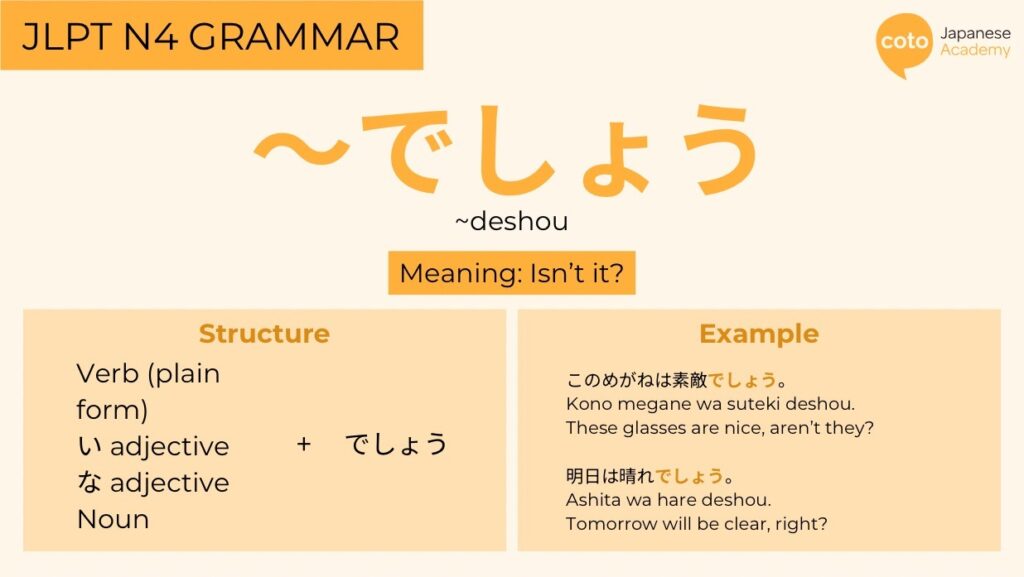
Ever used the Japanese grammar, でしょう (deshou)? Picture this. You recently got these new glasses, and you think they look nice. You want to tell your Japanese friend about your new glasses, but you want them to agree that they look nice. So what do you say when you want your friend to agree with you? You can say 素敵でしょう (suteki deshou), which translates in English to “Aren’t they nice?”
In Japanese, 〜でしょう (~deshou) is a way to seek agreement on something that you said.
Grammar patterns such as だろう or じゃない can be used to convey a similar meaning, whether you’re looking for sympathy, speculating, or want to confirm something. But which ones should you use and when? Knowing the difference between these grammar patterns can make or break your Japanese ability, and it can be the difference between sounding fluent and not.
In this blog post, we’ll show you how to use でしょう (deshou) as well as similar grammar patterns you can use to seek agreement, sympathy, and more.
Check Out Our Video Lesson on でしょう (Deshou)
Before you dive in, check out our quick video lesson on でしょう with our Japanese teacher, Nami-sensei!
Meaning of でしょう
でしょう is a grammar pattern that is used to seek agreement with the person you’re talking to. For example, you might use this grammar pattern to seek agreement with someone when talking about how expensive the food is at a restaurant:
このレストランの値段は高いでしょう。
Kono resutoran no nedan wa takai deshou.
This restaurant is quite expensive, isn’t it?
You can also use this grammar pattern in other ways:
- You can use it to sympathize with someone
- Or to speculate about something based on one’s assumption.
今日は寒かったでしょう。早く入って。
Kyou wa samukatta deshou. Hayaku haitte.
It must have been cold today. Come in quick.
田中さんはお金持ちでしょう。
Tanaka san wa okane mochi deshou.
Tanaka-san is probably rich.
All Functions of でしょう
1. Use でしょう for Speculation
One of the most fundamental uses of でしょう in Japanese is to express uncertainty or speculation. It’s commonly used when the speaker wants to offer their best guess or interpretation.
However, でしょう does more than just show uncertainty. It also signals that the speaker is presenting their own opinion or perspective to the listener. Because of this, it can sometimes create a slightly assertive or confident tone.
In other words, even though you’re not 100% certain, you’re still guiding the listener toward your viewpoint.
For example, if you say:
明日は雨が降るでしょう。
Ashita wa ame ga furu deshou.
(It will probably rain tomorrow.)
In this case, you’re offering a considered opinion, perhaps based on a weather forecast or personal judgment.
2. Use でしょう for Showing Shared Understanding
Another common use of でしょう is to seek agreement or confirm shared understanding with the listener.
In this case, the speaker isn’t just expressing uncertainty—they’re inviting the listener to agree with them. It’s similar to saying “right?” or “don’t you think?” in English.
This usage softens the statement and makes it more conversational, helping build a sense of connection between the speaker and the listener.
For example, if you and your friend just watched a great movie, assuming the other person feels the same way, you can say:
この映画は面白いでしょう?
Kono eiga wa omoshiroi deshou?
(This movie is interesting, right?)
3. Use でしょう to Seek Validation
Another important function of でしょう is to show shared understanding by making a thoughtful assumption about the listener’s situation. In many cases, this can feel like confirming information while also expressing empathy.
LAで働いています。
LA de hataite imasu.
I work in LA.
そうなんだ。毎日、通勤大変でしょう。
Sou nan da. Mainichi, tsuukin taihen deshou.
Really? Commuting every day must be tough, right?
In this conversation, 「でしょう」 shows that the second person is making a reasonable guess about the speaker’s situation. At the same time, they present it as something likely true, which creates a sense of empathy and understanding.
4. Use でしょう to Seek Information
In conversation, でしょう」can also be used to ask questions and seek information. This usage often appears with question words such as なん (what), だれ (who), どこ (where), いつ (when), and なんで (why), and it adds a higher level of politeness and formality to the question.
どなたでしょう?
(Who are you?)
This sounds polite and somewhat formal, often used in situations like answering the phone or speaking to someone whose identity is unclear.
Grammar Structure of でしょう
Below is a basic grammar structure of でしょう as well as its meaning:
| Structure | Meaning |
| Noun + でしょうVerb (plain form) + でしょうい adjective + でしょうな adjective + でしょう | To show sympathy, agreement, or speculation |
For な adjectives, omit the な at the end before using でしょう.
Other Alternatives to でしょう
1. だろう (Darou)
だろう can be translated as “probably” or “I assume” as this grammar pattern is used to speculate something based on one’s interpretation. It’s a more casual and assertive way of saying でしょう. You can also use this grammar pattern to confirm or find more information.
| Type | Structure |
| NounVerbい adjectiveな adjective | Noun + だろうVerb + だろうい adjective + だろうな adjectve + だろう |
今日は雨が降るだろう。
Kyou wa ame ga furu darou.
Today is probably going to rain.
袋に入った物は果物だろう。
Fukuro ni haitta mono wa kudamono darou.
The thing in the bag is probably fruit.
2. じゃない (Ja nai)
Translated as “isn’t it,” it may look like you’re expressing disagreement with this grammar pattern, but like でしょう, you can also use it to seek agreement with someone. However, since you’re asking a question using じゃない, it can sound more blunt. We recommend adding か to the end of the grammar pattern to sound more polite, since it translates as “don’t you think?”
| Type | Structure |
| Phrase | Phrase + じゃない + か |
これは水じゃない?
Kore wa mizu ja nai?
This is water, isn’t it?
佐藤さんは事務所に来るんじゃないか?
Satou san wa jimusho ni kurun ja nai ka?
Isn’t Satou-san coming to the office?
3. ではないか (De wa nai ka)
This grammar pattern is the more polite version of じゃないか. Only use this grammar pattern when you’re expected to be polite, as it might sound unnatural.
| Type | Structure |
| Phrase | Phrase + ではないか |
今日は寒いではないか。
Kyou wa samui de wa nai ka.
Today is cold, isn’t it?
三田さんは会社員ではないか。
Mita san wa kaishain de wa nai ka.
Isn’t Mita-san a salaryperson?
4. ね (Ne)
Commonly translated as “isn’t it,” or “right,” this is a sentence-ending particle that is used to look for agreement or confirmation about something. It works similarly to でしょう,
| Type | Structure |
| Sentence | Sentence + ね |
今日は暑いね。
Kyou wa atsui ne.
Today is hot, right?
昨日のテストは難しかったね。
Kinou no tesuto wa muzukashikatta ne.
Yesterday’s test was quite difficult, wasn’t it?
Conclusion: Use でしょう when you want to seek agreement, sympathy, or speculation
でしょう is a versatile grammar pattern used to seek agreement or sympathy, or when you want to speculate on something. The next time you want to talk about something based on your own assumptions, or whether you want to get someone to agree with you on something, use this grammar pattern!
Interested in improving your Japanese? Learn with Coto Japanese Academy!
If you want to learn beyond these grammar patterns, why not study Japanese with us? With campuses in Shibuya, Yokohama, Iidabashi, Minato, Shinjuku, and online, Coto Academy has been offering lessons focused on practical Japanese for over 25 years.
We offer part-time, intensive, and fully online lessons to suit your schedule. Fill out the form below for a free level check and start your Japanese learning journey with Coto Academy today!
Want to keep improving your Japanese grammar? Check out more guides and take your skills to the next level.
- かな (Kana): Meaning, Explanation, Example
- そんなに (Sonna ni): Saying “That Much” in Japanese
- ないでください (Naide kudasai): “Please Don’t” in Japanese (With Examples)
- 〜方がいい (~Hou ga ii): Meaning, Structure & Example
- JLPT N5 Grammar ~ませんか (Masenka): Meaning, Example, Use