






If you need to provide a reason or explanation for an action, you can use the JLPT N5 grammar, 〜ので (~node). It is similar to saying “because…” in English. It is often used to make a cause-and-effect statement, such as “since A, then B.”
Essentially, you can use 〜ので to logically connect 2 statements, similar to grammar 〜から(~kara). Let’s learn how to use this JLPT N5 grammar point by breaking down its meaning, structure, and example sentences.
Make Sure to Watch Coto Academy’s YouTube Video About 〜ので (~node)
Before you continue reading, why not take a moment to watch a quick YouTube lesson with our Japanese teacher, Yuka-sensei:
Meaning of 〜ので (~node)
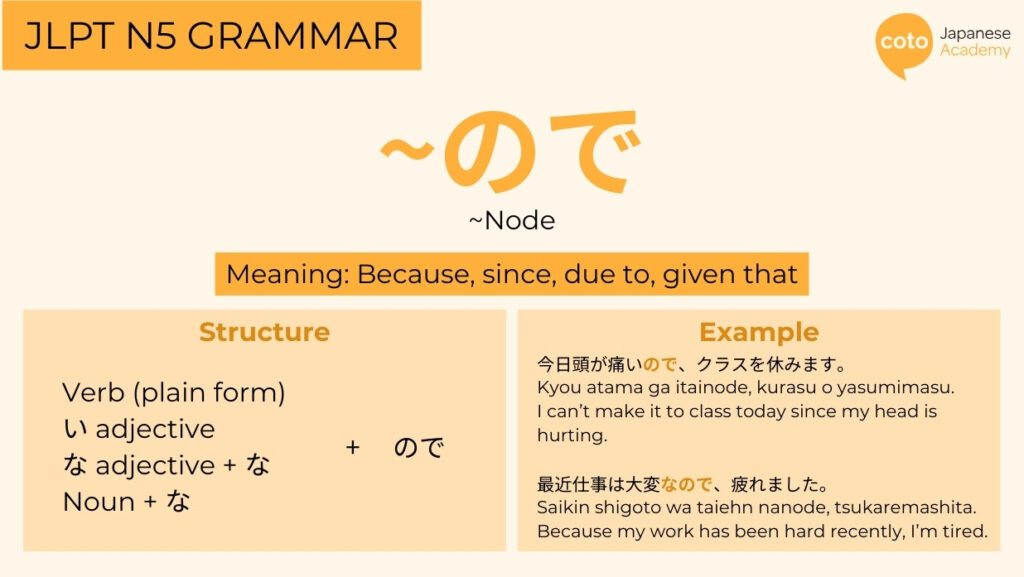
〜ので is a way to provide a reason or reasoning for something. It also establishes a logical connection between two separate statements. It’s similar to the expression, 〜から (~kara), but has a more formal nuance. Generally, you use this expression to explain “why”, establish a cause-and-effect, and even give an excuse. 〜ので most closely translates to the following:
- Because of
- Given that
- Since
- Due to
JLPT N5 〜ので Sentence Structure
Unlike the English expressions “because” or “since,” which are used before the reason, 〜ので is used after providing the reason. For example, in English you might say “Because I’m busy, I won’t go to the party,” which in Japanese would be:
いそがしいので、パーティーに行きません。
Isogashii node, paatii ni ikimasen.
Because I’m busy, I won’t go to the party.
You can think of 〜ので as being between two separate statements and connecting them logically, like a glue sticking 2 things together. So, 〜ので attaches at the end of the first statement, providing the reason. Specifically, it attaches to the last word of the reason statement. This word can be a noun, verb, or adjective.
| Type | Structure |
|---|---|
| Verb (plain form) | Verb + ので |
| い-Adjective | い-Adjective + ので |
| な-Adjective | な-Adjective + な + ので |
| Noun | Noun + な + ので |
Note that 〜ので itself does not conjugate into past, present, negative, or positive. The word to which 〜ので attaches is what conjugates. Let’s break down how this works with different verb conjugations.
| Form | Plain Form + ので | Meaning |
|---|---|---|
| Present | 雨が降るので | Because it will rain |
| Past | 雨が降ったので | Because it rained |
| Negative | 雨が降らないので | Because it won’t rain |
| Past Negative | 雨が降らなかったので | Because it didn’t rain |
| Volitional | 雨が降ろうので | Because it should rain |
Difference Between 〜ので (~Node) and 〜から (~Kara)
As mentioned, 〜ので is similar to the grammar 〜から, which are both used to provide a reason or reasoning for something. They are largely used for the same purpose, with the only difference being the context in which they are used.
1. ので is more formal
One key difference between “から” and “ので” is that “から” is more casual, while “ので” is more polite and even objective. You can use から in everyday conversation with family and friends. However, neither of these expressions would feel out of place or rude in either formal or casual situations and are commonly used in both.
For example, a speaker might say:
雨が降っているから行きません。
Ame ga futte iru kara ikimasen.
I won’t go because it’s raining.
In contrast, ので sounds softer and more polite, and it is often used in formal situations or when speaking respectfully. It presents the reason in a more objective or explanatory way, as in:
雨が降っているので行きません。
Ame ga futte iru node ikimasen.
I won’t go because it is raining.
Because of this nuance, learners often use から in everyday speech with friends and family, while ので is preferred in polite conversations, such as when speaking to teachers, colleagues, or customers.
2. ので carries an apologetic nuance
ので has a bit of apologetic nuance, pairing well with phrases like すみません (sumimasen) meaning “excuse me” or “sorry.” This expression is preferred when apologizing or providing a reason to your boss or anyone in a formal capacity.
Another difference between ので and から lies in where the emphasis is placed. から tends to emphasize the speaker’s own judgment, decision, or action.
Let’s take a look at the two examples below.
時間がないからタクシーで行きます。
Jikan ga nai kara takushii de ikimasu.
I will take a taxi because I don’t have time.
Here, the speaker is clearly stating their personal reason and decision. In contrast, ので emphasizes the situation or circumstances rather than the speaker’s choice.
時間がないのでタクシーで行きます。
Jikan ga nai node takushii de ikimasu.
I will take a taxi because I don’t have time.
In the second example, the focus is on the situation of not having enough time. This makes the explanation sound softer and less self-centered, as if the circumstances naturally lead to the result, as if to say that the circumstances are responsible for the result.
3. Use から for future predictions
When giving reasons for predictions or assumptions about the future, Japanese speakers generally prefer から rather than ので. から appears when expressing predictions about the future using だろう or its polite form でしょう. I
This is because だろう and でしょう express the speaker’s assumption, guess, or prediction about something that has not happened yet. Since から naturally connects to the speaker’s reasoning or judgment, it fits well with statements that involve personal predictions or speculation.
For example, you might say:
雨が降りそうだから、試合は中止になるだろう。
Ame ga furisoudakara, shiai wa chuushi ni naru darou.
Because it looks like it will rain, the game will probably be canceled.
Using ので in this type of sentence would sound unnatural because ので tends to present the reason as a more objective fact or established situation
Example Sentences Using 〜ので (~Node)
Let’s take a look at some example sentences to really understand how to use the JLPT N5 grammar point, 〜ので (~node)
Example 1:
今日頭が痛いので、クラスを休みます。
Kyou atama ga itainode, kurasu o yasumimasu.
I can’t make it to class today since my head is hurting.
Example 2:
雨が降っているので、出かけません。
Ame ga futte iru node, dekakemasen.
Because it’s raining, I won’t go out.
Example 3:
最近仕事は大変なので、疲れました。
Saikin shigoto wa taiehn nanode, tsukaremashita.
Because my work has been hard recently, I’m tired.
Example 4:
今日は日曜日なので、銀行は休みです。
Kyou wa nichiyoubi na node, ginkou wa yasumi desu.
Since today is Sunday, the bank is closed.
Example 5:
すみません、少し疲れたので、先に帰ってもいいですか。
Sumimasen, sukoshi tsukareta node, saki ni kaette mo ii desu ka?
I’m so sorry, but since I’m a bit tired, may I go home first?
Conclusion
〜ので is a very useful expression you can use to provide a reason or cause for something, and can even be used to apologize. So, try using it next time you speak Japanese to really understand how it works and ingrain it into your Japanese arsenal!
Learn More JLPT Grammar with Coto Academy!
If you want more practice using this phrase and many others in real Japanese conversations with a teacher who can offer practical guidance, sign up with us at Coto Academy.
Coto Academy has been teaching Japanese for over 25 years, with campuses in Shibuya, Yokohama, Iidabashi, Minato, and online. Our courses focus on practical Japanese, so the grammar you learn is designed for real-life use.
We offer part-time, intensive, and fully online lessons to suit your schedule. Ready to get started? Fill out the form below to contact us!
FAQ:
What does 〜ので mean?
〜ので is used to explain a reason or cause for something. It can be translated to “because,” “since,” or “due to.”
How is 〜ので different from 〜から?
〜ので is quite similar to 〜から since they are both used for explaining a reason or cause. But they differ in nuance with 〜ので being softer and even a bit apologetic, often being used with expressions like すみません (sumimasen), meaning “excuse me.” 〜から is a bit more direct and often used for giving personal reasons. However, neither of these expressions is considered rude and can be used in both formal and casual situations.
Can 〜ので be used to make requests?
〜ので is often used to politely explain the reason before making a request. For example, if you need a friend to tell you how to get somewhere, you can say 道が分からないので、教えてください (michi ga wakaranai node, oshiete kudasai), which means, “because I don’t know the way, please tell me.”
You may be interested in:
- JLPT N4 Grammar らしい (Rashii): Meaning, Explanation, Example
- JLPT N3 Grammar もし〜たなら (Moshi ~ Tanara) Meaning, Explanation, Example
- JLPT N3 〜に決まっている (~Ni Kimatte Iru): “Obviously” or “It Must Be” in Japanese
- JLPT N3 て仕方がない (Te Shikata ga Nai): “Can’t Help But..” in Japanese
- JLPT N2 気味 (Gimi): Saying “Seems” or “Tends to Be” in Japanese