





The JLPT N3 phrase そんなに (sonna ni) is a very useful everyday phrase that means, “that much,” “so much,” or “to that extent.” Most often, そんなに appears in negative sentences to downplay or deny the extent of something, making statements sound softer or more polite. When used in positive sentences, it typically conveys surprise or emphasis, highlighting that something is more than expected.
Now, let’s take a closer look at the grammar pattern, example sentences, and common use cases of そんなに!
そんなに (Sonna Ni) Meaning
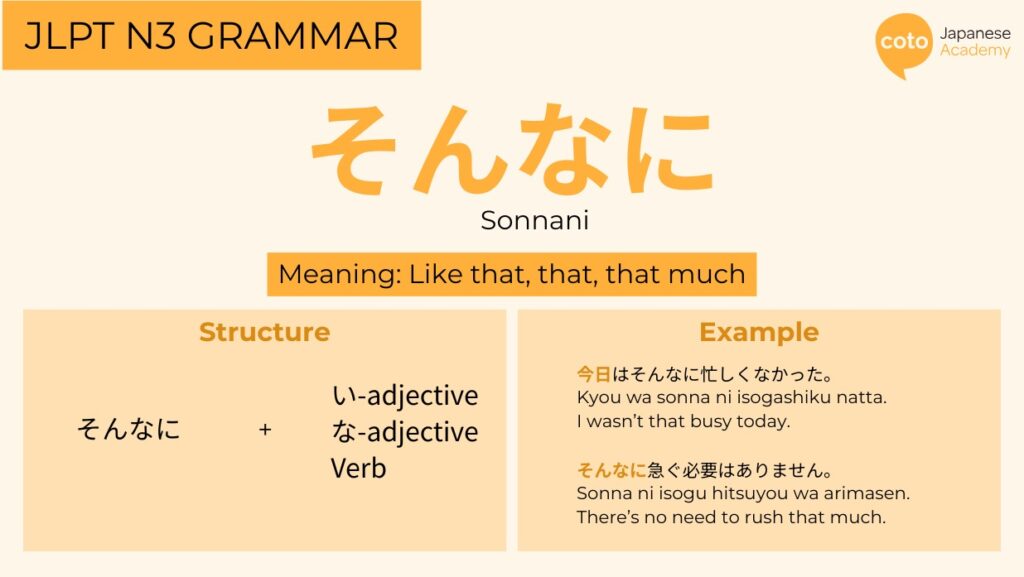
そんなに (sonna ni) can translate to “like that,” “that much,” or “that…” It’s a convenient adverb meant to add emphasis, deny, or downplay the degree of something. そんな (sonna) can translate to “like that,” and に (ni) is just a particle that indicates where something is or is going. So, together そんなに expresses a mild emphasis or whether something is “that much” or “that..(i.e., big, small, spicy).”
In a negative context, it is often used to soften or deny something, while in a positive context, it can be used to express your surprise. For example, そんなにいっぱいくれる!?(sonna ni ippai kureru!?) which means “Really? You’re giving me that much!?”
Want to study Japanese with us?
JLPT N4 そんなに (Sonna Ni) Sentence Structure
そんなに (sonna ni) is an adverb that precedes a verb, い-adjective, or な-adjective. You don’t need to conjugate the verb or adjective to use そんなに.
| Type | Structure |
|---|---|
| Verb | そんなに + verb |
| い-Adjective | そんなに + い-Adjective |
| な-Adjective | そんなに + な-Adjective |
When using そんなに, the verb doesn’t need to be conjugated into any specific form, but you can conjugate the verb into the present tense, past tense, negative, or positive.
| Form | そんなに + Plain Form | Meaning |
|---|---|---|
| Present | そんなに食べる | I eat that much |
| Past | そんなに食べた | I ate that much |
| Negative | そんなに食べない | I do not eat that much |
| Past Negative | そんなに食べなかった | I did not eat that much |
JLPT N4 そんなに Example Sentences
Let’s explore a few examples to really get a feel for how the grammar, そんなに, works in actual Japanese conversation.
Example 1:
そんなに高くないです。
Sonna ni takakunai desu.
It’s not that expensive.
Example 2:
そんなに心配しなくてもいいよ。
Sonna ni shinpai shinakutemo iiyo.
You don’t have to worry that much.
Example 3:
今日はそんなに忙しくなかった。
Kyou wa sonna ni isogashiku natta.
I wasn’t that busy today.
Example 4:
そんなに急ぐ必要はありません。
Sonna ni isogu hitsuyou wa arimasen.
There’s no need to rush that much.
Example 5:
えっ!そんなにかわいいの!?
Ee! Sonna ni kawaii no!?
Really? It’s that cute!?
Vocabulary List
Check out all the new words in the example sentences above, and try to remember new vocabulary alongside today’s Japanese grammar!
| Kanji / Writing | Furigana | Romaji | English |
|---|---|---|---|
| 高い | たかい | takai | expensive; high |
| 心配する | しんぱいする | shinpai suru | to worry |
| しなくてもいい | しなくもていい | shinaku temo ii | okay not to do |
| 今日 | きょう | kyou | today |
| 忙しい | いそがしい | isogashii | busy |
| 急ぐ | いそぐ | isogu | to hurry |
| 必要 | ひつよう | hitsuyou | necessary |
| かわいい | かわいい | kawaii | cute |
Learn More JLPT Grammar with Coto Academy!
Try using そんなに next time you speak Japanese! It’s a convenient phrase, great for everyday conversation and expressing emphasis or downplaying something. But if you want to practice using this JLPT grammar and many others in actual Japanese conversations, nothing beats practicing with a teacher who can offer practical guidance. So, consider signing up with us at Coto Academy!
Coto Academy has been offering Japanese classes for over 25 years, with campuses in Shibuya, Yokohama, Iidabashi, Minato, Shinjuku, and online. Our courses focus on practical Japanese, so the grammar you learn is designed for real-life use.
We offer part-time, intensive, and fully online lessons to suit your schedule. Start learning Japanese effectively and confidently with Coto Academy today!
Why join Coto Academy?
- Over 60+ different Japanese classes over 18 levels
- Small classroom of only up to 8 students for personalized support
- Professional, native Japanese teachers
- Ready to get started? Fill out the form below to contact us!
FAQ:
What does そんなに (sonna ni) mean?
そんなに means something like “that much” or “to that extent,” often used to deny or soften the degree.
Is そんなに (sonna ni) usually used with negatives?
It is very natural to use it with negative forms to soften something or deny. Here is an example of a natural way to use it: そんなに難しくない (sonna ni muzukashikunai) or “it’s not that difficult.”
Can そんなに (sonna ni) be used in positive sentences?
Yes, そんなに is often used in positive sentences. Usually, you use it to highlight your surprise, for example, そんなにいっぱいくれる!? (sonna ni ippai kureru!?) which means “Really? You’re giving me that much!?”