




The JLPT N3 grammar 〜かける/かけだ/かけの (kakeru/ kakeda/ kakeno) is a very useful expression to describe when you have started something but haven’t finished, or when you’re in the middle of something. The expression is mostly used to say:
- Halfway through..
- In the middle of..
- Not yet finished
Let’s take a look at kakeru, kake no, and kake da, their grammar structure, examples, and notes!
Make Sure to Watch Coto Academy’s YouTube Video About かける/かけだ/かけの
Before you continue reading, why not take a moment to watch a quick YouTube lesson with our Japanese teacher, Nami-sensei:
〜かける/かけの/かけだ Meaning
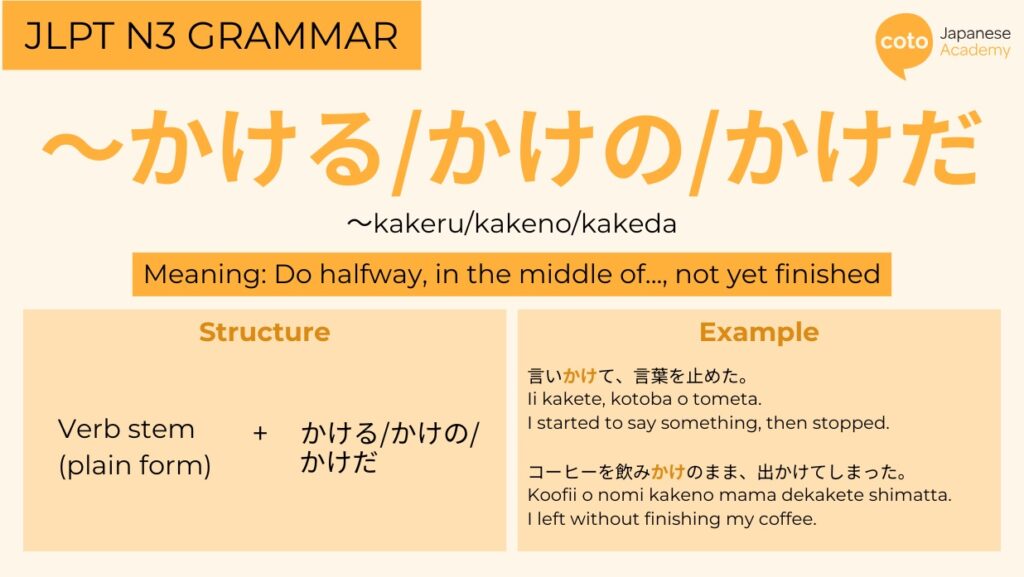
〜かける/かけの/かけだ expresses an action that has been started but is not yet finished, or something that is in the middle of completion. You can use this phrase to describe how you are halfway through something or whenever you’re not done with something.
〜かけ most closely translates to:
- Half-done
- About to
- In the middle of
Want to study Japanese with us?
JLPT N3 〜かける/かけの/かけだ (~kakeru/kakeno/kakeda) Sentence Structure
〜かけ(~kake) attaches to the end of verb stems (dropping ます). You can only use it with verbs that express a direct action (i.e., reading a book, watching a movie, making food).
| Type | Structure |
|---|---|
| Verb (ます form) | Verb (drop ます) + かけ |
Generally, 〜かけ (kake) has 3 common grammatical forms: かける、かけの、and かけだ. The table below shows how each grammar form is used:
| Form | Structure | Meaning / Usage | Examples Japanese | Examples English |
|---|---|---|---|---|
| 〜かける | Verb (ます form) + かける | Describes an action as incomplete or halfway done | 読みかける | To start reading but not finish |
| 〜かけの | Verb (ますform) + かけの + Noun | Describes a noun that is unfinished | 読みかけの本 | A half-read book |
| 〜かけだ | Verb (ます-stem) + かけだ | States that something is left unfinished | この本は読みかけだ | This book is half-read |
You can only attach a verb stem in plain form, without conjugating, to かけ. You conjugate かけ itself into positive, negative, past, and present:
| Form | Plain Form + かける | Meaning |
|---|---|---|
| Present | 読みかける | In the middle of reading |
| Past | 読みかけた | Was in the middle of reading |
| Negative | 読みかけない | Does not start reading/does not leave it half done |
| Past Negative | 読みかけなかった | Did not start reading |
JLPT N3 〜かける/かけの/かけだ (~kake/kakeno/kakeda) Examples
Let’s take a look at a few example sentences to really get a feel of how to use 〜かける/かけの/かけだ (~kakeru/kakeno/kakeda).
Example 1:
家を出かけたとき、雨が降り出した。
Ie o dekaketa toki, ame ga ori dashita.
Just as I was about to leave the house, it started raining.
Example 2:
読みかけの本が机の上にある。
Yomi kake no hon ga tsukue no ue ni aru.
There’s a book on the desk that I started reading but didn’t finish.
Example 3:
言いかけて、言葉を止めた。
Ii kakete, kotoba o tometa.
I started to say something, then stopped.
Example 4:
コーヒーを飲みかけのまま、出かけてしまった。
Koofii o nomi kakeno mama dekakete shimatta.
I left without finishing my coffee.
Vocabulary List
Check out all the new words in the example sentences above, and try to remember new vocabulary alongside today’s Japanese grammar!
| Kanji / Writing | Furigana | Romaji | English |
|---|---|---|---|
| 家 | いえ | ie | house |
| 出かける | でかける | dekakeru | to go out |
| 雨 | あめ | ame | rain |
| 降り出す | ふりだす | furidasu | to start falling |
| 読む | よむ | yomu | to read |
| 本 | ほん | hon | book |
| 机 | つくえ | tsukue | desk |
| 言う | いう | iu | to say |
| 言葉 | ことば | kotoba | words |
| 止める | とめる | tomeru | to stop |
| 飲む | のむ | nomu | to drink |
| 出かける | でかける | dekakeru | to go out |
Learn More JLPT Grammar with Coto Academy!
Try using the expression, 〜かける/かけの/かけだ (~kakeru/kakeno/kakeda), as much as you can when speaking Japanese! The more you use it, the more it’ll stick and just become a natural way you express yourself. If you want to practice using this JLPT phrase and many more in real Japanese conversations, nothing beats practicing with a teacher who can offer practical guidance. Sign up with us at Coto Academy.
Coto Academy has been teaching Japanese for over 25 years, with campuses in Shibuya, Yokohama, Iidabashi, Minato, and Shinjuku. Our courses focus on practical Japanese, so the grammar you learn is designed for real-life use.
We offer part-time, intensive, and fully online lessons to suit your schedule. Start learning Japanese effectively and confidently with Coto Academy today!
Why join Coto Academy?
- Over 60+ different Japanese classes over 18 levels
- Small classroom of only up to 8 students for personalized support
- Professional, native Japanese teachers
- Ready to get started? Fill out the form below to contact us!
FAQ:
What does 〜かける/かけの/かけだ (~kake/kakeno/kakeda) mean?
It indicates that an action is not completed, either because it was interrupted or was just about to happen.
Is 〜かけ (~kake) used for the future or the past?
The expression can be used for both, describing something about to happen or something already started, but is unfinished.
Can 〜かけ be used with all verbs?
Generally, かけ(kake) can only be used with intentional, controllable actions, not for indirect actions you have no control over.