


Do you find Japanese pronunciation difficult? Depending on your language background, it may come naturally or be very challenging. Japanese pronunciation is based on phonetic syllables, where words are usually made of just 1 or 2 sounds, usually a vowel and a consonant.
However, long vowels, double consonants, pitch, where to stress, and particular sounds like the Japanese “r” are often the most challenging for foreigners to pronounce correctly. While Japanese people can probably understand you even if your pronunciation isn’t perfect, part of the excitement of Japanese (or any other language) is learning new sounds outside your native tongue and expanding your perspective on human expression.
It’s truly one of the first steps towards fluency, so let’s break down Japanese pronunciation so you can speak like a native, or as close as possible!
Basic Japanese Sounds Represented in Writing
Japanese sounds are based on a phonetic syllabary represented by the Japanese kana, or writing systems: hiragana and katakana. Japanese writing also consists of kanji, which uses the same sounds as hiragana and katakana but is represented by Chinese logographic characters rather than a phonetic system.
Everyone who learns Japanese, from Japanese schoolchildren to foreign students, starts with hiragana, made up of 46 characters that each represent short syllable-based sounds (i.e., a, ka, ta). Katakana uses the exact same sounds, just different characters. So, we will use hiragana to show the core sounds of Japanese (you don’t need to worry about katakana or kanji!).
To speak Japanese, you must memorize every hiragana character and master how they are pronounced. Unlike the English alphabet, which is made up of individual letters that make a single sound (i.e., a, b, t, e), hiragana is made of short syllables known as mora (a, ka, ta, ba), which are spoken with the same length of time and strength.
Let’s start with the absolute basics: how to pronounce Japanese vowels.
Pronouncing Japanese Vowels
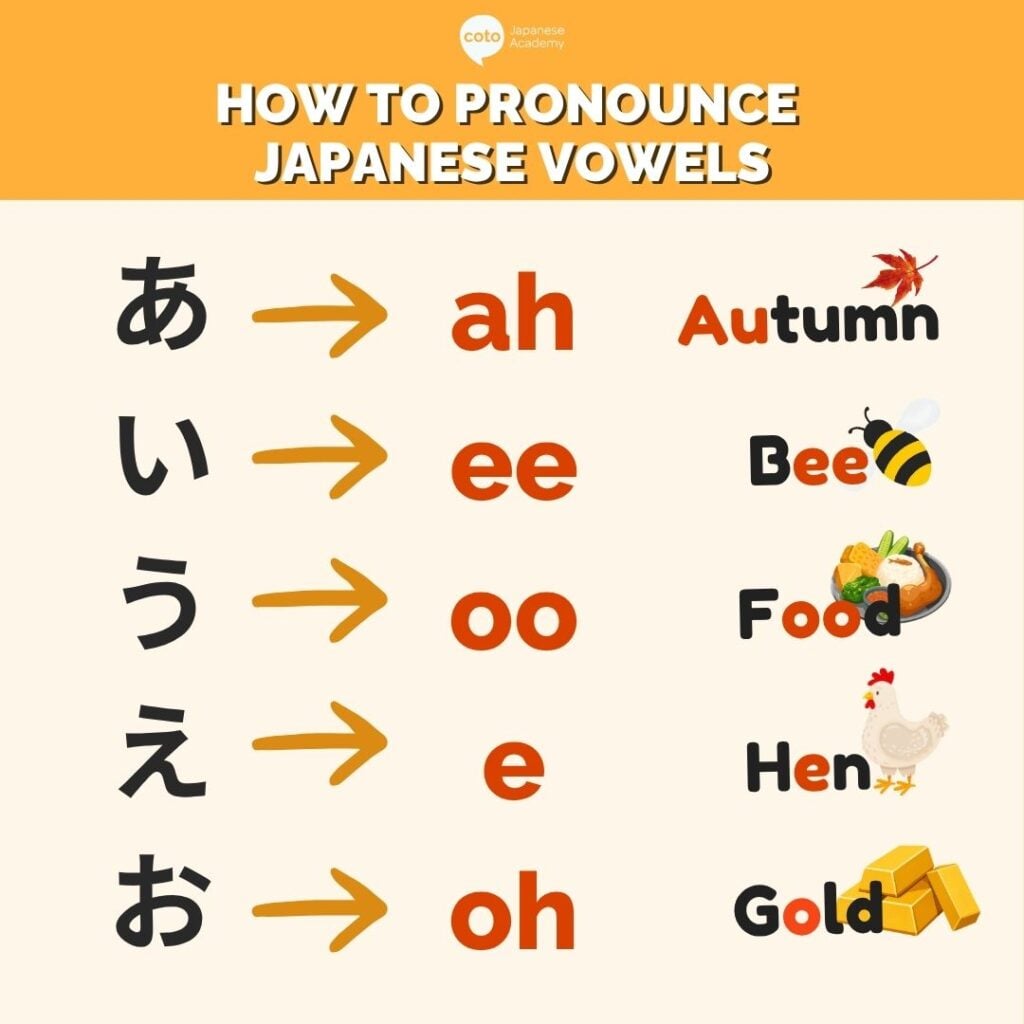
Japanese vowels form the foundation of the phonetic system, since they are part of just about every Japanese character. There are 5 Japanese vowels: a (あ), i(い), u(う), e(え), o(お). While you might recognize the Japanese romaji, or Western script, counterparts, they are not always pronounced the same. Let’s go through the pronunciation of each:
あ: pronounced ah, where you open your mouth wide and let your jaw drop, keeping your tongue low and relaxed and your lips unrounded, as in “father,” or similar to the “o” in “fox”
い: pronounced ee, where you widen your mouth into a slight smile and raise the front of your tongue close to the roof of your mouth, as in “meet” or the Spanish “sí”
う: pronounced oo, where you bring your lips closer together and pull your tongue slightly back, as in “food” or “rude.” Unlike the English “oo,” the lips are only lightly rounded, so it sounds a bit flatter and shorter
え: pronounced eh, where you open your mouth halfway and spread your lips slightly, with your tongue in the middle of your mouth, as in “bet.” Keep the sound steady, since the English “ay” glide doesn’t exist in Japanese
お: pronounced oh, where you round your lips into a small circle, open your jaw halfway, and pull your tongue back, as in “bone” or “roam.” Hold the shape without letting it slide into “ow” at the end, like the Spanish “o” in “dos”
| Japanese | Romaji | Pronunciation | Example |
| あ | a | ah | father, aunt |
| い | i | ee | meet, bee |
| う | u | oo | food, rude |
| え | e | e | bet, ken |
| お | o | oh | bone, foam |
Pronouncing Japanese Consonant Combinations
As mentioned, Japanese doesn’t really have stand-alone consonant sounds, with one exception: ん (n), which we will get to later. Otherwise, every Japanese consonant is paired with one of the vowels: あ, い, う, え, お, to form a mora, or vowel-consonant combinations (ka, sa, ta, ha).
Keep in mind, Japanese is spoken rather flat, without extra stress or length on consonants or vowels unless otherwise indicated (discussed in further detail later). This is one of the biggest pitfalls learners with an English-speaking background tend to fall into. For instance, English speakers tend to stress “h” sounds like “hot,” but in Japanese it’s much lighter.
Japanese has 46 main characters, as shown in the standard chart:
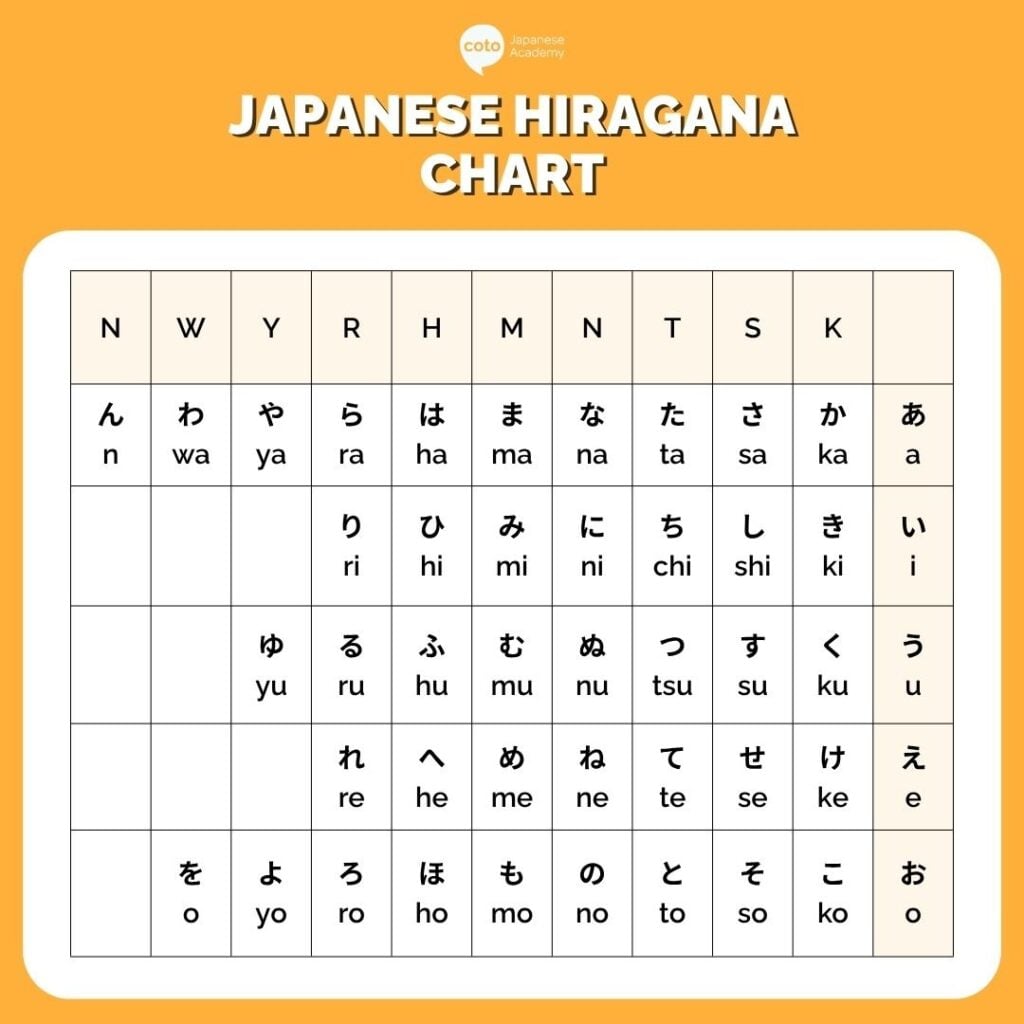
For the most part, every consonant in Japanese is pronounced pretty close to English just with less stress. So we will just go through the pronunciation of the first character of each line (K line, S line, etc.) along with a few characters to keep in mind:
1. K-Line:
The “k” sound is pronounced the same as the letter “k” or “c” in English, so か is pronounced ka, similar to coffee. The same goes for the rest of the characters.
2. S-Line:
The “s” sound in Japanese is similar to the letter “s” in English. さ is pronounced sa as in “saw.” Note that し is pronounced shi (similar to “she”) and not si.
3. T-Line:
The “t” sound in Japanese is similar to the “t” in English, but softer, with less of a puff of air. Try touching your tongue to the back of your upper front teeth instead of the roof of your mouth. So, た is pronounced ta as in “taco,” て is te as in “ten,” and と is to as in “toast.”
Note that ち is pronounced chi (similar to “cheese”) and つ is pronounced tsu (like the “ts” in “cats” followed by “oo”), not ti and tu. The tsu is present in the famous car brand name, “Mitsubishi.”
4. N-Line:
The “n” sound is almost identical to the English “n,” so な is pronounced na as in “nacho,” に is ni as in “knee,” ぬ is nu as in “noon,” ね is ne as in “net,” and の is no as in “note.” Just remember to keep each sound short and even, without extending the vowel.
5. H-Line:
The “h” sound in Japanese is much lighter than in English, with less breath behind it. So, は is pronounced ha as in “haha,” ひ is hi as in “heat,” へ is he as in “hen,” and ほ is ho as in “hole.” Note that ふ is pronounced fu, but it isn’t the English “f.” Instead, blow air gently between your lips, as if you were blowing out a candle, and make a soft “foo” sound, not touching your teeth to your lip.
6. M-Line:
The “m” sound is the same as the “m” in English, with your lips pressed together. So, ま is pronounced ma as in “mama,” み is mi as in “meet,” む is mu as in “moon,” め is me as in “met,” and も is mo as in “more.”
7. Y-Line:
The “y” sound in Japanese is the same as the “y” in English, but this line only has three characters: や, ゆ, and よ. They’re pronounced ya as in “yacht,” yu as in “you,” and yo as in “yo-yo.” The gaps for yi and ye are filled by い and え instead.
8. R-Line:
The Japanese “r” is one of the trickiest sounds for English speakers. It isn’t the English “r.” Instead, it’s a quick tap of the tongue against the ridge just behind your upper teeth, similar to the “tt” in “butter” or the “dd” in “ladder” when you say them quickly. This is why it can sound like a mix of “r,” “l,” and “d.” So, ら is pronounced ra, り is ri, る is ru, れ is re, and ろ is ro, all with that soft tap.
9. W-Line:
This really isn’t a W-line since the only character with the “w” sound is わ (wa), as in “want”, being pronounced almost identically to the “w” in English. The character を (o) is pronounced “o,” the same as お, and is mostly used as a particle, as in 水を飲む (mizu o nomu, “drink water”).
10. N (ん):
ん is the only consonant that stands alone in Japanese and isn’t paired with a vowel. It’s a nasal sound that changes slightly depending on the sound that follows it: before “m,” “b,” or “p” it sounds like “m,” as in “hum,” and before “k” or “g,” it sounds like “ng,” as in “sing.” At the end of a word, it’s a deeper, held “n” sound.
The Other Consonant Sounds in Japanese
Additionally, there are characters with the dakuten, or tenten (゛), and handakuten, or maru (゜), which are attached to certain rows of characters, altering their sound.
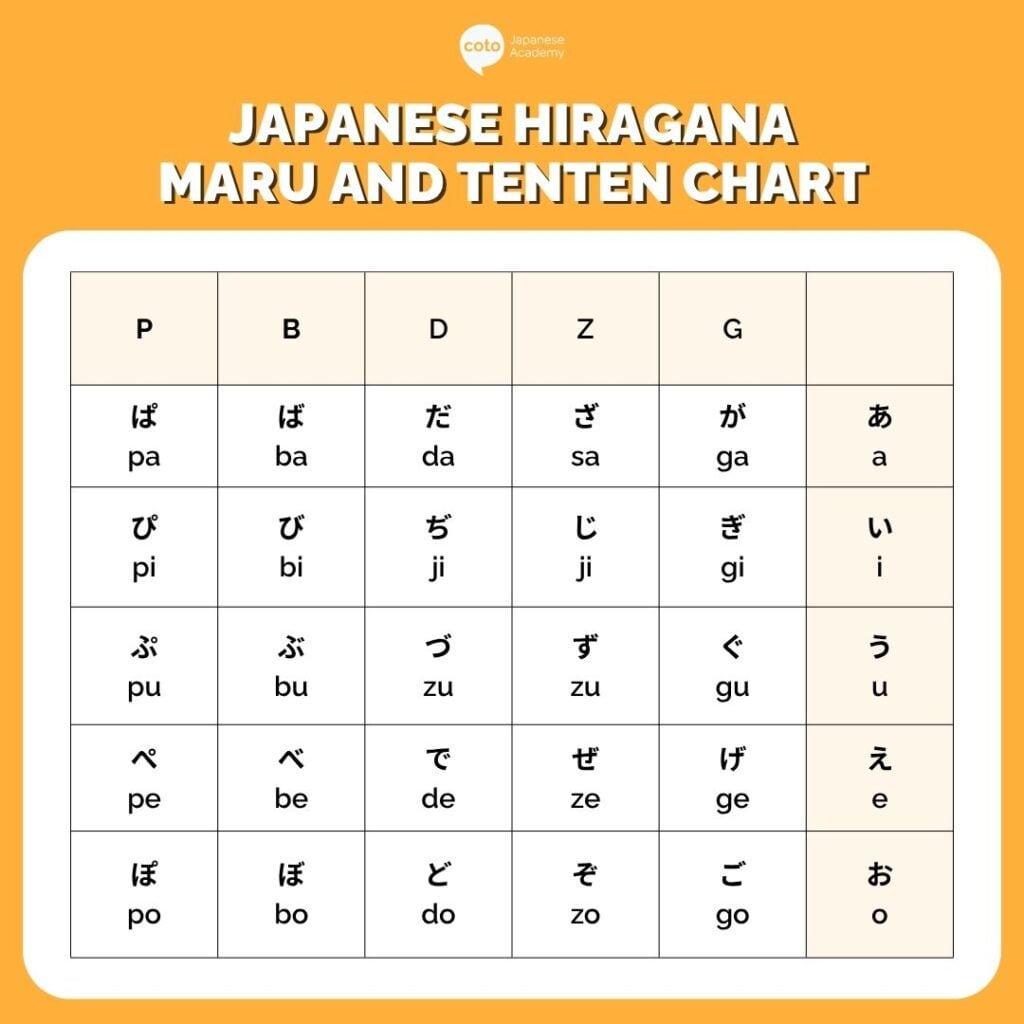
Tenten (゛) Lines
Adding a tenten (濁点, dakuten) to a character makes the sound “voiced,” which means your vocal cords vibrate. Try touching your throat as you say か (ka) and then が (ga); you should feel a buzz on the second one; essentially, it’s the same as producing the “g” sound.
G-Line
The K-line with「 ゛」creates a hard “g” sound as in “go”; you never pronounce the g-line as a soft “g,” as in “giant.”
- が: ga, as in “garage”
- ぎ: gi, as in “geese”
- ぐ: gu, as in “goose”
- げ: ge, as in “get”
- ご: go, as in “go”
Z-Line
The S-line with「゛」creates a “z” sound, as in “zoo.” Note that じ is pronounced “ji,” as in “jeep,” and not “zi.”
- ざ: za, as in “pizza”
- じ: ji, as in “jeep” (not “zi”)
- ず: zu, as in “zoo”
- ぜ: ze, as in “zest”
- ぞ: zo, as in “zone”
D-Line
The T-line with「゛」creates a “d” sound, but it’s softer than in English. Try touching your tongue to the back of your upper front teeth instead of the roof of your mouth. Note that ぢ and づ are pronounced exactly the same as じ and ず, so they’re only used in a few special words.
- だ: da, as in “dock”
- ぢ: ji, pronounced the same as じ and rarely used
- づ: zu, pronounced the same as ず and rarely used
- で: de, as in “dell”
- ど: do, as in “dough”
Note that both ぢ (ji) and づ (zu) are pronounced the same as じ and ず in the s-line.
B-Line
The H-line with「゛」creates a “b” sound, the same as in English, with your lips pressed together.
- ば: ba, as in “bar”
- び: bi, as in “bee”
- ぶ: bu, as in “boot”
- べ: be, as in “bet”
- ぼ: bo, as in “boat”
Maru (゜) Line
Adding a maru (丸, handakuten) to the H-Line changes it to the “p” sound. Unlike the English “p,” the Japanese “p” has less of a puff of air.
- ぱ: pa, as in “pasta”
- ぴ: pi, as in “peek”
- ぷ: pu, as in “pool”
- ぺ: pe, as in “pet”
- ぽ: po, as in “pole”
Small や (ya), ゆ (yu), and よ (yo) Sounds
や (ya), ゆ (yu), and よ (yo) can be combined with characters ending with い (i), such as き (ki), し(shi), or り(ri), creating a contracted sound where the pronunciation focuses more on the vowel than the “y” sound itself. They are also written much smaller when combined with other characters, for instance, や → ゃ.
Here is how they are written and pronounced with each consonant line:
| Line | ゃ (ya) | ゅ (yu) | ょ (yo) |
| K-line (き) | きゃ (kya) | きゅ (kyu) | きょ (kyo) |
| S-line (し) | しゃ (sha) | しゅ (shu) | しょ (sho) |
| T-line (ち) | ちゃ (cha) | ちゅ (chu) | ちょ (cho) |
| N-line (に) | にゃ (nya) | にゅ (nyu) | にょ (nyo) |
| H-line (ひ) | ひゃ (hya) | ひゅ (hyu) | ひょ (hyo) |
| M-line (み) | みゃ (mya) | みゅ (myu) | みょ (myo) |
| R-line (り) | りゃ (rya) | りゅ (ryu) | りょ (ryo) |
| G-line (ぎ) | ぎゃ (gya) | ぎゅ (gyu) | ぎょ (gyo) |
| Z-line (じ) | じゃ (ja) | じゅ (ju) | じょ (jo) |
| B-line (び) | びゃ (bya) | びゅ (byu) | びょ (byo) |
| P-line (ぴ) | ぴゃ (pya) | ぴゅ (pyu) | ぴょ (pyo) |
Generally, these contracted vowels will have a subtle “y” sound that precedes the vowel. However, the し, ち, and じ rows are the exceptions. With these rows, the “y” sound basically disappears.
- しゃ, しゅ, しょ are pronounced sha, shu, sho
- ちゃ, ちゅ, ちょ are pronounced cha, chu, cho
- じゃ, じゅ, じょ are pronounced ja, ju, and jo
Let’s look at the difference between contracted vowel sounds in Japanese words that have the “y” sound and those that don’t.
Examples with subtle “y” sound
- 京都 (kyouto): The iconic city, Kyoto (きょうと), actually keeps the subtle “y” sound, though be sure not to over-emphasize it.
- 病院 (byouin): The word for hospital, びょういん, also has a subtle “y” sound that is contracted from び and よ, pronounced as “byo,” almost like saying B.O.
- 旅行 (ryokou): The word for travel, りょこう, has a “y” sound combined with Japanese “r” similar to pronouncing the word ‘low’ but with a bit more of a roll off the tongue, as it starts further back in your mouth to pronounce the r sound.
Examples with no “y” sound
- 小学校 (shougakkou): The word for elementary school, しょうがっこう, begins with しょ, a contraction of し and よ. Unlike きょ or びょ, there’s no “y” to hear here. It’s pronounced “sho,” as in “show,” so just say “sh” followed by “oh.”
- 中 (chuu): The word for “middle” or “inside,” ちゅう, is a contraction of ち and ゆ. It’s pronounced “chu,” as in “chew,” with the “y” sound fully absorbed by the “ch.”
- 〜ちゃん (~chan): The common suffix for children and close friends, ちゃん, uses ちゃ, a contraction of ち and や. It’s pronounced “cha,” like the dance “cha-cha.”
How to Pronounce Japanese Double Consonants
While we did mention that Japanese is spoken rather flat, double consonants and extended vowels are exceptions to this rule. Double consonants are indicated by a little つ (tsu), っ, which adds emphasis to the following consonant sound.
Let’s take a look at some examples of double consonants:
- きっぷ (kippu): The Japanese word for ‘ticket’, きっぷ, contains っ, which puts stress on the “p” sound in ぷ. This time you can actually pronounce the “p” closer to how you would in Englishー with more strength than a single consonant in Japanese.
- 一回 (ikkai): いっかい, meaning “one time,” has the っ before か, emphasizing the “k” sound. Just like with kippu, the “k” sound will be pronounced with more strength.
How to Pronounce Japanese Extended Vowels
In hiragana, long vowels are usually written by adding a matching vowel after the character (あ after the あ-row, い after the い-row, う after the う-row). The exceptions are characters with the え sound, which is usually extended with い, like 先生 (せんせい, sensei), and お, which is usually extended with う, like 学校 (がっこう, gakkou), which is pronounced like a lengthened “oh” sound rather than a う (oo) sound. However, a few words, like 遠い (とおい, tooi) and 大きい (おおきい, ookii), use お instead.
Here are some examples of extended vowels in Japanese:
- お姉さん (oneesan): The word for “older sister,” or a friendly way to address a young woman, おねえさん, has え (e) extending the “eh” sound in ね. Hold the vowel for two beats, as in “neh-eh,” without changing your mouth shape or letting it turn into the English “ee.”
- 大きい (ookii): The word for “big,” おおきい, has two extended vowels. The first お (o) extends the “oh” sound in お, and the い (i) extends the “ee” sound in き. Each long vowel takes about twice as long to say as a short one, so it sounds like “oh-oh-kee-ee.”
Pronouncing extended vowels correctly matters because the word can completely change depending on whether a vowel is lengthened. For example, extending the vowel is the difference between aunt and grandmother, as well as uncle and grandfather.
- おばさん (obasan): “aunt,” vs. おばあさん (obaasan): “grandmother”
- おじさん (ojisan): “uncle,” vs. おじいさん (ojiisan): “grandfather”
Pitch Accents in Japanese Pronunciation
Now we’re almost finished with the basics, but the hardest part of Japanese pronunciation is perhaps pitch accent, which is much more subtle. Think of it as music where you move up and down an octave. It’s not about emphasizing a specific sound; rather, whether the pitch goes high or low.
In standard (Tokyo) Japanese, each syllable is either high (H) or low (L). There are general patterns that Japanese words tend to follow:
- If the first syllable is high, the pitch usually falls somewhere later in the word, often by the next syllable or sound.
- If the first syllable is low, the pitch usually rises later in the word, often by the next sound or syllable.
Here are some classic pairs of words that are spelled exactly the same in hiragana but are only distinguished by pitch. We denote high pitch with (H) and low pitch with (L):
Rain vs Candy
| Word | Reading | Meaning | Pitch Pattern |
| 雨 | あめ (ame) | rain | H-L |
| 飴 | あめ (ame) | candy | L-H |
雨 (rain):
飴 (candy):
| Word | Reading | Meaning | Pitch Pattern |
| 箸 | はし (hashi) | chopsticks | H-L |
| 橋 | はし (hashi) | bridge | L-H |
箸 (chopsticks):
橋 (bridge):
| Word | Reading | Meaning | Pitch Pattern |
| 神 | かみ (kami) | god | H-L |
| 紙 | かみ (kami) | paper | L-H |
神 (god):
紙 (paper):
Beyond pronunciation, Japanese is quite challenging, so find out why by reading our blog: Why is Learning Japanese So Hard? 6 Reasons to Know
Most Common Mistakes with Japanese Pronunciation
This may feel a bit like a recap of this whole blog, but it might be helpful to go over some of the common pitfalls that you should avoid in order to pronounce Japanese perfectly, like a native speaker. So, here are the top mistakes foreigners make when pronouncing Japanese words and sentences:
1. Over-enunciating Consonants
English speakers tend to give consonants a lot of force, especially k, t, p, and h. In English, these are often said with a puff of air, like the “p” in “pie.” In Japanese, they’re much softer and quicker, so each consonant blends smoothly into the vowel that follows. A good test is to hold your hand in front of your mouth: if you feel a strong burst of air when you say か, た, or ぱ, you’re probably pushing too hard. Think of consonants in Japanese as a light touch, not a punch.
Example: ポケモン (pokemon) isn’t “POH-keh-mon” with a heavy “p” and “k.” Each sound has about the same weight, so it sounds flat and even.
2. Ignoring Mora Timing
As mentioned earlier, Japanese is built on mora, and each mora takes about the same amount of time to say. English speakers often compress or stress syllables, which makes a word sound rushed or lopsided. Remember that ん, っ, and the second half of a long vowel each count as their own mora.
For example, 東京 (toukyou) is just two syllables in English (“Toh-kyoh”), but in Japanese it’s とうきょう, which has four morae: to-u-kyo-u. Likewise, 学校 (gakkou) has four morae (ga-k-ko-u), not two, so you need a short pause for the っ. Try tapping your finger for each mora to practice the rhythm.
3. Mispronouncing the Japanese ‘r’ and ‘f’
For people coming from an English background, the Japanese “r” sound can be quite difficult to grasp. The Japanese “r” is not the English “r.” It’s not an “L” sound either; it’s a sound produced by rolling the tip of your tongue on the roof of your mouth. Similar to the Spanish “r,” but a bit softer.
The same goes for ふ (fu). It isn’t the English “f,” where your upper teeth touch your lower lip. Instead, you blow air gently between your lips, like blowing out a candle. So 富士山 (Fujisan) sounds closer to “hoo-jee-san” with a soft, breathy start than “foo-jee-san.”
4. Shortening Long Vowels or Extending Short Vowels
This might be the most serious mistake, since changing the vowel length can change the entire meaning of a word. Learners often shorten long vowels because they sound unnatural in their own language, or stretch short vowels out of habit.
For instance, ビル (biru) means “building,” while ビール (biiru) means “beer.” Similarly, ここ (koko) means “here,” while 高校 (koukou) means “high school.”
5. Using English Stress Instead of Pitch Accent
English speakers naturally stress words by saying one syllable louder or longer, like “to-MA-to.” Japanese does not work this way. Instead of getting louder, the voice moves up or down in pitch. Putting stress on a syllable can make you sound unnatural, even if the sounds are correct. Try keeping the volume and length of each mora even, and let the pitch rise and fall on its own.
Conclusion: Japanese Pronunciation is Balanced and Smooth
Japanese fluency starts with proper pronunciation, which is balanced, smooth, and generally lacks over-enunciation of certain sounds. Once you master pronouncing basic Japanese sounds, words will start to become easier to say and roll off your tongue more naturally. On top of that, you’ll have far fewer awkward misunderstandings!
Speak Japanese Naturally with Coto Academy!
Mastering Japanese pronunciation also means stringing words together to form sentences while maintaining proper grammar and natural Japanese pitch. Join our courses at Coto Academy, where we will cover hiragana, katakana, and how to pronounce Japanese words like a native! Our classes focus on developing a natural instinct for spoken Japanese rather than just memorizing from a textbook!
So, visit one of our campuses in Tokyo and Yokohama, or join us online from anywhere in the world! Ready to sign up, or just want to have a casual chat to discuss more details? Fill out the form below for more details!
FAQ:
Is Japanese pronunciation difficult?
It depends on your native language, but many learners find it easier than expected, since Japanese has only 5 vowel sounds and few consonant clusters. The trickiest parts are usually the Japanese “r,” long vowels, double consonants, and pitch accent.
What is a mora?
A mora is the basic unit of rhythm in Japanese, and each one takes about the same amount of time to say. For example, 東京 (toukyou) has four mora: to-u-kyo-u. ん, っ, and the second half of a long vowel each count as one too.
How do you pronounce the Japanese “r”?
It’s a quick tap of the tongue against the ridge behind your upper teeth, similar to the “tt” in “butter.” It isn’t the English “r,” so it can sound like a mix of “r,” “l,” and “d.”
Does vowel length really matter in Japanese?
Yes, it can change the meaning of a word. For example, ビル (biru) means “building,” while ビール (biiru) means “beer,” and おばさん (obasan) means “aunt,” while おばあさん (obaasan) means “grandmother.”
What is pitch accent?
Pitch accent means that Japanese words are distinguished by whether each syllable is high or low in pitch, not by stress. For example, 橋 (hashi, “bridge”) and 箸 (hashi, “chopsticks”) are spelled the same in hiragana, but the pitch pattern is different