





Be warned: you are about to read the most groan-worthy Japanese dad jokes ever! 親父ギャグ (Oyaji gyagu), literally meaning “old man gags,” is the Japanese equivalent of “dad jokes.” They are characterized by cheesy puns, or ダジャレ in Japanese. Similar to English, Japanese puns are built on homophones, or words that sound the same but have different meanings.
Dad jokes are just as cheesy in Japanese as they are in any language, but they are a great way to learn about Japanese culture and humor while practicing informal sentence structures. Japanese dad jokes can help with picking up natural language through their use of non-literal, figurative language.
What Are Japanese Dad Jokes or 親父ギャグ (Oyaji Gagu)?
Most Japanese dad jokes use homophones, a fancy grammatical term for when two different words, with different meanings, sound very similar. Since the Japanese language only has a limited number of unique syllables to build words from, homophones end up being very common, and it’s quite easy to make corny jokes out of them. This is the basis of many dad jokes and ダジャレ in general.
Onomatopoeia, or the written form of action sounds, are abundant in the Japanese language, so they are another common component of dad jokes.
1. このステーキはすてき!(kono suteeki wa suteki!)
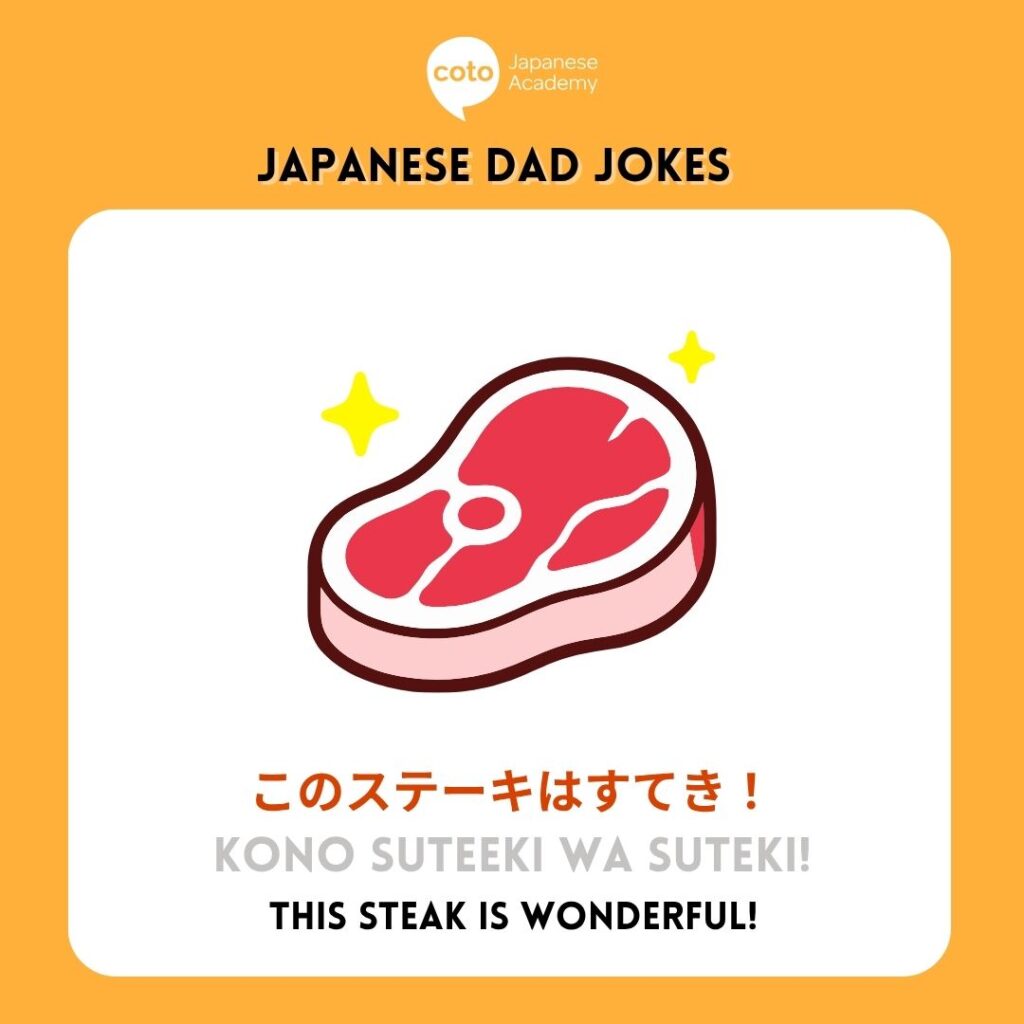
Romaji: Kono suteeki wa suteki!
Meaning: The steak is wonderful!
Joke Explanation:
Steak → ステーキ (suteeki)
Wonderful → ステキ (suteki)
A classic, simple homophone that relies on nearly identical sounds, and the best part is that it only requires JLPT N5 knowledge to understand! ステーキ, meaning beef steak, a dad’s favorite food, is said quickly in a shortened form to sound just like ステキ, which means lovely or wonderful.
ステキな isn’t a very natural way to describe delicious food, so the intentional word choice elicits the inevitable groan. For natural, casual ways to describe food, you can combine the prefixes めちゃ or マジで, meaning very, with おいしい or うまい, meaning tasty.
2. 美味すぎて、馬になった。(umasugite, uma ni natta.)
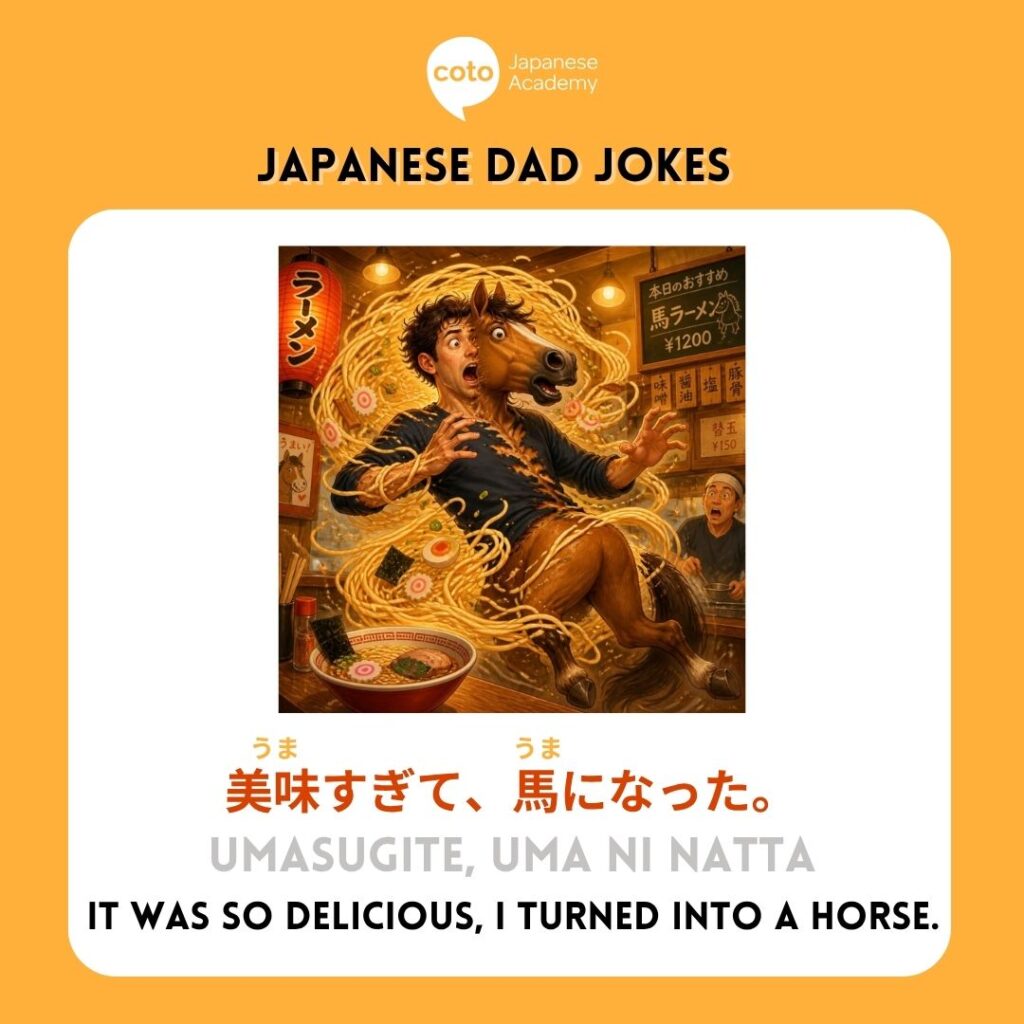
Romaji: umasugite, uma ni natta
Meaning: It was so delicious I turned into a horse.
Joke Explanation:
Delicious → 美味い (umai)
Horse → 馬 (uma)
The pun comes from the similar sounds of 馬 (uma), meaning horse, and 美味い (umai), meaning “delicious.” The joke also incorporates a bit of N4 grammar: the suffix すぎる (sugiru), which means “too much.”
For example, if you want to emphasize how cold it is outside on the first day of winter, you may say さむすぎる instead of just さむい. The て form lets you connect clauses fluidly, showing cause and relation or the order of events. 馬 is the corresponding second homophone, followed by なった, the past tense form of なる, meaning to become.
3. 土管の中でドッカーン (Dokan no naka de dokkaan.)
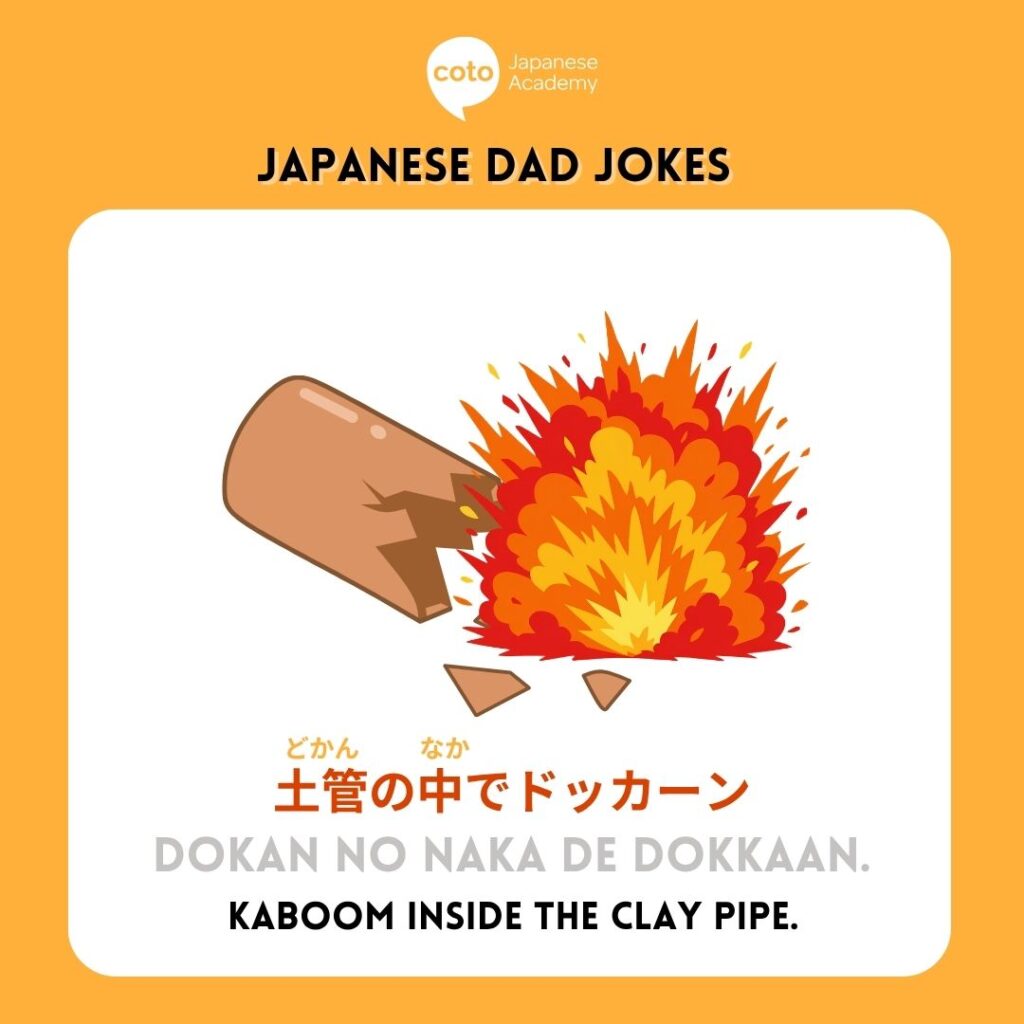
Romaji: Dokan no naka de dokkaan.
Meaning: Kaboom inside the clay pipe.
Joke Explanation:
Clay Pipe → 土管 (dokan)
Kaboom →ドッカーン
This one is a combination effect of onomatopoeia with homophones. This joke that relies on more advanced kanji & vocabulary (around N1 level), using the very particular word for clay / earthen pipe土管 to sound like the onomatopoeia ドッカーン. A very simple N5 grammatical structure using の中で as a prepositional phrase, denoting where the kaboom took place. What makes this joke a bit more difficult is the advanced-level vocab 土管, which you will probably never encounter unless you read construction signs.
4. 餃子を食べて、仰天!(gyoza o tabete, gyoten!)
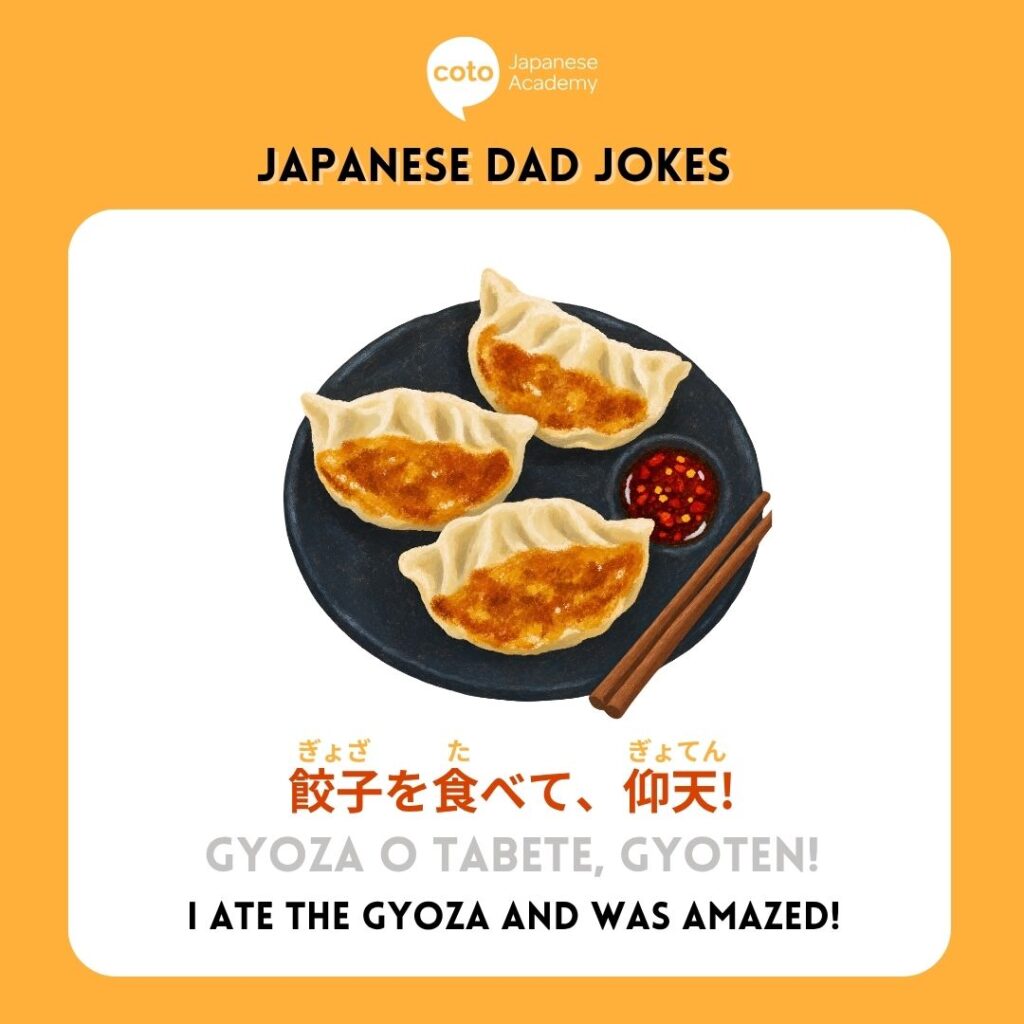
Romaji: gyoza o tabete, gyoten!
Meaning: I ate the gyoza and was amazed!
Joke Explanation:
Gyoza → 餃子
Amazed → 仰天 (gyoten)
This dad joke is a simple homophone that rhymes the popular Japanese dumplings, gyoza, with the expression of amazement, gyoten. Once again, we see the て- form grammar connecting the two clauses.
To read, this joke relies on more niche N3-level kanji knowledge. While 餃子 may be easier for foodies to recognize, 仰天 is quite advanced for learners. Still, this dad joke is easy to remember for your next visit to a Chinese restaurant!
5. チーターが池におっこちーたー. (Chiitaa ga ike ni okkochiitaa.)
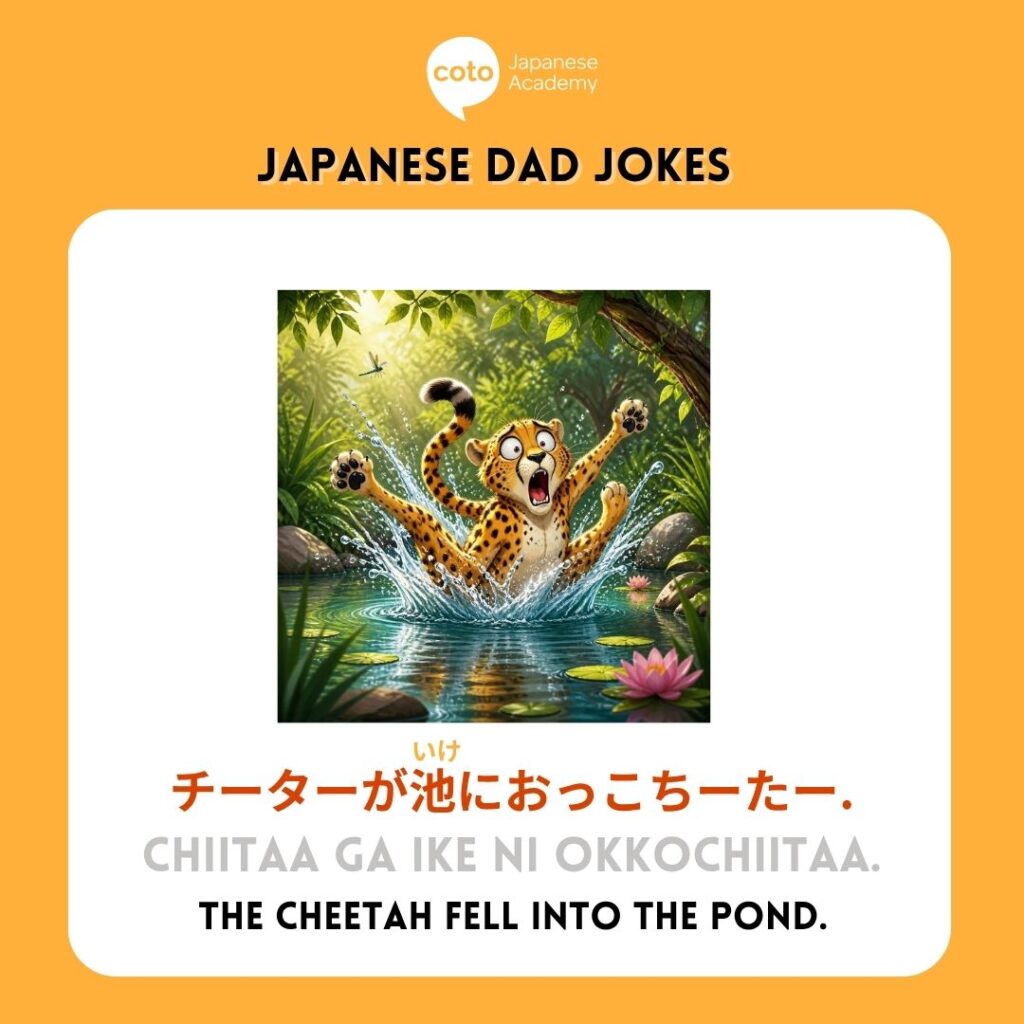
Romaji: Chiitaa ga ike ni okkochiitaa.
Meaning: The cheetah fell into the pond.
Joke Explanation:
Cheetah → チーター
Fall down → 落っこちる (okkochiru)
This is more of an N2-level joke because the dramatized, colloquial form of 落ちる used in this joke isn’t commonly learned or taught early on. The rest of the rhyme uses easier vocabulary and grammar. We see が used once again as a subject particle, describing what the cheetah is doing. Combining this with the kanji for pond, 池, and using に as a preposition for the direction of the cheetah sets us up for the punchline.
The informal past tense of “to fall down” sounds just like the katakana word for cheetah, if dragged out, completing our homophonic dad joke. Once again, 落っこちる is more of a spoken, dramatized version of 落ちる
6. イルカはいるか?(iruka wa iruka?)
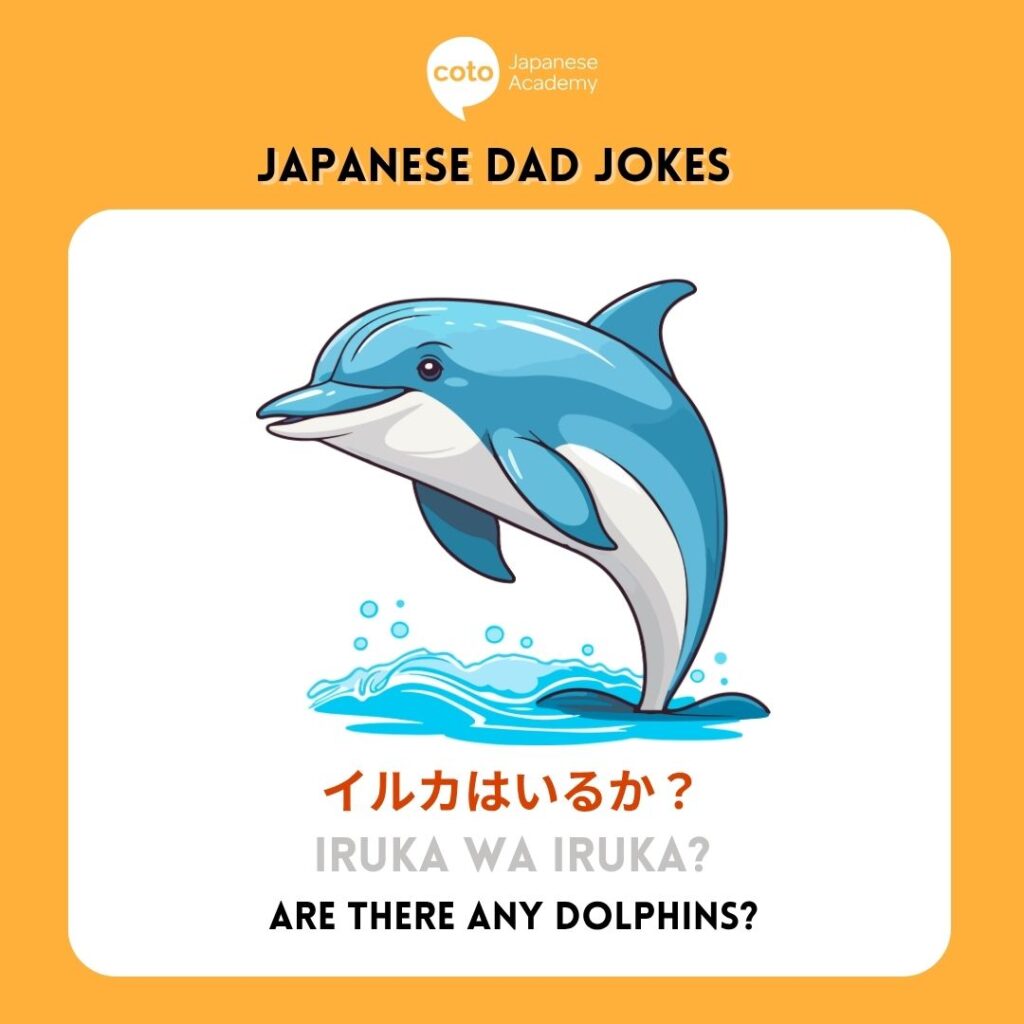
Romaji: Iruka wa iruka
Meaning: Are there any dolphins?
Joke Explanation:
Dolphin → イルカ
there is (living subject) → いる
This joke is as easy and cheesy as it gets. イルカ is written in katakana mainly because the kanji is hard to read, so it’s more convenient and accessible. は is used as our subject particle, as the dolphins are the subject of our silly question. いる, the word for “there is” when referring to animate subjects, is given the informal suffix か to turn it into a question. Maybe use this dad joke when you visit the Sumida Aquarium near Tokyo Skytree to test some reactions.
7. 車で、来るまで待つ。(kuruma de, kuru made matsu.)
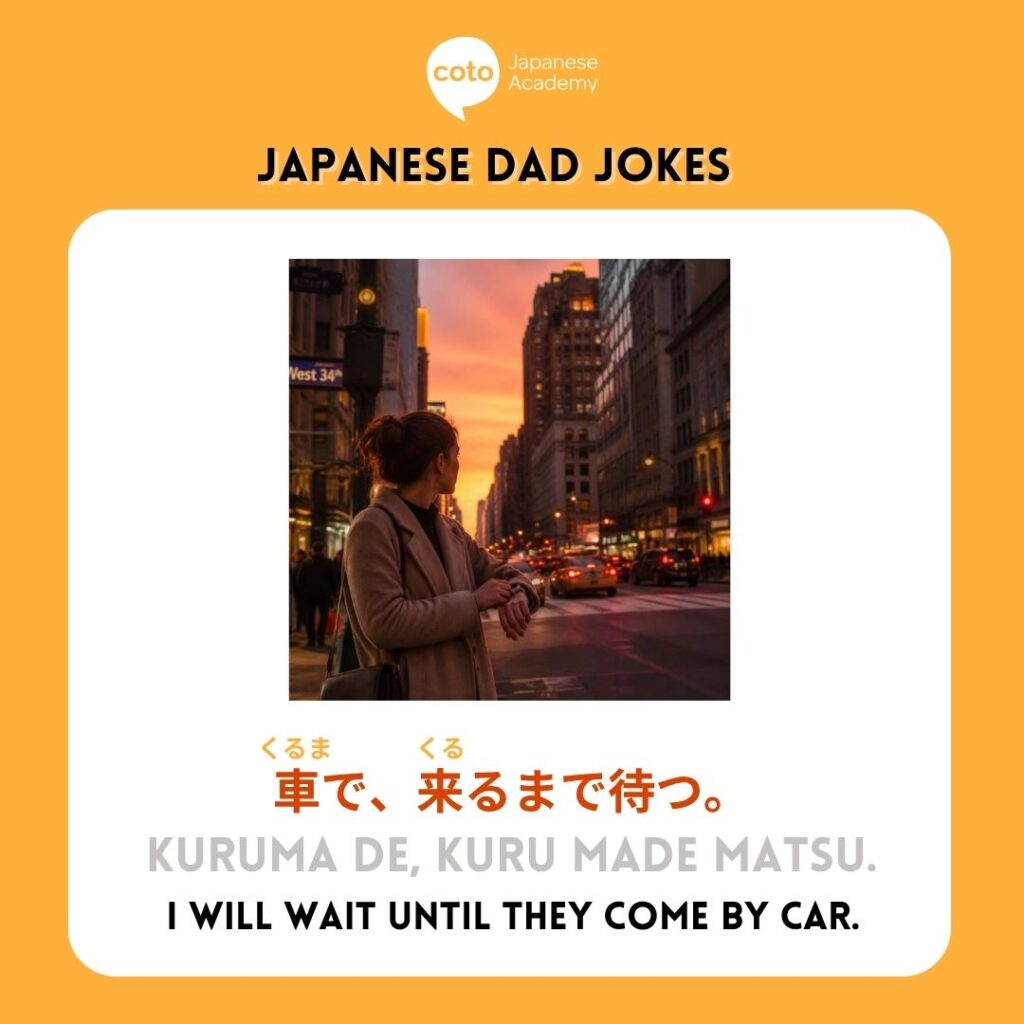
Romaji: kuruma de kuru made matsu
Meaning: I will wait until they come by car.
Joke Explanation:
Car → 車 (kuruma)
Come → 来る (kuru)
Until → まで
Great for beginners to stretch their minds, this one uses a somewhat clever homophone, relying on the connection between 来る and まで to form the punchline. A phonetic mirror, if executed perfectly, 来るまで should sound just like 車 being enunciated poorly. 待つ is an N5-level vocabulary word meaning to wait. まで has several grammatical uses, but here it signifies waiting for the preceding action to occur.
8. 歯科医師が司会した。(shikaishi ga shikaishita)
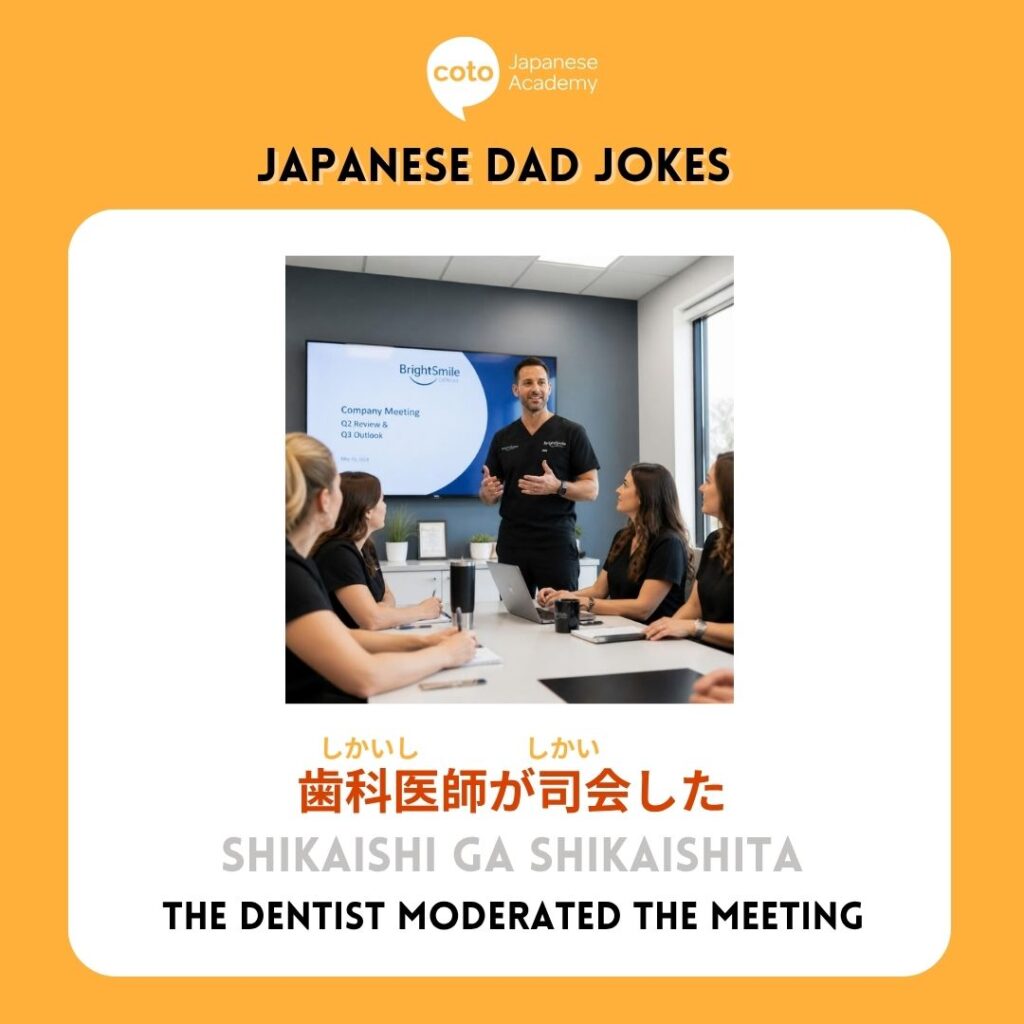
Romaji: shikaishi ga shikaishita
Meaning: The dentist moderated the meeting
Joke Explanation:
Dentist → 歯科医師 (shikaishi)
Moderated → 司会する (shikai suru)
Because of the vocabulary it uses, this joke might be around N2 level. It’s structurally similar to the homophone examples we explained earlier, but it requires advanced kanji & vocab knowledge. This joke rests on the past tense of 司会する (shikaisuru), which is 司会した (shikaishita), meaning “led” or “moderated”.
To pull this dad joke off, you must pronounce 司会した (shikaishita) to sound exactly like 歯科医師 (shikaishita), which takes some over-enunciation of the し in した.
9. 電話に出んわ (Denwa ni denwa)
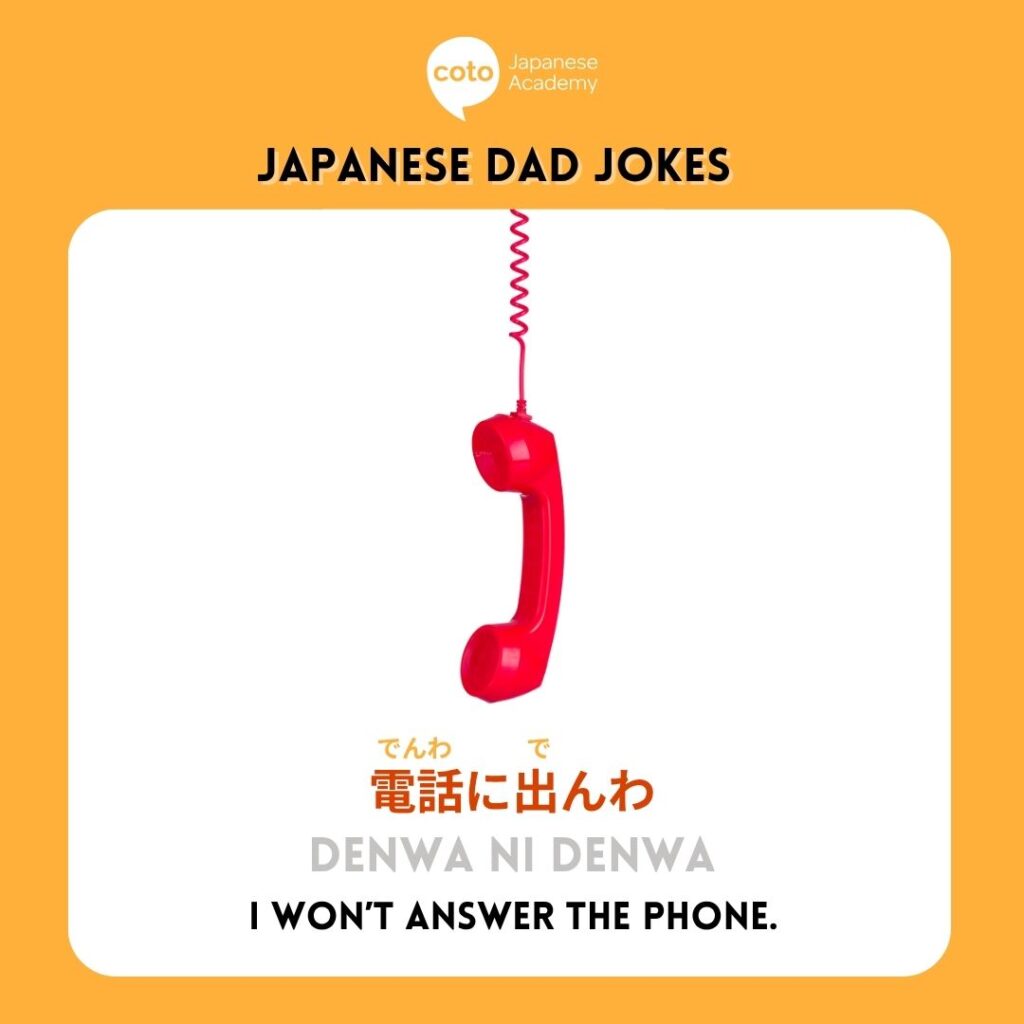
Romaji: denwa ni denwa
Meaning: I won’t answer the phone.
Explanation:
Phone → 電話 (denwa)
Answer → 出る (deru)
While the grammar and vocabulary are quite simple, the use of a different Japanese dialect could confuse beginners. This dad joke uses the Kansai dialect, which you may hear in Osaka or around Kyoto. The punchline of the joke takes the standard phrase 電話に出ない, dropping ない (nai) and adding ん (n), a shortened negative form, and the Kansai suffix わ, used to express emphasis. Now, 出ない sounds like denwa, similar to the word for “phone” or “call.”
In English, depending on where you learned to speak, we all say things a bit differently. The same applies to Japan, where different regions have their own way of saying things. One of the main alternatives to standard Japanese is the rough-sounding Kansai dialect.
10. 私はニューヨークで入浴した。(watashi wa nyuu yooku de nyuuyokushita.)
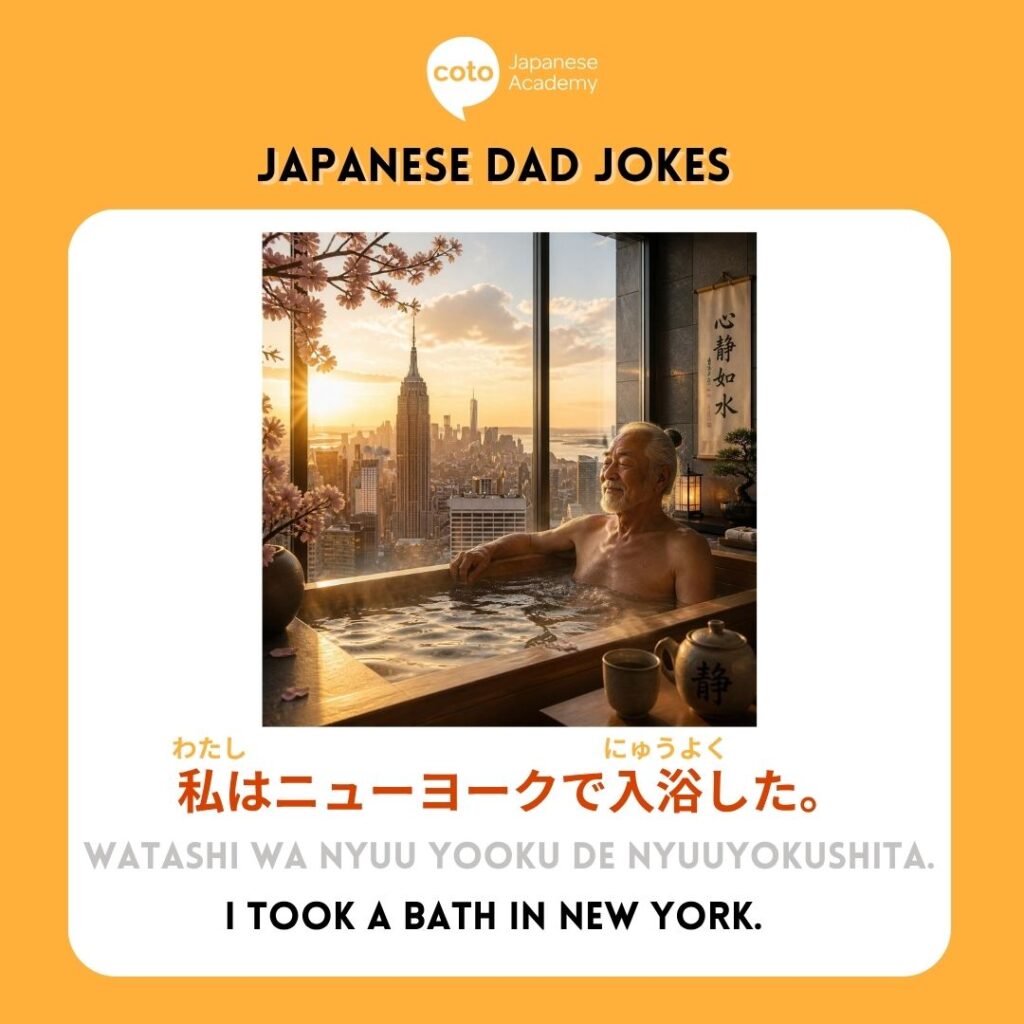
Romaji: Watashi wa nyuu yooku de nyuyokushita
Meaning: I took a bath in New York.
Explanation:
Bathing (formal) → 入浴 (nyuuyoku)
New York → ニューヨーク
Although this joke is grammatically simple, the term 入浴 (nyuuyoku) is very formal and uses old kanji that you will likely only see at an onsen. If you stretch out 入浴 (nyuuyoku), it sounds like how you would pronounce New York in katakana: ニューヨーク (nyuuyooku).
Combining these two homophones with the particle で, which denotes the location of the action, means the bath was taken in New York. Onsen are where you might see this kanji used seriously, for example: 入浴時間 (nyuuyoku jikan), meaning bathing hours.
How to Make Your Own Japanese Dad Jokes
Since these jokes are great practice for your Japanese skills no matter your level, consider playing around and writing your own. Here are a few easy steps to get you started.
- Pay attention to homophones. Japanese’s limited number of unique syllables naturally creates many homophones.
- Use simple grammar structures. These jokes don’t require difficult grammar, so don’t be afraid to form sentences informally.
- Use what you know. This is the best way to master a language; using what you have learned in your own way will lead to a strong acquisition of Japanese.
Conclusion: Dad Jokes are Great for Practicing Japanese!
Once you get the hang of these puns, it is fun to use the vocab and grammar that you are familiar with to construct your own. This is a very basic one:
Salmon roe → いくら
How much? → いくら
いくらはいくら?
How much is the salmon roe?
Expressing your sense of humor is a huge part of language learning and speaking Japanese more naturally! Jokes aren’t only fun; they can help you remember more words and express yourself more freely without sticking to rigid, literal definitions!
Sharing a laugh may be one of the best ways to practice Japanese!
Learn to Express Your Sense of Humor with Coto Academy!
Showing your sense of humor is essential for natural Japanese fluency! Join our conversation-focused Japanese courses to learn to speak Japanese confidently and even joke around with friends! We offer flexible, part-time classes as well as intensive classes at a variety of levels.
Whether you’re starting from scratch or you want to take your Japanese to the next level, we have a class for you! Visit one of our campuses in Tokyo or Yokohama, or join online from anywhere around the world!
Ready to sign up or just want a casual chat for more details? Just simply fill out the form below!
FAQ
What is oyaji gyagu?
親父ギャグ (oyaji gyagu) is the Japanese version of dad jokes. Literally meaning old man gag.
Why are dad jokes popular in Japan?
They originate from ancient poetry techniques and have been ingrained in modern comedy culture, with the added usefulness of their capability to break tension in stressful environments.
Can dad jokes help me learn Japanese?
Yes! They help you focus your listening skills for a language with so few syllables, and practice grammar by playing around with sentence structure.