




If you’ve registered for the JLPT and hit the point where self-study isn’t cutting it anymore, you’ve probably already started searching for a JLPT prep course. And that search gets harder fast if you’re taking the exam outside Japan or hoping to study online.
While there are plenty of online Japanese lessons out there, there are surprisingly few actual JLPT-focused courses. Even when you find one, there’s still the matter of finding a class with the right schedule: navigating time zones and pricing structures that aren’t always clear upfront.
So we did the legwork. Below are the best JLPT online courses available right now, with pricing, pros, cons, and what to weigh before you commit.
How Are JLPT Courses Different from Regular Japanese Courses?
So what’s the difference between a JLPT course and a regular Japanese course?
The short answer: a regular Japanese course teaches you to use the language; a JLPT course teaches you to pass a specific test. They overlap, but their priorities are different.
Regular courses (like Coto Academy’s typical Japanese lessons) are built around speaking and practical use. You’re learning to hold a conversation, order food, get through a job interview, and get that transfer to daily life in Japan. They don’t map cleanly onto how the JLPT actually tests you.
JLPT courses are built around one goal: passing the JLPT. On the content side, JLPT courses lean into grammar and analytical reading, which most conversation-based courses skip entirely, since it has little to do with speaking ability but a lot to do with passing.
On the practice side, expect regular mock tests under timed conditions rather than casual exercises, so you get used to the actual pacing before test day. And layered around all of that are exam-specific tips. Since it is usually taught by JLPT instructors, you will get tips like how to eliminate wrong answers fast, how to budget your time per section, and how question types tend to repeat across past exams.
Best JLPT Online Course
| Course | Level | Duration | Best For |
|---|---|---|---|
| Coto Academy | N3–N1 | 1 year or 6 months (flexible) | Learners who want live instruction with flexible scheduling and the option to focus on specific sections (grammar/reading vs. kanji/vocab) |
| J-Standard | N5–N1 | Flexible | Self-paced learners who want structure without a live class schedule. Good for beginners through upper-intermediate |
| Preply | Flexible | Flexible | Learners who want fully personalized 1-on-1 tutoring and don’t mind vetting tutors themselves |
| SNG | N3, N2 | 3 months | Learners who want a short, all-around intensive with a final practice exam |
| Kudan Institute | N3–N1 | 2 months | Learners near Japan-friendly time zones who want a short, grammar-only review. |
| Japonin (JOI) | N1–N4 (N5 private) | Flexible (book lesson by lesson) | Learners outside Japan who need scheduling flexibility over a fixed cohort |
Coto Academy

Best for: Learners who want live instruction with flexible scheduling and the option to focus on specific sections (grammar/reading vs. kanji/vocab).
| Available level | JLPT N3 to N1 |
| Duration | 1 year or 6 months |
| Price | Point-based subscription. Each lesson costs 2 points. The recommended plan is 16 points per 28 days at ¥16,800, or 8 points per 28 days at ¥9,600 on the monthly plan. |
| Highlights | JLPT lessons tailored to your focus area, flexible scheduling, and instruction taught only by professional instructors. |
Coto Academy offers a fully online JLPT preparation course through its learning platform, online.cotoacademy.com. You purchase lesson points and can book a class immediately.
The course is currently offered at the N3 and N1 levels, with two format options.
The one-year course focuses on grammar and reading, and you can join anytime. It’s built for steady, ongoing progress and includes interactive exercises throughout, which makes it useful even if you’re not specifically preparing for the JLPT.
The six-month course is split into two tracks: grammar and reading, or kanji and vocabulary. This one is lecture-style and designed to support self-study. Classes are taught primarily through instructor explanations in a group Zoom session, where students can ask and answer questions through chat. Through this course, you’ll watch instructors break down key vocabulary, expressions, and problem-solving strategies for each level, then practice with questions formatted just like the real JLPT.
Because the course is divided by test section, you can customize your prep. If you’re already covering vocabulary through something like Anki, you can skip that track and focus only on grammar and reading.
J-Standard
Best for: Self-paced learners who want structure without a live class schedule.
| Available level | JLPT N5 to N1 |
| Duration | Flexible |
| Price | $69/3 months, or $180/year |
| Highlights | 1,200+ lessons and quizzes, real-world dialogues, teacher-led, on-demand video instruction |
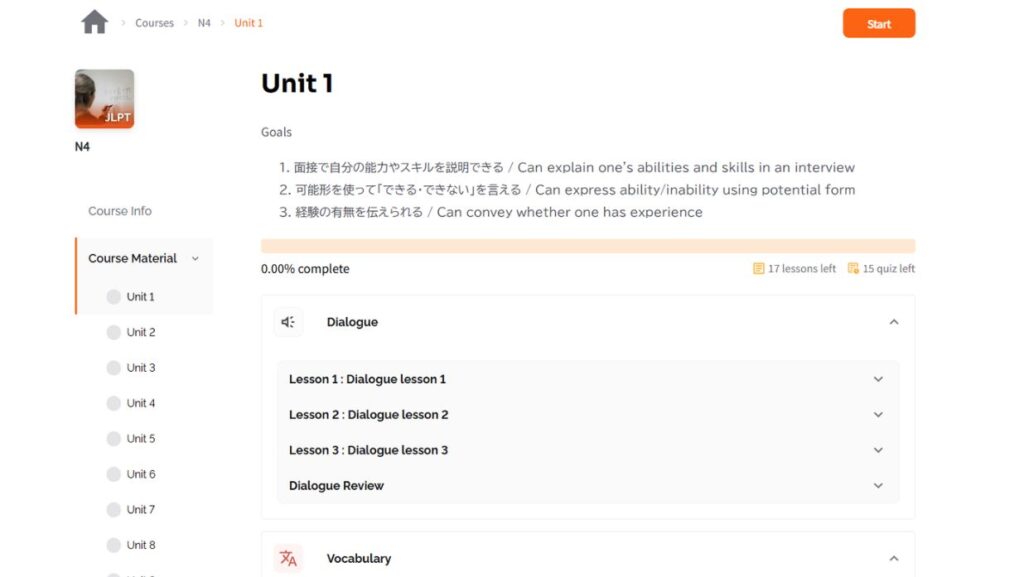
J-Standard is built for learners who want steady, structured progress without being tied to a class schedule.
It’s not a live online JLPT course, but that’s kind of the point. If you’ve ever sat down to study JLPT by yourself and had no idea where to start or what to focus on next, J-Standard takes that guesswork off your plate. It walks you step by step through every unit and level, so instead of piecing together your own study plan from scratch, you just follow the path. It covers everything from hiragana and katakana through N5 to N2 grammar and vocabulary, all in one platform, all at your own pace.
The learning journey follows four steps. You start by watching teacher-led videos to learn new grammar and vocabulary, then apply it through real, practical dialogues based on everyday situations in Japan.
From there, you move into JLPT-style drills and quizzes to lock in what you’ve learned, and track it all on a simple dashboard that keeps your study hours and progress visible.
Currently, the platform has over 1,200 lessons and quizzes covering grammar, vocabulary, listening, and reading. We recommend it if you want something affordable and flexible enough to fit into a busy schedule, without sacrificing structure.
Preply
Best for: Learners who want fully personalized 1-on-1 tutoring and don’t mind doing some legwork to find the right tutor.
| Available level | Flexible |
| Duration | Flexible |
| Price | $20 – 70/hour, depending on tutor |
| Highlights | Personalized plan since it is typically 1-on-1 tutoring, but not always with professional instructors |
You’ve probably already heard of Preply, a language platform that connects you with independent tutors. You can find tutors who specialize in JLPT prep and build a lesson plan around your specific goals.
The trade-off is consistency. Most tutors are native speakers, but not all of them are trained instructors, so teaching quality and JLPT-specific expertise can vary a lot from one tutor to the next. If you go this route, we recommend reading reviews and trying a few tutors before committing, since the experience depends on who you end up with.
Pricing varies and isn’t always affordable. Preply’s community tutors, meaning native speakers without formal certification, typically run $20 to $40 an hour. However, certified instructors cost more, usually $40 to $70 an hour, which adds up fast for private, one-on-one sessions.
The great thing is that because Preply usually only does 1-on-1 tutoring, it can work well if you want maximum flexibility and don’t mind doing some legwork to find the right fit, but it’s a less structured option compared to a dedicated JLPT platform like Coto Academy or J-Standard.
Want to double your chances of passing JLPT? Join Coto Academy!
SNG
Best for: Learners who already have a Japanese base and want a short, all-around intensive with a final practice exam.
| Available level | JLPT N3 and N2 |
| Duration | 3 months, 30 hours across 10 lessons |
| Price | ¥39,600 for new students |
| Highlights | All-around JLPT prep course on a short duration |
SNG’s Online JLPT Preparation Course covers all test sections: vocabulary, kanji, grammar, reading comprehension, and listening. Lessons use digital content to track your understanding as you go, and instructors focus extra time on whatever you’re struggling with most. You’ll get 30 hours of class time across 10 lessons, wrapping up with a final practice exam to confirm you’re ready for test day.
By the end of the course, you’ll have mastered the vocabulary, grammar, and kanji needed to pass the JLPT, built the listening skills to comprehend short conversations, and picked up test-taking strategies and tips to boost your overall score.
Note that this course isn’t for beginners. You’ll need at least 300 study hours of Japanese under your belt before enrolling in N3, or 600 hours for N2.
Want to study Japanese with us?
Kudan Japanese Institute
Best for: Learners in Japan-friendly time zones who want a short, grammar-only review before test day.
| Available level | JLPT N3 to N1 |
| Duration | 2 months |
| Price | ¥49,500 |
| Highlights | All-around JLPT prep course in a short duration |
Kudan Institute takes a narrower approach than most JLPT courses on this list: it covers grammar only. Rather than splitting attention across vocabulary, reading, and listening, the course drills grammar patterns intensively over a six-week run, timed right before the JLPT exam.
The structure centers on pattern recognition. Grammar questions are broken down and sorted into recognizable question types, so instead of memorizing textbook entries in isolation, you learn to spot what a question is actually testing. Each session pairs that analysis with strategy review, and then interactive practice with the target grammar so it doesn’t stay theoretical.
Enrollment is open mid-course, so joining in week three is a genuine option if you’ve only just realized grammar is your weak point.
The catch is that lessons run in the evening Japan time on weekdays. If you’re in Europe or the Americas, evening JST lands in your morning on a workday: early morning for much of Europe and the middle of the night for parts of North America.
Japonin
Best for: Learners outside Japan who need scheduling flexibility more than they need a fixed cohort.
| Available level | JLPT N1 to N4 (N5 via private lessons) |
| Duration | Flexible — book lesson by lesson |
| Price | From ¥1,280 per lesson (group) / ¥3,380 per lesson (private) |
| Highlights | All-around JLPT prep with bookable time slots and 2 free trial lessons |
Best for: Learners outside Japan who need scheduling flexibility more than they need a fixed cohort.
Japonin’s online JLPT space. Classes run on Zoom in 50-minute blocks with a maximum of seven students, and teachers average around 15 years of experience.
Group classes cover N1 through N4, with N5 handled through private lessons. Rather than focusing on grammar alone, the curriculum integrates grammar, vocabulary, kanji, reading, and listening, with grammar as the backbone, which suits learners who want their JLPT prep to double as general language study rather than pure exam drilling.
Instead of committing to a fixed weekly slot, you book each class individually from multiple time options each week, so the course bends around a shifting work schedule or an awkward time zone, not the other way around. Most lessons use Japonin’s own slides built from classroom experience rather than a commercial textbook, with published materials reserved for the final prep courses. Pricing sits at roughly ¥1,280–¥1,320 per lesson for small-group FlexLessons and from ¥3,380 for private one-on-one, and you can take up to two free 50-minute trial lessons at any level before committing.
Unfortunately, that same flexibility means no cohort moves through a syllabus alongside you, so you’re responsible for building a consistent study rhythm.
Want to study JLPT online? Join Coto Academy!
Ready to Start Your JLPT Prep?
Of all the options on this list, Coto Academy’s JLPT course is the one built to flex around you. Whether you want a full year of steady grammar and reading practice or a focused six-month sprint through the exact sections you’re weakest in, you pick the format, book lessons instantly with points, and learn from instructors who teach JLPT prep professionally — not tutors picking it up on the side.
If you’re serious about passing, don’t leave your prep to a platform that treats JLPT as an afterthought. Start with a course that was actually built for the exam.
FAQ
What is the best JLPT online course?
It depends on what you need. Coto Academy is the strongest all-around pick if you want live instruction, professional JLPT instructors, and flexible scheduling. J-Standard is best if you want a self-paced, affordable option without live classes. Preply suits learners who want 1-on-1 tutoring and are willing to vet tutors themselves. There’s no single “best” course for everyone — the right one depends on your level, budget, time zone, and whether you want live or self-paced instruction.
Are JLPT online courses actually effective?
Yes, as long as the course is built around the exam rather than general conversation. A good JLPT course gives you timed mock tests, exam-specific strategy, and focused practice on the sections the real test weights heavily, like grammar and reading — things self-study and conversation-based classes typically don’t cover in depth.
How long does it take to prepare for the JLPT with an online course?
It varies by level and course. Short intensives like Kudan Institute or SNG run 2–3 months and are designed as a final push before the exam. Longer programs like Coto Academy’s one-year track suit learners building proficiency from the ground up. As a rule, the higher the level (N2, N1), the more prep time you should budget.
How much do JLPT online courses cost?
Pricing ranges widely: J-Standard starts around $69 for 3 months, Japonin runs from about ¥1,280 per lesson, and structured short-term intensives like SNG or Kudan run roughly ¥39,600–¥49,500 for a 2–3 month course. Live 1-on-1 tutoring through Preply is the most expensive per hour ($20–$70), since you’re paying for individual attention.
Do I need to already know Japanese to join a JLPT online course?
Most courses assume some prior study. J-Standard is the exception, starting from hiragana and katakana for true beginners. Others, like SNG, require a minimum number of self-study hours (300+ for N3, 600+ for N2) before enrolling.