






Whether you are coming to Japan to look for work or just want to apply to Japanese companies, a good cover letter will help you stand out! Just like in any other country, a cover letter is a chance for you to make an impression on your potential employers and personally explain your experience and motivations. This is your chance to show who you are beyond the hard figures on your resume.
A cover letter is a stepping stone for your employers to get to know you a bit more personally. With that said, how do you write a good cover letter, that too, in Japanese?
What Are Japanese Cover Letters
Cover letters, or カバーレター (cover letter) in Japanese, are a relatively new concept in Japan and were not typically part of a Japanese hiring process. However, they are being more adopted, especially with the increase in Japanese job boards. A cover letter is meant to provide context for your resume, personally introduce yourself, and ultimately persuade your potential employer that you are worth the time to interview. However, there are some key differences in structure, where Western cover letters are considered somewhat flexible, in Japan, you should stick to the following structure and content:
1. Name and Personal Details
2. Company Name and Details
3. Introduction
4. Qualifications & Reasons for wanting to join
5. Closing Statement & Request for Response
6. Sign-off
What a Cover Letter is Not
Your cover letter should not be a detailed autobiography describing your life from birth. You don’t need to share your whole life story, just parts that are relevant. For example, if you’re applying for an engineering job, you can say something like “ever since I was a kid, I was fascinated with how machines worked…” and then discuss how this led you to pursue your current academic or work qualifications. Remember to keep it relatively concise, ideally under 1 page.
Also, cover letters are not meant to be generic papers that are mass-mailed to a bunch of companies. They are meant to be personalized, showcasing your unique interest in the company you’re applying for.
Do You Need a Cover Letter in Japan?
Traditionally, Japanese companies only required a Japanese resume, or rirekisho, and submitting a cover letter was uncommon. However, nowadays, many English-based jobs in Japan recommend or require a cover letter, especially when submitting an English resume.
Still, although a cover letter may be listed as “optional,” it is highly recommended. It helps you stand out, demonstrates professionalism, and clearly explains your suitability for the position. In the early stages of the application process, the cover letter may not always be carefully reviewed. However, in the later stages, especially before final interviews, it is increasingly read by hiring staff and potential supervisors.
A cover letter in English should be formal, concise, and well-structured. It should summarize your career so far and highlight your skills and relevant experience that may not be fully reflected in your resume.
Breakdown of Japanese Cover Letters
As briefly discussed, there are 6 main sections of a typical Japanese cover letter: personal details, company details, introduction, body, closing, and sign off. So, let’s break down in detail how you should write each part, piece by piece.
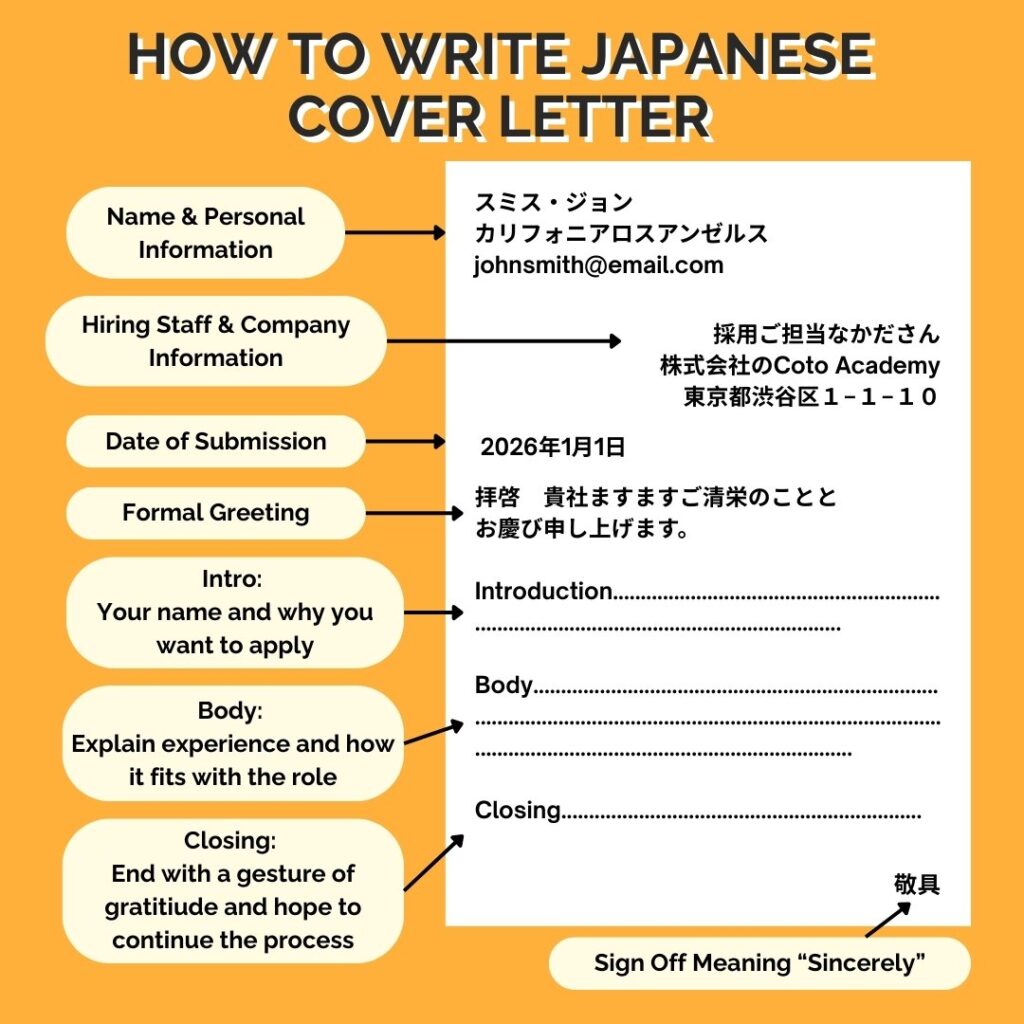
1. Name & Personal Details
Typically, at the very top of the resume is your name, followed by your address, phone number, and email address. You can align it to the right to make the section feel more separated from the rest of the cover letter. It’s not uncommon to have the date after your name and personal details.
2. Company Name & Details
Generally, you also provide the details of the company, including the name of the hiring manager, the company name, and the address. Some people decide to align the section to the right instead of the first section. This just helps to make each section feel more readable.
3. Introduction
Finally, for the actual cover letter, an introduction is normally written in Japanese as 採用ご担当様 (saiyou go tantou sama), which means Dear Hiring Manager. But it’s somewhat standard to use this common phrase at the start of a formal letter:
Example 1:
拝啓 貴社ますますご清栄のこととお慶び申し上げます。
Haikei kisha masumasu goseiei no koto to oyorokobimoushiagema su.
Dear Sir/Madam, I am happy to hear your company is doing well.
After the greeting, you introduce yourself by providing your name, the name of the position you are applying to, and expressing your interest. Here are some common phrases you can use when expressing interest in the company:
Example 2:
ぜひ一度、お話を伺える機会をいただければ幸いです。
Zehi ichido, ohanashi o ukagaeru kikai o itadakereba saiwai desu.
I’d really appreciate being given the chance to speak to you further about this.
Example 3:
・・・新聞で貴社の募集広告を拝見し、応募いたしました。
…shinbunde kisha no boshuu houkoku o haiken shi, obou itashimashita.
I wish to apply for the job post you advertised on…
Then, at the end of your introduction, give concrete reasons why you are interested in this job. Include useful phrases such as:
Example 4:
私は特にこの仕事に興味があります。なぜなら・・・
Watashi wa toku ni kono shigoto ni kyoumi ga arimasu. nazenara…
I am particularly interested in this job, the reason why is…
Example 5:
・・・として御社に勤務したいと考えております。
…toshite onsha ni kinmu shitai to kangaete orimasu.
I would like to work for you, in order to…
**Explaining Why You’re Leaving Your Company
If you’re currently working, you don’t necessarily need to give a reason for leaving your current company, especially since it’s better to focus on why you want to join the hiring company. But, if you feel the need, you can briefly describe the circumstances for why you are applying for the company and planning to leave your current employment. Try to emphasize pull factors (characteristics about the company that are motivating you to apply) without using any negative language about your current company (it’s actually a bad look). We highly recommend framing your plans to leave as a positive next step, rather than something negative, like you disliking something about your current company, or because your contract is ending.
Your reason should sound like you have learned something from your previous job. Here are some phrases that help you emphasize that:
Example 1:
現在の・・・の経験を活かし、さらに規模の大きいプロジェクトを担当したいと考えたためです。
Genzai no… no keiken o ikashi, sara ni kibo no okii purojekuto o tantou shitai to kanaeta tamedesu.
I would like to make the most of my experience in…, and take charge of larger-scale projects.”
Or an opening sentence describing what you currently do:
Example 2:
“現在私は・・・で・・・の担当として勤務しております。
Genzai watashi wa …de …no tantoutoshite kinmu shite orimasu.
Currently, I am working for… and my responsibilities include…
4. Qualifications & Reason for Wanting to Join
This is the meat of your cover letter, where you describe your background, why you think you are a fit, and why you would like to join the company. For writing this part, you should thoroughly read the job description and research the company so you can tailor your related work experience and skill sets to the qualifications of the job and the culture of the company.
Here are some common Japanese phrases you can use to highlight your skills:
Example 1:
・・・として・・・年働いてきた経験があります。
…toshite…nen hataraite kita keiken ga arimasu.
I have …years of experience working as…
Example 2:
・・・を使いこなすことができます。
…o tsuka konasukoto ga dekimasu.
I am an experienced user of…
You should also discuss your career objectives, how the position aligns with your goals, and how you can contribute to the company. Here is a phrase you can use:
Example 3:
貴社の・・・の実績を拝見し、・・・の分野において、今までの・・・のスキルを活かした仕事が可能だと考えました。また、・・・という社風にも大変魅力を感じております。
kisha no…no jisseki o haiken shi, …no bunya ni oite, ima made no… no sukiru o ikashita shigoto ga kanouda to kangaemashita. mata, …toiu shafunimo taihen miryoku o kanjite orimasu.
Having seen the achievements of your company, I thought that I could leverage my skills in… for the position in the field of…
Top Tip:
Increase your chances of being interviewed by matching your skill sets to the requirements listed on the job post.
Vocabulary
To help you, here are some skill-related vocabulary words that you can incorporate into your cover letter!
| English | Japanese | Hiragana | Romaji |
|---|---|---|---|
| Excellent communication skills | コミュニケーション能力 | こみゅにけーしょんのうりょく | Komyunikeshon nouryoku |
| Deductive reasoning | 演繹的推理力 | えんえきてきすいりりょく | Enekiteki suiriryoku |
| Logical thinking | 論理的思考能力 | ろんりてきしこうのうりょく | Ronriteki shikou nouryoku |
| Good interpersonal skills | 対人能力 | たいじんのうりょく | Taijin nouryoku |
| Analytical skills | 分析能力 | ぶんせきのうりょく | Bunseki nouryoku |
| Negotiation skills | 交渉能力 | こうしょうのうりょく | Koushou nouryoku |
| Presentation skills | プレゼンテーション能力 | ぷれぜんてーしょんのうりょく | Purezenteeshon nouryoku |
| Machine learning Skills | 機械学習能力 | きかいがくしゅうのうりょく | Kikai gakushuu nouryoku |
| Programming languages | プログラミング言語 | ぷろぐらみんぐげんご | Puroguramingu gengo |
5. Closing
In the closing section, briefly reiterate your interest, leave a strong closing statement that shows your motivation to work for the company, and politely ask for a response to your application. To start your closing paragraph, you can use some of these common phrases to express your motivation to work for the company:
Example 1:
貴社の一員となり、思う存分自分の力を発揮したいと考えております。
Kisha no icchin to nari, omou zonbun jibun o hakki shitai to kangaete orimasu.
I am highly motivated and look forward to the varied work that a position in your company would offer me.
Then, near the end of your closing section, here are some expressions to show gratitude and how they can contact you to move forward in the process.
Example 2:
お時間を割いていただいてありがとうございました。お目にかかれる日を楽しみにしております。私には・・・を通してご連絡ください。
Thank you for your time and consideration. I look forward to the opportunity to personally discuss why I am particularly suited to this position. Please contact me via…
Example 3:
お忙しいなか恐縮ですが、どうぞ宜しくお願いいたします。
Oisogashii naka kyoushuku desuga, douzo yoroshiku onegai itashimasu.
Sorry to bother you when you are busy, and thank you for your consideration.
These expressions are great for ending your cover letter since they show appreciation for the reviewer’s time and consideration and encourage them to contact you again. These are a few of the many expressions you can use to close your cover letter. You always want to close strong by expressing appreciation and how you are looking forward to continuing the process with them.
6. Signing-Off
At the very end of the cover letter, you should sign off like you would an email. But depending on how you started your cover letter, you would have to pair your opening with the closing. One of the most common openings used in both cover letters and formal letters in general is as follows:
拝啓 (haikei) meaning “Dear Sir/Madam,” which can only be paired with 敬具 (keigu), meaning “Sincerely,” or “Regards.”
Sometimes it is common to sign off with a signature, but in most cases, you can just type your name, especially since you will mostly send cover letters online.
Quick Tip: After sending your resume, wait about 2-3 weeks and send a follow-up by letter, email, or phone. Contrary to what people might believe, this proactive approach is often seen as a good characteristic by the hiring company and shows your enthusiasm and willingness to work for the company.
Do’s & Don’ts for Writing Cover Letters
Here are some things to be mindful of when you write your cover letter!
Things to do:
- Write clearly and accurately
- Use full sentences
- Use correct grammar
- Be confident
- Keep the length of the cover letter to 1 page or less (it is a summary of your resume)
- Let a native Japanese or a Japanese of yours read your letter and give you feedback on how to improve
- Use correct industry jargon, but do not overuse it
- Show that you have done research about the job for which you are applying
- Use positive, future-forward language expressing how you’re excited to continue working with the company.
Things not to do:
- Avoid using overly haughty words; confidence is good, but you don’t want to come across as arrogant or prideful.
- Try not to start all your sentences with “I”. Makes you look like a one-man show
- Avoid too many contractions such as I’m, don’t, He’s or she’s.
- While humor can help you stand out, try to ensure your tone is formal and do not rely too heavily on humor.
- Do not use exclamation marks.
- Do not say anything negative about your previous employer. This will not give you the best impression on the hiring team.
- Do not use short forms or text speak.
Read More: Guide to Japanese Keigo
Conclusion: Cover Letters Can Help You Stand Out in the Japanese Job Market
While cover letters were not the most common in the Japanese job market, they are slowly becoming common, especially as companies are starting to post more roles on job boards. So, try using some of the expressions on this blog on your next cover letter. These expressions will help your cover letter sound professional and clear while also expressing your interest in joining the company.
Start taking Japanese lessons and succeed in job hunting in Japan!
If you want to start learning Japanese, take classes at a top language school like Coto Academy. At Coto, you’ll gradually ease into both the Japanese language and culture, learning real Japanese as it’s spoken in everyday life.
We offer both part-time and intensive courses across four campuses in Tokyo and Yokohama. Soon we will be opening a campus in Shinjuku! We also have interactive online lessons so you can learn Japanese wherever you are.
At Coto Academy, classes are small, with only 8 students per classroom, so you get plenty of speaking practice and individual attention, and the curriculum is personalized based on different goals, whether you want to improve your business Japanese or practice more conversations.
Interested in studying with us? Fill out the form below for a free level check! You can also schedule a free consultation or chat with our team to find the best learning path for you.
FAQ:
Are cover letters required when applying for Japanese companies?
Japanese cover letters are not always required and are not as common as they are for Western companies. However, they are starting become more popular with companies that post jobs online and on different job boards.
How long are Japanese cover letters?
Japanese cover letters are typically concise, usually around one page or less, often consisting of just 3–4 short paragraphs that clearly discuss your background, motivations for joining, and appreciation to the interviewers for taking the time to consider your candidacy.
Do I have to explain why I'm leaving my current job?
Generally, it’s not necessary to discuss why you’re leaving your current company since you should just focus on what is motivating you to join the company. If you mention leaving your current job, keep it professional and positive. Avoid negative comments about previous employers. Detailed explanations are usually saved for the interview.
Should I write my Japanese cover letter in keigo?
Polite language (です・ます form) is standard. For more formal written submissions, respectful business expressions are recommended, like the ones we mentioned in this article. However, avoid overly complex keigo if it sounds unnatural. Clear and professional Japanese is better than forced formality.
Can I use the same cover letter for multiple companies
You can reuse the structure, but you should always customize the company name, why you’re interested in that specific company, and how your skills match their business. Japanese employers value sincerity and effort, so generic applications are easy to spot.